
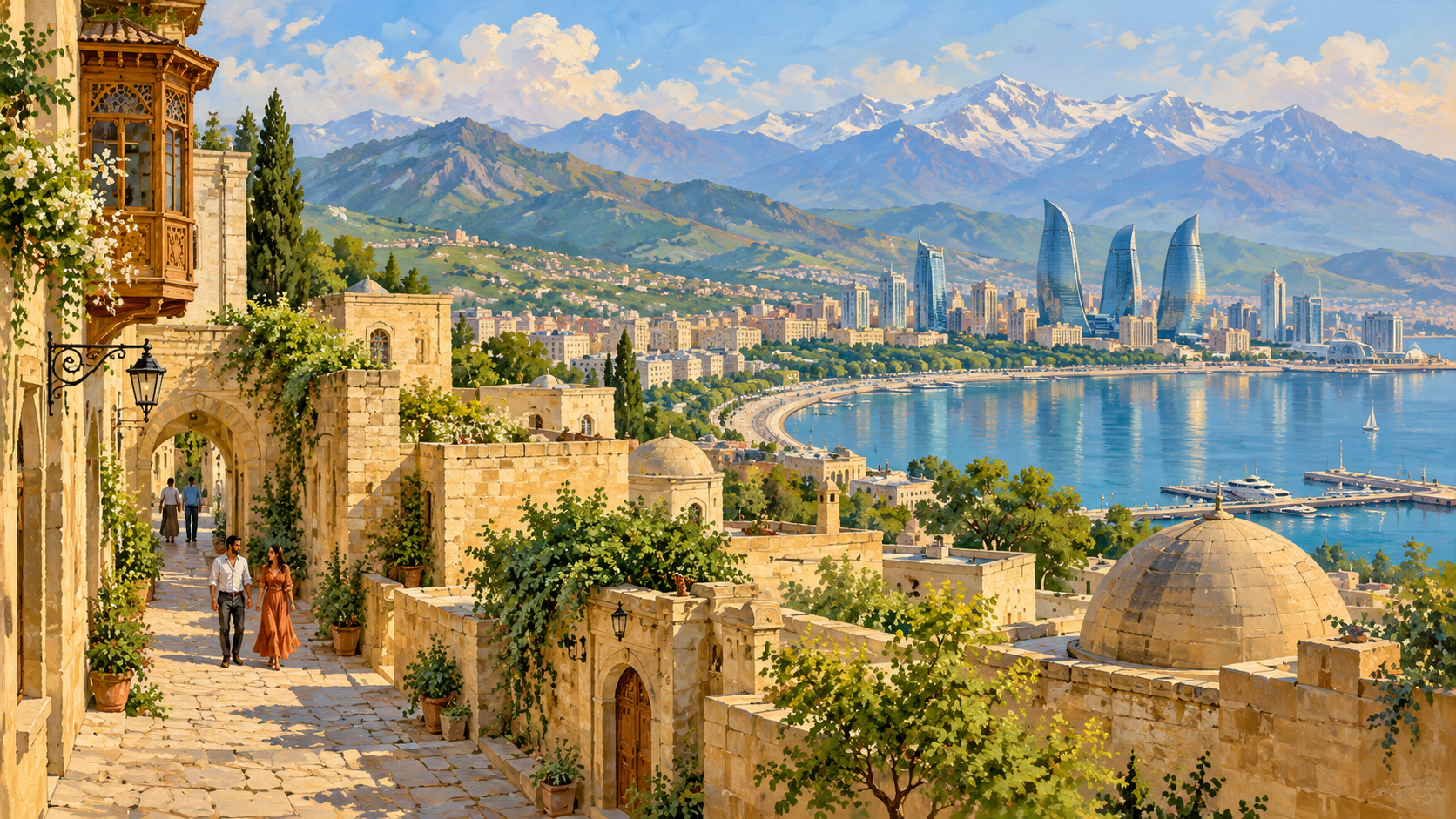
Azerbaijan Children Vocabulary | Words for Character and Nation Building introduces twenty age-appropriate English words connected to cultural knowledge, fair relationships and useful civic habits. What connects a copper bowl made by a skilled craftsperson, an ancient rock engraving, a musician’s improvised passage and a neighbour’s careful welcome? Azerbaijan provides four grounded ways for children to understand how knowledge, evidence, listening and hospitality contribute to shared life.
For international children aged roughly 8–12 learning English, and for the parents and teachers supporting them. This is not an official Azerbaijani syllabus, a manual on handling hot metal, a music performance qualification or a claim that every household shares the same practices. Cultural terms remain connected to the particular practitioners and communities that use them.
Source-based country overview: UNESCO recognises copper craftsmanship concentrated in Lahij, Azerbaijan, inscribed in 2015; Gobustan Rock Art Cultural Landscape, inscribed in 2007; and the improvisational tradition of Azerbaijani mugham, inscribed as intangible heritage in 2008. A further UNESCO entry recognises tea or Çay culture jointly for Azerbaijan and Türkiye in 2022. Each example teaches something different: a craft has makers, an archaeological image needs interpretation, a musical skill is transmitted, and a heritage practice can be shared across national borders.
Educational meaning of character and nation building: In these lessons, ‘nation building’ means children’s age-appropriate practice of accurate cultural attribution, careful evidence, cooperative learning, inclusion and everyday responsibility. It does not mean choosing sides in political disputes, making a child a representative of an entire community, or demanding that children adopt the cultural or religious beliefs of others.
Quick answer: what is the child learning?
| Part of the lesson | The task | The boundary |
|---|---|---|
| Twenty vocabulary words | Explain meaning, spot a misleading use and make an original sentence | A familiar-looking word is not always the correct word |
| Four country-specific chapters | Explain a fact, the people involved and a real distinction | A single example never describes an entire population |
| Fictional classroom story and six worked checks | Find and repair a false claim with a reason | Imaginary children are not real witnesses |
| Short home or school practice plan | Read, listen, revise, explain and transfer learning | Children are not assigned adult policy or safety duties |
Jump to 20 words · four chapters · story · answered checks · practice plan · guidance for adults · questions · sources and hubs.
20 children’s vocabulary words: clear meanings and original examples
The definition explains what the word means and gives a boundary against a common misunderstanding. The model sentences are imaginary examples created for English learning, not reports about actual children.
1. Making copperware with skill and credit
| Word | Meaning and distinction | Original sentence |
|---|---|---|
| Lahij | A mountain settlement in Azerbaijan known for copper craftsmanship; not a generic word for any craft market. | The article named Lahij when discussing a particular copperworking tradition. |
| copperware | Objects made from copper, such as vessels or decorative items; not simply raw metal. | The museum displayed copperware alongside information about its makers. |
| coppersmith | A craftsperson who forms or works copper using skilled techniques; not any seller of shiny bowls. | A coppersmith explained the stages of making a vessel. |
| apprentice | Someone learning a practical skill from an experienced worker or craftsperson; not an instant expert. | The apprentice learned why each step required careful practice. |
| craftsmanship | The quality and judgement of skilled making; more than how attractive an object looks. | The detailed finish showed craftsmanship that took time to develop. |
2. Reading ancient rock art with caution
| Word | Meaning and distinction | Original sentence |
|---|---|---|
| Gobustan | A protected cultural landscape in Azerbaijan with significant ancient rock engravings; not the name of all Azerbaijani art. | The history group studied UNESCO’s description of Gobustan. |
| petroglyph | An image made by carving, pecking or incising rock; not an image painted with a modern marker. | The petroglyph was cut into a rock surface. |
| archaeology | Research into human history using material remains and their context; not inventing a story from one picture. | Archaeology can test some ideas about earlier settlements. |
| inference | A reasoned conclusion drawn from evidence; not something directly observed or automatically certain. | The child’s inference was marked as tentative until more evidence appeared. |
| preservation | Keeping a valuable object or place from unnecessary damage or loss; not giving it to anyone who wants a souvenir. | Preservation rules help protect rock engravings. |
3. Music, improvisation and the passing on of knowledge
| Word | Meaning and distinction | Original sentence |
|---|---|---|
| mugham | A traditional Azerbaijani music form that prominently involves skilled improvisation; not every song performed in the country. | The class read about mugham before listening to a credited recording. |
| improvisation | Creating or adapting during performance using skill and attention; not acting without preparation. | The musician used improvisation within a learned tradition. |
| repertoire | The pieces and techniques a performer knows and can use; not just one favourite tune. | A performer’s repertoire develops through years of practice. |
| transmission | Passing knowledge or performance methods between people and generations. | Teaching and documentation support the transmission of music. |
| attribution | Naming the original maker, performer or source, not quietly taking credit for their work. | The listening guide included attribution for the recorded performance. |
4. Hospitality and responsible conversation across communities
| Word | Meaning and distinction | Original sentence |
|---|---|---|
| çay | The word for tea in Azerbaijani and Turkish contexts, linked to shared social practices; not proof everyone drinks the same tea. | The poster noted UNESCO’s joint listing of Çay culture. |
| hospitality | Welcoming and caring for guests respectfully, while considering their needs and choices. | Hospitality meant asking whether a visitor needed a clearer explanation. |
| dialogue | A two-way exchange involving listening and replies; not two speeches delivered without attention. | The group used dialogue to compare what each person understood. |
| inclusion | Removing practical barriers so different people can participate; not only stating that everyone is welcome. | The exhibit improved inclusion by supplying a readable caption. |
| accountability | Being ready to explain work honestly and correct errors; not insisting every first attempt was perfect. | The team showed accountability by changing its incorrect heritage label. |
Four learning chapters: knowledge, precision and a useful action
Read each chapter as a small investigation. Identify the fact established by a source, the word that explains it, the tempting but incorrect alternative, and the activity that helps the learner use the word outside its original context.
1. Lahij copper craftsmanship is skilled labour, not anonymous decoration
Words in focus: Lahij · copperware · coppersmith · apprentice · craftsmanship.
UNESCO inscribed the copper craftsmanship of Lahij on its Representative List of the Intangible Cultural Heritage of Humanity in 2015. Lahij is a community in Azerbaijan where the practice of making and using copperware has been passed among craftspeople. The UNESCO account describes stages of working and finishing the metal, with masters coordinating production and learners gaining techniques through practical involvement. When a child sees a polished copper bowl in a photograph, the shape and reflection are only the beginning of the story. The object exists because people acquired skills, used tools and made decisions at different stages.
A coppersmith is a worker with expertise in shaping the material. An apprentice is someone who learns under experienced guidance rather than becoming proficient immediately. The word craftsmanship directs attention to judgement, repeated practice and quality. Three pupils may all look at the same vessel, but only one may ask who made it and how the technique was learned. That question can be more educationally valuable than the most colourful description of the finished object.
UNESCO explains that Lahij’s copper craft has a social and economic role for practising families and artisans. It notes that makers produce, finish, decorate and sell their work, and that learned knowledge can be transmitted within families. A history label should not erase the individuals involved by saying ‘Azerbaijan makes these bowls’ as if a whole country were one workshop. The more accurate sentence is ‘Coppersmiths and other craftspeople in the Lahij tradition make copperware through specialised skills’. National heritage can be described with respect for the particular community that sustains it.
A learner may notice engraved decoration and decide it proves an exact religious, artistic or family meaning. That is too fast. Some designs have documented significance, while others require information from the maker or a reliable specialist. The student can safely observe a line, pattern or hammered surface, but should not invent a sacred interpretation. Names, sources and dates must be checked. A photograph of an antique object is not proof that every modern workshop makes its products in the same way.
Making copperware also involves tools and heat. This children’s lesson does not ask pupils to smelt metal, hammer hot copper or imitate an industrial workshop. Instead, a class can draw an imagined production sequence using paper cards: preparation, forming, finishing, decoration and attribution. For each card, ask which craftsperson might know the task and what evidence would establish the real process. Keep the model clearly labelled as simplified, not a technical manual or a full traditional demonstration.
Finally, children can practise attribution by writing two labels. The weak label says ‘A pretty copper object from somewhere’. The stronger says ‘This is an example of the Lahij copperworking tradition recognised by UNESCO; the specific maker and date of this photographed object require separate identification’. The second sentence avoids pretending to know a maker’s name and still recognises the living community. Good character begins with the habit of noticing whose skill is behind the finished product.
False inference and repair: Incorrect: ‘A beautiful copper bowl proves anyone can make it without training.’ Repair: ‘Lahij copperware is made through skilled craftsmanship, learned methods and the work of practitioners.’
Practice and transfer: Design a five-step paper diagram of a fictional craft workshop. Identify which features are based on UNESCO’s account, which are simplified and which would require a craftsperson’s explanation.
2. Gobustan rock engravings show the difference between evidence and a story
Words in focus: Gobustan · petroglyph · archaeology · inference · preservation.
UNESCO’s World Heritage description of Gobustan describes more than 6,000 rock engravings and other archaeological remains spread across a protected landscape in Azerbaijan. These images help researchers investigate human activity over long periods. They also show why children must be precise when observing the past. A petroglyph is a design cut or pecked into rock, whereas an image painted with pigment uses a different process. One may be called rock art, but the techniques should not be carelessly mixed up.
Archaeology studies physical traces of the human past in context. It may examine where an engraving appears, how rocks and surrounding deposits relate to each other, and whether other evidence supports a particular period. A child looking at a photograph cannot discover all that context from shape alone. UNESCO discusses images connected with hunting, fishing, people and animals, along with cave and settlement evidence. Saying ‘the source shows an image associated with fishing’ is defensible if the caption supports it; saying ‘I know the artist’s favourite meal’ is an invention.
An inference is a reasoned idea drawn from what has been observed. It can be useful, but it is not the same as direct sight. Imagine pupils examine a reproduction of an engraving containing an animal form. Observation: the reproduction shows an animal outline. Inference: perhaps the animal was important to people at the site. Unknown: what the individual maker intended in that moment. The middle statement may be plausible, but a responsible writer marks it as an inference and seeks sources before making it stronger.
Preservation is particularly important because rock art is a finite physical record. Once a surface is damaged, restoration may be difficult or impossible, and the original marks can be lost. UNESCO’s listing discusses the need for conservation and site management. Pupils should not be invited to touch, trace, scrape, chalk or copy an actual protected engraving on site. They can instead study licensed reproductions and create an unrelated paper drawing in class. A model illustrates the concept without endangering historic material.
Gobustan also teaches children to resist dramatic storytelling. A source may say that certain images reflect earlier ways of life, but it cannot support every modern tale attached to them. The fact that a site spans a long stretch of history does not mean each petroglyph is the same age. Explain ‘long time range’ with a simple school analogy: a library building may contain books published in many decades. Being kept in one room does not make all the books contemporaries.
Teachers can close with three headings: ‘Visible’, ‘Supported by UNESCO’ and ‘Still a question’. Have pupils write a short line under each heading, read it to a partner and ask whether a claim has quietly moved from one category to another. The lesson is larger than archaeology: careful inference protects people from misinformation in everyday life.
False inference and repair: Incorrect: ‘One petroglyph tells us the exact beliefs of every prehistoric inhabitant.’ Repair: ‘Rock engravings are important evidence, but wider beliefs and individual meanings require more research.’
Practice and transfer: Write three short captions for an imagined engraving: observation, cautious inference and a question to check. Make the level of certainty explicit.
3. Mugham uses trained creativity rather than unprepared guessing
Words in focus: mugham · improvisation · repertoire · transmission · attribution.
UNESCO recognises Azerbaijani mugham as an intangible cultural heritage element, inscribed in 2008 after earlier recognition in 2003. Its description highlights improvisation: performers develop music within artistic traditions rather than simply repeating a fixed recording note for note. A child might hear ‘improvised’ and conclude ‘the musician did not practise’. This reverses the meaning. Skilled improvisation often depends on long experience, attentive listening, knowledge of patterns and the ability to respond thoughtfully.
A performer’s repertoire includes music and techniques available to the performer. The pupil need not learn technical music theory to understand the distinction. A child can compare someone reading a single short line, someone who knows many songs, and someone who can shape a performance with skill. A repertoire is broader than one performance; improvisation is a way of using knowledge in the moment. Teachers can adapt this distinction to speaking, drawing or storytelling without claiming those classroom tasks reproduce the actual musical style of mugham.
Transmission is the passing on of living knowledge. UNESCO has described projects supporting mugham by teaching younger musicians, organising master classes and preserving historical recordings. That helps explain why both the performer and the learner matter. Skills survive not because someone stores a word in a list, but because people have opportunities to listen, practise, receive feedback and make judgements. A recording can be a resource, yet it does not replace the cultural context of performance or the experience of learning from a skilled teacher.
Attribution matters when the class uses music in a school display. A child who found a recording online cannot truthfully claim to have composed or performed it. The program should identify the performer and source when known and respect the permission needed to use or republish the recording. If the metadata does not identify a performer, write ‘performer not identified in this source’ rather than inventing a name. Accuracy is more respectful than false confidence.
UNESCO’s account also places mugham within a broader regional history and notes related traditions in neighbouring cultures. A child should not use similarities as proof that all neighbouring music is identical, nor present the tradition as culturally isolated. Connections, differences and changing performances are part of what scholars and practising musicians study. A good country-focused article can celebrate a meaningful Azerbaijani tradition without claiming that other cultures have no relationship to it.
For an age-appropriate exercise, have a pupil speak an improvised three-sentence explanation of a picture after studying the vocabulary, while another gives feedback on clarity. Mark it ‘English speaking exercise inspired by the distinction between preparation and improvisation’, not ‘traditional mugham performance’. The transfer lesson is that flexible thinking becomes more useful when supported by learning and a willingness to listen.
False inference and repair: Incorrect: ‘Mugham performers improvise, so they need no training.’ Repair: ‘Improvisation is a major feature of a learned musical tradition that relies on developed skills.’
Practice and transfer: Write a short programme note about a credited mugham recording. Distinguish the performer, the musical tradition, the source and one detail you cannot verify.
4. Shared Çay culture gives children a language for welcome and responsible dialogue
Words in focus: çay · hospitality · dialogue · inclusion · accountability.
UNESCO inscribed the culture of Çay, or tea, jointly for Azerbaijan and Türkiye in 2022. The element concerns more than a hot beverage. UNESCO describes the skills of making and serving tea, the objects associated with the practice, and the social relationships it can support. This is a clear example of shared heritage across borders. An article about Azerbaijan need not deny the Turkish connection to give its Azerbaijani cultural context. It is more precise to write that the two countries jointly nominated a tradition with related practices and locally varied meanings.
Hospitality is one of the values UNESCO associates with tea culture. It may involve making space for a visitor, offering a drink where appropriate and creating time for social connection. A child-friendly activity does not need actual tea, caffeine or boiling water. The class can imagine a welcoming reading table, using paper cups and signs rather than hot liquids. The valuable vocabulary task is asking whether the visitor can understand the instructions and has a real choice about participating. A genuine welcome does not require someone to accept food or drink they do not want.
Dialogue is an exchange in which people listen and respond. If two pupils each announce their ideas without taking account of the other’s questions, they have delivered separate speeches. A useful dialogue might begin, ‘What did you understand from this heritage label?’ and continue with a question based on the response. It can include disagreement without insult. This skill is important when children meet people whose home language or family traditions differ from their own.
Inclusion goes beyond a cheerful phrase on a sign. Imagine a cultural display with only one language, a noisy room and a very small caption. Some visitors may find it hard to take part. The organisers can ask what change would help: larger type, a brief spoken explanation, or an alternative activity. A visitor who needs support is not evidence that the event has failed; their feedback makes improvement possible.
Accountability is the final step. A student promised to prepare three translated labels and finished only two. The accurate report names the two completed items and the remaining task. Another pupil identifies that the heritage inscription is shared with Türkiye, so the group corrects a caption that had credited only Azerbaijan. Both acts are examples of accountability. They make the work more reliable without requiring the class to pretend that its first draft was perfect.
Nation building at a child’s scale might therefore be described in one practical sentence: ‘We made the display clearer, credited people accurately and listened to visitors who needed help’. It does not require an oath or a ranking of cultures. The greatest learning gain is the ability to use ordinary English words to explain a concrete improvement in shared life.
False inference and repair: Incorrect: ‘UNESCO recognised Çay culture for Azerbaijan alone and everyone must drink tea to participate.’ Repair: ‘The 2022 inscription is shared with Türkiye, and respectful hospitality offers people meaningful choices.’
Practice and transfer: Design a paper-only welcome station for an imaginary cultural display. Include one accessible explanation, one question to invite dialogue and one method for reporting a correction.
Fictional learning story: make corrections visible
At a fictional Azerbaijani school’s heritage display, Nigar describes a polished Lahij vessel but forgets to mention its makers. She changes the caption to credit coppersmiths and apprentices. Murad draws a rock engraving from Gobustan and claims he knows the artist’s exact thoughts; his class turns this into an explicit inference and asks for archaeological evidence. Leyla prepares a note about mugham and initially writes ‘improvised means untrained’; after reading UNESCO she revises it to describe learned musical creativity. Finally, the welcome table says that Çay culture is recognised only for Azerbaijan. The pupils find UNESCO’s joint Azerbaijan–Türkiye entry, correct the label and add an option for visitors who do not want a drink. All pupils and dialogue are imaginary teaching material, while the heritage facts come from the sources below.
Four close-reading questions
- 1. What new detail improved Nigar’s craft caption?
- 2. Why was Murad’s claim about the artist’s exact thoughts unsupported?
- 3. How did Leyla separate improvisation from lack of preparation?
- 4. Which change made the Çay display both more accurate and more welcoming?
Encourage the pupil to support each answer with a detail from the story and, for a factual claim, the linked source. A correct vocabulary label without a reason is not yet evidence of understanding.
Six vocabulary checks with worked answers
Question 1: A copper bowl is polished and attractive. Does that prove the maker learned no technique?
Worked answer: No. Lahij copperworking involves skilled craft processes and the learning of techniques.
How to explain: Identify the relevant situation, select the accurate word, and say which detail rules out an attractive but misleading alternative. Then make one new sentence in a different setting. This checks usable vocabulary rather than memorised slogans.
Question 2: What is the difference between a petroglyph and a modern painted sign?
Worked answer: A petroglyph is incised or pecked into rock; it is not simply paint applied to a surface.
How to explain: Identify the relevant situation, select the accurate word, and say which detail rules out an attractive but misleading alternative. Then make one new sentence in a different setting. This checks usable vocabulary rather than memorised slogans.
Question 3: A learner says one ancient drawing proves everyone’s beliefs in a whole society. What is missing?
Worked answer: Sufficient evidence. The claim is broader than what the single engraving can establish.
How to explain: Identify the relevant situation, select the accurate word, and say which detail rules out an attractive but misleading alternative. Then make one new sentence in a different setting. This checks usable vocabulary rather than memorised slogans.
Question 4: Does musical improvisation mean that a performer has no repertoire or training?
Worked answer: No. Mugham improvisation is built on learned musical skill.
How to explain: Identify the relevant situation, select the accurate word, and say which detail rules out an attractive but misleading alternative. Then make one new sentence in a different setting. This checks usable vocabulary rather than memorised slogans.
Question 5: Which country shares UNESCO’s Çay-culture inscription with Azerbaijan?
Worked answer: Türkiye, in a joint inscription in 2022.
How to explain: Identify the relevant situation, select the accurate word, and say which detail rules out an attractive but misleading alternative. Then make one new sentence in a different setting. This checks usable vocabulary rather than memorised slogans.
Question 6: A poster wrongly credits only one country and the class fixes it publicly. What has been shown?
Worked answer: Accountability through an accurate and verifiable correction.
How to explain: Identify the relevant situation, select the accurate word, and say which detail rules out an attractive but misleading alternative. Then make one new sentence in a different setting. This checks usable vocabulary rather than memorised slogans.
Seven-day plan: learn, explain and reuse the words
| Session | Age-appropriate instruction | What proves progress |
|---|---|---|
| Day 1: Notice | Study words 1–5. For each, state one correct example and one near-miss. | Accurate definition in the child’s own words |
| Day 2: Speak | Study words 6–10. Use two terms in a story about a safe school or family task. | The sentence conveys the intended meaning |
| Day 3: Source | Read a short accessible passage from an official source below, with an adult. | One supported fact and one unanswered question |
| Day 4: Compare | Study words 11–15. Sort claims into ‘observed’, ‘supported by source’ or ‘fiction’. | No fictional fact is presented as history |
| Day 5: Decide | Study words 16–20. Give pupils roles in a supervised imaginary group project. | A specific, safe responsibility and test |
| Day 6: Write | Write an 80–120-word original paragraph using three vocabulary terms. | Clear writing with no empty decorative use of words |
| Day 7: Transfer | Apply three ordinary words to an unfamiliar location or classroom scenario. | Correct meaning without copying culture-specific claims |
For revision, ask each learner to give a definition, reject a misleading example and use the word in a fresh sentence. A useful assessment can record ‘not yet’, ‘with guidance’ and ‘independently’ for each skill. Do not grade cultural identity, nationality, loudness or accent.
Notes for parents and teachers: character grows through precise habits
- Begin with an accurate fact, not a slogan. A named source is more useful than sweeping claims about how a population thinks.
- Distinguish a country from its government. Children can care about people, places and shared responsibilities without being asked to support a political authority.
- Respect the people behind cultural heritage. Name practitioners, community connections, cross-border inscriptions and permission limits where the sources support them.
- Teach difficult history clearly and gently. Do not erase enslavement or other harm, and avoid distressing images or unsupported personal stories.
- Keep children safe. Metalworking, protected rock art, dangerous seas and emergency decisions belong to trained adults and competent authorities.
- Use a narrow task to teach a big word. A checked source, readable sign, properly credited musician or accurate report is a useful contribution.
- Make room for correction. When a child says ‘I changed my label because the source showed otherwise’, reward the reasoning rather than the original confidence.
Frequently asked questions
Is Lahij copperware just a decorative tourist souvenir?
UNESCO describes it as a living cultural craft with specialist makers, apprentices, processes and community importance.
Does Gobustan’s rock art tell us exactly what every prehistoric person thought?
No. Petroglyphs and archaeological remains are valuable evidence; many interpretations still require specialist research.
Does improvisation in mugham mean musicians do not practise?
No. Mugham involves trained, structured musical creativity and transmission through experience.
Is Çay culture a UNESCO inscription for Azerbaijan only?
No. Azerbaijan and Türkiye jointly inscribed the tea-culture element in 2022.
Fact-checking sources and relevant articles
Country-specific facts have been checked against the institutional sources below on 23 October 2026. The learner stories, sample sentences, imagined exhibitions and practice questions are original editorial activities, not the national curriculum or real-world incident reports.
- UNESCO | Copper craftsmanship of Lahij (2015)
- UNESCO | Gobustan Rock Art Cultural Landscape
- UNESCO | Azerbaijani Mugham
- UNESCO | Mugham skills training and preservation project
- UNESCO | Culture of Çay, joint Azerbaijan–Türkiye inscription
- UNICEF | Convention on the Rights of the Child
Explore this country in the eduKateSG ecosystem
- Everything About Azerbaijan
- How Azerbaijan Works
- Understanding the Education System of Azerbaijan
- Top 100 Lahij Coppersmithing Vocabulary Words
- Top 100 Mud Volcano Geology Vocabulary Words
Follow the A–K Children Vocabulary country sequence
Afghanistan Children Vocabulary · Albania Children Vocabulary · Algeria Children Vocabulary · Andorra Children Vocabulary · Angola Children Vocabulary · Antigua and Barbuda Children Vocabulary · Argentina Children Vocabulary · Armenia Children Vocabulary · Australia Children Vocabulary · Austria Children Vocabulary · Azerbaijan (this article) · Bahamas Children Vocabulary
Main eduKateSG learning hubs
- Vocabulary Learning Hub | Primary to Junior College
- Vocabulary | Primary School to Adult and Career
- How Countries Work | World Index
- Top 20 Unique Vocabulary by Country | Index
A child who finishes this Azerbaijan guide should be better able to describe a place without stereotypes, distinguish a source-supported fact from an invented example, credit people for their skills, and help carry out a small responsibility safely. Vocabulary becomes a tool for character and community when the learner can explain and practise it.