
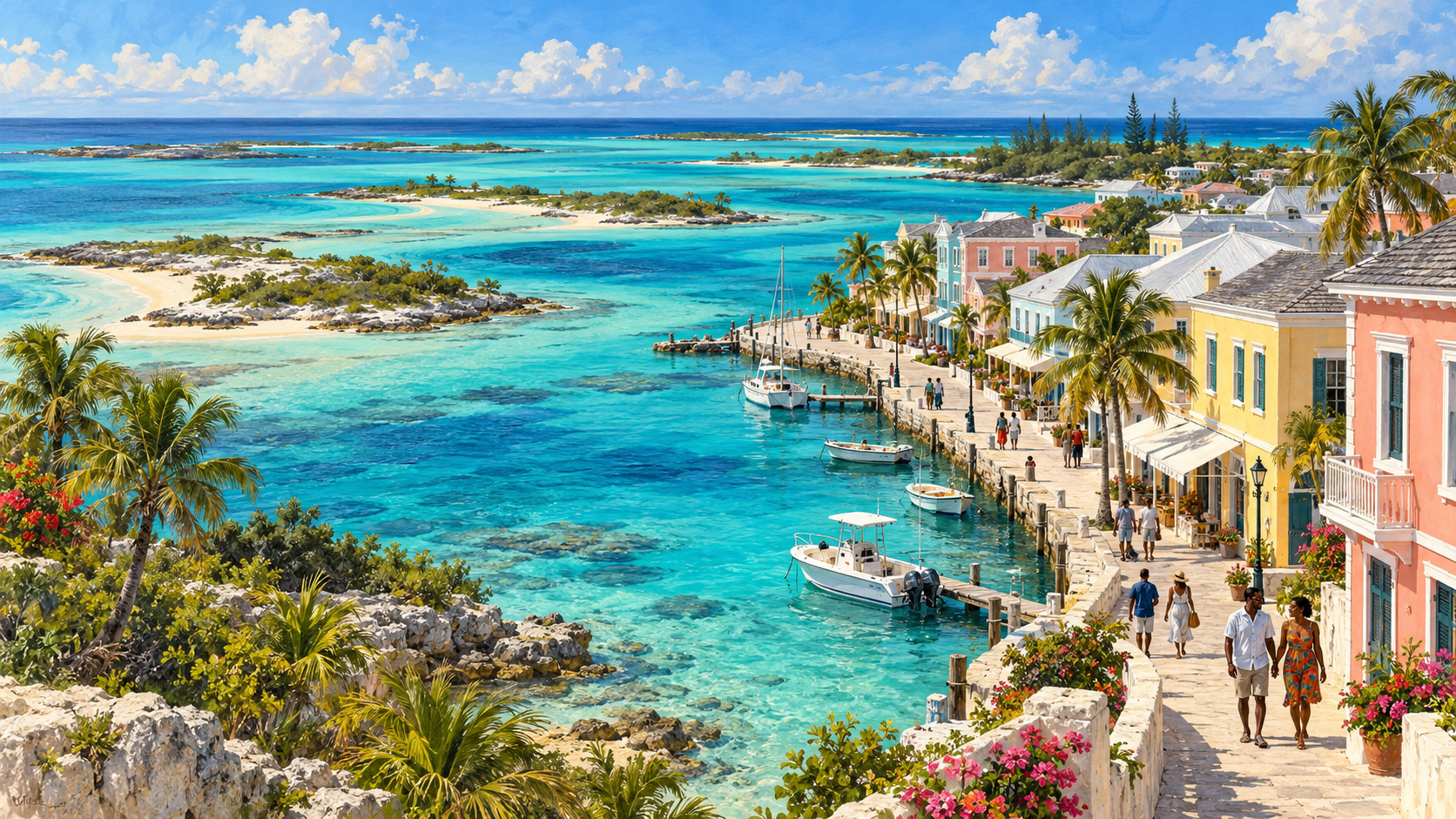
Bahamas Children Vocabulary | Words for Character and Nation Building introduces twenty age-appropriate English words connected to cultural knowledge, fair relationships and useful civic habits. How can children build character by learning about a country of many islands? The Bahamas provides engaging examples of precise map reading, the creativity and history of Junkanoo, marine conservation and the difference between a reliable weather alert and an unverified rumour.
For international children approximately aged 8–12, parents and educators. This is an English-language reading guide, not an official Bahamian syllabus, travel-safety instruction, real-time weather bulletin or claim that everyone on the islands shares the same traditions and experiences.
Source-based country overview: The Bahamas is an Atlantic archipelago of numerous islands and cays, as described in official Bahamian sources. UNESCO inscribed Junkanoo as living cultural heritage in 2023, explaining its roots among enslaved Africans and the community craftsmanship involved in making performances and costumes. The Bahamas’ Exuma Cays Land and Sea Park is known for its marine protection and no-take rules. The Bahamas Department of Meteorology is a national source for weather forecasts and warnings. These facts anchor words about identity, responsible use of nature and preparedness without requiring a child to undertake dangerous tasks.
Educational meaning of character and nation building: Here nation building means realistic community habits: accurate descriptions of islands and peoples, honest remembrance, giving cultural practitioners credit, respecting environmental protections, checking official warnings and helping one another safely. It is not a political pledge or a request for children to manage disasters.
Quick answer: what is the child learning?
| Part of the lesson | The task | The boundary |
|---|---|---|
| Twenty vocabulary words | Explain meaning, spot a misleading use and make an original sentence | A familiar-looking word is not always the correct word |
| Four country-specific chapters | Explain a fact, the people involved and a real distinction | A single example never describes an entire population |
| Fictional classroom story and six worked checks | Find and repair a false claim with a reason | Imaginary children are not real witnesses |
| Short home or school practice plan | Read, listen, revise, explain and transfer learning | Children are not assigned adult policy or safety duties |
Jump to 20 words · four chapters · story · answered checks · practice plan · guidance for adults · questions · sources and hubs.
20 children’s vocabulary words: clear meanings and original examples
The definition explains what the word means and gives a boundary against a common misunderstanding. The model sentences are imaginary examples created for English learning, not reports about actual children.
1. Reading island geography without confusing places
| Word | Meaning and distinction | Original sentence |
|---|---|---|
| archipelago | A group of islands within a stretch of water; not a single very large island. | The map presented The Bahamas as an archipelago. |
| cay | A small, low island, often formed of sand or coral material; not necessarily a permanent settlement. | The chart marked several cays as distinct from the larger islands. |
| coastline | The boundary area where land meets the sea; not the same as the whole island. | The pupils traced the coastline without naming every beach. |
| channel | A water passage through which boats or currents may move; not automatically a safe swimming route. | The map showed a channel between islands. |
| navigation | Finding and following a route using reliable information, not guessing from the colour of water. | Navigation on the model map required a scale and direction. |
2. Junkanoo’s creative skills and truthful history
| Word | Meaning and distinction | Original sentence |
|---|---|---|
| Junkanoo | A Bahamian cultural festival involving parades, costumes, music and shared creative work; not merely a costume shop. | The class researched UNESCO’s description of Junkanoo. |
| procession | A group moving together in an organised ceremonial or festive route; not a random crowd. | The programme described a colourful procession. |
| costume | Clothing or adornment made for a performance or event; not proof of the wearer’s everyday clothes. | The caption credited the costume designers and makers. |
| craftsmanship | Skill developed through planning, making and practice, not simply bright colours. | Craftsmanship made the complex paper designs possible. |
| transmission | Passing a practice or skill among people and generations, not just keeping one old photograph. | The older group taught younger participants as part of transmission. |
3. Marine habitats, no-take protections and stewardship
| Word | Meaning and distinction | Original sentence |
|---|---|---|
| marine reserve | An area of sea managed or protected under special rules; not necessarily an unrestricted public swimming area. | The class checked the marine reserve’s fishing rules. |
| no-take | A conservation rule that prohibits removal of specified resources, or all extraction as defined by the reserve; not a ban on looking. | The park’s no-take status means visitors cannot fish there. |
| habitat | The environmental conditions and place supporting a living species. | Shallow coastal waters provide habitat for many organisms. |
| biodiversity | The variety of living things and ecological relationships, not merely the number of one type of fish. | Biodiversity cannot be established from a single sea photograph. |
| stewardship | Responsible care for resources and places shared with others; not permission to collect protected animals. | Stewardship begins by following the park’s rules. |
4. Weather language and safe community coordination
| Word | Meaning and distinction | Original sentence |
|---|---|---|
| hurricane | A severe tropical cyclone in the Atlantic region, requiring attention to official weather information. | The class learned what an official hurricane warning describes. |
| forecast | An evidence-based statement about conditions that may occur; not a certainty or a promise. | A forecast may be updated when observations change. |
| preparedness | Planning suitable actions before a possible hazard, distinct from actions taken during the event. | Preparedness meant knowing the caregiver and school plan. |
| coordination | Organising people and actions so a task is carried out safely and clearly. | Coordination kept the imagined school practice orderly. |
| accountability | Being able to explain what was done and correct mistakes, not claiming success without checking. | The pupil showed accountability by revising the inaccurate weather notice. |
Four learning chapters: knowledge, precision and a useful action
Read each chapter as a small investigation. Identify the fact established by a source, the word that explains it, the tempting but incorrect alternative, and the activity that helps the learner use the word outside its original context.
1. An archipelago needs precise maps and respect for island differences
Words in focus: archipelago · cay · coastline · channel · navigation.
The Bahamas lies in the Atlantic Ocean and consists of many islands and cays. The official Bahamian government and embassy descriptions explain its scattered island geography. The word archipelago names the whole grouping of islands, while a cay names a particular small island. These words are not interchangeable. A child who writes ‘the Bahamas is one island’ has simplified the geography until it becomes wrong. The country’s residents live on different islands with different communities, services and connections; a photograph of Nassau cannot describe every Bahamian place.
A coastline is where the land and sea meet. A channel may lie between islands, but its existence on a map does not mean it is a safe place to swim or cross in a boat. The water’s colour tells an observer little about tides, currents or legal navigation requirements. Navigation involves reliable information about direction, scale, hazards and routes. In this children’s article, navigation is a paper-map learning activity, not real boating advice.
Imagine a fictional pupil tracing a route between New Providence, where Nassau is located, and another Bahamian island. On a small map, the route appears to take only a few centimetres. The pupil says it must be a very short walk. This confuses map distance with real distance and overlooks water between islands. A better question is ‘What is the map scale and which safe transport services exist?’ The child should not calculate a real travel time from appearance alone or assume that any two islands are connected by road.
Geography also shapes how shared services must be considered. A national notice may reach many islands, but delivering materials or services to separate communities can involve different practical challenges. Children can discuss a fictional book-delivery project without pretending to design actual shipping routes. Suppose one island’s school receives books regularly and another faces delays. A fair analysis asks where the books must travel, which dates are known and what obstacles need verifying. Blaming residents for a delivery problem without evidence would not be reasonable.
Words about geography can strengthen character when they protect people from being treated as interchangeable. A child describing the country could say ‘The Bahamas is an archipelago with many distinct island communities’. They should not add that every island has the same population, weather, jobs or local priorities without evidence. The same respectful precision is useful when writing about any country containing remote towns, mountains or regions.
For a paper-map task, draw three labelled fictional islands, two cays and one channel. Include a north arrow and a scale. Ask pupils to explain what the invented drawing can teach about terms and what it cannot establish about real Bahamian travel conditions. The correct answer admits the model is invented: it shows relationships, not present-day routes or safety advice.
False inference and repair: Incorrect: ‘The Bahamas is one island, so travelling between two Bahamian islands means walking along the coast.’ Repair: ‘It is an archipelago; water passages and transport arrangements must be represented accurately.’
Practice and transfer: Make a labelled paper map and explain the difference between a coastline, channel and cay. Use an official geographical source for real place names and label invented routes as invented.
2. Junkanoo teaches creativity, teamwork and respect for difficult history
Words in focus: Junkanoo · procession · costume · craftsmanship · transmission.
UNESCO inscribed Junkanoo on the Representative List of the Intangible Cultural Heritage of Humanity in 2023. Its description names it as the national cultural festival of The Bahamas, with music, performances, storytelling, costumes and extensive community preparation. A procession or parade is the moving performance, but the art begins much earlier. Craftspeople design and build elaborate costumes, musicians and performers practise, and groups coordinate a large shared activity. Reducing Junkanoo to ‘people in colourful clothes’ removes much of the human skill behind it.
UNESCO describes the making of costumes from materials such as cardboard and crepe paper and notes how skills are taught to younger participants. Craftsmanship identifies that trained creative work. Transmission refers to the teaching and learning that keep a practice alive. In Junkanoo settings, older practitioners can guide younger people through techniques and preparation. A completed photograph shows an outcome; a careful heritage description also acknowledges the long period of planning and the people who made the result possible.
The history should not be hidden. UNESCO links the origins of Junkanoo in The Bahamas to enslaved Africans who used limited holidays to recreate festivals and express culture. Enslavement means people were denied freedom and forced to live and work under the control of others; it was not a voluntary job. Children can learn this truthful fact without graphic descriptions. A festival can express joy and ingenuity while its history also includes injustice. Celebrating the resulting tradition does not make the system of enslavement acceptable.
For a classroom project, have children design a small fictional paper costume using ordinary art supplies under appropriate supervision. Do not call the result an authentic Junkanoo costume or imply that copying a striking photograph gives the class the full community practice. Credit the source that inspired the study and explain that expert practitioners know far more about materials, music and performance. Asking a participant about their craft, with permission, would be a better source for specific details than inventing an explanation.
UNESCO’s committee decision identifies many kinds of contributors to Junkanoo, including performers, costume makers, organisers, timekeepers and people who manage the event. Children can learn that public celebrations depend on less visible responsibilities. An event can fail even if the costumes are beautiful when instructions, timing, safety and respect are neglected. The word ‘teamwork’ becomes more useful when the learner can name which people coordinate which tasks.
Finally, ask who may be missing from an overly simple poster. If it celebrates only the largest costume, the poster may leave out musicians, learners, elders, craft workers and the history of enslaved ancestors. A better caption credits the living heritage bearers and describes the festival’s roots honestly. The civic lesson is an ability to appreciate beauty without erasing the people who created it.
False inference and repair: Incorrect: ‘Junkanoo is just a random parade with costumes.’ Repair: ‘It is a recognised Bahamian cultural festival sustained by skilled makers, performers, organisers and transmitted knowledge.’
Practice and transfer: Build a fictional parade planning chart with roles for craftsperson, performer, timekeeper and source-checker. State one way the group can honour the tradition without pretending its model is authentic.
3. Exuma marine protection means looking without taking
Words in focus: marine reserve · no-take · habitat · biodiversity · stewardship.
The Exuma Cays Land and Sea Park is a well-known protected area in The Bahamas. The official Bahamas tourism description identifies it as a landmark land-and-sea park and explains its strict no-take conservation rules: fishing is prohibited within the relevant protected area. A marine reserve has defined purposes and regulations; it is not simply a pretty location. The important distinction is that a visitor may be allowed to observe some features while being forbidden to remove protected resources. The exact rules, permits and access arrangements must be checked with the park authority before any real visit.
The word habitat refers to the environmental conditions that support a living thing. Marine habitats can include reefs, seagrass beds, shallow-water environments and mangrove settings. Biodiversity means the variety of organisms and ecological relationships within those systems. A bright underwater picture cannot establish the full variety of life in the park. It may show a fish or a coral, but a reliable biodiversity claim requires wider observation and scientific evidence over an appropriate area and period.
Stewardship is responsible care of something shared. It is not a claim that a child owns the protected water or can decide the conservation rules. A child can read a park sign, learn why no-take protections exist and avoid describing the collection of shells, fish or coral as a suitable classroom activity. Taking a protected organism or object would not become responsible simply because it is for a school project. Trained scientists, park staff and authorities handle research, permits and conservation decisions.
In a fictional school display, one pupil says ‘No-take means nobody is allowed to look at the water’. Another claims ‘The Bahamas has banned all fishing everywhere’. Both sentences exaggerate the rule. The first confuses extraction with observation; the second generalises a protected-area rule to an entire national territory. The more accurate lesson is that a particular no-take reserve has restrictions within its designated boundaries. Other waters may have different rules that require checking separately.
For a classroom activity, design a protected-area diagram with a shoreline, labelled habitats and a ‘no removal of animals or plants’ rule. Ask whether taking an underwater photograph would necessarily be safe or permitted in every location. The answer is no: access, wildlife disturbance, safety and equipment rules still matter. Children should not undertake unsupervised diving, collect unknown organisms or approach dangerous marine animals. The educational task stays on paper and uses official sources.
When learners compare the park with an imaginary ordinary beach, they can see that conservation rules are not arbitrary decorations on a sign. They exist to protect ecosystems and help people understand appropriate use. A word such as stewardship has meaning only when the child can explain the protected resource, the rule and the relevant boundary.
False inference and repair: Incorrect: ‘A no-take park bans all looking, and the same rule automatically covers every sea around The Bahamas.’ Repair: ‘No-take protects a defined reserve from fishing or removal under its rules; other areas require their own guidance.’
Practice and transfer: Prepare three sample signs for a model marine reserve: a no-take explanation, a habitat notice and a reminder to consult official access rules.
4. Hurricane vocabulary helps children follow trustworthy adult-led plans
Words in focus: hurricane · forecast · preparedness · coordination · accountability.
The Bahamas is exposed to Atlantic tropical weather, including hurricanes. The Bahamas Department of Meteorology provides forecasts, notices and warnings that people can use to make informed decisions. In this vocabulary guide, forecast means an evidence-based prediction that may change as more observations become available. It is not a guarantee. A statement that conditions may develop is different from an official instruction to take an immediate step. The most useful child-level skill is noticing the source, date, place and wording of the information.
Preparedness means suitable planning before a possible event. Adults, schools and responsible agencies decide which emergency arrangements are appropriate. A child can learn who their trusted adults are, where they are supposed to assemble for an authorised school practice, and why following instructions is safer than improvising. They should not be expected to drive, undertake rescue work, cross flooded water, test dangerous winds or independently choose whether to evacuate. This article is a vocabulary exercise, not a substitute for current local emergency guidance.
Coordination means arranging people and actions so that a plan operates safely. Imagine a practice exercise where pupils are given three contradictory meeting places. Even if everybody wants to help, confusion could result. The school can prevent this by issuing one clear practice notice, stating the date and time, identifying the adult in charge and helping pupils who need additional support. Different children may require different assistance, and an inclusive plan should consider those needs.
Another useful distinction is between real-time information and old media. A dramatic online video of waves might have been recorded years earlier or in a different country. It should not be shared as proof of current conditions in a named Bahamian island unless the location and date are verified. Children who see a forwarded warning should show it to a trusted adult and consult the appropriate official channel. Accuracy matters because rumours can distract attention from important instructions.
Accountability follows the exercise. Suppose an imaginary class had to prepare five printed practice notices but completed four. Their report should identify the four delivered and the missing fifth, not boast of complete success. A named adult should check the distribution of actual school instructions. The lesson is not to blame a child who missed a task, but to notice which step requires further attention so the plan can be corrected.
Finally, children can ask whether the word ‘resilience’ is being used carefully. Communities often respond creatively to adversity, but praising resilience should never be used as an excuse to deny people’s needs. Reliable public warnings, suitable shelters, accessible services and help from trained adults remain important. A child’s part is to listen, understand, ask questions, prepare with caregivers and avoid unsafe attempts to prove bravery.
A nation-building vocabulary lesson therefore finishes with observable habits: a clear notice, a verified source, an inclusive practice arrangement and an accurate report. These are ways to build trust without turning a classroom exercise into an emergency manual or an instruction to follow a rumour.
False inference and repair: Incorrect: ‘A forwarded clip proves a hurricane will certainly strike this island tomorrow.’ Repair: ‘Use the dated official forecast and follow guidance from responsible adults and authorities.’
Practice and transfer: Draft an imaginary ‘practice only’ school weather-information notice, including a clear source, date, lead adult, meeting location and a sentence saying it is not a real emergency warning.
Fictional learning story: make corrections visible
At a fictional children’s exhibition in The Bahamas, Kai draws New Providence and Exuma as if they were connected by a walking path. His classmate checks an atlas and changes the picture to show islands separated by water. Brianna writes that Junkanoo is only about bright clothes; after reading UNESCO, she adds its history, music, craftspeople and passing on of skills. Malik creates a marine park poster inviting visitors to take fish as souvenirs, and the group changes it after reading the Exuma no-take rules. When a dramatic old storm video circulates, Ari refuses to treat it as a current forecast and instead asks an adult to check the date and an official weather source. The group publishes a list of its revisions. All the students and scenes are fictional; source-backed facts are cited in the references.
Four close-reading questions
- 1. Why was Kai’s map inaccurate about the relationship among the islands?
- 2. Which part of Brianna’s revised caption gives credit to people, not merely objects?
- 3. What rule made Malik’s souvenir suggestion unacceptable?
- 4. Why could Ari not use an undated storm clip as proof of tomorrow’s weather?
Encourage the pupil to support each answer with a detail from the story and, for a factual claim, the linked source. A correct vocabulary label without a reason is not yet evidence of understanding.
Six vocabulary checks with worked answers
Question 1: Is The Bahamas a single island?
Worked answer: No. It is an archipelago containing many islands and cays.
How to explain: Identify the relevant situation, select the accurate word, and say which detail rules out an attractive but misleading alternative. Then make one new sentence in a different setting. This checks usable vocabulary rather than memorised slogans.
Question 2: Does a Junkanoo costume tell the full history of the festival?
Worked answer: No. The festival also has music, performance, craftsmanship, community transmission and historical roots.
How to explain: Identify the relevant situation, select the accurate word, and say which detail rules out an attractive but misleading alternative. Then make one new sentence in a different setting. This checks usable vocabulary rather than memorised slogans.
Question 3: What does no-take mean in the Exuma Cays Land and Sea Park?
Worked answer: The park has strict no-take protections, including a prohibition on fishing within the reserve.
How to explain: Identify the relevant situation, select the accurate word, and say which detail rules out an attractive but misleading alternative. Then make one new sentence in a different setting. This checks usable vocabulary rather than memorised slogans.
Question 4: Does a photograph of one fish establish the biodiversity of an entire marine park?
Worked answer: No. Biodiversity requires wider evidence about the variety of living things.
How to explain: Identify the relevant situation, select the accurate word, and say which detail rules out an attractive but misleading alternative. Then make one new sentence in a different setting. This checks usable vocabulary rather than memorised slogans.
Question 5: Can children safely rely on an undated forwarded hurricane video?
Worked answer: No. Current official information and guidance from trusted adults are needed.
How to explain: Identify the relevant situation, select the accurate word, and say which detail rules out an attractive but misleading alternative. Then make one new sentence in a different setting. This checks usable vocabulary rather than memorised slogans.
Question 6: A class reports an incomplete practice notice and corrects it. Which word describes the practice?
Worked answer: Accountability, because the group has accurately checked and revised the result.
How to explain: Identify the relevant situation, select the accurate word, and say which detail rules out an attractive but misleading alternative. Then make one new sentence in a different setting. This checks usable vocabulary rather than memorised slogans.
Seven-day plan: learn, explain and reuse the words
| Session | Age-appropriate instruction | What proves progress |
|---|---|---|
| Day 1: Notice | Study words 1–5. For each, state one correct example and one near-miss. | Accurate definition in the child’s own words |
| Day 2: Speak | Study words 6–10. Use two terms in a story about a safe school or family task. | The sentence conveys the intended meaning |
| Day 3: Source | Read a short accessible passage from an official source below, with an adult. | One supported fact and one unanswered question |
| Day 4: Compare | Study words 11–15. Sort claims into ‘observed’, ‘supported by source’ or ‘fiction’. | No fictional fact is presented as history |
| Day 5: Decide | Study words 16–20. Give pupils roles in a supervised imaginary group project. | A specific, safe responsibility and test |
| Day 6: Write | Write an 80–120-word original paragraph using three vocabulary terms. | Clear writing with no empty decorative use of words |
| Day 7: Transfer | Apply three ordinary words to an unfamiliar location or classroom scenario. | Correct meaning without copying culture-specific claims |
For revision, ask each learner to give a definition, reject a misleading example and use the word in a fresh sentence. A useful assessment can record ‘not yet’, ‘with guidance’ and ‘independently’ for each skill. Do not grade cultural identity, nationality, loudness or accent.
Notes for parents and teachers: character grows through precise habits
- Begin with an accurate fact, not a slogan. A named source is more useful than sweeping claims about how a population thinks.
- Distinguish a country from its government. Children can care about people, places and shared responsibilities without being asked to support a political authority.
- Respect the people behind cultural heritage. Name practitioners, community connections, cross-border inscriptions and permission limits where the sources support them.
- Teach difficult history clearly and gently. Do not erase enslavement or other harm, and avoid distressing images or unsupported personal stories.
- Keep children safe. Metalworking, protected rock art, dangerous seas and emergency decisions belong to trained adults and competent authorities.
- Use a narrow task to teach a big word. A checked source, readable sign, properly credited musician or accurate report is a useful contribution.
- Make room for correction. When a child says ‘I changed my label because the source showed otherwise’, reward the reasoning rather than the original confidence.
Frequently asked questions
Is The Bahamas one island or many?
It is an Atlantic archipelago consisting of many islands and cays; Nassau is on New Providence, not on every island.
What does UNESCO say about Junkanoo?
It was inscribed in 2023 as Bahamian intangible cultural heritage; UNESCO describes its roots among enslaved Africans and its elaborate community music, performance and craftsmanship.
Does no-take mean all fishing is banned throughout The Bahamas?
No. Exuma Cays Land and Sea Park has defined strict no-take protections. Elsewhere, different fisheries rules may apply.
Can this article replace official hurricane guidance?
No. It teaches vocabulary and source-checking. Real situations require current Bahamas Department of Meteorology information and guidance from the relevant authorities and caregivers.
Fact-checking sources and relevant articles
Country-specific facts have been checked against the institutional sources below on 23 October 2026. The learner stories, sample sentences, imagined exhibitions and practice questions are original editorial activities, not the national curriculum or real-world incident reports.
- Embassy of The Bahamas to the United States | Island geography
- UNESCO | Junkanoo (2023)
- UNESCO | Junkanoo committee decision, participants and safeguarding
- The Bahamas Ministry of Tourism | Exuma Cays Land and Sea Park
- Bahamas Department of Meteorology | Official information and forecasts
- UNICEF | Convention on the Rights of the Child
Explore this country in the eduKateSG ecosystem
- Everything About The Bahamas
- How The Bahamas Works
- Understanding the Education System of The Bahamas
- Top 100 Queen Conch Ecology Vocabulary Words
Follow the A–K Children Vocabulary country sequence
Afghanistan Children Vocabulary · Albania Children Vocabulary · Algeria Children Vocabulary · Andorra Children Vocabulary · Angola Children Vocabulary · Antigua and Barbuda Children Vocabulary · Argentina Children Vocabulary · Armenia Children Vocabulary · Australia Children Vocabulary · Austria Children Vocabulary · Azerbaijan Children Vocabulary · Bahamas (this article)
Main eduKateSG learning hubs
- Vocabulary Learning Hub | Primary to Junior College
- Vocabulary | Primary School to Adult and Career
- How Countries Work | World Index
- Top 20 Unique Vocabulary by Country | Index
A child who finishes this Bahamas guide should be better able to describe a place without stereotypes, distinguish a source-supported fact from an invented example, credit people for their skills, and help carry out a small responsibility safely. Vocabulary becomes a tool for character and community when the learner can explain and practise it.