
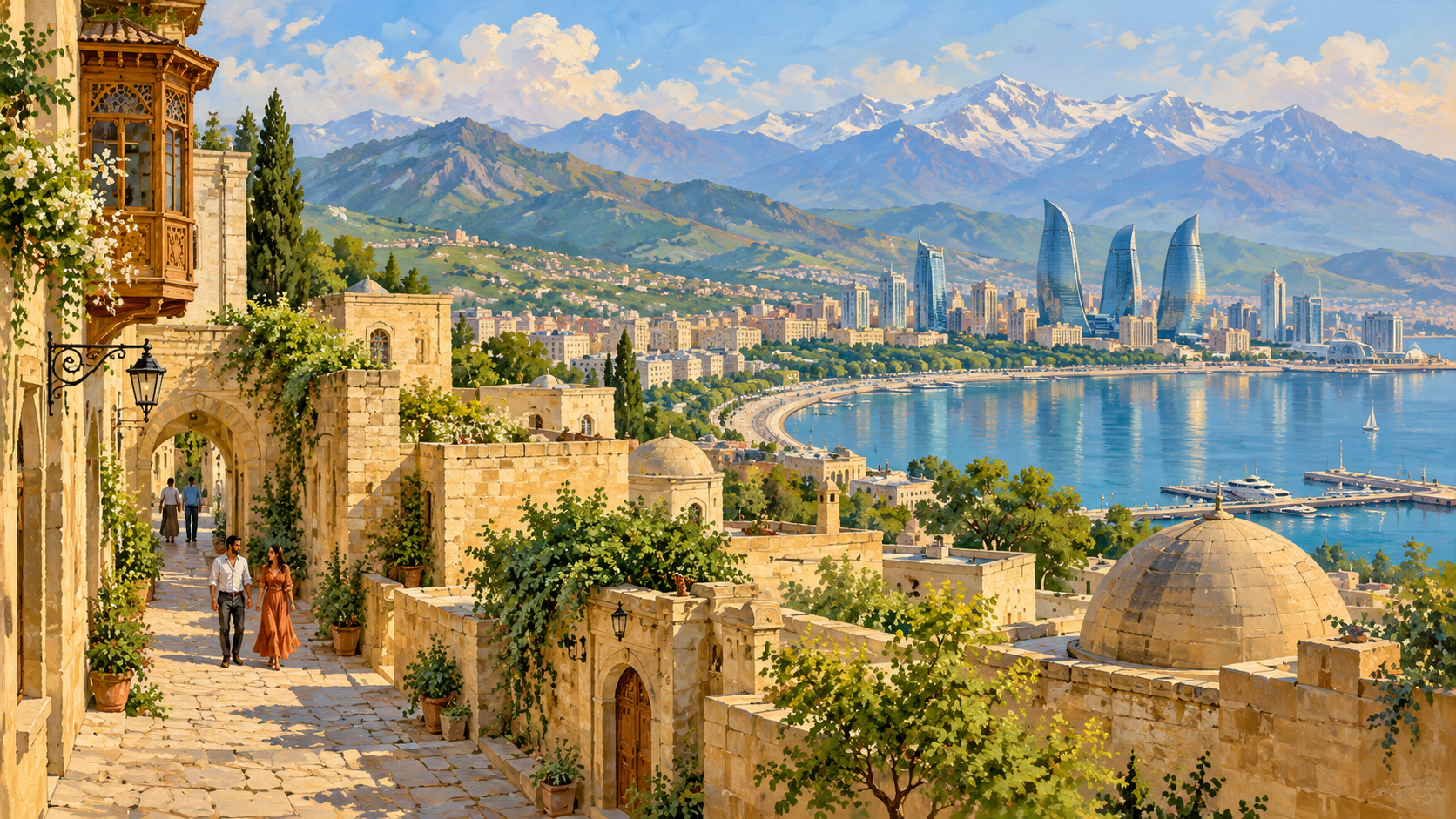
Azerbaijan invites you to look closely at the meeting of landscape, craft and city life. The best things to do when visiting and touring Azerbaijan include Baku’s Old City, the Caspian waterfront, carpet traditions, Gobustan’s rock art and regional visits to places such as Sheki and Lahij. A thoughtful Azerbaijan travel itinerary connects those experiences through careful planning and local interpretation.
For a first Azerbaijan holiday, a family journey or a reader exploring the Caucasus from home, Baku makes a useful starting point. This guide introduces ten experiences, explains what each adds and helps you choose a manageable route. Regional access, official travel advice and transport arrangements need to be checked before turning ideas into bookings.
Read current regional advice before planning. As checked on 8 October 2026, UK FCDO advice warns against all travel to parts of Azerbaijan and against all but essential travel to other areas. Its regional page identifies restrictions near the Armenia border and risks in conflict-affected south-western districts. This guide does not propose sightseeing routes through those areas. Consult your own government’s advice, Azerbaijani authorities and a reputable local provider for the exact places you intend to visit.
eduKateSG · A WORLD WORTH UNDERSTANDING
Find your way through Azerbaijan
Choose the part you need now, or follow the whole journey at your own pace.
A short journey can stay in Baku with selected excursions. A longer one can add a carefully organised regional chapter, such as Sheki and Lahij, after checking the route and current conditions. Mountain visits require their own preparation and should not be added casually to a city itinerary.
| Experience | Choose it for | Planning decision |
|---|---|---|
| Baku’s Old City | Historic streets and interpretation | Select one main interior visit |
| Contemporary Baku | Architecture and a Caspian setting | Check exhibition and access arrangements |
| Carpet Museum | Craft, pattern and cultural learning | Allow time to look at a few pieces closely |
| Absheron’s fire heritage | History and geological context | Use an informed guide and site rules |
| Gobustan | Rock art and landscape interpretation | Confirm the excursion’s actual stops |
| Sheki | Palace detail, craft and a regional stay | Give the town more than a hurried stop |
| Lahij | Copperwork and a village visit | Check road conditions and local access |
| Khinalig | Mountain culture and landscape | Confirm road, weather and permissions |
| Gabala’s regional history | A different regional chapter | Separate heritage and outdoor activities |
| Tea, food and music | Everyday connections | Choose a locally appropriate setting |
These are choices across several regions. They are not a guaranteed ten-day circuit, and inclusion in this article does not confirm that a location is accessible on your dates.
Baku’s Old City offers a good introduction to the historical layers of the capital. Begin with the streets and walls, then choose a principal visit such as the Maiden Tower or the Palace of the Shirvanshahs, subject to current visitor arrangements.
A guide can help you place individual buildings within a longer story. Ask what changed over time, which details remain visible and how the area functions today. Those questions are more useful than trying to memorise every date in the first hour.
Walk slowly enough to notice entrances, stone surfaces and the transition between larger spaces and narrow lanes. The district includes places where people live and work. Keep paths clear, respect private thresholds and ask permission before photographing someone closely.
Choose an interior visit according to the group’s interest and mobility. Confirm steps, available interpretation, opening hours and ticket arrangements with the site. If a visit involves climbing, understand what that means before presenting it to the group as a quick stop.
The official Old City introduction helps establish the setting. A satisfying first outing might include one guided walk, one main visit and a meal, with time afterwards to sort your observations into a few clear sentences.
After the Old City, give contemporary Baku a separate look. A waterfront walk and an architecture-focused visit can show how the city presents itself through public space and newer forms. The contrast becomes more interesting when you have already observed the historic district carefully.
Begin with function rather than a superlative. What is the building used for? How do visitors approach it? What kind of space surrounds it? If you visit an exhibition venue, check the current programme and choose the visit for its contents as well as its exterior.
The Caspian waterfront offers another way to read the city. Notice where people stop, how different routes meet and how the view changes as you walk. Pick a manageable section instead of assuming the whole boulevard needs to be covered.
Wind, heat and walking distances can affect the outing. Check the forecast, plan a seated pause and choose transport for the return if needed. A route that looks simple on a screen may feel quite different after a morning of sightseeing.
Azerbaijan Tourism’s Seaside Boulevard guide introduces this part of the city. Use it as an orientation tool, then confirm individual venues and activities directly.
The Carpet Museum is a valuable place to spend time with a craft rather than merely recognise its name. Its setting on Baku’s Seaside Boulevard also makes it a practical cultural stop within a city day.
Choose a few pieces to study closely. Look at repeated shapes, borders, colours and the organisation of the surface. Ask what the museum explains about their origin, materials and use. A single well-understood example can stay in the memory longer than a hurried survey of the whole collection.
For children, a pattern exercise can make the visit approachable. Sketch one geometric feature, describe the way it repeats and compare it with a pattern familiar from home. Follow the museum’s rules about photography and do not touch exhibits unless an authorised activity explicitly allows it.
If you later shop for a carpet or textile, ask clear questions about who made it, the materials and any documentation relevant to purchase and export. A museum visit provides background; it does not authenticate a product sold elsewhere.
The official Carpet Museum introduction gives an overview of the collection and craft. Check the museum’s current arrangements before visiting, particularly if a guided session or demonstration is important to your plans.
Ateshgah and Yanardag offer related but different experiences. One invites historical and religious interpretation; the other draws attention to natural flame and the landscape around it. An informed guide can help you understand those differences without reducing both sites to the same photograph.
Read a little before going, then ask the guide to explain what can be established from the site and what belongs to later interpretation. Religious history often involves several communities and periods. Clear explanations should make that complexity understandable without flattening it into a slogan.
Confirm the route, entrances and time allocated at each place. Some excursions combine several sites, so ask how long the day will involve transport and whether meals or admissions are included. Choose a pace that leaves room for explanation.
Stay within visitor areas and follow guidance around flames and barriers. Do not assume that a natural feature is safe to approach simply because it is a popular attraction. Keep children within the supervised visit and listen to the site staff’s instructions.
Azerbaijan Tourism’s fire heritage guide introduces the background. Current site information should settle the practical arrangements for the day you visit.
Gobustan is most rewarding when the rock art is understood alongside its setting. A guided visit can help you distinguish a visible marking from an interpretation of what it may represent. That difference is part of learning to look responsibly at evidence from the past.
Use the available museum or site interpretation before or alongside the outdoor visit. Choose a few examples to discuss rather than trying to photograph every surface. Ask what researchers know, how they know it and where uncertainty remains.
Follow designated visitor routes and never touch, trace or mark the rock art. Conservation depends partly on visitors accepting that close attention does not require physical contact. If a guide explains a restriction, let it shape the visit rather than negotiating around it.
Some excursions also include mud volcano viewing. Ask the provider to identify the exact stop, current access and safety arrangements. Keep away from vents and unstable areas, and do not treat mud features as places for bathing or unsupervised play.
The official cultural heritage overview places Gobustan within Azerbaijan’s heritage landscape. Check the precise excursion route before booking; similar tour titles can hide very different time allocations.
Sheki offers a change of pace from Baku and a useful opportunity to connect architecture with craft. Palace detail, local workshops and the town’s setting can form a satisfying stay when you leave room between the main visits.
The Sheki Khan’s Palace is a focal point to investigate, including its decorative detail and shebeke window craft. Confirm current visitor rules, especially photography restrictions. Some details are best appreciated through looking and explanation rather than through an image taken home.
A workshop visit can make the craft more tangible. Ask whether demonstrations are available, how long they take and whether visitors are welcome at the time you intend to arrive. A working craftsperson may need to concentrate; choose a moment that suits the work.
Do not organise the town solely as a rushed stop on a long driving day. If possible, stay long enough to walk, eat and revisit a detail that interested you. An overnight chapter can create a clearer memory than a brief arrival followed immediately by departure.
The official Sheki introduction and Silk Road reading route provide starting points. Your transport provider should confirm the practical journey and current route conditions.
Lahij is a place to approach with interest in the work people do. Copper craftsmanship and the village’s streets can give a regional visit a concrete focus. A good outing leaves room to observe, ask a question and understand how an object is made.
Arrange the visit through a provider who can confirm road conditions and local access. A village recommendation is not a promise that every route or workshop will be available on your dates. Ask how much driving is involved and whether the plan can change with the weather.
In a workshop, watch the sequence of the process. What happens first? Which stage requires the most skill? How does the maker recognise a finished piece? These questions turn a souvenir shop stop into an opportunity for learning, when the maker has time to explain.
If you buy something, ask about its materials, intended use and care. Confirm that the purchase is what you believe it is. Respect the craftsperson’s time and seek permission before taking photographs or video of the work.
Azerbaijan Tourism’s Lahij day-trip introduction is useful when considering the visit. Keep the rest of the day modest so that a change in travel conditions does not create pressure to hurry.
Khinalig introduces a mountain setting and a community with its own cultural context. It needs more preparation than a city walk. Begin with a reputable local provider who can explain the current route, weather, visitor arrangements and any relevant permissions.
Ask what the proposed experience actually involves. A vehicle visit, a village walk and a longer hike require different abilities and equipment. If the outing extends into higher terrain, confirm the guide’s qualifications and the plan for unsuitable conditions.
In the village, let the visit be shaped by what residents welcome. Homes and daily routines are not public exhibits. Use agreed meeting points, ask before photographing people and avoid entering private spaces because the view appears attractive.
The landscape may feel remote, but remoteness should prompt more careful organisation. Confirm transport both ways, communications, meal arrangements and the needs of every traveller. If conditions are unsuitable, choose another experience rather than pressing ahead to keep the itinerary unchanged.
The official Khinalig introduction provides background. It is a starting point for questions, not a current access permit or a substitute for local route advice.
Gabala can offer a regional chapter for travellers who want to connect a different setting with historical interpretation. Rather than beginning with a list of resort activities, consider the area’s heritage and the kind of outing your group would find meaningful.
A museum or interpreted heritage visit can provide context before a landscape excursion. Ask the guide to distinguish the present town from the historical places being discussed. Understanding that relationship makes the visit clearer and avoids treating every attraction as part of the same period.
If you add an outdoor activity, plan it separately. Confirm its location, current operation, physical demands and transport. A scenic attraction, a managed ride and a hike are different undertakings, even when they appear on the same tourism page.
Leave time for a meal and a quieter walk where appropriate. A regional day does not need to be filled with purchases and activities to feel worthwhile. The change in scale from Baku may itself be part of the experience.
The official museums and galleries overview includes regional heritage ideas. Use a local provider to confirm the exact site, opening arrangements and route you intend to follow.
A relaxed meal or tea stop can connect the major visits to everyday life. Choose a place recommended for the kind of experience you want and ask about the food, ingredients or serving customs. Keep the conversation open and let the host decide how much they wish to explain.
For a food-focused outing, describe dietary needs clearly. Ask about ingredients and preparation rather than relying on the translated name of a dish. If the meal is part of a tour, confirm that the provider can accommodate your requirements before departure.
Music can add another layer when a suitable performance is available. Check what the event is, whether it is open to visitors and how to book. A restaurant performance, a concert and a cultural presentation have different settings and expectations.
You do not need to understand every musical term to listen attentively. Notice the relationship between voice, instruments and rhythm, then ask for context from an appropriate guide or programme. Avoid recording a performance without permission.
Give this experience enough time to remain social. A tea stop hurried through between distant attractions loses the quality that makes it valuable. It can also serve as the place where you discuss what the day’s craft or heritage visit helped you understand.
Three to five days: Baku and selected excursions
Use Baku as a base. Combine Old City exploration, one or two cultural visits and a manageable waterfront outing. Add a separately organised Absheron or Gobustan excursion only after checking its actual schedule and current route.
Keep one afternoon flexible. It can absorb a delayed arrival, an exhibition you discover or a needed pause. If the excursion is long, avoid pairing it with an essential evening booking that leaves no margin.
Seven to ten days: add a regional stay
A Sheki chapter with a Lahij visit may suit some travellers, subject to route and access checks. Ask a reputable provider how to connect the places sensibly rather than joining them simply because they appear close on a broad map.
Count driving, meals and accommodation arrival as part of the day. Give regional visits enough time for walking and interpretation. If the journey would leave only a brief stop at each place, choose fewer destinations.
A mountain addition: plan around conditions
A Khinalig visit should have a current local plan and an alternative. Confirm the route, weather, permissions where relevant and the physical demands. Do not assume it can be inserted into every itinerary as an interchangeable day trip.
This guide does not suggest overland connections into Armenia or Russia. As checked on 8 October 2026, FCDO’s regional page states that those land borders are closed. Verify all proposed border crossings with the appropriate authorities rather than relying on a regional map or an older account.
Read the current regional map and advice
Use the FCDO regional risks page, your own government’s travel advice and Azerbaijani official information before booking. Restrictions and conflict-related hazards are geographically specific. Ask your provider to identify the exact route, including any detours.
The current FCDO page warns against all travel within five kilometres of the Armenia border, with its stated Nakhchivan qualification, and against all but essential travel in listed conflict-affected south-western districts. It also describes landmine and unexploded-ordnance risks. Follow the full current guidance rather than treating this summary as a route clearance.
Verify entry and local arrangements
Visa and entry requirements depend on nationality and circumstances. Consult official Azerbaijani channels and check the conditions that apply to your passport and planned stay. If a registration or permit is required for your itinerary, confirm the current procedure with the appropriate authority.
Keep copies of important booking details and a way to contact the provider. For regional journeys, confirm pickup, vehicle, driver, meals, admissions and the return arrangement. An itinerary title alone does not tell you what is included.
Match activity to ability
Describe mobility and stamina needs before booking a guided walk or mountain visit. Ask about stairs, uneven surfaces, altitude, toilets and opportunities to sit. If a provider cannot answer precisely, investigate further before treating the outing as suitable.
A shorter cultural visit can be a better choice than a demanding excursion that leaves someone uncomfortable. Build optional extensions only when meeting points and transport are clear.
Make room for changing conditions
Read the overall Azerbaijan travel advice for current regional developments and potential disruption. Keep essential connections separated from weather-dependent activities and check booking flexibility.
For the budget, include guided excursions, meals, admissions, regional transport and accommodation. Compare complete packages and ask about exclusions. A lower headline price may represent less time at the sites or more separate charges.
| English | 中文 | A useful question |
|---|---|---|
| Old city | 老城区 | Which entrance should we use? |
| Craftsmanship | 工艺 | How is this piece made? |
| Carpet pattern | 地毯图案 | What does the museum explain about this design? |
| Rock art | 岩画 | Which markings can visitors see? |
| Interpretation | 解说 | Is a guided explanation available? |
| Regional restriction | 地区限制 | Does our route enter a restricted area? |
| Permission | 许可 | Do we need official permission for this visit? |
| Road conditions | 道路状况 | Has the route been checked today? |
| Mountain guide | 山地向导 | What equipment should we bring? |
| Included admission | 已包含的入场费 | Which entrance fees are included? |
These English–Chinese prompts support clear questions. They are not Azerbaijani translations. For official restrictions, use the relevant authority’s full guidance and ask your provider to clarify practical arrangements.
Choose one object, building or landscape detail and write about it carefully. Begin with what you saw. Then add what a named guide, label or official source explained. Keeping those two kinds of information separate makes your writing more accurate.
A carpet paragraph can describe a repeated shape before explaining the museum’s interpretation. A rock-art paragraph can note a marking while making clear which meaning is uncertain. A village paragraph can describe a public street without claiming to know the private lives of the people who live there.
For families, ask everyone to choose one question that became clearer during the day. The answer might concern how a window is made, why a settlement sits in a particular place or how a museum presents evidence. A small, well-explained discovery gives the journey a useful intellectual thread.
Continue with the World Travel Vocabulary City Directory or use the World City Experiences Directory for focused urban reading.
Is Baku enough for a short trip?
It can be. A few city days with a carefully chosen excursion can provide variety without constant accommodation changes. Choose experiences that match your interests and leave time to understand them.
Can I visit the mountains spontaneously?
A mountain outing needs current route, weather and access information. Arrange it with a reputable local provider and discuss the group’s abilities. If conditions do not support the visit, use the alternative plan.
Can I combine Azerbaijan and Armenia by road?
Do not assume that connection is available. The current FCDO regional page states that the border is closed. Check official information for any proposed cross-border journey and avoid building bookings around an unverified crossing.
Where is the luxury companion guide?
Read Top 10 Things to Do in Azerbaijan | Luxury. It is a separate reading route; the practical access and official advice checks remain necessary for any style of travel.
Sources checked on 8 October 2026 include Azerbaijan Tourism’s Old City guide, Boulevard introduction, Carpet Museum overview, fire heritage guide, cultural heritage overview, Sheki guide, Lahij introduction, Khinalig introduction and museum directory, alongside FCDO travel advice and regional risks. Recheck before travel.
Continue to the Bahamas, revisit Austria, or return to the World Country Experiences Directory.