
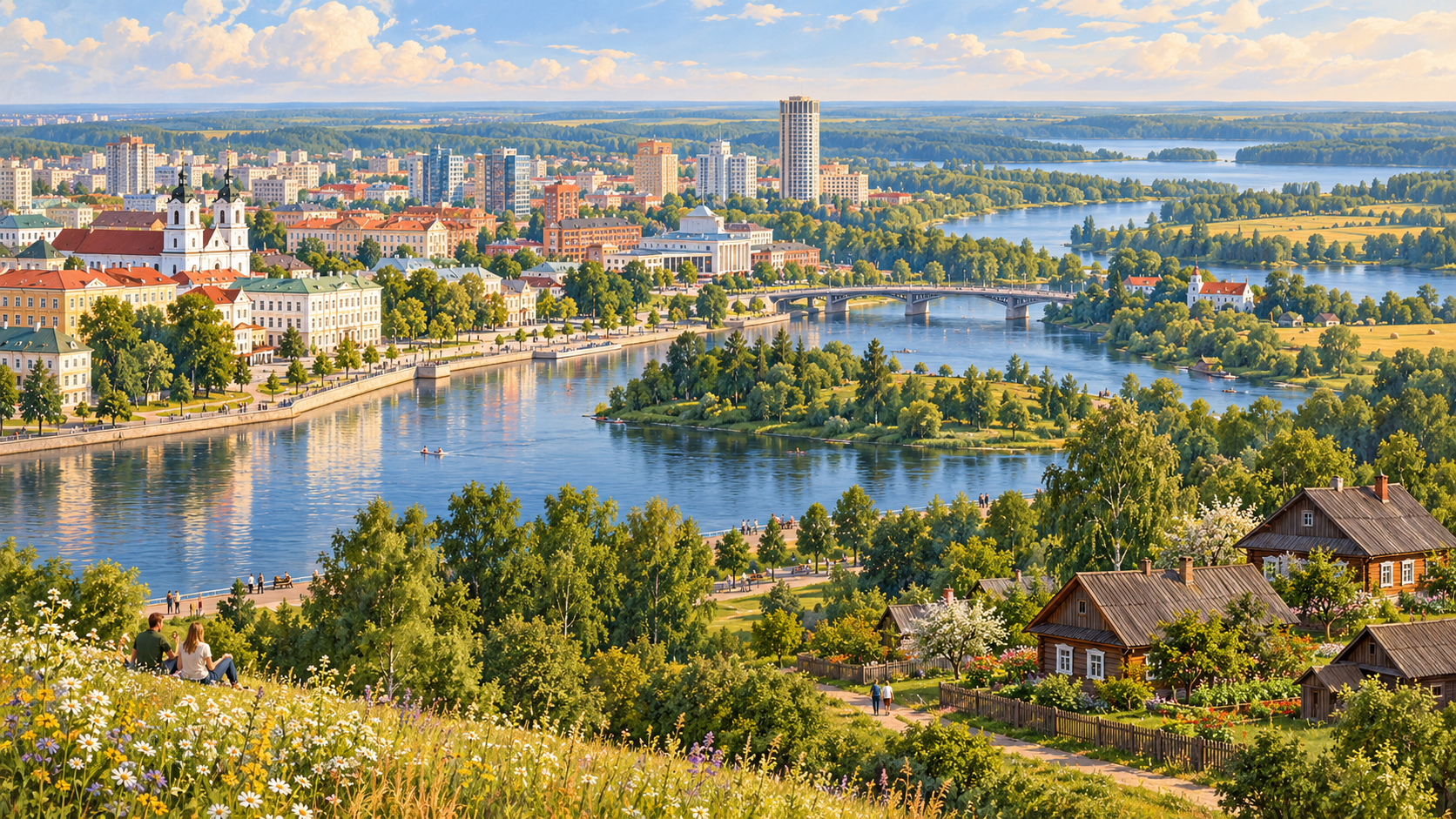
Belarus Children Vocabulary | Words for Character and Nation Building is an original English-learning guide with twenty words, four connected chapters and exercises that help children explain what they have learned. What can a finely woven straw ornament, a castle rebuilt across centuries, a forest spanning an international boundary and a multilingual classroom teach children? Belarus offers four connected vocabulary pathways for accurate descriptions, stewardship and fair communication.
Written in English for international learners roughly aged 8–12, with parent or teacher support. It is not an official Belarusian curriculum, political messaging or an assertion that all Belarusians share the same language or cultural interests. Cultural and religious symbolism is described as a belief or meaning within the practice, not as a scientific claim or an obligation to believe it.
Verified country context: UNESCO inscribed Belarusian straw weaving on its intangible-heritage list in 2022; it includes crafts such as baskets, ornaments, harvest wreaths and pawuks. UNESCO’s Mir Castle Complex listing describes Gothic, Renaissance and Baroque phases rather than a single original style. Its Białowieża Forest World Heritage description covers a protected forest extending across Belarus and Poland and home to European bison. Belarusian and Russian are described as state languages in Article 17 of Belarus’ constitution. These sources show why heritage, boundaries and legal language labels need careful distinctions.
How ‘character and nation building’ is used: In this guide, character and nation building means learning to give practitioners credit, preserve shared places, explain evidence, listen across languages and follow through on safe, realistic classroom commitments. It does not instruct children to endorse a political authority, adopt a faith or enter hazardous forests.
Quick answer: what is the learning purpose?
| Part | Children practise | Common mistake to avoid |
|---|---|---|
| 20 English vocabulary words | Define, distinguish, speak and write in context | Memorise without meaning |
| Four country-grounded reading chapters | Check the source, identify the people and explain an accurate term | Mistake one tradition for a whole country |
| Fictional story and six answered checks | Correct an error and give a reason | Pass imagined characters off as historical witnesses |
| A seven-day mini-course | Use the words at home or in school and then transfer them | Ask children to handle adult civic or safety duties |
Go straight to the 20-word bank · learning chapters · fictional story · six knowledge checks · seven-day plan · adult notes · questions · sources and hubs.
20 English vocabulary words for children: meaning and original sentences
A meaning should protect against an inaccurate nearby use. Culture-specific words are explained in the context of documented practices. Sample sentences are invented English exercises, not eyewitness reporting.
1. Straw weaving, practitioners and the meanings of symbols
| Word | Meaning and distinction | Example a child can read |
|---|---|---|
| straw | The dried stalks of cereal plants after grain has been removed; not the same as green living leaves. | The weaver used prepared straw to make an ornament. |
| weaving | Making a structure by interlacing flexible strands; not simply gluing pieces side by side. | The basket showed how weaving creates a useful shape. |
| pawuk | A traditional Belarusian geometric hanging straw ornament, sometimes linked with household beliefs; not a living spider. | The display explained a pawuk as a crafted hanging decoration. |
| symbolism | Meanings that people associate with forms, images or rituals; not a guarantee that an object has real supernatural power. | The caption attributed the ornament’s symbolism to its tradition. |
| craftsmanship | Developed skill, planning and judgement in making something; not merely an expensive price tag. | The tiny joins showed careful craftsmanship. |
2. Mir Castle, changing architecture and careful historical interpretation
| Word | Meaning and distinction | Example a child can read |
|---|---|---|
| Mir Castle | A UNESCO-listed castle complex in Belarus with building phases from different architectural eras; not a castle constructed wholly at one moment. | The class located Mir Castle on its heritage map. |
| Gothic | An architectural style with particular historical forms; not a synonym for everything old. | The site description identifies an early Gothic phase. |
| Renaissance | A historical cultural and architectural era influencing later changes at the castle; not a building material. | The timeline included Renaissance reconstruction. |
| restoration | Work undertaken to conserve, recover or repair a structure or object; not a guarantee every replaced detail is original. | The museum described phases of restoration after damage. |
| chronology | The order of events in time, not a random list of impressive dates. | The group arranged the castle’s changes in chronology. |
3. The shared Białowieża Forest, habitats and cross-border conservation
| Word | Meaning and distinction | Example a child can read |
|---|---|---|
| transboundary | Extending across an international boundary; not exclusive to one country. | Białowieża Forest is a transboundary heritage property. |
| European bison | A large wild European bovine species associated with Białowieża Forest; not the same as domestic cattle. | The exhibit identified European bison as part of the forest’s wildlife. |
| habitat | A place and environmental conditions that support a species. | The protected forest is a habitat for many organisms. |
| biodiversity | The variety of living organisms in an ecosystem or region; not just how many animals appear in one photo. | Long-term monitoring is needed to assess biodiversity. |
| stewardship | Responsible care for a shared natural or cultural place, not acting as its owner. | The class practised stewardship by keeping to authorised paths. |
4. Two state languages and meaningful participation
| Word | Meaning and distinction | Example a child can read |
|---|---|---|
| state language | A language with a formal status under national law; not necessarily every resident’s only home language. | The pupils read the constitutional description of two state languages. |
| multilingual | Using or living in a setting with several languages; not proof each person knows them all. | A multilingual display can still need clearer explanations. |
| perspective | A person’s viewpoint shaped by experience, not a substitute for checking a factual claim. | A local practitioner’s perspective helped the class ask better questions. |
| fairness | Just treatment with attention to different barriers and needs; not automatically giving everybody the same sheet. | Fairness led to a clearer notice for younger readers. |
| accountability | Being able to explain actions and results and correct mistakes, not merely promising to do well. | The pupil showed accountability by fixing a date in the castle timeline. |
Four linked chapters: vocabulary used in real reasoning
Each chapter connects five words with a documented country fact. The final contrast names a tempting error, and the activity asks children to transfer the underlying idea to something safe and familiar.
1. Belarusian straw weaving shows how living traditions need named makers
Focus vocabulary: straw · weaving · pawuk · symbolism · craftsmanship.
UNESCO inscribed straw weaving in Belarus, art, craft and skills on its Representative List of the Intangible Cultural Heritage of Humanity in 2022. Straw comes from the dried stalks of cereal plants. With appropriate preparation it can be used for weaving a variety of objects, including baskets, headgear, small ornaments and complex decorative forms. A child looking at a glowing yellow decoration may call it ‘gold’, but the material and the craft have a different story. It is a mistake to describe the piece as valuable only because it looks shiny.
Weaving describes interlacing flexible elements to make an object or surface. The exact methods vary with the item and the practitioner’s skill. UNESCO notes traditional techniques alongside the individual creativity of craftspeople today. The word craftsmanship recognises those decisions: preparing material, controlling shape, securing joins and producing a stable result. Simply copying a photograph does not prove a student understands the making process or the cultural meaning behind a form.
A pawuk is one of the traditional hanging straw constructions described by UNESCO. Some are complex diamond-shaped arrangements. UNESCO also describes beliefs associated with particular ornaments, including ideas of protection from misfortune. Symbolism is the word that keeps the explanation precise. A community may believe an ornament represents protection, but the article should not tell children that the object has scientifically proven power to prevent disease. A respectful description can say, ‘Some traditional pawuks carry protective symbolism’. It gives room for the cultural meaning without making a false factual guarantee.
UNESCO’s account stresses that knowledge is passed through families, specialist art centres, classes and community activities. It notes practitioners of different ages and genders, with particular traditional techniques often associated with certain types of products. This is a description of a cultural practice, not an instruction that every Belarusian family must use straw ornaments or that one gender is prohibited from learning. People differ in interests, belief and experience. A tradition becomes more accurately understood when the individual makers and methods are named.
For a safe learning activity, children can interlace paper strips into a simple square pattern. Call the finished piece an original classroom exercise, not an authentic Belarusian pawuk or a replica of a meaningful ceremonial object. Making a genuine complex straw form requires knowledge beyond a short lesson; the school should not claim to transmit the tradition on behalf of its practitioners. Rather, pupils can use the exercise to understand that repeated practice, training and careful material handling belong behind visible skill.
A display label can be assessed with three questions. Does it name the material correctly? Does it distinguish a maker’s technique from a visitor’s interpretation of meaning? Does it acknowledge the living practitioners and UNESCO source? An answer such as ‘Every Belarusian believes a straw spider prevents illness’ fails all three tests. An accurate label identifies the craft, describes its symbolic meaning in context and acknowledges varied participation and beliefs.
Finally, invite children to write a thank-you note to an imaginary craftsperson that contains a precise question rather than empty praise. ‘How do you keep the strands securely joined?’ is an example of curiosity about craftsmanship. It does not demand a secret or assume that a person is obligated to teach. The character habit is respect for another person’s knowledge and right to decide what they share.
Meaning repair: Misleading: ‘A pawuk is a magical spider that scientifically prevents illness for everyone.’ Repair: ‘A pawuk is a crafted geometric straw ornament with symbolic protective meanings in some traditions.’
Child-safe transfer task: Make an original interlaced paper design, clearly label it as a classroom model, and write two sentences about material and one question you would respectfully ask a real practitioner.
2. Mir Castle demonstrates why a monument can have several historical styles
Focus vocabulary: Mir Castle · Gothic · Renaissance · restoration · chronology.
UNESCO describes Mir Castle Complex as a landmark in Belarus whose construction began in the late fifteenth century in a Gothic form. Later changes involved Renaissance and Baroque architectural influences. The building was damaged, abandoned for long periods and eventually restored and altered in further phases. A visitor who writes that ‘the entire castle was built in one year and has never changed’ would misread the historic layers that make it interesting.
Chronology is the sequence of events. A good timeline distinguishes initial construction, later expansion, damage, abandonment and stages of restoration. Restoration is not the same as building something untouched from scratch; it may involve repairs and work undertaken to preserve or recover features, with choices that depend on evidence and conservation principles. Some elements may be later additions. A careful museum caption identifies which features belong to which periods when the sources support that distinction.
Gothic and Renaissance name historical styles, not ordinary adjectives for whether a building looks gloomy or fashionable. When pupils see a tower, arch or decorated entrance, they should avoid naming its style solely from a blurry photograph. Specialist interpretation uses design, context, documentary records and studies of the structure. Children can learn the general terms and then ask which parts of the actual site UNESCO identifies rather than claiming that every visible wall belongs to one period.
Mir Castle also illustrates that heritage crosses changing political boundaries. The property is in modern Belarus, but the UNESCO listing connects its history with wider architectural and cultural influences in Central and Eastern Europe. That does not make it less relevant to Belarus; it means national location and historical influence are different kinds of facts. An architectural style can travel across regions while local builders and patrons adapt it to their needs. Shared influences are not proof that every person living in those places had the same language, belief or political allegiance.
Ask pupils to imagine three photographs of the castle taken in different centuries. One could be from before a damaging event, another during reconstruction and the third from the present. If there is only one contemporary image, we cannot know the earlier appearance without historical evidence. A beautiful modern photograph can show the current form but should not be used to assert that a feature is unchanged from the original construction. This lesson transfers naturally to historic bridges, houses and school buildings in other countries.
For a paper-only class project, construct a timeline using different coloured blocks: early Gothic building, later Renaissance influence, subsequent Baroque changes, damage and later restoration. Explain that the model is simplified; UNESCO’s full history contains more detail. The child learns to describe change without exaggerating certainty. A class member who checks dates and catches an error makes a contribution even if another member drew the main illustration.
There is a subtle character lesson in restoration. Repairing a valued monument can mean respecting evidence and acknowledging earlier contributions rather than covering over every mark of change. In a classroom, correcting an old project has a similar logic. The corrected work can be better than the first version, but the team should not pretend the first version never existed. Honest chronology allows other people to understand what changed and why.
Meaning repair: Misleading: ‘Mir Castle is a pure Gothic building that has never been altered.’ Repair: ‘Its complex history includes Gothic beginnings and later Renaissance, Baroque and restoration phases.’
Child-safe transfer task: Draw a three-colour building timeline. Label original construction, later change and restoration, and write one reason a present-day photograph cannot prove an original feature’s date.
3. Białowieża Forest is a shared ecological place across a national border
Focus vocabulary: transboundary · European bison · habitat · biodiversity · stewardship.
UNESCO lists Białowieża Forest as a World Heritage site extending across Belarus and Poland. The term transboundary identifies something that crosses an international border. The forest’s ecological values are not contained neatly within one country’s side of a map. This is why calling the entire site ‘only Belarusian’ would be inaccurate, and why calling it ‘only Polish’ would also be incomplete. The property has history and protection involving both countries, though the legal authorities and rules on each side are not necessarily identical.
One famous species associated with the forest is the European bison. UNESCO describes the area as an important stronghold for these large wild mammals and numerous other species. A bison is not an ordinary domestic cow and should never be approached by children for a photograph. These animals are large, powerful and potentially dangerous. A responsible project uses maps, official pictures and ecological descriptions rather than asking pupils to venture into wildlife habitat to prove their courage.
A habitat is an environment that supplies a species’ living conditions. Białowieża’s habitats include forests with trees of different ages and the organisms living with them. Biodiversity describes the variety of living things and ecological relationships across an area. It cannot be inferred from one image of a bison or from counting a few animals on a single afternoon. Scientific monitoring, conservation reports and research offer more reliable views of the forest’s condition than a simple tourist snapshot.
UNESCO’s description discusses the primary forest character of the property and its importance for ecological processes and conservation. Stewardship concerns the responsible care of such a shared system. It should not be reduced to ‘pick any flowers you like to show affection for nature’. In protected areas, collecting organisms or leaving designated routes may be restricted. Children should follow responsible local guidance, and any actual conservation intervention belongs to trained staff and authorities. A safe educational contribution can be an accurate poster explaining why the forest is protected and which claims require research.
The word transboundary also opens a thoughtful civic question: can natural systems require cooperation across national borders? Rivers, migrating animals and ecosystems do not necessarily end at the same lines as political jurisdiction. A country can have responsibilities for the territory it administers while also sharing ecological challenges with its neighbour. This does not require children to take a political position on border policy. It is simply a geographical observation that responsible management should use evidence of where organisms and ecosystems exist.
Imagine two pupils making a forest map. One shades Belarus and omits Poland because the article is about Belarus. The other points to UNESCO’s description and asks them to include the Polish part of the World Heritage property. Correcting the map does not erase the Belarusian connection; it makes the geography truthful. A third pupil adds a bison silhouette and then labels it ‘one characteristic species’, rather than pretending it represents all of the forest’s biodiversity.
A learning activity can use a fictional two-country forest drawn on paper. Students divide the boundary line and then add a river and animal movement crossing it. Ask which ecological features continue across the line, what each authority would need to learn and why a single photograph is not enough to assess species abundance. Label it a model, not a current wildlife-tracking map. The resulting explanation teaches cooperation grounded in facts, not slogans about ownership.
Meaning repair: Misleading: ‘Białowieża Forest and all its wildlife belong exclusively to Belarus.’ Repair: ‘UNESCO lists a transboundary forest World Heritage property shared by Belarus and Poland.’
Child-safe transfer task: Draw a border running through an imaginary protected forest. Show habitats crossing the line, then write how evidence and rules can differ without making the habitat disappear.
4. Language and fairness require listening rather than compulsory agreement
Focus vocabulary: state language · multilingual · perspective · fairness · accountability.
Article 17 of Belarus’ constitution names Belarusian and Russian as state languages. The legal designation is a statement about status, not a claim that every resident uses both languages equally at home. The word multilingual helps us describe an environment in which several languages are used. Some people may use one language most often, some may know several and others may have different home languages. A national label should not be used to rank children’s worth or belonging.
Imagine a fictional school museum with a sign written in one language. An adult explains that visitors can ask for help, but some children remain confused. The group learns that a person may be able to repeat sounds without understanding the message. If a task needs to be done safely, the organisers should check comprehension through paraphrase or a clear visual explanation. A language with formal legal status does not automatically make every instruction easy for every learner. This distinction matters internationally, not only in Belarus.
Perspective refers to someone’s viewpoint shaped by knowledge and experience. One pupil may have visited Mir Castle with family and remember a courtyard. Another may only know it from an official photograph. Both perspectives can help the class ask questions, but neither proves a historical date without an appropriate source. A conversation is richer when different experiences are welcomed and factual claims are checked independently. Respecting a perspective is not the same as announcing that every assertion it contains must be true.
Fairness asks whether people receive just treatment, including support for genuine barriers. Giving every pupil exactly the same tiny printed caption may seem equal, but a learner with visual difficulties may need larger text. Another pupil may need a simple explanation of unfamiliar architectural words. Fairness does not demand that every child have the same family stories, learning needs or preferences. It invites adults to consider how a group can participate without embarrassment or coercion.
Accountability is the ability to explain what one did and what the results were. If the group promises two translated labels but completes only one, it should record that fact and identify the remaining task. It should not invent an imaginary second translation or quietly remove a difficult question from the report. A learner who admits ‘I have not verified this name yet’ is acting more responsibly than one who confidently invents it. This principle applies to all languages, heritage displays and environmental projects.
Children can practise a mock editorial meeting with five roles: reader, source-checker, illustrator, note-taker and access reviewer. The reader summarises the text. The source-checker confirms that UNESCO actually supports the claim. The illustrator makes a model and marks invented details. The note-taker records agreed changes. The access reviewer asks whether visitors can understand the information. Roles can rotate so that quiet pupils have opportunities to contribute without being forced to deliver public speeches.
There is no need to use political slogans or to make a child choose among adult disputes. Describing a state language, a protected forest or a craft tradition is not the same as praising a government. Countries contain diverse people whose dignity does not depend on identical opinions. The article’s meaning of nation building is the useful habit of checking information, keeping an achievable promise, respecting different perspectives and correcting errors. These are skills that children can carry to communities far beyond Belarus.
End with a short report: ‘We observed …’; ‘Our source supports …’; ‘We changed … because …’. If the learner fills each line with a specific detail and distinguishes what is known from what is imagined, the new words have begun to function in real communication. That matters more than repeating a flattering description of a country without evidence.
Meaning repair: Misleading: ‘Belarus has two state languages, so every child must speak both equally and agree with everyone.’ Repair: ‘State-language status is a legal fact; language use, needs and opinions can vary across individuals.’
Child-safe transfer task: Write a fictional two-language museum sign and test comprehension with a partner. Explain one fairness improvement and one fact that needs an official or specialist source.
Fictional story: practising a correction is a character skill
At a fictional Belarusian school, Hanna introduces a straw ornament as a magical device guaranteed to keep people healthy. Her teacher helps her explain the traditional symbolism of pawuks without turning a cultural belief into a scientific promise. Maksim draws Mir Castle as if Gothic, Renaissance and Baroque features had all been built at one moment, then revises his timeline after reading UNESCO. Alena colours a map of Białowieża Forest only inside Belarus, but the class corrects the boundary to include the Polish part of the UNESCO property. Finally, two pupils disagree about the language of an exhibit label; the team checks the constitutional fact, asks visitors what they understand and adds a clearer explanation. All students and dialogue are imaginary. The heritage, ecology and legal-language claims are grounded in named sources.
Four reading-comprehension prompts
- 1. Why was Hanna’s first description of a pawuk too certain?
- 2. How did a chronological timeline improve Maksim’s Mir Castle caption?
- 3. Why could Alena not shade only Belarus for a transboundary World Heritage property?
- 4. What made the museum notice more fair without forcing every child to have the same home language?
Ask the learner to explain which line of the story supports the answer, then to find the relevant institutional source for the historical or cultural fact. The fictional characters illustrate decisions; they are not people who actually attended these events.
Six self-checks and worked answers
Check 1: Does pawuk mean a living spider with proven protective medical effects?
Worked answer: No. It names a crafted straw ornament with traditional symbolic meanings.
How to reason: Begin with the information the question gives. State which word fits it, explain why a different tempting word or sweeping claim would be wrong, and try an original sentence in another context. This tests understanding instead of surface recognition.
Check 2: Was Mir Castle made entirely at one time in a single Gothic style?
Worked answer: No. UNESCO documents later Renaissance, Baroque and restoration phases.
How to reason: Begin with the information the question gives. State which word fits it, explain why a different tempting word or sweeping claim would be wrong, and try an original sentence in another context. This tests understanding instead of surface recognition.
Check 3: Which countries share the UNESCO Białowieża Forest property?
Worked answer: Belarus and Poland.
How to reason: Begin with the information the question gives. State which word fits it, explain why a different tempting word or sweeping claim would be wrong, and try an original sentence in another context. This tests understanding instead of surface recognition.
Check 4: Can one bison photograph measure the biodiversity of the whole forest?
Worked answer: No. Biodiversity requires broader ecological observation and evidence.
How to reason: Begin with the information the question gives. State which word fits it, explain why a different tempting word or sweeping claim would be wrong, and try an original sentence in another context. This tests understanding instead of surface recognition.
Check 5: Does two state languages mean every resident speaks both to the same level?
Worked answer: No. Legal language status is different from each individual’s language abilities.
How to reason: Begin with the information the question gives. State which word fits it, explain why a different tempting word or sweeping claim would be wrong, and try an original sentence in another context. This tests understanding instead of surface recognition.
Check 6: The team corrects a map and reports an unfinished sign. Which quality is shown?
Worked answer: Accountability: the group makes its evidence and progress clear.
How to reason: Begin with the information the question gives. State which word fits it, explain why a different tempting word or sweeping claim would be wrong, and try an original sentence in another context. This tests understanding instead of surface recognition.
A seven-day study plan: from recognition to usable vocabulary
| Session | Task | Success evidence |
|---|---|---|
| Day 1 — Notice | Read words 1–5 and explain one non-example for each. | A correct distinction in the child’s words |
| Day 2 — Speak | Read words 6–10 and create two original spoken sentences. | The listener understands the intended meaning |
| Day 3 — Source | Read a short, age-suitable part of an authoritative source with an adult. | One verified fact, one open question |
| Day 4 — Compare | Study words 11–15; sort a picture, sourced fact and fictional statement. | Observation does not become invented history |
| Day 5 — Decide | Study words 16–20 using a safe school or home scenario. | One real action within a child’s responsibility |
| Day 6 — Write | Produce 80–120 words with at least three selected terms. | Clear context and appropriate usage |
| Day 7 — Transfer | Use three words to examine a different place or everyday problem. | Accurate new application without borrowed stereotypes |
How adults can assess a child’s vocabulary without a high-pressure test
A learner who really understands a word can explain it without copying the printed definition, identify an attractive but wrong use and create a correct new example. Record each skill as ‘not yet’, ‘with guidance’ or ‘independently’. Leave room for corrections and later retrieval. An error repaired with evidence is progress, not a reason for embarrassment.
For an original paragraph, check whether the sentence has a clear subject and action, the vocabulary is necessary, the historical claims are sourced, fictional exercises are labelled as such, and the reader can understand why a particular action helps. A specific, accurate example matters more than a high count of advanced adjectives.
Parents and teachers: character without slogans
- Start with the right country facts. Institutional sources can support the heritage or ecological description; invented student scenes are teaching models, not evidence.
- A country includes different people. Family languages, religion, experience, economic circumstances and opinions can vary within the same nation.
- Do not romanticise coercion or hardship. Teach enslavement and other difficult history honestly, without sensational images or invented quotations.
- Attribute skills to the people who practise them. A beautiful festival, artwork or monument reflects makers and communities, not anonymous national magic.
- Keep risky tasks with trained adults. Turtle rescue, monument repair, wildlife intervention, dangerous tools and public infrastructure are not children’s assignments.
- Check real access. Inclusion and fairness are shown by explanations people can understand and activities they can use, not just a welcome phrase.
- Allow disagreement and correction. Being able to revise a claim after checking a source is part of good reasoning and civic character.
- Give children a doable next step. A checked date, readable label, respectful question and honest team report can all demonstrate contribution.
Frequently asked questions
What is a pawuk in Belarusian straw weaving?
A type of geometric hanging straw ornament, associated in some traditions with protective symbolism; the meaning should be presented respectfully as tradition, not a medical guarantee.
Why does Mir Castle show more than one architectural style?
UNESCO records Gothic beginnings and later changes involving Renaissance, Baroque and restoration, reflecting a complex history.
Is Białowieża Forest only in Belarus?
No. The UNESCO World Heritage property extends across Belarus and Poland and is important for wildlife including European bison.
Which languages have state-language status in Belarus?
Article 17 of the constitution identifies Belarusian and Russian. This does not imply identical proficiency or language preference for every person.
Credible sources, country reading and connected hubs
Country-specific heritage and environmental details have been checked against the sources below on 23 October 2026. Model story, original examples and practice tasks are independent editorial learning material, not an official national syllabus or report of real school activities. Site access, conservation measures and safety rules require up-to-date guidance from responsible authorities.
- UNESCO Intangible Heritage | Straw Weaving in Belarus, Art, Craft and Skills
- UNESCO World Heritage | Mir Castle Complex
- UNESCO World Heritage | Białowieża Forest, Belarus and Poland
- Text of Belarus Constitution | Article 17: Belarusian and Russian state languages
- UNESCO | Intangible Cultural Heritage in Belarus
- UNICEF | Convention on the Rights of the Child
Continue exploring this country through eduKateSG
- Everything About Belarus
- How Belarus Works
- Understanding the Education System of Belarus
- Top 100 Peatland Ecology Vocabulary Words | Belarus
A–K branch: children vocabulary by country
Afghanistan Children Vocabulary · Albania Children Vocabulary · Algeria Children Vocabulary · Andorra Children Vocabulary · Angola Children Vocabulary · Antigua and Barbuda Children Vocabulary · Argentina Children Vocabulary · Armenia Children Vocabulary · Australia Children Vocabulary · Austria Children Vocabulary · Azerbaijan Children Vocabulary · Bahamas Children Vocabulary · Bahrain Children Vocabulary · Bangladesh Children Vocabulary · Barbados Children Vocabulary · Belarus (this article)
Return to a major vocabulary or world-learning hub
- Vocabulary Learning Hub | Primary to Junior College
- Vocabulary by Age and Purpose
- How Countries Work | Global Index
- Top 20 Unique Country Vocabulary | Global Index
For children reading about Belarus, the aim is to use English words to describe reality without stereotypes, identify a source-supported claim, give credit to the people behind heritage, respect shared places and complete a small, safe responsibility. Accurate language and humane judgement are both worth learning.