
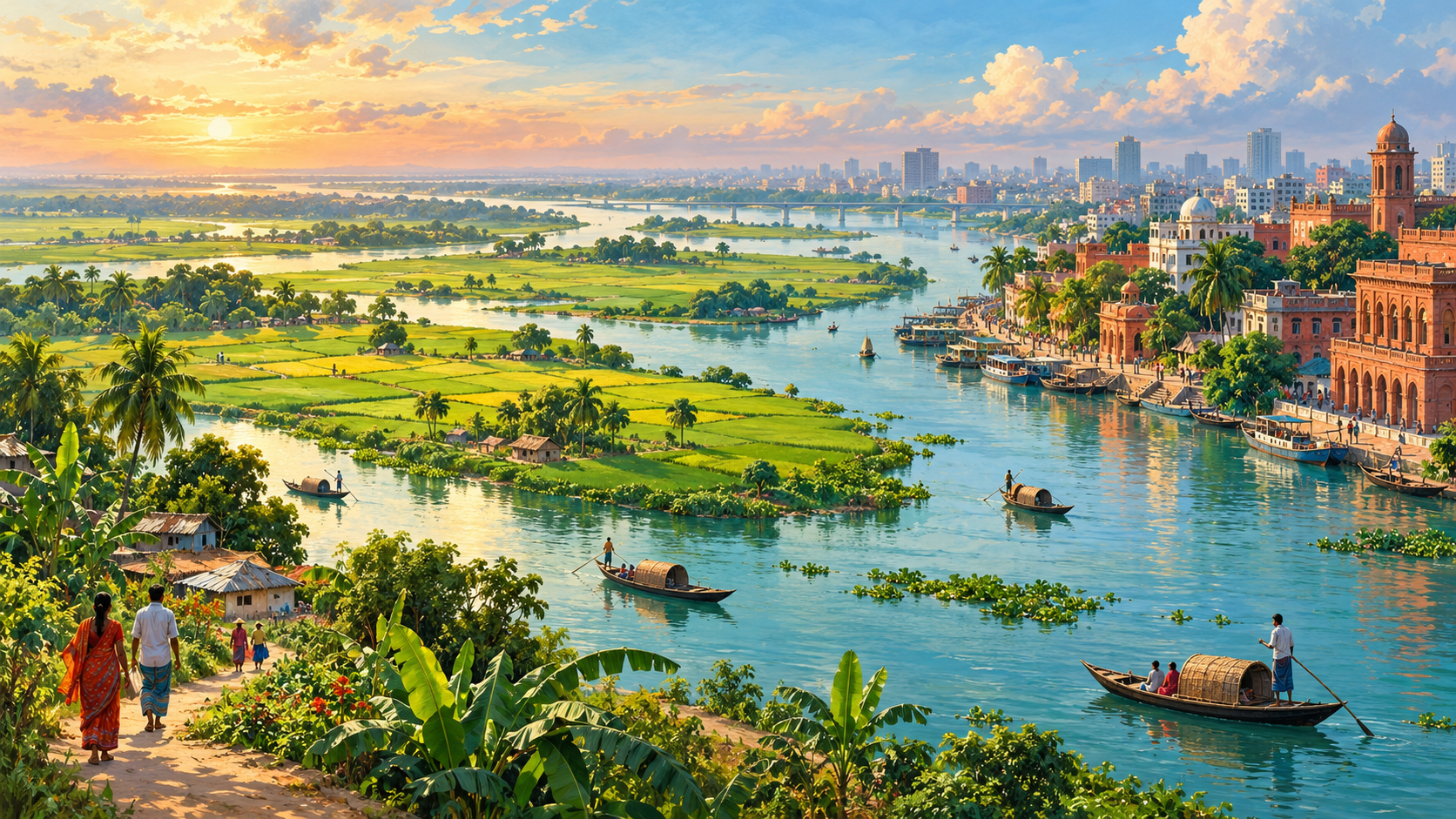
Bangladesh Children Vocabulary | Words for Character and Nation Building is a practical English-learning guide with twenty useful words, four connected chapters, original examples and safe exercises. Bangladesh helps young English learners ask four practical questions: Who made a beautiful textile? Who painted a city vehicle? What makes a tidal forest a habitat? And why does understanding a learner’s language matter? These questions build vocabulary for craftsmanship, evidence, nature and inclusive communication without treating the whole country as one cultural scene.
Designed for international learners about eight to twelve years old, parents and teachers. The guide is an independent English-reading resource, not a Bangladeshi school syllabus, a Bengali-language grammar course or a claim that every Bangladeshi family practises weaving or painting. Children’s projects are invented and should not replace professional craft training or protected-area guidance.
Verified country context: UNESCO recognises the traditional art of Jamdani weaving in Bangladesh (2013), rickshaws and rickshaw painting in Dhaka (2023) and the Bangladeshi Sundarbans World Heritage site (1997). UNESCO also records that the initiative for International Mother Language Day came from Bangladesh, was approved in 1999 and has been observed internationally since 2000. These source-backed examples join practical craft, urban creativity, mangrove ecology and meaningful language access.
What this guide means by character and nation building: Character and nation building in this lesson means giving makers credit, caring for other people’s work, understanding environmental protection, listening across languages and correcting misleading claims. The article does not ask children to promote a political movement or solve public policy problems assigned to adults.
Quick answer: what children will learn and practise
| Learning component | Visible skill | Common mistake avoided |
|---|---|---|
| 20 explained English words | Define, contrast and use the word correctly | Confusing an impressive term with a useful one |
| Four country-grounded reading chapters | Separate the source-backed fact from a fictional teaching scene | Treating every person in one country as identical |
| One invented story and six worked checks | Identify a mistaken claim and explain its repair | Pretending imagined pupils are real witnesses |
| A seven-day practice and retrieval plan | Notice, read, speak, write and transfer meaning | Memorising once without checking understanding |
Use the article path: 20 words · learning chapters · fictional story · worked checks · seven-day study plan · teacher guidance · FAQs · sources and reading.
20 children’s vocabulary words: clear meanings and original examples
Each word includes a distinction that prevents a misleading use. Sentences are original English-learning examples, not verified reports about named people. Culture-specific words are explained in the context of the communities and documented sources that give them meaning.
1. Jamdani: craft, skill and the meaning of attribution
| Word | Meaning and important distinction | Child-friendly model sentence |
|---|---|---|
| Jamdani | A patterned handwoven textile tradition associated with Bangladesh; not a machine print pasted onto fabric. | The pupil studied how Jamdani motifs are woven. |
| handloom | A loom operated by hand to weave fabric; not a machine that prints pictures. | The demonstration explained the role of a handloom. |
| weft | Threads passed across the lengthwise warp threads in weaving; not a finished garment. | The diagram showed the weft crossing the warp. |
| motif | A repeated visual element or idea in an artwork; not automatically a story with one universal meaning. | The writer described a floral motif but did not invent its history. |
| craftsmanship | Skilled, careful making built through practice; not only attractive colours. | The textile showed craftsmanship in its finely woven pattern. |
2. Rickshaw painting and the people behind street art
| Word | Meaning and important distinction | Child-friendly model sentence |
|---|---|---|
| rickshaw | A small passenger vehicle, often with three wheels; in Dhaka many are decorated with painted panels. | The painting exhibition explained the decorated rickshaw tradition. |
| mural | A painting or picture made on a large surface; different from an image simply printed on paper. | The class compared a city mural with a painted rickshaw panel. |
| artisan | A person who makes objects through skilled manual or creative work; not every shopkeeper. | An artisan showed how a decorative panel was prepared. |
| commission | An agreement to create work for another person, often for payment; not an invitation to copy freely. | The painter completed a commissioned design for a customer. |
| attribution | Acknowledging the maker and source of a work instead of taking credit for it. | Attribution helped the class name the artist correctly. |
3. Mangroves and evidence-based environmental stewardship
| Word | Meaning and important distinction | Child-friendly model sentence |
|---|---|---|
| delta | A land and water region formed through the accumulation of river sediments near a river mouth; not any marsh. | The rivers spread across a large delta near the Bay of Bengal. |
| mangrove | A salt-tolerant coastal tree or shrub adapted to tidal conditions; not every tropical plant. | The mangrove roots support organisms in muddy water. |
| tide | The regular rise and fall of sea level caused mainly by gravitational effects; not a storm surge. | The field diagram showed how the tide changed water levels. |
| habitat | An environment where an organism finds the conditions it needs; not simply one animal’s hiding place. | The Sundarbans provide habitat for many kinds of wildlife. |
| conservation | Informed protection and management of ecosystems and resources, rather than unlimited collecting. | Conservation rules can restrict damaging activities. |
4. Mother-language respect and genuine inclusion
| Word | Meaning and important distinction | Child-friendly model sentence |
|---|---|---|
| mother tongue | A language learned early in life or strongly connected with one’s home identity; not always the only language a child uses. | The learner explained a new idea first in her mother tongue. |
| linguistic diversity | The presence of different languages and language varieties in a community; not proof everyone knows them all. | Linguistic diversity calls for thoughtful communication. |
| comprehension | Understanding spoken or written meaning; not just being able to repeat sounds. | The teacher checked comprehension by asking for a summary. |
| inclusion | Arranging real participation for people with different needs; more than a welcome slogan. | Inclusion improved when the lesson offered a clear explanation. |
| solidarity | Supporting others appropriately while respecting their voice and choices; not speaking for them without consent. | Solidarity began by asking classmates which language support would help. |
Four learning chapters: knowledge, evidence and transfer
Use one chapter at a time. Read the source-based description, explain the five connected words, decide why the tempting opposite claim is inaccurate, then complete a safe activity in the learner’s own context.
1. Jamdani teaches that beauty comes from real makers and learned techniques
Five vocabulary words: Jamdani · handloom · weft · motif · craftsmanship.
UNESCO inscribed the traditional art of Jamdani weaving on its intangible-cultural-heritage list in 2013. It describes intricately patterned cotton cloth woven by skilled practitioners, particularly around Dhaka, with patterns formed directly at the loom. A handloom is a weaving structure used by a person to interlace threads. The crosswise threads are called the weft; the lengthwise threads are the warp. These technical words help a child see why a woven pattern is not identical to a printed image applied after a cloth has been made.
UNESCO explains that Jamdani often uses a discontinuous-weft method for its decorative patterns. This is a form of skilled work requiring patience and judgement. A child looking at a Jamdani sari might admire the repeated motif, but the photograph cannot reveal how many hours a particular maker spent or prove who designed every element. Craftsmanship is more than the visual result. It includes training, decisions about thread and structure, and cooperation among those who prepare and weave fabric.
The UNESCO account notes that learning is often passed among family members and apprentices, and that multiple specialist roles contribute to the textile’s production. This does not mean every child in Bangladesh is expected to become a weaver, or that family transmission should displace a child’s right to education and rest. The appropriate learning point is that knowledge has bearers and should be credited. A pupil can respect a family craft without being told to perform labour beyond their age or ability.
Try comparing two imaginary exhibition labels. The first says, ‘A colourful cloth appears in Bangladesh’. The second says, ‘Jamdani is a handwoven textile tradition in which skilled practitioners create patterns as they weave’. The second describes a process and credits human skill. A stronger version would name the individual craftsperson, workshop, date and source if the museum knew them. Inventing a maker’s name to sound precise would be worse than honestly writing ‘maker not identified’.
The word motif is also easily misused. It names a recurrent design element, such as a repeated shape, but does not guarantee a specific hidden meaning. Some traditional motifs have documented associations; other interpretations require the maker or a specialist. Children can learn to say ‘This photo shows repeated shapes’ without pretending to know an entire pattern’s symbolic history. That caution is respectful, not dismissive.
For a safe classroom activity, use strips of paper to illustrate how two directions can cross. Call it an invented model of interlacing, not authentic Jamdani technique. A learner can label the ‘warp’ direction and ‘weft’ direction in the paper pattern while acknowledging that real Jamdani weaving requires training, tools and knowledge beyond the exercise. This makes a difficult term concrete without appropriating a skilled community’s work.
Finally, have each pupil write a one-sentence explanation of the role of a weaver, a dyer or another contributor. Ask what part of the process their source supports. A small act of accurate attribution is a real character exercise. It prevents the work of particular people from vanishing behind an anonymous national stereotype.
Meaning repair: Misleading: ‘Jamdani patterns are just pictures printed onto cloth by a machine.’ Repair: ‘Traditional Jamdani is woven by hand, with motifs integrated into the fabric using skilled techniques.’
Safe transfer activity: Create a paper weaving model and write a caption separating what the model shows from what UNESCO documents about real Jamdani craftsmanship.
2. Dhaka rickshaw painting is mobile art supported by many contributors
Five vocabulary words: rickshaw · mural · artisan · commission · attribution.
UNESCO recognised rickshaws and rickshaw painting in Dhaka as intangible heritage in 2023. Its account describes richly decorated small passenger vehicles with painted flowers, birds, animals, imaginative images, historical figures and other subjects. Paintings on the panels may be seen by people as the vehicles move through city streets. This helps explain the art’s public character, but it does not make every decorated rickshaw a museum exhibit or every driver an artist. Drivers, vehicle makers, painters and customers can have distinct roles.
A rickshaw is a passenger vehicle. A mural usually belongs to a wall or other large surface, so the better label for a rickshaw is often ‘painted panel’ or ‘rickshaw painting’. A pupil can compare the effect of a wall painting with a moving painted vehicle, but should not insist that the two media are identical. Accurate vocabulary recognises differences in material, location and audience.
UNESCO explains that craft knowledge in rickshaw construction and painting may pass through workshops and family teaching. An artisan makes or decorates work using developed skill. A commission is an arrangement to create an artwork for a customer; it does not mean that the customer personally painted it. If a vehicle owner requests a colourful panel, that instruction is different from the painter’s execution and judgement. Recognising who did what makes a description clearer and fairer.
Attribution is especially important because an attractive image can circulate online without the painter’s name. Students should not claim to have designed or photographed someone else’s work. If a school uses an image from an authorised source, its label should credit the artist and photographer when known and explain the licence or permission. If they are unknown, say so instead of making them up. A picture on a public street does not automatically remove copyright or the need to respect a person’s privacy.
It is also inaccurate to say ‘every rickshaw in Dhaka has the same design’ or ‘every child there rides a decorated rickshaw’. UNESCO records a living practice with varied motifs and participants; it is not a census of every vehicle or household. A class needs to distinguish a heritage description from a broad demographic claim. The beauty of a well-known example cannot prove that all people have identical experiences of city transport.
For a school project, invite pupils to draw an original paper panel for an imaginary classroom vehicle. They should make their own patterns rather than trace an artist’s copyrighted design. On the back, ask each child to list the decisions they made: colour, composition, audience and the information that a viewer could understand. This gives learners a way to appreciate public art while respecting the skill and ownership of actual practitioners.
End with a short comparison. ‘A rickshaw is transportation’ is true but incomplete for this UNESCO element. ‘The decorated rickshaws of Dhaka are also vehicles for a distinctive urban folk-art practice’ better conveys the relationship between everyday work and art. A child’s character is strengthened when the description gives visibility to both creative work and the people who make a living using the vehicle.
Meaning repair: Misleading: ‘The person riding in a rickshaw automatically made the painting on it.’ Repair: ‘Vehicle users, owners, makers and painters may be different people whose contributions deserve clear attribution.’
Safe transfer activity: Draft two captions for a hypothetical rickshaw design: a factual description of the UNESCO tradition and a separate label explaining your own original classroom drawing.
3. The Sundarbans connect river deltas, tidal ecology and careful protection
Five vocabulary words: delta · mangrove · tide · habitat · conservation.
The Bangladesh Sundarbans is a UNESCO World Heritage site within the wider mangrove landscape of the Ganges, Brahmaputra and Meghna delta. In a delta, rivers carry sediment towards the sea, creating a changing geography of channels, mudflats and islands. A simple map may show a neat coastline, but the real land-water boundary can move over time. The word ‘delta’ helps children understand why a river mouth is often not a single fixed line. The UNESCO description discusses processes of water flow, deposition, erosion and tidal change.
A mangrove is a kind of salt-tolerant coastal vegetation adapted to tidal conditions. Mangrove roots, muddy water and changing salinity help create distinctive environments for fish, birds and other organisms. A tide is the regular rise and fall of sea level, principally related to gravitational effects. It is different from a cyclone-driven storm surge. These words need to be taught separately because the processes can interact but have different causes.
The Sundarbans provide habitat for many species. UNESCO’s description includes the Bengal tiger, birds, reptiles and aquatic life, but students should not assume that the presence of a species means it can be safely approached or seen on every visit. Some animals are dangerous and protected; children should not enter wild areas for a wildlife assignment or imitate risky filming. A diagram and official field report are more suitable learning materials than a demand to ‘find a tiger’.
Conservation includes informed management of habitats and protection from harmful activities such as illegal hunting or damaging extraction. It does not mean that a class may collect plants and animals as souvenirs. The site is a protected ecosystem and is also connected to communities and livelihoods. UNESCO describes the forest’s environmental role, including some protection from storms and the importance of the surrounding region for people’s lives. Acknowledging the forest’s benefits does not prove that it can stop every cyclone or that all nearby families are safe from flooding.
Imagine a fictional classroom teacher showing one photo of a tiger on a muddy riverbank. A pupil writes, ‘The Sundarbans are full of tigers at every point, so all visitors will see one’. The claim goes far beyond the photograph. A careful pupil says, ‘UNESCO lists Bengal tigers among the species associated with the protected forest; the photograph documents one animal in one location and time’. Good scientific language is not always the most exciting sentence, but it is more useful for understanding and safety.
A second exercise compares two drawn maps of the same fictional river mouth before and after sediment accumulates. Ask which areas might be covered at high tide and why that does not mean a permanent new island has formed. The diagrams are not predictions about today’s Sundarbans. They illustrate the meaning of delta and tide. Any claim about a real location’s changing boundary should rely on measured, dated information.
When learners read the site’s UNESCO description, they can write a short evidence chart: ‘Landform’, ‘Tidal process’, ‘Living things’, ‘Conservation reason’. That helps them build a connected explanation rather than a string of impressive words. A child’s contribution is the accurate account and responsible attitude, not the legal management of a vast and sometimes hazardous landscape.
Meaning repair: Misleading: ‘The Sundarbans are just a swamp where mangroves stop every storm.’ Repair: ‘They are a complex tidal mangrove ecosystem with important protective functions but not a guarantee against all hazards.’
Safe transfer activity: Label a fictional delta diagram with channels, tide levels, mangrove zones and one protected habitat. Explain which parts are models and which real-world claims need UNESCO evidence.
4. International Mother Language Day points towards learning through understanding
Five vocabulary words: mother tongue · linguistic diversity · comprehension · inclusion · solidarity.
UNESCO says the initiative for International Mother Language Day came from Bangladesh, was approved at the 1999 UNESCO General Conference and has been observed worldwide since 2000. The day falls on 21 February. It encourages respect for language and culture, especially the importance of preserving and supporting linguistic diversity. The recognition is international, not a statement that only one country has a mother tongue. It is a useful way to discuss why a child may know several languages and still need help with unfamiliar school vocabulary.
A mother tongue is often a language a child learned early or strongly associates with home and identity. Some children grow up with more than one, and not everybody feels that one simple label describes their linguistic life. Linguistic diversity means that different languages or language varieties are present across a community. Saying ‘Bangla is a major language in Bangladesh’ does not justify saying ‘everyone there speaks only Bangla’. A careful lesson makes room for other languages and individual backgrounds without requiring pupils to represent a whole group.
Comprehension means grasping the meaning of what is heard or read. Imagine a learner can pronounce every word of an English science instruction but cannot explain what action it asks for. Accurate pronunciation is useful, but comprehension has not yet been demonstrated. The teacher might explain an unfamiliar term in simpler English, invite a supported explanation in a familiar language or use a diagram. The aim is understanding, not embarrassing a learner who needs a bridge between words and meaning.
Inclusion requires real access. An English-language school sign may be beautifully printed but unhelpful to a newcomer who cannot yet interpret it. Providing a clear explanation or accessible translation can improve participation. That does not mean every class can instantly create perfect translations into all languages. Accuracy still matters: a faulty translation of a deadline or safety instruction may be worse than an honest request for help. Students can rehearse checking a translated message for preserved times, names and conditions.
Solidarity is supporting people while respecting their choices. A pupil might ask whether a classmate wants help understanding a new word and accept the answer. Speaking for someone without permission is different from standing with them. A confident English speaker could offer a simple definition, then give the other learner a chance to answer for themselves. This is stronger than declaring ‘I helped’ when the person affected had no say in what happened.
UNESCO notes that multilingual education supports participation and learning. The language of a classroom has practical consequences for who understands a question, who can explain their reasoning and whose knowledge remains visible. A teacher may set clear learning goals in English while allowing carefully structured scaffolds for comprehension. This is a pedagogical principle, not a claim that every Bangladeshi school follows the same language policy.
For a child-friendly assessment, ask students to write a two-sentence instruction about borrowing books, then explain it without reading the text aloud. The teacher checks that the meaning was preserved. Another pupil can suggest what additional visual or language support might help a new learner. End by asking what is different between saying ‘Everyone is welcome’ and providing an instruction that everyone can actually understand. That is the distinction between an intention and effective inclusion.
Meaning repair: Misleading: ‘Because Bangla is important in Bangladesh, no other languages or learning needs matter.’ Repair: ‘Respect for Bangla and the Bangladesh initiative for Mother Language Day can coexist with recognition of linguistic diversity.’
Safe transfer activity: Write an English library instruction with a date and time. Ask a partner to paraphrase it, then check whether every condition survived. Suggest one age-appropriate support for a newcomer.
Fictional story: watch how children correct mistakes
At a fictional Bangladesh school fair, Rafi writes that Jamdani is a printed pattern and corrects his caption after reading UNESCO’s handloom description. Ayesha studies rickshaw painting in Dhaka but initially calls the passenger the artist; her classmates remind her to credit the painters and vehicle makers appropriately. Mina draws a neat, fixed river mouth for the Sundarbans, then adds tidal channels and a note about changing landforms after checking the official World Heritage description. Finally, a new pupil can read the English sounds on a notice but does not understand the event time. The group checks comprehension, clarifies the instructions and records the correction. The pupils and fair are invented; the named cultural and geographical facts are sourced.
Four comprehension questions
- 1. What did Rafi need to correct about the Jamdani-making process?
- 2. Why is it important to identify the maker rather than only the owner or passenger of a rickshaw?
- 3. How did the concept of a delta change Mina’s map?
- 4. What evidence showed that a welcome notice was not yet fully inclusive?
Ask the learner to identify the exact action or piece of evidence that supports each answer. If their answer sounds like a slogan, ask for a specific example. The story is fictional; facts about real places and traditions should be checked against the linked institutional sources, never against the invented dialogue.
Six self-check questions with worked answers
Check 1: Is Jamdani traditionally made by simply printing patterns on cloth?
Worked answer: No. Its distinctive motifs are woven into fabric by hand using skilled techniques.
Explain your choice: Find the key fact in the question, name the word that best fits, and say which tempting alternative it excludes. Next, write an independent sentence about a different home or school situation. Correct reasoning matters more than reciting a word.
Check 2: Does a rickshaw passenger automatically count as its painter or maker?
Worked answer: No. The vehicle’s driver, painter and maker can be different people.
Explain your choice: Find the key fact in the question, name the word that best fits, and say which tempting alternative it excludes. Next, write an independent sentence about a different home or school situation. Correct reasoning matters more than reciting a word.
Check 3: Can one photograph of the Sundarbans tell us the whole number of species or the future flood risk?
Worked answer: No. Wider, dated ecological and environmental evidence is required.
Explain your choice: Find the key fact in the question, name the word that best fits, and say which tempting alternative it excludes. Next, write an independent sentence about a different home or school situation. Correct reasoning matters more than reciting a word.
Check 4: Are tides and storm surges identical processes?
Worked answer: No. Tides are regular sea-level variations; storm surges are weather-driven abnormal rises.
Explain your choice: Find the key fact in the question, name the word that best fits, and say which tempting alternative it excludes. Next, write an independent sentence about a different home or school situation. Correct reasoning matters more than reciting a word.
Check 5: What is the international observation date of Mother Language Day?
Worked answer: 21 February, an initiative of Bangladesh recognised by UNESCO in 1999.
Explain your choice: Find the key fact in the question, name the word that best fits, and say which tempting alternative it excludes. Next, write an independent sentence about a different home or school situation. Correct reasoning matters more than reciting a word.
Check 6: If a newcomer can pronounce an instruction but cannot explain it, what is missing?
Worked answer: Comprehension; an inclusive explanation should help the learner understand the meaning.
Explain your choice: Find the key fact in the question, name the word that best fits, and say which tempting alternative it excludes. Next, write an independent sentence about a different home or school situation. Correct reasoning matters more than reciting a word.
A seven-day plan for real vocabulary mastery
| Day | Study task | Proof of progress |
|---|---|---|
| Day 1 — Notice | Read five words aloud and explain how each differs from a nearby mistaken meaning. | One clear definition and one non-example |
| Day 2 — Say | Practise the second group of five words in two familiar school or family scenarios. | Understandable original sentences |
| Day 3 — Read | With an adult, read an age-appropriate paragraph from one linked source. | A supported fact and a question still open |
| Day 4 — Compare | Study the third word group. Sort statements into observed, sourced or fictional. | No made-up statement treated as history |
| Day 5 — Decide | Study the final five words in a supervised imaginary group problem. | A safe specific responsibility and reason |
| Day 6 — Write | Produce an 80–120-word paragraph with at least three selected words. | Accurate contextual use and clear explanation |
| Day 7 — Transfer | Explain a different neighbourhood or country’s example without importing unsupported details. | Independent application and source checking |
What counts as learning?
A learner should be able to define a word without copying the printed sentence, reject an attractive but false example and apply it correctly in a new context. Parents can record progress as ‘not yet’, ‘with support’ and ‘independently’. Revisit the words after several days and ask the child to explain a different example, rather than repeating the original sentence.
For written work, check subject and verb clarity, word choice, evidence, distinction between reported facts and imaginary examples, and a realistic child-scale action. A short accurate paragraph is better than a long one filled with grand claims. Make revising a mistaken statement part of the normal learning process.
Parents and teachers: teach character as observable action
- Lead with evidence. A named UNESCO description can establish a real fact; a classroom story can illustrate vocabulary but cannot provide new historical facts.
- A country is not one person. People differ in family histories, beliefs, languages, occupations, opportunities and opinions. Avoid claiming everyone thinks alike.
- Give makers and communities credit. Heritage is sustained by people and knowledge, not only attractive objects or photographs.
- Do not make children responsible for adult problems. Dangerous diving, excavation, protected-area management and official policy belong to trained adults and institutions.
- Preserve dignity in history and geography. Avoid romanticising dangerous labour, erasing inequality or treating a living community as a picture-book character.
- Check the meaning of an invitation. ‘Everybody is welcome’ is an intention; real inclusion requires people to be able to understand and participate.
- Reward justified revision. Correcting an oversimplified caption is a real demonstration of responsibility and respect.
- Keep the activities safe and portable. Children can practise with paper models, maps, classroom conversations and supervised research wherever they live.
Frequently asked questions
Is Jamdani simply an attractive sari print?
No. UNESCO recognises the traditional handwoven Jamdani craft, including its loom techniques and practitioners.
Why is Dhaka rickshaw painting cultural heritage?
UNESCO recognises its distinctive urban painted panels and the craftsmen, painters and intergenerational knowledge that sustain the tradition.
Are the Sundarbans found only in Bangladesh?
The wider Sundarbans landscape extends across Bangladesh and India. The Bangladesh World Heritage site is distinct from India’s separately inscribed Sundarbans National Park.
Did Bangladesh begin International Mother Language Day?
UNESCO states that Bangladesh initiated the proposal, approved in 1999; the international day has been observed since 2000 on 21 February.
Official sources, further reading and country links
Country facts have been checked against the linked institutional descriptions as at 23 October 2026. The English-learning definitions and original school stories are teaching material, not an official curriculum. Always consult the relevant authority for up-to-date rules, safety and site access.
- UNESCO Intangible Heritage | Traditional Art of Jamdani Weaving
- UNESCO Intangible Heritage | Rickshaws and Rickshaw Painting in Dhaka
- UNESCO World Heritage | The Sundarbans (Bangladesh)
- UNESCO | International Mother Language Day
- UNESCO Intangible Heritage | Traditional Saree Weaving Art of Tangail (2025)
- UNICEF | Convention on the Rights of the Child
Read more about this country
- Everything About Bangladesh
- How Bangladesh Works
- Schools of Bangladesh
- Top 100 Jamdani Weaving Vocabulary Words | Bangladesh
- Top 100 Rickshaw Painting Vocabulary Words | Bangladesh
- Top 100 Shital Pati Weaving Vocabulary Words | Bangladesh
Follow the A–K children vocabulary sequence
Afghanistan Children Vocabulary · Albania Children Vocabulary · Algeria Children Vocabulary · Andorra Children Vocabulary · Angola Children Vocabulary · Antigua and Barbuda Children Vocabulary · Argentina Children Vocabulary · Armenia Children Vocabulary · Australia Children Vocabulary · Austria Children Vocabulary · Azerbaijan Children Vocabulary · Bahamas Children Vocabulary · Bahrain Children Vocabulary · Bangladesh (this article) · Barbados Children Vocabulary · Belarus Children Vocabulary
Explore the eduKateSG vocabulary ecosystem
- Vocabulary Learning Hub | Primary to Junior College
- Vocabulary by Age and Purpose
- How Countries Work | Global Index
- Top 20 Unique Country Vocabulary | Global Index
For a child learning about Bangladesh, the goal is not to memorise national praise. It is to use twenty English words accurately, notice how real people contribute, check a source, respect differences and complete an age-appropriate action that can be explained. Character grows when words are used responsibly.