
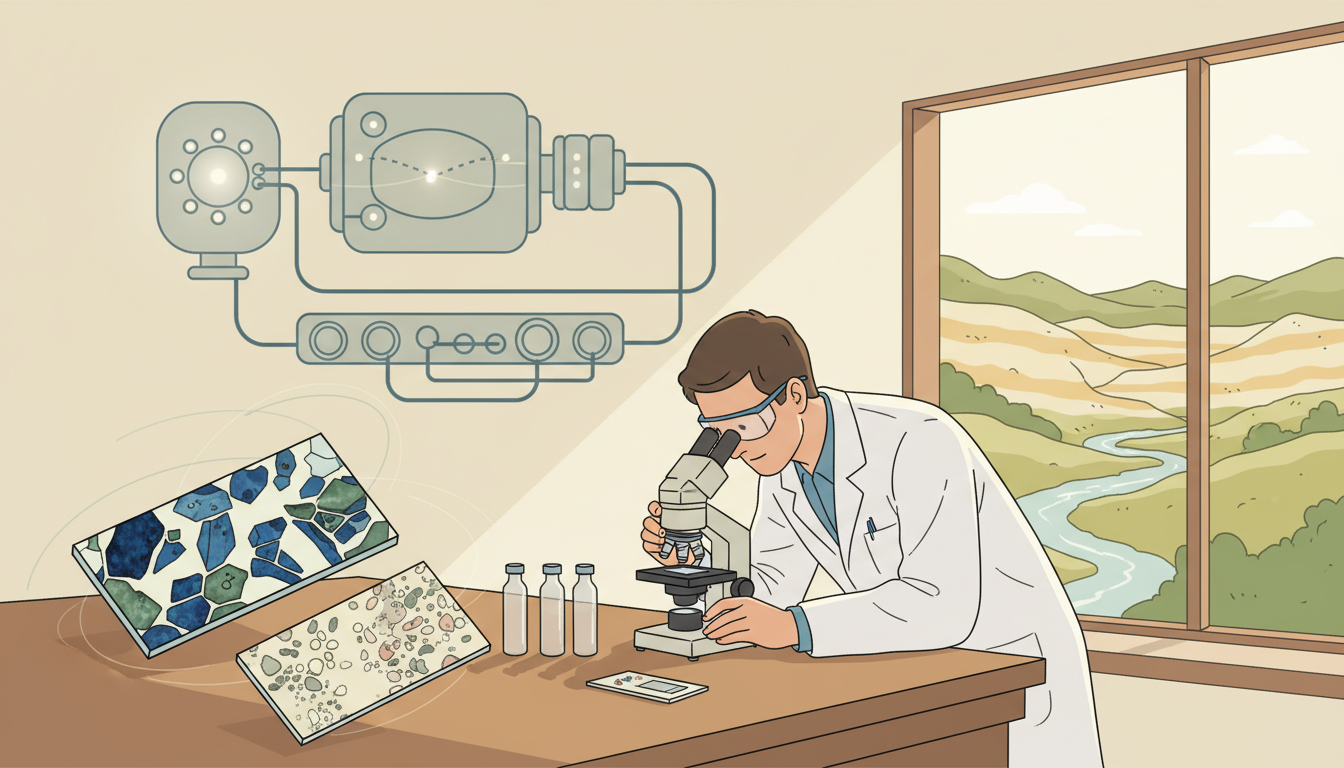
A student once asked me why a metal could be called “rare earth” when geologists say some rare-earth elements are not especially scarce in Earth’s crust. It is the sort of question I love, because an ordinary label can conceal several different problems: elemental abundance, ore concentration, separation Chemistry, industrial capacity and global supply.
This Chemistry Hougang guide explains rare earth elements, neodymium magnets, rare-earth mining, chemical separation, recycling and the worldwide materials supply chain. It is written for Secondary Science and JC Chemistry students, parents looking for a Chemistry tutor in Hougang, and university-minded learners who want to connect the periodic table to electric motors, digital devices, wind turbines and environmental decisions.
I want students to understand that owning a deposit of minerals is not the same as having a factory able to produce a reliable magnet. It takes Chemistry, measurement, metallurgy, engineering and professional skill to move from a mineral in rock to a component that performs a precise function. That is the educational story worth learning.
First, what are rare earth elements?
The rare earth elements are commonly described as a set of 17 elements: the 15 lanthanides, together with scandium and yttrium. They are grouped partly because of related chemical and economic properties, although the details differ among individual elements.
The US Geological Survey’s Rare Earths Statistics and Information identifies the group and describes principal economic sources, including minerals such as bastnäsite and monazite, and certain ion-adsorption clay deposits.
A common misconception is that “rare earth” means each element occurs only in exceptionally tiny amounts everywhere. Some members are reasonably abundant in the crust, but economically recoverable deposits and facilities for separation and refining are a different matter.
For a school learner, the first step is memorably simple: the name of a mineral group is not the same as a statement about the price, purity or accessibility of every member.
At university, the story becomes geochemical distributions, ionic radii, complex formation, solvent systems, phase behaviour and process economics.
Why are these elements grouped together chemically?
Many rare-earth elements commonly form +3 oxidation-state cations, such as Nd³⁺, Pr³⁺ and La³⁺, in appropriate compounds. Their related outer-electron and ionic behaviour helps explain why separating them can be challenging.
The similarities are substantial but not absolute. Certain rare-earth elements can display other oxidation states that matter in particular compounds and processes. Cerium, for example, commonly occurs in +3 and +4 states under different conditions, and europium can form +2 compounds.
I do not want students to memorise “every rare earth is always +3”. It is a useful introductory pattern, not a complete law.
Their electron arrangements, particularly involving f orbitals for the lanthanide series, help explain their behaviour and selected optical or magnetic properties. Yet a complete solid-state magnetic explanation requires more than the periodic-table position alone.
Our Periodic Table Explained article introduces why groups and electronic structure predict some patterns while leaving important material-specific questions open.
Rare-earth elements are not all equally used in magnets
A few rare-earth elements play especially important roles in certain powerful permanent magnets, including neodymium (Nd), praseodymium (Pr), dysprosium (Dy) and terbium (Tb).
The International Energy Agency’s Global Critical Minerals Outlook 2026 focuses on those magnet-related elements when analysing rare-earth supply risks in relevant applications.
That does not mean every rare-earth element is primarily used for magnets. Others have significant uses in catalysts, phosphors, optical materials, ceramics and other technologies.
Nor does it mean that every electric motor or wind turbine must use a rare-earth permanent magnet. Device designs differ. Some machines use different motor or generator architectures and different materials.
This distinction matters because popular articles often move from “some electric vehicles use rare-earth magnets” to “every electric vehicle battery is made of rare earths”. That is scientifically inaccurate.
Neodymium magnets are not lumps of pure neodymium
A familiar powerful permanent-magnet family is based on neodymium–iron–boron (Nd–Fe–B) materials. Their performance arises from the composition, crystal structure, microstructure, processing and magnetic properties of a specially engineered alloy system.
The magnet is not simply a chunk of neodymium. Iron is an important constituent, boron helps establish the relevant phase, and manufacturing or alloying modifications can change properties.
A student who knows the element symbols Nd, Fe and B has learned the vocabulary. A student who understands that composition and atomic arrangement jointly affect performance has begun learning materials science.
The same principle holds for silicon microchips, glass, stainless steel and lithium-ion battery electrodes. Identifying the constituent elements is necessary, but not sufficient, to predict a manufactured product’s performance.
That is why Chemistry and Engineering belong in the same conversation.
What makes a material a permanent magnet?
A permanent magnet retains magnetisation under appropriate conditions after an external magnetising field is removed. Materials used in such magnets involve magnetic order and resistance to demagnetisation.
However, “permanent” does not mean literally indestructible or unaffected by environment. Temperature, corrosion, physical damage and magnetic fields can influence real magnet performance. Different alloys and treatments alter the relevant limits.
For a Secondary learner, the takeaway is that magnetic behaviour belongs to the properties of particular substances and materials, not to all things called metals.
For a JC or university learner, the extension can involve electron structure, spin, magnetic anisotropy, exchange interactions and microstructure. Those are deeper physical ideas that need not be pretended to be fully explained by a simple valence diagram.
I would not encourage children to disassemble powerful magnets or experiment with magnets near electronics or medical devices. Strong magnets can cause injury or damage and require appropriate handling. The Chemistry can be taught through diagrams and trusted research sources.
Why mining a mineral is not the same as refining a rare earth
A mineral deposit may contain a mixture of many substances. The desired rare earths may be present as part of a mineral structure, alongside other elements and unwanted material.
Producing a usable product can require stages such as extraction, mineral concentration, chemical processing, separation, purification and conversion into specified compounds or metals. These stages are highly dependent on the ore and the intended product.
The rare-earth elements’ chemical similarities complicate separation. In some industrial processes, differing interactions with ligands or extractants can be used to separate related ions, but real facilities depend on specialised equipment, process design and rigorous environmental controls.
This is not an appropriate home or school experiment. Industrial separation can involve hazardous chemicals and waste streams and must be managed by trained personnel in suitable facilities.
What I teach instead is the separation problem: two substances may look chemically similar, yet a carefully chosen difference in chemical behaviour can make a separation possible.
That principle also appears in chromatography, analytical Chemistry and pharmaceutical purification.
A simple analogy for why separation takes work
Imagine a bag containing many small beads that all look similar. Some are fractionally different in size, but there is no simple hand-sorting process that can separate millions of them to high purity.
The analogy helps us recognise the challenge but cannot replace real rare-earth separation Chemistry. Ionic radius, oxidation state, complexation and solvent interactions are more important than literal bead diameter alone.
In a real process, each separation step has limited selectivity, may require energy or reagents, and may not recover 100% of every target substance. Achieving high purity can involve multiple stages and careful control.
This is why the existence of ore is not the entire explanation of industrial supply. A country might be able to mine material but still lack the infrastructure to turn it into separated oxides, metals, alloys or finished magnets.
The IEA’s 2026 Outlook discusses uneven development across mining, separation, refining and magnet manufacture.
Worked example: charge balance in neodymium oxide
Neodymium commonly forms Nd³⁺ in relevant compounds. Oxide ions carry charge O²⁻. To form a neutral oxide formula, we need total positive and negative charge to cancel.
Two Nd³⁺ ions contribute +6. Three O²⁻ ions contribute −6. Therefore, a common oxide formula is:
Nd₂O₃.
This is a formula-unit charge-balance exercise, not a claim that every neodymium-containing mineral or industrial material has this composition.
A student who tries to write NdO because it combines one metal with one oxygen has not accounted for ionic charge. The repair is to identify ions and balance total charge before choosing subscripts.
That skill is central to upper-secondary Chemistry and remains valuable in university materials work, even when actual crystalline compounds require more detailed descriptions.
Worked example: how much neodymium is in pure Nd₂O₃?
Using approximate atomic masses Nd = 144 and O = 16, calculate the formula mass:
Mr(Nd₂O₃) = 2(144) + 3(16) = 336.
The neodymium portion contributes 288 of those units. So the approximate mass fraction of neodymium in pure Nd₂O₃ is:
288/336 × 100% ≈ 85.7%.
Imagine a purely theoretical amount of 35.0 kg of pure Nd₂O₃. Its elemental neodymium content is approximately:
35.0 × 288/336 = 30.0 kg neodymium by mass.
The result is a statement of elemental composition. It does not guarantee that a real factory could recover 30.0 kg of usable neodymium metal from such a sample. Actual recovery depends on purity, process yield, losses and the product specification.
This is a central lesson across Chemistry: the amount of an element contained in a compound is different from the amount of useful material that a manufacturing process can obtain.
Rare-earth oxide, rare-earth element and magnet are three different units
This distinction becomes particularly important when reading industry statistics. A deposit may be reported in rare-earth oxide equivalent terms, a separation plant in tonnes of separated oxides, and a magnet factory in tonnes of finished magnetic material.
Those measures cannot be compared naively. A finished magnet can contain substantial non-rare-earth material, while different rare-earth oxides contain different fractions of their corresponding elements by mass.
The IEA’s 2026 rare-earth analysis often specifies whether a figure refers to rare-earth element content. That clarification changes how a number should be read.
I ask students to write a three-column table: input material, desired substance, and measurement unit. If the table is incomplete, they should not report a recovery rate as if it were proved.
This is the kind of basic mathematical and scientific discipline that matters more than copying a striking supply statistic.
A second worked example: mass recovery needs a precise denominator
Suppose a fictional recovery process begins with 100 kg of separated rare-earth oxide material containing 20 kg of a particular element, determined by a suitable assay.
After processing, a measured final product contains 15 kg of that element. The element-specific recovery is:
15/20 × 100% = 75%.
The denominator is 20 kg of the target element in the input, not 100 kg of overall feed material.
The output could contain other substances as well, so the final product’s total mass might be greater than 15 kg. A report using total product mass in place of target-element mass would give the wrong recovery claim.
This one exercise is valuable for Secondary percentage calculations, JC purity and yield work, and university chemical-process accounting.
Why a rare earth may be abundant but strategically difficult to obtain
A mineral’s abundance in Earth’s crust is only one part of its availability. Economically useful deposits, ore quality, energy, water, permitted mining, refining capability, infrastructure and downstream manufacturing all influence supply.
The USGS describes several rare-earth sources and the elements’ differing abundances. The IEA’s July 2026 report examines global refining concentration and vulnerabilities throughout the supply chain.
In particular, the IEA notes that expanding mines outside a dominant supplier does not automatically establish equivalent refining or magnet-making capacity. A new deposit is not the same as an operating facility that produces a specified, reliable finished component.
A student who understands this has learned a sophisticated distinction between natural resources and industrial capability.
Chemistry can make separation technically possible. Commercial deployment also needs investment, engineering, trained workers, rules and responsible social relationships with affected communities.
Rare earths and lithium-ion batteries: correct a common misconception
Lithium is a chemical element with atomic number 3. It is not one of the 17 rare-earth elements. Cobalt, nickel, copper and graphite are also not members of that rare-earth group.
Some electric vehicles use lithium-ion batteries and separate electric motors, and some motor designs use rare-earth permanent magnets. Confusing the two components leads to misleading statements about materials demand.
Our Lithium-Ion Batteries guide explains electrochemical storage. The battery’s chemistry, the vehicle’s motors, the electronics and the charging system each have different materials requirements.
A scientifically responsible comparison identifies which component uses which material. It should not claim all clean-energy technologies depend on exactly the same mineral mixture.
This distinction also matters in national supply-chain policy and the interpretation of critical-mineral reports.
How rare earths contribute to modern technologies
Certain rare earths are used for high-performance permanent magnets, which can be important in some electric motors and wind-turbine generators. Others contribute to optical, luminescent, catalytic and specialised material applications.
Different devices place different demands on weight, temperature, magnetic strength, durability and cost. Material selection is therefore an engineering decision as well as a chemical one.
The IEA’s report on Rare Earth Elements examines the upstream-to-downstream supply chain, and the USGS overview provides the wider mineral context.
I would not teach that every smartphone contains an identical set of rare earths. Designs change, and one specific device’s composition requires relevant technical data or measurement.
The transferable scientific skill is identifying the function of the material, rather than assuming that a familiar product’s name reveals its contents.
What does rare-earth recycling actually involve?
Products containing rare-earth materials may eventually become end-of-life equipment or manufacturing scrap. In principle, recovering useful elements from selected streams can reduce dependence on primary extraction and help recover value.
But the collection and processing challenge is substantial. The sought material may be a small component embedded within a larger object, mixed with other materials or bonded in a difficult-to-separate assembly.
Recycling requires suitable collection, identification, safe preparation, materials separation, chemical processing and quality control. Some recovery processes may be energy- or reagent-intensive; the appropriate environmental comparison depends on real operating data.
The IEA Global Critical Minerals Outlook 2026 describes the opportunity for rare-earth magnet recycling while emphasising infrastructure, processing and market constraints.
A headline stating that a magnet was “recycled” should be examined carefully. Did the entire magnet get reused? Were its rare-earth elements recovered? Was an alloy restored to suitable quality? Each is a different outcome.
Recycling numbers can conceal the difficult part
Suppose a fictional sorting facility collects 1,000 kg of mixed electronic scrap, identifies 50 kg of components containing rare-earth magnets, and sends those components to a specialised recycler.
The sorting yield into the magnet-component stream is 50/1,000 × 100% = 5%. But that is not the rare-earth recovery rate. It is the mass fraction of components selected from the original scrap.
If the magnets contain several elements and other materials, we must measure the target-element content before calculating metal-specific recovery. Collection and sorting success do not guarantee high-purity output.
This arithmetic helps students distinguish product collection, component separation, element content and final material recovery.
The same conceptual error appears in plastics, batteries and solar-panel recycling. One percentage cannot describe the whole industrial chain without a precise denominator.
Environmental responsibility begins before a magnet is manufactured
Mining and processing can affect land, water, energy demand, waste management and local communities. The impacts vary by deposit, technology, regulation and actual operating practice.
Some rare-earth ore bodies occur alongside naturally occurring radioactive materials. Where relevant, mining and processing must account for those constituents under appropriate specialist controls. This does not mean every rare-earth product is dangerously radioactive or that every deposit has identical conditions.
A responsible scientific article avoids both extremes: portraying every rare-earth mine as environmentally harmless, or claiming that the material itself can never be produced responsibly.
The correct approach is evidence-based assessment of the particular facility, its controls, emissions, waste handling, worker protection and long-term obligations.
This is where Chemistry intersects with environmental science, geology, governance and ethical decision-making. Knowledge of a profitable separation reaction is not a substitute for responsible practice.
Supply concentration is a materials and civilisation question
Rare earths are an example of how small amounts of specialised materials can support large manufacturing systems. A disruption affecting one processing stage can have consequences far beyond the mine that supplied the material.
The IEA’s 2026 Critical Minerals Outlook, published 16 July 2026, describes concerns about highly concentrated refining and downstream supply chains. It also reports that alternative projects are developing, while some critical stages remain constrained.
These are dated assessments of the industry and project pipeline, not a prediction that every announced project will operate on schedule or that every policy choice has a predetermined outcome.
Different countries may emphasise supply diversification, recycling, investment and cooperation in different combinations. Scientific evaluation should consider costs, environmental responsibility and the outcomes actually achieved rather than treating one geopolitical slogan as sufficient evidence.
Students learn something important here: a useful chemical substance can connect communities and industries across borders, and the decisions surrounding it involve more than the periodic table.
Five mistakes I would correct in class
- “Rare earths are all almost absent from Earth’s crust.” Some are relatively abundant; economic concentration and separation pose different problems.
- “Lithium is a rare-earth element.” It is not part of the defined 17-element group.
- “A neodymium magnet is pure neodymium.” Common Nd–Fe–B magnets are engineered materials involving several elements.
- “A country with a rare-earth mine can automatically manufacture magnets.” Refining, metals, alloys, equipment and manufacturing skills are additional stages.
- “Collected electronic waste equals recycled rare earths.” Actual element-specific recovery must be measured.
A student who can explain why each statement is incomplete has learned more than a collection of fashionable technology terms.
How this topic grows through a student’s education
Lower Secondary: know what an element is
Learn to distinguish an element, an ion, a mineral, an alloy and a finished product. Notice that an element’s name does not automatically explain a device’s performance.
Upper Secondary: charges and composition
Use common ion charges, balanced formulas and mass fractions. Calculate the composition of Nd₂O₃ as a school-level example while recognising it is not a complete industrial recovery model.
JC H1/H2: atomic structure and process reasoning
Link electron configurations, periodic trends, equilibria, chemical bonding, experimental design and the meaning of measurements at the applicable level. Advanced f-orbital details are not needed before the foundations are secure.
Polytechnic, university and professional practice
Further study can involve inorganic Chemistry, coordination compounds, separation science, geochemistry, materials synthesis, magnetism, analytical testing, process engineering and environmental assessment.
The professional practitioner must be able to explain not only what a material is, but how its composition, production and life cycle support or limit its intended use.
A four-week research project without magnets or chemicals
Strong magnets and industrial chemical processes are not needed for the learning work below. Use trusted diagrams, the periodic table, reports and calculations.
Week 1 — Identify: mark the 15 lanthanides, scandium and yttrium on a periodic table. Explain why lithium and cobalt are not rare-earth elements.
Week 2 — Calculate: derive Nd₂O₃ from ion charges and calculate the mass fraction of neodymium. Check units and state assumptions.
Week 3 — Trace a supply chain: draw mining → concentration → separation → refining → alloy/magnet production → end use → collection/recycling. Label one different specialist activity at each stage.
Week 4 — Read evidence: use the 2026 IEA report to explain why announced mining capacity cannot be compared directly with operating magnet output. Name one uncertainty in projections.
A student who completes this should be able to describe the issue without appealing to “rare” as the whole explanation.
Self-test questions and answers
How many elements are in the common rare-earth group?
17: the 15 lanthanides plus scandium and yttrium.
Is neodymium oxide electrically neutral if written as Nd₂O₃?
Yes. In the simplified ionic description, 2 × +3 and 3 × −2 sum to zero.
If pure Nd₂O₃ contains approximately 85.7% Nd by mass, does that guarantee a refinery recovers 85.7% of its feed as Nd metal?
No. That is composition, not actual process recovery or product purity.
Is lithium a rare earth?
No. It is an alkali metal, not a lanthanide, scandium or yttrium.
Does every electric-vehicle motor use rare-earth permanent magnets?
No. Designs differ, and a claim about a particular vehicle requires relevant technical information.
Does a mine opening prove domestic magnet manufacturing capacity exists?
No. Separation, refining, alloys, magnet production, equipment and industrial competence are separate stages.
Questions from parents and students
Is this topic useful for Secondary Chemistry examinations?
It can make periodic trends, formulas, charge and composition more meaningful. Exact syllabus requirements differ; the wider industry discussion should support rather than displace core Chemistry.
Must my child memorise all rare-earth atomic numbers?
Follow the current syllabus and build an understanding of the group before attempting advanced details. Conceptual accuracy is more useful than memorising unrelated facts.
Can the subject lead to careers?
Yes. Analytical, inorganic and materials Chemistry, geoscience, industrial engineering, magnet research, environmental monitoring and process science are relevant fields.
How do I recognise a good tutor’s explanation?
The student should be able to distinguish the element, mineral, oxide, alloy and finished magnet, then calculate a well-defined composition without confusing it with industrial yield.
Sources and further reading
- USGS — Rare Earths Statistics and Information
- IEA — Global Critical Minerals Outlook 2026
- IEA — Critical Minerals Outlook 2026 Executive Summary
- IEA — Rare Earth Elements: Supply Chain Overview
Continue the Chemistry Hougang library
- Periodic Table Explained: Elements, Stardust and Modern Technology
- Solar Cells: Silicon, Photons and Photovoltaic Electricity
- Semiconductor Chemistry: Silicon, Doping and Microchips
- Lithium-Ion Batteries: Redox, Charging and Recycling
- Green Chemistry and Sustainable Materials
- Chemical Analysis and Reliable Evidence
- Soap and Detergents: Micelles and Surfactants
- Sunscreen Chemistry: UV Filters and SPF
If a student can explain the difference between an oxide’s elemental content and a recovered metal yield, they are becoming a more careful scientist. Families exploring a pathway through Secondary and JC Chemistry can arrange a consultation with eduKate Singapore.