
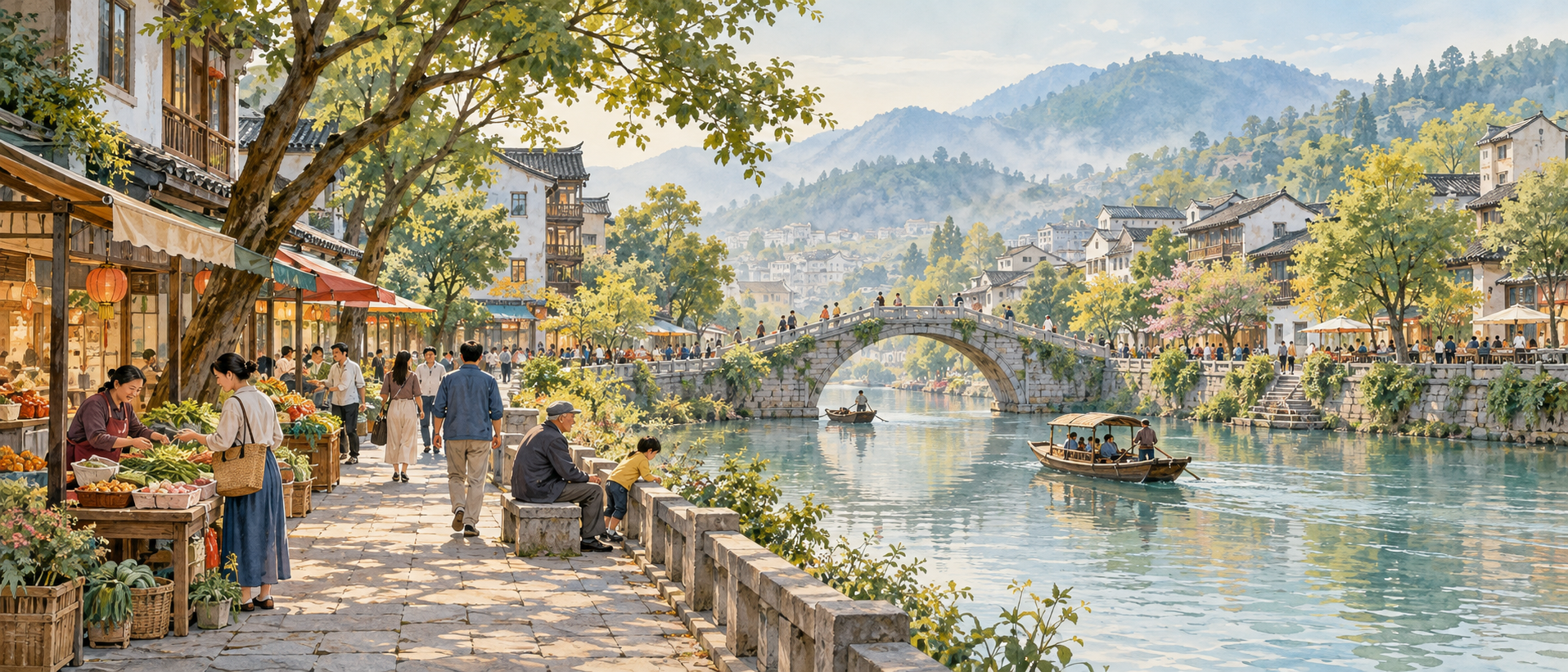
China Children Vocabulary | Words for Character and Nation Building. This original English guide links twenty carefully defined words with four substantial chapters, a fictional learning story, worked checks and a seven-day practice plan. Can a waterway teach responsibility, a brushstroke teach patience, a seasonal calendar teach careful observation, and a panda sanctuary teach ecological stewardship? China offers four ways for young English learners to move from an impressive word to a clear fact and a practical action.
For international children around eight to twelve years old and the adults helping them. This independent English-learning guide is not an official Chinese curriculum, a translation course, a political statement or permission to enter protected reserves. These examples relate to particular sites and traditions; they do not imply every person in China uses the same language, farming practice or artistic form.
Country facts checked against institutional references: UNESCO inscribed the Grand Canal on the World Heritage List in 2014, Chinese calligraphy as intangible heritage in 2009, the Twenty-Four Solar Terms in 2016, and Sichuan Giant Panda Sanctuaries as World Heritage in 2006. Those designations refer to historic infrastructure, skilled writing, seasonal knowledge and biodiversity conservation respectively, and do not establish that every modern community experiences the same conditions.
Educational purpose of character and nation building: In this guide, character and nation building means accurate communication, respect for skilled people, care for shared water and habitats, observation supported by evidence, and honest correction of mistakes. It is not compulsory political loyalty or a request for children to perform professional engineering, astronomy or wildlife work.
Quick answer: what children learn and how they use it
| Resource | Visible learning outcome | Misconception to prevent |
|---|---|---|
| 20 explained English words | Define the word, correct a near-miss and make an original sentence | A difficult spelling is the same as understanding |
| Four grounded country chapters | Distinguish source facts, limits and practical actions | One community’s practice represents an entire population |
| Fictional story and six worked checks | Show why an inaccurate caption needs repair | An imagined example is a real historical record |
| Seven-day revision programme | Read, speak, compare, check, write and transfer vocabulary | Children are responsible for adult science, heritage or public-policy decisions |
Find the twenty-word bank · four reading chapters · story · worked checks · study plan · teacher notes · frequently asked questions · references and related guides.
20 children’s vocabulary words: meanings, distinctions and examples
The definitions identify a useful meaning and something the word does not mean. The final column contains invented English learning sentences rather than descriptions of actual named children.
1. The Grand Canal: linked waterways and the responsibility of maintenance
| Word | Meaning and important distinction | Original child-friendly sentence |
|---|---|---|
| Grand Canal | A vast historic canal network running across parts of China; not a single straight modern river. | The project map labelled the Grand Canal. |
| waterway | A route of navigable or flowing water, natural or artificial depending on the context; not automatically a road for cars. | Goods can travel along a managed waterway. |
| hydraulic engineering | Designing and managing structures that handle water movement, storage or pressure; not only drawing a canal. | Hydraulic engineering helped connect different river basins. |
| grain transport | Moving harvested cereal products from one place to another; not the same as growing them. | The canal historically served grain transport. |
| maintenance | Regular work keeping an existing system functional; not the same as building it once. | A historic canal may require continuing maintenance. |
2. Chinese calligraphy: written characters, skilled hands and attribution
| Word | Meaning and important distinction | Original child-friendly sentence |
|---|---|---|
| calligraphy | Skilled artistic writing using deliberate letter or character forms; not every quick handwritten note. | The artist practised Chinese calligraphy. |
| character | A written symbol used in a writing system; not automatically one complete spoken word. | The learner studied a single Chinese character. |
| brushstroke | A movement or mark made with a brush; not an identical shape in every script style. | The teacher compared brushstroke directions. |
| script | A system or style of written signs; not a person’s entire language or identity. | The exhibit named different calligraphic script styles. |
| attribution | Crediting the person or source responsible for an image or idea; not claiming another artist’s work. | The caption included attribution for the calligrapher. |
3. Twenty-Four Solar Terms: seasonal evidence and meaningful observation
| Word | Meaning and important distinction | Original child-friendly sentence |
|---|---|---|
| solar term | One of twenty-four divisions of the traditional Chinese seasonal cycle related to the Sun’s annual movement; not a daily weather forecast. | The class learned that a solar term marks part of the yearly cycle. |
| solstice | One of the yearly points associated with the Sun’s maximum or minimum apparent position north or south; not every hot day. | A solstice relates to Earth’s yearly orbital geometry. |
| equinox | A time when the Sun crosses the celestial equator; not a guarantee of identical local weather everywhere. | The calendar noted a spring equinox. |
| seasonal | Recurring in connection with phases of the year; not an event that must occur on one identical weather day worldwide. | Seasonal practices vary across climates. |
| observation | Noticing and recording evidence with context, rather than assuming or inventing a result. | The pupil recorded the date of an observation. |
4. Sichuan panda habitats: biodiversity beyond a famous animal
| Word | Meaning and important distinction | Original child-friendly sentence |
|---|---|---|
| Sichuan Giant Panda Sanctuaries | A UNESCO World Heritage complex in Sichuan protecting important panda habitat and other biodiversity; not simply a zoo. | The map located the Sichuan Giant Panda Sanctuaries. |
| bamboo | A group of grasses with woody stems, an important food resource for giant pandas; not every forest plant. | Bamboo supports feeding needs in panda habitat. |
| habitat | The environment and conditions supporting a species’ life; not an animal enclosure by definition. | Pandas depend on suitable forest habitat. |
| biodiversity | The variety of living organisms and relationships in an ecosystem; not only the number of pandas. | A panda photograph cannot measure full biodiversity. |
| stewardship | Responsible care of places or resources through appropriate knowledge and rules; not permission to touch wild pandas. | The student practised stewardship with a sourced park notice. |
Four chapters: accurate context, responsible reasoning and a safe task
Each chapter contains five related words, country-grounded explanation, a tempting incorrect sentence to repair, and a small educational transfer task. Cultural and scientific activities are not permission to imitate restricted practices, handle sensitive remains, disturb wildlife or conduct unsafe fieldwork.
1. The Grand Canal links water engineering, transport and long-term work
Focus vocabulary: Grand Canal · waterway · hydraulic engineering · grain transport · maintenance.
UNESCO’s Grand Canal World Heritage property was inscribed in 2014. It is a vast historic system of inland waterways extending from the Beijing area toward Zhejiang in eastern China. Sections have histories reaching far back in time; UNESCO explains that the network was conceived as a more unified imperial transport and communication system during the Sui dynasty in the seventh century. A child should not describe it as one river dug overnight by one ruler. It was built and adapted in sections over long periods.
A waterway is a route or channel involving water. Some waterways are natural rivers, while a canal is a constructed channel intended for particular uses. The Grand Canal’s historic system linked different river basins and incorporated natural and artificial sections. A school map may draw one long line, but that is a simplification, not evidence that every section had the same depth, construction style or current use. Good geography labels the model honestly.
Hydraulic engineering means using knowledge to design or manage how water behaves in structures. UNESCO describes works such as dykes, weirs and bridges, as well as the challenges of connecting different drainage systems. A canal is not simply a trench. Water levels, flows, structures and sediment can all matter. In a classroom, children can learn the word through a diagram but should not attempt unsupervised water diversion or claim to have reproduced the historical system with one plastic tray.
Grain transport was a major historic function. UNESCO explains that the canal helped move rice and other goods, supporting administration and the supply of important cities. Transporting grain does not mean growing it. The farmer, storage worker, boat operator and system manager may have different roles. A thoughtful English sentence might say that the canal helped link producing regions and consumers. It should not suggest that everyone involved enjoyed equal rewards or that one waterway alone explains all Chinese economic history.
Maintenance is the work that keeps a system usable after construction. Waterways can need dredging, inspection, repairs and management as conditions change. UNESCO describes the Grand Canal’s successive adaptations, continuing roles and heritage protection. It is therefore misleading to write that the ancient builders finished every section once and nothing has changed since. An impressive engineering system often depends on generations of less visible effort. A child can appreciate the achievement while asking who kept it working.
The Grand Canal also affected the towns and cultures through which it passed. A trading or transport route can enable exchange of goods, ideas and people. But the presence of a canal does not prove that everyone living along it was wealthy, that all communities were identical or that access was equally available. A written source about imperial transport goals answers a different question from a survey of individual households. Good historical vocabulary keeps those claims separate.
A UNESCO heritage listing does not mean every section is a safe tourist path or that children can walk on maintenance structures. Real access, navigation and safety arrangements depend on local rules and current conditions. A child should not try to change water flows, clean a deep channel or operate machinery. Their age-appropriate task is to create an accurate educational map, read the heritage description and explain why managed systems require responsibility beyond the original construction.
Imagine a fictional poster saying, ‘The canal was dug in one day and still needs no work’. A source checker finds UNESCO’s description of centuries of construction, administration and adaptation. The class revises the text to say that the Grand Canal developed over a long period as a complex waterway system and remains culturally and historically important. The correction is small in wording but substantial in meaning. It replaces a dramatic simplification with a defensible relationship among time, infrastructure and people.
For an original classroom model, draw three imaginary towns and two rivers joined by a canal. Add a grain-storage point, a boat and a maintenance marker. Ask pupils what would happen if the channel became blocked, then identify who should respond in a real city. Students can explain the concept without pretending their drawing is a surveyed UNESCO route. Include a source note distinguishing the model from the actual ancient network.
A final question asks what is more important than remembering the canal’s approximate length. A learner should understand how it functioned as a connected system, how distinct workers contributed and why ongoing maintenance matters. The source gives historical scale and significance; a one-line slogan cannot replace that reasoning. This is vocabulary for responsible public explanation, not a demand to praise any government.
The broader character lesson is that shared achievements rest on work that is sometimes invisible. Building may draw attention, but care, repair and accurate records determine whether others can use a system later. A classroom group experiences a small version of this when it returns materials, checks a schedule and reports what remains unfinished. The scale is very different from a national canal, yet the English term maintenance has a clear practical meaning in both settings.
Repair a misleading statement: Incorrect: ‘The Grand Canal was one natural river completed instantly and never maintained.’ Repair: ‘It is a historic constructed-and-managed network assembled and adapted over centuries.’
Child-safe activity: Draw a clearly fictional canal connecting three settlements and label transport, storage and maintenance roles. Write a separate UNESCO-based sentence about the actual Grand Canal.
2. Chinese calligraphy makes the people behind written characters visible
Focus vocabulary: calligraphy · character · brushstroke · script · attribution.
UNESCO inscribed Chinese calligraphy on its intangible-cultural-heritage list in 2009. The practice combines communication with artistic attention to form, balance and movement. It is not simply the ability to produce any readable Chinese text quickly. Calligraphers work through deliberate choices about form and the relationship among marks, shapes and spaces. A learner can recognise the art without claiming that every person in China is an experienced calligrapher or that one person’s handwriting represents the entire country.
A character is a sign in the Chinese writing system. Characters are not automatically identical to whole spoken words in every grammatical context. A pupil should not assume that each character is one photograph-like picture whose meaning can be guessed from its shape. Writing systems develop over long periods and use learned conventions. When a student cannot read a character, the responsible approach is to consult a qualified source rather than invent a translation that sounds interesting.
A brushstroke is a mark or movement made with a brush. Calligraphy involves choices about pressure, direction and form, but a short English glossary does not teach the full technique. The same brush may produce different marks depending on the user’s training and the style selected. A child can practise a generic paper line with suitable classroom materials, yet that does not make the result an authentic work in a particular Chinese calligraphic tradition.
UNESCO describes several styles of script, including seal, official, cursive, running and regular scripts. These are styles of written form, not five separate spoken languages. A child who says ‘every Chinese person speaks regular script’ has confused writing with speech. Different Chinese language varieties and other languages used in China are not erased by the artistic study of Chinese characters. A writing system’s cultural importance does not justify claiming everyone shares identical family-language experiences.
Calligraphy also depends on people passing on knowledge. UNESCO describes master–apprentice instruction and school teaching among the ways the practice continues. A student may see a beautiful scroll in a museum but not know the maker’s training, date or intended reader. These details require documentation, not guesses based on the decoration. The surface may show the strokes, while the biography of an artist requires another source. A good article keeps those functions apart.
Attribution names the artist or source of a work. If a teacher includes a photograph of a famous scroll, the caption should identify the calligrapher where verified, the collection or photographer as appropriate, and any relevant permission. A child should never copy another artist’s contemporary design and present it as their own creation. It is also wrong to assign an anonymous image to a famous historical artist simply because the style resembles known work.
Some calligraphy works appear in poems, correspondence, festival decorations and formal displays. The context can affect how they are read and valued. A greeting on a public banner is not the same as a private letter or a museum scroll. A child can be curious about all three without insisting that they have identical meanings. The lesson’s purpose is to connect vocabulary with careful observation and respect for the human labour behind a visual form.
An imaginary exhibition might display five styles and claim ‘each script proves a different country invented writing from nothing’. That would be an unsupported historical claim. A source-backed caption can instead say that Chinese calligraphy uses different recognised script styles within a long written tradition. The exact development of each style involves its own history and evidence. One page of a glossary cannot replace the research needed to assign a precise origin date to an individual work.
For a safe original activity, children may use a brush or marker on scrap paper to explore thick and thin lines. Label the marks ‘our original study of brushstrokes’ and do not invent Chinese characters, translations or ritual purposes. If learning actual character forms, use teacher-checked examples and acknowledge the limits of beginner practice. The lesson can remain creative while avoiding cultural misrepresentation.
A pupil could compare a character in print type with a carefully made calligraphic rendition using a verified source. Ask what has changed visually and what must remain readable for the intended audience. Not all calligraphy is equally accessible to a beginner, and aesthetic appearance is not proof of comprehension. A useful exhibit offers a simple explanation without pretending the student has decoded a complex historic script.
The character-building principle is recognition of skill and credit. A group of learners may be fascinated by the beauty of the finished marks. Asking ‘Who made this, what source identifies it, and what can I honestly say about its form?’ makes their appreciation more thoughtful. These questions transfer easily to painting, textile art, music and scientific diagrams in any part of the world.
Repair a misleading statement: Incorrect: ‘Every decorative Chinese mark is a picture I can translate by guessing, and all calligraphy styles are spoken languages.’ Repair: ‘Calligraphy is skilled writing with several script styles; reading and attribution require sound sources.’
Child-safe activity: Make a paper-only original brushstroke study and separately write a sourced caption distinguishing character, script and calligrapher. Do not fabricate a Chinese translation.
3. The Twenty-Four Solar Terms connect seasonal observation with context
Focus vocabulary: solar term · solstice · equinox · seasonal · observation.
UNESCO inscribed the Twenty-Four Solar Terms as Chinese intangible cultural heritage in 2016. The source explains that the system originated in the Yellow River region and divides the Sun’s apparent annual motion into twenty-four segments. It became a way to organise knowledge about time, agricultural activities and recurring natural changes. These terms are more specific than ‘the weather is nice today’. They belong to a seasonal calendar system, not a promise that every location will have identical temperatures and rainfall.
A solar term identifies a segment or marker within this yearly cycle. The system includes points such as the Beginning of Spring and Greater Cold, among others. A child may read ‘Beginning of Spring’ and conclude that every place in China becomes warm on the same day. That is a mistaken use of the label. Geographic location, altitude and other climatic factors shape local conditions. Calendar terminology and measured local weather are different kinds of information.
A solstice relates to the Sun reaching an extreme apparent position north or south in its annual cycle. An equinox occurs when the Sun crosses the celestial equator. These are astronomical events connected to Earth’s movement and orientation, rather than names for every hot or cool day. They can be described at an age-appropriate level without requiring children to calculate celestial coordinates. Looking directly at the Sun without proper protection is unsafe and should never be a required activity.
The word seasonal means recurring in relation to parts of the year. UNESCO notes that the Twenty-Four Solar Terms have been connected with farming, rituals, festivals, sayings and practical knowledge. Such practices have developed among communities in different places. A season-related proverb can carry cultural meaning even though it is not a scientific weather forecast for every village or year. The article should attribute traditional observations instead of presenting them as guaranteed modern predictions.
Observation means noticing and recording something in context. People have long watched changes in plants, weather, sunlight and agricultural conditions to organise activity. That does not mean every seasonal belief is equally supported by modern measurements. A responsible learner should ask whether a statement is a cultural saying, a dated local observation or a testable scientific claim. These categories can coexist without being confused. Cultural recognition does not eliminate the need to verify a claim about tomorrow’s rainfall.
UNESCO’s account describes the knowledge as widely used and passed among communities, including different ethnic groups and forms of education. A national inscription does not mean all households follow every associated custom, or that each agricultural region uses one identical planting date. Farmers must consider local conditions and practical information. A student should not use a traditional solar-term name as instructions for a real farmer without checking the region, season and contemporary agricultural guidance.
An especially useful distinction is between a calendar and an observation record. The calendar predicts where the date falls in a cycle. A weather notebook records what happened at a particular place. If a child writes ‘the solar term says spring begins, therefore it was warm at our school’, the conclusion does not follow without a temperature record. The child can instead report that the date belongs to the named term and separately record today’s actual conditions using safe, ordinary observations.
For a classroom activity, draw an imaginary four-part year and mark solstice and equinox concepts with teacher-approved diagrams. Next, select two days when children can observe the length of shadows from objects without looking at the Sun. Record the date and time and acknowledge that the classroom observation is not a complete scientific derivation of the calendar. The purpose is to practise distinguishing an astronomical concept from locally recorded weather.
Some families mark particular solar terms with foods, celebrations or stories. An educational guide should not imply every Chinese community uses every custom in the same way. A respectful student can ask which celebration or proverb the source actually names, who practises it and whether the description concerns a particular region. This avoids converting rich traditions into a uniform national script that every child is expected to perform.
Imagine an exhibition caption saying, ‘UNESCO confirmed that on the Beginning of Spring every field in China becomes green’. A source checker rewrites it: ‘UNESCO recognised a Chinese calendar and seasonal-knowledge tradition originating around the Yellow River; actual weather varies by region and year’. The second is narrower and more accurate. It also helps readers understand that the inscription honours knowledge and cultural transmission rather than certifying a weather forecast.
The broader lesson is patience with the evidence. A named date, a cultural practice and a measured climate pattern all provide information, but answer different questions. Children can transfer this habit to school timetables: an announced sports day is not proof that the weather will be sunny, and a timetable’s presence does not establish that every planned activity happened. Words become useful when they help learners avoid that kind of mistaken inference.
Repair a misleading statement: Incorrect: ‘Each solar term guarantees one identical day of weather in every part of China.’ Repair: ‘The terms describe a traditional annual calendar and seasonal knowledge; local weather requires its own observation.’
Child-safe activity: Create a fictional yearly calendar with solstice and equinox markers. Write separate sentences describing a calendar date and a real observation that would need measurement.
4. Sichuan Giant Panda Sanctuaries protect a whole ecosystem, not merely one famous animal
Focus vocabulary: Sichuan Giant Panda Sanctuaries · bamboo · habitat · biodiversity · stewardship.
UNESCO inscribed Sichuan Giant Panda Sanctuaries – Wolong, Mt Siguniang and Jiajin Mountains as World Heritage in 2006. The property protects important giant-panda habitat across a mountain landscape, including reserves and scenic areas. It is not one zoo enclosure or a single visitor trail. UNESCO also describes many plants and other animals within the protected area. A child who sees one panda photo should understand that the photograph introduces a species, not the complete reason a vast ecosystem is protected.
Bamboo is an important food resource for giant pandas. It belongs to the grass family and can form part of complex forest vegetation. Saying that pandas eat bamboo helps explain one biological relationship, but does not mean any patch of bamboo automatically offers a complete and safe habitat. Food availability, terrain, other vegetation, shelter, suitable movement routes and human pressures can all matter. The word ‘bamboo’ alone cannot replace a scientific habitat assessment.
A habitat is the place and set of conditions that support an organism’s life. UNESCO describes the Sichuan property as a substantial and important area of contiguous panda habitat. It includes mountains and forests with ecological relationships beyond one feeding plant. A real wildlife population does not remain in one exact place for the convenience of a tourist photograph, and legal reserve boundaries are not identical to every individual’s daily movements. Children should learn to locate the property accurately and avoid treating it as a petting park.
Biodiversity means the variety of living things and their relationships. UNESCO’s description identifies other notable mammals and a high richness of plant species alongside pandas. A picture of three pandas cannot establish the number of every other species or the condition of forest ecosystems. A scientific report may require surveys, habitat research, climate information and repeated observations. The child who writes ‘there are many pandas, so all biodiversity is healthy’ has confused one population with the wider ecological picture.
A World Heritage listing is not a guarantee that every species is safe forever. Protected areas need management, funding, monitoring and attention to change. Ecological pressures may include habitat fragmentation, climate and activities outside a reserve. Specific current conditions require dated research and the responsible authority’s information. An older UNESCO description can establish the property’s outstanding value but should not be used as a new population census. This is a vital distinction between recognition and measured results.
Stewardship is responsible care for an environment through knowledge and rules. Children should not approach wild pandas, offer food, enter restricted habitat or try to move animals. Such work requires professionals and lawful authority. A school can safely teach the idea with an imaginary park notice stating why observers keep their distance and why sensitive habitats need protection. The exercise should not fabricate actual opening hours, routes or access permissions for Sichuan reserves.
UNESCO notes the value of connected habitats across boundaries of different protected areas. Animals and ecological processes do not necessarily stop at an administrative line. This is related to the idea of transboundary conservation in other country chapters, though Sichuan’s property is within China rather than spanning three sovereign states. A learner should not claim that every landscape crossing a reserve line also crosses a national border. Accurate words help keep geographic scale correct.
The area’s importance also involves people who live nearby and different kinds of management knowledge. Conservation is not simply ordering everyone away from forests or treating communities as obstacles. Real policies may require consultation, scientific study and attention to rights and livelihoods. A child-sized task can ask which groups would need to be heard before a change was made, while leaving actual choices to those responsible. This brings compassion into environmental vocabulary without turning a learner into a policy-maker.
Imagine a fictional poster: ‘Sichuan’s giant panda sanctuaries are a single cage filled only with pandas’. After reading UNESCO, the group rewrites it: ‘The World Heritage property is a large mountain-forest complex protecting important panda habitat and diverse plants and animals’. A second statement can explain that current ecological conditions require monitoring. The corrected text is better because it describes what the property is, not simply the one animal that draws attention.
For a safe learning model, pupils may draw a hypothetical mountain forest with bamboo, other vegetation, a panda and different animals. Every location and animal count should be labelled fictional. Then ask which elements can be verified from the UNESCO description and which would need new ecological measurements. The task helps students see why one species depends on a network of conditions beyond a favourite food. It also practises the difference between a diagram and a real habitat map.
An excellent final sentence is: ‘The Sichuan Giant Panda Sanctuaries protect a substantial ecosystem with bamboo-rich panda habitat and much other biodiversity; responsible care needs research and management’. Each phrase has a purpose. The property name locates the area, habitat links an animal to its environment, biodiversity widens attention beyond pandas, and stewardship explains human responsibility. A learner who understands those relationships has gained useful science vocabulary and a better way to discuss conservation.
Repair a misleading statement: Incorrect: ‘The giant panda sanctuaries are one zoo, and the presence of pandas proves every species is thriving.’ Repair: ‘UNESCO recognises a large habitat complex, and biodiversity conditions require more than one animal photograph.’
Child-safe activity: Draw an explicitly fictional forest food-and-habitat diagram. Write a source-backed caption about the Sichuan UNESCO property and identify one current trend that would require newer monitoring evidence.
Fictional story: correcting a confident but misleading caption
At a fictional international school, Lan calls the Grand Canal one ancient natural river dug in a single year. Her group checks UNESCO and revises the map to show a developed network and centuries of maintenance. Wei copies a calligraphy image and claims it is his own, until the teacher asks for attribution and the difference between a character and a script. Mei predicts identical weather for every region after reading a solar-term name; the class separates the calendar from local observation. Finally, Jun shows a panda photograph and says the whole sanctuary contains only pandas. A classmate adds forests, bamboo and other biodiversity after checking UNESCO. The children and classroom are fictional; the source facts are listed below.
Four reading-comprehension questions
- 1. Which part of Lan’s description overlooked the Grand Canal’s long development and maintenance?
- 2. How did Wei need to correct his calligraphy attribution?
- 3. Why could Mei not turn a solar term into a uniform national weather forecast?
- 4. What did Jun overlook about the Sichuan UNESCO property’s ecological purpose?
Each answer should point to the action or sentence in the invented story that supports it. For a real country fact, use the named institutional source below, not fictional pupil dialogue.
Six vocabulary checks with worked answers
Check 1: When did UNESCO inscribe the Grand Canal on the World Heritage List?
Worked answer: 2014. Its different sections have far older histories and were developed across centuries.
Explain which source fact or situation makes this answer correct, rule out a tempting misleading use and make one original sentence in another setting. An independent reason demonstrates more learning than copying a vocabulary label.
Check 2: Is a Chinese written character the same thing as a spoken language or script style?
Worked answer: No. Characters are written signs, while script styles concern their form and spoken languages concern speech.
Explain which source fact or situation makes this answer correct, rule out a tempting misleading use and make one original sentence in another setting. An independent reason demonstrates more learning than copying a vocabulary label.
Check 3: What year was Chinese calligraphy inscribed as intangible heritage?
Worked answer: 2009.
Explain which source fact or situation makes this answer correct, rule out a tempting misleading use and make one original sentence in another setting. An independent reason demonstrates more learning than copying a vocabulary label.
Check 4: Does one solar term guarantee the same local weather across China?
Worked answer: No. UNESCO recognises seasonal-calendar knowledge, while actual local weather varies.
Explain which source fact or situation makes this answer correct, rule out a tempting misleading use and make one original sentence in another setting. An independent reason demonstrates more learning than copying a vocabulary label.
Check 5: What year did UNESCO recognise the Twenty-Four Solar Terms?
Worked answer: 2016.
Explain which source fact or situation makes this answer correct, rule out a tempting misleading use and make one original sentence in another setting. An independent reason demonstrates more learning than copying a vocabulary label.
Check 6: Does one giant-panda photograph measure the biodiversity of an entire sanctuary?
Worked answer: No. Habitat variety, other species and changing conditions need broader evidence.
Explain which source fact or situation makes this answer correct, rule out a tempting misleading use and make one original sentence in another setting. An independent reason demonstrates more learning than copying a vocabulary label.
Seven days to build usable vocabulary
| Day | Child-friendly learning activity | Evidence of progress |
|---|---|---|
| 1 — Notice | Read words 1–5 and give each a correct meaning and contrasting non-example. | Independent, accurate definitions |
| 2 — Speak | Use words 6–10 in two safe, everyday school or family situations. | Clear new spoken sentences |
| 3 — Read | With an adult, read an age-appropriate excerpt from a named official source. | One supported fact and one unresolved question |
| 4 — Compare | Study words 11–15; distinguish observation, scientific data, history and invented analogy. | No fiction passed off as documentary evidence |
| 5 — Decide | Study words 16–20 and select a suitable task in a supervised mock class project. | Achievable responsibility and an outcome check |
| 6 — Write | Write 80–120 words using at least three terms and one verifiable fact. | Coherent source-grounded writing |
| 7 — Transfer | Use three general English terms to explain a different school or community. | Accurate application beyond the country example |
How adults can assess understanding
Ask for a definition without copying the glossary, an inaccurate example the child can repair, and a new sentence showing the term in context. Mark each ability ‘not yet’, ‘with help’ or ‘independently’. Revisit the word later. A learner who adjusts an answer after checking a reliable source is practising one of the most valuable habits in education.
When reviewing written work, check that each sentence has a clear subject, the word serves a useful purpose, country-specific claims are supported, invented scenarios are labelled, and the proposed action is safe and realistic for children. Short precision matters more than decorative language or confident unsupported generalisations.
For parents and teachers: build character through truth and dignity
- Use credible sources and dates. A UNESCO designation establishes a property’s heritage status, while current conditions or individual experiences often need newer evidence.
- Distinguish people, places and authorities. A country is not identical to one tradition, community, administration or building.
- Give living communities their own voice. A child may study a cultural practice without claiming its religious or artistic authority.
- Respect historical remains and the living people connected to them. Do not turn burials or sacred monuments into entertainment or unsupervised activity.
- Recognise different kinds of evidence. An archaeological object, a documented heritage description and a scientific observation answer different questions.
- Keep dangerous or expert work with adults. Fieldwork, wildlife management, high-altitude observatories and historical restoration require professional safety and permission.
- Check whether participation is real. A readable sign and a verified explanation are more useful than an untested declaration of welcome.
- Encourage revision. Accurate corrections and attribution are practical contributions to shared knowledge.
Frequently asked questions
Is the Grand Canal a single naturally formed river?
No. UNESCO describes a historically constructed and managed waterway network linking river basins and transport systems.
Are Chinese characters, calligraphy and spoken Chinese languages interchangeable ideas?
No. Characters are written signs, calligraphy is an artistic practice and spoken language varieties are a different aspect of communication.
What are the Twenty-Four Solar Terms?
A traditional Chinese division of the annual solar cycle, associated with seasonal observation and agricultural or cultural practices.
Can a solar term predict the exact weather in a particular classroom?
No. A calendar marker is not a measured local weather forecast.
Are the Sichuan panda sanctuaries only concerned with pandas?
No. UNESCO documents a large protected habitat system with many other plants and animals.
What is a suitable children’s conservation task?
A source-backed explanation, original diagram or careful classroom sign, not approaching wildlife or undertaking professional work.
Verified sources, companion country articles and vocabulary hubs
The country facts are grounded in named UNESCO, ESO and institutional sources available in October 2026. Student dialogue, model illustrations, examples and exercises are independent editorial learning material, not official national curricula or reports of actual school activities. Real-world access and safety rules must be checked with responsible authorities.
- UNESCO World Heritage | The Grand Canal
- UNESCO Intangible Heritage | Chinese calligraphy
- UNESCO Intangible Heritage | Twenty-Four Solar Terms
- UNESCO World Heritage | Sichuan Giant Panda Sanctuaries
- UNICEF | Convention on the Rights of the Child
Country learning in the eduKateSG ecosystem
- Everything About China
- How China Works
- China Education System
- Top 100 Nüshu Vocabulary Words
- Top 100 Chinese Mathematics and Ancient Astronomy Learning (eduKateSG)
A–K country vocabulary branch
Cabo Verde Children Vocabulary · Cambodia Children Vocabulary · Cameroon Children Vocabulary · Canada Children Vocabulary · Central African Republic Children Vocabulary · Chad Children Vocabulary · Chile Children Vocabulary · China (this article)
Vocabulary and world-learning guides
A child should complete this China guide able to use twenty words precisely, identify whose knowledge or labour lies behind a source, resist an attractive but unsupported claim and make one safe, explainable improvement. Vocabulary becomes character when clear words help people understand and respect one another.