
What should you know about China beyond its name? A useful country guide connects places with people: how a river shapes movement, how a language carries knowledge, how a school operates, and how a public decision reaches everyday life. This article takes those questions one chapter at a time.
Begin with geography and history, or move directly to food, music, learning and the environment. Cultural knowledge deserves close attention in its own right. Contemporary challenges also need careful evidence, without allowing one event or statistic to stand in for an entire country.
China at a glance
- Capital: Beijing.
- UN statistical region: Eastern Asia.
- Reading date: 20 October 2026; individual observations retain their own dates.
The capital and regional classification are listed in the UNData country profile. This guide uses specific dated sources for the other subjects rather than treating an old country summary as a current account of every institution.
This is an educational overview, not a travel itinerary or personalised medical, legal or financial advice. A cultural or environmental designation does not establish present access or safety. National data cannot replace the experiences of particular households and communities.
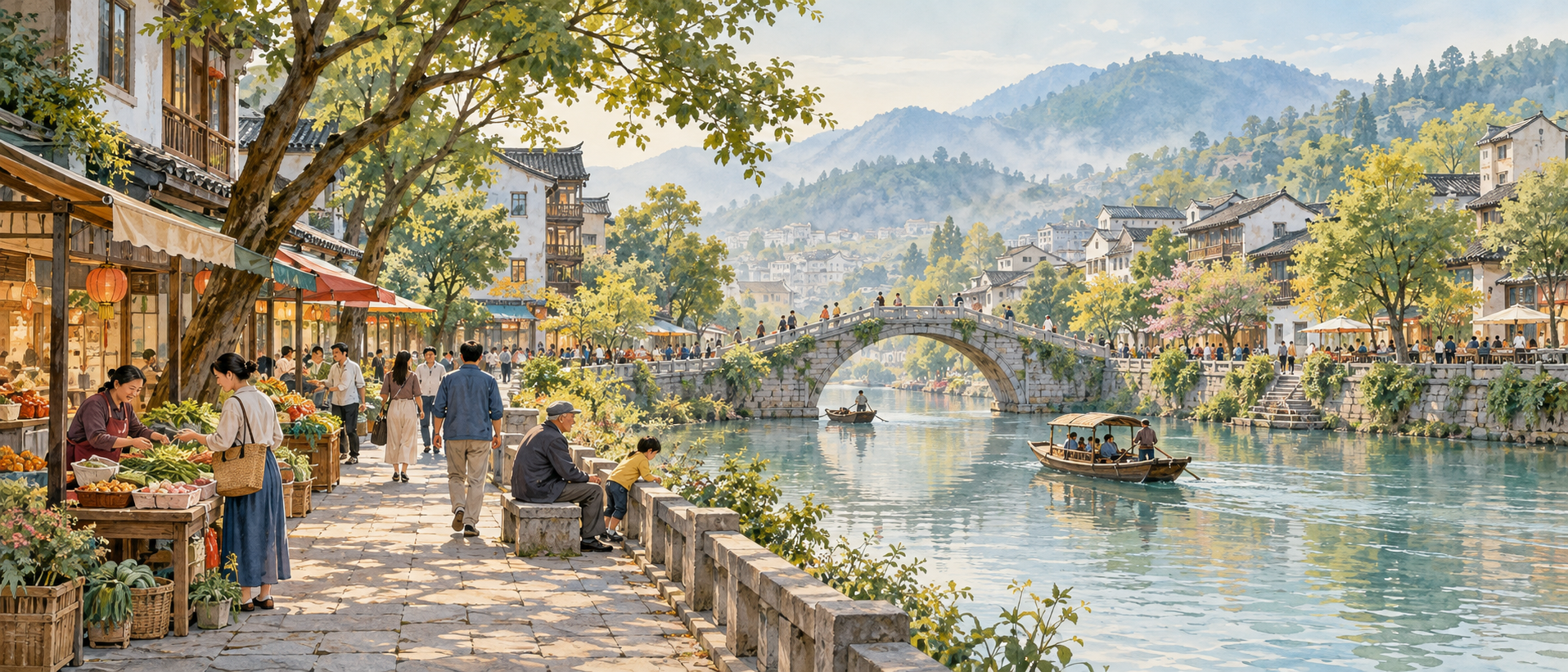
Cover illustration: an original AI-generated artistic interpretation of a riverside neighbourhood, market, footbridge, trees and distant hills. This is a nonliteral composite, not a photograph or an exact view of a named place.
Choose your route through China
- 1. Geography
- 2. Regions and settlements
- 3. Earlier history
- 4. Modern history
- 5. Government and institutions
- 6. People and languages
- 7. Economy and trade
- 8. Agriculture and resources
- 9. Transport and utilities
- 10. Education
- 11. Health and public services
- 12. Food and preparation
- 13. Music and oral knowledge
- 14. Arts and skilled making
- 15. Community and everyday life
- 16. Heritage and historical places
- 17. Environment and conservation
- 18. Science and practical skills
- 19. Regional and world connections
- 20. Student evidence and connections
1. Geography
A continental setting
China occupies eastern Asia beside the western Pacific, combining a long coast with an immense continental interior. The mainland faces the Bohai, Yellow, East China and South China seas. Its geographical range includes cultivated plains, forested mountains, grasslands and deserts. These contrasting environments are not evenly distributed: eastern farming districts, northern and western grasslands, and forests in the northeast and southwest create markedly different regional landscapes within the country. (MOFCOM)
The broad pattern of relief descends from high western terrain toward eastern lowlands and the coast. Mountains and plateaus occupy far more territory than an impression based only on the great coastal cities might suggest. Basins interrupt the highlands, while plains and hills provide different settings for farming and settlement. Consequently, a journey inland often crosses several changes of elevation and land use, rather than following one continuous, uniformly low continental plain. (MOFCOM)
The high plateau
The Tibetan Plateau is the most striking highland component of this geography. Its average elevation exceeds four thousand metres, and major mountain systems surround or cross it, including the Himalayas, Kunlun, Tanggula and Hengduan ranges. NASA’s satellite description emphasises the plateau’s combination of enormous height and extent. The landscape contains broad elevated surfaces as well as ridges and valleys, so a plateau should not be imagined as a perfectly level tabletop. (NASA)
Lakes and glaciers make these highlands important far beyond their immediate surroundings. The Yangtze and Yellow rivers have headwaters in the plateau region, as do rivers that flow toward other parts of Asia, including the Mekong, Salween, Indus and Brahmaputra. A June 2020 satellite image shows numerous lakes scattered across otherwise dry-looking terrain. This juxtaposition explains how an apparently austere highland landscape can also form a major source region for downstream water systems. (NASA)
Seasonal winds
Seasonal contrasts between land and sea help organise eastern China’s weather. During summer, the Asian continent heats more quickly than the surrounding ocean. The resulting pressure pattern encourages moist oceanic air to move inland. The Hong Kong Observatory explains that the Himalayas and Tibetan Plateau also influence this circulation. The monsoon is therefore a large-scale seasonal wind system shaped by both continental heating and topography, not simply another name for heavy rain. (HKO)
In winter the continental interior cools more rapidly, reversing the temperature contrast and encouraging air to flow outward toward the ocean. Cold surges can travel south through China and reach the southern coast. The observatory’s comparison of Hong Kong with similarly situated Honolulu illustrates the continental influence: Hong Kong has a larger seasonal temperature range. Coastal location alone therefore does not guarantee small seasonal contrasts when a vast continental landmass lies immediately inland. (HKO)
2. Regions and settlements
Desert and oasis
The Tarim Basin in Xinjiang contains the Taklimakan Desert, enclosed by the Tian Shan to the north and Kunlun Mountains to the south. Mountain barriers contribute to exceptionally dry conditions, and shifting dunes occupy much of the desert. Dust storms are especially common in spring. Winds frequently keep dust within the basin, although stronger events can lift particles high enough for atmospheric circulation to carry them far beyond western China. (NASA)
Water descending from the Kunlun creates very different environments along the desert margin. NASA’s photograph of an alluvial fan shows channels spreading across a broad apron of sediment before disappearing into dunes. A small reservoir supports nearby cultivation, while comparable fans farther west contain larger settlements and green fields. Such contrasts show why oasis geography matters: the location of mountain runoff can separate productive, inhabited land from extremely sparsely populated desert over short distances. (NASA)
Basins and rivers
The Sichuan Basin combines rolling hills, fertile farmland and major urban concentrations, including Chengdu and Chongqing. Its enclosing mountains also influence the atmosphere. During temperature inversions, warmer air overlies cooler air near the ground, reducing vertical mixing and allowing pollution to accumulate. Satellite observations reveal how this bowl-like setting can retain haze. The same regional map therefore explains both a distinctive settlement environment and a practical difficulty in dispersing urban and industrial emissions. (NASA)
Farther northeast, the Yellow River carries sediment from easily eroded loess landscapes toward the Bohai coast. Its delta has repeatedly changed shape as channels shift, sediment accumulates and older shores erode. Engineers redirected the main channel in 1996, creating a new focus for deposition. Landsat images also reveal expanding aquaculture ponds. The delta is thus a working landscape shaped jointly by river processes, flood-control decisions and coastal production, rather than a permanently fixed coastline. (NASA)
A connected urban delta
The Pearl River Delta illustrates a different transformation. NASA’s comparison of satellite images from 1988 and 2014 shows extensive farmland and smaller urban areas becoming a connected urban region. Shenzhen, Guangzhou, Foshan and Dongguan expanded toward one another across a landscape of waterways and alluvial soils. Development did not simply enlarge one old centre; it created a network of substantial cities whose built-up areas increasingly joined across formerly rural spaces. (NASA)
This multicentred pattern distinguishes the delta from cities that expanded around one dominant historical core. In its 2015 analysis, the World Bank measured urban land through the density of buildings and other constructed surfaces, rather than equating municipal administrative boundaries with the continuous city. That distinction is essential when comparing Chinese settlements: an urban region may span several jurisdictions, while an administrative city can include countryside beyond its densely developed neighbourhoods. (NASA)
3. Earlier history
Bronze and empire
Archaeology places the Shang dynasty, approximately 1600–1046 BCE, among the earliest securely documented states in Chinese history. Its political centres in present-day Henan produced sophisticated bronze vessels, weapons and evidence of writing. The Zhou conquered the Shang and initially ruled through a network of regional authorities. After the royal capital moved east in 770 BCE, competing states became increasingly independent, eventually producing the struggles conventionally grouped under the Warring States period. (Met)
Qin conquered its principal rivals in 221 BCE, creating an imperial government under Qin Shihuangdi. Standardised writing, weights, measures and coinage helped organise the new state, while appointed commandery officials strengthened central authority. The Han dynasty, conventionally dated 206 BCE–220 CE, adapted this institutional inheritance over a much longer period. Archaeological collections also reveal exchange across Central Asian and maritime routes, showing that early imperial society developed through outside contacts as well as internal consolidation. (Met)
Tang and Song
After centuries of division following the Han, the Sui reunited much of the country before the Tang dynasty, 618–907, developed a major imperial centre at Chang’an. Merchants, religious travellers and envoys arrived from across Asia. Civil-service examinations offered a route into government beyond hereditary aristocratic connections, although access remained unequal. Tang poetry, including work associated with Li Bo and Du Fu, emerged amid court life, military campaigns and periods of severe political disruption. (Met)
The Song period, 960–1279, further strengthened the importance of scholar-officials selected through examinations. During the Northern Song, the capital stood at Bianliang, now Kaifeng. Court patronage and educated officials helped shape influential traditions of landscape painting, while scholars debated the proper relationship between personal expression and public service. These developments connected political institutions with intellectual life: education and classical learning became important markers of authority alongside the continuing power of the imperial court. (Met)
Ming and Qing
The Ming dynasty, 1368–1644, followed the Mongol-led Yuan period. Its rulers used architecture, painting and decorative production to express imperial legitimacy, while artists also inherited techniques and influences from earlier international exchange. Blue-and-white ceramics and cloisonné reflected connections with the Islamic world, not a culture sealed from foreign contact. A court design bureau helped coordinate imperial production, illustrating how political authority could shape workshops, visual standards and the organisation of specialised crafts. (Met)
Manchu forces entered Beijing in 1644 and established Qing rule over the former Ming heartland. Subsequent expansion created a large, diverse empire reaching into Central Asia and Tibet. The court adopted and patronised Chinese cultural traditions while maintaining a Manchu ruling identity. Emperors such as Kangxi and Qianlong supported extensive artistic production. This imperial geography changed over time; it should not be treated as proof that every modern territorial claim was continuously or uniformly administered. (Met)
4. Modern history
Republic and civil war
The Qing faced foreign intervention, treaty ports, internal opposition and unsuccessful reforms during its final decades. The Wuchang uprising of 1911 helped trigger a wider revolution, and Sun Yat-sen became provisional president of the new Republic of China. The last emperor abdicated in February 1912. Ending imperial government did not produce national unity: regional military rulers retained substantial power, while republicans struggled to establish effective national institutions. (Historian)
Conflict between the Nationalists and Communists, Japanese invasion and the Second World War shaped the following decades. After Japan’s defeat in 1945, attempts at a political settlement failed and full-scale civil war resumed. Mao Zedong proclaimed the People’s Republic of China on 1 October 1949 after Communist military victories. The Nationalist-led Republic of China government withdrew to Taiwan, leaving governments on opposite sides of the strait and a political dispute that did not disappear with the fighting. (Historian)
Mao-era upheavals
The Great Leap Forward’s drive to reorganise agriculture and accelerate production was followed by catastrophic famine in 1959–1961. Economic research by Xin Meng, Nancy Qian and Pierre Yared identifies rigid grain procurement and failures to collect and respond to information as central institutional mechanisms. Their evidence challenges an explanation based solely on bad weather or unavoidable food scarcity. Government allocation decisions and the inability to adjust extraction to local conditions helped turn production shocks into mass suffering. (Meng/Qian/Yared)
The Cultural Revolution, 1966–1976, brought political persecution, factional conflict and disruption to schools, workplaces and communities. It was not confined to Beijing or university campuses. Guoqiang Dong and Andrew Walder’s research on rural Feng County used diaries, interviews and internal records to show how local disputes interacted with national campaigns. Military intervention could deepen factional divisions rather than simply restore order, revealing the complicated relationship between central mobilisation and violence within particular communities. (Dong/Walder)
Reform and repression
Economic reforms associated with Deng Xiaoping gained momentum from 1978. Rural household production incentives, township and village enterprises, and experiments with foreign investment changed the organisation of economic life. Reform proceeded unevenly through local trials rather than one immediate switch to a fully liberalised system. Later changes affected state enterprises, banking and taxation. Markets expanded, but political continuity and a continuing state role remained fundamental features of the transformation described by World Bank economist Bert Hofman. (World Bank)
Economic opening did not bring unrestricted political competition. In spring 1989, demonstrations in Beijing and other cities raised demands including accountability and political reform. On 3–4 June, troops violently suppressed the Beijing protest movement, killing civilians in the city’s streets as they advanced toward Tiananmen Square. Declassified diplomatic and intelligence records document the crackdown and its aftermath. Precise casualty totals remain uncertain, but that uncertainty does not diminish the established fact of lethal state violence. (Archive)
5. Government and institutions
The constitutional structure
The People’s Republic of China is constitutionally a socialist state under Communist Party leadership. The National People’s Congress is designated the highest organ of state power, with responsibilities including legislation, constitutional amendment and approval of major national plans and budgets. Its Standing Committee performs continuing legislative and supervisory work between full sessions. These formal constitutional arrangements explain state structures but do not establish how independently those institutions operate in practice. (NPC)
The State Council, headed by the premier, is the principal administrative body. The presidency is a separate state office, while courts and procuratorates occupy distinct positions in the legal system. Procuratorates perform prosecutorial and legal-supervision functions rather than acting as another chamber of parliament. The Constitution also provides for supervisory commissions. Understanding these institutions prevents the mistake of treating the president, government cabinet, legislature and ruling party as identical organisations with interchangeable responsibilities. (NPC)
Party and state
Communist Party organisations and government bodies form overlapping hierarchies. The Congressional Research Service describes party rank as taking precedence over government rank, with senior officials frequently holding both types of office. The Politburo Standing Committee sits at the centre of party decision-making. Personnel management is particularly important: the Party’s Organisation Department oversees recruitment, training and appointments across the system, linking leadership with institutions far below the central government. (CRS)
Party oversight also extends into the legal system through the Commission for Political and Legal Affairs, which supervises major policing, prosecutorial and court institutions. The Chinese People’s Political Consultative Conference is an advisory body, not a second legislative chamber or an opposition parliament. Its participants include approved minor parties and social groups within a Communist Party-led framework. These institutional relationships help explain why formal legal procedures should not be confused with separation of political power. (CRS)
Territory and administration
The PRC administers twenty-two provinces, five autonomous regions and four municipalities directly under the central government, as well as Hong Kong and Macao as special administrative regions. Its official list claims a twenty-third province, Taiwan, producing the frequently quoted total of thirty-four provincial-level divisions. Taiwan is separately governed by the Republic of China and is not administered by the PRC. The difference between a territorial claim and actual government is essential to interpreting these counts. (SCIO) (CRS)
Special administrative status does not mean that Hong Kong is simply another mainland municipality. Its Basic Law provides for separate executive, legislative and judicial institutions and preserves its pre-existing common-law system subject to the constitutional framework and subsequent legislation. These provisions describe a distinct legal arrangement within the PRC, not sovereign independence. They also should not be read as an automatic assessment of present-day political freedoms, which requires evidence about how laws and institutions are applied. (Hong Kong)
6. People and languages
Population and diversity
The census of 1 November 2020 counted approximately 1.412 billion people across thirty-one mainland provincial-level divisions and the armed forces. This dated total excludes Hong Kong, Macao and Taiwan residents and foreigners, including those living on the mainland. Within that census population, people classified as Han accounted for 91.11 percent, with recognised minority groups accounting for 8.89 percent. These categories describe administrative ethnicity, not uniform personal identities. (NBS)
The same census recorded 63.89 percent of this population as urban residents and 13.50 percent as aged sixty-five or older. Those figures show two important dimensions of social change: movement toward urban living and population ageing. Neither percentage means that all cities or regions share the same experience. Census classifications summarise a population, while local age profiles and settlement patterns remain important for understanding demand for schools, housing, employment and care. (NBS)
Speech and writing
Chinese speech is not a single locally uniform form. Linguistic research commonly distinguishes major groups including Mandarin, Wu, Xiang, Gan, Hakka, Min and Yue. A study comparing the sound inventories of 140 varieties found evidence of both historical relationships and extensive contact between groups. This helps explain why a simple branching family tree cannot capture every feature. Local pronunciation systems have developed through movement, neighbouring communities and exchange as well as inheritance from earlier forms. (Zhang et al.)
Putonghua and standardised Chinese characters provide a national framework for public communication, but national standardisation is also a matter of government policy. A revised language law took effect on 1 January 2026, strengthening requirements for standard-language use in schools, digital publications, audiovisual programmes and public-service platforms. The revision also clarified administrative responsibilities and penalties. These legal rules concern which forms institutions must promote or use; they do not erase the linguistic diversity found in everyday community life. (MOE)
Migration and belonging
Internal migration has connected rural communities with industrial and service employment in cities. The hukou household-registration system complicates migration because registration has historically been tied to access to local public services. The World Bank’s 2014 Urban China study examined this distinction between living in a city and holding local registration. It identified unequal service access as an issue for migrants and their families during urbanisation. (World Bank)
That study argued for moving from eligibility based mainly on a person’s place of origin toward provision based on residence. It linked registration reform with financing for education, health services and social protection, recognising that local governments must fund the services used by growing populations. These proposals describe a reform agenda, not proof that equal access has already been achieved everywhere. Migration therefore involves institutions and family opportunities as well as the movement of workers. (World Bank)
7. Economy and trade
Production and consumption
China’s economy combines internationally connected production with a vast domestic market. The World Bank’s July 2026 Economic Update highlighted high-technology investment and exports as important supports for activity, while household spending remained cautious and the property sector continued adjusting to weaker demand. Factories, construction and consumer services do not necessarily move together. Strong output in one sector can coexist with household uncertainty and slower activity elsewhere. (World Bank)
The same update emphasised social protection to encourage consumption by reducing households’ need to save against insecurity. It also examined employment changes associated with lower-carbon production, including demand for technical abilities, digital skills and adaptable learning. New industries do not automatically benefit every worker equally: training and portable credentials influence who can move into growing occupations. The report therefore linked economic restructuring with skills and income security, rather than treating growth as output alone. (World Bank)
International exchange
China joined the World Trade Organization on 11 December 2001 after accession negotiations. Membership placed its trade relations within a system of negotiated commitments, notification requirements and dispute procedures. This institutional change accompanied deeper integration into international production and markets. It did not mean that every trading disagreement disappeared: membership creates rules and mechanisms through which governments address disputes, while individual industries continue to face changing tariffs, regulations and commercial conditions. (WTO)
The WTO’s country profile records merchandise exports of approximately US$3.577 trillion in 2024. Such a figure measures goods crossing customs boundaries, not the value of all production inside China or the income earned by an average household. It also differs from trade in services. Keeping those categories separate matters when describing extensive supply chains: export totals show international commercial scale, but do not by themselves measure domestic prosperity or its distribution. (WTO)
Structural pressures
The IMF’s consultation published in February 2026 identified property-sector adjustment and its effects on local-government finances as sources of weakness. Debt accumulated around investment and construction can constrain later spending, while declining housing confidence can affect consumption. The report also discussed deflationary pressures and the limitations of relying on exports when global trade tensions are high. Its assessment describes interacting financial and demand problems, not merely a disappointing indicator or temporary fluctuation. (IMF)
Longer-term questions include productivity, ageing and investment allocation. The IMF argued that state-directed, debt-financed investment and some industrial support had contributed to excess supply and financial vulnerabilities in particular sectors. These are analytical findings, not a claim that every public investment is unproductive. The policy challenge is to support innovation and employment while improving financial discipline, household demand and the ability of resources to move toward activities that produce lasting economic value. (IMF)
8. Agriculture and resources
Grain and seasons
Rice, wheat and maize dominate China’s cereal production. FAO’s January 2026 assessment estimated the 2025 harvest at 657.5 million tonnes of cereals, including 299 million tonnes of maize, 209 million tonnes of paddy rice and 139.9 million tonnes of wheat. Paddy refers to rice before milling, so it should not be confused with the weight of finished rice available for cooking. These estimates concern a completed harvest, not a production target. (FAO)
Winter wheat accounts for most wheat production and illustrates the importance of timing. Heavy rain in autumn 2025 delayed planting in northern producing areas, requiring drainage and late-sowing measures before fields could be completed. Spring wheat follows a different calendar. FAO also noted feed-industry demand for maize and local losses from wet harvest conditions. A large national crop can contain regional differences in timing, quality and conditions faced by farmers. (FAO)
Rice with fish
Qingtian in Zhejiang provides an example of integrated farming. Rice grows in flooded fields alongside fish, with each component supporting the other. Fish disturb the water and soil, eat some insects and weeds, and return nutrients to the field. Rice provides shade and food within the same environment. FAO recognised this rice-fish culture as a Globally Important Agricultural Heritage System in 2005, acknowledging farming knowledge maintained through practice over generations. (FAO)
The system produces different foods from one field and can reduce dependence on chemical inputs. Its value lies in the relationship between crops, aquatic animals, water management and farmers’ knowledge, not simply in placing fish beside rice. Maintaining that relationship requires attention to field conditions and the needs of both organisms. It illustrates how agricultural innovation can include adapting an established ecological practice rather than replacing every traditional method with specialised monoculture. (FAO)
Minerals and processing
China’s resource economy includes mining, processing and imported raw materials. A US Geological Survey study published in June 2026 examined 2023 production across seventy-seven mineral commodities. China produced seventy-four and ranked first for thirty-nine in that dataset. These categories include both metals and industrial minerals. Such breadth explains why the country matters to many supply chains simultaneously, from bulk construction materials to specialised inputs used in modern manufacturing. (USGS)
Production leadership does not mean that all raw material originates domestically or that reserves match the same global shares. The USGS study distinguished geological resources from industrial capacity and noted China’s substantial imports of ores and concentrates. Its accompanying mapping connected mines, processing plants and trading ports. A mineral supply chain therefore extends beyond the deposit itself: refining, transport and access to foreign feedstock help determine how much usable material an economy can supply. (USGS)
9. Transport and utilities
Networks and movement
China’s transport network combines conventional railways, high-speed lines, roads, inland waterways and aviation. The Ministry of Transport’s 2025 bulletin recorded 165,000 kilometres of railway in operation at year-end, including 50,000 kilometres of high-speed railway. Approximately 76.8 percent of the railway network was electrified. These describe different characteristics: high-speed route length is not equivalent to electrified railway, and neither measures individual journeys or total track laid. (MOT)
The same bulletin reported about 5.58 million kilometres of roads, including 199,400 kilometres of expressways, alongside 128,700 kilometres of navigable inland waterways. It also counted 270 certified civil transport airports and 11,651 kilometres of urban rail in operation. These systems serve different scales, from neighbourhood commuting to long-distance freight. Rural roads, city transit and major intercity corridors are complementary parts of connectivity rather than interchangeable measures of one national transport service. (MOT)
Electricity in transition
China’s electricity supply combines coal, hydropower, wind, solar and nuclear generation. The International Energy Agency’s Electricity 2026 report estimated that solar photovoltaics supplied more than ten percent of electricity in 2025. Wind and solar together accounted for about twenty-two percent, while renewables collectively supplied about thirty-seven percent. These are shares of electricity generated, not installed generating capacity, and they exclude other forms of energy consumption such as direct fuel use in transport and industry. (IEA)
Distinguishing capacity from generation matters as wind and solar expand, because output varies with weather and time. Coal remains a major contributor even while lower-emission sources grow. The IEA’s report projected further renewable and nuclear expansion during 2026–2030, but those projections are not completed results. Electricity planning must connect new generating equipment with networks and operating arrangements that keep supply available when people and businesses actually require it. (IEA)
Water across regions
Water resources are unevenly distributed across China. The south and southwest hold comparatively abundant supplies, while northern regions face serious constraints and groundwater depletion. Pollution can further reduce the amount of water suitable for particular uses. The World Bank’s Watershed study treated water security as a problem of quality, demand, institutions and physical supply. A river or reservoir does not automatically guarantee clean water for every nearby community. (World Bank)
Large transfers and storage works are one response to this uneven geography, but they do not remove the need to manage consumption and protect catchments. The Watershed study stressed coordination across river basins, clearer responsibilities and better information for allocation decisions. Agriculture, cities, industry and ecosystems depend on connected water systems even when they lie in different administrative areas. Management requires considering upstream and downstream consequences rather than individual projects in isolation. (World Bank)
10. Education
Compulsory schooling
Mainland China’s legal framework provides nine years of compulsory education, with tuition and miscellaneous school fees prohibited during that stage. Children normally begin at six, although the law permits a later start in places where conditions require it. Responsibilities are divided among families, schools and public authorities, with local government playing an important implementation role. These legal duties establish an entitlement and obligation; they should not be mistaken for proof that every locality offers identical educational conditions. (MOE)
The pathway consists of six years of primary school followed by three years of junior secondary school, although some places use a five-plus-four arrangement. Senior secondary education normally follows for three years and is outside the nine-year compulsory stage. The OECD’s account distinguishes general academic schooling from vocational routes at this level. This structure explains why completing compulsory education and completing upper secondary education are different milestones in a student’s educational progression. (OECD)
Routes beyond school
The zhongkao is associated with entry to senior secondary schooling, while the gaokao plays a major role in admission to higher education. Admission is not organised through a single score interpreted identically everywhere: provincial authorities, universities and national policy interact through enrolment plans and quotas. Different routes and exceptions also exist. These arrangements make school transitions consequential for families, linking examination preparation with decisions about subjects, institutions and possible academic or vocational destinations. (OECD)
The revised Vocational Education Law of 2022 defines vocational study as an educational route of equal importance to general education. It provides for secondary and higher vocational schooling, training and connections between schools and businesses. The framework also links vocational learning with continuing education and changing employment needs. This is a legal commitment to the status and development of skills-based education, not evidence that every programme has identical resources, employer connections or outcomes for graduates. (NPC)
Scale and participation
The education ministry’s 2025 bulletin counted 3,167 higher education institutions within its reporting scope. These included 1,278 regular undergraduate institutions, eighty-seven vocational bachelor-level institutions, 1,554 higher vocational colleges and 248 adult higher education institutions. The categories show why higher education cannot be reduced to research universities alone. The bulletin excludes Hong Kong, Macao and Taiwan, and its institutional totals also exclude military institutions and technical schools administered through the human-resources system. (MOE)
The same bulletin reported a higher-education gross enrolment ratio of 61.30 percent and over twelve million children accompanying migrant workers in compulsory schooling. The first indicator is a population-based measure of participation, not a university graduation rate or an individual student’s chance of admission. The second highlights the scale of educating mobile families. Together they illustrate why expanding access involves both places in further education and continuity of schooling as households move. (MOE)
11. Health and public services
Care close to home
Health services involve more than hospitals and specialist operations. WHO’s China primary-care overview identifies general practitioners, public health nurses and community pharmacists among the professionals providing first contact near homes and workplaces. It describes three supporting pillars: basic insurance, local infrastructure and a community workforce. A clinic building, trained staff and a way to pay for care therefore solve different parts of the same practical problem of reaching people when help is needed.
Financing and quality also matter. WHO’s explanation of health reform connects family doctors and stronger primary-care teams with a tiered delivery system. Its definition of universal coverage includes prevention, treatment, rehabilitation and care near the end of life, without financial hardship. This is a standard against which services can be assessed, not evidence that every resident already receives every service equally. Insurance enrolment, an available appointment and affordable treatment are distinct questions.
Tracing and interrupting malaria
On 30 June 2021, WHO certified China as malaria-free after assessing the interruption of indigenous transmission. Its account of elimination explains a particularly concrete working method: the 1-3-7 surveillance timetable. A detected case is reported within one day; confirmation and investigation follow within three days; an appropriate response is organized within seven. The numbers refer to public-health tasks, not stages of an illness or a promise that treatment always takes a week.
In Yunnan, the Institute for Parasitic Diseases worked with local disease-control teams to investigate infections and prevent spread. Their work connected laboratory diagnosis, interviews, mosquito investigation and community responses. The distinction between stopping local transmission and eliminating every possible infection is important: certification does not make imported malaria impossible. Maintaining surveillance remains different from celebrating a historical milestone. This example shows how coordination and reliable information can be as important to prevention as a medicine.
Libraries as public infrastructure
The National Library of China’s service guide reveals another kind of public infrastructure. Reading areas and collections support recent Chinese books, reference works, children’s materials, periodicals and specialist research. A reader seeking a dictionary, an old newspaper or a scholarly article needs different forms of assistance. Reference staff and catalogues help connect questions with collections, while distinctions between open shelves and requested material organize how documents are located and used.
Specialist services include microfilms and reproduced literature associated with Dunhuang and Turpan, alongside foreign-language resources. Exhibitions at the National Museum of Classic Books make selected collections available through interpretation rather than ordinary borrowing. These activities connect preservation with access: a fragile original, a reproduction and a digital resource can serve different purposes. The library is therefore both a place for everyday reading and an institution that helps people investigate the documentary record of earlier societies.
12. Food and preparation
Cantonese small dishes
Dim sum provides a useful introduction to the variety within Cantonese cooking. The Hong Kong Tourism Board’s dish guide describes siu mai with pork, shrimp and mushroom, and har gow with shrimp inside translucent wrappers. These are not interchangeable parcels: wrapper texture, filling and shaping distinguish them. A small dish can demand considerable preparation, and the final steamer basket brings together decisions about ingredients, moisture, timing and the appearance of individual pieces.
Lo mai gai encloses sticky rice with chicken, mushrooms and other fillings in a lotus leaf before steaming. Cheung fun uses rice-noodle sheets rolled around fillings, while char siu bao encloses barbecued pork in a soft bun. Custard egg tarts introduce pastry rather than a steamed wrapper. These examples show several ways of holding a filling and creating contrasting textures. They describe one regional culinary tradition, not a single menu followed by all households across China.
Tea from leaf to gathering
Tea-making begins before water enters a cup. UNESCO’s 2022 tea heritage entry links managing plantations, picking leaves and manual processing with drinking and sharing. It identifies green, yellow, dark, white, oolong and black teas, alongside reprocessed products such as flower-scented teas. These categories make processing knowledge visible: tea is not simply one uniform ingredient sold under different place names. Producers maintain skills concerned with the qualities that leaves acquire as they are handled.
The social practices extend across homes, workplaces, teahouses, restaurants and religious settings. Serving tea can accompany hospitality, family gatherings or ceremonies, although preferences and routines differ among people and communities. Knowledge passes through relatives and apprenticeships, connecting growers, processors and other practitioners. Looking at a tea gathering therefore means following several relationships at once: agricultural work, skilled preparation, the vessels used for serving, and the conversation through which people welcome guests or maintain familiar ties.
Sichuan flavours and fermentation
Chengdu offers a different culinary focus from Cantonese dim sum. Its UNESCO Creative Cities profile describes Sichuan cooking through combinations of sweet, sour, bitter, spicy and salty flavours. Heat is part of this vocabulary, not the whole cuisine. The useful question is how flavours are combined within a preparation rather than whether every dish is extremely spicy. This approach encourages comparison of techniques and balance instead of reducing a region to one memorable sensation.
A concrete example is Pixian douban, a fermented seasoning from Chengdu’s Pidu district. Its ingredients include broad beans, red chillies, wheat flour and salt. Production involves salting, preparing a starter culture, mixing and fermentation, with stirring and exposure to sunshine during later stages. The resulting paste appears in preparations such as mapo tofu and twice-cooked pork. Flavour therefore emerges from ingredients transformed over time, not just from adding fresh chilli to a finished dish.
13. Music and oral knowledge
The guqin’s changing sounds
The guqin is a seven-string zither associated historically with scholars and intimate musical gatherings. UNESCO’s account of its performance tradition describes thirteen marked positions and three basic approaches to playing: open strings, stopped strings and harmonics. The contrast is physical as well as audible. A string may vibrate freely, be pressed firmly, or be touched lightly at a particular point, while the other hand supplies the plucking action that sets it in motion.
When a player presses and slides along a string, the sound can move between notes or acquire ornaments. Light touching produces a different effect from firm stopping. These techniques explain why learning the instrument involves coordinated touch and listening rather than simply memorizing a tune. UNESCO first proclaimed the tradition in 2003 and placed it on its Representative List in 2008. Those dates mark international recognition, not the beginnings of guqin music.
Minnan voices and ensembles
In southern Fujian, Nanyin connects music with Minnan communities, including communities overseas. Its ensemble can include a dongxiao bamboo flute and a pipa lute held horizontally. The repertoire includes instrumental music, vocal music and ballads sung in the Quanzhou variety of speech. A singer may also handle clappers, or performers may take turns. The relationship between voice, language and instrumental accompaniment gives this tradition a character quite different from solo guqin playing.
Nanyin appears in ceremonies, weddings, funerals and festive performances in courtyards or public spaces. Its songs and scores have also interacted with opera and puppet theatre. These connections make musical knowledge part of social memory: people recognize occasions and associations through what they hear. The tradition’s presence among Minnan populations in Southeast Asia also shows how migration carries cultural practices beyond a place of origin, while performers continue learning and adapting them in new settings.
Gesar in different telling traditions
The Gesar epic tradition is shared by Tibetan, Mongolian and Tu communities in western and northern China, with substantial regional differences. Performers recount episodes about King Gesar through alternating prose and verse rather than reciting one universally fixed text. The hero’s adventures belong to an epic narrative, not a straightforward historical chronicle. Individual performances draw on a larger body of stories, allowing a familiar character to connect many episodes and local ways of telling.
Tibetan performers may use mirrors, expressive gestures and sound effects, while Mongolian telling traditions can combine fiddles with improvised singing and spoken narrative. Stories also connect with rituals, visual art and theatre. The important unit of study is therefore a particular performer, community and occasion, not an abstract national version. Listening for changes in voice, musical accompaniment and audience participation helps explain how oral knowledge is renewed whenever a story is performed for people gathered together.
14. Arts and skilled making
Brushwork as visible movement
Calligraphy turns writing into an art of controlled movement. In Dawn Delbanco’s museum essay, the expressive possibilities begin with simple materials: ink, water and a flexible brush. Changing the amount of water alters the ink, while pressure, speed and the part of the brush touching the surface change a stroke. A line can therefore record several decisions at once. Its thickness or dryness is evidence of a process, not merely a decorative outline.
The Met’s examples include work by Huang Tingjian and Mi Fu from around 1095. Calligraphers can work in regular, running or cursive forms, balancing established stroke sequences with individual expression. Studying two examples involves both recognizing the script and noticing how marks occupy space. The same tools also connect writing with painting. That relationship helps explain why a painted composition, an inscription and the gestures of the brush can be considered together rather than as unrelated features.
Longquan’s kiln knowledge
At Longquan in Zhejiang, celadon production depends on close control of materials and firing. The UNESCO account of firing technology describes glazes made with mineral ingredients and plant ash, applied to a previously fired stoneware vessel before further firing. Too much or too little heat can alter the intended result. Makers combine temperature measurement with attention to the flame, bringing practical observation and inherited workshop knowledge into the same sequence of decisions.
The glaze is a transformed surface, not paint added after a finished pot has cooled. Recipes and firing skills pass within families and between teachers and learners, linking household ware with highly valued artistic work. Celadon’s characteristic green tones invite comparisons with jade, but the making process belongs to ceramics. Examining a vessel therefore involves questions about its body, coating and kiln treatment, as well as its outline or decoration and the uses imagined for it.
Xu Bing questions readable appearances
Contemporary artist Xu Bing approached writing from a deliberately unsettling direction. His Book from the Sky, made between 1987 and 1991, consists of books and scrolls printed with invented signs that resemble Chinese characters but do not form readable text. The project required thousands of carved movable-type blocks. Its painstaking workmanship gives the installation the appearance of learned authority, while its invented script prevents viewers from obtaining the meaning they expect from a book.
This is not a forgotten language awaiting translation. The inability to read is part of the artwork’s design. Xu Bing uses familiar printing conventions to make viewers examine their assumptions about knowledge, literacy and the authority of a carefully presented page. The contrast between skilled production and withheld meaning also creates a connection with older book arts without simply repeating them. A long-established technique becomes a means of asking a new question about how people trust written forms.
15. Community and everyday life
Preparing for the new year
The Spring Festival begins on the first day of the first month of the Chinese calendar. UNESCO’s 2024 heritage entry describes a sequence extending beyond that single day: cleaning, obtaining provisions and preparing food lead towards a reunion meal on New Year’s Eve. Greetings and visits then help renew relationships. These are practices followed in varying ways by participating families and communities, rather than a checklist that every person observes identically each year.
Public performances and community festivities add another scale to household preparations. Skills associated with decorations, music and celebration may pass through relatives, schools or apprenticeships. The calendar gives people a shared occasion, but the work of arranging a meal, making an object or rehearsing a performance is specific and local. Studying the festival can therefore reveal who teaches whom and how generations cooperate, without assuming that every participant shares the same beliefs or family circumstances.
Shanghai’s lanes and changing homes
Shanghai’s shikumen housing illustrates how everyday environments emerge from particular historical pressures. A municipal architectural account connects its growth with nineteenth-century refugees and housing demand, and describes a blend of Jiangnan residential forms and Western influences. Brick and wood houses were arranged in compact lanes called longtangs. Within a home, an entrance led through a sequence of spaces including living rooms, stairs, kitchens and rear exits, shaping how residents moved between household activities.
The buildings also depended on craft labour: wood, stone and brick carving accompanied construction and decoration. Some areas have subsequently acquired different uses. Tianzi Fang, for example, developed into a cultural and creative district, making adaptation part of the story alongside preservation. A surviving façade alone cannot tell us that household life remains unchanged behind it. Comparing plans, historical accounts and present uses helps distinguish the architecture of a neighbourhood from the changing activities it contains.
Learning movement with others
Taijiquan combines relaxed circular movements with regulated breathing and learned routines. UNESCO’s description identifies five steps and eight techniques, as well as paired hand-pushing practice called tuishou. It also recognizes different schools rather than one completely uniform sequence. Someone watching a group should therefore distinguish a particular teaching tradition from the larger category. The practice involves timing, balance and attention to another person’s movement, not only the appearance of a solitary pose.
Knowledge can pass through family lineages, master-apprentice relationships and formal education. Rituals marking a teaching relationship and names associated with individual schools help connect physical practice with social identity. UNESCO inscribed taijiquan in 2020 as living heritage. That recognition concerns cultural transmission; it is not clinical evidence for treating a disease. As an example of community activity, the useful focus is how people practise together, learn a shared vocabulary and maintain differences between styles.
16. Heritage and historical places
Reading the walls at Mogao
The Mogao Caves near Dunhuang in Gansu preserve Buddhist paintings and sculpture created across many generations. Their imagery also contains details of travel and work. UNESCO identifies a camel drawing a cart in Cave 302 and agricultural scenes in Cave 23. These features connect religious art with the material world familiar to patrons and painters. A cave wall can consequently be studied for composition, devotion and evidence about the activities represented within it.
Cave 61 includes a landscape of Mount Wutai with roads, temples and settlements, showing how an image can organize geographical knowledge. Manuscripts associated with the caves preserve several languages, including Chinese, Tibetan and Sogdian, reflecting intersecting networks of communication. The site joined the World Heritage List in 1987. Its value is not limited to spectacular individual images: the relationships among caves, texts and successive artistic traditions help researchers reconstruct exchanges across a much wider region.
Courtyards inside earthen walls
The World Heritage property Fujian Tulou comprises forty-six large earthen buildings in southwestern Fujian, rather than every tulou in the country. Circular or square plans turn inward around shared courtyards. High walls, limited external openings and carefully controlled entrances reflect defensive concerns, while tiled roofs protect the structures above. The building’s outward appearance therefore differs from its interior organization, where numerous households could occupy an elaborate arrangement of rooms and shared spaces.
UNESCO describes rooms allocated vertically among families, linking spaces on different floors. This detail makes the building easier to understand as inhabited architecture rather than a striking shape seen from above. The surrounding agricultural and wooded landscape also forms part of its setting. Studying a tulou involves construction techniques, family organization and the relationship between private and communal space. It is one regional housing tradition, not a model for all rural homes or communities in China.
Beijing’s north–south urban ensemble
Beijing’s Central Axis was inscribed on the World Heritage List in 2024. The ensemble connects palaces, gardens, ritual buildings and public spaces along a north–south organization of the city. Its development began under the Yuan and continued through Ming and Qing additions. UNESCO relates the arrangement to ideas expressed in the ancient Kaogongji. The planning principles concern an imagined political and ceremonial order, not evidence that the society itself was perfectly balanced.
The Drum and Bell Towers, Jingshan and the Temple of Heaven help explain the ensemble through distinct functions and positions. Its history includes rebuilding, remodelling and changes from imperial to public uses. Conservation therefore addresses an evolving urban place rather than a completely untouched monument. Looking at relationships between structures can reveal more than studying each building alone: direction, spacing and routes through the city show how architecture organized ceremonies, administration and the experience of movement.
17. Environment and conservation
Connected habitats in Sichuan
The Sichuan Giant Panda Sanctuaries include mountain habitats associated with Wolong, Mount Siguniang and the Jiajin Mountains. Giant pandas are the best-known animals, but the area also supports red pandas, snow leopards and clouded leopards. Its plants include bamboo, magnolias, rhododendrons, orchids and the distinctive dove tree. A conservation description that mentions only one celebrated mammal would miss much of the ecological variety contained within the same mountain landscapes and protected areas.
UNESCO identifies habitat fragmentation as a management concern and explains the importance of corridors allowing animals to move between suitable areas. Roads, settlements and intensive tourism can affect that connectivity. Protecting an animal therefore involves more than drawing a boundary around one forest: the arrangement of habitat patches and pressures around them also matters. These sanctuaries illustrate why conservation requires cooperation across management units and attention to the surrounding landscape, not simply maintaining a collection of isolated reserves.
Coastal stopovers on a flyway
The Yellow Sea–Bohai Gulf bird sanctuaries protect coastal habitats used along the East Asian–Australasian Flyway. Inscribed in 2019 and extended in 2024, the property includes tidal flats where travelling birds feed and rebuild energy stores. At Yancheng, these habitats are important for the spoon-billed sandpiper and Nordmann’s greenshank. The significance of a mudflat is therefore partly revealed by journeys extending far beyond what can be seen from its shore.
Food-rich stopping places connect breeding and wintering areas across countries. Losing one important stop can affect a population elsewhere, making migratory birds a shared conservation responsibility. UNESCO also identifies pressures from coastal modification, pollution, infrastructure and changes outside the property’s boundaries. Protected status does not remove those problems automatically. Effective conservation must consider feeding grounds, nearby resting habitat and wider coastal processes together, including the rivers and sediment supplies that help sustain the wetlands over time.
Particles and ozone behave differently
Air quality cannot be summarized by one pollutant. A 2019 study led by Ke Li examined summer observations from 106 sites in the North China Plain during 2013–2018. It investigated why falling concentrations of fine particles could accompany worsening surface ozone. Observations and modelling pointed to interactions within atmospheric chemistry: particles can remove reactive substances that would otherwise help produce ozone. Reducing one pollutant can therefore change the chemical setting in which another forms.
The researchers argued for considering nitrogen oxides and volatile organic compounds together when designing controls. This is a dated finding about a particular dataset and chemical problem, not a measurement of today’s air in every Chinese city. It demonstrates a broader environmental skill: compare several indicators and investigate mechanisms before declaring that a single improvement solves everything. Instruments, emission inventories and models answer related but different questions, and their combination can reveal effects that a photograph of the sky cannot.
18. Science and practical skills
Tu Youyou’s experimental pathway
Tu Youyou’s work on artemisinin shows how an old text can suggest a new experiment without replacing scientific testing. The 2015 Nobel scientific background describes her team’s study of sweet wormwood, Artemisia annua, during a search for antimalarial substances. Early extracts produced inconsistent results. Reading a preparation described by Ge Hong encouraged a lower-temperature extraction approach. The development involved changing the method and testing the outcome, not simply finding a familiar plant.
The team followed experimental results with clinical investigation, isolation of the active substance and work on its chemical structure. Those stages distinguish a researched medicine from an untested traditional preparation. Tu received part of the 2015 Nobel Prize in Physiology or Medicine for discoveries concerning malaria therapy. Her example connects historical reading, chemical technique, collaboration and repeated observation. It is a history of drug discovery, not a recommendation to prepare or use herbal treatments independently.
FAST listens in radio wavelengths
The Five-hundred-meter Aperture Spherical radio Telescope, usually called FAST, occupies a karst depression in Guizhou. Its large active reflector is designed for sensitive astronomical observations. Construction ended in September 2016, but completion of the structure was followed by commissioning; formal operation began on 11 January 2020. These dates distinguish building an instrument from demonstrating that its systems work together for research, a distinction important for other large scientific facilities.
The National Astronomical Observatories identifies neutral hydrogen, pulsars and interstellar molecules among FAST’s research targets. These are different questions about matter and objects in space, approached through radio observations rather than ordinary photographs. The telescope therefore links engineering with analysis: an instrument collects signals that researchers must interpret using physical models. Possible investigations are not the same as completed discoveries. The facility’s purpose is to produce observations from which testable explanations can develop.
Chang’e-6 returns lunar material
Chang’e-6 provides an example of a completed space mission rather than a future proposal. The mission chronology published by CNSA records its launch on 3 May 2024 and landing in the Moon’s South Pole–Aitken Basin on 2 June. The Queqiao-2 relay supported communications. Sampling used both a drill for material below the surface and a robotic arm for surface material, giving the mission two ways to collect evidence from the lunar far side.
The samples then travelled through several spacecraft operations: an ascent from the surface on 4 June, a rendezvous and transfer in lunar orbit on 6 June, and return to Earth on 25 June. The capsule landed in Inner Mongolia. The sequence explains the achievement more clearly than one launch date. Collecting material, transferring it and returning it safely were separate engineering tasks, completed before researchers could examine the evidence in laboratories.
19. Regional and world connections
Quanzhou’s maritime network
Quanzhou’s historical connections can be traced through more than its waterfront. UNESCO’s Song–Yuan heritage description links the port with ceramic and iron production, bridges, docks, administrative places and religious buildings. Together they explain a maritime trading centre connected to its inland producers. A ship’s cargo depended on roads and rivers, workshops and institutions, not only on sailors. The city was known as Zayton in Arabic and Western accounts of this period.
The Qingjing Mosque and Islamic tombs are among the religious evidence associated with the port’s international contacts. Their presence can be studied alongside production sites and transport remains rather than taken as the entire social history. Quanzhou’s example brings economic and cultural geography together: goods, people and religious practices moved through intersecting networks. The surviving components help explain how a city between inland mountains and the sea participated in connections reaching across East and Southeast Asia.
A corridor shared across borders
The Chang’an–Tianshan Silk Roads property is shared by China, Kazakhstan and Kyrgyzstan. Inscribed in 2014, it follows part of a much larger network, not a single road joining two endpoints. Its components include settlements, passes, posthouses, religious places and defensive structures. Different sections supported exchange in different ways. Goods could pass through several merchants, so the movement of an object over great distances does not mean one trader completed the entire journey.
The routes carried ideas and technologies as well as valuable materials. Their modern conservation adds another kind of connection: participating countries coordinate management and exchange information about the component sites. Historical trade routes and present heritage cooperation should remain distinct from contemporary infrastructure programmes that use similar language. A useful map therefore shows several layers: the places where evidence survives, the routes connecting them, and the institutions now responsible for conserving the shared historical record.
Migrants and the American railroad
Connections across the Pacific also involved difficult working lives. Stanford’s research on Chinese railroad workers traces many nineteenth-century migrants to Guangdong’s Pearl River Delta. They helped construct the western part of the United States’ first transcontinental railroad in dangerous conditions, with unequal pay. Workers organized a strike in 1867. Their history therefore concerns labour and collective action as well as engineering, challenging accounts that remember a railway’s owners more clearly than the people who built it.
The project brought together historians Gordon Chang and Shelley Fisher Fishkin with archaeologist Barbara Voss and other researchers. Payrolls, photographs, excavated objects and interviews with descendants reconstructed lives poorly represented in surviving personal documents. Ceramic bowls at work camps and records of employment supply different kinds of evidence about migration. Following those traces connects local communities in southern China with North American landscapes, while preserving differences between individual experiences instead of inventing one migrant story.
20. Student evidence and connections
Date a book through evidence
The British Library’s Diamond Sūtra learning resource offers a precise exercise in reading evidence. Its complete printed scroll carries a colophon naming the sponsor Wang Jie and a date corresponding to 11 May 868. Seven printed sheets were joined to make the scroll. Students can separate three questions: what the object is, how it was produced, and what supports its date. Each answer rests on a different material feature or part of its written record.
The illustrated frontispiece presents the Buddha teaching, while the colophon records circumstances of production. Compare these functions with the title page and publication information of a modern book. The object is important as an early complete dated printed text, but its date does not establish that printing was invented that year. This distinction supports a sound historical argument: a surviving object can demonstrate that a practice existed without identifying its very first occurrence.
Compare climate with clear units
The Hong Kong Observatory’s 1991–2020 normals provide a small, usable climate dataset. January’s mean rainfall is 33.2 millimetres, compared with 491.5 millimetres in June. Mean temperature is 16.5 degrees Celsius in January and 28.9 degrees in July. A student can graph rainfall and temperature separately, label the units, and explain the seasonal contrast. These figures describe a particular observation record and thirty-year baseline, not weather on one day.
Before comparing Hong Kong with another place, choose an equivalent period and the same quantities. A monthly mean temperature is not a record maximum, and rainfall total is not the number of rainy days. The Observatory publishes those measures separately, allowing students to see why labels matter. Such a comparison can connect geographical learning with local experience while avoiding a common mistake: using one city’s climate to represent a large country.
Investigate food beyond its appearance
A 2022 study of Changle Cemetery food remains shows how researchers combine evidence rather than guessing from shape alone. Meng Ren, Renfang Wang and Yimin Yang examined five samples from a Han-period tomb in Ningxia. Microscopic plant remains, proteins and chemical measurements helped identify ingredients, including millet in cereal preparations. The researchers also compared ancient material with modern millet prepared in different ways. This experimental comparison supported their interpretation of some remains as baked food.
Students can arrange the investigation as a chain: object, analytical method, observation and interpretation. A surviving cake does not announce its recipe, and a burial offering does not represent every meal eaten by everyone nearby. Different tests can strengthen a conclusion while leaving other questions open. Cooking and microscopy reveal why science and history often work together. A strong country study explains how knowledge is established, not simply how many facts readers remember.
Frequently asked questions about China
What is China’s capital?
Beijing is the capital.
Which statistical region includes China?
The United Nations places China in Eastern Asia.
What is a guqin?
A guqin is a seven-string zither played with plucking, pressing and harmonic techniques.
What did Chang’e-6 return?
Samples from the Moon’s far side on 25 June 2024.
Do the latest pages always contain current statistics?
No. Check each observation’s reference year and footnotes. Reading a page today does not turn an older observation into a current measurement.
Does a heritage designation establish safe access?
No. Heritage value and current access or safety are different questions. This article is for learning, not planning a journey.
Does one local example represent everyone?
No. Keep the people, place and date attached to an account. A documented example can explain a relationship without establishing a nationwide pattern.
How should students use the chapters?
Choose a focused question, preserve dates and definitions, and connect relevant evidence. Explain what remains uncertain instead of filling gaps with assumptions.
Continue reading: specialist guides to China
These links provide subject-specific background. Their travel-themed titles do not establish that visiting is safe or feasible; use them as reading resources here.
- How China Works | Government, Provinces, Factories and High-Speed Rail
- How Ministry of Education for China Works | 2026 Admissions, Nine-Year Schools, Zhongkao, Gaokao and AI Plan
- Schools of China | Primary, Junior, Senior, Vocational, Zhongkao and Gaokao 2026
- How Education System of China Works | Nine-Year Schooling, Zhongkao and Gaokao 2026
- What Is Taught in School | China
- Tutors of China | How Double Reduction, Zhongkao, Gaokao and Legal Tutoring Work
- Food traditions of China
- Cultural and landscape learning about China
Explore the Everything About Countries archive for national overviews. For the complete 195-country directory, visit How Countries Work | A–Z Guide. The How Singapore Works collection offers a different national case study; comparisons should account for history, scale and institutional responsibilities.
Keep the country’s people in the explanation
An explanation becomes stronger when it connects a national institution with a concrete question: who can use a service, how knowledge is passed on, what a measurement records, or how a change affects everyday work. Ask whose experience is represented and what additional evidence would help. That keeps analysis clear without turning people into illustrations of a single story.
Sources and further evidence
Sources were checked for this edition in October 2026. Statistical observations retain their own reference periods. Policy announcements and project plans are distinguished from completed outcomes.
- UNData country profile
- MOFCOM: Mainland geography
- NASA: Tibetan Plateau
- HKO: Monsoon mechanisms
- NASA: Taklimakan dust
- NASA: Alluvial fan
- NASA: Sichuan Basin
- NASA: Yellow River delta
- NASA: Pearl delta growth
- Met: Shang and Zhou
- Met: Qin and Han
- Met: Tang dynasty
- Met: Song dynasty
- Met: Ming dynasty
- Met: Qing empire
- Historian: Revolution of 1911
- Historian: Revolution of 1949
- Meng/Qian/Yared: Famine institutions
- Dong/Walder: Cultural Revolution
- World Bank: Reform history
- Archive: Tiananmen documents
- NPC: PRC Constitution
- CRS: Political system
- SCIO: Administrative divisions
- CRS: Taiwan governance
- Hong Kong: Basic Law
- NBS: Census 2020
- Zhang et al.: Language diversity
- MOE: Language law 2026
- World Bank: Urban China
- World Bank: Rebalancing growth
- WTO: China trade
- IMF: China consultation
- FAO: Cereal outlook
- FAO: Rice and fish
- USGS: China mineral production
- MOT: Transport 2025
- IEA: Electricity 2026
- World Bank: Water governance
- MOE: Compulsory education law
- OECD: Education pathways
- NPC: Vocational education law
- MOE: Education 2025
- Primary health care in China
- Universal health coverage and health reform in China
- China Certified as Malaria-Free by WHO
- Library Services
- 6 Must-Order Dim Sum for Beginners
- Traditional tea processing techniques and associated social practices in China
- Chengdu
- Introduction to GIs under the China-EU Agreement on Geographical Indicators (42): Pixian Douban
- Guqin and its music
- Nanyin
- Gesar epic tradition
- Chinese Calligraphy
- Traditional firing technology of Longquan celadon
- Book from the Sky
- Spring festival, social practices of the Chinese people in celebration of traditional new year
- Explore charm of Shanghai’s shikumen neighbourhoods
- Taijiquan
- Mogao Caves
- Fujian Tulou
- Beijing Central Axis: A Building Ensemble Exhibiting the Ideal Order of the Chinese Capital
- Sichuan Giant Panda Sanctuaries – Wolong, Mt Siguniang and Jiajin Mountains
- Migratory Bird Sanctuaries along the Coast of Yellow Sea-Bohai Gulf of China
- A Two-Pollutant Strategy for Improving Ozone and Particulate Air Quality in China
- The Nobel Prize in Physiology or Medicine 2015 – Advanced information
- Five-hundred-meter Aperture Spherical radio Telescope (FAST)
- About China’s lunar mission: Timeline of Chang’e-6 mission
- Quanzhou: Emporium of the World in Song-Yuan China
- Silk Roads: the Routes Network of Chang’an-Tianshan Corridor
- Stanford project gives voice to Chinese workers who helped build the Transcontinental Railroad
- Buddhist texts: The Diamond Sūtra
- Monthly Meteorological Normals for Hong Kong (1991-2020)
- Diet communication on the early Silk Road in ancient China: multi-analytical analysis of food remains from the Changle Cemetery