
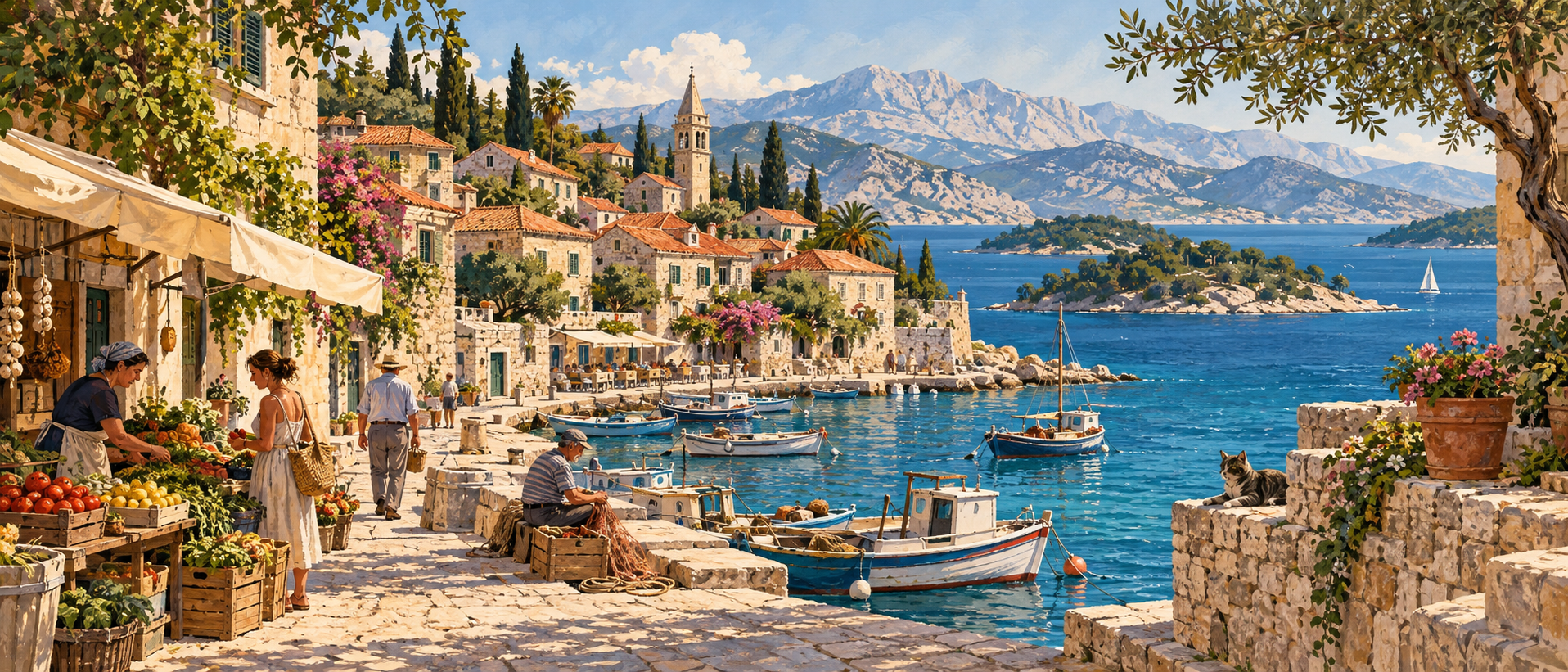
Croatia Children Vocabulary | Words for Character and Nation Building. Twenty useful English words connect four particular cultural or natural examples with trustworthy reading and age-appropriate practice. Croatia lets us move from a very small needle and thread to a group of voices, a town’s centuries-old tournament and the chemistry of lakes and waterfalls. The connection is the careful work behind every visible result: the lace-maker, the singer, the community organiser and the scientist all rely on skills that deserve accurate explanation.
Written for international children about eight to twelve years old and teachers or parents supporting them. This is an independent English-learning article, not the Croatian national curriculum, a guide to horse tournaments, a permission slip for protected wetlands or a requirement to participate in religious or regional customs. Stories and classroom examples are invented.
Country-specific UNESCO facts: UNESCO inscribed lacemaking in Croatia in 2009, klapa multipart singing in Dalmatia in 2012, Sinjska Alka in 2010 and Plitvice Lakes National Park as World Heritage in 1979. These sources concern distinct regional techniques, trained voice ensembles, a carefully organised local tournament and a dynamic limestone-water ecosystem. They do not prove that every Croatian household follows the same traditions.
Meaning of character and nation building: Here nation building means the transferable habits of listening carefully, giving makers and communities credit, being fair when describing rules and protecting shared natural and cultural places through appropriate conduct. It is not compulsory patriotic performance or a request that children do dangerous adult jobs.
Quick answer: the learning goals and limits
| Section | What children practise | What not to assume |
|---|---|---|
| 20 English vocabulary entries | Explain a term, recognise a near-miss and use it in an original sentence | Memorising spelling is understanding |
| Four country chapters | Connect a source fact with a particular person, place or process | One community’s experience is a whole country’s identity |
| Fictional reading story and six worked checks | Find misleading wording and explain an appropriate repair | Invented characters are historical witnesses |
| Seven days of independent use | Read, speak, compare, decide, write and transfer learned concepts | Young pupils should handle adult heritage or safety work |
Jump to 20-word bank · four chapters · fictional story · worked checks · practice plan · guidance for adults · frequently asked questions · sources and linked guides.
20 children’s English vocabulary words: meanings and original sentences
Each word includes its useful meaning and a boundary against a tempting incorrect use. The model sentences are invented teaching examples rather than reports about real pupils or historical people.
1. Lacemaking: the distinct regional skills of Pag, Lepoglava and Hvar
| Word | Meaning and distinction | Original example |
|---|---|---|
| lace | A delicate textile made by interlacing thread or similar material into patterned openings; not simply a printed lace picture. | The class studied real lace techniques. |
| needlepoint | A technique using a needle to create decorative textile stitches or lace; not the same as every bobbin method. | Pag is known for a needle-based lace tradition. |
| bobbin | A small spool around which thread is wound, used in some lace-making methods; not a musical instrument. | The Lepoglava example used bobbins. |
| aloe fibre | Thread-like material prepared from certain aloe leaves for the particular Hvar lace technique; not an invitation to process unknown plants. | The Hvar tradition uses carefully prepared aloe fibre. |
| practitioner | A person who actively carries out and sustains a craft or tradition; not simply someone who buys a souvenir. | The museum credited lace practitioners. |
2. Klapa: how different voices form one coordinated song
| Word | Meaning and distinction | Original example |
|---|---|---|
| klapa | A Dalmatian multipart singing tradition; not just a random group of people shouting together. | The students listened to a credited klapa performance. |
| multipart singing | Music in which different vocal parts combine; not necessarily everybody singing the same melody. | Multipart singing relies on different voices. |
| a cappella | Vocal music performed without instrumental accompaniment; not a measure of how loudly people sing. | The klapa group sang a cappella. |
| tenor | A higher adult male singing voice or voice part in certain group arrangements; not the leader of every kind of music. | The klapa first tenor began the song. |
| blend | The way different sounds combine into a coordinated result; not proof the singers lose their individual parts. | The singers listened for a balanced blend. |
3. Sinjska Alka: heritage, community rules and fair play
| Word | Meaning and distinction | Original example |
|---|---|---|
| Sinjska Alka | A particular historic horse-and-lance tournament in Sinj, Croatia; not every riding competition. | The guide named Sinjska Alka correctly. |
| chivalric | Associated with historic knightly customs or ideals; not a guarantee every past knight behaved fairly. | The tournament has a chivalric heritage. |
| ring | A circular target, in this context the alka struck with a lance; not a wedding ring. | The scoring target was an iron ring. |
| fair play | Honest respect for agreed rules and others in a contest; not a promise everyone will win. | The class discussed fair play without handling weapons. |
| transmission | Passing skills and cultural knowledge between generations; not simply filming one competition. | Community work supports the transmission of the Alka tradition. |
4. Plitvice: travertine, changing waterfalls and careful conservation
| Word | Meaning and distinction | Original example |
|---|---|---|
| karst | A landscape formed in soluble rock such as limestone, often featuring caves and distinctive water drainage; not any rocky hill. | Plitvice lies in a karst landscape. |
| travertine | A form of calcium-carbonate deposit formed from water, important to Plitvice’s natural barriers; not ordinary concrete. | Travertine builds part of the lake-barrier system. |
| barrier | Something that changes or restricts movement; here a natural tufa formation helping separate water levels. | The natural barrier helped create a waterfall. |
| monitoring | Repeated planned observation used to understand change over time; not one attractive photograph. | Park monitoring helps researchers study conditions. |
| stewardship | Responsible care based on rules and suitable knowledge; not climbing into fragile formations. | Staying on authorised routes was a form of stewardship. |
Four learning chapters: the real source, the right word and a safe task
Read a chapter as a small investigation. Name the people or site, ask what the official description establishes, examine an attractive but misleading claim and practise the general concept safely. Paper models do not confer the authority to perform cultural rituals or undertake hazardous work.
1. Croatian lace is not one fabric made by the same technique everywhere
Focus vocabulary: lace · needlepoint · bobbin · aloe fibre · practitioner.
UNESCO inscribed lacemaking in Croatia in 2009. It describes at least three regional traditions centred on Pag, Lepoglava and Hvar. A child who sees a delicate white textile might assume that every example was produced with one method. That would conceal much of the skilled work behind the finished pieces. UNESCO distinguishes needle-based, bobbin-based and aloe-fibre-related techniques, each connected with particular communities and practitioners.
Lace is a textile structure with decorative patterns and openings. A printed image imitating lace is not necessarily lace that has been physically made from thread. The distinction is valuable for children studying art and technology: a picture of an object and the process that produces it are different things. A pupil may accurately describe the visible pattern while still needing a qualified source to identify how the item was made.
The Pag tradition includes distinctive needlepoint lace. UNESCO connects it with decorative patterns used for clothing and household items. Bobbin lace, associated with Lepoglava, relies on threads wound on spools that can be manipulated and interlaced. The word bobbin therefore names a specific tool role. If a child describes bobbin lace as made entirely by painting lines onto fabric, the process has been misunderstood. The teacher can compare the techniques conceptually without turning the lesson into instructions for specialist work.
The Hvar practice is especially distinctive. UNESCO describes a form of lace made by Benedictine nuns using thread prepared from the core of fresh aloe leaves. That is why aloe fibre deserves a clear definition rather than a generic phrase such as ‘special plant string’. Children should not attempt to cut or process unknown plants or reproduce a monastery’s practice on their own. Learning a word is different from receiving permission or practical training.
A practitioner is a person who actually makes and carries the craft. UNESCO describes older women passing knowledge through teaching and courses, while the monastery tradition has its own setting. These are descriptions of the documented work, not instructions that every girl must practise lace or that every person in Croatia has identical religious beliefs. A child can respect a practice without belonging to it or being required to perform it. Participation is a choice shaped by context and the community’s knowledge.
The tradition also reveals how people can earn income through specialist skills. UNESCO notes that lace has played a role in regional identity and in rural women’s livelihoods. Yet a photo of a seller cannot tell a researcher exactly how much that individual earns or whether every maker has equal opportunities. Economic claims require economic evidence. A student can accurately say that lacemaking has provided important work without inventing a personal success story for an unnamed craftsperson.
In a fictional exhibit, one pupil labels Pag needle lace, Lepoglava bobbin lace and Hvar aloe lace as ‘the same machine-printed Croatian cloth’. Another reads UNESCO and rewrites the caption: ‘Croatia has several living lace traditions with different materials, tools and practising communities’. The correction gives readers a reason to look at the objects more carefully. It is a more respectful account than a broad national slogan that hides local expertise.
The word attribution matters even though it is not one of the five core terms. A finished lace item can have a named maker, a workshop, a date and a source. If these are unavailable, a museum label should not invent a woman’s name or assign the item to a particular town solely because its colour is familiar. Heritage labels can distinguish ‘this technique is found in a region’ from ‘this particular item was made there’. These are different levels of evidence.
For a safe school activity, draw three columns marked Pag, Lepoglava and Hvar. Under each, write the material or main technique documented by UNESCO and one detail the class still does not know about an unidentified photograph. Then use paper strips to demonstrate how crossing threads works in general. Label it ‘our original interlacing model’, not authentic regional lace. No sharp specialised tools or plant preparation are needed.
UNESCO inscription in 2009 is a date of formal recognition, not a claim that the craft was invented that year. Different methods have older histories and continue through people who practise them now. Teaching that distinction stops pupils from confusing institutional lists with actual dates of creation. A craft can be longstanding and still face choices about how knowledge should be transmitted to interested new learners.
Finish with one sentence that connects place, technique and person: ‘Croatia’s Pag, Lepoglava and Hvar lace traditions are sustained by practitioners who use different kinds of thread work and knowledge’. A child who understands that sentence has moved from noticing a pretty object to recognising the people and the practical skills behind it. That is a meaningful part of cultural vocabulary.
Misleading statement and correction: Misleading: ‘All Croatian lace is machine-printed in one town and uses identical tools.’ Repair: ‘UNESCO recognises distinct Pag, Lepoglava and Hvar techniques and practising communities.’
Child-safe transfer: Create a source-backed three-column comparison of Pag, Lepoglava and Hvar. Write a separate label for an original paper-thread model and explain what it cannot prove.
2. Dalmatian klapa singing teaches listening, roles and reliable attribution
Focus vocabulary: klapa · multipart singing · a cappella · tenor · blend.
UNESCO inscribed klapa multipart singing of Dalmatia, southern Croatia in 2012. The source identifies it as a particular vocal tradition, not the name for every musical group or song in Croatia. Klapa singers often perform a cappella, meaning without instrumental accompaniment, and develop a coordinated sound from different vocal parts. An audience may hear one smooth musical result, but individual singers have different roles. This makes the heritage a useful example of collaboration that does not demand sameness.
Multipart singing combines distinct vocal lines or parts. UNESCO explains that klapa groups may include a first tenor, other tenors, baritones and bass voices. The first tenor typically begins the singing, and the other singers enter according to the group arrangement. The word tenor names a vocal range or part; it does not automatically mean the most important person in every music tradition. Each role contributes to the overall sound.
The word blend describes how those voices combine. An excellent blend does not mean the singers are all making identical notes. Rather, the group listens carefully so that parts work together in pitch, timing and expression. A child can understand that distinction without pretending to reproduce the specific vocal technique. A classroom might speak a short invented poem in different groups, then discuss how coordinating timing affects clarity. It should not call this exercise an authentic klapa performance.
UNESCO notes that klapa song themes often concern love, ordinary experiences and the environment. The source describes different modes of performing and transmitting songs, including traditional, festival and modern settings. Some practitioners learn through oral teaching, while others encounter recordings and organised festivals. A tradition can have continuity and change; a video from a recent festival is not a record of how every group sang centuries ago.
Attribution matters when choosing a performance for school. A song can have a lyricist, composer, arranger and performing group. If a recording identifies the group, that name should be included in the caption. A student may enjoy the sound but cannot truthfully claim to have composed it. An online file also does not automatically grant permission to reproduce lyrics or sound. The safe alternative is to cite UNESCO’s explanation and use a short authorised example when available.
UNESCO’s description connects klapa with the musical identity of Dalmatian communities. That does not prove that every person on the Croatian coast enjoys it, nor that all Croatians speak the same language variety or perform the same songs. The correct scale of a sentence matters. ‘Klapa is an important Dalmatian tradition’ is a reasonable source-backed claim; ‘all Croatians sing klapa at home daily’ is an unsupported statement about millions of people.
Imagine an imaginary poster headed ‘Klapa means ten people shouting one note’. It might contain an arbitrary number and a misleading musical description. The class revises it after checking UNESCO: ‘Klapa uses coordinated multipart, often a cappella, singing with distinct vocal roles’. The revised statement explains what makes the form notable. It is more informative than a claim based only on volume or the number of people visible in a photograph.
A good listener can ask how a group manages disagreement or mistakes. Singers may need to practise, accept feedback and adjust timing to match one another. This transferable idea is relevant to school projects, where different learners may contribute writing, source-checking, illustration and presenting. But it does not mean the classroom has learnt the whole technical art of klapa, and it does not give outsiders authority to rewrite its cultural conventions.
Another potential mistake is to claim that music performed without instruments is unskilled or primitive. A cappella singing may demand careful pitch, breath and coordination. Instruments are not the only evidence of musical technique. UNESCO’s entry describes performers as skilled amateurs who learn through community participation. A child can learn to respect a practice without ranking it against the classical orchestral music they happen to know.
For a general English listening exercise, a teacher may divide pupils into two groups and have them read different original lines at planned times. They can describe blend, timing and multipart roles using ordinary words. If no appropriately licensed klapa recording is available, the UNESCO description alone is enough for a vocabulary lesson. No pupil should be pressured to sing solo or disclose their cultural background to prove participation.
Finish by writing a programme note that distinguishes the music’s origin, its type and a specific performer’s identity. When the performer is unknown, the label should say so. The result is a precise explanation that honours individual skills and regional history while avoiding an unsupported national stereotype.
Misleading statement and correction: Misleading: ‘Klapa is everyone shouting one melody loudly and requires no musical skill.’ Repair: ‘It is a skilled Dalmatian multipart singing practice involving distinct vocal parts, listening and blend.’
Child-safe transfer: Write a five-line concert note naming Dalmatia, a cappella singing, tenor and blend. Add a separate credit field for a verified performing group.
3. Sinjska Alka offers words for fair play without making horse tournaments children’s games
Focus vocabulary: Sinjska Alka · chivalric · ring · fair play · transmission.
UNESCO inscribed Sinjska Alka, a knights’ tournament in Sinj, on the Representative List in 2010. The contest has been held in the town of Sinj since the eighteenth century and is linked with community memory and historical customs. It is not a nationwide contest in which every Croatian child must take part. Its name comes from an alka, an iron ring used as the target. The term has a particular history and does not simply mean any wedding ring or circular toy.
The competition involves horse riders moving at high speed and aiming lances at a suspended target. It is therefore a specialist, potentially dangerous activity, not a physical challenge for a school field. A child who has learnt the vocabulary must not be encouraged to ride an unfamiliar horse or handle a lance. The English lesson can use paper drawings and a fictional scoring chart to illustrate the roles of rules and judgement without imitating the risky action.
The adjective chivalric relates to historical knightly customs and ideals. The source’s use of the word does not establish that every historical knight behaved kindly or that all past conflicts were fair. It identifies a cultural inheritance and form of competition. UNESCO describes a statute codified in 1833 and the emphasis on ethics and fair play. A learner can recognise that traditions may contain formal rules, but should not mistake a heritage contest for a modern national judiciary or government.
Fair play means following agreed rules and treating opponents appropriately. It is different from pretending everybody wins or that every difficult decision has an obvious answer. A contestant who accepts a properly judged result may show fair play even when disappointed. Likewise, a classroom group can apply fair play when sharing materials or correcting a scoring error. The scale of a paper classroom game differs greatly from the actual Sinjska Alka, and this distinction should be stated.
UNESCO explains that participants have particular connections to Sinj and the Cetinska krajina region. The whole community can contribute to making, caring for and repairing clothes, equipment and other materials associated with the event. A photograph of a mounted rider hides the seamstresses, craftspeople, organisers and people who maintain the tradition. A good programme note does not let the most dramatic action erase the less visible work.
The word transmission describes knowledge carried across generations. Local families, organisers and practitioners may help teach the skills and meanings associated with the tournament. UNESCO connects the practice with collective memory and community events. Its recognition in 2010 did not create the tournament; it formally acknowledged an older living practice. A child should distinguish the eighteenth-century origins, nineteenth-century codification and twenty-first-century inscription.
The tournament has relationships with local religious observances and customs. Studying a practice’s cultural context does not require an international learner to adopt those religious beliefs. A country article should also avoid assuming every resident of Sinj participates in the same way or that all Croatian families have the same connection to the event. The existence of a heritage practice does not turn a whole community into a uniform group of performers.
Imagine a school poster saying ‘All Croatian children should prove courage by copying Sinjska Alka with toy lances while riding’. It confuses appreciation with imitation and overlooks safety. A responsible correction is ‘Sinjska Alka is a specialised heritage tournament requiring trained participants; pupils can learn its history and fair-play vocabulary through safe classroom models’. This revision still makes the practice interesting, but it refuses to put children at risk.
In a safe paper exercise, draw a ring target and give imaginary points for hitting different zones. Use pencils or small tokens placed by hand, not thrown objects or horses. Ask what happens when two learners disagree about a point. The group can write a rule before the game, record the result and allow an explanation. This models fair play at a suitable scale without claiming to reproduce the real tournament’s technical scoring system.
Teachers can also ask whether different pupils’ contributions matter. The child who checks rules, the one who draws the target and the one who records points each improves the activity. This comparison makes the word contribution practical. The real Sinjska Alka likewise depends on more than a rider. The classroom is learning a general civic habit of fairness and reliable organisation, not a national martial skill.
An accurate final caption might read: ‘Sinjska Alka is a longstanding Sinj tournament recognised by UNESCO in 2010, maintained by skilled riders, craftspeople and local community traditions’. A student can add that its rules emphasise fair play, while making clear that training and official arrangements belong to practitioners. That is a stronger summary than a dramatic claim about every Croatian child’s bravery.
Misleading statement and correction: Misleading: ‘Sinjska Alka is a safe horse-and-lance game that all Croatian pupils should perform.’ Repair: ‘It is a specialist local heritage tournament whose fair-play principles can be discussed through safe models.’
Child-safe transfer: Create a fictional paper target game with clear agreed rules and a method for correcting scoring errors. Label it a classroom analogy, not a Sinjska Alka performance.
4. Plitvice’s lakes and waterfalls are a changing natural process
Focus vocabulary: karst · travertine · barrier · monitoring · stewardship.
UNESCO inscribed Plitvice Lakes National Park as World Heritage in 1979. The park lies in central Croatia and is famous for interconnected lakes and waterfalls in a karst landscape. Karst develops where water acts on soluble rocks, including limestone and dolomite, creating distinctive landforms and drainage. A child may notice the striking blue and green lakes, but the colours alone do not explain how the system works or prove the water is safe for swimming.
UNESCO describes the ongoing formation of travertine or tufa barriers, built from calcium-carbonate deposits associated with water and ecological processes. A barrier can change the flow of water and create differences in level that result in waterfalls. In this context it is a natural structure, not simply a concrete wall placed by people. The distinction shows how living organisms, water chemistry and rock formation can interact over time.
Some natural barriers are affected by vegetation, bacteria and other environmental conditions. UNESCO notes that the formation of tufa depends on specific physical, chemical and biological processes. A photograph of a waterfall captures a visible effect, but does not identify the rate at which mineral material was deposited or the long history of the lake system. A pupil should not invent a number such as ‘each barrier grows ten metres a year’ without measured scientific evidence.
The park has upper and lower lake groups with different settings. UNESCO describes distinctions in the underlying rocks and landforms. The upper lakes occur in a gentler setting associated with dolomites, while the lower lakes occupy a more canyon-like limestone area. A small map is useful for understanding those locations, but a source must support any claim about a particular lake’s depth, visitor accessibility or current level. One image of an upper lake does not represent every part of the property.
Monitoring means observing conditions systematically over time. Park managers and scientists may check water quality, ecological processes, visitor effects and other factors. The World Heritage inscription recognises outstanding natural value, but it does not mean every present condition is perfect. UNESCO discusses pressures that can affect water quality and natural formation processes. Claims about change should include the dates and methods of observations rather than relying on one visually attractive photograph.
The park also contains forest ecosystems important for bears, wolves, birds and other life. A photo of a waterfall does not measure wildlife numbers, and the presence of a protected designation does not imply visitors will see a wild bear. Such animals are not classroom demonstration subjects. A child’s learning should involve official descriptions and diagrams, not attempts to track or approach dangerous wildlife. Experts and authorities manage research, safety and conservation.
Stewardship means responsible care based on knowledge and appropriate rules. The park’s travertine formations can be fragile, so visitors should not climb onto protected barriers, disturb plants or collect samples. Real access restrictions and route conditions depend on current park guidance. A vocabulary article cannot provide authoritative travel directions or tell a family that a particular path is open. The child-sized act of care is accurate communication and following responsible adults’ instructions.
Imagine a fictional class poster reading ‘Plitvice is a series of artificial dams made once and never changed’. Another student checks UNESCO and learns that the natural barriers are shaped by continuing geological and biological processes. The corrected caption might say, ‘Plitvice’s lakes and waterfalls are associated with ongoing travertine formation in a karst landscape’. This sentence is more scientifically useful because it links the visible feature with the process that makes it possible.
Another mistaken conclusion is that a natural site must be untouched by all human influences. Protected parks can receive visitors and involve management interventions intended to safeguard ecosystems. The presence of a boardwalk or information centre does not make the lakes artificial, and the existence of a protected boundary does not mean every human impact disappears. A child can learn to distinguish a natural hydrological process from the infrastructure and rules used to protect it.
For a paper exercise, draw three invented water levels separated by natural barrier shapes. Add arrows for flowing water and a label for travertine. Clearly mark the picture as an illustrative model, not a current surveyed map of Plitvice. Then write one source-backed fact about the park and one unknown that requires scientific measurement. A good student may say they do not know the actual deposition rate, which is a truthful limit.
The chapter finishes with a general lesson: beauty can encourage interest, but evidence explains what is happening. A learner who sees a blue lake should ask how its water and rock system works rather than assume the colour proves purity or permanent stability. Accurate words help protect nature because they prevent false confidence. The important character skill is the willingness to check a claim before repeating it, even when an image looks convincing.
Misleading statement and correction: Misleading: ‘Plitvice’s waterfalls were all built from concrete at one time and remain unchanged.’ Repair: ‘UNESCO documents naturally developing travertine barriers and ongoing water and ecological processes.’
Child-safe transfer: Draw a fictional three-lake karst diagram with natural barriers and a waterfall. Describe which parts are a model, and name one measurement that a scientist would need for a real trend claim.
Fictional classroom story: correcting the source and the sentence
At an imagined Croatian school exhibition, Petra labels Pag, Lepoglava and Hvar lace as one machine-made product. Her classmates use UNESCO’s description to name three different methods. Luka says klapa is just loud unison shouting, and a teacher introduces multipart singing and blend. Ana invites pupils to copy Sinjska Alka on horses; an adult changes the activity to a safe paper target and a fair-play discussion. Finally, Marin calls Plitvice’s natural barriers concrete walls that cannot change, and he revises the label to explain travertine formation. These pupils and scenes are fictional; the heritage facts come from the UNESCO sources below.
Four comprehension questions
- 1. What technique differences were missing from Petra’s first caption?
- 2. Why was Luka’s description of klapa musically inaccurate?
- 3. How could Ana preserve the fair-play lesson without an unsafe tournament imitation?
- 4. What natural process did Marin leave out of the lake diagram?
Ask the child to explain which invented classroom action supports the answer. For a real cultural, historical or ecological claim, use the UNESCO references below. The fiction is a learning model, not eyewitness testimony.
Six vocabulary checks with worked answers
Check 1: When did UNESCO inscribe lacemaking in Croatia?
Worked answer: 2009, for distinct regional traditions including Pag, Lepoglava and Hvar.
To demonstrate understanding, identify the supporting fact, rule out one tempting but inaccurate alternative, and make a new sentence in another context. A correct explanation is worth more than a memorised label.
Check 2: Which Croatian location has an aloe-fibre lace practice?
Worked answer: Hvar, in a specialist tradition associated with Benedictine nuns.
To demonstrate understanding, identify the supporting fact, rule out one tempting but inaccurate alternative, and make a new sentence in another context. A correct explanation is worth more than a memorised label.
Check 3: What is klapa multipart singing?
Worked answer: A Dalmatian vocal tradition in which different parts, often without instruments, blend together.
To demonstrate understanding, identify the supporting fact, rule out one tempting but inaccurate alternative, and make a new sentence in another context. A correct explanation is worth more than a memorised label.
Check 4: Which year was Sinjska Alka inscribed?
Worked answer: 2010. The tournament predates that formal UNESCO recognition by centuries.
To demonstrate understanding, identify the supporting fact, rule out one tempting but inaccurate alternative, and make a new sentence in another context. A correct explanation is worth more than a memorised label.
Check 5: What does the word travertine describe at Plitvice?
Worked answer: Natural calcium-carbonate deposits that contribute to lake barriers and waterfalls.
To demonstrate understanding, identify the supporting fact, rule out one tempting but inaccurate alternative, and make a new sentence in another context. A correct explanation is worth more than a memorised label.
Check 6: Can one photograph establish a lake’s current water quality or the future of its barriers?
Worked answer: No. Such conclusions require appropriate monitoring and scientific evidence.
To demonstrate understanding, identify the supporting fact, rule out one tempting but inaccurate alternative, and make a new sentence in another context. A correct explanation is worth more than a memorised label.
Seven days to learn words children can use independently
| Session | What to do | How to assess progress |
|---|---|---|
| Day 1 — Notice | Read words 1–5 and define each in different language from the table. | One correct example and non-example |
| Day 2 — Speak | Use words 6–10 in two safe school or family situations. | Clear original oral sentences |
| Day 3 — Source | Read an age-appropriate official excerpt with adult assistance. | A documented fact and an open question |
| Day 4 — Compare | Learn words 11–15 and sort statements as observation, source fact, inference or fiction. | No imagined history passed off as a record |
| Day 5 — Decide | Learn words 16–20 and discuss a fictional group task with a safe action. | A named responsibility and realistic outcome check |
| Day 6 — Write | Write an 80–120-word original paragraph using three target words and one source. | Clear writing and correct attribution |
| Day 7 — Transfer | Apply three general words to another community or place. | Correct meaning without assuming identical cultures |
A three-part retrieval check
Ask whether the child can explain a term without copying the printed definition, recognise a convincing misuse and apply it in a new setting. Mark ‘not yet’, ‘with help’ or ‘independently’. Repeat the activity several days later. When the child corrects an error after finding a reliable source, that is evidence of academic growth.
When reviewing a paragraph, check whether every sentence has a clear subject and action, whether vocabulary makes the explanation more exact, whether country claims have sources, and whether any example is fictional and age-appropriate. An honest unknown is better than an invented date, location or name.
Notes for parents and teachers: practical character, not empty slogans
- Start with the named source. A heritage inscription supports a specific description, not a claim that all residents have identical practices.
- Credit the people behind an object. Artists, craft workers, teachers and conservation specialists can make different contributions.
- Do not turn heritage into compulsory performance. Children may learn about festivals without acquiring permission or skills to imitate them.
- Preserve historical dignity. A colonial building or ancient object has a history and human context that a photograph alone does not explain.
- Respect safety and qualifications. Horse tournaments, specialised processing, protected-area access and repairs are adult responsibilities.
- Keep scientific measures attached to their method. A photograph shows an observation, not a long-term population or geological trend.
- Make inclusion practical. The intended reader should actually be able to understand a notice, not just see ‘welcome’ printed on it.
- Reward source-based revisions. An honest correction helps readers and respects the people whose work is being described.
Frequently asked questions
Is all Croatian lace made with bobbins?
No. UNESCO describes Pag needle lace, Lepoglava bobbin lace and Hvar aloe-thread lace.
Does a cappella mean all klapa singers perform exactly one note?
No. It means vocal music without instrumental accompaniment, and multipart singing involves distinct parts.
Can children ride horses with lances to learn Sinjska Alka?
No. The heritage tournament is a trained, hazardous activity. A paper model teaches fair play safely.
Is Plitvice a set of man-made concrete dams?
No. Its lakes and waterfalls are associated with natural travertine or tufa formation in karst geology.
Does UNESCO recognition prove no conservation challenges remain?
No. Heritage listing identifies value; safeguarding and ecological conditions require continued management and evidence.
What is a suitable character-building goal?
Accurate source credit, a fair classroom decision, improved explanations and respect for cultural and natural sites.
Primary sources and connected eduKateSG learning
The country-specific information above was verified against the named UNESCO and institutional sources in October 2026. Original student stories, practice diagrams, sentences and imagined experiences are editorial teaching material rather than a national school syllabus or reports of actual events. Consult responsible authorities for current visitor access or safety.
- UNESCO | Lacemaking in Croatia (2009)
- UNESCO | Klapa multipart singing of Dalmatia (2012)
- UNESCO | Sinjska Alka tournament in Sinj (2010)
- UNESCO World Heritage | Plitvice Lakes National Park
- UNICEF | Convention on the Rights of the Child
Read more about this country
- Everything About Croatia
- How Education System of Croatia Works
- Croatia Education System Overview
- Top 100 Glagolitic Script Vocabulary Words
Continue the A–K Children Vocabulary country sequence
Costa Rica Children Vocabulary · Côte d’Ivoire Children Vocabulary · Croatia (this article) · Cuba Children Vocabulary · Cyprus Children Vocabulary
Return to vocabulary and world-learning hubs
- Vocabulary Learning Hub
- Vocabulary by Age and Purpose
- How Countries Work | A–Z
- Top 20 Unique Vocabulary by Country
A learner who completes this Croatia guide should be able to explain twenty English terms, identify what a credible source supports, recognise a maker or affected community and complete one small, safe correction. Accurate language becomes part of character when it improves understanding and respect.