
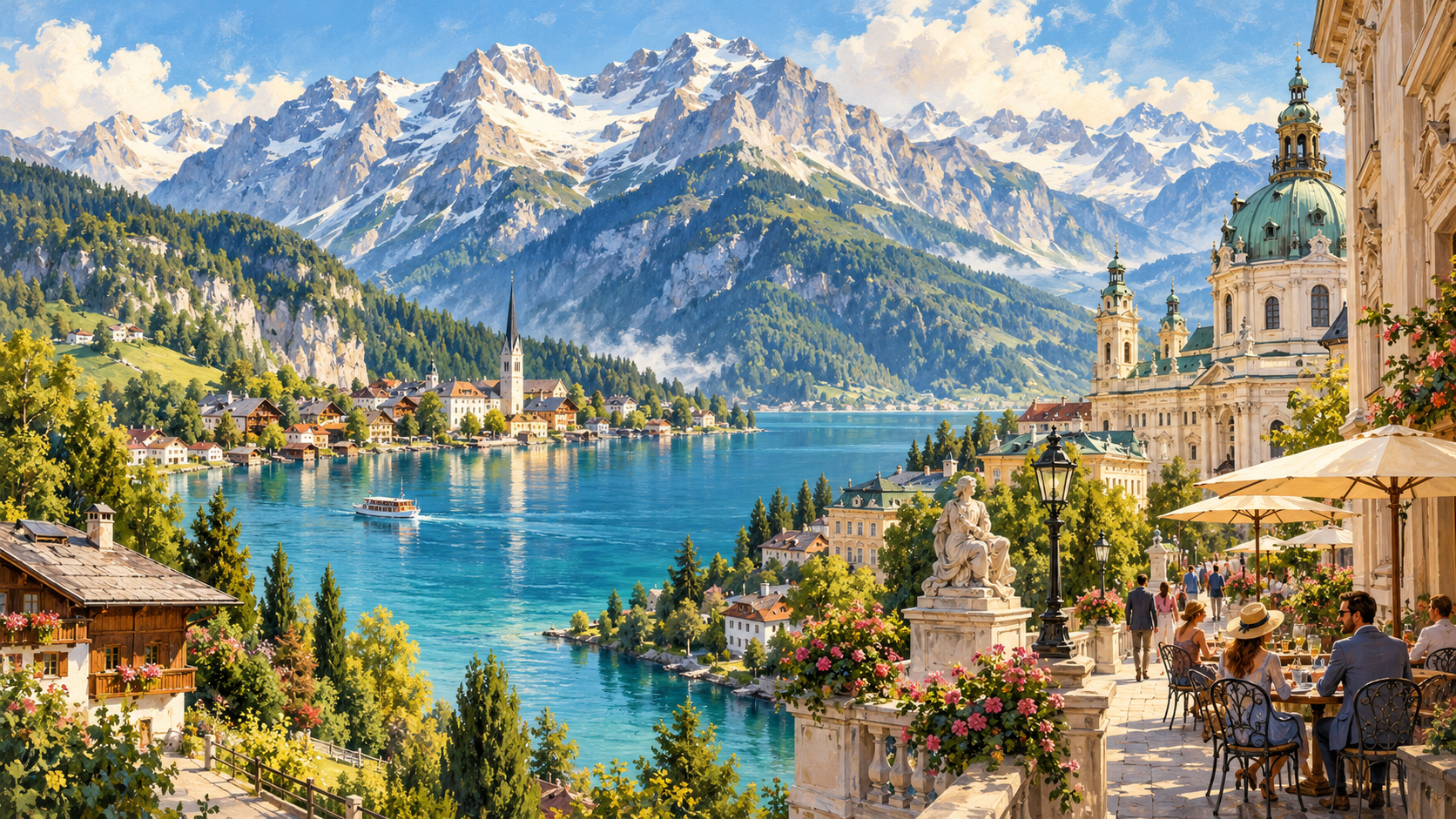
How does Austria’s government work, why are there nine federal states, and how do healthcare insurance, public transport, apprenticeships, tourism and taxes fit together? Austria is a federal parliamentary republic in central Europe. Its federal president is head of state, the chancellor leads the federal government, and the elected National Council is central to legislation and political accountability. Nine federal states, districts and municipalities help administer a country that includes the capital Vienna, industrial regions, Alpine valleys and many cross-border connections.
The easiest way to understand Austria is to follow a daily need through federal law → state and district administration → municipalities and service providers → railway, school, workplace, clinic or home. A healthcare card depends on social insurance, a rail ticket depends on infrastructure and multiple transport operators, and a vocational qualification depends on both a company and a school. This guide explains those connections, beginning with the questions readers most often ask.
Austria at a glance: the system in seven answers
- Government: federal parliamentary democratic republic with a federal president, chancellor, ministers and two parliamentary chambers.
- States: nine Bundesländer, including Vienna, which is both the national capital and a federal state.
- Local administration: provinces, districts and municipalities carry different legal and service responsibilities.
- European framework: Austria is a member of the European Union and uses the euro; EU responsibilities and Austrian domestic powers intersect.
- Healthcare: statutory social insurance is the foundation for many residents; coverage and patient costs depend on the service and insurance arrangement.
- Schools and skills: nine years of compulsory school education, followed by differing academic and vocational pathways; the dual apprenticeship system joins workplaces and vocational schools.
- Daily infrastructure: railways, regional transport, roads, energy, housing and Alpine hazard management are closely linked to the economy.
This article was reviewed on 20 October 2026. Formal structures can be checked through the Austrian Parliament’s political-system guide and the federal government’s overview. For current prices, population and economic figures, use Statistics Austria, not an unlabelled comparison chart.
1. Who runs Austria: president, chancellor or parliament?
Austria has a federal president as head of state and a federal chancellor who leads the federal government. The government includes ministers who direct policy areas and administration. The president has constitutional appointment and other formal powers; the practical management of most policy is carried out through the federal government and parliamentary process.
The directly elected National Council (Nationalrat) has 183 members under the current constitutional framework and plays the central role in federal legislation and government accountability. A government or individual minister can face a vote of no confidence. The second chamber, the Federal Council (Bundesrat), represents the interests of the provinces.
These distinctions help interpret a headline. A presidential appointment, a cabinet proposal, a vote in the National Council, an objection by the Federal Council and a regulation issued by a ministry are different acts. One may enable the next, but none should be reported automatically as a completed public-service outcome.
2. What is the difference between the National Council and Federal Council?
The National Council is elected by the public and is the principal chamber for passing federal laws and exercising political scrutiny. The Federal Council represents the nine federal provinces; its members are delegated by provincial legislatures rather than selected through one separate nationwide public election for that chamber.
The Federal Council can object to many laws, but such objections are generally suspensive rather than absolute. Some matters require its consent. This is an important nuance: Austria’s second chamber gives federal states a voice without making its powers identical to the National Council.
For the exact processes, consult the National Council’s official guide and the Federal Council’s description. The point of bicameral lawmaking is not to guarantee agreement; it creates structured responsibilities and review.
3. What are Austria’s nine federal states?
They are Vienna, Lower Austria, Upper Austria, Burgenland, Styria, Carinthia, Salzburg, Tyrol and Vorarlberg. Each state has its own elected legislature and executive arrangements under Austria’s federal constitutional structure. The German term Bundesland means federal state; the plural is Bundesländer.
An Austrian state is not simply an administrative region drawn for statistics. Federal and state responsibilities are distributed by law, and states also carry out some administration under federal frameworks. The scope of their powers is different from the sovereignty of a separate country and should not be compared mechanically with provinces elsewhere.
Vienna is a particularly useful case study. It functions as Austria’s national capital, one of its federal states and a city with municipal responsibilities. The institution responsible for a Vienna task can therefore differ from what would happen in a smaller town located within a larger state.
4. Why does Austria have districts and municipalities as well?
Federal states are divided into administrative areas and municipalities, with special arrangements for certain cities. District administrative authorities help implement many laws and administrative functions, while municipalities handle assigned local services. A municipality is not automatically the body that decides every road, school or hospital matter inside its territory.
Consider a new playground and a nearby regional road. The playground and local maintenance may involve municipal responsibilities. The wider road might come under state or another competent authority. Safety regulations can involve district administration. Residents experience one neighbourhood while the rules distribute tasks among different offices.
The Austrian Parliament’s federal-state explanation also describes fiscal responsibilities and administrative cooperation. The student’s lesson is to separate the place where a problem occurs from the institution legally empowered to fix it.
5. How does a national policy reach an Austrian village?
A law can establish rules and budgets, but it cannot operate a library, railway crossing or care service alone. Ministries, state authorities, district offices, municipalities, public agencies, social-insurance organisations and contracted companies may all be involved, depending on the task.
Original fictional example: A village library needs improved disabled access. The owner and operator must assess the building, comply with relevant accessibility and building rules, find funding, arrange the work and make sure residents can use it. A grant may help, but grant approval is not the same as completing the entrance or keeping it safe in winter.
Good public-service evaluation follows five stages: who has authority, how the work is funded, who carries it out, who maintains it and what the actual user experiences. That approach works for Austrian schools, stations, clinics and even local flood barriers.
6. Who collects taxes and who pays for public services?
Austria’s major tax revenues are generally raised under federal laws, while the federation, states and municipalities share public resources under financial arrangements. Local and provincial budgets also have their own revenue and spending responsibilities. Federalism therefore involves negotiation about money as well as lawmaking.
A national healthcare or education goal may require contributions and cooperation from more than one government level. A municipality may need to maintain local access while a higher-level institution finances or operates the main facility. Maintenance, staffing and equipment must continue after the initial investment.
The parliamentary guide notes that income tax and value-added tax are important federal taxes, with provinces receiving a share under periodically renegotiated fiscal equalisation arrangements. A budget headline should be read alongside this revenue-sharing system, rather than interpreted as money automatically available for every local project.
7. Is Austria part of the European Union, and what does the euro change?
Yes. Austria joined the European Union in 1995 and uses the euro. EU membership affects shared-market rules and certain international, commercial, environmental and other policies, while Austria retains domestic institutions and constitutional powers. An EU rule and an Austrian municipal bylaw occupy different levels of the legal system.
Euro currency simplifies many transactions with other euro-area countries. It removes the need to exchange currencies for ordinary purchases across the euro area, but it does not guarantee identical prices, wages or tax systems across member countries.
Businesses still need to understand national payroll obligations, public-service rules and local conditions. A supplier from another EU country may move goods under single-market arrangements, but a local restaurant still needs to follow applicable Austrian food safety and municipal requirements. European integration is an additional layer, not a replacement for all national governance.
8. How does Austria’s social health insurance work?
Statutory social health insurance is a central part of Austrian healthcare. Employment and other legal conditions often establish compulsory insurance cover; qualifying family members may also be covered under applicable rules. The precise institution, contributions and entitlements depend on the person’s status and applicable law. It is not accurate to say every health service is entirely free.
An insured person may use an e-card and see participating doctors or services. Hospitals, outpatient care, medicines, specialist appointments and certain services can involve different financing or co-payment rules. Public services and supplementary private healthcare exist within the larger system.
The Austrian government’s official health-insurance explanation sets out compulsory coverage and possible self-insurance. Always check a person’s actual insurance status and current entitlement before drawing conclusions about coverage.
9. Why does a health insurance card not solve every health problem?
Insurance deals with access and payment rules, but effective medical care also depends on available clinicians, hospital facilities, medicine supplies, appointment systems and transport. A person might have a valid insurance card while still needing to wait for a specialist or travel from an Alpine valley to a regional hospital.
Illustrative case: A patient needs a diagnostic scan. A doctor identifies the need, the appropriate referral and booking system establishes the appointment, the patient travels to the facility and the scan is performed by qualified staff. If the road is closed or the scanner is unavailable, coverage alone does not create an appointment.
The fair measures of healthcare performance therefore include financial protection, waiting times, quality and geographic access. Counting insurance cards or hospital buildings captures only part of the system.
10. Why is the Austrian railway network such an important national asset?
Austria sits at a European crossroads. Railways connect Vienna, regional cities, industrial areas, Alpine valleys and neighbouring countries. They carry passengers and freight, providing alternatives to road travel and helping businesses connect to larger European markets. A train system only works when tracks, power, stations, timetables and passenger information fit together.
The ÖBB network and other operators form part of wider domestic and cross-border mobility. Journeys may also depend on regional buses, urban trams or metro services and the last walk to a destination. A fast intercity train is not enough if the final bus stops running before passengers arrive.
Transport should be judged by door-to-door usefulness, not only maximum train speed. Reliability, safety, accessible stations, connections and clear ticket information determine whether an ordinary passenger can use the infrastructure.
11. What is Austria’s KlimaTicket and why does it matter?
The KlimaTicket Ö is a nationwide annual public-transport pass valid on a wide range of participating rail and public transport services. Specific route coverage and exceptions are described by the official operators. Regional tickets also exist. The concept is to make complex travel across networks easier to understand and use.
The ÖBB information page explains nationwide validity across all nine federal states on participating services, and the official KlimaTicket website lists the current conditions. Fares may change, so avoid relying on an old price from a 2021 article.
The deeper design principle is friction reduction. A person who knows one pass will cover the relevant journeys can more easily plan a trip between school, work and home. However, ticket simplicity cannot replace real transport frequency, accessible stops or sufficient capacity.
12. What does a missed rail connection reveal about the system?
Original fictional example: A student travels from a small town to an apprenticeship workplace and vocational school. The regional bus is delayed during snowfall and misses its rail connection. The student may have valid tickets and a correct timetable, yet loses valuable time.
The problem crosses road maintenance, bus scheduling, railway dispatch, weather information, the employer’s attendance expectations and the school’s communication procedures. No one actor owns the whole journey. Better connections, sensible buffers and reliable real-time information can reduce disruption.
The lesson is practical: a transport network must be evaluated as a sequence of links, not as isolated machines. One apparently small timetable change can improve or damage daily opportunities for many people.
13. Why do mountains make Austrian transport planning difficult?
The Alps help shape Austria’s landscape, tourism economy and regional identity. They also introduce tunnels, steep grades, mountain passes, winter maintenance needs and exposure to heavy rain, avalanches or slope hazards in some areas. The engineering requirements of a valley route differ from those of a flat urban street.
Snowfall can delay local roads even when a national motorway is operating. A damaged bridge may affect school access, freight and emergency journeys simultaneously. Alpine infrastructure needs careful design, inspection and maintenance over many years.
More roads are not always the only answer. Rail connections, better transfer points, local transport, safety monitoring and reliable weather information can sometimes address demand more efficiently. The appropriate combination depends on geography and the people who use the routes.
14. How does tourism affect local budgets and services?
Austria’s historic cities, cultural attractions and Alpine destinations create tourism jobs and business opportunities. Hotels, restaurants, guides, shops and transport services benefit from visitors. But visitor demand also places pressure on waste collection, roads, water, accommodation, emergency services and natural spaces.
A small winter resort may serve a modest resident population but far more people during peak weeks. It cannot plan every utility and transport decision solely around permanent residents. At the same time, overbuilding infrastructure for one seasonal rush can impose long-term costs.
A strong tourism system balances local incomes with housing affordability, environmental care and the daily needs of residents. Counting overnight stays or ticket sales is useful, but it is not an adequate measure of whether the community can thrive year-round.
15. Why does Austria have manufacturing as well as tourism?
Austria’s economy includes manufacturing, engineering, machinery, specialised suppliers, pharmaceuticals, food products, professional services and tourism. Many firms operate within European supply chains, selling components or finished goods across borders. Their success relies on skilled labour, standards, energy, transport and stable commercial relationships.
A machine-building firm may need parts from several countries and deliver finished equipment to another EU market. A missed freight connection, late electronic component or electricity problem can delay the whole order. Export success is a result of hundreds of coordinated decisions rather than one national slogan.
Statistics Austria publishes data on output, employment, trade and prices at its official portal. When comparing industries, separate turnover, output, exports, value added and employment: each measures a different aspect of the economy.
16. What was happening to Austrian prices in 2026?
Statistics Austria reported 3.6% year-on-year inflation for September 2026, on its Consumer Price Index reporting page. That figure compares consumer prices with September 2025; it is not a monthly 3.6% price rise and does not mean every household bought an identical mix of goods and services.
Inflation matters because households must pay for rent, energy, transport and groceries with income that may change at a different rate. A business may also face rising wage, material and supply costs. Monetary policy for the euro area connects to the European Central Bank, while Austrian tax and spending decisions involve national institutions.
The official CPI/HICP page also distinguishes the domestic Consumer Price Index from the harmonised measure designed for cross-country comparisons. A good reader always identifies the measure and year before drawing conclusions.
17. Why are hydropower and electricity networks important?
Austria uses hydropower as a major part of its electricity system. Flowing water can provide renewable generation, but river conditions, precipitation and seasonal demand matter. Other generation technologies, storage, cross-border electricity trade and grid operations contribute to the overall supply picture.
A household sees a switch; beneath it is a chain of generation, transmission, distribution, contracts, maintenance and regulation. A hydropower station is not useful to a remote user if a distribution line is damaged or the network cannot deliver the required capacity.
Claims about ‘renewable electricity’ need careful definitions. Installed capacity, annual domestic generation, imports and the electricity actually consumed are not identical. A particularly wet year and a dry year can produce different results without changing the number of plants.
18. How are schools organised in Austria?
Austria has nine years of compulsory school education, generally beginning in the year after a child turns six under the applicable age rules. The first four school years are commonly in Volksschule, followed by different lower-secondary routes including Mittelschule and the lower level of AHS. The ninth year can be completed through suitable academic, vocational or preparatory pathways.
The official schooling rules, updated July 2026, explain age and stage requirements. Austria also has further education and training expectations for young people and a variety of academic or technical upper-secondary programmes.
For full pathway details use eduKateSG’s Schools of Austria, How Education System of Austria Works and How Ministry of Education for Austria Works. These existing specialist articles complement this wider national-systems guide.
19. How does Austria’s apprenticeship system work?
Austria is well known for its dual training system, in which apprentices learn in a company and attend vocational school. Official guidance describes a typical training allocation of about 80% at the company and 20% in vocational school, although requirements and particular arrangements vary by occupation.
This connects education directly to the economy. Employers provide supervised practical experience, vocational teachers supply structured knowledge and qualifications establish an identifiable skills pathway. Students gain real work experience while developing mathematics, technical literacy, language and professional habits.
The official apprenticeship training guide explains contracts, learning arrangements and examinations. It does not mean every teenager follows an apprenticeship or that a vocational route is simply an easier version of an academic route. They prepare people for different work and study trajectories.
20. What happens after school if a student wants university?
Austria offers pathways including academic secondary programmes and certain higher vocational schools that can lead to the Matura qualification, as well as other recognised routes and access conditions for tertiary education. Universities, universities of applied sciences and professional qualifications serve different purposes.
A family comparing options should start with the student’s interests and qualification requirements, not an assumption that one route is automatically best. Some learners need a strong theoretical pathway; others benefit from hands-on training. Recognition, programme quality, placement availability and personal support matter.
Behind every future engineer, health worker, business owner or technician is a chain of lessons, examination systems, mentoring, practical experience and later professional development. Education is therefore human infrastructure that supports all the country’s other systems.
21. How do an ageing population and labour market affect services?
Austria, like many European countries, must plan for a changing age profile and the needs of families, workers and older residents. When more people need care, transport and accessible housing, public demand shifts. Healthcare staffing, pension systems and retirement transitions must be analysed alongside workforce supply and economic productivity.
An older resident’s daily independence can depend on three systems at once: a nearby public-transport stop, accessible housing and an available clinic. A care-service policy may be sound on paper yet ineffective if the resident cannot physically reach or use it.
Planning therefore involves both the long view and the individual. A training programme started today may not produce fully qualified care workers immediately. A new clinic needs not only construction funding but also nurses, equipment and stable future operation.
22. What happens when an Alpine flood affects three governments?
Fictional worked case: Heavy rainfall damages a local bridge near a mountain village, interrupting a school journey and deliveries to a pharmacy. The municipality reports the local disruption; the road’s legal operator organises repairs; district and state authorities may have emergency and safety responsibilities. Affected transport companies communicate alternative routes.
The pharmacy’s medicine stock, student attendance, the local economy and emergency access are all affected. The original issue appears to be a bridge, yet it touches health, education, transport, water management and public communication.
A good recovery plan therefore asks which service is urgent, who is legally responsible, which temporary alternatives are safe, how to fund repairs and what long-term improvements could make the route less vulnerable. Reopening a road is one milestone; restoring dependable daily life is the larger outcome.
23. Austria compared with Singapore: what is transferable?
Singapore is a dense island city-state built around a major port, airport and closely linked urban services. Austria is a landlocked Alpine federal republic embedded in European land transport networks. Both depend on education, trusted institutions, infrastructure, public health and international commerce, but the physical settings differ.
Austria’s KlimaTicket offers a useful study of integrated ticketing across operators; Singapore’s public transport illustrates a different model of dense connectivity. Austrian hydropower depends on terrain and river conditions, while Singapore uses water technologies and infrastructure under very different natural constraints.
The useful comparison is problem, institution, infrastructure, outcome. Ask what each country is trying to solve before judging the design. See How Singapore Works and How Singapore Connects | Roads, Expressways and Junctions.
24. A simple exercise: how one ticket connects a whole country
Draw a journey from an Alpine town to Vienna: walk → local bus → regional station → intercity train → city transport → destination. Above each arrow write what could go wrong: weather, timetable mismatch, accessibility, crowding, maintenance or ticket validity. Then draw a second row with the organisation responsible for each problem.
Finally, mark which issues can be solved by an individual operator and which need cooperation. A national ticket can simplify payment, but not remove a blocked bridge. A new tunnel can reduce a journey time, but not guarantee a conveniently timed local bus. This is what it means to study Austria as a system rather than only as a map.
Frequently asked questions about how Austria works
Does Austria have a president or prime minister?
Austria has a federal president as head of state and a federal chancellor as head of government. The roles are different; Austria is a parliamentary republic.
How many states are there in Austria?
Nine Bundesländer: Vienna, Lower Austria, Upper Austria, Burgenland, Styria, Carinthia, Salzburg, Tyrol and Vorarlberg.
Is Vienna a city or a federal state?
Both. Vienna is the national capital and is itself a federal state, with administrative arrangements that combine city and state functions.
Is Austria a member of the European Union?
Yes. Austria joined in 1995 and uses the euro. EU law and institutions operate alongside Austria’s domestic constitutional arrangements.
What is the difference between Nationalrat and Bundesrat?
The National Council is the directly elected principal legislative chamber. The Federal Council represents the provinces and can review or object to legislation under constitutional rules.
Is Austrian healthcare completely free?
No. Statutory insurance covers many eligible services, but costs and contributions depend on the person’s status, service and applicable rules. Some out-of-pocket expenses can arise.
How does KlimaTicket work?
It is an annual ticket for extensive participating public transport across Austria, with scope and exceptions set out by the official ticket scheme. Check current conditions and prices before travel.
How long does compulsory school education last?
Nine school years under the national framework, typically including four years of primary school followed by lower-secondary routes and an appropriate ninth-year placement.
Why does Austria emphasise apprenticeships?
The dual system links supervised company training with vocational school, helping learners develop recognised practical and theoretical skills for the labour market.
Why does a federal state matter to a local service?
A state has its own institutions, responsibilities and budgetary arrangements. The proper operator for a road, school or administrative service must be determined by law and local arrangements, not guessed from the address alone.
Continue through the world and Singapore civilisation library
This article belongs to How Countries Work, the international sibling of How Singapore Works. Compare nearby entries: Australia’s federal states, Medicare and schools, Argentina’s provinces and inflation, Armenia’s parliament and regional connections, and Albania’s municipalities and EU integration. These examples reveal how different countries organise law, infrastructure, learning and everyday service.
Primary sources and date of review
- Austrian Parliament: political system — government and federal structure.
- Austrian Parliament: nine-state federal system — shared powers and revenues.
- The National Council and the Federal Council — legislative responsibilities.
- Austrian government: compulsory health insurance — coverage and possible self-insurance.
- ÖBB: KlimaTicket Ö — ticket coverage, networks and current conditions.
- Statistics Austria: CPI/HICP, September 2026 — 3.6% annual inflation.
- Austrian government: compulsory schooling, July 2026 — nine school years and pathway rules.
- Austrian government: dual apprenticeship training — company and vocational school roles.
- Reviewed: 20 October 2026. Household, transport and emergency scenarios are original educational illustrations, not reports of particular incidents.