
Where is Bhutan, what is it famous for, and how do its landscapes, institutions and everyday lives fit together? Bhutan is often introduced through mountain scenery and the idea of Gross National Happiness. A fuller country portrait also examines history, public services, livelihoods, migration and the practical choices involved in development.
This guide takes those subjects seriously without treating the country as a perfect retreat from the modern world. It connects villages, towns, schools, cultural traditions and international relationships, while distinguishing a measured indicator from a slogan and a planned project from an operating service.
Bhutan at a glance
- Official name: Kingdom of Bhutan.
- Location: the Himalayas in South Asia; see the World Bank country overview.
- Capital: Thimphu.
- Land neighbours: India and China.
- Coastline: none; Bhutan is landlocked.
- National language: Dzongkha, alongside other languages used in communities and institutions.
- Currency: ngultrum, code BTN.
- Reading date: 20 October 2026 in Singapore. Statistics, policy changes and historical observations retain their own dates.
Stable basic facts are drawn from the official Bhutan at a Glance 2023 reference for the country’s name, capital, national language and currency; the World Bank overview supports the location, borders and landlocked geography. Older reference publications are not used here as evidence for current economic or population figures.
Three distinctions help: a national happiness index is not the percentage of people who are always happy; environmental commitments need dated measurements; and a constitutional promise must be distinguished from the experience of particular people. Keeping these distinctions visible makes appreciation more informed rather than less possible.
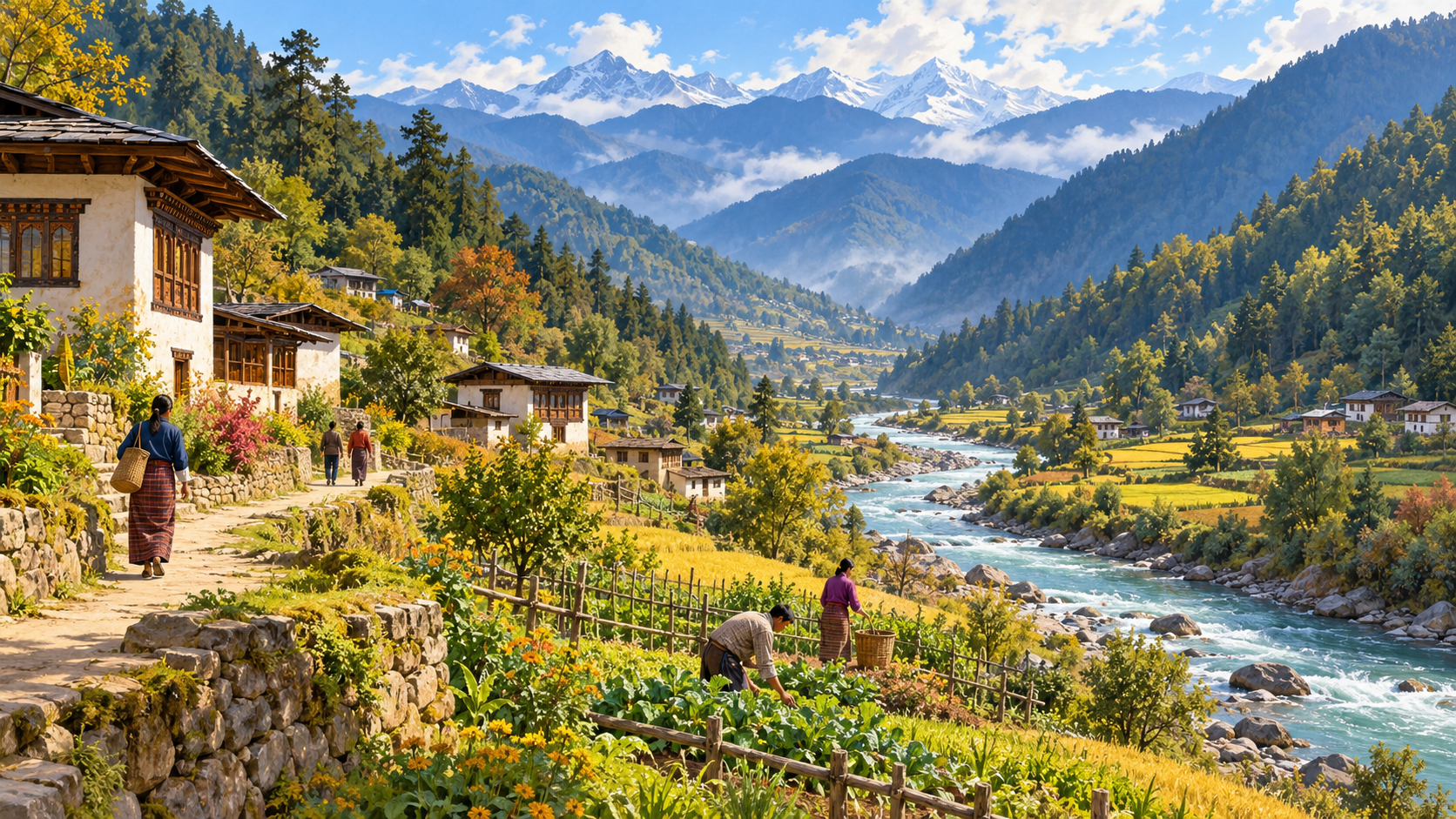
Cover illustration: an original artistic interpretation of Bhutan-inspired mountain valleys, traditional-style homes and cultivated landscapes, not a literal geographic view.
Choose your route through Bhutan
- 1. Bhutan on the map: a Himalayan kingdom between two large neighbours
- 2. Landscapes, climate and river systems
- 3. History: unification, monarchy and a changing state
- 4. People, population records and languages
- 5. Government, monarchy and parliamentary elections
- 6. Rights, courts and public accountability
- 7. Towns, urban growth and Gelephu Mindfulness City
- 8. The economy, Gross National Happiness and hydropower
- 9. Trade, currency and regional relationships
- 10. Roads, aviation and digital infrastructure
- 11. Education, examinations and routes into adulthood
- 12. Health services and social support
- 13. Homes, work and everyday life
- 14. Food, farming and the shared table
- 15. Arts, festivals, faith and languages
- 16. Heritage, tourism and the meaning of recognition
- 17. Sport, leisure and contemporary storytelling
- 18. Forests, wildlife and energy choices
- 19. Challenges and choices for the future
- 20. What readers should take away from Bhutan
1. Bhutan on the map: a Himalayan kingdom between two large neighbours
A Himalayan state between India and China
Bhutan is a landlocked kingdom in the eastern Himalayas, between India and China. Its national statistical overview gives a land area of 38,394 square kilometres. India borders its western, southern and eastern sides, while the northern frontier faces the Tibetan region of China. There is no coastline, and Nepal and Bangladesh are nearby countries rather than direct neighbours. This position helps explain two enduring features of Bhutanese life: mountain terrain makes internal connections demanding, and access to overseas markets depends on routes through another country. Its small outline on a continental map therefore conceals a complicated geography of valleys, passes and border gateways. Sources: National Statistics Bureau: Bhutan at a Glance 2023; World Bank: Bhutan country overview.
Thimphu is the capital and an expanding urban centre
Thimphu is Bhutan’s capital and largest city. The municipal annual report describes a city that grew across older settlements in Chang and Kawang, including places such as Changzamtok and Hejo. This history matters because the capital did not simply appear on an empty site: urban streets, public buildings and housing have absorbed and reorganised established communities. Thimphu’s importance as a national centre should also be distinguished from the wider Thimphu Dzongkhag, or district. A city and its surrounding administrative territory can share a name while covering different populations and landscapes, so any population figure needs its geographical boundary as well as its year. Sources: Thimphu Thromde: Annual report.
The northern boundary remains a diplomatic question
Bhutan’s northern frontier has a long historical relationship with Tibet, but present boundary negotiations are conducted between Bhutan and China. Their foreign ministries reported a fifteenth expert-group meeting in Beijing from 30 March to 1 April 2026. Discussions concerned the three-step roadmap for boundary negotiations; a joint technical team also discussed alignment in areas without disputes. The statement records continued negotiation, not a completed settlement of every disputed section. A general atlas can show Bhutan’s position without resolving these questions. Detailed border claims require dated, attributed maps, especially where a line on paper might otherwise imply agreement that the governments have not announced. Sources: Bhutan Foreign Ministry: Fifteenth expert meeting on the Bhutan–China boundary.
2. Landscapes, climate and river systems
Elevation produces several climates within one country
Bhutan’s landscapes rise from warm southern foothills into temperate mountain valleys and much colder high Himalayan terrain. The World Bank–ADB climate profile identifies elevation as a central reason for the country’s climatic diversity. A journey across Bhutan can therefore cross conditions that a national average conceals. Southern slopes receive strong monsoon influence, while mountain barriers create marked local differences in rainfall. Temperature, exposure and water availability help determine where fields, forests and settlements occur. Describing Bhutan only as snowy mountains misses its subtropical south; describing it by the weather in Thimphu misses conditions at both higher passes and lower border towns. Sources: World Bank and ADB: Climate Risk Country Profile, Bhutan.
Rivers connect the highlands to the Brahmaputra basin
The National Centre for Hydrology and Meteorology groups Bhutan’s principal drainage into the Amochhu, Wangchhu, Punatsangchhu and Manas basins. Their waters ultimately join the Brahmaputra system in India. Some headwaters extend into Tibet, so a catchment is not the same thing as a national territory. Rivers descend steeply through narrow valleys, with tributaries entering from side slopes. Monsoon flows carry much more water and sediment than the lean season, while snowmelt also contributes. These variations matter to farming, bridges and electricity generation: an annual water total does not describe how much water is available in a particular dry-season week. Sources: National Centre for Hydrology and Meteorology: River system of Bhutan.
A beautiful landscape also requires practical risk management
Bhutan faces earthquakes, landslides, river floods, glacial-lake outburst floods and forest fires. UNDRR’s work with Bhutanese institutions treats infrastructure as an interconnected system rather than a collection of isolated structures. A damaged road can obstruct access to a power facility; a disrupted electricity supply can affect communications and public services. The same valley that offers relatively usable land may also concentrate exposure to floods. Planning therefore has to consider where assets are placed, how they are maintained and whether alternative connections exist. These are engineering and governance questions as much as questions about weather, and they shape the real cost of development in mountain terrain. Sources: UNDRR: Strengthening the resilience of Bhutan’s infrastructure.
3. History: unification, monarchy and a changing state
Political unification preceded the hereditary monarchy
Bhutan’s political history includes more than one form of rule. The national civics curriculum describes the dual system associated with Zhabdrung Ngawang Namgyal in the seventeenth century, with distinct spiritual and temporal leadership. In 1907, Ugyen Wangchuck became the first hereditary monarch, establishing the Wangchuck dynasty. These are different milestones: the consolidation of a political and religious order was not the same event as the creation of the hereditary monarchy. Nor was the twentieth-century monarchy identical to today’s constitutional arrangement. Keeping the sequence clear helps explain why royal institutions, religious authority and elected government all have historical significance without collapsing them into a single, unchanging system. Sources: Bhutan curriculum: Civics for Classes XI and XII.
The first National Assembly was established in 1953
Parliament’s own history dates the establishment of the National Assembly, or Tshogdu, to 1953 under the Third King, Jigme Dorji Wangchuck. It provided a forum for discussing public concerns, development plans, national income and expenditure. That institution belongs to the history of political reform, but it should not be described as the present party-based elected chamber operating decades ahead of its creation. The Assembly’s membership and relationship with the monarchy evolved over time. Today’s bicameral Parliament dates to the democratic transition of 2008. Bhutan’s institutional development was therefore a sequence of changes, with earlier deliberative bodies preparing ground for a different constitutional order. Sources: Parliament of Bhutan: History of Parliament.
United Nations membership widened international engagement
Bhutan joined the United Nations on 21 September 1971 as its 128th member. The UN’s country office was established in early 1974, and the relationship subsequently expanded across development programmes and international cooperation. Membership is an important marker of Bhutan’s participation in global institutions, rather than the date on which the country first existed as an independent political community. The current UN cooperation framework for 2024–2028 links international support to national priorities and the Sustainable Development Goals. This longer history complicates the familiar image of a completely isolated kingdom: Bhutan has managed the pace and terms of external engagement, while building substantial international relationships. Sources: United Nations in Bhutan: About the UN.
The India relationship changed through negotiated treaties
India and Bhutan’s 2007 Friendship Treaty updated their 1949 agreement. The newer text recognises sovereignty and provides for close cooperation on matters affecting their national interests, alongside commitments to friendship. It should be read in its own wording rather than described through an obsolete summary of the earlier treaty. This is especially important when explaining Bhutan’s foreign relations: a close partnership with a much larger neighbour does not make Bhutan an Indian state. Treaty arrangements, development finance, trade access and shared security concerns all help explain the relationship, but they are separate from the question of Bhutan’s sovereign status. Sources: India’s Ministry of External Affairs: India–Bhutan Friendship Treaty.
4. People, population records and languages
The 2017 census counted different population categories
Bhutan’s 2017 Population and Housing Census recorded 735,553 people in its total enumeration, comprising 681,720 Bhutanese and 53,833 non-Bhutanese persons. The resident-population figure used in the main demographic series was 727,145 after excluding 8,408 transient persons. These figures are not competing estimates of exactly the same group. They answer different questions about who was counted and included. Citizenship, residence and presence on census day are distinct concepts, particularly where visitors and temporary workers are involved. Every use of these totals should retain the census year and definition; none of them is a fresh count of Bhutan’s population in October 2026. Sources: National Statistics Bureau: Population and Housing Census 2017.
A population projection is a model-based planning figure
The National Statistics Bureau’s 2017–2047 projection series gives 790,718 for the main population series in 2026. That number is a projection based on an earlier census and demographic assumptions, not the result of a 2026 nationwide enumeration. Assumptions about births, deaths and migration influence the path of a projected population, and unexpected migration can change the relationship between a model and reality. For schools, housing or employment planning, the age structure and location of residents matter alongside the national total. Readers should therefore compare like definitions and dates, rather than treating every published number headed ‘population’ as interchangeable evidence. Sources: National Statistics Bureau: Population Projections 2017–2047.
A national language operates within a multilingual society
Dzongkha is Bhutan’s national language, supported by dedicated language-development institutions. The Department of Tourism’s country introduction identifies communities including Ngalops, Tshanglas and Lhotshampas, alongside Bumthaps, Khengpas, Brokpas, Monpas and others. It describes a multilingual country in which English also has an important role. These broad labels should not be treated as a complete account of an individual’s identity or language abilities. Family language, everyday conversation and institutional communication need not be identical. Recognising this diversity gives a more accurate picture of Bhutan than assuming that a shared citizenship, national dress or official language means everyone has the same cultural background. Sources: Department of Tourism: About Bhutan; Department of Culture and Dzongkha Development: Language research and promotion.
The Lhotshampa refugee history belongs in the national story
The displacement of Lhotshampa people, Bhutanese of Nepali ethnic origin, is a major and painful part of modern history. A UNHCR evaluation records approximately 100,000 arrivals in Nepal during the early 1990s. It distinguishes Bhutan’s claim that people left voluntarily or were not citizens from refugees’ accounts that they were forced to flee because of their ethnicity. This disagreement must be attributed rather than erased. In November 2015, UNHCR reported that more than 100,000 refugees from Bhutan had been resettled from Nepal to third countries since 2007. That was a dated resettlement milestone, not proof that every question of citizenship, return, family separation or remaining refugees had been resolved. Sources: UNHCR: Evaluation of resettlement programmes; UNHCR: Bhutanese resettlement passes 100,000.
5. Government, monarchy and parliamentary elections
The King and prime minister hold different constitutional roles
Bhutan’s Constitution, adopted on 18 July 2008, establishes a democratic constitutional monarchy. The Druk Gyalpo is head of state, while executive, legislative and judicial powers are constitutionally distinguished. As of 20 October 2026, the King is Jigme Khesar Namgyel Wangchuck and the prime minister is Tshering Tobgay. The Prime Minister’s Office identifies Tobgay’s administration as the current government, and Parliament records his presentation of the State of the Nation report in June 2026. The monarchy’s continuity and the election of a government are therefore compatible features of the same political system; they should not be presented as alternative answers to how Bhutan is governed. Sources: Constitution of the Kingdom of Bhutan, 2008; Prime Minister’s Office: Current government; National Assembly: Prime Minister’s 2026 State of the Nation report; Gelephu Mindfulness City: Official overview.
Election results need their dates and subsequent changes
National Assembly elections use a primary round followed by a general contest between the two highest-placed parties. The general election of 9 January 2024 returned 30 seats for the People’s Democratic Party and 17 for Bhutan Tendrel Party. Those figures describe that election. On 4 September 2025, PDP candidate Phuntsho Dendup won the Nubi–Tangsibji by-election, a constituency BTP had won in 2024. A guide repeating the original 30–17 split as an unchanged current total would miss that development. The 47-seat chamber’s political composition must be checked against subsequent vacancies and by-elections as well as the last nationwide poll. Sources: National Assembly of Bhutan: About; Election Commission: 2024 National Assembly results; Election Commission: Nubi–Tangsibji by-election result.
The National Council has a distinct review function
Bhutan’s other parliamentary chamber, the National Council, has 25 members: one elected from each of the 20 dzongkhags and five appointed by the King. Its members do not belong to political parties. The Council’s institutional guide describes both legislative work and scrutiny of government policies, programmes and performance. Money and financial bills do not originate there. These differences make it more than a smaller copy of the National Assembly. The two chambers bring different forms of representation and review into lawmaking, while committees examine issues in greater detail than is possible in a full parliamentary sitting. Sources: National Council Secretariat: Institutional information.
Local government brings decisions closer to communities
Dzongkhags are districts, while gewogs are smaller local-government areas; a gup is a gewog’s elected head. Bhutan’s local-governance department’s 2024–2025 progress report describes work involving 20 district governors, 205 gups and 205 gewog administrative officers. One initiative trained local officials to identify resources and prepare area-based development proposals. This is a practical side of decentralisation: national priorities still need local knowledge about land, livelihoods and what a community can maintain. District headquarters, municipal administrations and rural gewogs also have different responsibilities. The familiar name of a town should not be used as shorthand for every institution operating in its surrounding district. Sources: Department of Local Governance and Disaster Management: Annual progress report.
6. Rights, courts and public accountability
Human-rights commitments need scrutiny of actual practice
In Bhutan’s November 2024 Universal Periodic Review, the United Kingdom recommended accession to the Convention Against Torture, equal educational access regardless of religion or belief, protection for media expression and decriminalisation of defamation. These were the UK’s recommendations, not evidence that reforms had subsequently been implemented. More recently, Human Rights Watch reported on 21 September 2026 that at least 28 political prisoners remained detained. It said most belonged to the Nepali-speaking community and alleged torture and trials without defence lawyers in their cases. These are attributed findings of a rights organisation. The dated reporting highlights continuing concerns about detention and fair trials alongside the country’s elected institutions and development achievements. Sources: UK Mission to the UN: Bhutan’s 2024 Universal Periodic Review; Human Rights Watch: Remaining political prisoners.
Courts provide several levels of adjudication and appeal
The judiciary’s institutional overview identifies the Supreme Court, High Court, Dzongkhag Courts and Dungkhag Courts. The Supreme Court hears appeals from the High Court and has an important role in legal interpretation. The High Court is the first-instance court for constitutional cases and also hears appeals from lower courts. District and subdistrict courts handle cases within their territorial jurisdictions. This structure distinguishes the making of law from its interpretation and application in particular disputes. Access to justice nevertheless involves more than the existence of a hierarchy: understandable procedures, timely hearings and the practical ability to bring a case determine how useful institutions are to residents. Sources: Judiciary of Bhutan: About the Judiciary.
Anti-corruption work combines investigation and prevention
The Anti-Corruption Commission describes a mandate that includes detecting and investigating suspected corruption, together with prevention and public education. Its work concerns how authority and resources are used, including the systems that can allow misconduct to recur. A complaint is an allegation requiring examination; an investigation is not itself a conviction. Maintaining that distinction protects both accountability and fairness to the people involved. For students examining public institutions, the commission offers a concrete example of why good governance cannot be judged only by a national reputation. It also requires channels for reporting concerns, evidence-based investigations and changes that reduce opportunities for abuse. Sources: Anti-Corruption Commission: Frequently asked questions.
Public audit asks what money achieved
The Royal Audit Authority examines government financial statements and conducts compliance and performance audits. Performance auditing considers whether public resources were used economically, efficiently and effectively. Those questions go beyond checking whether an expenditure appears in an account: a completed building may still fail to provide a useful service, while a formally authorised purchase may offer poor value. Audit findings and follow-up can help Parliament and public bodies identify what needs correction. This is a different function from a criminal investigation, although serious findings may require further action. Keeping these roles separate makes reports on spending, irregularities and institutional performance easier to interpret accurately. Sources: Royal Audit Authority: What we do.
7. Towns, urban growth and Gelephu Mindfulness City
Thimphu’s growth is also a planning question
Thimphu’s City-wide Design Code connects new development to the city’s 2023 structure plan. It uses mapped area types and attention to local context rather than treating every plot as an isolated building opportunity. The aim is to manage an evolving urban environment while maintaining a sense of place. This means that the capital’s future cannot be understood only through photographs of traditional-looking façades. Street connections, the relationship between buildings and public space, and the way different neighbourhoods fit together also matter. A planning document establishes rules and intentions; whether an individual project follows them must be checked through its implementation. Sources: Thimphu Thromde: City-wide Design Code.
Paro combines a town, an airport region and farmland
Paro is widely encountered through its international airport, but the wider district is also an agricultural landscape. The district agriculture service lists paddy, wheat, asparagus and potatoes among its main crops, with apples an important cash crop. Its statistical profile records ten gewogs, illustrating how much more territory a dzongkhag includes than its urban centre. Farms, villages and highland areas therefore belong in the picture alongside visitor accommodation and transport services. Land-use decisions here affect several activities at once: expanding buildings or roads can change access and income opportunities while placing pressure on productive land and the character of the valley. Sources: Paro Dzongkhag: Agriculture; Paro Dzongkhag: At a glance; Department of Tourism: Visiting Bhutan and transport.
Phuentsholing links commerce with a difficult river edge
Phuentsholing is a major commercial and industrial gateway on Bhutan’s border with India. ADB’s township project describes a city constrained by steep terrain and the Amochhu River, where expansion requires protection against flooding and bank erosion. The project record reports the completion of 4.7 kilometres of protective river walls in November 2022 and the reclamation of 66 hectares. Its broader township programme remained listed as active when checked in October 2026. These details show both delivered infrastructure and continuing development work. They also explain why urban land at a border gateway is not merely available space: making it usable can require substantial protective investment. Sources: ADB: Phuentsholing Township Development Project.
Gelephu Mindfulness City is a legal jurisdiction and a developing project
Gelephu Mindfulness City was established by Royal Charter in February 2024 as a highly autonomous special administrative region within Bhutan, adjoining Assam in India. Its official description gives it distinct executive, legislative and judicial institutions. A public legislation register contains enacted measures, including business and company laws, so its legal framework is already more than a concept drawing. The wider vision for an economic hub remains a development programme with projects at different stages. Legal establishment, investment agreements, construction contracts and operating facilities are separate milestones. Pictures of the proposed city should therefore be labelled as plans or concepts whenever they show work that has not yet been built. Sources: Gelephu Mindfulness City: Official overview; Gelephu Mindfulness City: Legislation.
8. The economy, Gross National Happiness and hydropower
Gross National Happiness is a defined measurement framework
Gross National Happiness is a development philosophy with a statistical framework, rather than a claim that every Bhutanese person is always happy. The 2022 survey uses 33 indicators across nine domains, including health, education, time use, governance and living standards. Its central classification requires sufficiency in at least 66% of weighted indicators. Using that threshold, 48.1% were classified as extensively or deeply happy; the national GNH index was 0.781. The index is therefore not the percentage of people who answered that they felt happy. Its authors present GNH and GDP as complementary tools: one examines selected conditions of well-being, while the other measures economic production. Sources: Centre for Bhutan and GNH Studies: 2022 GNH Survey Report.
Hydropower and investment drive growth, but forecasts remain conditional
Bhutan’s economy combines agriculture, public and private services, construction, manufacturing and electricity production. The World Bank’s Spring 2026 Development Update forecasts growth of 7.1% for fiscal year 2025–2026 and 6.4% for 2026–2027, with hydropower projects, investment and exports providing major support. These are forecasts from a named publication, not final measured results for either year. The same assessment identifies exposure to external shocks, climate risks and project delays. A large infrastructure project can lift construction activity before its generating units operate, while later electricity sales change export income. Looking at both phases helps explain why growth can vary sharply between years. Sources: World Bank: Bhutan Development Update, Spring 2026.
Generating capacity, electricity output and exports are different measures
A power station’s megawatt rating describes capacity; gigawatt-hours measure electricity produced over time. Exports are the portion sold abroad after domestic requirements and other system considerations. Bhutan can therefore export electricity in high-flow months while importing during winter shortages. In January 2026, the World Bank approved financing for the 1,125-megawatt Dorjilung project, whose expected annual production exceeds 4,500 gigawatt-hours. Those are project design and future-output figures, not electricity already generated by an operating station. The project’s stated purpose includes reducing the seasonal supply gap and increasing exports to India. Its eventual contribution will depend on construction, river conditions, transmission and operating performance. Sources: World Bank: Dorjilung hydropower financing.
Hydropower assets also carry financing obligations
The 2026–2027 national budget reports that, on 31 March 2026, hydropower-related borrowing represented about 58.3% of Bhutan’s external debt. The share is of external debt, not all government spending or annual export earnings. Revenue-producing infrastructure can help service loans, but construction delays, costs and financing terms still matter. The IMF’s 2026 publication of its Bhutan consultation also notes that a shift from intergovernmental arrangements towards private partnerships and lenders can change the risks borne by government. Hydropower should consequently be assessed through both its productive assets and its liabilities. Calling all such debt harmless, or treating it as borrowing with no associated income, loses important distinctions. Sources: Ministry of Finance: Budget report 2026–2027; IMF: Bhutan 2025 Article IV consultation, published2026.
9. Trade, currency and regional relationships
Trade with India connects production to markets and supplies
India is Bhutan’s principal trading partner and an essential transit route for trade with other countries. Bhutan’s Foreign Ministry identifies electricity, dolomite, ferro-silicon and semi-finished products among exports sold to India. For goods arriving from farther away, the Liaison and Transit Office in Kolkata provides a practical connection to seaports. Established in 1972, the office facilitates clearance of Bhutan-bound goods through Kolkata and Haldia ports and Kolkata’s international airport. It works with Indian customs and port authorities and monitors goods moving through Indian territory. Bhutan’s landlocked position therefore creates a chain of logistical relationships: overseas shipping, customs clearance, transit transport and the final border crossing all affect delivery to Bhutanese businesses and consumers. Sources: Bhutan Foreign Ministry: Bilateral relations; Royal Bhutanese Consulate: Liaison and Transit Office.
The ngultrum’s rupee peg shapes monetary policy
Bhutan’s currency is the ngultrum, commonly abbreviated Nu. The Royal Monetary Authority states that it has been pegged at par to the Indian rupee since its introduction in 1974. This means the official relationship is one ngultrum to one rupee; it does not make Bhutan’s currency identical to every foreign currency or remove the need for foreign-exchange management. The central bank describes exchange-rate targeting as the anchor of monetary policy and acknowledges constraints on independent policy operations. Given Bhutan’s close trade and financial connections with India, the currency arrangement is an important link between domestic prices, external payments and the wider regional economy. Sources: Royal Monetary Authority: Monetary policy.
Bangladesh cooperation includes agreements and unfinished ambitions
Bhutan’s relationship with Bangladesh offers another route for regional economic cooperation. At foreign-office consultations on 18 August 2026, the two governments discussed expanding product coverage under their preferential trade agreement and exploring a possible free-trade agreement. The statement also called for faster operationalisation of a Bhutanese special economic zone in Kurigram. These formulations matter: an intention to explore a treaty is not a signed treaty, and a commitment to advance a zone is not evidence that it is fully operating. Cooperation also takes place through regional organisations including SAARC and BIMSTEC, connecting bilateral projects with broader discussions about trade, investment and regional access. Sources: Bhutan Foreign Ministry: Fourth Bhutan–Bangladesh consultations.
Graduation from the UN’s LDC category was a milestone, not an endpoint
Bhutan left the United Nations’ least-developed-country category on 13 December 2023, becoming the seventh economy to graduate. UNCTAD treats this as an important development milestone while also discussing the work needed for a smooth transition. The category concerns a defined international assessment; leaving it does not mean that every household is affluent or that a small mountain economy has overcome all structural constraints. Trade support, investment opportunities and economic diversification remain relevant after graduation. For a country guide, the precise wording matters: Bhutan is a former least-developed country, while the challenges of building resilient incomes and a wider productive base continue. Sources: UNCTAD: Bhutan leaves the least-developed-country category.
10. Roads, aviation and digital infrastructure
Roads remain the main surface-transport network
ADB’s preparation project for the Lhamoizingkha–Sarpang highway explains Bhutan’s heavy dependence on roads for movement within the country and towards neighbouring Indian states. The established northern east–west highway provides a cross-country connection through the central mountain region, while new southern connections are being developed or prepared. Road construction in such terrain requires more than laying a surface: alignment, slopes, drainage, bridges and maintenance determine reliability. The ADB record concerns project preparation, so it should not be used as evidence that the proposed highway is already open. For residents and businesses, a dependable existing connection can matter as much as a shorter line drawn on a future network map. Sources: ADB: Preparing the Lhamoizingkha–Sarpang highway expansion.
Existing air and road gateways have different functions
Paro is Bhutan’s established international air gateway, served by Drukair and Bhutan Airlines. The tourism authority lists four official road entry points from India: Samtse, Phuentsholing, Gelephu and Samdrup Jongkhar. These gateways connect different parts of the country, so arriving by air and crossing the southern frontier are distinct journeys. Domestic transport includes road services and limited aviation options, shaped by the terrain and the scale of demand. A list of gateways is not a promise about a particular flight, vehicle service or border procedure. Operational schedules and entry requirements need separate checks close to the date of travel. Sources: Department of Tourism: Visiting Bhutan and transport.
The new Gelephu international airport is under construction
On 3 October 2026, Gelephu Mindfulness City Authority announced an airfield construction contract for the new international airport. BBS’s reporting from the project described earthworks nearing completion and a package including a planned 3,000-metre runway, taxiways, aircraft aprons and air-traffic-control facilities. The reported opening target was December 2029. As of this guide’s October 2026 check, that evidence supports an airport construction programme, not an operational new international hub. It is important to distinguish this project from Gelephu’s pre-existing airport facilities. Contract awards and target dates demonstrate progress, but passenger operations require completed works, aviation approvals and actual services. Sources: GMC and BBS: Gelephu airport airfield contract.
Digital identity adds another kind of national infrastructure
Bhutan launched its National Digital Identity programme nationwide in October 2023. The GovTech–Druk Holding announcement describes a mobile-wallet system intended to support authentication for government and commercial services, with consent and individual control central to its design. Digital credentials can reduce the need to repeat identity checks through paper documents, but a launch does not prove that every resident can use every service. Practical access depends on compatible devices, connectivity, skills and help when something goes wrong. Digital infrastructure therefore has a social dimension as well as a technical one: its value is realised when people can complete necessary tasks reliably and understand what information they are sharing. Sources: GovTech and Druk Holding: Nationwide digital-identity launch.
11. Education, examinations and routes into adulthood
Understanding the school-leaving qualifications
Bhutan’s examination names describe different stages of secondary schooling. The Bhutan Certificate of Secondary Education, or BCSE, is associated with Class X, while the Bhutan Higher Secondary Education Certificate, or BHSEC, follows the two-year Class XI–XII programme. The Bhutan Council for School Examinations and Assessment, BCSEA, distinguishes school-based assessment from external examinations in its operational guidelines. This matters for families comparing qualifications: completing a class, sitting an examination and qualifying for a subsequent programme are related but separate steps. The 2026 examination timetable still uses these national qualification names, so descriptions of reform should retain the actual stage and examination concerned. BCSEA: operational guidelines for examinations and assessment.
A reform with two different starting dates
An education-ministry announcement dated 23 March 2026 marked the handover of a National Student-Learning Assessment Framework and thirteen assessment syllabuses for Key Stage 5. Implementation was scheduled for the 2026 academic year, while joint Class XII certification by Cambridge and BCSEA was to begin in 2027. The distinction prevents an announced future qualification from becoming an imaginary achievement already available to every learner. The framework also gives attention to continuous assessment and coursework. Its significance reaches beyond the final certificate: teachers need to align classroom tasks, feedback and judgements with the learning that the new assessment system is intended to recognise. Education Ministry: assessment-framework handover.
Making learning materials genuinely accessible
UNICEF’s September 2026 research on accessible digital textbooks examines a pilot involving nineteen schools in nine districts. Features such as audio and sign-language video can provide additional ways for children with disabilities to engage with lessons. The research also considers the practical support needed around a device, including teacher preparation and appropriate assistive technology. A digital textbook therefore becomes useful through an accessible learning environment, rather than simply through distribution. The pilot is evidence of experimentation and implementation in participating schools; it does not establish that every classroom has the same equipment or that one technology removes every barrier to participation. UNICEF Innocenti: accessible digital textbooks.
Practical skills and the transition into work
The government’s 2025 Labour Market Information Guide describes vocational institutions covering technical trades, hospitality, power-sector training and traditional arts. It also points job seekers towards employment service centres, counselling and labour-market information. These routes broaden the meaning of education beyond progression through academic examinations. A trainee may need workshop practice, an employer placement and a recognised assessment of competence as much as classroom instruction. For readers, the useful connection is between learning and the work it enables: the availability of a course does not by itself establish the availability of a suitable job, equipment or continuing professional development after graduation. MoICE: Labour Market Information Guide for Job Seekers.
12. Health services and social support
What the public-health commitment covers
Bhutan’s National Health Policy commits to free basic public-health services in modern and traditional medicine, with universal health coverage directed towards citizens. The same policy provides for services to non-Bhutanese people on a payment basis. Those statements should not be collapsed into a promise that all care is free for every person in the country. Referral arrangements and the scope of basic services also matter when describing the system. This is an institutional overview, not individual medical or travel advice: a constitutional or policy commitment explains the public objective, while eligibility, available treatment and the circumstances of a particular patient remain separate questions. Royal Government: National Health Policy.
A network rather than a single hospital
WHO’s 2025 evaluation describes a health system extending from national referral services to district facilities, basic health units and community outreach. Village health workers help connect residents with formal services. This network is especially important when considering how care reaches scattered settlements: a specialist hospital and a local point of contact perform different functions. The practical chain includes recognising a problem, reaching a facility, arranging referral and maintaining follow-up. Reading health provision through that chain gives a fuller picture than counting prominent buildings alone. Staffing, communication and continuity determine whether separate facilities operate as a service that people can actually use. WHO: evaluation of its contribution in Bhutan.
Prevention alongside treatment
A national screening campaign announced in November 2024 invited adults aged eighteen and above to checks covering blood pressure, blood glucose, overweight and obesity, and cardiovascular risk. Its dates, 14 November to 7 December 2024, describe a particular campaign rather than an appointment available indefinitely. The initiative illustrates why public health includes finding risks before severe illness develops. The PEMA adds another dimension through its national work on mental health and child protection, linking prevention and response with treatment, rehabilitation and aftercare. Together these institutional examples show that health provision includes continuing support and social circumstances as well as treatment during a hospital visit. Health Ministry: national NCD screening campaign. The PEMA: mental health and child protection.
Building a wider system of protection
A social-protection assessment published by UNICEF and the Office of Cabinet Affairs and Strategic Coordination in August 2025 maps existing programmes and their gaps. It identifies the Thirteenth Five-Year Plan’s ambition to develop a comprehensive social-protection system by 2029. The target is a planning commitment, not proof that a complete system already covers every household. For families, protection can concern the ability to keep meeting essential needs when income, health or caring responsibilities change. The assessment’s emphasis on coordination is therefore significant: a collection of separate schemes must be judged by who can obtain support, where gaps remain and how services connect. UNICEF and Cabinet Affairs: social-protection assessment.
13. Homes, work and everyday life
Buildings shaped by place and household needs
The tourism department describes regional differences in traditional domestic architecture: rammed earth and timber are prominent in western houses, stone appears in eastern building traditions, and bamboo has a place in the south. Its account of older multi-storey homes links lower levels with livestock, family and shrine spaces with upper floors, and roof spaces with drying or storage. These are architectural traditions rather than a description of every present-day household. They reveal how a building can organise several kinds of work and belief together. A family home is simultaneously shelter, a place of food preparation, storage, social relationships and, for some households, religious practice. Department of Tourism: cultural experiences and architecture.
Urban housing is also everyday infrastructure
The Asian Development Bank’s Green and Resilient Affordable Housing Sector Project supports low-income rental housing and associated facilities in Bhutan. Energy efficiency and disaster resilience are part of its design, alongside affordability. The project remained active in 2026, so its planned homes should not all be counted as completed dwellings. This programme illustrates the connection between housing and urban opportunity: access to employment means less if a household cannot secure suitable accommodation nearby. A useful assessment therefore considers rent, basic services and building performance together. Architectural appearance alone cannot explain whether a growing town provides a workable home for its residents. ADB: Green and Resilient Affordable Housing Sector Project.
One farming household shows several kinds of work
A WFP account from Ura follows farmer Tshering Dema and a women’s farming group supplying vegetables to the school attended by her daughter. The 2022 story describes greenhouse support and the organisation needed to connect production with school demand. It is a specific household and community example, rather than a representative portrait of every Bhutanese farmer. Nevertheless, it makes several forms of work visible at once: growing food, coordinating with other producers, arranging supply and supporting children’s education. Farming can be understood through these relationships as well as through the crop itself, especially when a regular institutional buyer creates a more predictable market. WFP: a farmer supplying her daughter’s school.
Identity and services in a digital setting
Bhutan’s National Digital Identity system uses a mobile wallet and verified credentials to support interactions with government and businesses. Its official explanation also recognises physical identification as an alternative under the 2023 legal framework. Digital identity therefore belongs in an account of daily life, not only in a technology chapter: it concerns how someone proves who they are when accessing a service. The important questions are practical ones, including access to a suitable device, understanding the process and obtaining help when something fails. The existence of a national system should not be interpreted as evidence that every resident uses it with equal ease. Bhutan NDI: identity-wallet questions.
14. Food, farming and the shared table
Chillies, cheese and a wider cuisine
Ema datshi combines chillies and cheese and is widely identified as Bhutan’s national dish. The tourism department’s account also describes red rice and a broader range of dishes, including pork preparations such as phaksha paa and chicken dishes such as jasha maroo. These examples make a better introduction than treating one celebrated recipe as the entire cuisine. Ingredients, household preferences and regional traditions create variation within a national food identity. A meal can therefore open several lines of enquiry: what is grown nearby, what is bought, how food is preserved or prepared, and which combinations acquire a special association with home or hospitality. Department of Tourism: foods of Bhutan.
Haa’s dumplings connect food and celebration
In Haa, hoentay are buckwheat dumplings associated with local culinary identity and the Lomba celebration. The local tourism account describes fillings including turnip leaves, perilla seeds, cheese, ginger and garlic, and the exchange of dumplings between households. That exchange is as important to understanding the food as its list of ingredients. Preparing and sharing a seasonal dish can bring labour, family knowledge and neighbourhood relationships into the same activity. Recipes may vary between cooks, so a regional description is best treated as a guide to a tradition rather than a rule governing every kitchen or a claim that the same celebration is observed nationwide. Haa Tourism: local food traditions.
Highland livelihoods behind dairy foods
FAO’s study of transhumant grazing describes the multiple roles of yaks in Bhutanese highland livelihoods: milk for dairy foods, fibre and other materials, and transport. Seasonal movement connects herding with the availability of grazing across different elevations. Because the study is historical, it should not be used to invent a current herd total or production figure. It remains useful for explaining why a food ingredient can belong to a larger livelihood system. Butter or cheese carries a story of animal care, pasture, movement and household labour. Changes affecting any one part of that system can consequently matter beyond the food on the plate. FAO: yak herding and transhumant grazing in Bhutan.
School meals connect nutrition with local markets
WFP’s 2022 account of school meals describes the government’s assumption of the national programme in 2019 and work on the School Meal Planner PLUS. Menu planning and advance orders were intended to connect schools’ nutritional needs with farmers’ production decisions. This is a concrete example of food policy joining two objectives: helping children eat adequately and improving the reliability of demand for producers. It also reveals the organisation behind an apparently simple school lunch. Menus, procurement, delivery and preparation must fit together. The account documents work at that time; it does not establish identical implementation or results in every school in 2026. WFP: school meals and local food systems.
15. Arts, festivals, faith and languages
Religious life has both depth and diversity
Buddhist practice is visible in monasteries, prayer wheels, prayer flags and ceremonies, as the Department of Culture and Dzongkha Development’s account explains. These objects and places carry meanings for practitioners that a photograph alone cannot convey. Bhutan also has Hindu communities: the Hindu Dharma Samudaya of Bhutan describes its work as a religious organisation founded in 2009. An account of national culture should leave room for that diversity and for differences between individuals. Religious traditions can shape calendars, family observances and artistic expression without making every resident’s beliefs identical. Sacred narratives should likewise be presented as traditions of belief, with their significance explained respectfully. Culture Department: prayer wheels and Buddhist practice. Hindu Dharma Samudaya of Bhutan.
Drametse: performance as living heritage
UNESCO inscribed the mask dance of the drums from Drametse on its Representative List of the Intangible Cultural Heritage of Humanity in 2008, following its earlier proclamation in 2005. The sacred dance honours Padmasambhava and combines sixteen masked dancers with ten musicians. Its contrasting movements represent peaceful and wrathful figures within the religious tradition. This is living heritage: it depends on people learning music, movement and the meanings of performance. UNESCO’s account draws attention to transmission and training. Recognition alone cannot perform that work; the continuity of the tradition rests on practitioners having the time, knowledge and opportunities to pass it on. UNESCO: Drametse mask dance.
Textiles combine skilled work and creative choices
The Royal Textile Academy connects textile display and conservation with teaching weaving skills. Its training also includes areas such as dyeing, design and business knowledge. That combination makes textiles a useful way to understand the relationship between heritage and livelihoods. A finished cloth embodies decisions about materials, colour, pattern and technique, while earning an income from the work requires other capabilities as well. Museums preserve objects, but training keeps the ability to make them available to another generation. Contemporary design and commercial skills can therefore sit alongside preservation, provided the people practising the craft remain central to how its future is shaped. Royal Textile Academy: weaving and textile preservation.
Languages need everyday use and deliberate support
The culture department’s language-research and promotion work includes Dzongkha resources, dictionaries, research on indigenous languages and bilingual publications. Its remit also reaches digital tools and materials. This provides a practical view of language preservation: a language needs opportunities to be spoken, read, taught and used in changing settings. A dictionary records words, while classroom materials and digital resources can help people apply them. National-language development and attention to other community languages are related but distinct tasks. A country profile should therefore avoid equating one official language with a complete description of the languages used in homes, communities and cultural life. Culture Department: language research and promotion.
16. Heritage, tourism and the meaning of recognition
World Heritage status requires precise wording
As checked on 20 October 2026, UNESCO’s World Heritage country page lists no inscribed properties for Bhutan and eight entries on its Tentative List. Those entries include cultural sites and landscapes as well as protected natural areas, such as Royal Manas and Jigme Dorji. Tentative listing signals potential nomination; it is not inscription on the World Heritage List. This distinction also separates a place-based World Heritage designation from the intangible-heritage recognition discussed in the previous chapter. A site can be historically, spiritually or ecologically important without an international label, and accurate terminology allows readers to understand what a particular recognition actually establishes. UNESCO World Heritage Centre: Bhutan.
Taktsang brings landscape and sacred history together
Paro Taktsang, commonly called the Tiger’s Nest, is associated with sacred caves and traditions concerning Guru Rinpoche. The culture department recounts the legend of his arrival on a tigress and identifies 1692 as the construction date of the monastery complex under Tenzin Rabgye. Separating those two kinds of account preserves both meaning and chronology: a religious tradition about the eighth century is different from the documented history of a later building. The site’s appeal also lies in its relationship with its cliff setting. For an educational reader, the most useful questions concern pilgrimage, patronage, architecture and the continuing religious life of the place. Culture Department: Paro Taktsang.
A restored trail can connect communities
The Trans Bhutan Trail organisation describes the restoration of an old route through cooperation involving the Bhutan Canada Foundation, tourism authorities, communities and volunteers. Its not-for-profit model directs resources towards the trail and participating communities. This makes the route more than a line drawn across a visitor’s map. Maintaining a trail requires local knowledge, physical work and continuing decisions about use. The initiative offers a way to examine tourism through connections between settlements rather than only through famous monuments. Its community purpose should be assessed through actual participation and maintenance, since restoration is a continuing responsibility rather than a single completed ceremony. Trans Bhutan Trail: restoration and community work.
Understanding the Sustainable Development Fee
The tourism department’s rules, checked on 20 October 2026, set a standard Sustainable Development Fee of US$100 per adult per night for most international visitors. Different arrangements include the Indian rate, child concessions, a Bangladesh concession and designated border-area waivers. A twenty-four-hour waiver for Samtse, Phuentsholing, Gelephu and Samdrupjongkhar took effect on 2 June 2026. These exceptions make a blanket statement about one fee for all visitors inaccurate. The SDF is also separate from accommodation and other travel services. For this country profile, its significance is the policy choice to link tourism with public funding; individual charges require the current official rules. Department of Tourism: Sustainable Development Fee questions.
17. Sport, leisure and contemporary storytelling
Archery is a social occasion as well as a sport
Archery is Bhutan’s national sport. The tourism department describes traditional contests over a distance of about 145 metres, with songs and dancing accompanying the competition. It also introduces khuru, a game involving the throwing of large darts. Such activities reveal how leisure can combine physical skill with a shared social occasion. Traditional local formats should not automatically be treated as identical to the rules used in every international competition. Equally, the prominence of one national sport does not describe everybody’s preferences. A fuller picture of recreation leaves space for different ages, abilities, interests and opportunities to participate, as well as for celebrated traditions. Department of Tourism: archery and traditional games.
Girls’ football shows how participation is built
The Bhutan Football Federation’s account of a 2025 women’s football campaign in Mongar describes a two-day programme for eighty girls aged six to sixteen. Sessions included ball control, passing and matches, supported by coaches and volunteers. This local example shows the practical work behind the phrase developing sport: beginners need a place to play, guidance and opportunities to gain confidence. The event’s attendance is evidence about that programme, not a national measure of girls’ sporting participation. Its educational value lies in making the pathway visible, from an introductory activity to the possibility of continued practice and organised competition. Bhutan Football Federation: girls’ football campaign.
International competition creates another sporting pathway
For the 2026 Asian Games in Aichi-Nagoya, the Bhutan Olympic Committee announced a delegation of thirteen athletes competing in archery, athletics, boxing and taekwondo. Its September announcement identified this as Bhutan’s eleventh participation in the Asian Games. Those details describe the delegation and should not be converted into an unsupported claim about medals or results. They also illustrate the distinction between broad participation at home and preparation for international competition. A small team still depends on coaching, selection, training and institutional support. Following those connections helps readers understand elite sport as a sustained programme rather than only a moment inside a stadium. Bhutan Olympic Committee: 2026 Asian Games delegation.
Cinema offers stories, not a complete social survey
Pawo Choyning Dorji’s Lunana: A Yak in the Classroom follows a young teacher who hopes to leave for Australia but is assigned to a remote school, according to its distributor’s synopsis. The film was nominated for International Feature Film at the 2022 Academy Awards. Nomination should not be misreported as winning. Cinema gives audiences a way to encounter questions about education, ambition, belonging and distance through characters and dramatic choices. A fictional story can prompt thoughtful discussion of those themes without becoming evidence that every teacher or village has the same experience. Its artistic perspective is part of what viewers should examine. Academy: the 2022 Oscars. Samuel Goldwyn Films: Lunana synopsis.
18. Forests, wildlife and energy choices
Forest cover: a measurement and a legal commitment
Bhutan’s 2023 National Forest Inventory reports forest cover of 69.71 per cent of total land, approximately 2.68 million hectares. Its fieldwork ran from July 2021 to June 2022, so the figure needs that survey context rather than a claim of continuous real-time measurement. The Constitution separately requires at least sixty per cent of total land to remain under forest cover for all time. These figures answer different questions: the inventory estimates observed coverage, while the constitutional threshold states a lasting obligation. Neither alone describes every forest’s ecological condition, species composition or exposure to fire and other pressures. Department of Forests: National Forest Inventory 2023. Constitution of Bhutan: Article 5.
Carbon-negative does not mean emissions-free
Bhutan’s provisional Third Nationally Determined Contribution, submitted in November 2025, refers to the first Biennial Transparency Report’s inventory for 2022. It records a national greenhouse-gas balance in which removals exceeded emissions. That is the basis for describing the country as carbon-negative for the inventory year. The term concerns a net balance across an accounting period; it does not mean that transport, industry or households produce no emissions. Keeping the year and accounting boundary visible matters when comparing countries or evaluating progress. A strong forest sink and efforts to limit emissions address different sides of the same balance, and both require continued attention. Bhutan: Third NDC, provisional submission.
Wildlife needs connections between protected places
The management plan for Biological Corridor 3 explains how corridors connect protected areas and support wildlife movement and genetic exchange. The concept is important because conservation boundaries on a map do not remove animals’ need to move through a landscape. A connected system therefore requires attention to the spaces between major protected areas as well as to the areas themselves. Management can involve habitat condition, land use and relationships with people living nearby. For readers, this offers a broader definition of conservation success: protecting a substantial area matters, but the ability of habitats to function together is another question that area alone cannot answer. Bhutan for Life and forestry authorities: Biological Corridor 3 plan.
Solar power addresses a seasonal energy question
UNDP’s May 2025 discussion of solar energy highlights Bhutan’s 180-kilowatt pilot in Wangdue Phodrang, inaugurated in October 2021. It places solar development alongside the seasonal decline in hydropower output during winter and the resulting need for electricity imports. This is a useful complement to the large-project story of the energy sector. Electricity availability depends on when generation occurs, as well as on annual totals or installed capacity. Diversification consequently involves technical and commercial questions: connecting a new source, financing it and matching production with demand. A pilot demonstrates an application; it does not by itself establish nationwide deployment or completion of future targets. UNDP: harnessing solar potential.
19. Challenges and choices for the future
Youth employment needs the correct denominator
Bhutan’s National Statistics Bureau reported overall unemployment of 3.0 per cent in its third-quarter 2026 Labour Force Survey, conducted in August. For young people aged fifteen to twenty-four, the unemployment rate was 17.5 per cent. That youth figure refers to the youth labour force, not to all people in the age group; many young people are studying or otherwise outside it. The report also gives a wide confidence interval, reminding readers that sample estimates contain uncertainty. The contrast raises an important policy question about the transition into suitable work, while neither rate alone describes wages, job security or the quality of available employment. National Statistics Bureau: Q3 Labour Force Survey 2026.
Migration reshapes the places people leave and enter
The United Nations’ 2025 demographic horizon scan examines internal migration towards urban opportunities alongside international migration and its consequences. These movements can affect rural households, care responsibilities and the staffing of public services. They also reflect individual and family choices about education, employment and future prospects. A balanced account should therefore consider both origin and destination: a move may widen one person’s options while changing the support available to another household member. The report contains forward-looking analysis as well as observations, so projected population changes should not be presented as events that have already happened or as an unavoidable outcome. United Nations Bhutan: demographic horizon scan.
Climate risk includes losses that money cannot capture
Bhutan’s assessment of climate-induced loss and damage, published online by UNDP in February 2026, considers economic and non-economic consequences. Extreme weather can affect infrastructure and livelihoods, while damage to ecosystems, cultural places or community relationships is harder to express in a monetary total. This distinction matters when discussing adaptation: rebuilding a road and restoring a sense of security are different tasks. A useful country-level account connects hazards with the people and services exposed to them. National environmental commitments do not remove the need for preparedness, resilient infrastructure and practical support after damaging events. These are complementary responsibilities within the same development challenge. UNDP and Bhutan: climate-induced loss and damage.
Waste shows the material side of development
The National Waste Inventory Survey 2025, released in June 2026, estimated that Bhutan generated about 241 tonnes of waste each day, roughly forty per cent more than in the 2019 survey. Generated waste is not the same measure as waste dumped or left uncollected. Its composition also matters because food waste, recyclable materials and other streams require different arrangements. The findings make consumption visible as a public-service issue: collection, separation, treatment and disposal must keep pace with what households and institutions produce. Cleaner surroundings depend on those systems and on participation, alongside national commitments to conserve forests and protect the wider environment. UNDP: National Waste Inventory Survey findings.
20. What readers should take away from Bhutan
Connect national commitments with everyday delivery
A productive way to finish this profile is to follow one public commitment into the daily arrangements that make it meaningful. Choose education, healthcare, housing or conservation, then ask who provides the service, who can use it and what practical steps connect the two. Look for the people doing the work as well as the institution announcing the policy. This approach turns a country profile into an explanation of relationships. It also makes room for uneven experiences: an ambitious national objective and an unresolved local difficulty can exist at the same time without either cancelling the importance of the other.
Read a number with its date and denominator
Keep four questions beside any statistic: what was counted, who or what formed the comparison group, when were the observations made, and how was the result produced? A percentage without those details can invite a misleading conclusion even when the number itself was copied correctly. Distinguish a survey estimate from a legal threshold, a recorded outcome from a target, and a pilot’s participants from a whole population. The same habit applies beyond Bhutan. It helps readers compare countries more fairly and recognise when an apparently simple claim actually combines evidence drawn from different years, definitions or administrative systems.
Treat culture as something people continue to make
Approach a building, dish, performance or textile by asking about the knowledge and relationships behind it. Who learned the skill, who passes it on, and what circumstances allow the practice to continue? Consider religious meaning where it is relevant, while leaving room for variation between communities and individuals. These questions encourage a respectful account of culture without freezing it into a single timeless image. They also connect heritage with contemporary livelihoods and choices. A thoughtful reader can appreciate a familiar national symbol while remaining curious about experiences that are less visible in photographs, promotional material or a short introductory description.
Use Bhutan to practise connected thinking
The strongest final exercise is to trace one change across several chapters. Imagine how a new employment opportunity could affect a household’s location, housing needs, children’s schooling, food purchases and use of transport. Then consider whose perspective is missing from that first account. This is an analytical exercise, not a forecast that every change will follow one path. It brings the country’s institutions, environments and everyday lives into the same discussion. Bhutan becomes easier to understand when readers connect those scales, preserve the dates and limits of their evidence, and resist reducing a complex society to a slogan or a single statistic.
Frequently asked questions about Bhutan
Where is Bhutan?
In the Himalayas, between India and China. It has no sea coast.
What is the capital of Bhutan?
Thimphu. Other towns and valleys have distinct administrative, cultural and economic roles.
Is Bhutan part of India or China?
No. Bhutan is a separate sovereign country, with its own institutions and international relationships.
What is the national language?
Dzongkha. The national-language designation should not be mistaken for a claim that everyone uses only one language.
What currency does Bhutan use?
The ngultrum, coded BTN. Currency arrangements and individual banking or payment conditions are separate questions.
Does Gross National Happiness mean everybody is happy?
No. It is a development concept with a specific measurement framework. An index value, a sufficiency threshold and the share of respondents in a category describe different things.
Is Bhutan a monarchy or a democracy?
Its constitutional system combines a monarchy with elected democratic institutions. The government chapter explains their separate roles.
Can a census total be compared directly with every population projection?
Not without checking the reference date and population definition, including the treatment of residents and transient people.
Are all Bhutanese healthcare services free for every visitor?
No. Basic public-service guarantees, citizenship, eligibility and treatment charges require careful distinctions.
Do all school reforms take effect on their announcement date?
No. A draft framework, an implemented syllabus and a future certification arrangement are different developments.
Does a tentative UNESCO listing mean a place is inscribed?
No. Tentative properties are candidates for a different process. World Heritage and intangible cultural heritage are also separate programmes.
Does carbon-negative mean there are no emissions?
No. A net balance depends on emissions, removals, accounting scope and reference year. It does not mean every activity is emissions-free.
Is Gelephu Mindfulness City already a completed city?
Planning, legal arrangements, contracts, construction and operating services need to be assessed separately, using dates and specific evidence.
Does a national statistic describe every household?
No. Geography, age, employment, family circumstances and access to services can produce very different experiences within the same country.
Can this guide replace travel or professional advice?
No. It is an educational overview. Current entry arrangements, fees and individual legal, healthcare or financial decisions require appropriate up-to-date sources.
Continue reading: Bhutan’s specialist guides
- How Bhutan Works: monarchy, democracy, happiness measures and hydropower.
- How Education System of Bhutan Works: school stages and assessment.
- How Ministry of Education for Bhutan Works: education responsibilities.
- Schools of Bhutan: institutions and pathways.
- What Is Taught in School | Bhutan: curriculum and learning.
- Tutors of Bhutan: learning support.
- Top 10 Places to Visit in Bhutan: heritage and landscapes.
- Top 10 Things to Eat in Bhutan: food traditions.
Explore the Everything About Countries archive for national overviews and How Countries Work for institutional explanations. The How Singapore Works | Civilisation collection provides another national case study with different circumstances. For the complete alphabetical country directory, use How Countries Work | A–Z Guide.
Understanding Bhutan beyond the postcard
A country can value cultural continuity while facing difficult choices about work, services, environmental change and the future. Following those choices is more useful than assuming that a familiar national image explains every person’s experience.
The chapters therefore bring evidence back to its proper scale: a dated survey, a particular institution, a local landscape or a household question. That approach leaves room for cultural appreciation, historical responsibility and scrutiny of contemporary development at the same time.
Sources and further evidence
Sources were checked for this edition in October 2026. Each statistical observation, policy statement and historical record retains its own date. Government announcements describe stated programmes; they do not alone establish completed outcomes.
- World Bank: Bhutan country overview
- National Statistics Bureau: Bhutan at a Glance 2023
- Thimphu Thromde: Annual report
- Bhutan Foreign Ministry: Fifteenth expert meeting on the Bhutan–China boundary
- World Bank and ADB: Climate Risk Country Profile, Bhutan
- National Centre for Hydrology and Meteorology: River system of Bhutan
- UNDRR: Strengthening the resilience of Bhutan’s infrastructure
- Bhutan curriculum: Civics for Classes XI and XII
- Parliament of Bhutan: History of Parliament
- United Nations in Bhutan: About the UN
- India’s Ministry of External Affairs: India–Bhutan Friendship Treaty
- National Statistics Bureau: Population and Housing Census 2017
- National Statistics Bureau: Population Projections 2017–2047
- Department of Tourism: About Bhutan
- Culture Department: language research and promotion
- UNHCR: Evaluation of resettlement programmes
- UNHCR: Bhutanese resettlement passes 100,000
- Constitution of Bhutan: Article 5
- Prime Minister’s Office: Current government
- National Assembly: Prime Minister’s 2026 State of the Nation report
- Gelephu Mindfulness City: Official overview
- National Assembly of Bhutan: About
- Election Commission: 2024 National Assembly results
- Election Commission: Nubi–Tangsibji by-election result
- National Council Secretariat: Institutional information
- Department of Local Governance and Disaster Management: Annual progress report
- UK Mission to the UN: Bhutan’s 2024 Universal Periodic Review
- Human Rights Watch: Remaining political prisoners
- Judiciary of Bhutan: About the Judiciary
- Anti-Corruption Commission: Frequently asked questions
- Royal Audit Authority: What we do
- Thimphu Thromde: City-wide Design Code
- Paro Dzongkhag: Agriculture
- Paro Dzongkhag: At a glance
- Department of Tourism: Visiting Bhutan and transport
- ADB: Phuentsholing Township Development Project
- Gelephu Mindfulness City: Legislation
- Centre for Bhutan and GNH Studies: 2022 GNH Survey Report
- World Bank: Bhutan Development Update, Spring 2026
- World Bank: Dorjilung hydropower financing
- Ministry of Finance: Budget report 2026–2027
- IMF: Bhutan 2025 Article IV consultation, published2026
- Bhutan Foreign Ministry: Bilateral relations
- Royal Bhutanese Consulate: Liaison and Transit Office
- Royal Monetary Authority: Monetary policy
- Bhutan Foreign Ministry: Fourth Bhutan–Bangladesh consultations
- UNCTAD: Bhutan leaves the least-developed-country category
- ADB: Preparing the Lhamoizingkha–Sarpang highway expansion
- GMC and BBS: Gelephu airport airfield contract
- GovTech and Druk Holding: Nationwide digital-identity launch
- BCSEA: operational guidelines for examinations and assessment
- Education Ministry: assessment-framework handover
- UNICEF Innocenti: accessible digital textbooks
- MoICE: Labour Market Information Guide for Job Seekers
- Royal Government: National Health Policy
- WHO: evaluation of its contribution in Bhutan
- Health Ministry: national NCD screening campaign
- The PEMA: mental health and child protection
- UNICEF and Cabinet Affairs: social-protection assessment
- Department of Tourism: cultural experiences and architecture
- ADB: Green and Resilient Affordable Housing Sector Project
- WFP: a farmer supplying her daughter’s school
- Bhutan NDI: identity-wallet questions
- Department of Tourism: foods of Bhutan
- Haa Tourism: local food traditions
- FAO: yak herding and transhumant grazing in Bhutan
- WFP: school meals and local food systems
- Culture Department: prayer wheels and Buddhist practice
- Hindu Dharma Samudaya of Bhutan
- UNESCO: Drametse mask dance
- Royal Textile Academy: weaving and textile preservation
- UNESCO World Heritage Centre: Bhutan
- Culture Department: Paro Taktsang
- Trans Bhutan Trail: restoration and community work
- Department of Tourism: Sustainable Development Fee questions
- Department of Tourism: archery and traditional games
- Bhutan Football Federation: girls’ football campaign
- Bhutan Olympic Committee: 2026 Asian Games delegation
- Academy: the 2022 Oscars
- Samuel Goldwyn Films: Lunana synopsis
- Department of Forests: National Forest Inventory 2023
- Bhutan: Third NDC, provisional submission
- Bhutan for Life and forestry authorities: Biological Corridor 3 plan
- UNDP: harnessing solar potential
- National Statistics Bureau: Q3 Labour Force Survey 2026
- United Nations Bhutan: demographic horizon scan
- UNDP and Bhutan: climate-induced loss and damage
- UNDP: National Waste Inventory Survey findings