
Where is Brunei, what is it famous for, and how do its rivers, forests, institutions and communities shape everyday life? This guide connects the country’s geography and history with the practical questions of work, education, health, food and public responsibility.
Brunei is more than a picture of royal buildings or oil wealth. Understanding it means noticing how a household reaches a school, how a village keeps food knowledge alive, and how public institutions respond to changing needs. The chapters bring these different scales together, while distinguishing the experiences of citizens, residents and visitors where that distinction matters.
Brunei at a glance
- Country: Brunei Darussalam.
- Region: Southeast Asia, on Borneo’s northwestern coast.
- Capital: Bandar Seri Begawan.
- Official language: Malay.
- Districts: Brunei-Muara, Belait, Tutong and Temburong.
- Reading date: 20 October 2026 in Singapore. Statistics and policy statements retain their own dates.
Stable country facts: Ministry of Foreign Affairs introduction.
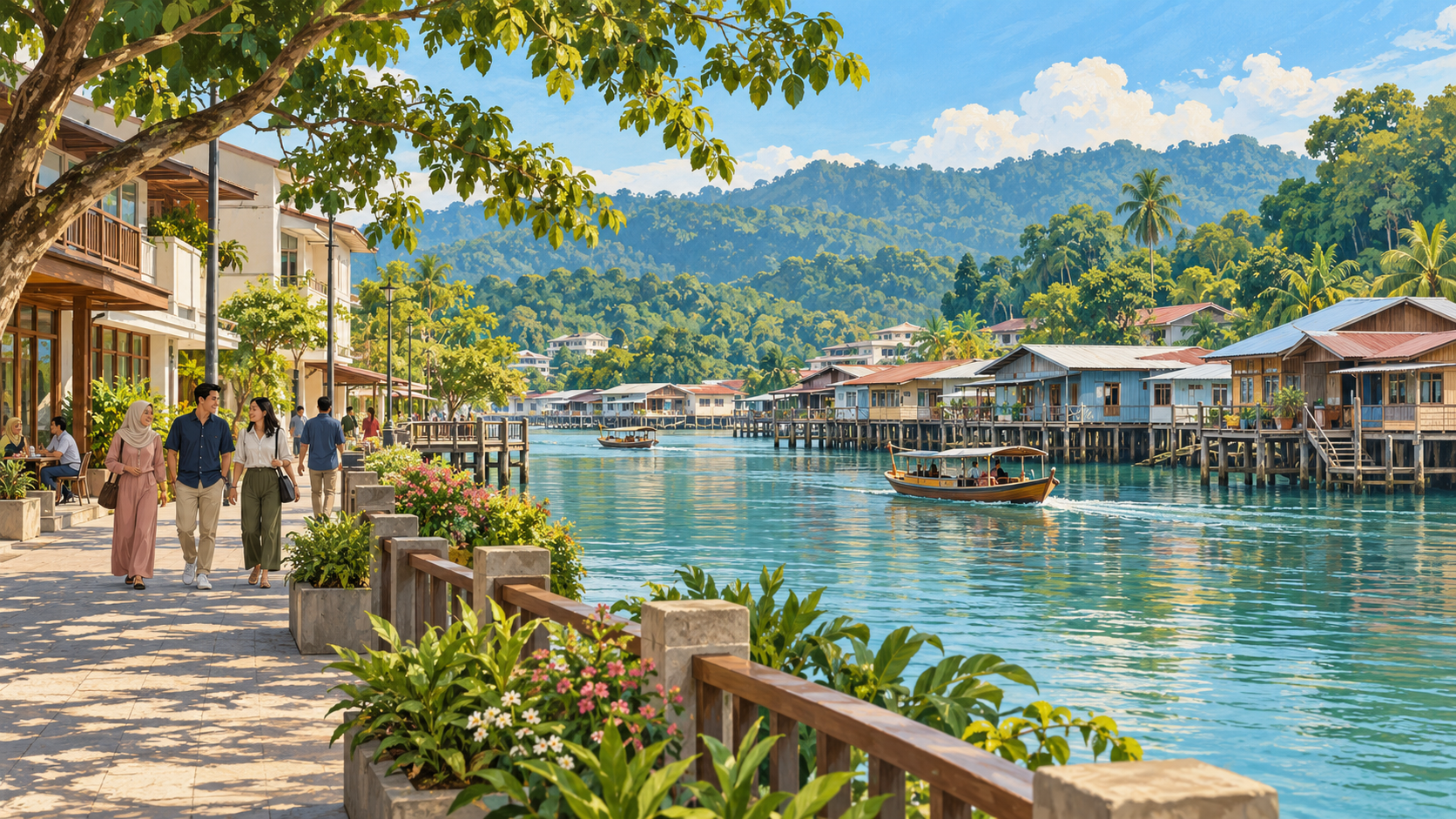
Cover illustration: an original AI-generated artistic interpretation of a Brunei-inspired riverfront, stilt houses, forested hills and everyday life. This composite is not an exact depiction of Kampong Ayer or any other named place.
Choose your route through Brunei
- 1. Brunei on the map: a small country with varied landscapes
- 2. History: the sultanate, colonial influence and independence
- 3. People and languages: population is more than one number
- 4. Government: monarchy, institutions and national goals
- 5. Law and rights: distinguish rules, enforcement and access
- 6. Cities and settlements: reading Brunei beyond the capital
- 7. The economy: hydrocarbons, diversification and public finances
- 8. Money and work: currency, jobs and retirement saving
- 9. Trade and international connections: a small domestic market
- 10. Infrastructure: bridges, ports, aviation and digital networks
- 11. Education and routes into adulthood
- 12. Health services and social support
- 13. Homes, work and everyday life
- 14. Food, ingredients and the work of sharing a meal
- 15. Arts, craft skills and living culture
- 16. Heritage, museums and thoughtful tourism
- 17. Sport, recreation and shared public space
- 18. Environment, energy and a changing climate
- 19. Challenges and choices for the future
- 20. Learning synthesis: connect places, people and evidence
1. Brunei on the map: a small country with varied landscapes
Borneo, the coast and the interior
Brunei Darussalam lies on the north-western coast of Borneo, facing the South China Sea and bordered on land by the Malaysian state of Sarawak. Its area is about 5,765 square kilometres. The Brunei mission’s geographical profile describes a coastal belt of tidal lowlands, hilly country farther inland and rugged eastern terrain reaching approximately 1,850 metres at Bukit Pagon. That combination matters: a small national territory can contain very different environments. A map of Brunei should therefore show relief and coastlines as well as its international boundary; a flat outline alone conceals much of the country’s physical character.
The national territory has two separated land sections. Brunei-Muara, Tutong and Belait occupy the larger western section, while Temburong lies to the east. Brunei Tourism’s Temburong overview helps locate this eastern district and the Sultan Haji Omar Ali Saifuddien Bridge connection across the bay. The separation does not make Temburong a different country, and sharing Borneo does not make Brunei part of Malaysia or Indonesia. For students, this is a useful distinction between an island, a sovereign state and an administrative district. Transport routes can connect separated territory without erasing the geographical gap or the neighbouring international border.
Rain, rivers and seasonal patterns
Brunei is generally hot, humid and wet throughout the year, but its rainfall still has seasonal patterns. The Meteorological Department’s climate explanation identifies the northeast monsoon from December to March and the southwest monsoon from June to September, with intervening transition periods. December is normally especially wet; February and March are relatively drier. These are long-term patterns rather than promises about a particular afternoon. El Niño can bring prolonged drier conditions, while La Niña is associated with wetter conditions. Calling the country equatorial therefore explains its broad climate without implying that weather is identical every month.
Rivers connect the interior, settlements and coast. The official Tutong River profile describes an approximately 137-kilometre waterway flowing from the district’s highlands through Tutong town to the South China Sea, with mangroves along parts of its course. Following one river is a practical way to understand a landscape: upstream land use, the town beside the channel and the coastal estuary form a connected system. Boats also reveal a different geography from roads. Riverbank habitats and tidal reaches help explain why settlement, transport and wildlife cannot be understood solely by studying the country’s highways.
2. History: the sultanate, colonial influence and independence
A long history before the modern state
Brunei’s history reaches much further back than independence in 1984. The Brunei History Centre’s account of the sultanate places the conversion of Awang Alak Betatar, who became Sultan Muhammad Shah, in the mid-fourteenth century. This is an official historical chronology, and early dynastic traditions should be read alongside archaeological and documentary evidence. Islam, royal authority and connections across the Malay world became central to the sultanate’s identity. Students should avoid imagining today’s fixed national borders stretching unchanged into the medieval past: earlier kingdoms organised power and relationships differently.
British influence developed through treaties rather than an immediate replacement of the monarchy. According to the US Office of the Historian’s diplomatic chronology, Brunei became a British protectorate in 1888. Its 1959 constitution established self-government, while Britain retained responsibilities that included foreign affairs and defence until full independence. These stages explain why the words protectorate, self-government and independence are not interchangeable. The Sultan continued to occupy a central position, but the extent of external control changed. A historical timeline should identify which powers moved, rather than describe every constitutional change simply as freedom or foreign rule.
War, political conflict and restored sovereignty
The Second World War brought Japanese occupation and fighting to Brunei. The Australian government’s Brunei commemoration record documents the Australian landings at Pantai Muara and Muara Island on 10 June 1945 as part of the campaign in Japanese-occupied Borneo. The memorial at Green Beach connects a specific coastal place with that wider history. Military operations are only one part of wartime experience, however: a landing date does not describe every civilian experience of occupation, displacement or rebuilding. It does explain why the coast also contains sites of international remembrance.
Political conflict continued after the war. A revolt began in December 1962, and Britain sent forces after the Sultan requested assistance. The British parliamentary statement of 10 December 1962 records attacks in Brunei town and Seria and discusses the unsettled question of a proposed Malaysian federation. It is a contemporary statement from a government directly involved, so its descriptions of rebel intentions require that context. The episode shows that Brunei’s route to its present political order involved contested choices, rather than a smooth sequence of ceremonies and constitutional documents.
Brunei resumed full independence on 1 January 1984. The Foreign Ministry’s institutional history explains that preparations for managing external relations had already begun with a Diplomatic Service Department in 1979. Existing commissions in Kuala Lumpur, London and Singapore became high commissions in 1984. Independence therefore involved practical institution-building as well as a declaration: officials, overseas representation and responsibility for international relationships had to develop. This helps connect national history with everyday government work, while distinguishing the centuries-old sultanate from the internationally independent state operating today.
3. People and languages: population is more than one number
Residents, citizenship and demographic change
The Department of Economic Planning and Statistics’ 2025 estimates put Brunei’s population at 458,600, compared with 455,500 in 2024. The 2025 total included 351,700 citizens, 26,500 permanent residents and 80,400 temporary residents. Brunei-Muara contained 72.5% of the population, showing the strong concentration around the capital district. These are resident-population estimates, not a count of citizens alone and not a completed 2026 census. Citizenship and residence are different categories with different implications for rights and services. The figures describe how many people live in the country, but cannot by themselves explain their household circumstances or sense of belonging.
Malay is the official language. English is also widely used, and Chinese languages and other community languages contribute to daily communication. The Foreign Ministry’s language overview describes this multilingual setting. It is useful to distinguish a language’s official position from the language someone chooses at home, with friends or at work. A person may use several languages across a single day. Nor should speaking Malay automatically be treated as evidence of a particular citizenship, religion or family background. Language is both a practical means of communication and a part of identity, with considerable variation between individuals.
Indigenous languages and language change
Brunei’s linguistic heritage includes more than Standard Malay and English. A Universiti Brunei Darussalam research project identifies Malay, Kedayan, Dusun, Bisaya, Tutong, Belait and Murut among its officially recognised indigenous languages. The project separates Standard Malay and Brunei Malay recordings for comparison. This makes an important classroom point: language labels used in administration do not remove differences in pronunciation, vocabulary or community use. Listening to recorded speech can reveal distinctions that a list of names cannot. Indigenous languages should be approached as living systems of knowledge and communication, rather than decorative additions to a national profile.
Language use also changes between generations. UBD’s Tutong dictionary project describes the Tutong language as endangered and notes that many younger members of the community use Brunei Malay and English despite valuing their heritage. A dictionary can support teaching and documentation, but its existence does not establish that transmission to children is secure. Equally, language shift does not mean that a community has lost all cultural identity. The most useful questions concern where a language is spoken, who has opportunities to learn it, and whether young speakers can use it naturally in everyday settings.
4. Government: monarchy, institutions and national goals
Authority and current leadership
Brunei is a monarchy in which the Sultan holds executive power. Article 4 of the Constitution of Brunei Darussalam places supreme executive authority in the Sultan, who is also Prime Minister; ministers are responsible to him. Article 3 establishes Islam as the official religion, identifies the Sultan as its head and provides for other religions to be practised in peace and harmony. These constitutional provisions describe the formal framework. They should not be mistaken for a complete account of how every community experiences government, religious practice or access to public institutions.
As checked on 20 October 2026, Sultan Haji Hassanal Bolkiah Mu’izzaddin Waddaulah remained Sultan and Prime Minister. The cabinet announcement effective 4 June 2026 retained the Crown Prince, Haji Al-Muhtadee Billah, as Senior Minister at the Prime Minister’s Office. It also appointed Prince Abdul Malik as a minister in that office and Prince Abdul Mateen as Minister of Foreign Affairs. The announcement introduced coordinating minister roles and renamed the primary-resources and tourism ministry as the Ministry of Economy, Trade and Industry. This dated reshuffle matters because older official biographies may preserve superseded titles.
Deliberation, philosophy and planning
The Legislative Council provides a formal setting for discussing laws, expenditure and public issues. The Department of Councils of State’s 2026 explanation describes ex-officio and appointed members, including district representatives, and procedures for budget scrutiny, questions and ministerial statements. It was re-established in 2004. Its presence should not be read as evidence of a government chosen through competitive national parliamentary elections. To understand the institution, look at both what it discusses and how its members acquire office. Publicly available proceedings can reveal policy concerns without changing the constitutional location of executive authority.
The national philosophy of Melayu Islam Beraja, commonly abbreviated MIB, brings together Malay identity, Islam and monarchy. The Prime Minister’s Office’s strategic-plan explanation presents these principles as part of the government’s ethos. Understanding this framework helps readers interpret official ceremonies, civic language and institutions. It does not justify assuming that all residents hold identical beliefs or experience public life in the same way; national doctrine and individual experience are different kinds of evidence.
Wawasan Brunei 2035 sets long-term goals for an educated and skilled population, quality of life and a dynamic, sustainable economy. An August 2026 account of its updated framework emphasises coordination and implementation. Such a plan expresses what government aims to achieve; it is not proof that every goal has already been reached. Students can assess progress by connecting the vision to dated outcomes such as employment, service access and economic diversity. Clear reference dates keep a national aspiration separate from a measured result.
5. Law and rights: distinguish rules, enforcement and access
Parallel legal systems
Brunei has common-law-based statutory courts and a separate Syariah court system. The Council of ASEAN Chief Justices’ legal overview explains the influence of English common law and equity, adapted through local legislation and circumstances. It also describes how the Syariah Penal Code expanded Syariah courts’ criminal jurisdiction beyond their earlier concentration on Muslim personal-law matters. A civil court is not simply a court for non-Muslims, and Syariah jurisdiction cannot be understood through a single slogan. The governing statute, offence, parties and procedural rules matter when identifying which legal framework applies.
Section 3 of the Syariah Penal Code Order 2013 states a general application to Muslims and non-Muslims unless the text expressly provides otherwise. Particular offences and conditions therefore need individual examination. Saying that all Syariah provisions apply only to Muslims is inaccurate; saying that every provision applies identically to everyone is also inaccurate. A country atlas can explain this structure, but should not substitute for current professional advice about an actual case. Legal texts identify possible liabilities; they do not, by themselves, establish how frequently a particular provision is prosecuted or punished.
Punishment, equality and the evidence behind claims
In its 18 February 2025 response to the UN rights review, Brunei stated that a de facto moratorium on executions covered both common-law and Syariah cases. That is a statement about execution policy, not abolition of capital punishment or repeal of offences. The same response retained Brunei’s reservation to Article 9(2) of the women’s rights convention and described an application route for citizenship for children of women citizens married to foreign nationals. An application procedure should not be confused with automatic equal transmission of nationality. These distinctions affect how claims about protection and equality are evaluated.
The rights implications are contested internationally. In their statement of 4 April 2019, UNAIDS and UNFPA urged repeal of discriminatory criminal provisions, including those concerning consensual same-sex relations, and warned about consequences for health and rights. This is the agencies’ stated assessment, distinct from the government’s defence of its legal system. A careful account can report both the law and the criticism without endorsing punishment or pretending that a moratorium removes every risk. Formal rights, administrative requirements, enforcement and a person’s ability to obtain help must be examined separately.
6. Cities and settlements: reading Brunei beyond the capital
Bandar Seri Begawan and the water villages
Bandar Seri Begawan is Brunei’s capital. The municipal department’s historical account records the change from Bandar Brunei to its present name on 4 October 1970, honouring the former Sultan Omar Ali Saifuddien. Names on maps can therefore carry political memory as well as identify a place. When comparing urban statistics, check whether a figure refers to the municipal area, a wider built-up area or the whole Brunei-Muara district. Those boundaries answer different questions and should not be treated as interchangeable.
Kampong Ayer is a group of settlements on stilts along the Brunei River. The official water-village profile describes boat access, wooden walkways and a cultural gallery. Its importance lies in combining inhabited neighbourhoods with a distinctive relationship to water. It is not simply an open-air display from the past. Visitors and students should distinguish public paths and visitor facilities from residents’ homes. Studying how movement works between boats, jetties and walkways offers a concrete example of settlement adapting to its physical setting.
Western towns and eastern connections
Belait brings industrial and rural landscapes into the same district. Brunei Tourism’s district guide links the Seria area with oil extraction, the Billionth Barrel Monument and Seria Energy Lab, while also identifying forest settlements and longhouses farther inland. Kuala Belait and Seria should not be collapsed into one generic oil town. Nor does an industrial identity describe every household or occupation in the district. The contrast between coastal industry and inland communities makes Belait useful for examining how different livelihoods share a regional economy.
Tutong adds agricultural settlements, a river town and several indigenous communities to the national picture. The official Tutong guide highlights paddy cultivation and crop farms, alongside Tutong, Kedayan, Dusun and Iban cultural presence. A district profile is best read as a guide to diversity rather than a fixed description of every resident. The town, farms and inland villages occupy different positions within the same landscape. This is another reason a short visit to the capital cannot stand in for understanding the whole country.
Bangar is the principal town to locate when studying Temburong. The official Temburong brochure and town map identify its jetty, market and civic landmarks, connecting the district’s everyday centre with surrounding settlements. A visitor may travel onward to forest-based activities, but the district also contains ordinary places for shopping, administration and social life. Reading the town map before a wider district map helps distinguish a regional service centre from a visitor attraction. It also counters the misleading idea that an extensively forested district is uninhabited.
7. The economy: hydrocarbons, diversification and public finances
What produces national income?
Oil and natural gas have shaped modern Brunei. The Petroleum Authority’s industry history traces the Seria oil discovery to 1929 and the first oil exports to 1932. Production links onshore and offshore resources with processing, shipping and overseas customers. Upstream activity means finding and extracting hydrocarbons; downstream activity processes them into products further along the supply chain. These distinctions matter when discussing diversification. Moving from extraction into manufacturing can add industrial capabilities, while still leaving the economy connected to hydrocarbon inputs, international energy markets and the operating performance of large facilities.
For 2025, DEPS national accounts report nominal GDP of BND19,610.1 million and nominal GDP per person of BND42,760.7. GDP measures the value of production, and a per-person average does not mean that every resident receives that amount as income. Nominal figures also reflect prices, so they should not be confused with inflation-adjusted growth. This is particularly important for a commodity-producing economy: export prices can change the monetary value of output even when physical production moves differently. Comparing living standards requires more information about earnings, household needs and access to services.
Diversification is a process
The IMF’s assessment published on 23 September 2026 estimated real growth of 1.0% in 2025 and projected 2.3% for 2026. The latter was a forecast, not a completed annual result. It identified hydrocarbon price volatility and persistent fiscal deficits as vulnerabilities, alongside substantial buffers and a stable monetary framework. These findings explain why a wealthy resource base does not eliminate budget choices. Saving, spending and investing resource income affect both present services and future generations. A favourable forecast should therefore be read together with its assumptions and risks.
Enterprise policy provides another view of diversification. The Brunei Economic Development Board’s Growth Facilitation Fund targets downstream oil and gas, tourism, services, food and information technology. Its support is linked to eligible businesses and activities, including technology adoption and expanded production. The existence of a fund is evidence of a policy instrument, rather than a guarantee that a new company will succeed. Meaningful diversification requires customers, productive firms, skills and sustained employment. It is helpful to ask whether smaller domestic businesses can participate in supply chains and develop capabilities alongside large investment projects.
8. Money and work: currency, jobs and retirement saving
A close monetary relationship with Singapore
Brunei uses the Brunei dollar, written BND or B$. Under the Currency Interchangeability Agreement, the Brunei and Singapore dollars exchange at par through the participating monetary authorities and banks. The Brunei Darussalam Central Bank’s explanation makes an important distinction: each currency is customary tender in the other country, so ordinary retailers are not obliged to accept it. A Singapore-dollar note is therefore not a promise of acceptance at every Brunei counter, or vice versa. The arrangement also underpins Brunei’s currency-board framework and links domestic monetary conditions closely with Singapore’s monetary policy.
The 2025 Labour Force Survey highlights report 220,400 employed people and a 5.0% unemployment rate for the population aged 18 and over, with labour-force participation of 66.5%. The age definition matters when comparing another country’s statistics, which may begin at 15. Unemployment is measured against the labour force, not the entire population; people studying or otherwise outside it are a separate category. National totals also cannot tell a school leaver whether a suitable vacancy exists. Skills, experience, location and the type of work offered all shape the practical transition into employment.
Pay protection and longer-term security
Brunei’s minimum-wage framework is sector-specific. The official minimum-wage order sets BND500 a month for covered full-time employees and BND2.62 an hour for covered part-time employees; its expanded industry schedule took effect on 1 April 2025. Coverage must be checked against the legal categories, rather than assumed for every job. A statutory floor is also different from a recommended salary guide or a typical wage. Employment research should distinguish basic pay, working hours, contractual benefits and deductions, because a monthly headline alone gives an incomplete picture of what a worker receives.
Retirement saving forms another part of employment. Under the SPK Member Account described by the Employees Trust Fund, members contribute 8.5% of basic salary each month. The account includes specified opportunities for pre-retirement withdrawals and a full-withdrawal option at age 60. These rules should be read with the scheme’s eligibility and withdrawal conditions. Savings contributions reduce immediate take-home pay while building resources for later life, so neither the salary before deduction nor the account balance alone measures financial well-being. Scheme benefits and rules also differ from a promise of identical retirement income for everyone.
9. Trade and international connections: a small domestic market
Goods, partners and regional institutions
International trade connects Brunei’s producers and consumers with much larger markets. For July 2026, DEPS merchandise-trade statistics recorded exports of BND1,613.3 million and imports of BND1,159.2 million, leaving a goods-trade surplus of BND454.1 million. These are one month’s goods figures, not annual income and not the entire balance of payments. Imports can include industrial inputs as well as consumer goods, so rising imports are not automatically evidence of economic weakness. The trade balance answers a specific accounting question; it does not, by itself, measure job quality or the distribution of income.
Brunei joined ASEAN on 7 January 1984, shortly after independence, as documented in ASEAN’s admission record. Regional membership provides an institutional setting for relationships with neighbouring states. For a small country, cooperation concerns more than exports: transport, diplomacy and cross-border issues also require regular contact. Membership does not merge national legal systems or make all borders disappear. Students can distinguish the organisation, its individual agreements and the domestic measures used to implement them. Each level helps explain how a country can retain sovereignty while participating in shared regional arrangements.
Trade agreements and practical requirements
The Comprehensive and Progressive Agreement for Trans-Pacific Partnership entered into force for Brunei on 12 July 2023, according to New Zealand’s official CPTPP guidance. Its long name is often shortened to CPTPP. Entry into force is the point at which treaty obligations begin for a party; it is different from the earlier signing or ratification announcement. For businesses, an agreement can improve access to overseas markets, but actual treatment depends on the product, destination and relevant commitments. A national trade agreement is an opportunity framework, rather than an automatic order book for every exporter.
The Regional Comprehensive Economic Partnership, or RCEP, entered into force for Brunei on 1 January 2022. The Brunei government’s commencement announcement places it within wider regional trade and investment cooperation. Different agreements can overlap: the same trading relationship may be covered by more than one set of preferential rules. That does not mean a business can combine whichever clauses it likes. The useful question is which complete arrangement applies to a shipment or service and what evidence is required. This turns an abstract list of memberships into a practical lesson about how trade rules work.
The Brunei Trade portal’s guidance on certificates of origin shows one practical requirement: exporters may need to establish where a product qualifies as originating to claim preferential treatment. Shipping something from Brunei does not necessarily make it Brunei-originating under an agreement. This distinction is especially useful when imported components or raw materials are processed locally. Trade facilitation involves documentation and reliable administration as well as tariff reductions.
10. Infrastructure: bridges, ports, aviation and digital networks
Connections over water
The bridge connection to Temburong changed the practical relationship between Brunei’s two land sections. The European Commission’s engineering account records the Temburong Bridge opening to traffic on 17 March 2020. It provides a direct road connection across the bay. Its importance is geographical as well as technical: road access can alter journeys to work, services and family. A bridge should still be studied as part of a network, including approach roads and destinations, rather than judged only by its length or appearance.
Muara is a key maritime gateway. The port operator’s profile describes a deep-water port developed in 1973 and lists container, conventional cargo and warehouse services. These are different parts of the logistics chain: goods must move between ships, storage and onward transport, with customs and commercial arrangements alongside physical handling. A port’s existence does not tell readers how quickly or cheaply every shipment moves. For an economy connected to overseas supplies and customers, reliable maritime access matters to ordinary shops and manufacturers as well as the companies directly involved in shipping.
Air travel and information flows
Royal Brunei Airlines illustrates the role of aviation in connecting a small state internationally. The airline’s own historical account dates its establishment to 18 November 1974 and its first flight from Bandar Seri Begawan to Singapore to 14 May 1975. The capital remains its hub. Aviation involves more than holiday travel: it creates connections for family visits, study, business and cargo. Historical route announcements should not be mistaken for current timetables, however. A useful atlas explains the function of the network while directing actual travellers to current schedules and entry requirements.
Digital infrastructure supplies another kind of connection. AITI’s official launch announcement dates the availability of 5G mobile services to 22 June 2023, involving the national network provider and retail telecommunications operators. A launch date establishes the introduction of a service, but does not prove equal signal quality, affordability or digital skills for every household. The same distinction applies to online public services: putting a process on the internet is only one step towards making it usable. Infrastructure becomes meaningful through people’s ability to reach, afford and effectively use the services it supports.
11. Education and routes into adulthood
School stages, languages and a changed starting age
Brunei’s education pathway begins before primary school. The Ministry of Education describes one preschool year followed by six primary years, ending with the Primary School Assessment, or PSR. Its primary-school account places English alongside Malay-language subjects, Islamic Religious Knowledge and Melayu Islam Beraja, rather than presenting schooling as monolingual. A legal change also matters: the 2023 amendment lowered the compulsory-school-age starting threshold from six to five, effective 1 January 2024. That rule concerns compulsory education; it should not be mistaken for a promise that every resident has identical admission, scholarship or fee entitlements. MOE: Primary education; Compulsory Education Act amendment, 2023.
Inclusive education requires specific support
The Department of Special Education’s page, updated on 6 March 2025, describes educational psychology, speech and language therapy, occupational therapy, and support for dyslexia, hearing and visual impairments. Its district network includes an Independent Living Skills Center in Temburong. These details broaden the meaning of learning beyond examination results: communication, mobility and everyday independence can be important educational outcomes. The department describes small-group and individual approaches, but a published service list does not establish what a particular child receives. Appropriate support depends on assessment, planning with the school and the resources available for that learner. MOE: Department of Special Education.
Technical routes connect learning to practical systems
The Institute of Brunei Technical Education offers routes into the systems that keep the country working. Its listing includes telecommunications-network apprenticeships, construction and draughting through Dual TVET, and laboratory science and pharmacy-technician programmes. The Brunei Maritime Academy offers marine-engineering and nautical-studies diplomas, alongside deck and engine-rating apprenticeships. Hospitality courses include professional cookery and services. The School of Business also describes its Youth Enterprise Services Center as a setting for practical business operations. These are distinct pathways rather than a single vocational track; students need to check the advertised intake, entry qualifications and workplace requirements for their chosen programme. IBTE: Schools and programmes.
University learning can extend beyond campus
UBD’s Faculty of Science describes Discovery Year as experiential learning normally undertaken in the third year. Options include study abroad, internships, community outreach and incubation, allowing students to encounter research, workplaces, organisations or enterprise outside ordinary lectures. Placement is not automatic: the faculty identifies academic performance, host quotas and disciplinary background among its selection considerations. This is a useful example of the difference between a programme’s design and an individual student’s experience. An internship can help someone test a career interest, while a community project may reveal practical problems that a classroom explanation alone would miss. UBD Faculty of Science: Discovery Year.
12. Health services and social support
Healthcare entitlement depends on status
Brunei’s healthcare entitlements depend on citizenship and residence category. The July 2025 charging scheme distinguishes citizens and stateless permanent residents from permanent residents with foreign nationality and other foreigners. A ministry clarification dated 10 July explains that changes took effect on 1 July. It identifies exemptions for treatment already underway at specified hospitals before that date until completion or discharge, and for mental-health and infectious-disease categories covered by the relevant legislation. Financial hardship can be assessed by medical social workers, with assistance or instalments considered for eligible cases. The ministry also affirms access to urgent and emergency treatment. MOH: Health-charge policy clarification, 10 July 2025; MOH: July charging scheme.
Much care happens outside the hospital ward
Community health services bring together treatment, prevention and referral. The ministry lists maternal care before and after birth, childhood vaccination, basic investigations, wound care and referral to specialist clinics or emergency departments. Nursing services include postnatal home visits and breastfeeding support, while clinics provide diabetes education, foot screening and smoking-cessation support. Child-health services cover children from birth to five and their caregivers. This organisation follows people through different stages of life and connects household routines with clinical care. A vaccination appointment, a mother’s home visit and an adult’s long-term disease review therefore belong to the same wider care network. MOH: Community Health Services.
Screening has defined entry conditions
The National Health Screening Programme, introduced in 2019, offers eligible citizens and permanent residents cardiovascular-risk checks and selected cancer screening. Its published age bands include forty and above for cardiovascular risk, fifty to seventy-five for colorectal screening, forty to sixty-nine for breast screening, and twenty-five to sixty-five for cervical screening. Previous diagnoses, recent tests and other clinical conditions also affect eligibility. Registration can begin through BruHealth or a health centre, with eligibility reviewed before an appointment. These are population-screening pathways, not instructions to delay seeking medical attention when symptoms appear or to substitute an online form for clinical assessment. MOH: National Health Screening Programme.
An application system is one part of welfare
Sistem Kebajikan Negara, usually shortened to SKN, provides an application route for welfare support. Its user guide asks applicants to prepare an email address and scanned supporting documents, register an account, complete personal details and submit an application. Separate guidance covers annual school-needs assistance, and the portal includes a village-head verification form. The process illustrates how support depends on information being gathered and checked. Registration should not be described as automatic approval or payment. For a household with limited digital confidence, understanding the documents and obtaining help with the application can be as important as knowing that assistance exists. Sistem Kebajikan Negara: Applicant user guide.
13. Homes, work and everyday life
Housing combines opportunity with responsibilities
The National Housing Scheme combines access to a home with an application and repayment process. The Housing Development Department says allocation follows the application-year queue and depends on completed houses being available. Applicants provide employment evidence and financial records; self-employed applicants also submit business documentation. Repayment arrangements include salary or pension deductions and other approved payment methods, with repayment periods linked to remaining service and capped at thirty years. Allocated homes carry residential-use conditions. These provisions explain why eligibility, allocation and ownership responsibilities are different stages, and why a public-housing application should not be described as an immediate house grant. Housing Development Department: Frequently asked questions.
Working routines vary by employment arrangement
Workplace schedules should not be inferred from government-office hours alone. Labour Department guidance distinguishes non-shift work from shift arrangements and summarises ordinary non-shift limits of eight hours a day or forty-four hours a week, with overtime provisions and exceptions. Its reminder about Ramadan says private-sector flexibility is subject to the employer’s discretion. That is a practical warning against assuming every workplace follows the same shortened day. A nurse, shop employee and office worker may organise family time differently. The applicable law, contract, rest periods and actual roster need to be considered together when describing working life. Labour Department: Hours of work and overtime.
Retirement support has different categories
The Employees Trust Fund, TAP, explains that the National Retirement Scheme’s Retirement Account pools employer contributions, with additional government assistance, to provide income from age sixty. Its FAQ distinguishes lifetime-benefit arrangements for eligible citizens and stateless permanent residents from SPK Basic for permanent residents with foreign nationality. The latter uses the member’s retirement savings to calculate a time-limited payment stream. The scheme also has a separate Member Account, to which voluntary contributions can be made. Membership category, average salary and contribution-related factors influence benefits. Retirement support therefore links employment history and savings arrangements to household income later in life. TAP: National Retirement Scheme FAQ.
Digital confidence is an everyday skill
On 8 May 2024, AITI reported an outreach event for more than thirty older residents at Tutong’s senior-citizen activity centre. Sessions addressed online identity protection, fraudulent websites and online scams. The local example adds human detail to discussions of a digital economy: using a phone confidently is different from recognising a suspicious payment request or protecting personal information. Training at a familiar community venue can make those subjects easier to approach. The event demonstrates an activity that took place, rather than proving that all older people have the same skills or that digital exclusion has disappeared. AITI: Digital inclusion event in Tutong.
14. Food, ingredients and the work of sharing a meal
Ambuyat and nasi katok offer different kinds of meal
Ambuyat begins with sago starch and becomes a sticky food eaten using the bamboo utensil called a candas. Its accompaniments supply contrasting flavours: cacah binjai uses tangy wild mango, while sambal belacan, grilled fish, vegetables and beef can join the shared spread. Nasi katok is more compact: steamed white rice, fried chicken and sambal. Sellers distinguish their versions through the sauce’s flavour and heat. These meals show why a country’s cuisine cannot be reduced to one ingredient or occasion. The experience includes texture, accompaniments, portioning and whether people share several dishes or buy a individual meal. ASEAN Tourism: Brunei food guide.
Bamboo and leaves are part of the kitchen
Bamboo chicken, associated with Iban longhouse cooking, places marinated chicken, onions and spices inside bamboo tubes. Leaves close the opening and the filled bamboo cooks over an open fire. The container is therefore part of the cooking method. Wajid Temburong shows another local distinction: it uses beras Jawa, giving a less sticky texture than conventional glutinous-rice wajid. Coconut milk and sugar cook to a dark caramel consistency before being mixed with the rice. The sweet is enclosed in nyirik leaves and secured with a small skewer. Ingredients, heat and wrapping together produce the finished food. Brunei Tourism: Local delicacies.
Kelupis carries knowledge in its wrapping
A Pelita Brunei culinary feature dated 9 February 2022 describes heating coconut milk until its oil separates, adding glutinous rice and salt, then wrapping the partly cooked mixture in nyirik leaves before steaming. Its account distinguishes shorter, larger Brunei parcels from smaller, elongated Kedayan ones; Kedayan parcels may be linked into strings. The feature also places kelupis at weddings, Hari Raya and other gatherings. Preparing many parcels creates shared work for relatives and neighbours, with experienced hands demonstrating folding and tying. Regional variety here lies in a practical technique as well as in the food’s name. Pelita Brunei: Kelupis preparation and traditions.
Food heritage is still taught through participation
A government civic-programme visit on 24 September 2026 brought participants to Jerudong B’s village council at Pantai Siandang. The programme introduced village enterprises and traditional foods, including dalamu, sumbui-sumbui, lapat and lamban. Participants observed kelupis preparation and wrapping, tried preparing dalamu and linked kelupis parcels themselves. This documented occasion shows heritage being practised rather than only displayed on a restaurant menu. It also connects food knowledge with village relationships and small-scale enterprise. The lesson for a visitor or student is to notice the makers and the teaching process, alongside the finished dish placed on the table. Pelita Brunei: Civic visit and traditional food.
15. Arts, craft skills and living culture
Textiles and metalwork begin with trained hands
At the Brunei Arts and Handicraft Training Centre on Jalan Residency, traditional skills are presented through training, displays and opportunities to encounter artisans. Kain tenunan, the woven brocade associated with Bruneian craft, incorporates gold and silver threads; silverwork provides another example of patient, specialised making. Looking closely changes what a visitor sees. A textile is not merely a colourful surface: thread, repeated pattern and workmanship are essential to the object. A training centre also makes an important cultural point. Preserving a craft requires people who can continue producing it, not simply a room where older examples are stored. Brunei Tourism: Arts and Handicraft Training Centre.
Technology includes tools, houses and ways of working
The Malay Technology Museum at Kota Batu approaches culture through practical knowledge. Its displays include model houses, hunting and fishing implements, craft tools and reconstructions of water-village dwellings. Communities represented include Murut, Dusun, Kedayan and Penan people. This widens the meaning of technology beyond electronics: a tool or dwelling embodies decisions about material, purpose and environment. Comparing exhibits can reveal different solutions to similar needs, such as shelter or obtaining food. Museum models are interpretations, however, so they are most useful when their labels and community context are read alongside the objects rather than treated as timeless portraits. Brunei Tourism: Malay Technology Museum.
Jipin connects music, coordinated movement and occasions
Bruneian dance forms include Jipin Laila Sembah and Jipin Susun Sireh. A Ministry of Culture, Youth and Sports announcement describes paired, coordinated footwork accompanied by instruments such as gambus, violin and drums, sometimes with gulintangan. Performances belong to weddings, community celebrations and national occasions, while instruction and cultural groups help pass on the skills. On 26 September 2026, the ministry announced Brunei’s participation with Indonesia, Malaysia and Singapore in a joint Zapin nomination for UNESCO’s 2028 evaluation cycle. That is a nomination process, not an inscription already awarded, and it acknowledges a tradition shared across national boundaries. MCYS: Joint Zapin nomination announcement.
Culture outside the capital has its own settings
Mendaram Besar Longhouse in the Labi area of Belait offers a specific Iban example. The official tourism description presents a twelve-door residence, woven crafts, food and ngajat dance, with performance dress incorporating feathers, bells and beads. These elements are encountered within a residential setting rather than a purpose-built city museum. The distinction matters: a longhouse is also people’s home. Visitors should approach any organised encounter through the hosts’ arrangements and respect private spaces. One named longhouse can introduce communal architecture and local cultural presentation without being made to represent every Iban household or every way of living in Belait. Brunei Tourism: Mendaram Besar Longhouse.
16. Heritage, museums and thoughtful tourism
A mosque is architecture and a place of worship
Completed in 1958, Omar Ali Saifuddien Mosque is named after Brunei’s twenty-eighth sultan. Its golden dome, Italian marble columns and stained-glass windows contribute to its distinctive appearance. The surrounding lagoon contains a replica of a sixteenth-century royal barge, placing another historical reference beside the building. The gardens and water create a setting that can be studied together with the architecture. A visitor should remember that visual prominence does not turn a working religious place into an unrestricted attraction. Access arrangements and appropriate behaviour need to follow the mosque’s current instructions, particularly around worship. Brunei Tourism: Omar Ali Saifuddien Mosque.
Ceremonial objects explain public monarchy
The Royal Regalia Museum displays objects associated with the monarchy, including material from the present sultan’s Silver and Golden Jubilees. A prominent exhibit is the golden chariot used in the 1992 Silver Jubilee procession, alongside ceremonial weapons, shields and heirlooms. Such objects help a reader imagine how authority is presented publicly through procession, dress and carefully arranged space. Their historical value is not simply that they are elaborate. Ask what event an object served, who used it and what message it communicated. Those questions turn a visit from a sequence of photographs into an examination of ceremony. Brunei Tourism: Royal Regalia Museum.
A gallery adds context to the water village
Established in 2009 within Kampong Ayer, the Cultural and Tourism Gallery uses photographs, artefacts and displays to explain the water village’s history, craft traditions and community life. It gives visitors a way to connect a visible settlement with records and interpretation, rather than viewing houses only from a passing boat. Comparing an older photograph with a present-day view can prompt questions about continuity and change. The gallery is a useful introduction, but it cannot replace the perspectives of residents. Responsible interest includes respecting ordinary homes and recognising that a heritage landscape also contains contemporary routines and private lives. Brunei Tourism: Kampong Ayer Cultural and Tourism Gallery.
Forest tourism depends on the setting it uses
Ulu Temburong National Park introduces a different kind of destination. The official tourism account describes about 50,000 hectares of rainforest with both lowland and mountain environments. The appeal includes observing the forest and its wildlife rather than finding a single monument. That changes the visitor’s role: quiet attention, suitable preparation and following local guidance matter more than collecting a guaranteed list of sightings. A forest visit can also create questions for later study about habitats, conservation and how visitor access is managed. The landscape’s value continues beyond the portion a traveller sees during one excursion. Brunei Tourism: Ulu Temburong National Park.
17. Sport, recreation and shared public space
Outdoor recreation can be close to the city
Tasek Lama Park brings outdoor leisure into Bandar Seri Begawan’s urban setting. The official description lists a natural waterfall, hiking paths, birdwatching, picnic areas and facilities including reflexology walks and a climbing wall. Different visitors can therefore seek different experiences: a short stroll, a more demanding walk or time observing the surroundings. A park is also useful social infrastructure, giving people somewhere to spend time without every activity depending on a purchase. Its listed facilities should be treated as a guide to the place, with current conditions and maintenance checked before planning around a particular feature. Brunei Tourism: Tasek Lama Park.
Car-free streets allow another use of the centre
Bandarku Ceria began on 2 October 2016 as a Sunday car-free initiative. A government report on the 4 January 2026 event describes walking, jogging and cycling, with families and food-and-drink vendors sharing the city-centre activity. The programme connects recreation with small businesses and a different experience of public streets. Removing vehicles for a period can make space for movement at a slower pace and for people to meet. This is a dated example of how the centre is used, not a guarantee of an uninterrupted weekly schedule; individual events can change with conditions. Pelita Brunei: Healthy living through Bandarku Ceria.
Youth football needs a regular development pathway
An October 2026 Football Association of Brunei Darussalam release describes the Grassroots Cup and plans for regular under-eight and under-ten leagues. It also discusses improvements intended for two playing fields and futsal facilities. The distinction between existing activity and planned provision matters when judging progress. Children need repeated opportunities to practise and compete, while coaches and organisers need usable space and a dependable calendar. A cup can introduce participation, but a season offers a different rhythm of learning. The federation’s account shows what it is trying to build; later results would establish how extensively those plans were delivered. FABD: Grassroots development and governance update.
Facilities reveal more than one sporting culture
The Youth and Sports Department’s directory covers all four districts. Brunei-Muara’s entries include gasing and pétanque grounds, tennis courts, swimming pools and Serasa’s water-sports complex. Belait includes Mumong facilities and Seria’s arena; Tutong lists its sports complex, running track and aquatic centre; Temburong has a sports complex and pool. The variety makes room for traditional games, court sports, athletics and water-based recreation. It also prevents the capital from becoming the whole sporting story. A directory demonstrates provision, however, rather than participation rates: who can reach, afford or comfortably use the facilities remains a separate question. Youth and Sports Department: Sports facilities.
18. Environment, energy and a changing climate
Forest restoration is measured after planting
At Badas in Belait, forest conservation includes work in damaged peat-swamp areas. UBD’s report of 2 October 2025 says its research project began in 2021 and had planted 334 Rubroshorea albida saplings before the second phase. At that launch, fifty volunteers helped plant another two hundred saplings of Dryobalanops rappa. The species and location matter: restoration is tied to a particular ecosystem rather than interchangeable tree planting. Numbers planted describe an activity, however, not long-term survival or recovered ecological function. Following the young trees and conditions at the site is necessary before declaring the restoration successful. UBD: Second phase of Badas tree planting.
The climate target uses a projected comparison
Brunei’s NDC 3.0, submitted to the UN climate registry on 16 September 2025, sets a conditional target of reducing greenhouse-gas emissions by twenty percent relative to business-as-usual levels in 2035. This compares emissions with a projected pathway, not with a historical year’s actual total. The implementation period is 2026–2035. The document makes delivery contingent on technological maturity, international cooperation, support and appropriate economic circumstances. These qualifications are part of the commitment itself. To judge progress, later emissions inventories must be compared with the stated baseline and accounting method; announcing the target does not demonstrate that the reduction has occurred. Brunei Darussalam NDC 3.0, submitted to UNFCCC.
Rooftops can participate in electricity production
The Department of Energy’s net-metering programme allows eligible solar-photovoltaic owners to send surplus electricity to the national grid in return for credits. Its published conditions cover existing Department of Electrical Services customers, an absence of outstanding arrears and systems within the specified capacity range; an appointed installer handles the application process. This makes the energy transition tangible at building scale. A roof becomes a potential generating surface, but sunshine alone does not complete a project. Installation quality, connection approval, equipment and the household’s pattern of electricity use all influence how such a system functions in practice. Department of Energy: Net-metering programme.
Weather observations need their dates attached
The Meteorological Department’s review records a mean temperature of 28.9°C in 2024, 0.8°C above its 1991–2020 reference average. It also reports a high of 36.9°C on 30 March that year and discusses observations at Brunei International Airport. These are dated measurements, not a forecast for a visitor’s particular day in 2026. For students, the example separates weather, a long-term reference period and an annual anomaly. For communities, warmer conditions raise practical questions about comfortable classrooms, shaded outdoor areas and cooling demand. One annual value is useful evidence, but long-term interpretation requires the wider record. Meteorological Department: 2024 climate review.
19. Challenges and choices for the future
A qualification needs a route into work
The i-Ready apprenticeship FAQ illustrates a challenge between finishing education and establishing a career. It describes a pathway for registered, unemployed citizens and permanent residents with little work experience, with degree, diploma and technical-qualification routes. The programme’s stated purpose is to build employability through workplace learning. That purpose should not be reported as a guaranteed permanent job or a measured reduction in unemployment. Useful questions concern the quality of supervision, the skills acquired and what happens after a placement. A strong transition needs employers able to use new skills as well as graduates prepared to offer them. MPEC: i-Ready programme eligibility.
Enterprise requires capabilities, not only enthusiasm
BEDB’s Micro Bootcamp description gives practical substance to business development: participants work on planning, finance, marketing and pitching, with a business plan and live pitch among the programme outputs. The listed eligibility includes citizens or permanent residents aged eighteen and above. Such training can help someone turn an idea into a clearer offer, estimate costs and explain why a customer might buy it. It does not establish that every participant’s business will survive. The broader challenge is to connect skills and support with sustained demand, reliable delivery and enough income to maintain the business beyond its launch. BEDB: Business bootcamp programmes.
Digital participation remains a work in progress
A current example is AITI’s Digital Perkasa procurement, whose quotation deadline was 19 October 2026. It sought a provider for hands-on digital-literacy training directed at vulnerable and underprivileged groups, including assessment before and after participation. As of this article’s research date, that document demonstrates a commissioning intention; it does not show completed training or proven improvements in employment. Its design nevertheless identifies a useful priority. Digital services become more inclusive when people can navigate them confidently and safely, and when programme evaluation checks what participants learned rather than merely counting how many attended. AITI: Digital Perkasa procurement.
Longer lives also need healthier years
Brunei’s STEPS survey, conducted from November 2022 to November 2023, involved 3,017 adults aged eighteen to sixty-nine. Its fact sheet estimated obesity, defined as BMI of at least thirty, at 32.4% in that adult age range, with a 95% confidence interval of 27.4–37.8%. This is a dated sample-based estimate, not a measurement of every resident in 2026. It helps explain why prevention belongs alongside treatment in discussions of future wellbeing. The constructive response is to examine food environments, opportunities for movement and access to preventive care, without reducing people’s health or dignity to a single measurement. MOH: STEPS Survey 2022/23 fact sheet.
20. Learning synthesis: connect places, people and evidence
Build explanations at more than one scale
A useful country study moves between the national system and a specific place. Start with a question from this atlas, such as how people learn, obtain support or care for an environment. Then connect an institution to a local example and to the person using it. An education pathway becomes clearer when followed through a student’s choices; a conservation programme becomes clearer when examined at its field site. The aim is not to select one example as the whole country. It is to explain how broad policies become practical activities, while leaving room for different experiences.
Keep four kinds of statement separate
Make four columns in your notes: observation, rule, target and interpretation. Put a dated survey result in the first, an eligibility condition in the second, a future ambition in the third, and your explanation of what it might mean in the fourth. This simple method prevents several common errors. A programme announcement is not an outcome; a national average is not every household; an attractive visitor experience is not a complete account of daily life. When comparing Brunei with another country, check that the dates, populations and definitions match before treating two numbers as directly comparable.
Read objects and meals as evidence
Choose one food, woven object or museum exhibit discussed here. Describe what it is made from, how it is produced and the setting in which people encounter it. Only then discuss its meaning. This order keeps cultural study grounded in skills, materials and human choices rather than a list of colourful labels. Ask whose knowledge is being represented and whether the account concerns a particular community, a commercial visitor activity or a wider practice. A respectful explanation can recognise shared regional traditions while still identifying what is distinctive about the local example you have studied.
Finish with an argument that can be checked
A strong final project could answer: how can a country maintain valued forms of support while adapting its skills, energy use and opportunities for the future? Use three examples from different chapters, explain the connection between them and state a limitation in the evidence. Avoid predicting an inevitable success or failure. Instead, identify what future information would change your judgement: a completed programme evaluation, a newer survey or measured environmental results. This approach makes the atlas a starting point for thoughtful inquiry. Understanding grows when you can explain both what the evidence supports and what it cannot yet establish.
Frequently asked questions about Brunei
Where is Brunei?
On the northwestern coast of Borneo in Southeast Asia.
What is Brunei’s capital?
Bandar Seri Begawan.
What language is official?
Malay. The language chapter also explores the country’s wider linguistic life.
How many districts does Brunei have?
Four: Brunei-Muara, Belait, Tutong and Temburong.
What is Brunei famous for?
Its royal and religious architecture, Kampong Ayer, forest landscapes and oil-and-gas economy are prominent features. Its everyday life also includes technical education, village enterprises, sport and cultural practice.
What is Kampong Ayer?
A river settlement whose heritage is explored through its buildings, communities and cultural gallery. It is a lived-in place, so a visitor should respect residents’ privacy.
What is ambuyat?
A sticky sago-starch food eaten with a candas and flavourful accompaniments. The food chapter explains its texture and the dishes served alongside it.
What is nasi katok?
A compact meal of white rice, fried chicken and sambal, with vendors offering different versions of the sauce.
What can readers learn about Temburong?
The chapters connect its forest landscapes with settlements, services and foods such as wajid Temburong, rather than treating it only as a scenic excursion.
Is healthcare free for everyone living in Brunei?
No. Citizenship, permanent-resident status and other eligibility conditions matter. The health chapter explains the distinctions in the July 2025 policy clarification.
Does Brunei have technical education as well as universities?
Yes. The education chapter introduces IBTE’s vocational pathways and university learning beyond the classroom.
What makes the climate target important to interpret carefully?
The stated reduction is conditional and measured against a projected business-as-usual pathway in 2035. It is not a claim that emissions have already fallen by that amount.
Is this a travel itinerary?
It is an educational country overview. Current opening arrangements, access conditions and individual travel requirements need separate checks.
How can students use the article?
Connect examples across chapters, keep each statistic’s date and definition, and distinguish a rule or target from a demonstrated result.
Where can I learn more about education and institutions?
The specialist guides below explore schools, curriculum, learning support and public responsibilities in greater detail.
Continue reading: Brunei’s specialist guides
- How Brunei Works: monarchy, oil and gas, and public services.
- How Education System of Brunei Works: school stages and qualifications.
- How Ministry of Education for Brunei Works: education responsibilities.
- Schools of Brunei: institutions and pathways.
- What Is Taught in School | Brunei: curriculum and learning.
- Tutors of Brunei: learning support.
- Top 10 Places to Visit in Brunei: heritage and landscapes.
- Top 10 Things to Eat in Brunei: food traditions.
Explore the Everything About Countries archive for national overviews and How Countries Work for institutional explanations. The How Singapore Works | Civilisation collection provides another national case study with different circumstances. For the complete alphabetical country directory, use How Countries Work | A–Z Guide.
Understanding Brunei through connected questions
Country knowledge becomes more useful when it leads to a precise question. How does a national programme reach a household? What skills keep a food tradition alive? How do a forest project, a classroom and a business contribute to the future in different ways?
Use these connections to build explanations that leave room for variation. A dated measurement, a public commitment and a person’s experience each tell us something, but they do not answer exactly the same question.
Sources and further evidence
Sources were checked for this edition in October 2026. Each statistical observation, policy statement and historical record retains its own date. Government announcements describe stated programmes; they do not alone establish completed outcomes.
- Ministry of Foreign Affairs introduction
- Brunei mission’s geographical profile
- Brunei Tourism’s Temburong overview
- Meteorological Department’s climate explanation
- official Tutong River profile
- Brunei History Centre’s account of the sultanate
- US Office of the Historian’s diplomatic chronology
- Australian government’s Brunei commemoration record
- British parliamentary statement of 10 December 1962
- Foreign Ministry’s institutional history
- Department of Economic Planning and Statistics’ 2025 estimates
- Foreign Ministry’s language overview
- Universiti Brunei Darussalam research project
- UBD’s Tutong dictionary project
- Constitution of Brunei Darussalam
- cabinet announcement effective 4 June 2026
- Department of Councils of State’s 2026 explanation
- Prime Minister’s Office’s strategic-plan explanation
- August 2026 account of its updated framework
- Council of ASEAN Chief Justices’ legal overview
- Syariah Penal Code Order 2013
- 18 February 2025 response to the UN rights review
- their statement of 4 April 2019
- municipal department’s historical account
- official water-village profile
- Brunei Tourism’s district guide
- official Tutong guide
- official Temburong brochure and town map
- Petroleum Authority’s industry history
- DEPS national accounts
- IMF’s assessment published on 23 September 2026
- Brunei Economic Development Board’s Growth Facilitation Fund
- Brunei Darussalam Central Bank’s explanation
- 2025 Labour Force Survey highlights
- official minimum-wage order
- expanded industry schedule
- the Employees Trust Fund
- DEPS merchandise-trade statistics
- ASEAN’s admission record
- New Zealand’s official CPTPP guidance
- Brunei government’s commencement announcement
- Brunei Trade portal’s guidance on certificates of origin
- European Commission’s engineering account
- port operator’s profile
- airline’s own historical account
- AITI’s official launch announcement
- MOE: Primary education
- Compulsory Education Act amendment, 2023
- MOE: Department of Special Education
- IBTE: Schools and programmes
- UBD Faculty of Science: Discovery Year
- MOH: Health-charge policy clarification, 10 July 2025
- MOH: July charging scheme
- MOH: Community Health Services
- MOH: National Health Screening Programme
- Sistem Kebajikan Negara: Applicant user guide
- Housing Development Department: Frequently asked questions
- Labour Department: Hours of work and overtime
- TAP: National Retirement Scheme FAQ
- AITI: Digital inclusion event in Tutong
- ASEAN Tourism: Brunei food guide
- Brunei Tourism: Local delicacies
- Pelita Brunei: Kelupis preparation and traditions
- Pelita Brunei: Civic visit and traditional food
- Brunei Tourism: Arts and Handicraft Training Centre
- Brunei Tourism: Malay Technology Museum
- MCYS: Joint Zapin nomination announcement
- Brunei Tourism: Mendaram Besar Longhouse
- Brunei Tourism: Omar Ali Saifuddien Mosque
- Brunei Tourism: Royal Regalia Museum
- Brunei Tourism: Kampong Ayer Cultural and Tourism Gallery
- Brunei Tourism: Ulu Temburong National Park
- Brunei Tourism: Tasek Lama Park
- Pelita Brunei: Healthy living through Bandarku Ceria
- FABD: Grassroots development and governance update
- Youth and Sports Department: Sports facilities
- UBD: Second phase of Badas tree planting
- Brunei Darussalam NDC 3.0, submitted to UNFCCC
- Department of Energy: Net-metering programme
- Meteorological Department: 2024 climate review
- MPEC: i-Ready programme eligibility
- BEDB: Business bootcamp programmes
- AITI: Digital Perkasa procurement
- MOH: STEPS Survey 2022/23 fact sheet