
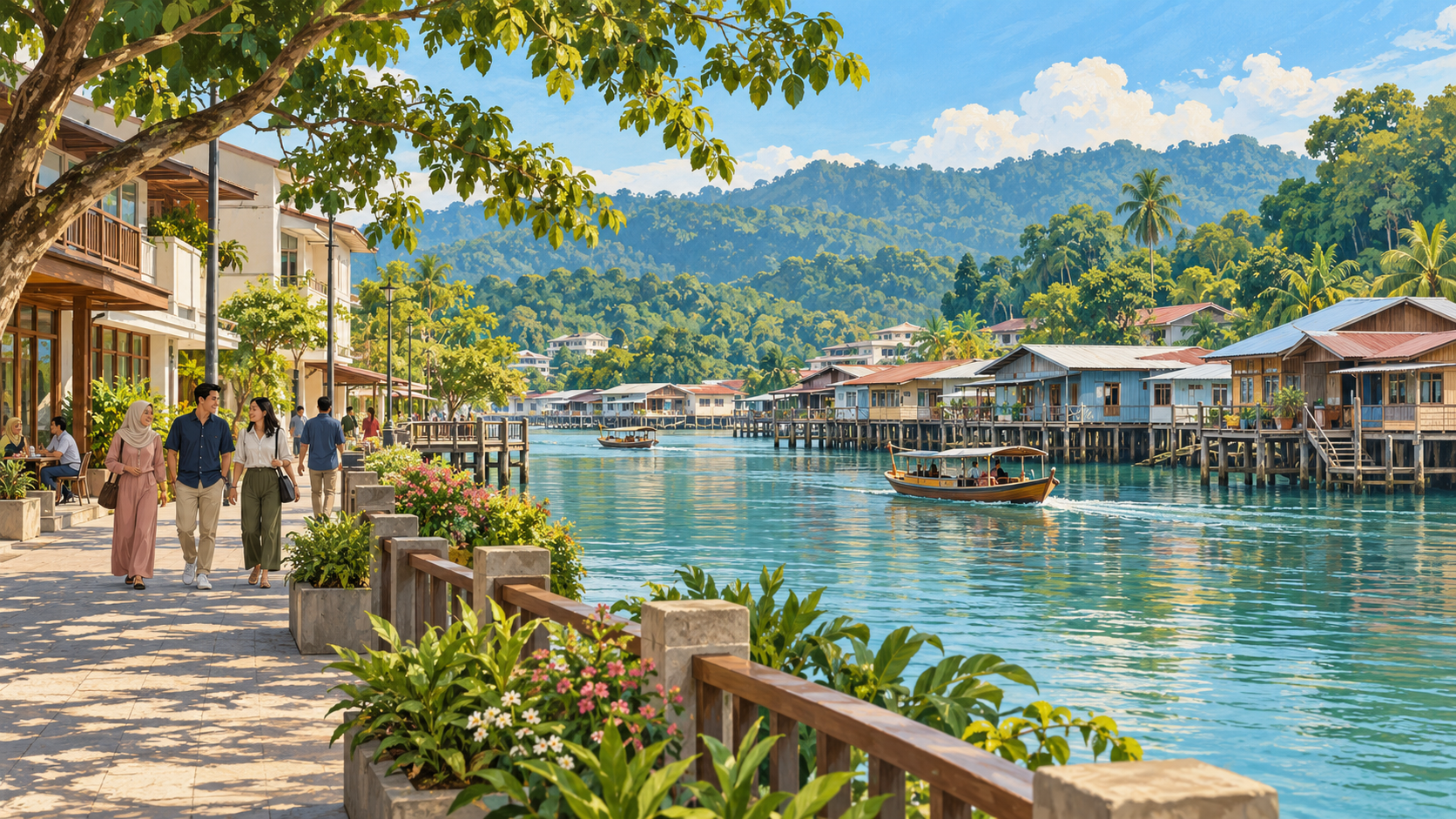
How does Brunei’s government work, why is its Sultan also prime minister, and how do oil and gas, public services, schools and the Singapore dollar connection fit together? Brunei Darussalam is a small sovereign state on the island of Borneo in Southeast Asia. Sultan Hassanal Bolkiah is head of state and prime minister, with executive authority concentrated in the monarchy under the country’s constitutional and emergency arrangements. Ministries administer public programmes, while an appointed Legislative Council debates national matters without operating as a competitively elected parliament.
Brunei works through a connected system: royal government and national budgets → energy income and investment → ports, roads, utilities, schools and hospitals → household opportunity. Brunei’s oil and gas sector has long supported national spending, but energy markets change and future generations need more productive industries and skills. Brunei’s four districts, Temburong’s separated geography, Vision 2035 and the unusual one-to-one currency relationship with Singapore give this country a distinctive operating model.
Brunei explained in one minute
- Political system: hereditary monarchy with executive authority centred on Sultan Hassanal Bolkiah, who also serves as prime minister.
- Legislative Council: appointed and ex-officio members; it is not the same as a parliament elected through current competitive national general elections.
- Capital: Bandar Seri Begawan in Brunei-Muara District.
- Four districts: Brunei-Muara, Belait, Tutong and Temburong.
- Economy: oil, natural gas, refining, petrochemicals and other production, with a long-term diversification agenda.
- Currency: the Brunei dollar is exchanged at par with the Singapore dollar under a formal currency interchangeability agreement.
- Schools: SPN21 framework alongside religious education, secondary qualifications, technical and higher-education pathways.
- Long-term goal: Wawasan Brunei 2035 — skilled and successful people, high quality of life and a dynamic, resilient economy.
This guide was reviewed on 20 October 2026. The IMF’s September 2026 assessment supplies recent economic conditions, Wawasan Brunei 2035 sets out the national goals and Brunei Darussalam Central Bank explains the Singapore currency arrangement.
1. Who actually governs Brunei?
The Sultan and Yang Di-Pertuan, Hassanal Bolkiah, is Brunei’s head of state and prime minister. The current political system concentrates substantial executive authority in the monarchy rather than distributing it through a prime minister chosen by a competitively elected national parliament. Ministers and senior officials implement policy under this arrangement.
Brunei’s 1959 Constitution was subsequently amended. Emergency powers originating in the political crisis of 1962 have remained an important feature of government. The formal provisions for a Legislative Council do not mean the country operates like a modern parliamentary democracy where an elected opposition can vote a government out of office.
The published Constitution explains the legal structures. A country explanation should describe those powers accurately while leaving space to discuss civil liberties and the limits of political competition.
2. Does Brunei have a parliament or elections?
Brunei has a Legislative Council, the Majlis Mesyuarat Negara, whose members are appointed or hold ex-officio positions. Under the constitutional schedule, the council can include up to 45 members, including specified appointed categories and representatives from the four districts. The statutory maximum should not be confused with the current number of seats filled.
Brunei does not hold current competitive general elections for its national Legislative Council. The council discusses national policy and budget matters but is not an independent elected legislature in the same sense as Singapore’s Parliament or the Malaysian Dewan Rakyat. The Sultan’s legal and institutional powers must be recognised in interpreting its work.
The Inter-Parliamentary Union’s Brunei profile and Department of Councils of State provide structural and meeting information. Readers should keep legal arrangements, appointments and public debate distinct.
3. What is the 2026 government coordination reform?
In 2026, Brunei created or reorganised coordinating ministerial posts intended to improve work among ministries and accelerate delivery under Vision 2035. An August Legislative Council discussion supported the new arrangements as a way to link government functions and reduce fragmentation.
Coordination may sound like an internal administrative concern, but it affects ordinary people. A new housing area can require roads, drainage, power, water and school places supplied through several different agencies. If one ministry completes its part and another is delayed, the whole neighbourhood may still struggle.
The August 2026 Legislative Council account explains the rationale. As always, the creation of an office is a structural change; improved service quality must be verified through results.
4. What does Melayu Islam Beraja mean?
Melayu Islam Beraja, often abbreviated MIB, is commonly translated as the Malay Islamic Monarchy philosophy. It describes Brunei’s state identity through Malay traditions, Islam and the monarchy. The philosophy influences public education, civic language and national institutions.
A cultural framework is not a substitute for a complete account of society. People live and study in varied communities, and the rights, everyday experiences and religious practices of individuals may differ. Brunei’s Islamic legal framework and restrictions affecting expression and other personal freedoms are relevant to an accurate discussion of governance.
For students, this is a chance to distinguish cultural identity, state policy, legal requirements and the lived experiences of different residents. One term may describe a national philosophy, but it cannot tell you every aspect of one family’s life.
5. What are Brunei’s four districts?
Brunei is divided into Brunei-Muara, Belait, Tutong and Temburong. Bandar Seri Begawan is in Brunei-Muara, and Belait is associated with major oil and gas activity. Temburong has rainforest landscapes and is physically separated from Brunei’s western main territory by part of Malaysia’s Sarawak state.
District offices and specialised agencies carry administrative responsibilities within the national system. The four districts are not constitutionally separate sovereign states with independent foreign policy or their own national currencies. National ministries and local bodies interact in delivering roads, public works and other services.
This is why a district name matters to a resident: it identifies geographic access and relevant offices, but not necessarily the operator of every school or utility in that area.
6. Why is Temburong separated from the rest of Brunei?
Brunei’s territory consists of two parts separated by Malaysian territory. Temburong lies to the east of the main western area. Historically, road journeys between the parts of Brunei often required crossing through Malaysia, with the associated border and transport considerations.
The Sultan Haji Omar ‘Ali Saifuddien Bridge, opened in 2020, connects the western side of Brunei with Temburong across Brunei Bay. It changed the travel possibilities by creating a direct domestic route without necessarily passing through Malaysian border checkpoints.
This is a strong example of infrastructure reducing friction. A family trip, emergency movement or supply delivery can become more predictable when the legal and geographic journey is simplified. However, the bridge still requires maintenance, safe driving, environmental management and connections to local roads.
7. What makes oil and natural gas important to Brunei?
Oil and natural gas have historically supplied much of Brunei’s export earnings and a significant share of government revenue. The industry involves offshore and onshore extraction, treatment, pipelines, liquefied-natural-gas facilities and international buyers. These revenues support national expenditure while creating exposure to global commodity prices and production conditions.
Oil and gas production can be highly capital-intensive. Even when exports earn substantial income, the industry alone may not provide sufficient varied employment opportunities for everyone. A country with resource wealth still needs strong schools, competitive firms, technical training and sound public financial planning.
The September 2026 IMF review explicitly identifies hydrocarbon-price volatility as an important risk despite Brunei’s financial buffers and growing downstream activity.
8. What did the IMF say about Brunei’s economy in 2026?
The IMF reported that Brunei’s real GDP grew 1.0% in 2025 and projected 2.3% growth in 2026, largely supported by hydrocarbons. It projected inflation of approximately 1.3% in 2026 and noted that the fiscal deficit for FY2025/26 was estimated around 18.9% of GDP.
Those figures describe different measures: economic output, the rate of change in consumer prices and the government’s fiscal balance. A high current-account surplus from exports can coexist with a substantial government fiscal deficit because they measure different flows.
The key practical lesson is to label actual results and projections separately. The IMF’s September forecasts are not guaranteed final 2026 figures. A student comparing countries should note the period attached to every statistic.
9. What is Brunei trying to do beyond upstream oil and gas?
Economic diversification means building more sustainable activity in manufacturing, petrochemicals, food production, logistics, tourism, technology, business services and other sectors. Some downstream industries still use oil and gas as input; that can add domestic processing value without making the economy entirely independent of hydrocarbons.
An oil field produces raw materials. A refining or petrochemical facility can process materials into products for different customers. The chain needs electricity, skilled engineers, specialised equipment, port facilities, safe operating standards and external buyers.
A more varied economy should be measured by competitive exports, productive jobs, business survival and skills rather than merely the number of investment announcements. Diversification is a long-term system, not a single factory opening.
10. Why does the Hengyi refinery at Pulau Muara Besar matter?
Pulau Muara Besar is linked to Brunei’s downstream industrial development. The Hengyi refinery and petrochemical complex processes hydrocarbon-related feedstock, connecting large-scale manufacturing to shipping, energy, environmental regulation and technical employment.
A refinery is not a self-contained island of machinery. It needs a port, tanks, pipelines, maintenance, safe operations, trained employees, reliable supply and market access. Expansion plans must be differentiated from facilities already working.
The IMF’s September 2026 staff report discusses downstream projects including the Hengyi Phase II expansion among medium-term developments. They are investment plans and capacity expectations, not a statement that all additional production had already come online by October.
11. How do ports connect Brunei’s economy?
Maritime connections allow Brunei to import food, equipment and commercial goods while exporting products. Muara’s port infrastructure and associated shipping services play important roles, while industrial projects may have specialised marine requirements. Land transport then moves goods from terminals to shops, homes or factories.
Picture a hospital ordering replacement diagnostic equipment from overseas. The supplier ships it, customs and port staff process the cargo, a vehicle transports it and trained technicians install it. If the equipment remains at a terminal because a document is missing, the hospital may have a budget but not the benefit.
A good port system therefore needs accurate data, safe handling, reliable shipping schedules and transport connections. The total journey matters more to the patient or business than the size of a quay.
12. What makes Brunei’s currency relationship with Singapore unusual?
Brunei uses the Brunei dollar, while Singapore uses the Singapore dollar. Under the Currency Interchangeability Agreement established in 1967, Brunei’s and Singapore’s monetary authorities and licensed banks accept and exchange the two countries’ currencies at a fixed one-to-one value without an exchange charge.
There is an important everyday qualification. The agreement makes the other country’s currency customary tender, rather than automatically making it legal tender that every private retailer must accept. Brunei’s central bank explains that retailers may choose not to accept Singapore-dollar cash, and vice versa. The currency value is at par; acceptance in each shop is a separate question.
Read the Monetary Authority of Singapore’s agreement guide and Brunei Darussalam Central Bank’s explanation. This 1:1 arrangement is a direct and concrete connection between Brunei’s economy and Singapore.
13. Does a one-to-one currency value mean prices are the same?
No. A Brunei dollar and a Singapore dollar have equal exchange value under the agreement, but a bowl of noodles, hotel room, grocery item or taxi ride need not cost the same numeric amount in both countries. Wages, rent, taxes, competition, transport and operating costs differ.
Imagine a small Brunei retailer ordering a product from Singapore. The predictable conversion reduces one financial uncertainty. Freight, import procedures, packaging, labour and retail costs may still make the selling price different.
The agreement reduces exchange-rate risk between the two currencies and supports trade, travel and payments. It cannot guarantee identical prices or remove every economic risk.
14. How does Vision 2035 guide public planning?
Wawasan Brunei 2035 sets three broad national aspirations: well-educated, highly skilled and accomplished people; a high quality of life; and a dynamic, sustainable economy. These goals connect education to productive work and to the long-term affordability of public services.
A young child beginning school in 2026 may become a worker or entrepreneur well after 2035. Education and skill policy therefore needs to anticipate changing industries, including digital systems, advanced manufacturing, health, finance and environmental management.
The official Vision 2035 portal publishes the goals and dated activities. A vision is a framework for choices; it should not be treated as evidence that every goal has already been reached.
15. Why do planning targets need realistic milestones?
A country may set a 2035 objective because schools, ports and industrial investment take many years to develop. One ministry can announce a plan, but implementing it requires land, finance, people, engineering and ongoing coordination.
Original fictional example: a government aims to open a new vocational training facility. The building is completed, but machinery delivery is delayed and too few specialist teachers have been hired. From outside, the project looks complete; inside, students cannot yet undertake the planned practical lessons.
Good evaluation separates design, construction, staffing, operation and verified learning outcomes. The same method works for clinics, power networks and private factories.
16. How are electricity and water connected in Brunei?
Electricity supplies homes, offices, schools, hospitals and industry. Water production and distribution may rely on pumps, treatment facilities and functioning communications. A prolonged electricity interruption can therefore create water or healthcare problems as well as a loss of lighting or air-conditioning.
A household experiences a water tap rather than the plant, reservoir and pumping stations behind it. If production is sufficient but a distribution pipe is damaged, the family still cannot use the service. If electricity is interrupted at a pump, the same outcome can occur for a different reason.
A strong public system monitors generation, transmission, distribution, safety and maintenance separately. Announced infrastructure capacity is only one measure of actual reliability.
17. How do roads and bridges improve access?
Brunei’s small overall territory does not mean every journey is simple. Districts have different settlement patterns, and rivers, wetlands and separated territory influence transport design. Roads, bridges and junctions connect homes to schools, offices, industrial facilities and health services.
A new major bridge can shorten travel or remove border formalities from a particular route, but it needs safe local approaches, signs, maintenance and emergency arrangements. A final narrow road can still limit the benefit of a wide bridge.
The most useful travel measure is from the actual starting point to the actual destination, including waiting and transfer time. This is a general rule of good infrastructure planning.
18. How does Brunei’s healthcare system connect to quality of life?
Brunei provides extensive public healthcare services through the Ministry of Health and related facilities, with eligibility and charges depending on status and service. The system includes clinics, hospitals, specialist care and public-health programmes. A national entitlement does not mean every appointment is instantaneous or that every resident has identical arrangements.
A March 2026 Legislative Council report summarised patient feedback about government health facilities: long waiting times were the most frequently reported concern, followed by staff attitude and communication, clinical services, registration arrangements and facility issues. Those were categories in feedback data, not a comprehensive survey proving every patient had the same experience.
See the 2026 Legislative Council healthcare discussion. It illustrates why public-service quality depends on listening to patients and improving operations, not simply on the existence of a hospital.
19. How does the SPN21 education system work?
Brunei’s SPN21 is the National Education System for the 21st Century. Formal learning begins with preschool and progresses through primary and secondary stages. The Ministry of Education explains that students complete six primary years after preschool, with the Primary School Assessment (PSR), and proceed to common lower-secondary years and different upper-secondary routes.
Its secondary education guidance describes academic, applied, specialised and special-education pathways, with examination routes including Brunei–Cambridge GCE O Level or IGCSE and technical qualifications. The detailed rules need checking for the cohort and calendar year.
For the full learning pathway, visit Schools of Brunei and How Education System of Brunei Works. These specialist guides cover school stages; this article concentrates on why education is part of the whole country’s operating system.
20. Why does Brunei teach in both Malay and English?
The Ministry of Education describes Bahasa Melayu and English as important in the national learning system, with curriculum arrangements differing across subjects and stages. Islamic Religious Knowledge and nationhood education have their own roles, alongside mathematics, science, technology, social studies and languages.
Language matters economically because workers must communicate with local communities and international companies. A young engineer may read a technical manual in English while also working in Malay-language settings. Accuracy in both school subjects and communication supports safety and productivity.
For a family, the relevant goal is not simply to collect examination grades. It is to learn to reason, read, write and apply knowledge confidently, with suitable pathways for further study and employment.
21. What makes technical and vocational education important?
Oil and gas operations, port services, healthcare technology, building maintenance, water treatment and manufacturing need skilled technicians as well as graduates with advanced academic degrees. Technical education can provide pathways into responsible work, while upskilling helps current workers adapt as industries change.
A refinery may need mechanical technicians, instrument specialists, safety staff and logistics managers. If only expensive machinery is imported but no local workforce can maintain it, the project remains fragile. Training must therefore be connected to real equipment, standards and employers.
The success measure is not the number of students enrolled alone. Completion, practical competence, safe working practice, sustainable employment and future progression are more useful tests.
22. Why does rainforest protection matter in a hydrocarbon economy?
Brunei’s forests and wetlands support biodiversity, water catchments and nature tourism. Temburong is associated with extensive rainforest landscapes and conservation opportunities. Protecting these areas requires land-use decisions, scientific monitoring and respect for communities and the natural environment.
Resource income and environmental stewardship are not necessarily separate topics. An energy-intensive industry may support public revenue while also requiring careful pollution control and long-term emissions strategy. Forest protection can maintain ecosystem value that is difficult or costly to replace.
For learners, ask how one investment affects water, wildlife, tourism, employment and household quality of life. A strong national plan recognises multiple effects rather than counting only the immediate financial return.
23. Worked example: a hospital delivery across two districts
Fictional teaching scenario: a medical supplier in the Brunei-Muara area must deliver replacement equipment to a clinic serving a more distant district. The part arrives through import channels, is documented, assigned to a vehicle and delivered. A qualified technician must then install and test it. The clinic can use the equipment only after all those steps work.
If the road is temporarily closed, transport planning becomes the limiting factor. If the equipment reaches the clinic but there is no specialist available, workforce capacity becomes the limit. If power is unreliable, the machine cannot safely perform its intended function.
This simple story connects public finance, international trade, roads, professional education and healthcare in one chain. It shows why service delivery is a system rather than an announcement.
24. Brunei and Singapore: a distinctive close comparison
Brunei and Singapore share Southeast Asian relationships, trade, education links and an exceptional one-to-one currency agreement. Yet they have very different political and economic arrangements. Singapore is a parliamentary republic and a dense international shipping and manufacturing centre. Brunei is a monarchy with substantial hydrocarbon resources and a smaller, more dispersed population.
The currency relationship is a useful example of cooperation without political identity: two separate sovereign states can maintain monetary interchangeability while choosing different fiscal, industrial and governance systems. Equal currency value does not mean equal prices or the same economic policy.
For the broader civilisation method, read How Singapore Works and How Singapore Connects | Roads, Expressways and Junctions.
25. How can a student check a claim about Brunei?
- Identify the institution: Sultan and Cabinet, appointed Legislative Council, district office, ministry, central bank or business.
- Distinguish role from election: an appointed council member is not necessarily someone elected through a national general election.
- Check the budget: oil export earnings, fiscal deficit, current-account balance and GDP growth are different measurements.
- Check the stage: a planned refinery expansion, future port project or 2035 goal is not a completed 2026 result.
- Check currency rules: Brunei and Singapore dollars are exchanged at par, but private retailers need not accept the other currency.
- Follow the person: a school, clinic or water system has succeeded only when people can use it reliably.
A useful five-minute exercise is to write ‘clean water reaches a school’ at the end of a page. Working backwards, add tap, pipes, pumping, water treatment, electricity, maintenance, staff and budget. Then identify which link might fail during a storm. This is how an everyday service becomes a lesson in national organisation.
Frequently asked questions about how Brunei works
Is Brunei a monarchy or a parliamentary democracy?
Brunei is a hereditary monarchy with executive authority concentrated in the Sultan and an appointed Legislative Council. It does not hold current competitive national parliamentary general elections.
Who is Sultan and prime minister in October 2026?
Sultan Hassanal Bolkiah holds both roles.
How many districts does Brunei have?
Four: Brunei-Muara, Belait, Tutong and Temburong.
Why is Temburong separated from the rest of Brunei?
Part of Malaysian Sarawak separates its land territory from Brunei’s western portion. The bridge opened in 2020 provides a direct road connection within Brunei.
Why does Brunei earn so much from oil and gas?
Energy production and exports have historically supplied substantial government revenue and external earnings. Exposure to global prices and production disruption also creates risk.
Is one Brunei dollar always equal to one Singapore dollar?
The two currencies exchange at par under their longstanding currency interchangeability agreement.
Can a Singapore shop refuse Brunei-dollar cash?
A private retailer is not necessarily obliged to accept the other country’s currency. Licensed banks and monetary authorities have specific exchange obligations under the agreement.
What are Brunei’s Vision 2035 goals?
Educated and highly skilled people, a high quality of life, and a dynamic and sustainable economy.
Is the IMF’s 2.3% growth number for 2026 a completed result?
No. It is a September 2026 forecast for the full year, subject to later actual data and revisions.
Where can I find Brunei school examination information?
Use the Ministry of Education’s current official guidance and the linked eduKateSG school-system articles for SPN21, PSR, SPE, O Level and technical pathways.
Continue the international civilisation library
This guide belongs to How Countries Work, the global sibling of How Singapore Works. Compare Brazil’s federal system and Amazon, Botswana’s diamonds and Okavango, Bosnia and Herzegovina’s complex institutions, and Belize’s island and reef connections. The purpose is not to make every country sound identical, but to explain how each turns resources and decisions into real services.
Authoritative sources and editorial review
- Constitution of Brunei Darussalam, WIPO Lex — royal executive and Legislative Council provisions.
- Inter-Parliamentary Union, Legislative Council of Brunei — appointed composition and constitutional maximum.
- Department of Councils of State, August 2026 — coordinating ministers.
- IMF, 23 September 2026 — GDP, inflation, fiscal deficit and projections.
- IMF Brunei staff report, September 2026 — downstream industry and medium-term economic outlook.
- Wawasan Brunei 2035, government portal — national goals.
- Monetary Authority of Singapore and Brunei Darussalam Central Bank — currency at par and customary tender.
- Ministry of Education, primary pathway and secondary pathways.
- Brunei Legislative Council, March 2026 healthcare feedback.
- Editorial review: 20 October 2026. Fictional service examples illustrate system connections; government goals, financial forecasts and project plans are not presented as completed outcomes.