
What should you know about the Central African Republic beyond its name? A useful country guide connects places with people: how a river shapes movement, how a language carries knowledge, how a school operates, and how a public decision reaches everyday life. This article takes those questions one chapter at a time.
Begin with geography and history, or move directly to food, music, learning and the environment. Cultural knowledge deserves close attention in its own right. Contemporary challenges also need careful evidence, without allowing one event or statistic to stand in for an entire country.
The Central African Republic at a glance
- Capital: Bangui.
- UN statistical region: Middle Africa.
- Reading date: 20 October 2026; individual observations retain their own dates.
The capital and regional classification are listed in the UNData country profile. This guide uses specific dated sources for the other subjects rather than treating an old country summary as a current account of every institution.
This is an educational overview, not a travel itinerary or personalised medical, legal or financial advice. A cultural or environmental designation does not establish present access or safety. National data cannot replace the experiences of particular households and communities.
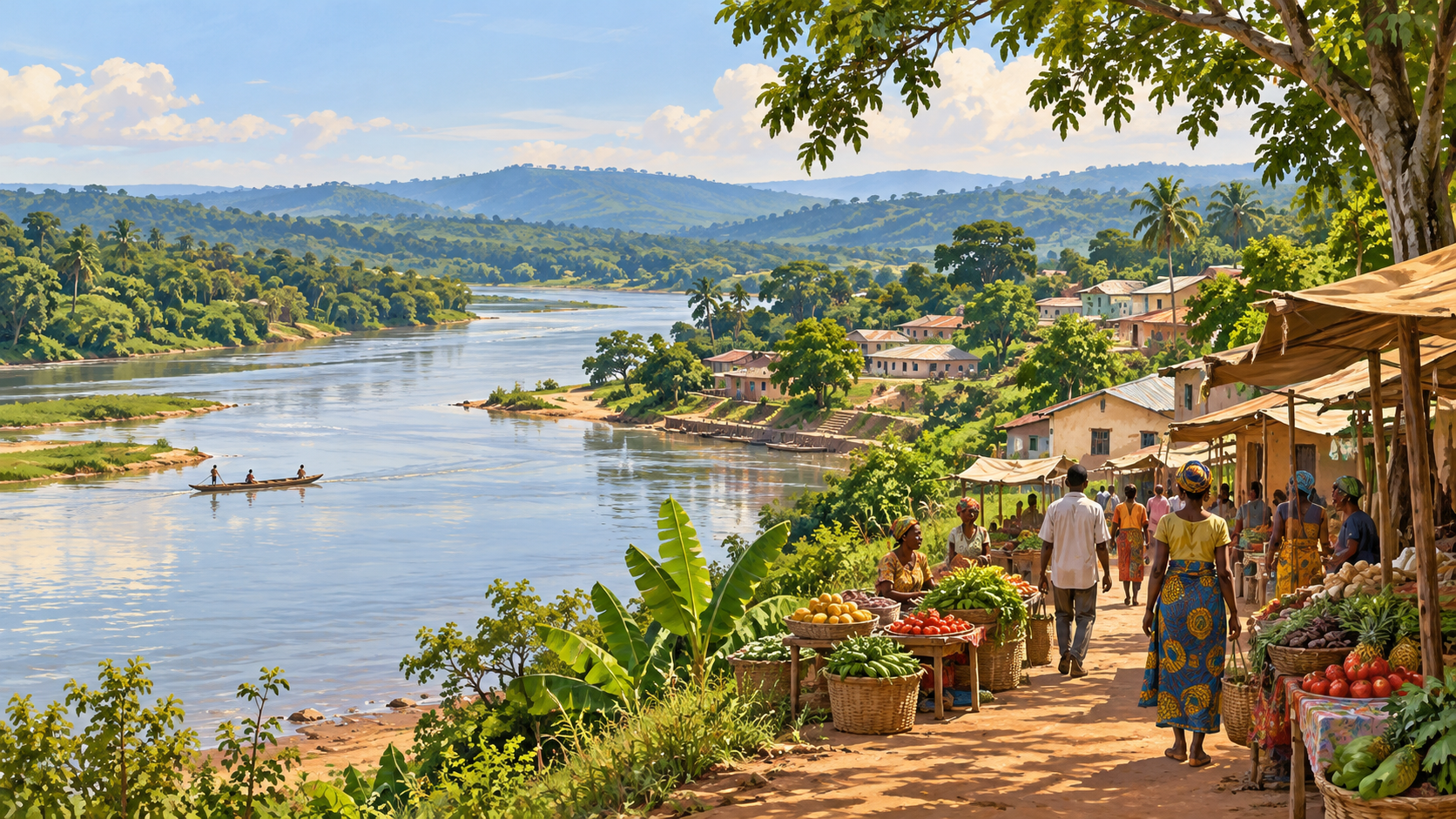
Cover illustration: an original AI-generated artistic interpretation of a river, green hills and a riverside community. This is a nonliteral composite, not a photograph or an exact view of a named place.
Choose your route through the Central African Republic
- 1. Location and geography: an inland country between major basins
- 2. Regions, rivers and settlements: reading the national map
- 3. History before independence: older societies and colonial rule
- 4. Independence and contemporary history: political change over time
- 5. Government and institutions: rules, representation and justice
- 6. People, languages and communities: belonging in a diverse society
- 7. Economy, trade and livelihoods: households within regional systems
- 8. Agriculture, forests and resources: production and stewardship
- 9. Infrastructure: water, electricity and transport networks
- 10. Education pathways: access, learning and further study
- 11. Health and public services
- 12. Food traditions: ingredients and techniques
- 13. Music, performance and oral knowledge
- 14. Arts, crafts and contemporary expression
- 15. Family, community, work and everyday life
- 16. Landscapes and heritage places
- 17. Environment, biodiversity and conservation
- 18. Science, knowledge, skills and future questions
- 19. Regional and world connections
- 20. Student evidence and connections
1. Location and geography: an inland country between major basins
Six neighbours, no coastline
The Central African Republic lies in the interior of Africa, north of the Democratic Republic of the Congo. Cameroon borders it to the west, Chad to the north, Sudan and South Sudan to the east, and the Republic of the Congo to the southwest. The two countries called Congo are separate neighbours. Covering roughly 623,000 square kilometres, the republic is a substantial inland territory rather than a small enclave. (National policy)
Being landlocked means that overseas goods must pass through another country before reaching a seaport. The national agriculture policy identifies links through Douala in Cameroon and Pointe-Noire in the Republic of the Congo. These are connections between different transport systems, not a coastline belonging to the Central African Republic. The country's geographical position therefore places border administration and regional infrastructure alongside domestic roads in the movement of agricultural inputs and traded products. (National policy)
Plateaus, rock and higher ground
Much of the country consists of gently rolling plateaus, with isolated rocky hills called inselbergs rising above surrounding surfaces. Higher ground occurs in the northwest and northeast, where elevations exceed 1,300 metres. A ridge between these uplands separates drainage toward Lake Chad from drainage toward the Congo. This broad watershed is more useful for understanding the landscape than imagining the entire country as either dense rainforest or a uniform plain. (BGS)
Beneath these landscapes, ancient crystalline rocks form much of the geological foundation. Younger sedimentary rocks occur especially in the west and north, while river valleys contain more recent alluvial deposits. Tropical weathering has also produced extensive iron-rich surface materials. Geology and scenery are related but not identical: the same broad plateau can contain different rock types, soils and groundwater settings, which is why a geological map adds information that a political map cannot provide. (BGS)
A transition from forest to drier savanna
The ecological pattern changes markedly across the country. Humid southern environments support dense forest, while much of the centre contains savanna, woodland and forest corridors along rivers. Toward the far northeast, drier conditions become more prominent. FAO's account of forest genetic resources describes this transition through several climatic and vegetation zones, rather than one national habitat. Even within a zone, a riverbank and an exposed slope can support different vegetation. (FAO)
Rainfall, drainage and terrain work together. Waterlogged soils occur in poorly drained areas of the Sangha, Oubangui and Chari systems, whereas other surfaces have different moisture conditions. The forests of the southwest and the more seasonal landscapes farther north therefore belong to a connected but varied physical setting. Reading the country through its soil, water and vegetation patterns gives a clearer starting point than treating the word tropical as a complete geographical description. (FAO)
2. Regions, rivers and settlements: reading the national map
A network beyond Bangui
Bangui occupies the southern edge of the country beside the Oubangui River, not its geographical centre. A national map also reveals a broad western network including Bouar, Berberati, Bozoum and Bossangoa. Sibut, Bambari and Kaga-Bandoro help orient the central part of the country. These named places provide a more useful mental map than an empty outline with one capital: they locate distinct regional settings within a large national territory. (UN map)
Farther east, Bria, Bangassou, Obo, Ndélé and Birao mark different directions and river catchments. Bangassou is associated with the southern Mbomou borderlands, while Birao lies in the far northeast. Prefecture names on a map refer to administrative areas; town names identify settlements within them. A map's publication date matters because administrative divisions can change, even when the relative positions of rivers, hills and long-established towns remain recognisable. (UN map)
Two major drainage directions
The Oubangui, also commonly written Ubangi in English, belongs to the Congo basin. Its headwaters include the Mbomou and Uele, and it receives tributaries such as the Kotto. Farther west, the Mambéré connects with the Sangha system, also flowing toward the Congo. These rivers link the southern country to a much larger basin shared with neighbouring states; national borders divide political jurisdictions, not the movement of water through a catchment. (FAO)
Northern drainage follows a different route. Rivers including the Ouham, Bamingui and Bahr Aouk connect with the Chari system toward Lake Chad. Floodplains and seasonal wetlands accompany parts of this network, while small lakes occur alongside larger rivers. The contrast is fundamental: two nearby locations on opposite sides of the watershed may send their rainwater toward different destinations. FAO's historical hydrographic reference remains useful for these river relationships, although its old production statistics are not current measurements. (FAO)
Growing towns and public services
The National Development Plan for 2024–2028 describes urban expansion in Bangui and secondary cities such as Berberati and Bambari. It identifies pressure on housing, services and shared infrastructure, together with substantial informal construction. Urban growth is consequently more than an increase in the number of buildings. It changes where people need water, drainage, transport and public facilities, and it raises questions about land administration and the coordination of new neighbourhoods. (National development plan)
The same plan distinguishes housing supply from the systems that support it. Construction materials, household finance, land rules and planning capacity all appear in its diagnosis. Its proposed reforms are policy intentions, not proof that every settlement already has adequate services. A careful regional account therefore separates three things: where towns are located, how their built areas are changing, and what institutions can actually provide to residents. Those questions require different kinds of evidence. (National development plan)
3. History before independence: older societies and colonial rule
Settlements, crafts and earlier landscapes
Archaeology reveals settlement and production long before the colonial state. In a 1995 study, archaeologist Étienne Zangato connected village remains, metalworking sites and funerary places in the northwestern Moni, Ndio and Bouar areas. His survey inventory included sixteen village sites and thirty-eight metallurgical sites, alongside stone monuments and other burial sites. Looking at these places together moves the historical picture beyond isolated objects toward the relationships between habitation, craft activity and commemorative landscapes. (Archaeological study)
Zangato's study also explains why reconstructing a chronology requires more than quoting an ancient date. Earlier researchers had obtained widely differing results from charcoal associated with monuments, and disagreed about how these samples related to construction, later activity or disturbance. Excavated layers and the context of an object therefore matter alongside laboratory dating. The evidence supports a history of changing human activity, while leaving specific questions open rather than assigning every site to one timeless culture. (Archaeological study)
Concessions, labour and resistance
French colonial expansion transformed the region into Oubangui-Chari. Historical geographer Yves Boulvert describes the establishment of Bangui as a colonial post in 1889 and the subsequent concession system, through which extensive territories were assigned to private commercial interests. Colonial extraction was not simply the arrival of new trade. Requisitioned labour and coercive demands reshaped relationships between local communities, administrators and companies, while the organisation of routes influenced where colonial authorities sought to concentrate settlements. (Historical geography)
Resistance also belongs at the centre of this history. The Kongo-Wara movement of 1928–1931, particularly associated with Gbaya areas in the west, opposed colonial demands, including labour requisitions. Its history makes clear that local people did not passively accept the new order. Studying colonial rule involves examining the institutions that imposed obligations as well as the people who challenged them, rather than reducing the period to a succession of European officials and administrative names. (Historical geography)
Boganda and political emancipation
Barthélémy Boganda became a prominent advocate of political and social change. Elected to the French National Assembly for Oubangui-Chari in 1946, he was returned in 1951 and 1956. His parliamentary biography records his criticism of colonial abuses and his commitment to the emancipation of African peoples. His movement, MESAN, connected territorial politics with wider debates about how former colonies could obtain self-government and establish relationships based on consent rather than subordination. (Parliamentary biography)
Boganda also favoured maintaining a larger political association among the territories of French Equatorial Africa. That ambition did not prevail. Oubangui-Chari became the Central African Republic in 1958, with Boganda heading its government, but he died in an aircraft crash in March 1959 before full independence. His career links local representation, French parliamentary politics and pan-African ideas. It also explains why the creation of the republic and its subsequent independence are related but distinct milestones. (Parliamentary biography)
4. Independence and contemporary history: political change over time
Independence, republic and empire
Independence was proclaimed on 13 August 1960 under David Dacko. The United States recognised the new country that day and established diplomatic relations, according to its official diplomatic history. This date marks sovereign independence, whereas the republic's establishment in 1958 belongs to the preceding transition. Distinguishing the two helps make sense of national commemorations and avoids compressing a process of constitutional change into a single moment or a single leader's career. (Diplomatic history)
Jean-Bédel Bokassa took power in 1966 and concentrated authority in the presidency. In 1976 he proclaimed an empire; French-backed intervention restored Dacko in 1979. André Kolingba subsequently seized power in 1981. Multiparty elections brought Ange-Félix Patassé to the presidency in 1993. The sequence includes military seizures, monarchical government and electoral transitions, making it misleading to describe the whole post-independence period as one unchanged political system or a smooth institutional progression. (Historical background)
Conflict and damage to civilian institutions
On 15 March 2003, a coup led by François Bozizé overthrew Patassé. The United Nations Yearbook records that the takeover interrupted preparations for a national dialogue, while the new authorities later organised a dialogue during the transition. The episode illustrates the difference between a government's stated plan for constitutional normalisation and the means by which it took power. Both belong in the historical record, rather than allowing later promises to erase the initial rupture. (UN Yearbook)
The violence documented for 2003–2015 also damaged institutions used in ordinary civilian life. OHCHR's mapping work records attacks on schools, hospitals and places of worship, including abuses by Séléka and anti-balaka elements. These findings concern identified actors and events, not collective responsibility assigned to a religion or population. An account centred only on changes in the presidency would miss disrupted teaching, interrupted medical care and the destruction of buildings on which communities depended. (OHCHR)
Peace agreements and the 2025–2026 elections
The government and representatives of fourteen armed groups signed the Political Agreement for Peace and Reconciliation in Bangui on 6 February 2019, following talks in Khartoum. The African Union welcomed the agreement and called for support for its implementation. Signing a peace agreement establishes commitments and a framework for political work; it does not, by itself, demonstrate that every commitment has been fulfilled. Subsequent developments must therefore be assessed separately from the agreement's original ambitions. (African Union)
The presidential election took place on 28 December 2025. The UN Secretary-General's February 2026 report records that the Constitutional Council confirmed Faustin-Archange Touadéra's re-election on 19 January with 77.90 per cent of the vote. It also records opposition objections and reported irregularities, alongside observers' assessments of generally calm polling. The confirmed figure differs from the earlier provisional result. Contemporary history needs both the official outcome and the documented disputes, clearly distinguished from one another. (UN election report)
5. Government and institutions: rules, representation and justice
The constitutional framework changed in 2023
A new constitution was promulgated in August 2023 after a referendum. The UN's contemporaneous report explains that presidential and parliamentary terms were extended from five to seven years and term limits removed. It also records a new vice-presidential position, the abolition of the Senate and the conversion of the Constitutional Court into a Constitutional Council. Older descriptions based on the 2016 constitution therefore cannot simply be reused as accounts of the present institutional framework. (UN constitutional report)
The same report describes new eligibility conditions and the removal of certain checks on executive power, including parliamentary-bureau review of contracts involving national resources. Opposition parties and some civil-society and religious organisations challenged aspects of the process and text. Constitutional study therefore has two connected dimensions: what the adopted rules say, and the debate over how those rules distribute authority. Reporting the legal change does not require treating political objections as either nonexistent or automatically proven. (UN constitutional report)
National and local representation
The Inter-Parliamentary Union records the National Assembly as a unicameral legislature, meaning that parliament has one chamber. Its election record covers voting from 28 December 2025 to 26 April 2026 and lists Simplice Mathieu Sarandji's election as speaker on 7 May 2026. Parliamentary data have several layers: the election timetable, the number of seats, and party results. A table explicitly labelled provisional should not be silently presented as a complete final allocation. (IPU)
A June 2026 briefing by the UN's Special Representative reported installation of the new legislature on 4 May and formation of a government on 21 May. It also reported that women constituted 45 per cent of elected municipal councillors following the local polls. Municipal representation is a different level of government from the National Assembly. Keeping those levels separate allows readers to understand local participation without confusing a municipal percentage with women's representation in national parliament. (UN briefing)
Institutions beyond elections
Courts are another part of public authority. UNDP describes the Special Criminal Court as operating within the national judicial system with international support, prosecuting serious crimes. Its role is different from the electoral responsibilities of the Constitutional Council. A country can therefore have several bodies whose names contain court or council while their jurisdictions, procedures and purposes remain distinct. Understanding those responsibilities is more informative than treating every institution as an interchangeable branch of the presidency. (UNDP)
UNDP's account places judicial proceedings alongside work on prisons, security-sector reform and the restoration of public institutions. It stresses that progress requires sustained political, financial and technical backing. An announced institution, an operating office and a completed judicial process are not the same thing. For a student of government, the central questions are therefore both formal and practical: which body has a responsibility, and what evidence shows that it is carrying out that responsibility? (UNDP)
6. People, languages and communities: belonging in a diverse society
Official languages and multilingual lives
French and Sango are the country's official languages, as recorded by the International Organisation of La Francophonie. Official status identifies a language's place in public institutions; it does not mean that every person uses both languages in the same way. The country's membership of the Francophonie dates from 1973. This institutional relationship is one part of its linguistic history, alongside the national role of Sango and the languages used within families and communities. (OIF)
France's country profile lists numerous other languages, including Gbaya, several Banda varieties, Manza, Bokoto, Gbanou and Fulbé. A list of languages should not be mistaken for a map of exclusive territories or a set of fixed personal identities. People can participate in more than one linguistic community. These names nevertheless make an important point: the two official languages do not exhaust the country's linguistic resources or the different ways that people communicate. Language and citizenship are different categories. (Country profile)
Indigenous rights and meaningful participation
The Central African Republic ratified the International Labour Organization's Indigenous and Tribal Peoples Convention, No. 169, on 30 August 2010. NORMLEX records the convention as in force. Ratification is a legal commitment, rather than a measure of whether every community's rights are realised in practice. It gives discussion of indigenous peoples a rights-based foundation, instead of presenting communities only as objects of cultural interest or assuming that a single national average describes their circumstances. (ILO NORMLEX)
A concrete example appears in UNICEF's climate-resilience safeguards: its Indigenous Peoples Plan addresses the rights of the Mbororo Fulani pastoralist community. The programme also publishes information in French, Sango, Fulfulde and Arabic, including audio summaries. These formats make the question of participation tangible: a written notice in one language is not equivalent to information people can understand and discuss. The documents describe safeguards and intended engagement, not proof that every proposed activity has already succeeded. (UNICEF safeguards)
Mobility, return and rebuilding community life
Cross-border displacement and return are also part of contemporary social history. UNHCR reported 19,751 voluntary refugee returns during 2024, supported by the agency and refugee-hosting governments. The announcement, published in March 2025, connected returns with the need for reintegration support. A return count describes movement during a specified period. It is not the total number of displaced Central Africans, nor does returning automatically restore housing, employment, education or all the relationships interrupted by displacement. (UNHCR)
Community experience also depends on access to land, resources and decent work. An ILO regional study published in 2017 identified discrimination and weak data as important obstacles for indigenous women and men in Central Africa. Its regional findings should not be converted into identical claims about every Central African community. They identify useful questions for understanding inclusion: whose work is recognised, whose rights are protected, and whose circumstances remain poorly represented in public statistics. (ILO study)
7. Economy, trade and livelihoods: households within regional systems
Agriculture and household livelihoods
Agriculture is central to household livelihoods, not merely one export category. The World Bank's 2023 Poverty Assessment, drawing on the 2021 household survey, reported that roughly seven in ten working-age people depended on farming. It describes rainfed production and crops such as cassava, maize, rice, sorghum and millet. The date matters: this is evidence from a particular survey period, rather than a continuously updated count of everyone working in agriculture today. (Poverty assessment)
The assessment connects farm performance with access to inputs, markets and complementary infrastructure. It also places education and social protection alongside agricultural development, recognising that household welfare cannot be read from crop output alone. A family may produce food for its own use as well as for sale, so the value of farming is broader than recorded commercial transactions. The report's recommendations describe possible policy responses, not completed improvements or guarantees of future household income. (Poverty assessment)
A shared currency and central bank
The Central African Republic belongs to the monetary area served by the Bank of Central African States, known as BEAC. The other member countries are Cameroon, Chad, the Republic of the Congo, Equatorial Guinea and Gabon. These six states share a central bank and the Central African CFA franc. Monetary membership is therefore a regional arrangement: the national economy has its own production and public finances while using money issued within a common institutional framework. (BEAC)
BEAC states that the currency has a fixed parity of 655.957 CFA francs to one euro. This describes the monetary framework, not the price of goods in a market or the cost of an individual transaction. The bank's responsibilities include currency issuance and monetary policy for the member states. Understanding this distinction helps separate three subjects often confused in a country profile: the unit used for payments, regional monetary institutions, and domestic living conditions. (BEAC)
Imports, logistics and public revenue
WTO trade data for 2024 identify Cameroon as a major source of recorded imports and list goods including petroleum products, medicines, vehicles and telecommunications equipment. Such a profile shows why trade concerns everyday services as well as commercial firms: fuel, medical supplies and equipment are part of the imported basket. These are recorded merchandise flows for one year. They should not be interpreted as a complete account of informal exchanges or services traded across borders. (WTO)
An IMF explanation of fuel-market reform links supply shortages, river shipments, informal imports and tax collection. It describes severe disruption in 2022 and an improvement in supply during 2024, while noting continuing price and revenue problems. This historical example connects logistics to public finance without assuming that every difficulty has one cause. Imported fuel must arrive physically, pass through a market and generate recorded transactions before its availability and associated taxes can enter economic accounts. (IMF)
8. Agriculture, forests and resources: production and stewardship
Crop calendars vary across the country
FAO's country brief dated 15 July 2026 illustrates how agricultural calendars differ by region. It described maize planting in central and southern areas completed in April, with harvesting expected from mid-August. In northern areas, millet and sorghum planting had finished in early July, with harvesting anticipated from October. These were seasonal expectations at the time of reporting, not a confirmation of harvested volumes or evidence that every locality followed the same timetable. (FAO seasonal brief)
The brief also identified displacement, insecurity and limited access to agricultural inputs as constraints on production. It reported different movements in cereal prices, showing why one food-price figure cannot describe every crop or market. Crop calendars, production estimates and food prices answer different questions: when cultivation takes place, how much is produced, and what consumers pay. Distinguishing these measures is especially important when a seasonal bulletin combines observations already made with expectations for the coming months. (FAO seasonal brief)
Forestry and timber legality
The southwest's forests support a timber sector governed partly through a Voluntary Partnership Agreement with the European Union. The agreement entered into force in July 2012. The VPA facility's archived 2024 account describes a legality-assurance system intended to trace timber through the supply chain and verify compliance with agreed legal requirements. This concerns the rules under which timber is produced and traded; it should not be confused with a blanket statement that all forest use is sustainable. (VPA facility)
The system combines a definition of legality, supply-chain controls, verification, licensing and independent auditing. These elements perform different jobs: tracing a log does not, on its own, establish compliance with every relevant rule. The facility explains that licensing depends on joint assessment of the system's readiness. An agreement's entry into force and a fully functioning licensing regime are therefore separate milestones. This distinction helps readers understand forest governance as an ongoing institutional process rather than a single announcement. (VPA facility)
Minerals and the information needed for accountability
Gold and diamonds are prominent in the country's extractive economy. The Extractive Industries Transparency Initiative describes a sector in which informal activity and limited reporting complicate the measurement of production and revenue. Mineral wealth in the ground is not the same thing as a measured public benefit. Following the sector requires information about what is extracted, who holds rights, what companies or traders pay, and what public bodies receive and record. (EITI)
EITI's country account notes that the 2024 Mining Code introduced requirements for contract publication and identification of beneficial owners. Beneficial ownership identifies the people who ultimately own or control a company, rather than stopping at its registered name. EITI also says that the country lacks a legal framework for public disclosure of those owners. Submitting ownership information to an authority and publishing it for public scrutiny are therefore different matters. (EITI)
9. Infrastructure: water, electricity and transport networks
Water services require continuing management
UNICEF's year-end report for 2025 records provision of safe water to 23,539 people through construction and rehabilitation of boreholes. It also reports support for 95 water-point management committees. These are results from the organisation's response activities during that reporting year, not a national water-access percentage. The distinction matters because a project can reach specific communities without describing the condition of every water system or household elsewhere in the country. (UNICEF 2025 report)
The same report describes sanitation and hygiene work alongside water supply, including sanitation support reaching 18,572 people. Boreholes, sanitation facilities and community management belong to related but distinct parts of service provision. A newly constructed water point is a physical asset; arrangements for its use and upkeep concern the continuation of the service. Reporting both infrastructure and management therefore gives a fuller picture than counting installations alone, while still leaving national coverage to separate evidence. (UNICEF 2025 report)
Generation capacity and electricity service
The Danzi solar power plant near Bangui was commissioned in 2023 with 25 megawatts of generating capacity and battery storage, according to the World Bank's project account. Solar panels and storage serve different functions: panels generate electricity from sunlight, while batteries help shift some of that electricity to other times. The project illustrates the addition of a new generating source to the national power system, rather than an automatic connection for every household. (World Bank)
The commissioning account described an anticipated reach of about 250,000 people. That figure was a project expectation, not a household survey showing achieved coverage. Generating capacity, delivered electricity and customer connections are different measures, and a power plant's megawatt rating is not an estimate of the number of homes with reliable service. For understanding infrastructure, the useful question is how production, storage and distribution fit together, rather than treating one impressive project number as the whole system. (World Bank)
Road works and links between transport systems
An African Development Bank mission in September 2026 reviewed work on the Pointe-Noire–Brazzaville–Bangui–N'Djamena multimodal corridor. The Bank reported that the 69-kilometre Bossarangba–Mbaïki section and 4.5 kilometres of urban roads in Mbaïki were 98 per cent complete at 31 August 2026. The urban works included solar street lighting. This is a dated construction-progress report for named components, not a declaration that the whole international corridor had been completed. (AfDB)
The same mission examined modernisation of Bangui-M'Poko airport, reporting the terminal and associated works more than 90 per cent complete. It also identified project delays associated with compensation and clearing road rights of way. These details show the different tasks behind infrastructure delivery: engineering works, administrative preparation, funding and arrangements with affected communities. A corridor combines transport modes and national jurisdictions, while an individual project's construction percentage measures only the scope and date specified in its report. (AfDB)
10. Education pathways: access, learning and further study
The structure of formal education
A 2024 World Bank education-project appraisal describes a system comprising three years of preprimary education, six years of primary school, four years of lower secondary and three years of upper secondary. This sequence maps the formal stages of education. It does not mean that every learner enters at the expected age, completes every stage without interruption or has equal access to the institutions needed to continue. System design and individual educational experience are different subjects. (Education appraisal)
The appraisal identifies examinations at the end of primary school, lower secondary and upper secondary, including the brevet des collèges and baccalauréat. Entry to lower secondary also involves an entrance examination. Alongside this sequence, it describes second-chance programmes for children who never enrolled or left school early, with possibilities for rejoining formal education. These routes distinguish a learner's present school position from the qualifications and further stages that may follow. (Education appraisal)
Learning levels inside the classroom
In August 2026, UNICEF described an experimental Teaching at the Right Level programme in 25 schools. At Saint Paul school in Bangui, teachers assessed reading and mathematics before arranging learners by demonstrated skills rather than age or grade alone. Reading groups progressed through letters, words, paragraphs and stories. This provides a concrete example of teaching that responds to what pupils can currently do, while retaining the distinction between a classroom example and nationwide practice. (UNICEF learning pilot)
The programme used interactive activities and teacher training, with additional sessions planned alongside the regular curriculum. UNICEF described a wider target of 100 schools in Bangui and several prefectures. That target should not be reported as an achieved nationwide rollout. The example also separates attendance from learning: being enrolled in a grade does not itself show mastery of its reading or mathematics content. Assessment supplies information that the enrolment record alone cannot provide. (UNICEF learning pilot)
Vocational and university routes
UNESCO-UNEVOC's 2022 country profile describes technical and vocational education through public institutions, private providers and workplace training. Its account contrasts provincial training in agriculture, horticulture and livestock with Bangui programmes in accounting, management, computing, mechanics and electrical work. It also identifies shortages of teaching equipment and qualified trainers. This dated profile illustrates the breadth of vocational learning without implying that every named occupation is taught in every centre or that its institutional inventory remains unchanged. (UNESCO-UNEVOC)
Higher education also includes professionally oriented study. The Francophone University Agency's regional report describes its 2019 support for management degrees at the University of Bangui's enterprise-management institute. This historical example shows a connection between university learning and organisational skills, rather than presenting tertiary education as purely theoretical. It is evidence of a particular programme and partnership, not a current admissions announcement. Together, school, vocational and university routes describe different forms of learning rather than a single path followed by everyone. (AUF report)
11. Health and public services
A health facility is more than a building
A clinic marked on a map does not, by itself, tell us which services it can provide. The World Health Organization’s HeRAMS update assessed 1,083 health service delivery units using information reported up to 31 May 2025. Its operational review considers whether facilities function, which partners support them and whether basic amenities are available. Separate reports examine particular kinds of care, including child health, trauma care and communicable diseases.
This approach separates infrastructure from the ability to deliver a service. A facility’s status and its available services are related questions, but they are not interchangeable. WHO also says that checking and validating the information continued after the reporting date. The figures therefore describe a dated operational assessment, not a guarantee about every clinic today. For understanding public services, the important unit is the functioning system, rather than the building alone.
Water systems connect homes, schools and clinics
Water supply is another public service with several connected parts. UNICEF’s account of its work in CAR covers drinking-water points, sanitation facilities and hygiene in communities, schools and health centres. The same account identifies ageing urban networks and the difficulty of sustaining services beyond major settlements. A pipe, pump or latrine is a physical object; the public service also depends on keeping that object usable and accessible over time.
UNICEF names SODECA and ANEA among its partners and describes deep wells with solar-powered pumps and gravity-fed distribution networks. These systems use energy and height to move water, but still need inspection and maintenance. Local committees and management structures are intended to help keep new water points working. Thus water service connects engineering with organization: the question is not only where water can be found, but who keeps the distribution system functioning.
Civil registration makes people visible to institutions
Public administration can have an everyday presence in an official document. A UNICEF report published in February 2026 describes the issue of 1,339 supplementary judgements to children in twelve schools in Ouham-Fafa. These documents addressed missing birth records. Schools helped identify pupils needing registration, linking education with civil administration rather than treating them as entirely separate services. The report concerns a particular programme and set of schools, not a complete national count.
Registration creates a durable record that institutions can refer to when identifying a person. It also illustrates the difference between announcing a right and making the procedures for exercising it work. Forms, records, local officials and schools all have roles in that process. A useful public-service comparison therefore asks two questions: what does an institution officially provide, and what arrangements allow people to obtain it? Neither question can replace the other.
12. Food traditions: ingredients and techniques
Ngunza combines leaves, groundnuts and patient preparation
Ngunza, also written ngundja, shows how different parts of a crop enter a meal. The Central African cultural association Acewa’la describes a stew of cassava leaves with groundnut paste, onion and palm oil. Fish or fresh or smoked beef may be added. The leaves are cooked until tender, while the groundnut paste contributes body to the sauce. This is a dish built through preparation, not simply a collection of raw ingredients.
Accompaniments introduce further variation. Acewa’la names gozo, a mound made with cassava flour; mangbere, steamed cassava paste; boiled cassava; plantain; and rice. The sauce and its accompaniment therefore perform different jobs on the plate, with the starchy component carrying the leaf mixture. Describing these alternatives is more accurate than proposing one compulsory national meal. The account explains a culinary tradition; it is not a complete preparation or food-safety recipe for unfamiliar cassava products.
Processing changes the possibilities of cassava
The wider technical background appears in S. K. Hahn’s FAO-hosted account of cassava processing. Across African food traditions, roots may be peeled, soaked, fermented, pressed, dried or milled, in different combinations. Flour stirred into hot water produces a different food from fermented pulp steamed inside leaves. Processing changes texture, storage possibilities and transportability. It also matters because cassava contains compounds that make appropriate preparation essential; a brief country guide cannot substitute for reliable preparation instructions.
The report does not imply that every method belongs to every Central African household. Instead, it explains why the same crop can support distinct foods and skilled occupations. Milling creates a material that can be measured and mixed; drying removes water; wrapping gives a soft preparation a container during steaming. Looking at these transformations reveals work that a list of dish names would hide, from choosing ingredients to managing moisture and heat.
Koko makes cutting part of the recipe
Koko begins with leaves from a climbing plant, Gnetum africanum, rather than from cassava. In Acewa’la’s description of Central African preparation, very fine cutting is a defining skill. The account describes customers in Bangui buying whole leaves and taking them to a trader who specializes in slicing them. The cut leaves are cooked with an onion and groundnut-paste sauce, with versions incorporating meat or dried fish. Texture begins with the knife, before the pot is heated.
The association also describes yabanda as a preparation without the groundnut paste, showing that a familiar ingredient does not demand one fixed sauce. Its account contrasts fresh leaves used locally with dried leaves used in diaspora cooking. That distinction connects food to storage and distance, rather than ranking one household as more authentic than another. A food tradition can preserve a recognizable cutting technique while ingredients, accompaniments and the place of cooking change.
13. Music, performance and oral knowledge
Aka polyphony is coordinated improvisation
Among Aka communities in the southwest, singing can combine several independent vocal parts at once. UNESCO’s account of Aka polyphonic singing, inscribed in 2008, describes a four-voice contrapuntal tradition in which performers introduce variations. The result is not a crowd trying to sing one tune identically. Different lines remain distinguishable while contributing to a shared musical whole. Improvisation works within knowledge held and practised by the performers.
UNESCO links the music with occasions such as funerals, hunting-related ceremonies and the establishment of encampments. Hand-clapping, dance, drums and string instruments can be involved, depending on the occasion. Children learn through participation, so musical knowledge passes through listening, movement and repeated social experience rather than relying only on written scores. This example belongs to particular communities. It should not be treated as the single sound of CAR or as a performance detached from the people who sustain it.
Banda ensembles weave instruments into a whole
The Smithsonian Folkways release Banda Polyphony offers another specific listening context. Its 1970s recordings, made and annotated by Simha Arom, present music associated with Linda and Dakpa communities. Ensembles combine instruments made from materials including bamboo, tree roots and animal horn. Flutes, horns, drums and voices contribute distinct parts. The catalogue treats neighbouring communities as musically related but not identical, a useful correction to the idea that one ethnic label describes one uniform repertoire.
Two tracks present Eci ameya first through horns and then through voices. Comparing them provides a concrete listening exercise: which musical relationships remain recognizable when the sound-producing medium changes? Another track pairs slit-drum players. These recorded examples make arrangement, timing and cooperation audible. They are also historical documents with recording dates and editorial choices. A published album is evidence of particular performances, not a claim to contain every current practice of the communities named.
Bibi Tanga connects languages and musical styles
Music associated with CAR also travels through bands, studios and diaspora lives. The Free Music Archive profile of Bibi Tanga and the Selenites describes a musician with Central African family roots who grew up across countries, including France. His work combines funk and other popular styles, with lyrics in Sango, French and English. The archive includes a live session recorded for WFMU’s Transpacific Sound Paradise in August 2010, locating the music within a particular broadcast encounter.
This example adds a different kind of musical movement to the chapter: a performer can work between languages without representing a whole nation in every song. A listener might compare phrasing, vocal delivery and instrumental texture across tracks rather than search for one supposedly pure national style. Community transmission and contemporary recording are not opposite stages of development. They are different settings in which people make choices, collaborate and find audiences.
14. Arts, crafts and contemporary expression
Plant knowledge becomes material design
Craft begins with understanding a material. The French National Museum of Natural History’s ngongo record describes Sarcophrynium prionogonium, a plant whose broad leaves can wrap products or food for cooking. Its long stems can be split into fibres for baskets and mats. The museum connects its specimen with ethnobotanical research among Monzombo speakers along the Oubangui. A plant record therefore documents more than a scientific name: it can preserve evidence of practical choices and learned techniques.
Leaf surfaces and stem fibres offer different possibilities. One can contain and cover; the other can be arranged into a woven structure. Examining those uses helps explain the relationship between design and botanical knowledge without describing crafts as merely decorative. It also raises a question about documentation: who identified the useful properties, and whose knowledge appears in the label? A museum specimen is one record of that relationship, not a replacement for the expertise of makers.
Samuel Fosso turns portraiture into performance
Samuel Fosso’s career makes Bangui an important place in the history of contemporary photography. The Maison Européenne de la Photographie’s retrospective account describes how the Cameroon-born artist established a studio in Bangui as a teenager. Alongside commissioned photographs, he made staged self-portraits. Clothing, posture and setting became tools for inventing characters. His early work included outfits made by local tailors, connecting the photographic image with other skilled work in the city.
Series such as 70’s Lifestyle, Tati and African Spirits approach identity through performance rather than treating a portrait as a neutral mirror. A useful reading of an image asks what the sitter has chosen to show, what a costume suggests and how the frame directs attention. Fosso’s movement between countries also complicates a simple national label. His work belongs within CAR’s cultural connections without requiring his biography or artistic concerns to fit inside one border.
A student takes the camera
Rafiki Fariala’s 2022 documentary We, Students! follows his own circle at the University of Bangui. In the film’s published director interview, he explains that he wanted to show student life from within it. Studying, earning money, sharing space and negotiating friendship become connected parts of the story. The camera does not arrive only as an outside observer: the filmmaker belongs to the relationships he records, and that position shapes what he can see.
Fariala also describes friends taking turns with the camera or sound recording, making collaboration part of the film’s production as well as its subject. This is a particular authored account, not a statistical survey of every student. Its importance lies partly in that specificity. Watching a documentary carefully means considering framing, selection and trust alongside the events depicted. Contemporary expression can bring ordinary conversations into public view while leaving room for other people to tell different stories.
15. Family, community, work and everyday life
Care is visible in particular relationships
An everyday-life chapter should begin with people, not a claim that all families behave alike. A UNICEF account from Bemal, published in April 2025, describes a Central African couple caring for a young child from Chad. Earlier relationships formed across the border helped connect the households. Their story includes the practical work of securing a birth document, showing how personal care and administrative support can meet around the needs of one child.
The account illustrates a particular foster family, not a universal household arrangement. It also resists a narrow picture of borders as lines across which only goods or officials move: friendship and responsibility can extend across them too. Questions about everyday life become more precise when they ask who provides care, what resources a household uses and which institutions assist it. Such questions leave space for different family histories, rather than turning one moving story into a national personality.
Markets bring energy and skilled work together
Work is easier to understand through its tools than through a vague label such as “informal economy.” In December 2024, UNDP reported solar installations in Kaga Bandoro, including systems serving the central market and a women’s community space. The wider project supplied equipment such as sewing machines, shelling machines, oil presses and computers. These examples reveal different occupations: making garments, processing crops, preparing oil and handling information all involve distinct skills and working routines.
The report establishes that equipment and infrastructure were supplied; its ambitions for higher incomes are not the same thing as measured long-term results. Machines need maintenance, operators and customers, while a workplace also depends on water, lighting and organization. Following these relationships gives a more useful picture of a market than treating it simply as a colourful scene. Workers are making decisions about production, services and livelihoods, not performing an unchanging tradition for an observer.
Radio is part of shared public conversation
Everyday communication includes institutions that people hear rather than visit. Fondation Hirondelle’s description of Radio Ndeke Luka identifies news, debates, educational programmes, music and entertainment in French and Sango. Founded in 2000, the station works with community-radio partners as well as its own broadcasting network. This mix matters: a schedule can move between public affairs and practical information without reducing listeners to audiences for politics alone.
Producing a programme involves reporters, presenters, technicians and editorial judgement. The choice of language affects who can follow a discussion, while a debate format allows competing explanations to be heard in the same programme. The foundation also describes journalist training and work against misinformation. These are stated activities, not proof that every broadcast reaches everyone or persuades every listener. Radio offers one window into shared life, alongside household conversations, workplaces, schools and other media.
16. Landscapes and heritage places
Sangha is a landscape across three countries
The Sangha Trinational World Heritage property, inscribed in 2012, joins protected forests in CAR, Cameroon and the Republic of the Congo. Its national-park components are Dzanga-Ndoki, Lobéké and Nouabalé-Ndoki respectively. The Democratic Republic of the Congo is a different country and is not a participant. The property protects a connected forest landscape, while a wider buffer zone recognizes that ecological processes and human activities also extend beyond the park boundaries.
Forest clearings are important parts of this landscape rather than empty gaps between trees. UNESCO describes varied habitats that support different plants and animals, including forest elephants and great apes. Studying the property through a map shows why three adjoining parks can matter together: a political boundary is not necessarily a boundary for water, vegetation or animal movement. Its heritage value illustrates relationships extending beyond one national jurisdiction.
Manovo-Gounda St Floris reveals ecological transitions
Northern CAR presents a different landscape. UNESCO’s description of Manovo-Gounda St Floris National Park emphasizes savannas, floodplains and an ecological meeting place between several African habitat regions. The property was inscribed in 1988 and covers 1,740,000 hectares. Its significance is not simply that it is large. Variation within the area creates different settings for vegetation, grazing animals, predators and waterbirds, connecting landform and seasonal water with the kinds of life a landscape can support.
Its heritage history also includes serious conservation concerns: UNESCO lists the property as World Heritage in Danger from 1997 to the present. Older descriptions of its fauna must not be read as a current census or a promise that particular animals can now be seen there. The distinction matters in environmental history. A place can retain outstanding ecological importance while its condition changes. Understanding that tension is more informative than presenting a protected-area label as proof of successful protection.
Bouar’s megaliths invite archaeological questions
Near Bouar, standing-stone monuments open a different way of reading the landscape. CAR submitted the megaliths of Bouar to its UNESCO Tentative List in 2006. A tentative submission is not inscription on the World Heritage List. The national heritage description places the monuments around the watershed between the Congo and Chad drainage systems and identifies arrangements of stones, orientations and associated features that can be studied archaeologically. The material evidence opens questions about earlier lives.
How were stones selected and moved? How do the arrangements relate to watercourses? Which interpretations depend on excavation rather than appearance alone? The submission also identifies erosion and removal of stones as threats. When material is displaced, information about its original setting may be lost even if the stone itself survives. Heritage study therefore concerns relationships among objects, places and records, not only impressive monuments. These descriptions support learning about sites, not assumptions about present access or visitor arrangements.
17. Environment, biodiversity and conservation
Wetlands connect upstream actions with downstream habitats
The Convention on Wetlands’ 2009 account of the CAR Sangha River site describes periodically flooded forests, rivers, marshes and lakes. This shifts attention from large land animals to the movement of water through an entire habitat. The designation account connects wetlands with biodiversity and local activities including fishing and farming. A river is not only a blue line on a map: its connected wet areas change how water, sediment and living organisms occupy the landscape.
The same account identified sediment from upstream mining as a concern because silting could reduce places where fish shelter during the dry season. That is a specific reported environmental pressure, not a measured statement about every stretch of the river today. It demonstrates why conservation needs a catchment perspective. Protecting one location while ignoring activities farther upstream can miss part of the problem. Seasonal refuges, flood behaviour and livelihoods belong in the same discussion.
Wildlife monitoring turns sightings into evidence
In eastern CAR, African Parks describes Chinko as a mixture of savanna and tropical forest. Its biodiversity work uses walking surveys, camera traps and other observations to document wildlife. The operator reports that camera images and calls helped confirm eastern chimpanzees in northern Chinko. Different methods reveal different things: a photograph can establish that an animal passed a camera, while repeated, systematically collected observations are needed to investigate broader distribution or change.
The organization also describes a saltlick observation platform inaugurated in 2025, with nearby communities participating in its maintenance and activities. Such infrastructure links observation with local responsibilities. Nevertheless, management reports should be read as reports from the organization doing the work, not as independent proof of every claimed outcome. A careful environmental account asks which species were recorded, over what area and period, using which method. Counting observations and estimating populations are related tasks, but not identical ones.
Conservation includes rights and accountability
Conservation also concerns people’s rights within the landscapes where they live. A WWF account published in March 2020 describes a grievance system in Dzanga-Sangha, formalized in 2016 with a human-rights centre and a BaAka community association. It identifies community monitors, social workers and lawyers as parts of the arrangement. The purpose is to provide ways to raise and address problems, including matters that extend beyond the protected area itself.
This is evidence that a mechanism was described and established, not a guarantee that every complaint was resolved or every right protected. The account also identifies the Ndima-Kali association as a way for BaAka members to express cultural and community priorities. These details make participation more concrete than a general promise to “help local people.” Conservation assessment needs to consider who has a voice, how decisions can be challenged and whether environmental work respects the people affected by it.
18. Science, knowledge, skills and future questions
Research connects climate with health questions
Scientific work in CAR includes asking how environmental change interacts with disease. The Pasteur Network’s climate-and-health programme profiles Claire Sangba-Kembi, a public-health researcher at Institut Pasteur de Bangui. Her work concerns medical entomology, malaria and vector ecology in the context of climate change. Medical entomology studies insects relevant to health; vector ecology examines the organisms that transmit infection within their environments. These fields join observation of living organisms with questions about human populations.
The programme emphasizes research capacity, shared tools and the development of climate-and-health observatories. Those are objectives and areas of work, not proof that a particular weather event caused a particular outbreak. A sound investigation needs comparable observations over time and attention to other explanations. Naming a researcher and a question makes the country’s scientific activity visible without turning an unfinished research programme into a completed discovery. Knowledge grows through methods and people, not only through laboratories and equipment.
A field can also be a classroom
Agricultural knowledge can develop through organized comparison in a field. A 2018 FAO account of a CAR project’s design describes farmer field schools as practical learning settings. The team adapted participation requirements so that people with limited literacy could take part, while planning literacy support alongside agricultural training. That design recognizes a difference between lacking formal schooling and lacking useful knowledge. Experience, observation and discussion can contribute to a shared investigation.
The account also proposed using radio, theatre and other communication channels to discuss agriculture and nutrition. These were programme approaches and intentions, not proof that every planned activity happened or produced its expected benefit. Their educational value is the connection between a question and a method: what could participants compare, what would they observe and how would they explain the result? Future improvements depend on learning from conditions in particular fields, rather than assuming one technique works everywhere.
Organizing work requires knowledge too
Skills include organizing a group as well as making a product. An International Labour Organization report from November 2018 describes cooperative training in Bangui for participants from agricultural, vocational and artisan institutions. Topics included cooperative principles, organizational structures and management. Participants also visited a fish-farming cooperative on the city’s outskirts. The visit connected classroom concepts with questions about how people actually coordinate production, responsibilities and decisions in a working organization.
A cooperative is not made successful simply by giving it a name. Members need ways to organize participation and handle practical challenges, which is why management appeared alongside technical activity in the training. The report anticipated that participants would later train young people; it does not establish the eventual reach of that work. For students considering future questions, the lesson is broad but concrete: useful innovation can concern decision-making and teaching methods as much as machinery or scientific invention.
19. Regional and world connections
Shared rivers require shared arrangements
CAR’s regional connections include institutions concerned with water rather than simply political borders. The Congo-Oubangui-Sangha basin commission, CICOS, describes its mandate as promoting inland navigation and integrated water-resource management. Its founding agreement dates from 1999, with an additional agreement in 2007. The objectives include coordinating navigation rules, considering different water uses in regional planning and sharing benefits from those uses. Cooperation here concerns the practical operation of a basin, not only meetings between governments.
Navigation and water management can ask different questions about the same river. A transport planner may focus on navigable channels, while other users consider water supply, ecosystems or food production. Bringing those interests into one planning framework does not remove every disagreement, but it identifies why consultation across boundaries is necessary. CICOS’s mandate describes what the institution is meant to do. Whether particular measures achieve their goals must be assessed through separate evidence about implementation and results.
Fibre cables give connectivity a physical geography
Digital communication also follows routes through real landscapes. In its 2023 account of CAR’s fibre-backbone inauguration, the African Development Bank reported 935 kilometres of terrestrial and underwater fibre installed and operationalized. The network connected CAR with Cameroon and the Republic of the Congo. The described route follows towns along the Bangui-Douala road corridor before branching through Berberati towards the neighbouring countries. Internet connections depend on cables, junctions and cross-border coordination.
This was a reported infrastructure achievement, not evidence that every household obtained affordable or reliable internet. Backbone capacity must connect with local networks, devices, power and services before people can use it. Separating those stages helps explain why a major cable project and uneven individual access can coexist. It also reveals a regional connection: information may travel internationally through neighbouring networks even when its sender and recipient are communicating for an ordinary local purpose.
Forest cooperation joins national and wider priorities
Forest questions also connect CAR with institutions beyond its borders. COMIFAC, the Central African Forests Commission, identifies CAR among its members and traces its origins to commitments made in the 1999 Yaoundé Declaration. Its stated role concerns coordinated conservation and sustainable management of forest ecosystems. The commission also links forest resources with the economic and social development of the people who depend on them. That framing places livelihoods within forest policy rather than outside it.
A regional institution can help countries discuss shared goals without making their forests or communities identical. Different territories contain different habitats, laws and interests, so coordination involves negotiation as well as common language. The existence of a commission does not demonstrate that forest pressures have disappeared. It provides an institutional connection through which problems may be addressed. Read alongside water and communication networks, it shows that regional belonging is built through several kinds of relationships, each with its own responsibilities.
20. Student evidence and connections
Keep the date attached to the number
A country profile can contain several years of evidence. UNICEF’s child-related SDG assessment for CAR, for example, lists a primary-school completion figure of 31 per cent for 2020 and basic drinking-water access of 36 per cent for 2022. These indicators describe different reference years. Neither becomes a 2026 observation simply because the page is read in 2026. Some entries have no displayed value, which is different from reporting zero.
For a student project, copy the indicator’s wording and year alongside the number before making a chart. Then ask what population it describes and whether a comparison uses the same definition. A percentage is not the number of people, and two percentages need not have the same denominator. These checks can prevent a chart from making a misleading argument. Accurate comparison begins with comparable questions, not with matching colours or column widths.
A record shows an observation, not everything present
Biodiversity evidence has a similar need for context. The Global Biodiversity Information Facility explains that its network brings together records from museum specimens, photographs and other sources, using shared standards. Each record concerns where and when a species was documented. A historical specimen and a recent observation can therefore appear in the same wider information system, although they answer different questions about the present. The collection date matters just as much as the date a database was consulted.
Applied to CAR, a useful classroom exercise is to compare an observation map with a map of the places actually surveyed. An area with few records may need more investigation; blank space alone cannot establish that no organisms live there. Equally, several records of a species do not automatically count several different animals. A careful caption explains the evidence, its timespan and its limits. That practice connects map reading with the methods behind a conservation claim.
Build connections without taking ownership of voices
Cultural evidence needs care as well as accuracy. UNESCO’s ethical principles for living heritage place communities and practitioners at the centre of safeguarding, emphasize informed consent and recognize that customary limits on access may matter. An available recording is therefore not permission to describe its performers as anonymous examples or to assume every practice is open for anyone to reproduce. Attribution should identify the maker, community or institution as precisely as evidence allows.
A strong final project can connect one place, one practical process and one human voice. The question might concern food preparation, a performance or the work behind a public service. Explain what each source contributes, distinguish description from your own interpretation and identify a question that remains unanswered. The aim is not to produce a single sentence that defines Central Africans. It is to show how specific evidence supports a richer understanding while preserving differences and acknowledging what remains unknown.
Frequently asked questions about the Central African Republic
What is the capital?
Bangui is the capital of the Central African Republic.
Which currency is used?
The BEAC CFA franc, identified by the currency code XAF.
Is Central Africa the same thing?
No. The Central African Republic is a country; Central Africa is a wider geographical region.
What is ngunza?
A cassava-leaf stew that can include groundnut paste and other ingredients.
What is Aka polyphony?
Several independent vocal parts interweave, with performers introducing variations.
Where is Sangha Trinational?
Its protected forests span the Central African Republic, Cameroon and the Republic of the Congo.
Are Bouar’s megaliths a World Heritage property?
They are on the Tentative List, not the World Heritage List.
Do the latest pages always contain current statistics?
No. Check each observation’s reference year and footnotes. Reading a page today does not turn an older observation into a current measurement.
Does a heritage designation establish safe access?
No. Heritage value and current access or safety are different questions. This article is for learning, not planning a journey.
How should students use the chapters?
Choose a focused question, preserve dates and definitions, and connect relevant evidence. Explain what remains uncertain instead of filling gaps with assumptions.
Continue reading: specialist guides to the Central African Republic
These links provide subject-specific background. Their travel-themed titles do not establish that visiting is safe or feasible; use them as reading resources here.
- How the Central African Republic Works | Government, Security, Minerals and Services
- How Education System of the Central African Republic Works | CEF1, Brevet, BAC and 2026 Learning
- How Ministry of Education for the Central African Republic Works | 2026–27, CEF1, Brevet and BAC
- Schools of the Central African Republic | Primary, Collèges, Lycées and 2026 Reforms
- What Is Taught in School | Central African Republic
- Tutors of the Central African Republic | CEF1, Brevet and Baccalauréat Learning Support
- Cultural and Landscape Learning in the Central African Republic
- Food Traditions of the Central African Republic
- Top 100 Forest Elephant Ecology Vocabulary Words | Central African Republic
Explore the Everything About Countries archive for national overviews. For the complete 195-country directory, visit How Countries Work | A–Z Guide. The How Singapore Works collection offers a different national case study; comparisons should account for history, scale and institutional responsibilities.
Keep the country’s people in the explanation
An explanation becomes stronger when it connects a national institution with a concrete question: who can use a service, how knowledge is passed on, what a measurement records, or how a change affects everyday work. Ask whose experience is represented and what additional evidence would help. That keeps analysis clear without turning people into illustrations of a single story.
Sources and further evidence
Sources were checked for this edition in October 2026. Statistical observations retain their own reference periods. Policy announcements and project plans are distinguished from completed outcomes.
- UNData country profile
- National agriculture policy: geographical context
- British Geological Survey: hydrogeology
- FAO: forest genetic resources
- UN Geospatial: national map
- FAO: inland fishery geography
- Central African Republic: National Development Plan 2024–2028
- Étienne Zangato: archaeological landscapes, 1995
- Yves Boulvert: historical geography
- French National Assembly: Barthélémy Boganda
- US Office of the Historian: independence
- US State Department: historical background, 2004
- United Nations Yearbook 2003
- OHCHR: mapping report on attacks against protected institutions
- African Union: peace agreement communiqué
- United Nations: S/2026/71
- United Nations: constitutional changes in 2023
- IPU: National Assembly election record
- MINUSCA: 2026 Security Council statement
- UNDP: justice and rule of law partnership
- OIF: Central African Republic profile
- France Diplomatie: country profile
- ILO NORMLEX: CAR ratifications
- UNICEF: inclusive environmental and social safeguards
- UNHCR: voluntary returns in 2024
- ILO: indigenous work and rights in Central Africa
- World Bank: Poverty Assessment 2023
- BEAC: common currency and central bank
- WTO: CAR trade profile, 2024 data
- IMF: CAR fuel-market questions
- FAO GIEWS: 15 July 2026 country brief
- VPA ALA Facility: CAR forest governance
- EITI: CAR extractive governance
- UNICEF: CAR 2025 year-end situation report
- World Bank: Danzi solar commissioning
- African Development Bank: September 2026 investment mission
- World Bank: Accelerating Results in Education appraisal
- UNICEF: Teaching at the Right Level pilot
- UNESCO-UNEVOC: CAR TVET profile
- AUF: regional university programmes
- HeRAMS Central African Republic status update May 2025: Operational status of the health system
- Water, sanitation and hygiene
- Our parents say that with this paper we can go very far
- Ngunza / Ngundja
- An overview of traditional processing and utilization of cassava in Africa
- Koko
- Polyphonic singing of the Aka Pygmies of Central Africa
- Central African Republic: Banda Polyphony
- Bibi Tanga and the Selenites: Biography
- Ngongo
- Samuel Fosso
- We, Students! Press kit
- A birth certificate. Merlin, acknowledged in CAR
- Kaga Bandoro (centre RCA): le PNUD inaugure des infrastructures solaires pour l’autonomisation des femmes rurales
- Radio Ndeke Luka
- Sangha Trinational
- Manovo-Gounda St Floris National Park
- Les mégalithes de Bouar
- Central African Republic’s Sangha River Ramsar site
- Chinko: Biodiversity Conservation
- Good conservation means human opportunity and human rights
- Climate and Health Observatory Accelerator project
- From conflict to peace in Central African Republic: empowering women and youth is key
- Training of Trainers Workshop on Think.Coop, Start.Coop and My.Coop conducted in the Central African Republic
- Mandat de la CICOS
- Inauguration de la Dorsale optique nationale de la République centrafricaine et de l’interconnexion avec le Congo
- Missions de la COMIFAC
- Child-Related SDG Progress Assessment for Central African Republic
- What is GBIF?
- Ethics and Intangible Cultural Heritage