
What should you know about the Republic of the Congo beyond its name? A useful country guide connects places with people: how a river shapes movement, how a language carries knowledge, how a school operates, and how a public decision reaches everyday life. This article takes those questions one chapter at a time.
Begin with geography and history, or move directly to food, music, learning and the environment. Cultural knowledge deserves close attention in its own right. Contemporary challenges also need careful evidence, without allowing one event or statistic to stand in for an entire country.
The Republic of the Congo at a glance
- Capital: Brazzaville.
- UN statistical region: Middle Africa.
- Reading date: 20 October 2026; individual observations retain their own dates.
The capital and regional classification are listed in the UNData country profile. This guide uses specific dated sources for the other subjects rather than treating an old country summary as a current account of every institution.
This is an educational overview, not a travel itinerary or personalised medical, legal or financial advice. A cultural or environmental designation does not establish present access or safety. National data cannot replace the experiences of particular households and communities.
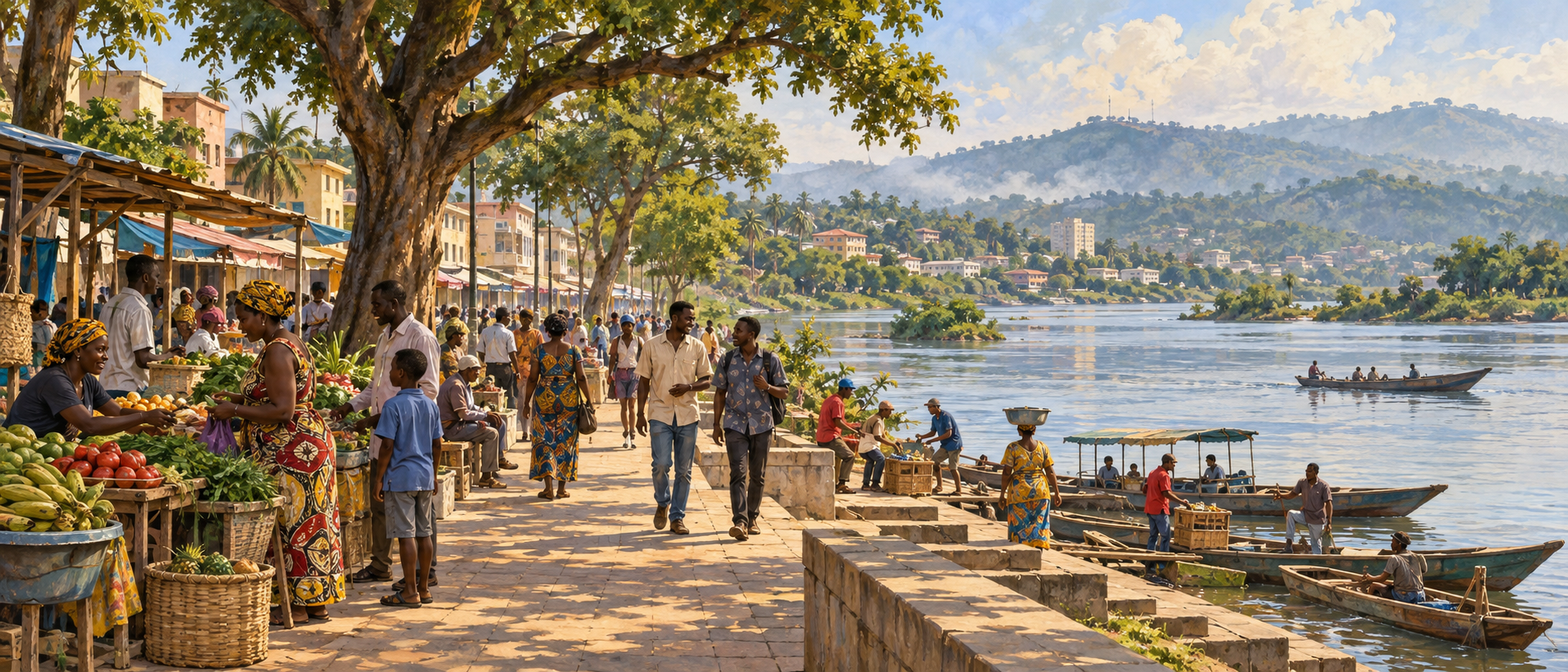
Cover illustration: an original AI-generated artistic interpretation of a riverside neighbourhood, shaded market, boat landing and distant green hills. This is a nonliteral composite, not a photograph or an exact view of a named place.
Choose your route through Congo
- 1. Geography
- 2. Regions and settlements
- 3. Earlier history
- 4. Independence and modern history
- 5. Government and institutions
- 6. People and languages
- 7. Economy and trade
- 8. Agriculture and resources
- 9. Transport, energy and water
- 10. Education
- 11. Health and public services
- 12. Food and cooking
- 13. Music and oral knowledge
- 14. Arts and skilled making
- 15. Community and everyday life
- 16. Heritage and its care
- 17. Environment and conservation
- 18. Science and practical skills
- 19. Regional and world connections
- 20. Student evidence and connections
1. Geography
A country beside the Congo
The Republic of the Congo lies in Central Africa, with an Atlantic coastline and territory extending into the Congo Basin. It borders Gabon, Cameroon, the Central African Republic, the Democratic Republic of the Congo and Angola’s Cabinda enclave. Congo-Brazzaville is a useful distinguishing name, not a different country: it separates this republic from its much larger neighbour across the Congo River. Both countries belong to the same wider regional geography. (FAO)
The landscape is more varied than an uninterrupted rainforest map suggests. A coastal sedimentary basin gives way to older rocks in the Mayombe and Chaillu areas, while sandy formations underlie the central Batéké plateaux. Farther into the Congo Basin, extensive river deposits occupy low-lying ground. These geological contrasts matter because water moves differently through sand, fractured rock and alluvium, influencing where groundwater can accumulate and how settlements obtain it. (BGS)
Land and river systems
Two principal drainage systems organize much of the country: the Congo system in the centre and north, and the Kouilou-Niari system in the southwest. Smaller coastal catchments also carry water towards the Atlantic. Many rivers flow throughout the year, sustained by substantial rainfall and groundwater entering their channels. The country therefore combines an inland river orientation with a separate coastal one, rather than directing every stream into the Congo itself. (BGS)
Temperatures remain warm through the year, but rainfall is not uniform from north to south. A World Bank climate assessment describes wetter periods around March to May and September to November, with the dry season generally lasting longer in southern areas. Local seasonality matters more than the simple label tropical. Heavy rain can also produce urban and river flooding, so abundant water does not mean that every settlement experiences it safely. (World Bank)
Seasons and wetland landscapes
Forest and savanna form a geographical mosaic. Historical forest assessments distinguish the Mayombe and Chaillu forest areas from the much larger northern forest zone, with open landscapes between and around them. The equator crosses the country, but latitude alone does not explain its vegetation. Relief, soils, drainage and seasonal rainfall combine to produce different environments, which is why a forested northern riverbank and an open southern plateau can both be recognizably Congolese. (FAO)
The Lac Télé and Likouala-aux-Herbes area shows what a wetland landscape actually contains. Its Ramsar description records swamp forest, floodable savanna and floating grassland along waterways. Patches of firmer ground support villages and cultivation within this watery setting. Such places are neither empty forest nor a continuous lake. Understanding the alternation of channels, flooded vegetation and inhabited ground is essential to understanding movement and settlement in the northern interior. (Ramsar)
2. Regions and settlements
Two urban poles
Congo’s population is distributed very unevenly. The 2023 census preliminary results placed 58.2 percent of residents in the departments containing Brazzaville and Pointe-Noire. This is a concentration in two urban poles, not an even spread across the national territory. The same census described much lower population densities in most of the other departments. A national population total therefore conceals the distance between crowded city neighbourhoods and sparsely settled rural districts. (INS)
Pointe-Noire is the principal Atlantic economic centre, shaped by petroleum activity and its deepwater port. Its urban landscape also has a less visible physical structure: low plateaux separated by poorly drained areas. UN-Habitat’s city profile connects this terrain with difficulties in sanitation and movement between neighbourhoods. The port city is consequently both a major commercial gateway and a place where the practical geography of drainage strongly affects ordinary urban life. (UN-Habitat)
Coast and interior
The coastal city’s growth cannot be separated from the decision to build an ocean outlet for the railway. The port authority dates selection of the Pointe-Noire site to July 1921. Port construction followed the railway’s inauguration in 1934, and the first deepwater quay entered service in April 1939. Those stages explain why the railway terminus and harbour belong to one connected history, even though the two facilities were not completed together. (PAPN)
Inland regions have their own economic combinations rather than simply serving as a backdrop to the cities. IFAD’s regional development work identifies cassava, potatoes and onions in the Plateaux area, and cassava, cocoa, coffee, palm oil and river fishing in Cuvette and Cuvette-Ouest. It also identifies poor roads and high marketing costs as constraints. A productive locality can therefore remain commercially isolated when moving its harvest is expensive or unreliable. (IFAD)
Administrative and urban change
Administrative maps need a date. Laws promulgated on 8 October 2024 created Djoué-Léfini, Nkéni-Alima and Congo-Oubangui, with Odziba, Gamboma and Mossaka respectively as their administrative centres. The same legislative package adjusted neighbouring territorial jurisdictions. Older references to twelve departments consequently describe an earlier arrangement. These changes reorganize administration within the same country; they do not create new sovereign states or automatically change the historical identity of every locality. (Congo)
Urban development also involves improving existing neighbourhoods, not only constructing new districts. UN-Habitat’s Congolese programme has supported participatory upgrading, particularly in Pointe-Noire, through work with communities, municipal actors and national institutions. Its approach links housing conditions to land, regulations, finance and local capacity. This makes neighbourhood improvement a governance problem as well as a building problem: residents need usable services and a voice in decisions affecting the places they already inhabit. (UN-Habitat)
3. Earlier history
Kingdoms before colonial borders
The country’s history did not begin with European exploration. Kongo and Téké civilizations developed political, artistic and intellectual traditions across the coast and interior of the Congo Basin. Their historical spaces crossed the river and do not fit neatly inside present national borders. A Quai Branly research presentation emphasizes the relationship between art, philosophy and oral knowledge in these traditions, reminding readers that carved objects belonged to systems of meaning rather than isolated decoration. (Quai Branly)
Loango provides another perspective on political organization before the modern republic. The kingdom’s own historical account describes seven provinces, represented by seven stars above an open hand, and identifies Vili as its language. It also describes royal selection and succession through the maternal line. These traditions should be read as the institution’s account of its heritage, not as a claim that today’s Congolese state is governed through the same royal arrangements. (Loango)
French expansion and its records
French expansion acquired a crucial written instrument in September 1880, when Pierre Savorgnan de Brazza concluded a treaty with the Téké ruler Makoko Iloo. France ratified the agreement in 1882, and later expeditions extended its colonial claims. The treaty belongs to a history of unequal imperial expansion, not the discovery of an uninhabited country. Existing rulers, communities and political relationships were already present when European governments began converting agreements into territorial authority. (Archives)
Colonial administration also generated evidence against its own claims of benevolent rule. Historian Catherine Coquery-Vidrovitch’s archival research describes the extraordinary inspection sent to French Congo in 1905 after a public scandal. Brazza’s mission found abuses across a colonial territory broader than today’s Republic of the Congo. He died on the return journey, and officials assembled the final report from the mission’s papers. The episode distinguishes French colonial violence from, without minimizing, neighbouring Belgian colonial abuses. (Coquery-Vidrovitch)
Labour and global war
The Congo-Océan railway was built between 1921 and 1934 to link Brazzaville with the Atlantic and accelerate colonial resource extraction. French labour archives document the administration’s recruitment of forced African labour from across Equatorial Africa and beyond. Workers faced difficult terrain, dense forest and severe logistical conditions. The line is therefore not only an engineering landmark: its history also records coercion and population displacement built into the colonial economy that demanded it. (ANMT)
During the Second World War, Brazzaville became an important base for Free France after central African colonial territories rallied in 1940. Charles de Gaulle established the Empire Defence Council there on 27 October that year. African territory, people and resources gave the movement an operational foundation beyond Europe. This international role forms part of the city’s history, but it took place under colonial rule and should not be confused with Congolese independence. (Defence)
4. Independence and modern history
Republic and political change
Two dates mark different steps in the creation of the modern state. The Republic of the Congo was proclaimed on 28 November 1958, while independence from France followed on 15 August 1960. The first date is commemorated as Republic Day and the second as Independence Day. Keeping them separate clarifies the transition from an autonomous republic within the late colonial framework to an internationally independent country with its own sovereign institutions. (Congo)
The first decades after independence brought repeated changes of leadership and political direction. Fulbert Youlou’s presidency ended in 1963, followed by Alphonse Massamba-Débat and then Marien Ngouabi. The country adopted the name People’s Republic of the Congo in 1969. Ngouabi’s assassination in 1977 was followed by further leadership changes, and Denis Sassou N’Guesso came to power in 1979. These transitions were part of a single-party socialist period, not continuous competitive electoral succession. (Congo Embassy)
Pluralism and conflict
The political framework changed around the beginning of the 1990s. The Congolese Labour Party abandoned its Marxist-Leninist orientation in 1990, and the country moved towards multiparty politics and a market-oriented economy. Pascal Lissouba won the presidential election in 1992. This transition opened political competition, but did not remove rivalries that soon became violent. Constitutional change did not itself produce lasting political stability. (Congo Embassy)
United Nations humanitarian reporting describes recurrent violence from 1993, large-scale war in 1997 and renewed fighting in 1998–1999. Sassou N’Guesso returned to the presidency in October 1997 after the decisive fighting. Destruction and displacement affected Brazzaville and other parts of the country, with later violence spreading into the interior. These were the Republic of the Congo’s civil conflicts, distinct from the wars occurring in the neighbouring Democratic Republic of the Congo. (UN)
Peace agreements and elections
Conflict later continued to affect the Pool region. On 23 December 2017, the government and representatives associated with Pastor Ntumi reached a cessation-of-hostilities and ceasefire agreement at Kinkala. The African Union welcomed the agreement and its importance for peace. A ceasefire is a specific commitment to stop fighting, not proof that every displaced household has recovered. Its historical significance lies in opening a route away from violence and towards implementation and reconciliation. (African Union)
The presidential election of 2026 returned Denis Sassou N’Guesso to office. The Constitutional Court’s final decision of 28 March proclaimed his re-election after polling on 12 and 15 March across fifteen departments. The court rejected a candidate’s request to annul the election before publishing the definitive results. Its decision establishes the officially declared winner and legal outcome, while an assessment of electoral competitiveness would require evidence beyond the institution’s own certification of the vote. (Court)
5. Government and institutions
Executive and legislature
The 2015 Constitution describes Congo as a unitary, decentralized and secular republic. The president is head of state, with responsibility for national independence and the functioning of public institutions, and appoints a prime minister to lead the government. The presidential term is five years, renewable twice under that text. These provisions describe the constitutional framework, which must be distinguished from judgments about how political power operates in practice. (Congo)
Parliament includes the National Assembly, whose 2022 election filled 151 seats. The Inter-Parliamentary Union records that the Congolese Labour Party won 112 of them, giving it a substantial majority. This distribution helps explain the parliamentary balance produced by that election without assuming that the existence of several parties means equal political influence. The Assembly is a national representative institution, different from municipal councils and from the executive ministries administering particular policy areas. (IPU)
Representation and constitutional review
The second parliamentary chamber is the Senate. The Inter-Parliamentary Union records 72 seats and indirect election through local representative bodies, rather than a nationwide direct ballot for senators. Its recorded 2023 composition included 23 women and 49 men. The chamber’s method of selection gives territorial and local political structures a role in national representation. Creating additional administrative departments does not, on its own, establish that the number of Senate seats has changed. (IPU)
The Constitutional Court has operated as a separate institution since 2003. Its published work distinguishes constitutional review from electoral disputes and includes decisions, opinions and other formal instruments. This is important when reading official announcements: a court’s review of a law is not the same procedure as its examination of an election result. The institution’s stated role concerns the Constitution and fundamental rights, while its actual decisions provide the evidence for particular legal outcomes. (Court)
Administration and shared rules
State administration extends beyond the capital through departments headed by prefects. A government announcement records the appointment of prefects for fifteen departments under a decree of 31 March 2025, including the three recently created departments. Prefects represent an appointed administrative structure, so they should not be casually equated with elected local councillors. Understanding that distinction helps explain how national decisions reach local territory and why decentralization involves more than changing lines on a map. (Government)
Some rules governing economic life are shared regionally. Congo belongs to OHADA, the organization established to harmonize business law across its member states. Its purpose includes improving legal and judicial predictability for enterprises and facilitating trade and investment. This does not make Congo and other members one country: national institutions continue to operate within a common legal framework in specified areas. Regional membership therefore adds another layer to understanding how public rules affect business activity. (OHADA)
6. People and languages
Population and public languages
The 2023 census preliminary results recorded 6,142,180 residents and a young population: 76 percent were below thirty-five. It reported 4.1 people per ordinary household. These are census-year observations, not an exact count for 2026. They show why education, employment and housing are central concerns: households and age groups explain needs that a national total alone cannot reveal. (INS)
French is the official language, while Lingala and Kituba have the constitutional status of national vehicular languages. Vehicular means that a language helps communication across communities with different home languages. The three therefore have different legal labels. Calling them co-official would erase the distinction that the Constitution makes between official administration and national linguistic communication, despite their overlapping importance in everyday public life. (Congo)
Language in daily life
Congo has belonged to the Organisation internationale de la Francophonie since 1981. This places it within an international network built around the French language, rather than defining the whole country as culturally French. Institutional membership and everyday language use are different questions. French can connect Congolese speakers with education, publishing and international exchange while existing alongside African languages and identities that cannot be reduced to a single measure of French-speaking population. (OIF)
Language choices can also change between generations within a single town. Research presented by a Université Marien Ngouabi scholar on Loutété examines parents’ local languages and children’s preference for French, Kituba and Lingala. The study asks how status, communication habits and perceived insecurity affect transmission. This is evidence about a particular research setting, not a claim that every Congolese household behaves alike. It highlights why speaking several widely shared languages does not automatically preserve every home language. (Balenda)
Rights and belonging
Indigenous peoples are part of Congo’s present society, not merely its distant past. The Congolese Observatory of Human Rights has documented discrimination and helped develop debate around the 2011 law protecting indigenous populations. Its research also stresses the distance between recognition in law and everyday enjoyment of rights. A careful account therefore avoids presenting legal protection as an already completed solution, and recognizes that access, dignity and participation depend on how institutions and communities act. (OCDH)
The population also includes refugees and asylum-seekers, particularly people displaced from the Central African Republic and the Democratic Republic of the Congo. UNHCR’s country strategy emphasizes that many live in rural hosting areas, including places where basic services are already limited. Legal identity, schooling and livelihoods are therefore shared development concerns for displaced people and host communities. Refugee inclusion is not only a border issue; it involves practical access to the institutions of daily life. (UNHCR)
7. Economy and trade
Oil and the monetary system
Petroleum is central to Congo’s economy, especially export earnings and public finances. The World Bank describes a country with considerable natural wealth but a strong dependence on the oil sector. That concentration creates a difference between producing valuable exports and building a broad base of employment and household income. A change in oil production or prices can affect the national economy even when the daily work of many residents takes place outside the petroleum industry. (World Bank)
Congo uses the Central African CFA franc, issued by the Bank of Central African States, or BEAC. The same monetary area includes Cameroon, the Central African Republic, Chad, Equatorial Guinea and Gabon. Its fixed parity is 655.957 CFA francs to one euro. This is a regional currency arrangement, not the Congolese franc used in the Democratic Republic of the Congo. The similarly named West African CFA franc is issued by a different regional central bank. (BEAC)
Diversification and commerce
Diversification means expanding activities beyond petroleum in ways that create durable income and jobs. The World Bank’s 2025 economic update identifies stronger agricultural value chains and regional demand for manufactured exports, while noting limited absorption of workers. The useful question is therefore not only whether a non-oil sector grows, but how widely its benefits spread. Processing local resources, developing skills and improving productive assets are different pieces of that broader economic challenge. (World Bank)
Trade operates within overlapping regional arrangements. The WTO’s 2023 review identifies Congo’s participation in CEMAC, the Economic Community of Central African States and the African Continental Free Trade Area. The country’s development plan also aimed to improve regular supplies to domestic markets and reduce food-import dependence. Membership creates frameworks for exchange, but moving goods still requires transport, customs procedures and functioning suppliers. Regional agreements and practical trading capacity should not be mistaken for the same thing. (WTO)
Public finance and accountability
Public debt and payment pressures affect what the state can finance. In its March 2026 assessment, the IMF identified revenue pressure from lower oil prices, elevated debt vulnerabilities and newly accumulated domestic and external arrears. It recommended stronger cash planning, expenditure control and debt management while protecting productive investment and vulnerable people. Arrears mean payments have fallen overdue, so the issue is not only the amount borrowed but also the timing and reliability of public payments. (IMF)
Transparency is especially important where resource revenues are concentrated. EITI’s 2023 assessment described its reporting as a major public source on Congolese oil, gas, forestry and mining, including repayments of resource-backed loans. Publishing contracts and revenue information makes it easier to ask how extraction benefits the country. Disclosure does not itself guarantee good management, but it creates material that citizens, researchers and oversight institutions can examine rather than relying solely on headline export values. (EITI)
8. Agriculture and resources
Food crops and processing
Cassava is a central food crop, alongside plantain, maize, groundnuts, other tubers and fruit trees. Congo’s national plant-resource assessment describes cultivation in several southern areas, including the Niari valley. The farming landscape is therefore more varied than a single-crop label suggests. Crop diversity matters for household meals, planting choices and local markets, while the national importance of cassava helps explain why improvements in its production and processing receive particular policy attention. (Congo/FAO)
Processing can be as important as growing a larger harvest. An IFAD account of a cassava initiative in Bouenza describes household taste tests of flour, work on quality standards and plans to strengthen links between small producers and industrial buyers. The project involved IFAD, FAO and the World Food Programme. Its logic connects farming with storage, milling, consumer preferences and market access: flour that buyers accept requires more than simply increasing the area planted. (IFAD)
Markets and fisheries
Agricultural investment is often organized around links between production areas and the two major urban markets. The African Development Bank’s PRODIVAC design targeted farming basins in Plateaux, Pool, Bouenza, Cuvette and Niari, connected with Brazzaville and Pointe-Noire. It combined attention to inputs, soil fertility, finance and rural infrastructure. These were project objectives, not proof that every planned improvement occurred. They show why agricultural productivity and the ability to sell produce must be addressed together. (AfDB)
Fishing draws on two different water environments: the Atlantic coast and the extensive inland river system. FAO’s sector work distinguishes marine activities, inland capture fisheries and freshwater fish farming rather than treating all fish production as one industry. Pointe-Noire has a particular role in coastal landings and distribution. Across these activities, the route from water to market includes handling and preservation, so a country’s abundant rivers do not automatically translate into dependable supplies for every consumer. (FAO)
Timber and mineral potential
Timber is both an economic resource and a governance responsibility. Congo’s forest-law partnership agreement with the European Union sets out a system for checking harvesting rights and tracing wood through supply chains towards export. Its design makes legality a question of documented origin and control, not merely the appearance of a finished product. An agreement establishing such requirements should not be confused with evidence that every timber shipment already meets them or that all forests face identical pressures. (EU/Congo)
The mineral economy extends beyond oil, but a deposit is not the same as an operating mine. The United States Geological Survey’s account for 2022 describes potash development in the Sintoukola district, including the Kola and Dougou Extension projects and their respective study stages at that time. Potash-bearing sylvinite is relevant to fertilizer production. These examples illustrate mineral potential while keeping geological resources, feasibility work and actual commercial output conceptually separate. (USGS)
9. Transport, energy and water
Connecting sea and interior
Road connections shape the relationship between the coast, inland settlements and neighbouring countries. The African Development Bank’s Ndendé-Dolisie project forms part of the Libreville-Brazzaville corridor and includes transport facilitation as well as road construction. Its Congolese section is associated with Niari. This illustrates why a corridor is more than a paved strip: border procedures and the ability to move people and goods reliably matter alongside the physical condition of the road itself. (AfDB)
Rivers provide another transport network, with ports such as Brazzaville, Mossaka and Oyo linking people and cargo to inland routes. CICOS, the regional basin commission, identifies low-water conditions on the Oubangui and Sangha as constraints on navigation and safety. A river shown prominently on a map is therefore not equally usable by every vessel throughout the year. Water level, channel knowledge and suitable infrastructure determine how effectively this natural network functions. (CICOS)
Electricity beyond generating stations
Congo’s electricity system combines fossil-fuel generation with hydropower rather than relying on a single source. IRENA’s profile records 851 megawatts of installed generating capacity in 2024, including 214 megawatts of hydro capacity. Its wider energy account also captures substantial bioenergy use outside electricity generation. Capacity describes the equipment available, not the electricity actually delivered: output, network losses and household access are separate measures, and the profile gives them different reference years. (IRENA)
The PASEL electricity programme approved in 2024 addresses transmission and distribution performance, not only generation. Its design includes reducing losses, improving collections and introducing smart meters and management systems. These planned interventions connect equipment, maintenance and commercial operations: power must travel through a working network, be measured properly and support a financially viable service after it leaves the generating station. (World Bank)
Service delivery in practice
In Matoto 1, a village in Sangha, UNICEF’s 2021 reporting describes an ORA school that previously relied on river or stream water. A new borehole and improved latrines changed the facilities available to pupils and nearby households. The wider intervention installed solar-powered water pumps at schools in Matoto 1, Enyelle and Ngabala. This example connects water supply, sanitation and education at village scale, rather than treating abundant surrounding rivers as equivalent to a dependable drinking-water service. (UNICEF)
Air transport links the capital, the coast and a central inland airport. AERCO’s institutional account identifies the international airports of Brazzaville, Pointe-Noire and Ollombo within its concession, which began operating in April 2011. It describes responsibilities for operating, maintaining, investing in and developing these facilities. Airport management is distinct from the state’s regulatory and oversight functions, a separation that helps explain why airlines, airport operators and aviation authorities have different responsibilities within the same transport system. (AERCO)
10. Education
School structure and learning
School structures are undergoing reform. In January 2026, the government approved a bill proposing one preparatory primary class instead of two, reducing primary schooling from six to five years and making the final preschool year compulsory. Its account said the bill would go to Parliament, not that all provisions were already operating. The proposal retained four-year lower and three-year upper general secondary cycles, ending with the BEPC and baccalaureate. (Government)
A separate ministerial announcement changed the examination framework. ACI reported in October 2026 that the Certificate of Elementary Primary Studies, or CEPE, would no longer be a state examination from the 2026–2027 school year. A new format for progression from CM2 to sixième was announced for June 2027. This announced examination change should not be confused with proof that every component of the broader school-structure bill has been enacted and implemented. (ACI)
Access and foundational skills
ORA schools offer a particular response to barriers faced by indigenous children. The name refers to observing, reflecting and acting, and UNICEF describes an intercultural, non-formal approach preparing learners to enter ordinary primary schools. Its reporting from Mozaka in Likouala shows the importance of French and mathematics alongside school materials and trained classroom facilitators. Such provision is not evidence that indigenous children cannot learn in formal schools; it addresses unequal opportunities and the obstacles surrounding access. (UNICEF)
The TRESOR programme approved in 2024 focuses on equitable access to quality preschool and primary education, foundational reading and mathematics, and stronger management. Its intended beneficiaries include indigenous children, refugees, displaced children and host communities, with attention to departments facing greater needs. These programme aims connect participation with actual learning, rather than assuming that buildings alone close the gaps between different groups of children. (World Bank)
Higher and vocational education
Université Marien Ngouabi provides a long-established centre of higher education in Brazzaville. It was created on 4 December 1971 as the University of Brazzaville after the breakup of the Foundation for Higher Education in Central Africa. The university took its present name in 1977. That institutional history connects contemporary Congolese higher education with both regional cooperation and the country’s own post-independence development, rather than placing university education outside the story of national institution-building. (UMNG)
Vocational education addresses a different part of the skills pathway. An African Development Bank project design proposed training centres, occupational competency standards, teacher preparation and stronger participation by employers. Its emphasis on evaluating employment outcomes shows the intended link between instruction and work. Planned centres and training targets should not be reported as completed achievements without follow-up evidence. The broader educational question is whether learners gain useful capabilities and credible pathways into further study, livelihoods or employment. (AfDB)
11. Health and public services
Neighbourhood links
In Makélékélé, Brazzaville, community health workers connect households with formal services. A UNICEF account from February 2024 follows Ariel in Kinsoundi, where neighbourhood conversations address illness and vaccination concerns. His role is not to replace the health centre. Recognising signs that require referral makes local contact part of a wider system, with different responsibilities at household, neighbourhood and facility levels.
The account describes twenty workers receiving five days of training through the MAVIMPI YA MBOTE programme and kits of essential medicines. They learned to handle specified uncomplicated illnesses and recognise danger signs. The practical sequence combines preparation, supplies, contact and referral. A trained person without replenished materials, or a referral without a receiving integrated health centre, would leave that chain incomplete.
Staff and referral
A June 2025 UNFPA announcement describes the redeployment of humanitarian midwives to address staffing needs. The first three received equipment and mission orders for facilities in Gamboma, Bétou and Pointe-Noire. Maternity care, family planning and support relating to gender-based violence were among the intended responsibilities. These are named destinations and assignments, not evidence that every planned service was subsequently delivered.
The deployment links professional skills with the equipment and organisational arrangements needed to use them. A midwife’s work also connects an initial consultation with further care when a case requires another facility or specialist. Reading the announcement as a plan preserves an important distinction: staff allocation can be documented immediately, whereas sustained access and patient outcomes require later evidence from the services concerned.
Equipment and maintenance
Small devices can change what staff notice. In a 2023 UNICEF report from Pointe-Noire, temperature-monitoring bracelets were being tried for babies with low birth weight in six health centres in the Loandjili district. An alarm alerted caregivers to a temperature concern, while weekly follow-up connected families with staff. The bracelet was one component of neonatal care, not a substitute for clinical assessment. Individual experiences in the report illustrate the approach without proving its effectiveness across the country or confirming a proposed expansion.
Public services also depend on less visible maintenance. UNICEF’s Congo water and sanitation programme describes training in operating, maintaining and technically monitoring water points, alongside community latrines and school hygiene activities. Installing infrastructure and keeping it usable are different tasks. Someone must identify faults, arrange repairs and sustain everyday routines around cleanliness. This connects engineering with local organisation: a functioning water point depends on people and responsibilities after construction, while school participation can make hygiene learning part of an institution’s daily life. Its programme links household practices with institutions responsible for service delivery, so prevention includes both everyday habits and organised technical support.
12. Food and cooking
Cassava and named dishes
Cassava becomes several different foods through skilled processing. Research led by Serge Trèche in 1992 examined chikwangue and foufou production in rural settings and Brazzaville workshops. Fermentation helps soften roots through microbial and enzymatic activity, and the researchers investigated partially mechanised production. The subject is a sequence of transformations rather than a single raw ingredient. This historical processing research is not a household preparation guide; safe processing cannot be reduced to a passing description of fermentation.
A WHO conference guide prepared for Congo in 2013 gives several culinary examples. Sakasaka combines pounded cassava leaves with ingredients such as peanut paste or palm oil; chicken in mouambé or mossaka uses a palm-nut sauce. Maboké places freshwater fish in leaves for steaming. These descriptions show different uses of leaves: some become an ingredient, while others serve as a cooking wrapper. Naming those processes is more informative than presenting one supposedly universal Congolese menu.
A school kitchen’s supply chain
At Matsoua school in Mindouli, WFP’s March 2020 account follows Luria, a participating parent and school cook, as she buys ingredients and prepares lunch. Chikwangue accompanies saka saka. A coupon system allowed the school committee to purchase food locally rather than receiving only standard dry supplies. The kitchen therefore connected a children’s meal with nearby sellers and the committee’s decisions.
The pilot began in November 2019 in five schools serving about 3,500 children. Weekly coupons supported purchases including vegetables and beans, allowing menus to draw on locally familiar foods. These figures describe that pilot, not today’s national coverage. Its mechanism matters: directing purchasing through a school committee can connect meal planning, available produce and local trade, while requiring reliable accounting and delivery.
Markets and research
Urban food systems extend beyond the market stall. A 2020 Strasbourg doctoral thesis investigates production and distribution around Brazzaville, including cassava, market vegetables, fruit-tree nurseries and Gnetum leaves known as koko or mfoumbou. Its research scope places cultivation, plant propagation and selling within the same urban and peri-urban system. A nursery supplies future plants rather than an immediately edible harvest. Keeping that distinction helps explain how food provision involves several time scales and kinds of work.
A 2025 study of smoked-fish sellers interviewed 105 women at Brazzaville’s Bernard Kolélas market, formerly called Total. It identified difficulties involving credit, transport, taxation and supplies. Respondents also described using earnings for food, schooling, health and water. This is evidence about a particular sample and market, not all Congolese households. Following the product from supplier to stall reveals why selling fish requires working capital and transport arrangements as well as knowledge of customers and the food itself.
13. Music and oral knowledge
Rumba and musical exchange
UNESCO inscribed Congolese rumba in 2021 through a joint nomination by the Republic of the Congo and the Democratic Republic of the Congo. Its urban music and dance accompany occasions including celebration and mourning, in public and private settings. The shared inscription recognises a cultural practice crossing a state boundary, rather than assigning all its performers or history to one country.
Transmission takes several forms. Professional and amateur groups, clubs, schools and apprenticeship introduce people to performance and associated skills, including instrument making. A musical tradition survives through repeated work: learning a part, rehearsing with others and adapting to an occasion. Its social meanings are not limited to entertainment, since the same broad practice can accompany gatherings with very different emotional and ceremonial purposes.
Artists and city institutions
Brazzaville joined UNESCO’s Creative Cities Network for Music in 2013. Its profile points to the Pan-African Music Festival, FESPAM, and Feux de Brazza as cultural meeting places. Festivals organise encounters among performers, audiences and institutions; they are not themselves a complete account of the city’s music. The profile also sets out ambitions for cultural development. Proposed libraries, exchanges or residences should be distinguished from facilities and programmes independently documented as operating.
The project Les Mamans du Congo and Rrobin offers a specific contemporary combination. Led by Gladys Samba, the singers bring Lari-language material and lullabies into collaboration with electronic and hip-hop production. Their representative’s account describes percussion using everyday and recycled objects, including plates, forks and baskets. Objects associated with domestic work become sound-making materials. The collaboration therefore changes both musical arrangement and the setting in which inherited vocal material reaches an audience, without representing every Congolese musical practice.
Knowledge through performance
In Likouala, Radio na Bayaka’s community-audio work involved Aka contributors in making songs, testimonies and stories. Audiopedia’s account describes solar-powered players and repeated discussion, translation and review of material about health and rights. The process matters as much as the recording: speakers and listeners can question whether an explanation is understandable and appropriate. Oral knowledge is not merely collected from a community; contributors help shape what is recorded and how it is used.
Another shared UNESCO element is Mvet Oyeng, inscribed in 2025 for the Ekang community in Gabon, Cameroon and Congo. Epic narration combines a stringed instrument, song, movement and audience participation. Listeners may clap, sing or respond, helping make the performance an exchange rather than a one-way recital. Sacred and popular forms have different settings. The community and multinational scope are essential: this recognition does not make Mvet Oyeng a practice followed uniformly by everyone in the Republic of the Congo.
14. Arts and skilled making
Painting and teaching
Brazzaville’s Poto-Poto painting school was founded in 1951. UNESCO’s account of a March 2023 exhibition describes an encounter between different generations of practising artists and highlights Marcel Gotène’s work. A school can function as more than a building where techniques are taught: exhibitions place earlier work beside newer choices, giving artists and audiences material through which to discuss continuity and change.
The exhibition also connected local artistic practice with international recognition, recalling the Picasso Medal awarded to Gotène in 2002. Such an award is one episode in an artist’s career, not a measure of every work’s meaning. The useful connection is institutional: training, exhibition and recognition give paintings different public settings, while the decisions about colour, composition and subject remain those of individual artists.
Sculpture as social memory
Artist Rhode Makoumbou’s own biography describes learning from her father, David Makoumbou, in Brazzaville. Her painting includes oil applied with a knife. Since 2002 she has also developed sculptures using sawdust and wood glue around a metal framework. The construction separates supporting structure from the shaped surface, allowing figures to become substantially larger than the small materials from which they are assembled.
Makoumbou identifies women’s social activities and village occupations as important subjects. She describes the work as a way to preserve memory of activities undergoing change. That purpose connects technique with observation: a figure’s posture and task can communicate labour, not simply serve as decoration. Her account represents one artist’s deliberate project rather than a claim that women’s lives or village experience are identical throughout Congo.
Objects across collections
A Téké figure in Le Havre’s museum collection has bent legs, angular arms, patterned facial features and attachments at the elbows. The catalogue describes wood, fibres and metal, and reports radiographic examination revealing a metal bead. Its origin is recorded as Congo or the Democratic Republic of the Congo, so a precise national attribution would exceed the evidence. Collection records can combine visible form with technical investigation, while keeping uncertainty about provenance. Reported spiritual purposes belong to the object’s cultural interpretation, not verified medical effects.
Pointe-Noire-born Trigo Piula’s gallery biography describes an artistic practice connecting European painting references with African ritual imagery. His 2014 painting Mbusi Benetton, identified as part of Luciano Benetton’s collection, brings the Mona Lisa into relation with a Kwele mask from Gabon. The reference is deliberately cross-border, not evidence that the mask originated in Congo. Reading the juxtaposition requires attending to both sources and the artist’s transformation of them, rather than treating contemporary painting as a straightforward copy of an older tradition. The resulting image belongs to Piula’s own argument about cultural exchange.
15. Community and everyday life
A meal and a meeting place
At Makoubi school in Lékoumou, a 2021 WFP account describes Indigenous and Bantu parents sharing responsibility for preparing meals together. The canteen, introduced in October 2020, served 313 pupils at the time of the report. Georgette and Préfina’s experiences connect a public programme with repeated practical tasks: preparing food, sharing a kitchen and helping children eat during the school day.
Parents interviewed for the account associated the shared work with improved relations. That is a locally reported experience, not proof that discrimination has disappeared. The example nevertheless identifies a concrete setting for contact: people cooperate around a responsibility rather than simply being told to get along. The meal also links children’s participation in school with adults’ contributions outside the classroom.
Dress and photographic collaboration
Photographer Baudouin Mouanda’s La SAPE, rêve aller et retour explores dress through collaboration with Congolese people in Greater Paris. A Musée Carnavalet exhibition dossier identifies the 2018 project and Mouanda’s Brazzaville-based practice. Clothing here is part of a staged photographic encounter, with choices about pose, location and presentation. It cannot stand as a documentary description of what every Congolese person wears.
The project’s movement between Brazzaville and a diaspora setting makes belonging something expressed and reworked across places. A photograph records the encounter selected by its maker and participants, not an unfiltered view of an entire community. Paying attention to collaboration avoids reducing stylish clothing to an exotic spectacle. It also directs questions towards who chose the image, who appears in it and how the setting contributes meaning.
Clubs and local decisions
Sport offers another form of shared identification. CAF’s historical list of African club champions records CARA Brazzaville as the winner in 1974. This was a club achievement, not a title won by the national team. The distinction also prevents confusion with AS Vita Club of the Democratic Republic of the Congo, listed as the 1973 champion. Names, dates and competition levels matter when a sporting memory is retold. A historic championship can be discussed without inventing present-day standings or assuming every resident supports the same club.
Around Odzala-Kokoua, the park manager’s community account describes mapping former village locations and ceremonial sites, alongside local representation through local ASDD development associations. It also reports a 2023 protocol concerning women’s fishing rights. These processes connect land, livelihoods and decision-making rather than treating a protected area as an empty landscape. They are the manager’s account, not independent proof that rights disputes are resolved. Evaluating their practical effects requires residents’ perspectives and evidence about how agreements operate over time. Mapping a ceremonial site, for example, makes a place’s social meaning visible alongside its ecological significance.
16. Heritage and its care
Connected forests
The Sangha Trinational World Heritage property, inscribed in 2012, spans three countries. Lobéké National Park lies in Cameroon, Dzanga-Ndoki in the Central African Republic, and Nouabalé-Ndoki in the Republic of the Congo. The shared property recognises connected forests and wetlands, not three unrelated national landmarks. Conservation therefore requires cooperation across boundaries that animals and ecological processes do not necessarily follow.
Forest clearings are important within this larger landscape. Animals gather around resources concentrated in these openings, while surrounding habitats support movement and feeding at other times. Protecting connections is different from guarding only conspicuous gathering places. UNESCO’s account also identifies relationships with local and Indigenous communities: conservation management must consider livelihoods and rights, not simply count protected hectares or treat human presence as irrelevant.
Odzala-Kokoua’s landscapes
The Forest Massif of Odzala-Kokoua entered the World Heritage List in 2023. Its forests preserve evidence of ecological change, including forest expansion over older savanna landscapes. Marantaceae-rich vegetation and forest clearings contribute to the property’s variety. This is a specific World Heritage inscription, distinct from the older biosphere-reserve designation associated with Odzala; the two programmes should not be merged into one date.
UNESCO also identifies the rocky and mist-affected forests around Etokou and exchanges of nutrients associated with clearings and wildlife. These features connect geological setting, vegetation and animal activity. Care for the property includes responsibilities towards Indigenous peoples, with free, prior and informed consent relevant to management. International recognition is therefore not a declaration that every conservation challenge has been settled or that access is unrestricted.
Places proposed for recognition
The former slave embarkation port of Loango was submitted to UNESCO’s Tentative List in 2008. The Congolese proposal describes a coastal place of remembrance in Kouilou, associated with the wider historical landscape around Diosso and the Mâ Loango museum. Coastal erosion makes the physical setting vulnerable. A tentative entry records a state’s proposed heritage value; it is not inscription on the World Heritage List. Studying the place requires distinguishing material remains, commemorative meaning and historical claims, rather than repeating uncertain numerical estimates of people transported. Remembrance and physical conservation are connected.
The royal domain of Mbé is another 2008 Tentative List entry. The proposal links former Téké royal capitals with sacred forests, the queen’s office at Ngabé and water from the Nkouembali falls used in royal inauguration. This is a landscape organised through institutions and remembered places, not only a surviving palace. The state’s account provides a starting point for investigation, while terminology and ritual explanations require careful attribution. Neither this proposal nor Loango’s should be presented as a completed World Heritage inscription.
17. Environment and conservation
Peat and environmental history
Peat records environmental history as well as storing carbon. A 2022 Nature study led by Yannick Garcin examined a core from Ekolongouma in the Republic of the Congo. The researchers reconstructed a drier phase when the water table fell and older peat decomposed. Layers below the surface therefore preserve evidence of changing conditions, rather than representing an unchanging store accumulated at a constant rate.
When wetter conditions returned, peat accumulation resumed. The result helps explain why water balance matters: changes in saturation can affect whether organic material is preserved or decomposes. The study concerns a particular investigated site within the wider central Congo Basin peatland complex. Regional findings spanning both Congos must retain that geographical scope, rather than being assigned entirely to the Republic of the Congo.
Rivers and wetlands
The Ramsar site Grands affluents, designated in 2007, includes wetlands associated with the Oubangui, Sangha, Likouala-Mossaka and Alima rivers. Its official description combines flooded forests, marshes and other waters. This is a connected wetland system rather than a single lake. River levels shape the relationship between habitats, making a fixed shoreline an incomplete picture of the landscape through the year.
The site account also identifies fishing and river transport as important uses. Water is simultaneously habitat, route and livelihood resource. Changes in one part of the system may therefore matter to people and ecosystems elsewhere, which is why a river-basin perspective differs from studying isolated points on a map. Ramsar designation identifies international wetland importance; it does not by itself demonstrate that every pressure has been removed.
Coastal connections
On the Atlantic coast, Conkouati-Douli’s Tentative List description presents a national park created in 1999 with terrestrial and marine components. Its mixture of forest, wetlands and coastal environments shows how conservation can cross the shoreline. The 2008 UNESCO submission remains a tentative proposal, not a World Heritage inscription. A national park and a proposed international designation are different legal and administrative categories. Keeping them separate avoids treating a place as unprotected simply because one particular international recognition has not been granted.
WCS’s Congo Marine programme identifies turtle feeding areas in Loango Bay, including waters near Pointe-Indienne, and nesting around Mvassa. Its work connects monitoring with fisheries issues such as accidental capture and illegal fishing, alongside partners including Renatura and the University of Exeter. Feeding and nesting locations serve different stages of an animal’s life, so protecting only one type of site leaves an incomplete picture. Marine planning must also account for fishing activity around places such as Matombi, rather than imagining the coast without working communities.
18. Science and practical skills
Observation over time
Research at Goualougo in Nouabalé-Ndoki began in 1999. WCS describes sustained observations of chimpanzees and gorillas, including seasonal patterns, social relationships and tool use. Repeated observation lets researchers compare an unusual event with longer-term behaviour. A single sighting may suggest a question, but following individuals and recording circumstances over time provides a stronger basis for investigating how and when a behaviour occurs.
The programme also connects behavioural observation with health research, molecular methods and comparisons between forest settings. Work involving Congolese researchers and trainees makes field experience part of scientific capacity building. Different methods answer different questions: watching an animal reveals activity in context, while laboratory analysis can examine material not distinguishable by sight. Their combination is valuable precisely because neither method supplies every kind of evidence alone.
Training researchers
The Congolese Foundation for Medical Research, FCRM, led by Francine Ntoumi, reported its training activities during a July 2024 audience with the Senate president. Its account listed more than forty master’s students and twenty doctoral students trained, as well as workshops involving health personnel. These are the institution’s reported cumulative outputs, not an independently evaluated measure of national research capacity.
Training connects individual qualifications with the ability to sustain research teams and interpret evidence in health services. The same FCRM account sought recognition as an organisation of public utility. A request for that status is not confirmation that it was granted. Separating training already reported from an institutional objective still being pursued keeps the description useful without turning an advocacy meeting into proof of a completed administrative change.
Technology and local expertise
Digital skills enter a different policy arena. In a March 2022 analysis, UNDP described Congo Digital 2025 through three strands: services for citizens, public administration and business. It also noted fifteen solutions identified through the national technology-innovation forum, FONIT. These categories distinguish who a technology is meant to serve, rather than treating every application as equivalent. The document called for strategic and operational work; it does not establish that the 2025 ambitions were achieved or that all households gained dependable digital access.
Local expertise can also revise a scientific assumption. A 2025 WCS account of research led by Gaston Abea describes years of following gorillas at Mondika and Goualougo. Ground-scratching previously interpreted as insect foraging was connected with eating a truffle, Elaphomyces labyrinthinus. Observation and collected specimens enabled the identification. Abea’s experience from the Bomassa-Bangombé community was central to the investigation. The example shows knowledge developing through careful attention, field tracking and laboratory taxonomy, rather than assuming that an established explanation must be correct.
19. Regional and world connections
Sharing a river basin
The International Commission of the Congo-Oubangui-Sangha Basin, CICOS, links inland navigation with shared water management. Its founding agreement dates to 1999, with a 2007 addition broadening its remit. Both the Republic of the Congo and the Democratic Republic of the Congo participate. A river journey can cross jurisdictions even when it follows one continuous channel, creating a need for compatible rules and information.
CICOS’s stated tasks include harmonising navigation arrangements, supporting channel information and coordinating matters such as maintenance and vessel-related rules. Shared hydrographic data can help institutions describe the same waterway consistently. These are functions assigned to a regional body, not a guarantee that every route is maintained or every regulation implemented. The distinction between institutional mandate and measured performance is essential when assessing cross-border cooperation.
Peatlands and agreements
In March 2018, the Republic of the Congo, the Democratic Republic of the Congo and Indonesia signed the Brazzaville Declaration on peatlands. UNEP’s announcement describes commitments to protection, coordination and knowledge exchange. The connection with Indonesia shows that environmental cooperation need not involve neighbouring countries: places with comparable ecosystems can share experience even when their political histories and landscapes differ.
Peatland management involves decisions across sectors because water, land use and carbon storage are connected. An agreement can establish common intentions and create a basis for later cooperation, but its signature does not prove that drainage, degradation or competing land claims have been resolved. To assess results, a reader would need subsequent implementation records and environmental observations, alongside perspectives from communities whose livelihoods depend on the affected landscapes.
Networks for health and research
Brazzaville also has a regional role through the WHO Regional Office for Africa. A December 2010 announcement described the opening of a strategic health operations centre there, with conferencing links to country offices, WHO headquarters and support teams. The purpose was to connect information and decision-making during emergencies. This dated example shows why a regional headquarters matters beyond its host city. It does not establish that the original equipment remains unchanged or that coordination alone guarantees an effective response to every outbreak.
The CANTAM 2 research network linked twelve institutions across five African countries with three European partners. Its completion account describes activities including scientific writing and grant-writing workshops, as well as research cooperation. Such a network pools specialised skills rather than locating every capability in one institution. The programme also reported Congo’s entry into WHO’s international pharmacovigilance system in November 2020, connecting medicine-safety reporting with a wider information system. Network-wide totals must remain regional figures, not be reassigned as achievements belonging solely to Congo.
20. Student evidence and connections
Check identity and dates
Begin a research table with the country’s identity. The UN Statistics Division’s M49 classification gives Congo the numerical code 178 and the three-letter code COG; the Democratic Republic of the Congo is 180 and COD. Record the code beside every downloaded dataset. This simple check prevents a search result containing the word Congo from silently changing the subject. In a spreadsheet, compare codes before joining tables, rather than relying only on similar country names.
Next, separate publication date from the date represented by evidence. The WHO malaria profile released in December 2024 uses information validated as of 14 November 2024 and derives from the World malaria report 2024. These are related publications, not independent confirmations. A useful exercise is to list the reporting period, validation date and release date in separate columns. Then ask whether two health indicators actually describe comparable periods before drawing a trend.
Read biodiversity records
Biodiversity databases require another distinction. The GBIF country report generated in January 2026 separates occurrence records from species totals and distinguishes records about Congo from data published by institutions based there. One species can have many observations, while a foreign institution may publish a Congolese specimen record. Classify those categories before making a chart. A reduced record count may reflect duplicate removal or correction, rather than an animal disappearing from the landscape.
The Global Register of Introduced and Invasive Species for Congo offers a versioned checklist, with version 1.1 published in 2022. Introduced and invasive are not interchangeable labels, and a checklist is not a census of abundance in every locality. Record its version and definitions before comparing it with another database. A productive question is what evidence supports a classification, not simply how many names appear on the screen at the moment of access.
Compare sources and questions
Survey scope determines whose experience a result describes. The August 2021 UNHCR-WFP Joint Assessment Mission concerned Central African refugees and asylum-seekers from the Democratic Republic of the Congo in Likouala and Plateaux. Its subjects included food security, nutrition and livelihoods. Identify the sampled population and places before using any finding. Such an assessment can illuminate particular displacement experiences without representing all residents of Congo, all refugees everywhere or conditions several years after the survey.
Finally, distinguish a catalogue from the work it describes. The Institut français du Congo library record for Le Koko ou mfumbu identifies a 2007 volume directed by Fidèle Mialoundama, published by L’Harmattan. That verifies bibliographic information, not every claim inside an unread book. Use it to locate a fuller source and connect food with botany and regional exchange. Keeping a note of what was actually consulted makes a student’s argument easier for another reader to check and extend.
Frequently asked questions about Congo
What is the Republic of the Congo’s capital?
Brazzaville is the capital.
Which statistical region includes Congo?
The United Nations places Congo in Middle Africa.
Is Congolese rumba shared by both Congos?
Yes. UNESCO inscribed it jointly for the two countries in 2021.
Where is Mvet Oyeng practised?
The 2025 UNESCO inscription concerns the Ekang community in Gabon, Cameroon and Congo.
Do the latest pages always contain current statistics?
No. Check each observation’s reference year and footnotes. Reading a page today does not turn an older observation into a current measurement.
Does a heritage designation establish safe access?
No. Heritage value and current access or safety are different questions. This article is for learning, not planning a journey.
Does one local example represent everyone?
No. Keep the people, place and date attached to an account. A documented example can explain a relationship without establishing a nationwide pattern.
How should students use the chapters?
Choose a focused question, preserve dates and definitions, and connect relevant evidence. Explain what remains uncertain instead of filling gaps with assumptions.
Continue reading: specialist guides to the Republic of the Congo
These links provide subject-specific background. Their travel-themed titles do not establish that visiting is safe or feasible; use them as reading resources here.
- How the Republic of the Congo Works | 15 Departments, Oil, Forests and Trade
- How Ministry of Education for the Republic of the Congo Works | 2026 CEPE Reform, BEPC, BAC and 3 Ministries
- Schools of the Republic of the Congo | Primary Reform, Collège, BEPC, BAC and Technical Routes
- What Is Taught in School | Republic of the Congo
- How Education System of Congo Works | Republic of Congo, CEPE Reform and BAC 2026
- Tutors of the Republic of the Congo | How Répétiteurs, CEPE Reform, BEPC and Bac Work
- Food traditions of the Republic of the Congo
- Cultural and landscape learning about the Republic of the Congo
Explore the Everything About Countries archive for national overviews. For the 195-country index, see How Countries Work | A–Z Guide to 195 Countries and Everyday Life. The How Singapore Works collection offers a different national case study; comparisons should account for history, scale and institutional responsibilities.
Keep the country’s people in the explanation
An explanation becomes stronger when it connects a national institution with a concrete question: who can use a service, how knowledge is passed on, what a measurement records, or how a change affects everyday work. Ask whose experience is represented and what additional evidence would help. That keeps analysis clear without turning people into illustrations of a single story.
Sources and further evidence
Sources were checked for this edition in October 2026. Statistical observations retain their own reference periods. Policy announcements and project plans are distinguished from completed outcomes.
- UNData country profile
- FAO: Congo setting
- BGS: Congo groundwater
- World Bank: Climate setting
- FAO: Forest landscapes
- Ramsar: Lac Télé
- INS: Census 2023
- UN-Habitat: Pointe-Noire
- PAPN: Port history
- IFAD: Regional farming
- Congo: Department laws
- UN-Habitat: Urban upgrading
- Quai Branly: Kongo and Téké
- Loango: Historical institutions
- Archives: Brazza treaty
- Coquery-Vidrovitch: Brazza inquiry
- ANMT: Congo-Océan labour
- Defence: Free French Africa
- Congo: Republic and independence
- Congo Embassy: Modern chronology
- UN: Congo humanitarian appeal
- African Union: Pool ceasefire
- Court: Election decision 2026
- Congo: Constitution 2015
- IPU: Assembly election 2022
- IPU: Senate composition
- Court: Constitutional justice
- Government: Department administration
- OHADA: Regional business law
- OIF: Congo membership
- Balenda: Urban language transmission
- OCDH: Indigenous rights
- UNHCR: Congo inclusion
- World Bank: Oil dependence
- BEAC: CFA currency
- World Bank: Economic update 2025
- WTO: Congo trade review
- IMF: Fiscal assessment 2026
- EITI: Revenue transparency
- Congo/FAO: Crop resources
- IFAD: Cassava processing
- AfDB: Agricultural value chains
- FAO: Fisheries systems
- EU/Congo: Timber legality
- USGS: Minerals 2022
- AfDB: Dolisie corridor
- CICOS: River navigation
- IRENA: Congo energy
- World Bank: Electricity and schools
- UNICEF: Rural water supply
- AERCO: Airport operation
- Government: Education proposal 2026
- ACI: Primary examination reform
- UNICEF: ORA classrooms
- UMNG: University history
- AfDB: Vocational training
- Protéger ma communauté, ma priorité !
- Les sages-femmes humanitaires de l’UNFPA retournent sur le terrain pour sauver des vies
- Un bracelet pour sauver la vie!
- Eau, Hygiène et Assainissement
- Amélioration de la qualité des aliments fermentés à base de manioc : opération Congo : amélioration des procédés technologiques traditionnels utilisés pour la préparation de produits dérivés des racines de manioc dans le contexte socio-économique accompagnant l’urbanisation au Congo (rapport final)
- Informations générales à l’intention des participants
- Aujourd’hui à la cantine, c’est saka saka !
- Incidences des principales productions végétales consommées et des habitudes alimentaires dans la dynamique intra et péri-urbaine de Brazzaville
- Genre et entrepreneuriale: Analyse de la contribution du commerce de poisson fumé dans l’amélioration des conditions de vie et d’autonomisation des femmes vendeuses du marché Bernard Kolelas, ex Total à Brazzaville (République du Congo)
- Congolese rumba
- Brazzaville
- Les Mamans du Congo X Rrobin
- Radio na Bayaka: Participatory Awareness Raising Project for the Aka Indigenous Population
- Mvet Oyeng, musical art, practices and skills associated with the Ekang community
- Exposition de peintures organisée par l’UNESCO Brazzaville
- Biographie: Rhode Bath-Schéba Makoumbou
- Statuette Téké
- Trigo Piula
- WFP-backed school meals promote social inclusion among Indigenous peoples
- Regards du Grand Paris: dossier de presse
- All you need to know about past winners of the CAF Champions League
- Odzala-Kokoua Community Development
- Sangha Trinational
- Forest Massif of Odzala-Kokoua
- Ancien port d’embarquement des esclaves de Loango
- Domaine royal de Mbé
- Hydroclimatic vulnerability of peat carbon in the central Congo Basin
- Grands affluents
- Le Parc National de Conkouati-Douli
- Congo Marine
- Goualougo
- La Présidente de la FCRM en audience avec le Président du Sénat
- L’ère du numérique : le Congo dans le starting-block
- Gorillas in Congo’s Nouabalé-Ndoki National Park Scratch the Ground for Truffles, Not for Insects as Long Assumed
- Mandat
- Historic agreement signed to protect the world’s largest tropical peatland
- WHO African Region Gets Own Strategic Health Operations Center
- CANTAM 2
- Standard country or area codes for statistical use (M49)
- Malaria 2024 Congo country profile
- GBIF Country Report: Republic of the Congo
- Global Register of Introduced and Invasive Species – Congo
- Congo, Rep. – UNHCR-WFP Joint Assessment Mission – August 2021
- Le Koko ou mfumbu (Gnétacées): une plante alimentaire d’Afrique centrale