
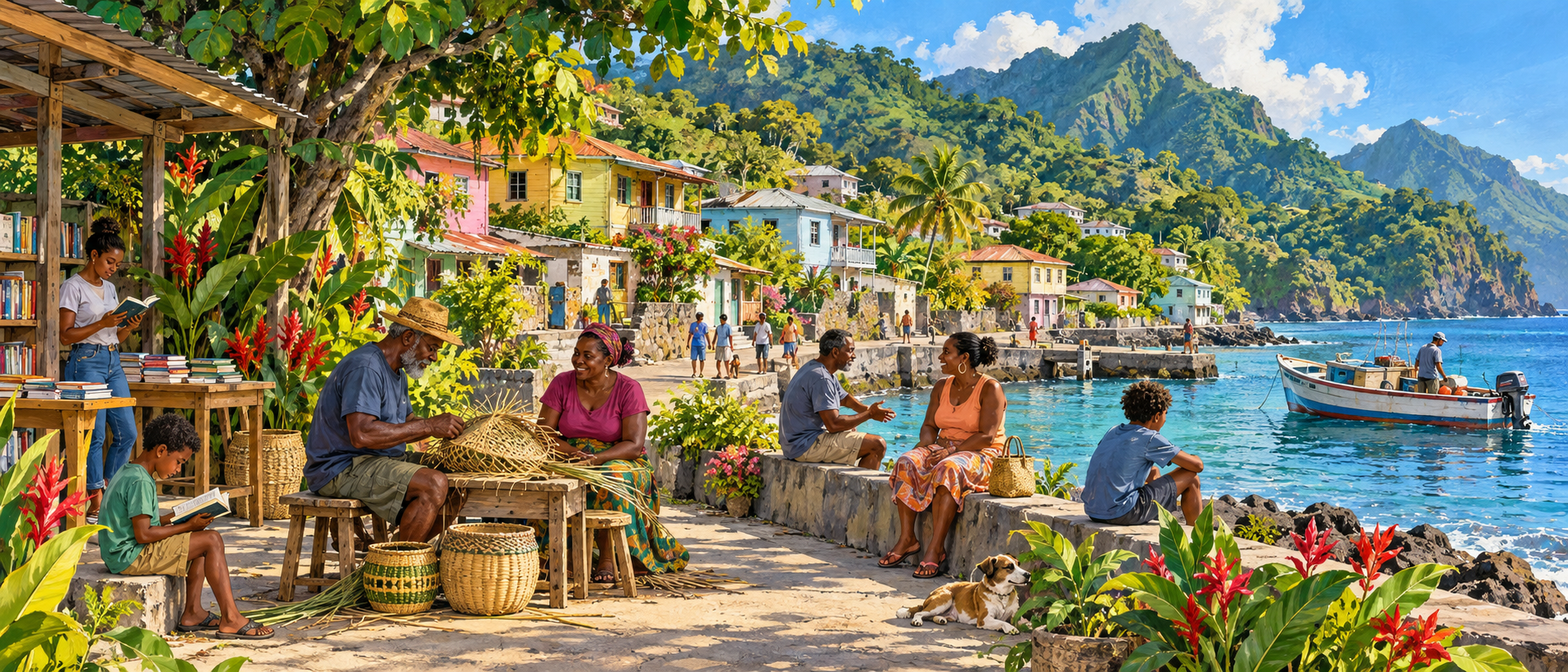
What should you know about Dominica beyond its name? This guide connects an island’s landscapes with the people, institutions and skills that give places meaning. It follows historical evidence and contemporary examples across community life, work, learning and cultural expression, without letting one image or headline stand for the whole country.
Begin with geography and history, or move directly to food, music, learning and the environment. Cultural knowledge deserves close attention in its own right. Contemporary challenges also need careful evidence, without allowing one event or statistic to stand in for an entire country.
Dominica at a glance
- Capital: Roseau.
- UN statistical region: Caribbean.
- Reading date: 20 October 2026; individual observations retain their own dates.
The capital and regional classification are listed in the UNData country profile. This guide uses specific dated sources for the other subjects rather than treating an old country summary as a current account of every institution.
This is an educational overview, not a travel itinerary or personalised medical, legal or financial advice. A cultural or environmental designation does not establish present access or safety. National data cannot replace the experiences of particular households and communities.
Cover illustration: an original AI-generated artistic interpretation of readers, a basket craftworker and neighbours beside colourful coastal houses, a fishing boat and lush green hills. This is a nonliteral composite, not a photograph or an exact view of a named place.
Choose your route through Dominica
- 1. An Island Built by Earth and Water
- 2. Regions, Settlements and Local Decisions
- 3. Histories Before the Independent Republic
- 4. Independence and the Work of Recovery
- 5. How Public Institutions Share Responsibility
- 6. People, Languages and Connections Abroad
- 7. An Economy of Connections and Choices
- 8. Agriculture as Knowledge and Livelihood
- 9. Infrastructure That Connects Daily Life
- 10. Education and the Capacity to Shape Change
- 11. Health and everyday services
- 12. Food, ingredients and skilled work
- 13. Music, words and shared memory
- 14. Arts, stories and places to create
- 15. Community, participation and shared effort
- 16. Heritage, landscapes and living knowledge
- 17. Environment and careful conservation
- 18. Science, observation and practical skills
- 19. Dominica and a connected world
- 20. Learning connections for students
1. An Island Built by Earth and Water
Finding the right Dominica
The Commonwealth of Dominica lies in the Eastern Caribbean between Guadeloupe to the north and Martinique to the south. Its capital is Roseau. These names matter: this island state is not the Dominican Republic, and Roseau is not Santo Domingo. Reading the country from its own position on the map reveals a small island connected closely to neighbouring islands, rather than a smaller version of another Caribbean nation. (Government profile; UN geographical names)
Dominica belongs to the Lesser Antilles, the island chain curving along the Caribbean Sea’s eastern edge. The University of the West Indies explains that this volcanic arc formed through subduction, as one tectonic plate descends beneath another. North of Dominica, the chain divides into active western volcanic islands and an older eastern limestone arc. The island therefore belongs to a much larger geological system extending beneath the sea and beyond its own shoreline. (UWI volcanic arc)
Mountains with a geological memory
Across Dominica itself, volcanic rocks and the materials produced as they weather dominate the landscape. The UWI Seismic Research Centre identifies nine potentially active volcanic centres, rather than one mountain accounting for the entire island. Older rocks along the Atlantic side and younger volcanic landscapes elsewhere record successive stages of formation. Deeply cut slopes and valleys show that construction by volcanism and reshaping by erosion have worked together over time. (UWI Dominica geology)
Morne Diablotins illustrates how a mountain can retain evidence of eruptions without a written eyewitness account. Smithsonian descriptions identify lava domes near its summit and deposits from pyroclastic flows on its flanks, while noting the absence of known historical eruptions there. Geological history is therefore not limited to recorded human memory. Rock formations, landforms and laboratory dating can reveal events whose traces survive even when no surviving document describes them. (Smithsonian volcano record)
Rainfall becomes a living network
Rainfall adds another layer to this geography. The national Meteorological Service describes trade winds carrying Atlantic moisture towards the island, where rising ground encourages rain. Windward Douglas-Charles and leeward Canefield can consequently experience different conditions on the same day. June to November is generally wetter, while December to May is relatively drier. These are seasonal tendencies, not promises that every district or every day will follow an identical pattern. (Meteorological climate overview)
Water flowing from the interior also connects landscape to settlement. Dominica’s 2011 national water-policy background describes rivers and other surface sources as the main foundation of public water supply. This means the condition of an upstream catchment matters to people well beyond it. Rainfall alone does not create a reliable service: collection points, pipes, storage, maintenance and wastewater arrangements stand between abundant water in the landscape and dependable water in homes. (National water policy)
2. Regions, Settlements and Local Decisions
More than a capital city
Dominica’s census geography recognises ten parishes, including Saint George, Saint John, Saint Andrew and Saint David. Its table separates the City of Roseau from the remainder of Saint George when comparing populations. Parishes organise statistical information, but their boundaries do not make every settlement within them identical or erase the importance of local identities. (CSO parish table)
The Physical Planning Division uses geographic information systems to connect land with information about its use. Such systems can display subdivisions, support environmental assessments and help planners analyse relationships between places. A map of settlement, for example, answers a different question from a map of vegetation or water. Combining these layers helps explain why regional development cannot be reduced to finding an apparently empty piece of land and building there. A site belongs to surrounding networks of water, movement and existing uses that a single outline cannot fully explain. (Planning GIS overview)
The scale of community government
Local government gives communities an institutional voice beneath the national level. A government account revised in 2002 describes municipal and village councils working on amenities, recreation, community facilities and communication with central authorities. It also explains their dependence on national resources and delegated responsibilities. That historical description remains useful for understanding the system’s purpose, while its old membership totals should not be mistaken for a freshly verified account of every council. (Local government history)
The Electoral Office’s council directory offers a different regional view through familiar settlement names. It groups Calibishie, Marigot, Wesley and Woodford Hill in the northeast, while identifying Grand Bay in the south and communities such as Colihaut and Saint Joseph in the west. This is a geography of lived connections and local administration. Its place groupings are more useful here than officeholder names that an undated directory may not keep current. (Council regional directory)
Territory and changing land use
The Kalinago Territory requires particular attention rather than being treated as just another village district. Kalinago Affairs describes a Chief and Council with responsibilities for community management, supported by hamlet committees. Its account refers to the framework created in 1978 and uses some historical legal terminology. The central point is contemporary community agency: decisions about the Territory involve institutions representing Kalinago people, not simply outside descriptions of Indigenous heritage. (Kalinago institutional account)
Regional planning is also changing around the new international airport. In September 2026, the government said a Northeast Development Plan was being prepared to guide housing, agriculture, recreation, commerce and other land uses around Woodford Hill, Wesley and neighbouring communities. Airport construction was still advancing. This is a statement about planning and expected opportunities, not evidence that all proposed development has arrived or that its eventual benefits are already settled. (Northeast planning update)
3. Histories Before the Independent Republic
Indigenous lives and colonial encounters
Dominica’s earlier history cannot begin with a European arrival. Archaeological research at LaSoye Point identifies an earlier Kalinago settlement beneath evidence interpreted as a later Dutch trading establishment. The finding places Indigenous people within a landscape of exchange and encounter, rather than outside history until colonisation. It also shows why excavated objects and settlement layers matter: they can complicate a simple story in which one population merely disappears when another arrives. (LaSoye archaeological research)
Research on colonial plantations adds further detail without making colonial documents the only voice. Northwestern University’s archaeological survey focuses on sites around Portsmouth and Soufrière and investigates encounters among European settlers, Kalinago people and enslaved Africans. Material remains can illuminate work, consumption and the organisation of daily life. Looking across more than one locality also discourages the assumption that colonial power reached every part of the island in the same way. (Colonial archaeology project)
Plantations, coercion and resistance
European competition nevertheless altered the island profoundly. Britain captured Dominica in 1761, and its possession was formally recognised in 1763. French and British colonial systems both brought enslaved Africans to work on the island. These changes were not simply a sequence of flags on a map. They involved forced movement, unequal control of labour and land, and institutions whose influence continued long after particular colonial administrators had left office. (CBIU historical overview)
The record of enslavement is also a record of resistance. Britain’s National Archives points to Dominica newspapers from 1798 among sources documenting people escaping slavery. Such notices were written from the perspective of those seeking to recover control, not as neutral biographies of the people described. Reading them critically means recognising both their evidential value and their injustice: an administrative description can preserve a trace of someone’s attempt to claim freedom. (National Archives guide)
Freedom and enduring leadership
Emancipation is remembered through more than a single date. Dominica’s Division of Culture links the annual observance around 1 August to the transitions of 1834 and 1838. It also emphasises how slavery and abolition shaped later society and how African cultural influences endure. This approach connects institutional change with the lives that followed it. Ending a legal system of bondage was momentous, but remembering emancipation also asks what freedom made possible. (Emancipation history)
Kalinago political history likewise includes disruption and persistence. The Division of Culture records the colonial suspension of the Chief’s office from 1930 to 1953 after a violent incident in the Territory. Its account presents the Chief as a representative able to advance community dignity and interests. That history challenges the image of Indigenous leadership as merely ceremonial. Institutions have been constrained, restored and adapted, while Kalinago people remain participants in shaping their future. (Kalinago leadership history)
4. Independence and the Work of Recovery
From association to sovereignty
The route to independence included a period of associated statehood beginning in 1967. A British parliamentary debate in 1978 described how internal political responsibility had already passed to Dominica, while the United Kingdom retained responsibilities in external affairs and defence. Association was therefore different from both earlier colonial administration and full independence. Recognising this intermediate stage makes political change easier to understand as a negotiated process rather than one abrupt event. (Parliamentary transition record)
The decisive transition came on 3 November 1978. The contemporary British order modifying existing enactments records the termination of Dominica’s association with the United Kingdom from that date. Independence changed the international and constitutional position of the country, giving new meaning to institutions already developed through earlier struggles. It did not erase inherited languages, economic relationships or administrative practices. The new republic had to work through those legacies while exercising its own sovereignty. (1978 transition order)
A state among partners
Dominica also joined the Commonwealth on 3 November 1978, according to the organisation’s membership chronology. The same day can therefore represent both separation from colonial authority and participation in a voluntary international association. Independence need not mean institutional isolation. For a small state, relationships with other countries can provide settings for discussion and cooperation while leaving national identity intact. Membership describes a connection between sovereign states, not a continuation of colonial government. (Commonwealth membership chronology)
Regional integration developed through the Organisation of Eastern Caribbean States. Its institutional chronology traces the founding Treaty of Basseterre to 1981 and the later economic-union arrangements to the revised treaty signed in 2010 and brought into force in 2011. Shared approaches span areas including education, agriculture, tourism and energy. These arrangements show how neighbouring islands can combine some capacities without becoming one country, addressing problems whose scale exceeds a single administration. (OECS integration chronology)
Disasters and long-term rebuilding
Hurricane Maria made the challenge of national recovery especially stark after striking on 18 September 2017. The World Bank reports that the subsequent assessment placed combined damage and losses at roughly US$1.3 billion, equivalent to 226 per cent of the GDP comparison used. This does not mean annual production literally vanished by that percentage. It expresses the extraordinary scale of destroyed assets and interrupted activity relative to a small national economy. (World Bank Maria assessment)
The government’s 2020 Climate Resilience and Recovery Plan turned rebuilding into a wider national ambition. Its importance lies in connecting recovery with how the country intends to organise development, rather than treating reconstruction as replacement alone. A plan, however, is not a certificate of finished resilience. Roads, homes, services and institutions must continue to function through changing conditions. The distinction between a stated objective and a demonstrated result remains essential when following Dominica’s progress. (Climate resilience plan)
5. How Public Institutions Share Responsibility
Constitution and executive roles
Dominica’s Constitution establishes a Parliament consisting of the President and a House of Assembly. This differs from a directly elected executive presidency combining the roles of head of state and government. The framework distributes responsibilities among institutions. Knowing who holds a title is useful, but understanding these relationships explains how public authority is organised and how decisions are meant to be made. (Constitutional framework)
The President’s Office explains that the President appoints as Prime Minister the House member likely to command the support of the elected majority. Ministers are appointed on the Prime Minister’s advice, while presidential responsibilities also include ceremonial and community functions. These relationships separate the head of state from government’s day-to-day political leadership. Parliamentary government is consequently better understood through connections between offices than through isolated job descriptions. (Presidential responsibilities)
Leadership in the present
As checked in October 2026, the President’s official website identifies Sylvanie Burton as the holder of that office. Elected in September 2023 and inaugurated on 2 October, she became Dominica’s first woman and first Indigenous president. This is an important institutional milestone without implying that any one person represents every experience within a community. Her presidency places Kalinago representation within the central institutions of the republic, not only within discussions of heritage. The significance concerns both the history of the office and the people able to occupy it. (President’s official biography)
Roosevelt Skerrit remains Prime Minister in the government’s 2026 communications. In January, his office described priorities centred on major development projects, education and opportunities for future generations. Those statements explain the administration’s agenda, not an independent verdict on its performance. Comparing promises, budgets, implementation and results is part of understanding public policy. A project can be politically important while its timetable, cost or distribution of benefits still requires careful scrutiny. (2026 government priorities; October officeholder check)
Representation and regional justice
Representation becomes concrete in constituency elections. The Electoral Office’s final count for the December 2022 general election records candidates, votes and rejected ballots for the constituencies where polls took place. These categories answer different questions: a candidate’s votes measure one contest, while the number of representatives concerns the composition of the House. Keeping the units distinct avoids misleading comparisons and makes election records more informative than a single headline about winners or turnout. (Official election returns)
Some judicial responsibilities are shared through regional institutions. The Caribbean Court of Justice records that Dominica joined its appellate jurisdiction on 6 March 2015, making the Court part of the country’s final appeal arrangements. This is another example of sovereignty exercised through cooperation rather than isolation. A regional court does not turn its member countries into a single state; it provides a common judicial institution within an agreed framework of responsibilities. (CCJ accession record)
6. People, Languages and Connections Abroad
A population is more than a total
The Central Statistics Office describes a census as a count of people and households that also gathers demographic, social and economic information. Its value extends beyond producing one population figure. The location and circumstances of households help shape decisions about services, schools and infrastructure. Dates remain crucial: an older census table is evidence about its own reference period, while a later estimate is a different statistical product and should be labelled accordingly. (CSO census explanation)
The 2011 census records a population predominantly classified as of African descent, alongside Kalinago people, people of mixed heritage and several smaller groups. These historical statistical categories are neither a current count nor complete individual identities. They show diverse backgrounds, but cannot assign any person a language, belief, occupation or way of life. (CSO 2011 census)
Languages as knowledge
Kwéyòl carries histories of African creativity under plantation enslavement and of continuing Caribbean cultural exchange. The Division of Culture describes a language long used orally and later supported by coordinated work on writing systems. Its account names collaboration among Dominican, Saint Lucian, Martiniquan and Guadeloupean organisations and researchers. Writing conventions make knowledge easier to teach and publish, but the language’s importance also lives in conversation, humour, memory and the meanings speakers create together. (Kwéyòl language account)
Kokoy adds another strand to this linguistic landscape. The Division of Culture associates this English-based Creole particularly with northeastern communities such as Marigot, Wesley, Woodford Hill and Clifton, and with connections to other Caribbean islands. Its account also acknowledges earlier social stigma and speakers’ desire for recognition. That history is a reminder that judgments about a language often reflect unequal social power, rather than any inability of its speakers to express complex ideas. (Kokoy language account)
Lives across national boundaries
Dominican lives also extend beyond the island. An IOM study of Eastern Caribbean diaspora organisations places migration within overlapping connections involving employment, education, family and major disruptions. Its quantitative comparisons use historical migration data, not a live count of everyone abroad. The broader lesson is that movement does not necessarily end belonging. People can build lives elsewhere while continuing to maintain relationships, cultural attachments and practical connections with communities in Dominica. Families may consequently belong to social networks stretching across several places at once. (IOM diaspora mapping)
Those relationships can also take organised forms. IOM’s regional migration-governance study identifies a Diaspora Unit in Dominica and discusses channels through which Caribbean communities abroad engage with their home countries. Family support, charitable activity and business connections are different kinds of involvement, not one uniform economic flow. Understanding diaspora participation therefore requires more than adding up money: it also involves the institutions and personal relationships through which ideas, skills and assistance circulate. (IOM governance study)
7. An Economy of Connections and Choices
Growth and vulnerability
Dominica’s economy combines agriculture, tourism, construction and other services rather than resting on one activity alone. The World Bank’s October 2026 overview reports growth of 4.5 per cent in 2025, compared with 3.5 per cent in 2024, with construction, tourism and agriculture contributing. These are national production measures, not direct measures of every household’s experience. Expansion can create opportunities while leaving important questions about employment, costs and the distribution of income. (World Bank 2026 overview)
The IMF’s 2026 assessment places that growth alongside significant constraints. It identifies a narrow economic base, dependence on citizenship-by-investment revenues and large imported inputs for development projects. Public debt and exposure to shocks complicate the choices available to government. This creates a practical tension: investment may improve future capacity while increasing near-term financing needs. Neither the benefits nor the pressures can be understood simply by treating all construction spending as an automatic gain. (IMF 2026 consultation)
Money and trade
Dominica uses the Eastern Caribbean dollar within a shared monetary system. An ECCB account explains the currency’s fixed relationship of EC$2.70 to one US dollar, maintained since July 1976, and the role of pooled reserves. A common currency reduces one source of uncertainty in regional economic relationships. It does not remove differences between national economies, nor does a stable exchange rate mean that the prices of individual goods never change. (ECCB currency account)
Trade statistics reveal another set of connections. The WTO’s Dominica profile distinguishes agricultural from other merchandise and records imports, export destinations and tariff measures with their own reference years. These distinctions matter because buying construction equipment, selling crops and supplying a service are not interchangeable activities. A trade table becomes useful when the reader checks what is being measured, in which year and in what unit, rather than treating every number as current. (WTO country profile)
Enterprises and public finance
The investment-promotion authority highlights tourism, renewable energy, agribusiness, aquaculture and knowledge services as areas of opportunity. That list describes an agency’s development priorities, not proof that each sector already has equal scale or proven success. For local enterprises, creating value can involve processing a product, organising a service or applying a skill to an existing need. Diversification is therefore about capabilities and customers as well as attracting new investment projects. (Investment sector priorities)
Citizenship-by-investment receipts also form part of the public-finance story. The official programme distinguishes contributions to an Economic Diversification Fund from investment in approved real-estate projects, and describes the fund as supporting public and private development. These mechanisms should not be confused with ordinary merchandise exports or household earnings. Their developmental significance depends on how resources are managed and converted into useful assets and services, rather than on the existence of a funding channel alone. (CBIU programme structure)
8. Agriculture as Knowledge and Livelihood
Diverse crops and practical skills
Dominican agriculture is more varied than a single export crop. The Agriculture Division’s horticulture programme identifies diversification into root crops, passionfruit, hot peppers, ginger, plantain, pineapple and culinary herbs. It also recognises the wider chain of people depending on production, including farm families, workers, hucksters and exporters. A crop becomes an economic livelihood through harvesting, handling, transport and sale, not simply because a plant grows successfully in fertile soil. (Horticulture programme)
Practical training helps connect equipment with effective use. In June 2026, FAO reported a Portsmouth workshop for 56 farmers, extension officers and other agricultural professionals on irrigation, fertigation and nutrient management. Participants examined issues such as uneven water distribution and clogged irrigation lines. The report described demonstration sites still being established. That distinction matters: training had taken place, while the wider installation and learning network remained a programme under development. (FAO June 2026 training)
Recovery and planting material
Recovery after Maria also involved restoring the means to work. In an October 2024 account, the World Bank described agricultural support providing equipment and inputs, rehabilitating cropland and introducing soil conservation, diversification, water management and agroforestry. Its beekeeping example shows how recovery can rebuild a small enterprise rather than merely replace a damaged object. Equipment matters most when it reconnects a producer with skills, productive assets and customers who can sustain the business. (Agricultural recovery account)
Planting material is another important form of preparedness. IICA’s summary of its 2025 work in Dominica describes a quality-seed programme that trained participants in mobile seed banks, conservation of plant genetic material, drones and digital information systems. A seed system includes knowledge about what is available and how it can be multiplied or distributed. Protecting this capacity helps explain why agricultural recovery requires planning before a storm, not only assistance afterwards. (IICA 2025 achievements)
Community-led adaptation
Work in the Kalinago Territory demonstrates why adaptation should include community participation. An IICA project scheduled from August 2026 to February 2027 sets out plans for a greenhouse roadmap, farmer training, land and water management, and business skills. It also identifies consultation and evidence-based planning as objectives. These are planned activities, not verified achievements. Respectful development means treating producers as participants with knowledge and priorities, rather than presenting them only as beneficiaries of outside expertise. (Kalinago agriculture project)
Livestock production brings a related challenge: supplying feed without placing unnecessary pressure on imports or land. IICA’s 2026 forage project aims to multiply locally adapted grasses and other feed plants while improving pasture management and reducing erosion. Its design links agricultural institutions, cooperatives and young producers. The intended benefits still require implementation and measurement. The underlying idea is clear, however: food production depends on maintaining the ecological and practical systems that support it. (IICA forage project)
9. Infrastructure That Connects Daily Life
Moving people and goods
On a mountainous island, road engineering involves much more than a strip of pavement. The Public Works Ministry’s March 2025 update reported completion of the Bois Diable–Castle Bruce section of the East Coast rehabilitation project, including culverts, retaining walls and drainage works. Those supporting structures help the road interact with slopes and flowing water. The statement confirmed that section, not every part of the wider project, illustrating why completion claims need precise boundaries. (East Coast road update)
Air and sea infrastructure connect those inland routes to wider networks. The Dominica Air and Sea Ports Authority identifies Douglas-Charles and Canefield airports, cargo operations at Woodbridge Bay near Roseau and Longhouse in Portsmouth, and facilities serving ferries and cruise vessels. Different facilities perform different tasks. The movement of people, building materials, food and other goods depends on these interfaces, making ports part of everyday economic life rather than simply places of arrival. (DASPA facilities overview)
Electricity and new capacity
The new international airport represents additional capacity still being built. A June 2026 government update described work on earthworks, runway and taxiway construction, the passenger terminal, cargo facilities, air-traffic control and a fuel farm. These components have to operate together before an airport can fulfil its intended role. Reported construction progress is therefore not equivalent to an operational opening, and expected future connections should not be described as services already available. (Airport construction report)
Geothermal electricity reached a different stage in 2026. An official October announcement states that the ten-megawatt plant at Laudat in the Roseau Valley entered commercial operation in July after testing and was supplying the national grid. This is an operating facility, not merely a proposal. Lower dependence on imported fuel is central to its purpose, while the size and timing of any reduction in consumers’ bills must be assessed separately rather than assumed. (Geothermal operation update)
Water and digital services
Water infrastructure has its own sequence from financing to construction and service. An April 2025 DOWASCO statement reported the arrival of materials and preparatory work for upgrades serving communities including Castle Bruce, Grand Fond and Calibishie. The project involved pipes, fittings, local labour and site preparation, with Caribbean Development Bank and UK support. That announcement documented mobilisation, not completion. Reliable supply ultimately depends on the functioning system, not simply the delivery of its components. (DOWASCO project update)
Digital infrastructure links physical networks with information and services. Dominica’s Caribbean Digital Transformation Project describes goals involving public services, businesses, residents and participation in a wider digital economy. Connectivity can make information easier to exchange, but useful access also depends on skills and services designed for people’s needs. A strategy or project website demonstrates organised effort; it does not establish that every household already has equal connectivity or can use every service successfully. (Digital transformation programme)
10. Education and the Capacity to Shape Change
Learning needs and assessment
Education is supported by more than classrooms and examinations. The ministry’s school-operations description includes district officers, learning-support advisers, guidance counsellors, early-childhood responsibilities and special-education support. These roles address different aspects of students’ experience and of school organisation. Their presence in the system’s design does not measure how well every need is met, but it shows why educational quality depends on coordinated support around teaching, rather than on a teacher working alone. (School support structure)
The Curriculum, Measurement and Evaluation Unit connects what is taught with how learning is assessed. It describes curriculum guidance, teacher development and diagnostic assessments intended to identify needs, alongside a Grade Six assessment at the end of primary schooling. An assessment can therefore serve more than a sorting function. Used carefully, it can help reveal what a student understands and where teaching needs to respond, instead of reducing learning to a final score. (Curriculum and assessment)
Pathways beyond school
Dominica State College provides a local setting for tertiary education and lifelong learning. Its institutional history traces strands of provision through teacher training, the Technical College at Stock Farm and sixth-form education. Those different origins help explain why education beyond secondary school is not only one academic route. A national college can connect disciplinary knowledge, practical training and community needs while giving students pathways that do not all require leaving the island immediately. (State College history)
Connections between training and work are also part of current reform planning. The education ministry’s WISTLE stakeholder-engagement document identifies teachers, school leaders, the TVET Council and private industry among participants in consultation. It also addresses TVET certification and transitions for learners with special educational needs. This is a framework for involvement, not evidence that all proposed changes have succeeded. Its value lies in recognising that relevant education requires discussion across classrooms, workplaces and communities. (WISTLE engagement plan)
Reform as continuing work
Government reporting on education-reform consultations in 2025 framed the task as preparing citizens for both national needs and wider opportunities. Expanding access remains important, but access alone cannot settle questions about teaching, relevance or inclusion. Reform consequently involves deciding what learners should be able to understand and do, and how schools can support those goals. Consultation is one stage in that process; implementation and evidence about students’ experiences must follow it. (Education reform consultations)
Recent college initiatives show students engaging with emerging fields without requiring claims of completed success. In September 2026, Dominica State College announced plans for a Youth Internet Governance Lab; in October, it reported preparations for students to represent the country in the FIRST Global robotics challenge. These are opportunities for participation and learning, not competition results. They illustrate how education can connect local learners with technical questions and international conversations while remaining grounded in Dominica. (College digital lab; Robotics preparations)
11. Health and everyday services
Care beyond the hospital
PAHO’s 2024 country profile identifies an ageing population and noncommunicable diseases among the pressures on Dominica’s health system. These concerns put continuing care beside emergency treatment. A country needs services that can accompany people over time, rather than treating health only as a sequence of sudden crises or new buildings.
The profile also highlights the availability and training of health workers. Professional knowledge is part of a service’s infrastructure, even though it cannot be photographed as easily as a hospital. Its indicators refer to different years, so the profile should not be read as a live description of every community’s care.
Buildings, systems and dignity
PAHO’s final report on its 2015–2023 Smart Health Care Facilities project records retrofitting at Portsmouth Hospital and health centres including Grand Bay, La Plaine, Trafalgar and Massacre. The programme joined disaster resilience with environmental performance. A health building must support the work inside it while using resources responsibly. Importantly, the report distinguishes completed retrofits from design work and smaller interventions elsewhere. These dated improvements are evidence of particular work, not a promise about present staffing, opening arrangements or uninterrupted service at every facility.
For the 2024–2025 reporting period, PAHO describes support for integrating mental health into Dominica’s primary care. Training, identification and referral tools, and a rights-based approach are among the reported activities. The example places mental health within ordinary services rather than outside the health system. It also foregrounds dignity: people seeking support should be understood as individuals, not reduced to a label. This programme account explains an approach and its implementation work; it is not an independent measure of everyone’s experience or access.
Connections that keep services working
The WHO and UNFCCC health-and-climate profile for Dominica, published in 2020, considers climate hazards alongside health vulnerabilities and service resilience. Its framework includes monitoring, early warning and preparedness as different tasks. A warning has to reach people who can interpret and act on it; preparation needs responsibilities and resources agreed beforehand. The profile therefore helps explain why resilient healthcare involves information and coordination as well as construction. It is a historical assessment, not a current alert or a guide to personal treatment.
PAHO’s feature on Dominica’s health-system transformation discusses the Dominica China Friendship Hospital, formerly Princess Margaret Hospital, alongside its connections with primary care and support services. Interviewees raise staff capacity and digital literacy as practical concerns. Introducing an information system is not simply a matter of buying computers: people must know how it fits their work. The account invites students to trace a service across departments, recognising that buildings, records and professional relationships need to connect if the whole system is to function well.
12. Food, ingredients and skilled work
A dish with room for variation
Discover Dominica identifies callaloo soup, made with young dasheen leaves and coconut milk, as the national dish. Its culinary account mentions a land-crab version during the Creole season. Naming a dish opens a conversation about ingredients and preparation; it does not mean that every household cooks one identical recipe.
The same account introduces codfish sancoche and pelau among the island’s dishes. Soup, seasoned rice and coconut-based cooking offer different ways to combine ingredients. A national food story is richer when it leaves room for personal taste and occasions, rather than turning a short list into rules for what people must eat.
Learning from makers
The Kalinago community portal presents cassava-bread making among the activities at Kalinago Barana Autê. It places this knowledge beside craft and canoe-building demonstrations led by people with specialist skills. Food is therefore something made and taught, not merely an object displayed for outsiders. Describing the centre does not describe every Kalinago family’s daily routine. A respectful learner asks who is explaining a practice, listens to that person’s account and recognises a living community whose members have varied work, interests and ways of participating.
At Pointe Baptiste in Calibishie, a family chocolate producer traces its beginnings to Alan Napier’s kitchen experiments in 2010. Its own account connects cocoa grown in Dominica with local farmers and chocolate-making work. Following a product from pod to bar reveals several stages rather than a single act of manufacture. Growers, processors and people developing flavours contribute different knowledge. The business’s description is useful evidence of its own story, without making its promotional claims about quality or sustainability a verdict on all chocolate production.
Cooperation and everyday nourishment
Dominica’s Cooperative Development Division describes Northeast Cocoa Producers establishing a nursery and using a cooperative koudmain approach to create cocoa plots. Its account reports training for thirteen people, with agricultural support and donated plants. The example makes collaboration concrete: a nursery, planting material and shared effort connect learning with work on the land. It is a project account, not a current measure of harvests or earnings. Agricultural skill includes organising people and resources, as well as knowing how to care for a crop.
The Global Child Nutrition Foundation’s Dominica report for the 2022–2023 school year describes parents, students and volunteers participating around school meals. It records parent-teacher meetings, food preparation, serving and cleaning, alongside local sourcing. A meal has a social organisation behind it: someone plans, supplies, cooks and clears away. The report is based on government survey information for that school year, not a claim that every school currently uses the same arrangement. It offers a practical connection between nourishment, learning and shared responsibility.
13. Music, words and shared memory
Musicians explaining their craft
The Division of Culture’s description of Jing Ping Music: Foundation to Innovation introduces a documentary about a four-piece folk band. Experienced musicians discuss their journeys, while contemporary performers explain how jing ping has influenced their creative work. The focus is on people making choices, not on an anonymous national soundtrack.
A documentary description is an invitation to listen, rather than a substitute for hearing the performances. Students can prepare questions about how musicians learn from one another and how an older form enters new work. Tradition need not mean repetition without change; the title itself places a foundation beside possibilities for innovation.
Rhythm and the spoken voice
In a 2015 account, Dominican practitioner Noreen Joseph describes bèlè through dancers, a drummer and singers who exchange a lead phrase and response. She explains that the drummer follows the dancers’ footwork. That relationship makes attention part of performance: sound and movement answer one another. Her account is a practitioner’s description, not a rule that every performance must be identical. Beginning with what participants do helps students understand a dance as skilled interaction, rather than reducing it to a colourful image or costume.
The Kalinago Territory’s website presents the story of Bakwa, a great serpent associated with Waitukubuli and the landmark L’escalier Tete Chien. The page identifies the account as a legend and links storytelling with ancestors, land and survival. A reader should preserve that framing rather than turn a cultural narrative into a scientific explanation or assume every community member tells it identically. Oral tradition can carry relationships and meaning, while the storyteller’s perspective remains important when another person records, retells or studies the story.
Cultural advocates and changing sounds
Mabel “Cissie” Caudeiron appears in the Division of Culture’s history as a composer, researcher and organiser who promoted folk culture. She founded the Kairi Artistic Troupe and helped organise the National Day celebrations of 1965. Her work included writing about music, dance and dress. These activities show that cultural recognition is built through effort: collecting knowledge, arranging performances and persuading audiences to value it. A familiar tradition may owe much to particular people who created opportunities for others to hear, practise and discuss it.
The Dominica Festivals profile of WCK connects the band, formed in 1988, with bouyon and recordings including Culture Shock. Its 2022 account also describes a later lineup that continued the sound, showing that a band’s name can span changes in membership. Recorded songs, live performance and the work of individual musicians belong in the same history. This is one strand of Dominica’s musical life, not its complete definition. Students can trace a named group without assuming that every resident prefers the same music.
14. Arts, stories and places to create
An old mill with another purpose
The Old Mill Cultural Centre’s institutional history begins with a site that produced sugar, rum and molasses, later becoming part of a lime estate. A portion was assigned to cultural use in 1976. Its changing purpose makes the building a way to think about how earlier working landscapes acquire new uses.
The account records Hurricane David’s damage in 1979, restoration beginning in 1980 and the centre’s formal establishment in 1985. It describes spaces for research, sculpture and dance. These dated stages matter: a cultural institution develops through decisions and repair, rather than appearing fully formed or remaining untouched by events around it.
Materials and opportunities to practise
The Division of Culture’s profile of Hilroy Fingal describes an artist working beyond canvas, using bottles, vases, bamboo, wood and calabash alongside drawing and painted clothing. The range encourages close attention to materials. A curved vessel presents different possibilities from a flat surface, while an object used in a home has a relationship with everyday life. Naming the maker prevents craft from becoming anonymous decoration. The profile introduces his practice without requiring us to invent meanings for artworks we have not closely examined.
The Dominica Institute for the Arts lists examples of training that include children’s choir, creative dance, ballet, guitar and music theory. Performance and formal study appear beside one another: making music can involve listening, physical practice and understanding how a piece is organised. These are examples from the institution’s description, not a current enrolment promise. For a student, the important connection is that artistic confidence can be developed through learning. A finished concert or exhibition reveals only part of the practice that makes it possible.
Readers, writers and viewpoints
The Division of Culture describes the Dominica Writers’ Guild as a setting for exchanging ideas, sharing work and organising poetry readings. Writing can look solitary, yet feedback and performance bring it into relationships with other people. Reading a poem aloud may reveal pauses or emphasis that are less obvious on the page. A guild’s stated purpose does not tell us when its next meeting occurs. It does show why cultural life needs spaces where unfinished work can be discussed, not only stages for completed achievements.
Jean Rhys’s Wide Sargasso Sea was published in 1966 and reworks a story connected with Charlotte Brontë’s Jane Eyre. Norton’s edition description identifies Jamaica and Dominica among its settings and points to Creole and French language within the novel. This opens a literary question about viewpoint: what changes when another voice tells a related story? A novel is an imaginative work, not a national survey. Its catalogue can guide further reading, but interpretation of particular scenes should come from reading the text itself.
15. Community, participation and shared effort
People organising to help
The Dominica Red Cross Society describes its mission through humanitarian service, community resilience and work with volunteers. Its headquarters is in Goodwill, Roseau. The organisation’s public forms include volunteer applications and records of voluntary hours, making visible some of the structure behind a word as broad as helping.
A volunteer organisation needs ways to bring people into its work and account for their contribution. Time, preparation and coordination matter alongside generosity. The Society’s stated mission identifies its purpose, not proof that every need is met. It offers a starting point for understanding how community assistance becomes organised rather than depending only on spontaneous goodwill. Keeping records also makes it possible to see how tasks are shared.
Speaking for oneself
The Dominica Association of Persons with Disabilities traces its founding in 1983 to nine people with disabilities, including founder Reginald Rolle. Its own history emphasises self-advocacy and self-representation. That distinction matters: people are not merely recipients of services, but participants in deciding what inclusion and opportunity should look like.
DAPD’s account of its work includes information-technology skills, sign language, leadership and recreation, including cricket for people with visual impairments. Participation therefore extends beyond a single service or activity. These examples describe the organisation’s experience, not current course availability. They invite students to ask how an activity can be designed around different participants without treating one kind of body or communication as the only starting point.
Local knowledge shaping decisions
UNDP’s July 2022 account of women farmers in Dominica describes a Community Score Card process for identifying problems, suggesting solutions and discussing them with service providers. Farmers and agricultural extension workers appear in dialogue, rather than as a one-way chain of instruction. Such a process gives practical experience a place in decisions: people who work the land can explain where support fits and where it misses the problem. The story documents a particular initiative, not a national survey of influence or a guarantee that every proposal was adopted. Its value lies in showing participation as organised discussion with a purpose.
A January 2020 UNDP report describes support to the Portsmouth Association of Yachting Services after Hurricane Maria, including the donation of seven outboard engines. It links the association’s marine work with fishers, farmers, laundry services, restaurants, guides and transport. One activity can therefore connect many occupations, including work that a visitor might not notice. The donation is a dated recovery action, not evidence that every business recovered at the same pace. Following these connections helps explain a community economy through the people doing its work, without making promises about present services or conditions.
16. Heritage, landscapes and living knowledge
A forested volcanic landscape
Morne Trois Pitons National Park entered UNESCO’s World Heritage List in 1997. The listing describes tropical forest and volcanic features in Dominica’s central and southern highlands. Lakes, hot springs and fumaroles belong within a landscape whose scientific interest comes from relationships between landforms, water and living things.
Boeri Lake, Freshwater Lake and the Boiling Lake appear in that description. Their names should not be mistaken for a statement about present conditions or access. Heritage recognition identifies values to understand and conserve; it does not turn a changing landscape into a place outside natural processes or management responsibilities.
Buildings and the people within them
Dominica’s 2015 tentative-list submission places Fort Shirley within Cabrits in the north of the island. It remembers the 1802 revolt by enslaved African soldiers of the Eighth West India Regiment, alongside the fort’s barracks, cisterns, stores and other working spaces. Reading a fort through those people broadens attention beyond walls and weapons. The submission also describes restoration led by historian Lennox Honychurch from 1982. Tentative-list inclusion is not World Heritage inscription; the document records the country’s case for considering the place.
The Division of Culture’s history of Pointe Michel follows a particular coastal community through settlement, fishing, farming, churches and a school established in 1922. It also encourages readers to ask older people about local history. A village account can connect places that otherwise appear as separate dots: a shore, a road, a churchyard and a classroom. Memories can add perspective while still needing dates and context. The story of one community should remain local, rather than being stretched into a single history for every Dominican village.
Skills carried forward by people
A government report from 2022 describes five women and five men completing seven weeks of woodcraft training, with certificates presented at Barana Autê on 8 July. The Kalinago chief encouraged participants to develop craft cooperation and future enterprise. The completed training and the hoped-for business growth are different claims. This example places Kalinago makers in a contemporary setting of learning, design and livelihood choices. It does not freeze Indigenous identity in the past or suggest that cultural continuity requires everyone to practise the same occupation.
UNESCO’s Dominica living-heritage project record covers May 2021 to January 2025 and describes aims including community-based inventorying, training and a safeguarding roadmap. Collaboration with Indigenous communities and attention to disaster risk are part of its design. An inventory should involve the people who hold and practise knowledge, not simply collect labels from outside. The record explains intended work; it does not prove that every planned output was completed. Safeguarding asks what helps people continue, adapt and teach practices that matter to them.
17. Environment and careful conservation
Parrots, forests and headwaters
Dominica’s 2015 tentative-list account describes Morne Diablotin National Park in the northwest and links its establishment to protecting the island’s two endemic parrots. The Sisserou is the imperial parrot; the Jaco is the red-necked parrot. Endemic here means that these species occur naturally only in Dominica, not that they are equally common everywhere.
The same account connects rainforest and higher-elevation vegetation with river headwaters. Conservation can therefore concern habitats and water systems together, not just one conspicuous animal. This is a historical site description and a tentative submission, not a current bird count. Neither a protected boundary nor a heritage proposal removes the need for continuing observation and care.
A shared coast and a threatened frog
The 2015 submission for Soufrière–Scott’s Head Marine Reserve describes separate zones for a fish nursery, fishing, recreation and diving. Only the fish-nursery section was proposed for the tentative list. That detail makes the boundary of a claim important. The account also describes a management body involving fishers, village representatives and other users. A marine reserve is not simply empty water set aside on a map; it is a place where uses and responsibilities must be negotiated. The description does not establish present enforcement or access conditions.
The Zoological Society of London’s mountain-chicken conservation account concerns a large frog, Leptodactylus fallax, rather than a bird. Work in Dominica includes a breeding facility, molecular diagnostics and training in surveys and animal care, responding to the fungal disease chytridiomycosis. Conservation combines field knowledge with laboratory and husbandry skills. The programme’s dated survey findings should not be turned into an exact count of all frogs alive today. Understanding what was searched, when and by whom is part of interpreting evidence about a rare species.
Monitoring and participation at sea
A 2008 sea-turtle action plan for Dominica links coastal-community participation with beach monitoring, record-keeping and habitat conservation. Its authors propose scientifically grounded research and livelihood opportunities rather than assuming that tourism automatically protects wildlife. A plan can show how people intended activities to fit together, but it cannot by itself confirm later results. The practical work of recording observations matters: a sighting becomes more useful when its date, location and method are clear enough for others to understand and compare.
National Geographic’s Pristine Seas account records an expedition around Dominica in November and December 2022, studying nearshore reefs, seagrass, deeper water and offshore areas. Fellows from a Dominica marine-conservation programme contributed local knowledge to the team. The range of habitats resists a single picture of the sea as uniformly blue and empty. Research brings different observations together, while each method sees only part of the system. This dated expedition is evidence of investigation, not a present assessment that every habitat is healthy or fully protected.
18. Science, observation and practical skills
Reading an active landscape
The University of the West Indies Seismic Research Centre explains volcano monitoring through several kinds of evidence: earthquakes, ground movement and the chemistry of gases and hot springs. No single instrument tells the whole story. Scientists compare measurements to understand changes and to distinguish a signal from the limits of its recording.
In Dominica, the Centre also describes working with guides and forestry officers who observe visual changes in remote places, including the Boiling Lake. Local observation and instrument records contribute different knowledge. This account explains methods, not a current alert, eruption prediction or statement about whether a route should be used.
Listening without claiming translation
A 2024 Nature Communications paper led by Pratyusha Sharma examines structure in sperm-whale codas using an Eastern Caribbean dataset. The researchers distinguish timing features including rhythm and tempo, as well as variation they call rubato and ornamentation. Finding patterned differences is not the same as translating what a whale means. This is a useful lesson in scientific progress: a result can expand what researchers know while leaving a larger question unresolved. The careful claim is about vocal structure, not a completed dictionary of whale language.
Project CETI’s 2024 annual report describes acoustic and behavioural research using tools such as hydrophones, tags, drones and underwater gliders. It also presents a ten-month Dominica Marine Conservation Fellowship combining research techniques with water, vessel, storytelling and leadership skills. The range makes technical work more human: collecting data depends on people who can operate equipment, collaborate and explain what they are doing. These are activities reported for a particular programme and period, not evidence that ambitious goals for understanding whale communication have already been achieved.
Communication as a technical skill
A March 2023 UWI Seismic Research Centre release describes a pilot with the University of Cambridge on locally appropriate volcanic-risk communication in Dominica. Interviews, surveys, community discussions and a creative workshop formed part of its proposed approach. Communication research asks what people understand and what information they need, rather than assuming that a technically correct message is automatically useful. The announcement is not proof that every intended film or activity was completed. It shows that studying hazards also involves listening to the people who live with them.
FAO reported in February 2021 on fishermen’s training in Dominica, including a five-day course and a separate course in VHF radio communication. The reported participant counts should not be added as though they were necessarily different people. Radio use places clarity, procedure and practice beside knowledge of boats and fishing. A technical skill is not only handling an object; it includes communicating with others in a shared system. This historical training example is not present-day maritime advice or a claim about current course availability.
19. Dominica and a connected world
An achievement with a clear name
Thea LaFond won the women’s triple jump at the Paris Olympic Games on 3 August 2024, giving Dominica its first Olympic medal. World Athletics records her winning second-round distance as 15.02 metres. The result belongs to the Commonwealth of Dominica, not the Dominican Republic, a different country with a similar English name.
A precise result makes room for a better story than a vague claim of national greatness. Event, date, athlete and measurement each matter. LaFond’s achievement can inspire questions about preparation and performance without suggesting that talent is shared automatically by everyone from the same place or that one medal defines an entire country.
Representing more than one scale
Cricket West Indies’ report on Alick Athanaze’s July 2023 Test debut places him at Windsor Park in Dominica, playing for West Indies against India. He made 47 in the first innings, with his family among the spectators. The scene connects a home ground with a regional team and an international contest. Sporting identity does not always fit one level of the map. A match report gives a specific performance to examine, not a current ranking or a prediction about the rest of a player’s career.
Michele Henderson, a singer and songwriter from Dominica, wrote and performed Celebrating CARICOM, launched as the Caribbean Community’s official song in July 2014. CARICOM’s account connects the work with ceremonial and community occasions. A regional institution can be represented through an artist’s voice as well as through meetings and documents. The example makes cultural contribution visible within international cooperation. It also invites attention to authorship: the song is a particular person’s work, not anonymous background music that belongs to a region without a maker.
Music moving between islands
A historical Division of Culture profile follows Gordon Henderson from Dominican bands into work in Guadeloupe and with Exile One. It connects his Creole songwriting with cadence-lypso and describes learning French for the wider recording and media environment. Musicians move through languages, workplaces and audiences, making cultural geography more complicated than national borders alone. The 1994 profile should be read in its historical setting, not as a statement about present personnel or age. Its useful thread is an individual career built through exchange and creative decisions.
The organiser’s July 2025 launch release for the World Creole Music Festival announced a programme including WCK and a Bouyon Assembly with performers from Dominica and Guadeloupe. A programme reveals how organisers imagine a conversation between artists and audiences. It is not proof that every announced act later appeared. Reading the named participants makes the regional connection concrete while preserving that limit. A festival can provide a meeting point for different musical paths, rather than requiring all Creole-speaking communities to share one sound or cultural history.
20. Learning connections for students
Begin with a question and a source
Singapore’s National Library Board organises its SURE framework around Source, Understand, Research and Evaluate. Use those steps to choose a focused question about Dominica rather than collecting unrelated facts. Keep the original claim, its date and your own explanation visibly separate so that another reader can follow your reasoning.
Check the country as well as the topic when searching: similar names can lead to the wrong page. Ask whether a document reports an event, proposes future work or describes an institution’s purpose. A useful project can explain what remains uncertain. Correcting a first impression is evidence of learning, not a failure to finish.
Compare forests and listen carefully
NParks’ account of Singapore’s native forests distinguishes primary rainforest, mature secondary forest and younger vegetation shaped by past land use. That offers a framework for a comparison, not proof that all tropical forests have the same history or species. Make a small chart showing location, habitat description and the source’s observation date. Leave a space for questions you cannot yet answer. Comparing clearly defined features is more informative than ranking two countries by how green they appear in photographs or how attractive their landscapes look.
The National Archives of Singapore’s oral-history guidance explains searching by keywords and browsing by interviewee or project. Apply that attention to context when working with a recorded voice: who spoke, when, and in response to what question? For a classroom interview, ask permission and agree how the words may be used. One person’s memory can be valuable without representing an entire community. A good presentation distinguishes the speaker’s account from the student’s interpretation, rather than silently turning a personal story into a general fact.
Measure, make and revise
Meteorological Service Singapore’s climate page identifies long-term charts based on Changi observations for 1991–2020. Before comparing rainfall or temperature, decide whether the other figure uses the same measure, units and period. A station, an island-wide average and one wet afternoon answer different questions. The task can begin with designing a fair comparison even before every number is available. Explain missing data instead of filling gaps with guesses, and use a chart only when it helps a reader see the relationship you are investigating.
Science Centre Singapore’s Tinkering Too description connects materials, circuitry, sewing and computational exploration. A country project can similarly end with a modest design exercise: sketch a useful object, explain the problem and identify what testing would be needed. Label it as your proposal rather than a device already used by people elsewhere. Show one revision and why you made it. The strongest outcome is not necessarily a spectacular model, but a clearer understanding of the people, materials and choices that an idea would involve.
Frequently asked questions about Dominica
What is Dominica’s capital?
Roseau is the capital.
Which statistical region includes Dominica?
The United Nations places Dominica in the Caribbean.
What is Dominica’s national dish?
Callaloo soup, made with young dasheen leaves and coconut milk, is Dominica’s national dish.
When did Morne Trois Pitons become a World Heritage site?
Morne Trois Pitons National Park was inscribed in 1997.
Do the latest pages always contain current statistics?
No. Check each observation’s reference year and footnotes. Reading a page today does not turn an older observation into a current measurement.
Does a heritage designation establish safe access?
No. Heritage value and current access or safety are different questions. This article is for learning, not planning a journey.
Does one local example represent everyone?
No. Keep the people, place and date attached to an account. A documented example can explain a relationship without establishing a nationwide pattern.
How should students use the chapters?
Choose a focused question, preserve dates and definitions, and connect relevant evidence. Explain what remains uncertain instead of filling gaps with assumptions.
Continue reading: specialist guides to Dominica
These links provide subject-specific background. Their travel-themed titles do not establish that visiting is safe or feasible; use them as reading resources here.
- How Dominica Works | Government, 10 Parishes, Geothermal Energy and Hurricanes
- Education in Dominica: School Stages, CSEC, Technical Training and College Routes
- Science Tutors of Dominica | Grade Six Science, CSEC Integrated Science 2027 and SBA
- How to decide which Mathematics Tutor to go to? | Dominica
- How to decide which English Tutor to go to? | Dominica
- English Tuition | Dominica
- Food traditions of Dominica
- Cultural and landscape learning about Dominica
Explore the Everything About Countries archive for national overviews. For the full 195-country directory, explore How Countries Work | A–Z Guide to 195 Countries and Everyday Life. For government and public services, read How Dominica Works. The How Singapore Works collection offers a different national case study; comparisons should account for history, scale and institutional responsibilities.
Keep the country’s people in the explanation
An explanation becomes stronger when it connects a national institution with a concrete question: who can use a service, how knowledge is passed on, what a measurement records, or how a change affects everyday work. Ask whose experience is represented and what additional evidence would help. That keeps analysis clear without turning people into illustrations of a single story.
Sources and further evidence
Sources were checked for this edition in October 2026. Statistical observations retain their own reference periods. Policy announcements and project plans are distinguished from completed outcomes.
- UNData country profile
- Government: Country profile
- UNGEGN: Santo Domingo identity
- UWI: Caribbean volcanic arc
- UWI: Dominica geology
- Smithsonian: Dominica volcanoes
- Meteorological Service: Climate
- Government: National water policy
- CSO: Census parish table
- Planning Division: Geographic information systems
- Government: Local government system
- Electoral Office: Village council directory
- Kalinago Affairs: Indigenous Peoples Plan
- OPM: Northeast development plan
- Archaeologists: LaSoye encounters
- Northwestern: Colonial Dominica archaeology
- CBIU: Dominica history
- National Archives: Slavery records
- Culture Division: Emancipation observance
- Culture Division: Kalinago chiefs
- UK Parliament: Dominica association debate
- UK: Dominica transition order
- Commonwealth: Membership history
- OECS: Integration milestones
- World Bank: Resilience after Maria
- Government: Climate resilience plan
- Dominica: Constitution
- Presidential responsibilities
- President Office: Sylvanie Burton
- OPM: Priorities for 2026
- OPM: October 2026 prime minister
- Electoral Office: December 2022 election
- CCJ: Dominica accession
- CSO: Census purpose
- CSO 2011 census
- Culture Division: Kwéyòl
- Culture Division: Kokoy
- IOM: Eastern Caribbean diaspora mapping
- IOM: Caribbean migration governance
- World Bank: Dominica overview
- IMF: Dominica 2026 consultation
- ECCB: Currency stability
- WTO: Dominica tariff profile
- Invest Dominica: Industry sectors
- CBIU: Economic Diversification Fund
- Agriculture Division: Horticulture
- FAO: Vegetable production training
- World Bank: Agricultural livelihoods recovery
- IICA: Dominica achievements 2025
- IICA: Kalinago agricultural resilience
- IICA: Climate-smart forage
- Public Works: East Coast road works
- DASPA: Ports and airports
- OPM: Airport construction update
- OPM: Geothermal commercial operation
- DOWASCO: Water infrastructure project
- Government: Digital transformation project
- Education Ministry: School operations
- Education Ministry: Curriculum and assessment
- Dominica State College: Institutional history
- Education Ministry: WISTLE engagement plan
- Government: Education reform consultations
- Dominica State College: Current initiatives
- Robotics preparations
- Pan American Health Organization: Dominica – Country Profile
- Pan American Health Organization: Smart Health Care Facilities in the Caribbean – Final report UK Project
- Pan American Health Organization: Integrated mental health services strengthened within primary care
- World Health Organization and United Nations Framework Convention on Climate Change: Health and climate change: country profile 2020: Dominica
- Pan American Health Organization: Dominica’s Health Systems Transformation
- Discover Dominica: Culinary experiences
- Kalinago community portal: Barana Autê
- Pointe Baptiste: Chocolate making
- Cooperative Development Division: Cocoa growers
- GCNF: Dominica school meals, 2022–2023
- Division of Culture: Jing Ping documentary
- Noreen Joseph: Bèlè practice
- Kalinago Territory: Bakwa and storytelling
- Division of Culture: Mabel Caudeiron
- Dominica Festivals: WCK
- Division of Culture: Old Mill Cultural Centre
- Division of Culture: Hilroy Fingal
- Division of Culture: Arts training
- Division of Culture: Writers’ Guild
- Norton: Wide Sargasso Sea
- Dominica Red Cross Society: Dominica Red Cross
- Dominica Association of Persons with Disabilities (DAPD) Inc.: About Us
- United Nations Development Programme: Amplifying the Voice of Women Farmers in Dominica
- United Nations Development Programme: UNDP supports livelihoods in Dominica
- UNESCO: Morne Trois Pitons National Park
- UNESCO: Fort Shirley tentative submission
- Division of Culture: Pointe Michel history
- Dominica GIS: Kalinago woodcraft training
- UNESCO: Dominica living-heritage project
- UNESCO: Morne Diablotin tentative submission
- UNESCO: Soufrière–Scott’s Head submission
- Zoological Society of London: Mountain chicken conservation
- Dennis Sammy: Action Plan for a Sea Turtle Conservation and Tourism Initiative in the Commonwealth of Dominica – A Community Based Approach
- National Geographic Society: Dominica
- The University of the West Indies Seismic Research Centre: Volcano Monitoring
- Pratyusha Sharma and co-authors; Nature Communications 15: Contextual and combinatorial structure in sperm whale vocalisations
- Project CETI: The 2024 Annual report PROJECT CETI
- The University of the West Indies Seismic Research Centre: UWI Seismic Research Centre Pilots Evidence Based Risk Communication in Dominica
- Food and Agriculture Organization of the United Nations: Safety at sea training of fisherfolk continues in Dominica
- World Athletics: LaFond’s Paris gold
- Cricket West Indies: Athanaze’s Test debut
- CARICOM: Celebrating CARICOM
- Division of Culture: Gordon Henderson
- Discover Dominica: Creole festival, 2025
- National Library Board: SURE school courseware
- NParks: Story of native forest
- National Archives of Singapore: Oral histories
- Meteorological Service Singapore: Climate
- Science Centre Singapore: Tinkering Too