
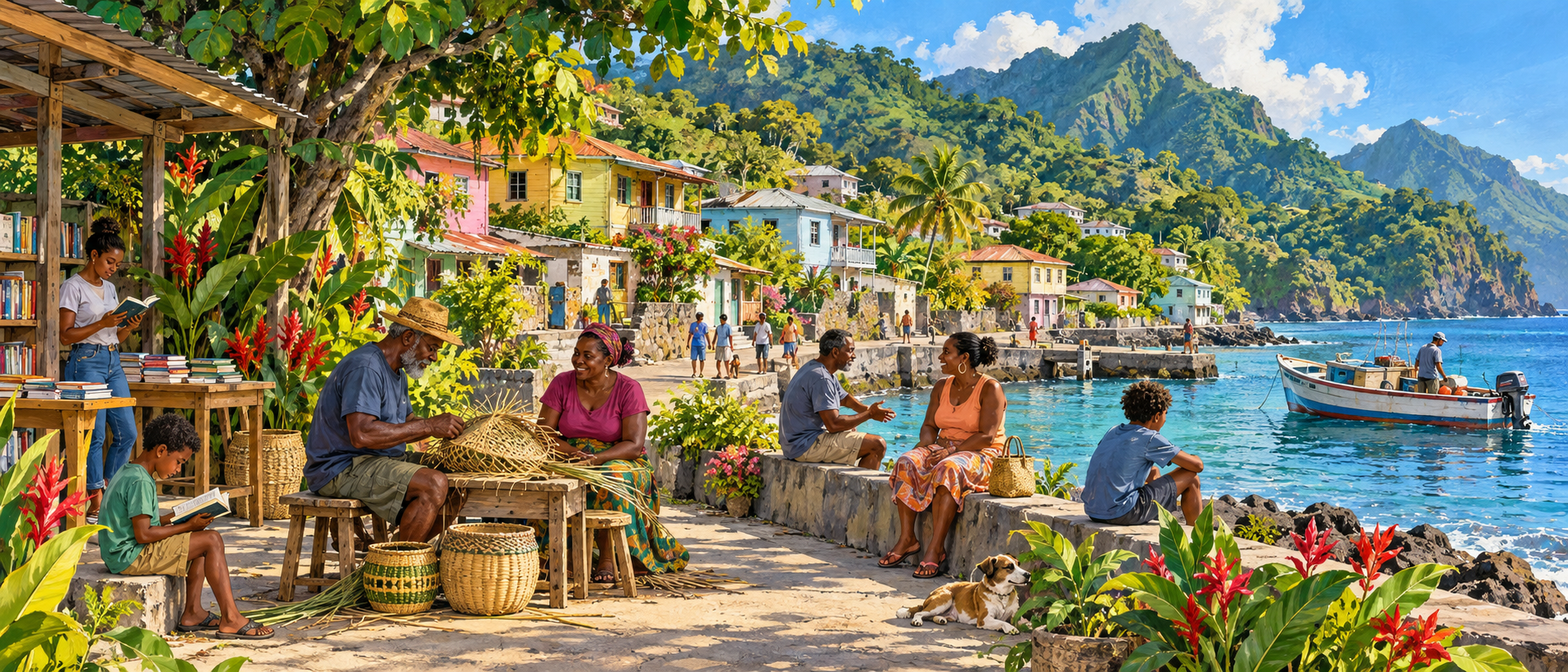
How does Dominica work, and how does a small Caribbean country run its government, ten parishes, electricity, hospitals, schools and hurricane protection? Dominica—officially the Commonwealth of Dominica—is an independent parliamentary republic in the eastern Caribbean, with Roseau as its capital. It is known as the Nature Island for mountains, dense forests, rivers and volcanic landscapes. Those same landscapes create practical problems: narrow roads, steep slopes, water management, transport disruption and powerful storms. Its public institutions, small economy and developing geothermal electricity system help explain how people organise daily life.
One important distinction first: Dominica is not the Dominican Republic. They are two different countries with different capitals, governments, currencies and histories. Dominica is a smaller island nation in the Lesser Antilles; the Dominican Republic occupies part of Hispaniola with Haiti. This guide is specifically about Dominica, where geography, a small population and exposure to hurricanes strongly shape the choices of public authorities.
Dominica at a glance: the quick answers
- Country: Commonwealth of Dominica, an independent state since 1978.
- Capital: Roseau.
- Political system: parliamentary republic, with an elected House of Assembly, a president as head of state and a prime minister leading government.
- Leadership in October 2026: President Sylvanie Burton and Prime Minister Roosevelt Skerrit.
- Administrative geography: ten parishes, a useful territorial grouping but not ten equally equipped local governments.
- Currency: Eastern Caribbean dollar (XCD), shared through the Eastern Caribbean Currency Union and managed by the Eastern Caribbean Central Bank.
- Economy: tourism, agriculture, construction, government activity and revenues linked to its Citizenship by Investment programme.
- Electricity: a geothermal plant reached commercial operation on 31 July 2026, following years of development.
- Risks: hurricanes, floods, landslides, earthquakes, volcanic hazards and disruption to island supply chains.
- Population: roughly 66,000 in the World Bank’s October 2026 overview; estimates vary by source and date.
These points are supported by the World Bank’s October 2026 country overview, the Government of Dominica’s prime-minister page, the president’s official 2026 parliamentary address and the independent energy regulator’s geothermal operating update.
1. Is Dominica a monarchy, a republic or a parliamentary democracy?
Dominica is a parliamentary republic. The president is the constitutional head of state, while the prime minister and cabinet lead government policy. The House of Assembly makes laws and provides the national political forum for budget approval and scrutiny. The president is not a monarch or a directly elected American-style executive president. That distinction helps readers understand which office actually controls day-to-day policy.
A national decision, such as investing in a bridge, goes through several steps: political approval, legal authority, public funding, planning, procurement, construction, maintenance and public accountability. A minister can announce a programme, but roads, schools and water systems still need engineers, teachers, contractors, monitoring and money. The quality of implementation is the part residents encounter.
2. What do Dominica’s ten parishes mean?
Dominica is traditionally divided into ten parishes: Saint Andrew, Saint David, Saint George, Saint John, Saint Joseph, Saint Luke, Saint Mark, Saint Patrick, Saint Paul and Saint Peter. They are geographic and administrative reference areas associated with local communities and historical boundaries. A parish is not automatically a stand-alone public authority with all the responsibilities of a province or municipality in a much larger country.
The island’s small towns and villages are spread across coastal strips, river valleys and mountain terrain. Their access to roads, clinics, markets and schools can differ substantially. A map that simply colours the ten parishes may hide why one village needs a resilient bridge while another needs slope protection or water storage. The correct way to read the map is alongside topography and population, not as ten identical service districts.
3. How do central and local institutions divide responsibility?
Dominica’s government directs national policy, budgets and many important services. Local councils and community organisations provide forms of neighbourhood representation and coordination, with functions that depend on law and financing. A local need may therefore involve a village council, a central ministry, a utility, a contractor or a disaster-response agency. It is worth establishing who owns a particular road or asset before deciding where to report a problem.
Imagine a landslide blocks the only access road to a village. Safety responders must first assess whether travel is safe. A road authority identifies the asset and arranges inspection and clearance, while community organisations may help residents obtain information and supplies. If rebuilding requires slope engineering, the long-term project can involve central funding and specialist teams. The work is not complete when the mud is merely moved aside.
4. Why is Dominica called the Nature Island?
Dominica’s rainforests, volcanic mountains, rivers and hot springs support a distinctive environment. Visitors come for hiking, waterfalls, diving, birdlife and dramatic landscapes rather than only large beach resorts. Those natural assets are also working systems: forests help stabilise slopes, watersheds supply communities, and biodiversity can support livelihoods and research. Keeping them healthy has economic as well as ecological value.
Tourism depends on public access, trained guides, visitor safety, accommodation, waste systems and transport links. A waterfall may be spectacular but difficult to reach after heavy rainfall. A hiking route that crosses a river must have appropriate weather guidance. Responsible visitor growth therefore depends on the same infrastructure and maintenance that residents use, not on advertising images alone.
5. How does the economy earn money?
Tourism, agriculture, construction, small business, public activity and a Citizenship by Investment programme contribute to Dominica’s economy. Bananas and other crops have long mattered, but agricultural production faces transport costs, storms, land availability and access to buyers. Tourism spreads spending among accommodation operators, guides, restaurants and suppliers, but can fluctuate with airline connections, weather and international demand.
The World Bank’s October 2026 update says Dominica’s economy grew in 2025, driven by construction, tourism and agriculture. An expanding economy does not mean every household’s income rises evenly. Public projects may create work, but high import costs or storm damage can offset gains. A useful question is whether growth reaches farmers, young workers and remote communities, not just a headline GDP rate.
6. What is Citizenship by Investment and why does it matter?
Dominica operates a legally defined Citizenship by Investment programme under which qualifying applicants may obtain citizenship subject to the applicable legal processes, due diligence and financial requirements. Programme revenue can affect public finances, while the rules and international scrutiny can change. This article does not promote the programme, guarantee eligibility or offer immigration advice.
For public-policy purposes, ask how revenue is recorded, spent, audited and linked to durable public value. A country may finance roads, housing or resilience projects with unusual revenue sources, but such money can be volatile and subject to external compliance concerns. A sound public budget should distinguish one-off receipts from recurring costs. A school or hospital needs staff and maintenance every year, not only an opening-day construction budget.
7. Why are hurricanes so damaging on a green island?
Hurricanes bring powerful winds, intense rain and storm surge. On steep terrain, saturated slopes can slip and small streams can rise rapidly. Bridges, electric lines, schools, farms, ports and drinking-water facilities may fail together. Tropical Storm Erika in 2015 and Hurricane Maria in 2017 caused severe damage, with combined losses estimated by the World Bank at nearly three times Dominica’s GDP.
The risk is not only the wind speed. A damaged road may keep ambulances away from a clinic; a power outage may interrupt water pumping; a closed port may delay fuel and food. Recovery therefore requires interconnected planning: safer buildings, drainage, route redundancy, warning systems, emergency communications, financing and community preparedness. Climate resilience is a system, not one reinforced concrete wall.
8. How does Dominica prepare for disasters and rebuild?
After major storms, Dominica adopted an explicit ambition to build greater climate resilience. That can include stronger construction standards, resilient housing, roads and bridges, backup services, drainage and disaster-risk financing. Each requires a realistic maintenance plan. A new road built without appropriate hillside drainage may again become unusable after heavy rain.
Take a clinic as an example. If its roof survives a storm but there is no electricity for medicines, no safe water and no accessible road, it cannot provide normal service. Better design must look at the whole route from supply delivery to patient access. The World Bank describes recovery and resilience as central to Dominica’s development partnerships, because disasters can erase years of economic progress in a short period.
9. Is Dominica producing electricity from volcanoes?
Yes—from geothermal heat associated with the island’s volcanic geology, not from visible lava. A geothermal plant extracts useful heat from underground resources to generate electricity through engineered equipment and carefully managed wells. Dominica’s geothermal facility in the Roseau Valley is designed around approximately ten megawatts of generation capacity, with grid connection and commercial obligations governing its operation.
A significant 2026 update matters here. Dominica’s Independent Regulatory Commission reported that the geothermal facility reached its Commercial Operation Date on 31 July 2026, after completing required tests, and began operating under its power-purchase agreement. That is stronger evidence than earlier announcements merely saying commissioning was expected. Whether it lowers household bills or improves reliability requires measured operational and tariff outcomes over time.
10. What difference could geothermal electricity make?
An island that imports fuel is exposed to global prices, shipping disruption and foreign-currency costs. Locally produced geothermal power can diversify electricity supply and potentially reduce some exposure to those risks. It does not eliminate the need for a dependable transmission network, maintenance crews, backup systems or financing. A generator can operate correctly while an unrelated line failure still leaves a village without power.
A renewable plant’s real contribution depends on actual energy delivered, availability, costs, system stability and regulation. The regulator has therefore stressed performance after commercial operation, not just a successful construction milestone. It is reasonable to celebrate the engineering achievement while still asking what ordinary customers actually experience.
11. How do roads, ports and airports connect a mountainous island?
Dominica’s roads often follow valleys or negotiate steep hillsides. Roseau connects with communities and transport facilities by routes that can be affected by landslides or heavy rainfall. Air connections, ports and domestic roads together determine how residents travel, tourists arrive and goods enter the economy. The closure of one crucial route can affect school attendance, access to healthcare and deliveries far beyond the blockage itself.
An agricultural grower may need to carry produce from a hillside farm to a collection point, then to a coastal buyer or an export channel. The cost is shaped by roads, fuel, cold storage, storm damage, port services and demand. This is why transport planning must consider farms and households, not just visitor traffic.
12. How are healthcare and schools organised?
Dominica provides public education and healthcare through national institutions and service networks, alongside private and community activity. School attendance depends on safe facilities, teachers, learning resources and roads; medical care depends on clinicians, medicines, emergency transport and functioning water and power. The smaller scale of the national population can make specialist capacity difficult and some services concentrated rather than evenly distributed.
In a storm, both systems may become community recovery assets. A school can serve as a coordination location or shelter where designated, and a clinic may need backup power, safe water and communication links. Education is also central to rebuilding: young people need continuity of learning even while their families repair homes and livelihoods.
13. Why does Dominica use the Eastern Caribbean dollar?
Dominica belongs to the Eastern Caribbean Currency Union. It uses the Eastern Caribbean dollar, which is shared across several neighbouring states and territories and managed by the Eastern Caribbean Central Bank. The currency is pegged to the US dollar, supporting a common monetary arrangement for members. This is distinct from the Dominican peso used in the Dominican Republic.
The IMF’s 2026 currency-union report describes the ECCB framework and the longstanding EC$2.70-to-US$1 peg. Using a shared currency does not mean member countries share identical public budgets or tax systems. Dominica still makes many of its own fiscal, infrastructure and service decisions within a regional financial setting.
14. A worked example: reopening a village school after a storm
Illustrative case: Heavy rain damages a hillside road and interrupts electricity and water supply. The school building is still standing, but teachers and students cannot safely reach it. The education authority checks the premises, road teams assess access, the utility restores connections, and local community groups help identify families with transport or learning-material problems.
The result is not delivered by one ministry alone. It depends on the environment, infrastructure, household needs and government coordination. A reopening date is meaningful only if it produces safe, continuing access to learning. That interconnected approach is the clearest way to understand Dominica.
Frequently asked questions about Dominica
Is Dominica the same as the Dominican Republic?
No. Dominica is a small independent island state in the eastern Caribbean with Roseau as its capital. The Dominican Republic is a much larger country on Hispaniola with Santo Domingo as its capital.
How many parishes does Dominica have?
Ten. These are traditional territorial divisions, not ten identical self-contained provincial governments.
What is Dominica known for?
Rainforests, waterfalls, volcanic landscapes, hiking, rivers, biodiversity and its ambition to develop stronger climate resilience.
Does Dominica have a president or a prime minister?
Both. The president is head of state in a parliamentary republic; the prime minister heads government.
Is Dominica’s geothermal plant operating in 2026?
The Independent Regulatory Commission reported commercial operation beginning on 31 July 2026. Actual grid performance and customer outcomes should be followed through later regulatory reports.
What currency is used in Dominica?
The Eastern Caribbean dollar (XCD), not the Dominican peso. The currency is shared through the Eastern Caribbean Currency Union.
Why are storms such a serious problem?
Steep terrain, intense rainfall, small island infrastructure networks and exposure to hurricanes mean roads, power, water and livelihoods can be damaged at the same time.
Continue reading the country series
This is part of How Countries Work, the world companion to How Singapore Works. Continue with what to learn when visiting Dominica, things to do on Dominica, and how Antigua and Barbuda works for a comparison with another eastern Caribbean state.
Sources and date of review
- World Bank: Dominica overview, 7 October 2026 — population estimate, economic context and climate resilience.
- Dominica Independent Regulatory Commission: geothermal commercial operation — the 31 July 2026 milestone.
- Government of Dominica: national flag and ten parishes — official parish count and symbolism.
- Government of Dominica: head of government — leadership.
- IMF: 2026 Eastern Caribbean Currency Union report — currency and shared central bank.
- Dominica 2026 geothermal project background — planned capacity, superseded for operational status by the regulator’s later update.
- Reviewed: 20 October 2026. The school scenario is illustrative. Laws, programme eligibility and tariffs should be checked against official current notices.