
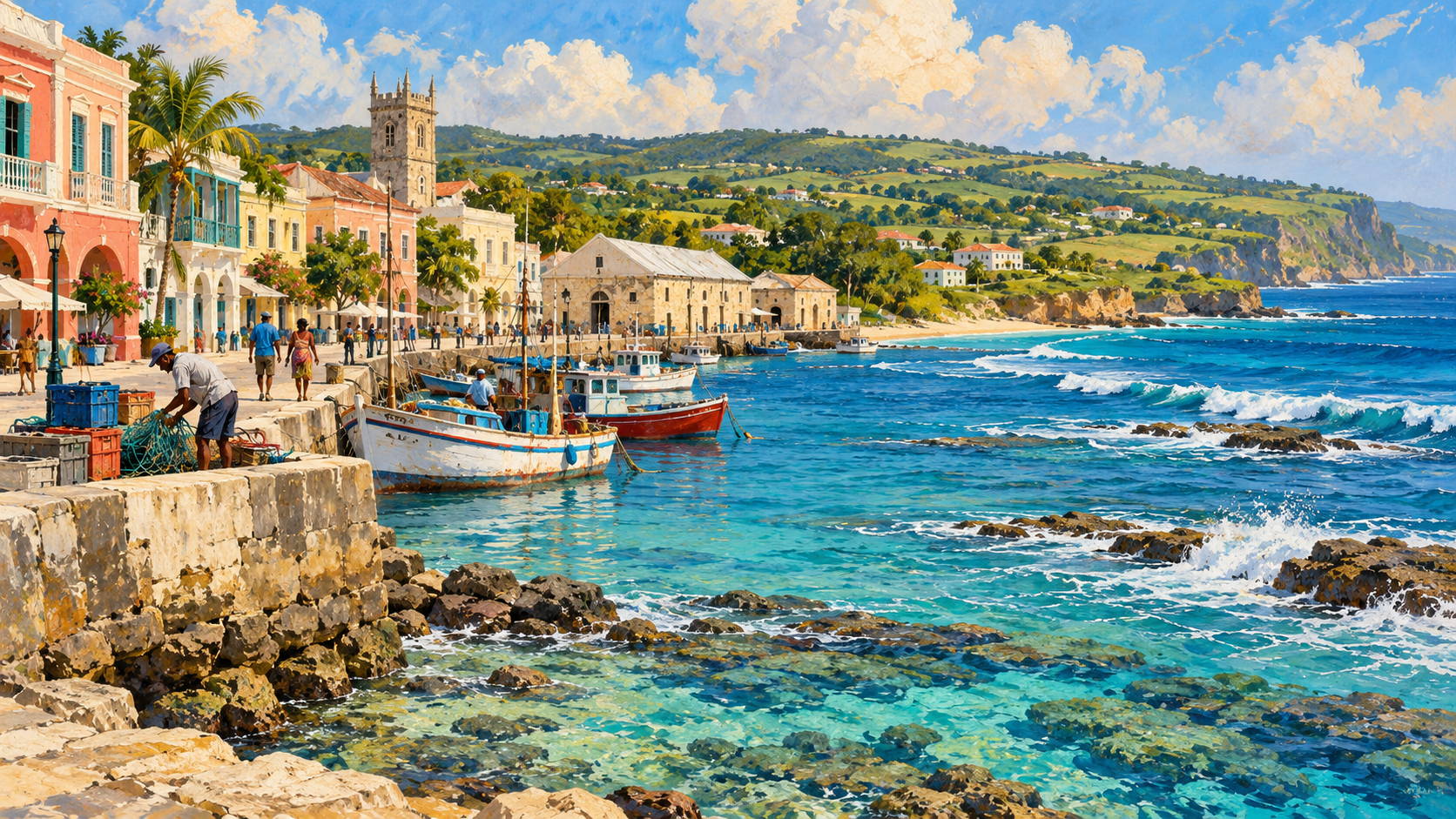
How does Barbados’s government work after it became a republic, who is president, and how do tourism, public debt, schools and hurricane protection fit together? Barbados is an independent parliamentary republic in the eastern Caribbean. It became a republic in November 2021, replacing the British monarch with a Barbadian president as head of state while retaining its parliamentary system. In October 2026, President Jeffrey Bostic and Prime Minister Mia Amor Mottley hold different constitutional roles. The Barbados Labour Party won all 30 House of Assembly seats in the February 2026 election.
The best way to understand how Barbados works is to follow law and public finance → transport, utilities and coastal protection → tourism and business → jobs, schools, clinics and households. Tourism brings visitors and spending, but a small island must also manage imports, currency stability and climate shocks. Hurricane Beryl’s 2024 damage to fisheries and port facilities demonstrated that one storm can affect livelihoods, food, transport and the national budget at once.
Barbados in one minute: key facts explained
- Government: parliamentary republic with a president as head of state, prime minister as head of government and a bicameral parliament.
- 2026 election: Barbados Labour Party won all 30 elected House of Assembly seats in February; Mia Mottley continued as prime minister.
- Legislature: an elected House of Assembly and an appointed Senate.
- Currency: Barbadian dollar, pegged at BDS$2 to US$1.
- Economy: tourism, services, construction, financial and professional work, alongside agriculture and manufacturing.
- Risk: extreme weather, coastal damage, debt pressures and energy-import dependence.
- Response: disaster finance, fisheries recovery, resilient infrastructure, economic reforms and renewable-energy investment.
This article is reviewed on 20 October 2026. The Barbados Government Information Service identifies the current president and prime minister. The Inter-Parliamentary Union’s 2026 election record confirms the House result. The IMF June 2026 statement explains fiscal strategy and risks.
1. Why is Barbados a republic, not a monarchy?
Barbados became a republic on 30 November 2021, after decades as an independent nation under a constitutional monarchy. It replaced the monarchy’s head-of-state role with a Barbadian presidency. It did not discard its entire parliamentary tradition or give the president the same kind of executive authority as a powerful directly elected president elsewhere.
In Barbados’s parliamentary system, the prime minister leads the government and is accountable through parliamentary institutions. The president fulfils constitutional head-of-state functions. Distinguishing the two roles prevents a common confusion: ‘Barbados has a president’ does not mean ‘Barbados has a presidential executive government’.
A country’s constitutional label explains its rules for authority; everyday success still depends on delivery. A new president does not automatically improve a damaged harbour or fix a school route. Parliament, ministries, public workers, budgets and citizens all remain part of the operating system.
2. Who runs Barbados in 2026?
The Government Information Service identifies Jeffrey Bostic as president and Mia Amor Mottley as prime minister. Prime Minister Mottley leads the executive and her government’s programme, while the president has a separate constitutional role. Their titles should not be conflated.
The Barbados Labour Party won every elected constituency in the House of Assembly in the general election held on 11 February 2026. The result gave the government a very large parliamentary mandate; it also raised continuing questions about the practical operation of scrutiny when there is no elected opposition sitting in the House. Parliamentary debate, courts, public information, the Senate and civic institutions still matter.
The Inter-Parliamentary Union records the 30-seat result and notes the new House’s first session on 20 February. This is an election fact, not a claim that everyone agrees with the government’s policies.
3. Does Barbados have a parliament and a Senate?
Yes. Barbados retains a bicameral parliamentary structure, combining an elected House of Assembly with an appointed Senate. The House plays the central role in sustaining a government, approving legislation and public finance through constitutional procedures. The Senate adds a separate chamber of review and debate.
A law can establish a spending programme or regulatory obligation. It does not itself build a school, repair a breakwater or deliver medicine. Government departments and operators must interpret the law, procure services, deploy trained people and maintain the results.
When a public announcement says ‘Parliament approved’, ask what passed: a bill, a budget, an amendment or another motion? Then ask whether implementing rules, procurement and physical delivery have happened. These are separate stages and should be reported separately.
4. Why does a 30–0 election result matter?
The February 2026 election gave the Barbados Labour Party every elected House seat. A majority of that size can make passing government legislation easier, but it does not remove fiscal limits, legal procedures or the importance of institutional accountability. Different political perspectives continue to exist beyond the House, and public debate remains essential.
An election result is an answer to who won a defined vote. It is not a direct measurement of public-service quality. A government may win overwhelmingly and still need to improve drains, healthcare waiting times and housing affordability. Equally, long-term reforms can require difficult decisions that are not visible in an election map.
A balanced civics lesson separates three things: voter choice, legislative authority and programme results. All matter to understanding government, but none can stand in for the others.
5. How do Barbados’s 11 parishes fit into administration?
Barbados is traditionally divided into eleven parishes. They are useful for geographic reference, settlement, services and cultural identity. The country’s modern administration is not simply eleven independent parish governments matching the municipalities of a large federal country. National ministries and statutory bodies are central to major service delivery.
A drainage issue in St Michael and a road concern in St Philip may be geographically different but still depend on the same national agency or public operator. The correct route for a complaint depends on the asset and statutory responsibility, not merely the parish name.
This is a useful contrast with federal countries such as Argentina: Barbados’s national institutions operate within a compact island system, while Argentina’s provinces have constitutionally different powers. Comparing their territorial labels without the underlying legal roles would be misleading.
6. Why is tourism central to the economy?
Tourism supports hotels, guest houses, taxis, restaurants, attractions, entertainment, food suppliers, maintenance, construction and transport. The visitor’s holiday is also a demand on water, electricity, roads, wastewater systems, coastal landscapes and emergency services. The economic contribution is broader than money spent on accommodation alone.
The World Bank reported that tourism, business services, construction and manufacturing contributed to growth in 2024. That should not be read as proof that tourism receipts reach every household equally. Jobs, wages, sourcing, taxes, skills and ownership shape who benefits.
Imagine a visitor buying dinner near Bridgetown. The kitchen buys fish, vegetables, electricity, refrigeration, cleaning supplies and payment services. A single restaurant bill connects farmers, fishers, utility workers, banks, the labour market and tourism. That is why tourism is a national system rather than a single industry.
7. Does Barbados have other important industries?
Yes. Financial and professional services, commerce, construction, manufacturing, creative activity, agriculture and fishing form other parts of the economy. Diversification matters because tourism demand depends on foreign incomes, flights, geopolitical conditions and climate. A pandemic or severe hurricane can reduce arrivals even when local businesses are well managed.
A company exporting a product or selling professional services abroad needs trained people, communications, finance, clear regulations and reliable electricity. A fisher needs a seaworthy boat, landing facilities, buyers, cold storage and suitable weather. These are different sectors, yet many share the same ports, roads and financial services.
A stronger economy is not necessarily one with no tourism. It is one with multiple productive sources of income, broad opportunity and buffers against shocks.
8. How does Barbados finance public services?
Government programmes are funded through taxes, other revenues, investments and, when appropriate, borrowing. Roads, schools, hospitals, public safety, coastal protection and social support all compete for finite resources. The challenge is not merely choosing attractive projects but funding them through construction and years of operation.
The government’s Barbados Economic Recovery and Transformation programme, known as BERT, combines fiscal, debt, competitiveness and resilience reforms. By 2026, the IMF described improved public finances since the initial programme, but also long-term productivity, skills and climate challenges.
A key distinction is between money allocated and benefits delivered. A budget can fund a marina restoration, but engineers, workers, contractors and safety inspection must still complete the project. A loan can help rebuild a facility while creating repayment obligations. Good analysis asks about both the asset and its future cost.
9. What is BERT 2026?
BERT refers to Barbados Economic Recovery and Transformation. BERT 2026 is a renewed policy programme focusing on productivity, competitiveness, fiscal sustainability, financial markets, human capital and resilience. The IMF’s June 2026 announcement describes a 36-month precautionary Stand-By Arrangement of approximately US$257 million, intended to provide insurance against potential external financing shocks.
‘Precautionary’ matters. The arrangement is not identical to an announcement that the entire amount has already been spent on public programmes. Its conditions, available access and actual drawings should be checked individually. Nor should a debt statistic be confused with the cash balance of a single household.
Read the IMF Executive Board’s June 2026 statement and staff report for the precise aims and risks.
10. What makes Barbados’s currency stable against the US dollar?
Barbados uses the Barbadian dollar, whose official fixed exchange-rate arrangement is BDS$2 = US$1. The Central Bank of Barbados explains this peg and the monetary-policy and foreign-reserve responsibilities required to maintain it.
A fixed exchange rate can help businesses plan prices for imported supplies and tourism transactions, but it does not make every good affordable. If the overseas price of fuel increases or freight becomes more expensive, local costs can still rise. Wages, productivity and taxes also matter.
The Central Bank’s explanation is a helpful reference. A peg is a policy commitment requiring reserves and discipline, not a mathematical guarantee that living costs will remain unchanged.
11. How do foreign reserves and imports affect a small island?
Barbados imports many goods, including fuel and equipment, while earning foreign exchange through tourism, services, exports and other transactions. External reserves help the monetary system meet international payments and support the exchange-rate arrangement. They are distinct from government cash allocated to local schools.
A hospital ordering an overseas medical device needs a supplier, foreign-currency payment, shipping, customs and local installation. A storm that delays a vessel may affect availability even if the hospital has already approved the purchase. This is why ports, finance and healthcare are linked.
To understand external resilience, look at import cover, debt obligations and the reliability of trading relationships as well as GDP growth. A thriving visitor season is valuable, but it should also help build capacity for difficult periods.
12. What did Hurricane Beryl do to Barbados in 2024?
Hurricane Beryl passed roughly 150 kilometres south of Barbados in early July 2024. Its powerful seas and surge nevertheless damaged the port, fisheries marina, coastal protection and fishing fleet. The World Bank reported that 240 fishing vessels were damaged or destroyed, alongside damage to tourism property and housing.
It is important not to say the hurricane made a direct landfall simply because damage was severe. Where its centre travelled and what its waves did to the coast are separate facts. The recovery challenge spans boats, harbours, incomes, safe navigation and the customers who rely on fishing.
The World Bank’s November 2024 response announcement explains the impacts and a US$54 million recovery project. The storm is a historical event; recovery work continues in later years.
13. Why is the fishing harbour so important beyond seafood?
Fishing supports boat owners, crews, vendors, processors, markets, restaurants, transport firms and families. Harbours protect vessels and provide safe landing and handling facilities. A damaged breakwater can leave boats vulnerable, even when the fish population offshore has not changed.
By September 2026, the World Bank described a fisher replacing a Beryl-damaged boat with assistance through the Beryl Barbados Project. This is a specific case of an operational recovery initiative, not a claim that every affected vessel had been replaced.
Read the September 2026 fisher’s recovery account. It demonstrates why reconstruction has a long tail: repairing a barrier, replacing a boat and restoring predictable earnings are three separate achievements.
14. How does a climate-resilient debt clause work?
A climate-resilient debt clause is a financing provision allowing specified debt payments to be deferred under defined disaster conditions. The precise triggers and contracts matter. It does not mean all debt is automatically forgiven or that every hurricane activates unlimited new spending.
Barbados became a prominent early adopter of such clauses, with the World Bank reporting agreements made around Hurricane Beryl. The broader purpose is to free short-term resources for recovery when disaster disrupts the public budget. Repayment is deferred under agreed terms; the obligation and its long-term consequences must still be understood.
The World Bank’s September 2024 account describes the negotiations and emergency response. A clear civics explanation distinguishes insurance, a contingent line of credit, payment deferral and a grant because they solve different financing problems.
15. Why does climate risk shape housing and transport?
Coastal roads, drainage, homes, utilities and tourism infrastructure face exposure to storm surge, flooding and changing coastal conditions. When facilities are built, governments and owners must consider not only construction costs but also maintenance, emergency access and the risk of damage over decades.
A low-cost road might appear affordable until repeated flooding forces expensive repairs. An elevated or better-drained route may cost more initially but maintain safe access to a hospital during storms. Those are life-cycle decisions requiring engineering evidence and public consultation.
Climate-resilient planning is not the promise that every disaster will be avoided. It is the discipline of understanding which failures are likely, who will suffer and what cost-effective measures can reduce harm.
16. How does renewable energy affect Barbados’s future?
Barbados has ambitions to expand renewable electricity significantly, including solar, wind and storage. The World Bank describes a goal of reaching 95% renewable energy by 2030. That is a policy target, not proof the grid has already achieved 95% renewable generation.
Solar panels can produce electricity during sunshine, but a reliable grid must also balance evening demand, cloud cover, storms, storage capacity and maintenance. Batteries, flexible generation, transmission, safety standards and clear commercial rules are parts of the same system.
Energy diversification may reduce import dependence over time, but a project should be assessed by output, cost, grid reliability and environmental effects. Installed capacity is not the same as electricity used by households across every hour of the year.
17. Why does school education belong in the economic picture?
Barbados’s education system includes primary and secondary schools and regional qualification pathways such as CSEC and CAPE. The country has debated school placement and secondary education reform. The exact examination and entry arrangements should be checked for the relevant year and cohort.
Education supplies the human capital behind tourism management, nursing, financial services, construction, conservation, engineering and business. A child studying science can later contribute to renewable-energy systems; a student learning mathematics and writing well may become a financial analyst or coastal engineer.
For detailed education information, read Schools of Barbados, How Education System of Barbados Works and How Ministry of Education for Barbados Works. These explain exams and school policy; this article explains how schooling connects with the country’s operations.
18. Why are skills and productivity still important?
A high educational attainment tradition does not automatically guarantee that every job can be filled or every business is productive. Employers need current technical skills, communication, digital competence and reliable workplace practice. Workers need opportunities, transport and salaries sufficient for daily needs.
The IMF’s 2026 Article IV analysis identifies skills gaps, limits on diversification and relatively low productivity growth among Barbados’s structural challenges. The response cannot consist only of giving people certificates; businesses, educational institutions and regulators must cooperate to create work where those skills are used.
Imagine a hotel replacing an old cooling system. The imported equipment is available but no local technician knows how to service it. A training partnership could reduce downtime and keep money circulating locally. Skills policy can be practical infrastructure.
19. Worked example: a tourist’s day depends on six systems
Fictional teaching scenario: a visitor arrives at Grantley Adams International Airport, travels to accommodation, eats locally caught fish and joins a coastal activity. The visit seems like a simple holiday. Behind it stand border administration, safe roads, wastewater treatment, electricity, harbour facilities, food safety and emergency information.
If a storm damages the fishing marina, the restaurant may have trouble sourcing local fish. If the port is also affected, replacement kitchen equipment can take longer to arrive. A disruption in one part of the island economy changes visitor experiences and household earnings.
The right response is coordinated rather than departmental blame. Which shared asset failed first? Which operator can repair it? What alternatives exist? How should businesses and families be informed? These are the everyday questions of a functioning country.
20. Barbados compared with Singapore: what can we learn?
Both countries are island states connected to international trade, services, education and finance. Singapore is a dense city-state with a large maritime logistics network and very limited domestic natural resources. Barbados is a smaller Caribbean state with major tourism activity, a fixed exchange-rate system and important hurricane exposure.
The question is not which country should copy the other in full. The useful comparison is how geography, finance and institutions turn long-term planning into real service outcomes. Singapore’s road hierarchy solves dense urban movement problems; Barbados’s coastal protection and port infrastructure must address storm-surge risks while supporting livelihoods.
Read How Singapore Works and How Singapore Connects | Roads, Expressways and Junctions for the companion case study.
21. How can you tell whether a Barbados policy is working?
- Ask who acts: president, prime minister, parliament, ministry, central bank, utility or contractor?
- Identify the stage: announcement, legal approval, procurement, operation or verified outcome?
- Check finances: is support a loan, grant, debt deferral or contingent facility?
- Check risk: does the project still work during a major storm or supply interruption?
- Check people: have fishers, students, patients, elderly residents and low-income families gained practical access?
- Check the date: a 2030 energy target is not a 2026 achievement; a 2024 disaster is not a live weather forecast.
Try writing a three-line public-project review: ‘The project is intended to do X.’ ‘By Y date, official evidence shows Z.’ ‘What remains unknown is whether households experience the expected improvement.’ This exercise is a strong defence against confusing hope with performance.
Frequently asked questions about how Barbados works
Does Barbados still have the British monarch as head of state?
No. Barbados became a parliamentary republic on 30 November 2021 and has a Barbadian president.
Who is the prime minister in 2026?
Mia Amor Mottley continued as prime minister after the February 2026 election, when the Barbados Labour Party won all 30 elected House seats.
Who is president of Barbados in October 2026?
Jeffrey Bostic is identified as president by the Government Information Service. The president and prime minister have different constitutional roles.
How many parishes does Barbados have?
Eleven. They are useful territorial and historical divisions but do not each operate as a province-level federal government.
Is the Barbadian dollar tied to the US dollar?
Yes, at two Barbadian dollars for one US dollar under the country’s longstanding official exchange-rate arrangement.
What is BERT 2026?
The Barbados Economic Recovery and Transformation policy programme, supported by the IMF’s 2026 precautionary financing arrangement and focused on fiscal sustainability, productivity, human capital and resilience.
Did Hurricane Beryl directly land on Barbados?
Its centre passed south of Barbados in 2024, yet the storm caused major coastal and fisheries damage. Passing offshore does not mean the island escaped serious impacts.
What is a climate-resilient debt clause?
A contractual provision that can allow debt-service payments to be deferred when specified disaster triggers are met. Deferral is different from permanent debt forgiveness.
Has Barbados already reached 95% renewable electricity?
No such achievement is established by the cited 2026 material. The 95% figure is a policy goal for 2030, not proof of present delivery.
Why should students care about ports and climate finance?
Because both affect whether schools, workers, hospitals, businesses and families can recover and function after a disruptive event.
Explore the international civilisation collection
Read this within How Countries Work, the world-facing sibling of How Singapore Works. Compare The Bahamas | Islands and hurricanes, Bahrain | Monarchy and finance, Bangladesh | Rivers and garment factories and Belarus | Government and industry. These four cases show why institutions, geography and public services should always be studied together.
Sources and editorial review
- Barbados Government Information Service: Government — president and prime minister.
- Inter-Parliamentary Union, February 2026 House election — 30 seats.
- Prime Minister’s Office, February 2026 Cabinet — portfolios.
- Central Bank of Barbados, 2:1 currency peg.
- IMF, June 2026 consultation and precautionary arrangement — BERT and fiscal strategy.
- World Bank, Barbados overview — tourism, energy goals, debt and disaster risk.
- World Bank, November 2024 Beryl recovery — storm damage and financing.
- World Bank, September 2026 fisher recovery — real post-storm programme.
- Reviewed: 20 October 2026. All hypothetical family and tourism stories are educational examples; policy goals are distinguished from outcomes.