
Did you know that a single station near the northern entrance of the Singapore Botanic Gardens now joins two very different parts of the MRT network? A passenger stepping onto the Downtown Line from Bukit Timah can change to the Circle Line at Botanic Gardens without travelling all the way into the central business district first.
This seems ordinary once you are used to it. But it demonstrates something important about transport: the greatest improvement may come not from building another line through your street, but from connecting the lines that already cross the city.
The quick answer: Botanic Gardens MRT (CC19/DT9) is an underground interchange between the Circle Line and Downtown Line. The Circle Line station opened in October 2011; the Downtown Line platforms opened in December 2015. With Circle Line Stage 6 opening in July 2026, the Circle Line now operates as a completed loop, adding another dimension to journeys that pass through Botanic Gardens.
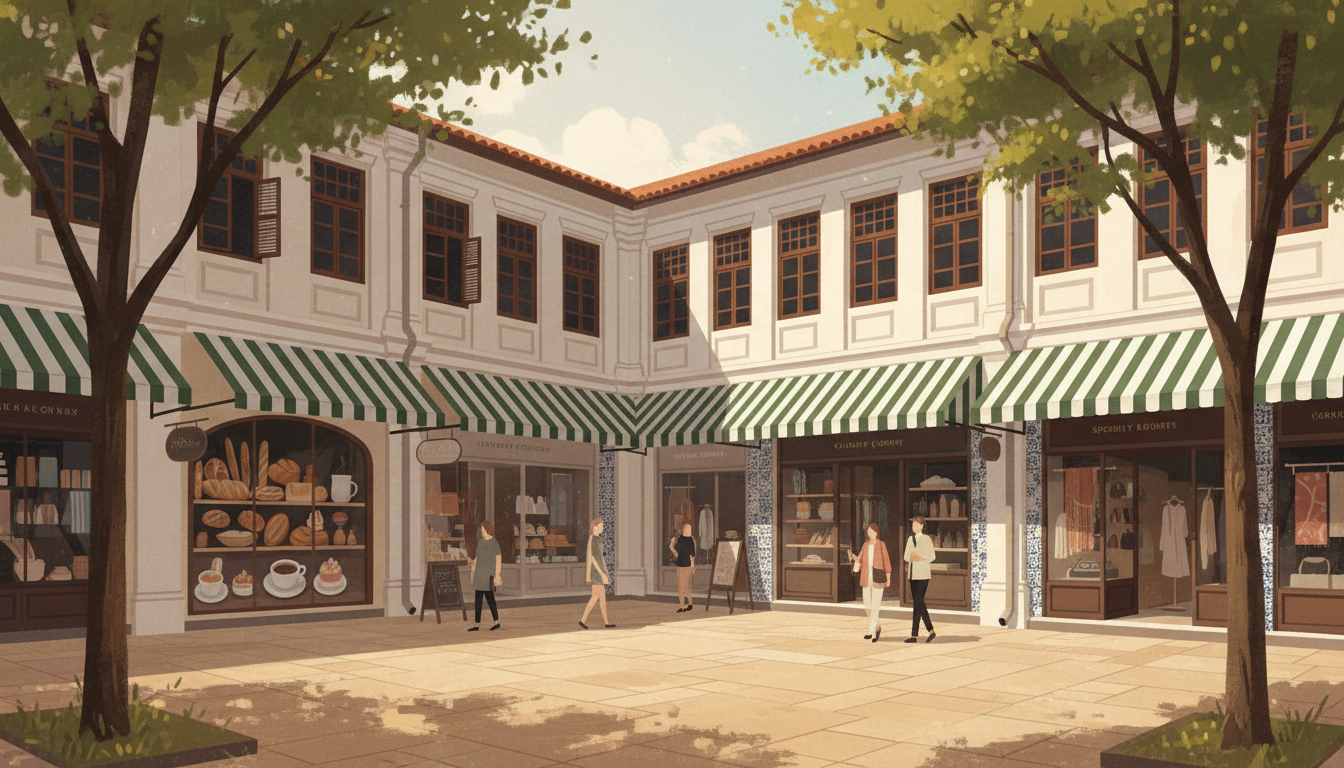
The featured artwork shows a conceptual Cluny Court streetscape near Botanic Gardens MRT, not an image of the railway station or its underground platforms.
Jump to: What does the interchange actually connect? · Which line arrived first? · How do passengers know which line to take? · What changed on the Circle Line in July 2026? · Why does a loop create different route choices? · Why is the location useful beyond commuters? · How is this different from the future King Albert Park interchange? · How to plan a sensible Botanic Gardens MRT transfer
1. What does the interchange actually connect?
The Circle Line runs as an orbital route connecting different parts of Singapore’s rail network. The Downtown Line provides a different route through Bukit Timah and towards the city and eastern Singapore.
Where those routes meet, a traveller has more choices. Someone travelling from Sixth Avenue can remain on the Downtown Line for some destinations, or change at Botanic Gardens to reach areas better served by the Circle Line.
That is why an interchange is more useful than the sum of two nearby stations. It joins the networks into one system of possible routes, potentially reducing detours and the need to travel through other busy transfer points.
2. Which line arrived first?
The Circle Line opened its fourth and fifth stages on 8 October 2011, bringing the line through Botanic Gardens. The station initially served Circle Line passengers and nearby destinations.
The Downtown Line Stage 2 opened on 27 December 2015. With the Downtown Line’s arrival, Botanic Gardens became a transfer station with the identifiers CC19 and DT9.
This sequence is important. The interchange did not spring into existence with both lines on a single day. Transport networks often develop in phases; an established station gains new significance when another line reaches it.
For people who knew the neighbourhood before 2015, that second connection could change which rail routes were convenient for daily trips.
3. How do passengers know which line to take?
The station codes provide the first clue: CC identifies the Circle Line and DT identifies the Downtown Line. Once you know the destination, an official network map and the station’s directional signs help you find the correct train.
A useful planning habit is to distinguish the line from the direction on the line. Boarding the right line in the wrong direction may still lead away from your destination.
Follow platform signs and real-time service information rather than relying on where a train or escalator appears physically closest. If you have a stroller, wheelchair or heavy luggage, use the signed lift route; not every connection should be assumed to have the same amount of walking.
4. What changed on the Circle Line in July 2026?
On 12 July 2026, Circle Line Stage 6 opened for passenger service, adding the new stations Keppel, Cantonment and Prince Edward Road between the HarbourFront and Marina Bay ends of the earlier line.
That completed the main Circle Line loop, making Singapore’s first full-loop MRT service. For passengers at Botanic Gardens, the network now offers different paths around the circle depending on their destination.
LTA introduced new wayfinding that explains clockwise and anticlockwise directions and includes guidance for services using the spur section. That is why a traveller should not assume that every train simply follows the loop in the same way.
The rail line changed, but Botanic Gardens remains the same interchange in the wider network: a place where an orbital rail route connects with the Downtown Line.
5. Why does a loop create different route choices?
Imagine a circular track with several stations marked around its edge. To reach another station on the loop, there are two possible directions: clockwise or anticlockwise.
One direction will often involve fewer stops, although service patterns, transfers and waiting times can affect the best practical choice. A loop also creates options if parts of a network are busy or a passenger wants to reach a station from a different approach.
With the Downtown Line crossing the Circle Line at Botanic Gardens, travellers gain another branch of possible journeys. In graph theory, the station is a network node, and the rail segments are links. Adding links can shorten some routes without moving the nodes themselves.
Students learning basic networks in mathematics can draw a simple map of five stations and test how adding one connection changes the shortest path.
6. Why is the location useful beyond commuters?
Botanic Gardens MRT sits near the Bukit Timah Entrance of the Singapore Botanic Gardens, a UNESCO World Heritage Site. It also serves nearby residential areas, educational institutions and destinations around Cluny Park Road and Bukit Timah Road.
The station therefore helps different groups: students travelling to classes, residents making daily journeys, workers and visitors exploring the Gardens. A good interchange does not need all its users to be making the same trip.
However, being labelled the ‘Botanic Gardens’ station does not mean every attraction inside the Gardens is directly outside the exit. The site is large; a visit to a particular garden or gallery may involve a significant additional walk.
Before a family outing, check the official Gardens map for the entrance closest to your intended destination.
7. How is this different from the future King Albert Park interchange?
Botanic Gardens already works as an interchange. King Albert Park currently serves the Downtown Line but is planned to connect with the future Cross Island Line Phase 2, targeted for 2032.
Both illustrate the same network principle: when separate lines meet, they make more journeys possible. But the engineering stage and user experience are different. Botanic Gardens is a working transfer today; the new Cross Island Line interchange at King Albert Park remains a construction project in 2026.
Treating future and existing connections separately helps families make decisions based on the transport that actually operates now.
8. How to plan a sensible Botanic Gardens MRT transfer
Did you know an interchange can make a neighbourhood feel closer to the rest of Singapore without changing the distance on a map? Botanic Gardens MRT shows how the value of a station comes from the connections it provides.
- Check the destination: decide whether to remain on the Downtown Line or change to Circle Line.
- Read the line codes: CC19 is Circle Line; DT9 is Downtown Line.
- Use 2026 signs: the Circle Line now operates as a full loop, with clockwise and anticlockwise guidance.
- Allow transfer time: underground connections can require additional walking and lift or escalator movements.
- Plan the final walk: the Bukit Timah Entrance is useful for some Botanic Gardens attractions, but not all are nearby.
- Check live advisories: use LTA or operator updates for temporary disruptions, first/last trains and accessibility changes.
Frequently asked questions
Which MRT lines meet at Botanic Gardens?
The Circle Line (CC19) and Downtown Line (DT9) connect at Botanic Gardens MRT station.
When did Botanic Gardens MRT open?
The Circle Line station opened in October 2011, and the Downtown Line connection opened in December 2015.
Is the Circle Line a full loop in October 2026?
Yes. Circle Line Stage 6 opened for passenger service on 12 July 2026, completing the main loop.
Is Botanic Gardens MRT the closest station for every attraction in the Gardens?
No. The Gardens is extensive, with several entrances. Check the official map for the attraction you plan to visit.
How is Botanic Gardens different from King Albert Park?
Botanic Gardens is already an operating two-line interchange. King Albert Park’s future Cross Island Line interchange is planned for 2032.
Sources and further reading
These official resources support the historical, ecological and rail details. Always check their latest visitor and operating information before travelling.
- LTA: Circle Line history and staging
- LTA: Downtown Line and 27 December 2015 opening
- LTA: Circle Line Stage 6 opened in July 2026
- LTA: New full-loop Circle Line wayfinding
- SMRT: MRT journey and station information
- Singapore Botanic Gardens: Visitor information and entrances
Explore the How Bukit Timah Works series
- Why King Albert Park will become a deep interchange
- Why the Botanic Gardens is UNESCO heritage
- Why schools and MRT stations follow Bukit Timah Road
More from this four-part batch: How Bukit Timah Works | Why Bukit Timah Road and Dunearn Road Run Side by Side · How Bukit Timah Works | Why Beauty World Food Centre Is on the Fourth Floor · How Bukit Timah Works | How the Learning Forest Recreates Lost Wetlands