
Did you know that you can enjoy a former granite quarry, a forest walk and a children’s playground beside Bukit Timah Hill without climbing to the summit? That is the value of Hindhede Nature Park, a compact green destination near Bukit Timah Nature Reserve.
The quick answer: Hindhede Nature Park is a 9.5-hectare part of Singapore’s Central Nature Park Network with easy walking trails, a lookout over Hindhede Quarry, wildlife and a family playground. NParks lists opening hours of 7am–7pm and an approach from Beauty World MRT.
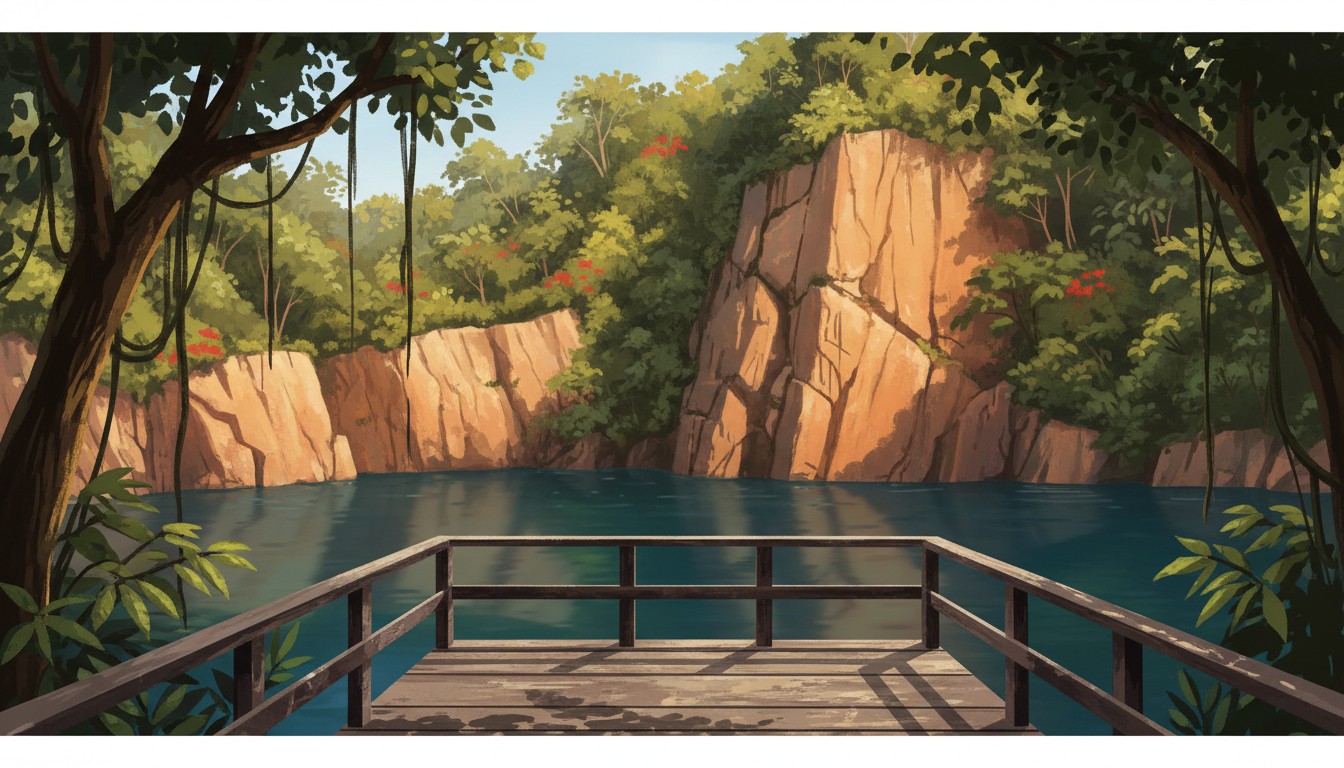
Featured image is an original conceptual illustration inspired by Hindhede Quarry, not a documentary photograph.
At a glance: Why is Hindhede different from the Bukit Timah summit trail? · How did Hindhede Quarry become a lake? · What can visitors learn at the quarry lookout? · Which animals might families observe? · Why is there a playground inside a nature park? · What does ‘wheelchair accessible’ mean at Hindhede? · Why does NParks prohibit pets and bicycles? · How can families plan a good visit?
Why is Hindhede different from the Bukit Timah summit trail?
Bukit Timah Nature Reserve and Hindhede Nature Park are neighbours but have different visitor experiences. The nature reserve protects a rare part of Singapore’s primary rainforest, and the summit route can be steep. Hindhede provides a shorter, gentler way to encounter greenery and understand the land around the hill.
NParks describes the well-defined paths as suitable for nature walks by young children and older adults. That does not mean every footpath is flat or equally accessible; weather, the chosen route and individual mobility still matter.
Nature parks can support a protected reserve by offering appropriate recreational access around the more sensitive forest. This helps visitors experience nature while following planned routes rather than exploring every patch of the reserve on their own.
How did Hindhede Quarry become a lake?
Granite was extracted from several sites around Bukit Timah as Singapore developed. Quarrying leaves steep rock faces and altered ground where stone has been removed. At Hindhede, the former extraction landscape now presents a memorable water-and-cliff view.
A water-filled quarry is not the same as a natural prehistoric lake. It is a landscape shaped by human activity and later colonised by plants and wildlife. The striking exposed rock provides a visible clue to the area’s industrial past.
The still surface can be deceptive. It does not make the water suitable for swimming, fishing or wading. NParks’ official park map prohibits swimming and directs visitors to the designated viewing and walking routes.
This creates a valuable geography lesson: geological resources influence human choices, and those choices reshape the landscape long after an industry has ceased operating.
What can visitors learn at the quarry lookout?
The lookout at the end of the park’s nature-walk route offers a view across the water to the rock cliffs and surrounding trees. From there, compare the exposed rock with areas where plants have grown.
Which parts reveal excavation? Where are roots and shrubs taking hold? Is the shoreline uniform or irregular? These are simple observations that encourage students to read a landscape instead of treating it only as a photograph.
Stay behind the lookout’s barriers. Neither the vertical rock walls nor the water should be approached to obtain a better picture. A designated viewpoint is part of the park’s solution for making natural and industrial heritage visible without inviting unsafe exploration.
A family might sketch the scene, label two features caused by quarrying and two features associated with vegetation or weathering, and compare them with the official interpretation.
Which animals might families observe?
NParks features the plantain squirrel, greater racket-tailed drongo and banded woodpecker on its Hindhede visitor page.
The squirrel may be recognised by its stripes and bushy tail; the drongo is notable for long racket-like tail feathers; and the woodpecker may be seen moving around trunks and branches. Wildlife sightings are unpredictable, so these examples are not a promise that all three animals will appear during one short walk.
Quiet watching is more effective and responsible than feeding animals or walking into vegetation after them. Give wildlife space, and avoid disturbing nesting or feeding behaviour.
For younger children, ask them to describe where an animal moves—ground, trunk or canopy—before trying to learn its name. Those observations offer a useful introduction to habitats.
Why is there a playground inside a nature park?
NParks lists ziplines and climbing nets in Hindhede’s designated children’s play area. They offer a way to combine outdoor recreation with nature observation in one outing.
The equipment is separate from the living forest: children may use approved play structures under appropriate supervision, but should not treat trees, quarry walls or barriers as extra climbing equipment.
This division of uses helps the park serve different ages while protecting the natural surroundings. A family can explore a trail, take a break for play, then continue to a designated viewpoint.
Check the condition of play surfaces and displayed instructions, particularly after rain. Parents should choose activities appropriate to a child’s age and ability.
What does ‘wheelchair accessible’ mean at Hindhede?
NParks describes Hindhede as wheelchair-accessible and elderly-friendly and identifies an accessible ramp in front of the Bukit Timah Nature Reserve Visitor Centre.
That is helpful for choosing an approach, but the park’s entire network should not be assumed to have a uniform gradient and surface. Check the current trail map for the specific feature you intend to reach, especially with a stroller, wheelchair or walking aid.
Accessibility is about the complete journey: where you arrive, which ramp or footpath you use, and whether the viewpoint or facility is reachable in the conditions on the day.
Why does NParks prohibit pets and bicycles?
Hindhede belongs to a protected nature network. NParks says pets are not allowed to protect wildlife, and its park map lists bicycles as prohibited on the hiking trails.
Even animals that seem well behaved can disturb forest wildlife. Leaving designated trails can compact soil, damage roots and gradually expand the footprint of a walking path.
Use an appropriate separate park or connector for activities that Hindhede does not permit. The goal is not to eliminate recreation but to match each activity with a place designed for it.
Similarly, do not collect plants, feed monkeys or release pet fish into a quarry. A small action repeated by many visitors can cause lasting ecological changes.
How can families plan a good visit?
Start: use Beauty World MRT as a public-transport reference and follow a suitable approach to Hindhede Drive and the visitor centre.
Opening hours: NParks lists 7am–7pm. Check the latest site notices.
Route: follow designated walking paths to the quarry lookout and allow time to return before closing.
Safety: stay out of quarry water and away from cliffs; avoid walking during thunderstorms.
Access: check the map and ramp information when visiting with someone using a mobility aid.
Wildlife: never feed animals or bring pets into the park. NParks requires organised groups of more than 30 to apply for a permit at least one month ahead.
Did you know that one modest-sized green space can teach geology, ecology, public safety and urban design? Hindhede works because each element—the trail, playground, lookout and protected habitat—has an intentional role.
Frequently asked questions
Where is Hindhede Nature Park?
It is located along Hindhede Drive next to Bukit Timah Nature Reserve, with Beauty World MRT listed by NParks as the nearby station.
How big is the park?
NParks lists 9.5 hectares.
What time does Hindhede open and close?
The official park page lists 7am to 7pm.
Can visitors swim at Hindhede Quarry?
No. NParks prohibits swimming and requires visitors to stay on designated routes.
Is Hindhede a good choice for young children?
NParks describes easy walks and a playground with climbing nets and ziplines. Choose the route and equipment according to age, weather and ability.
Can I bring a dog?
No. NParks does not permit pets in Hindhede Nature Park.
Official sources and further reading
- NParks: Hindhede Nature Park details
- NParks: Hindhede nature walks
- NParks: Hindhede park map and visitor rules