
Did you know that one of the loveliest water views around Bukit Timah is a reminder of stone extraction? Singapore Quarry is a former quarry landscape inside Dairy Farm Nature Park. The water, cliffs and surrounding greenery form a quiet setting very different from the land’s earlier industrial role.
A lake full of dragonflies may look ancient and untouched. But at a former quarry, the landscape was changed by people before nature began adapting to the space left behind.
The quick answer: Singapore Quarry works today as a naturalised freshwater lake with viewing opportunities for birds and other wildlife. NParks manages the visitor experience and surrounding trails. It is a place to observe ecology and history—not a swimming hole, climbing venue or operating quarry.
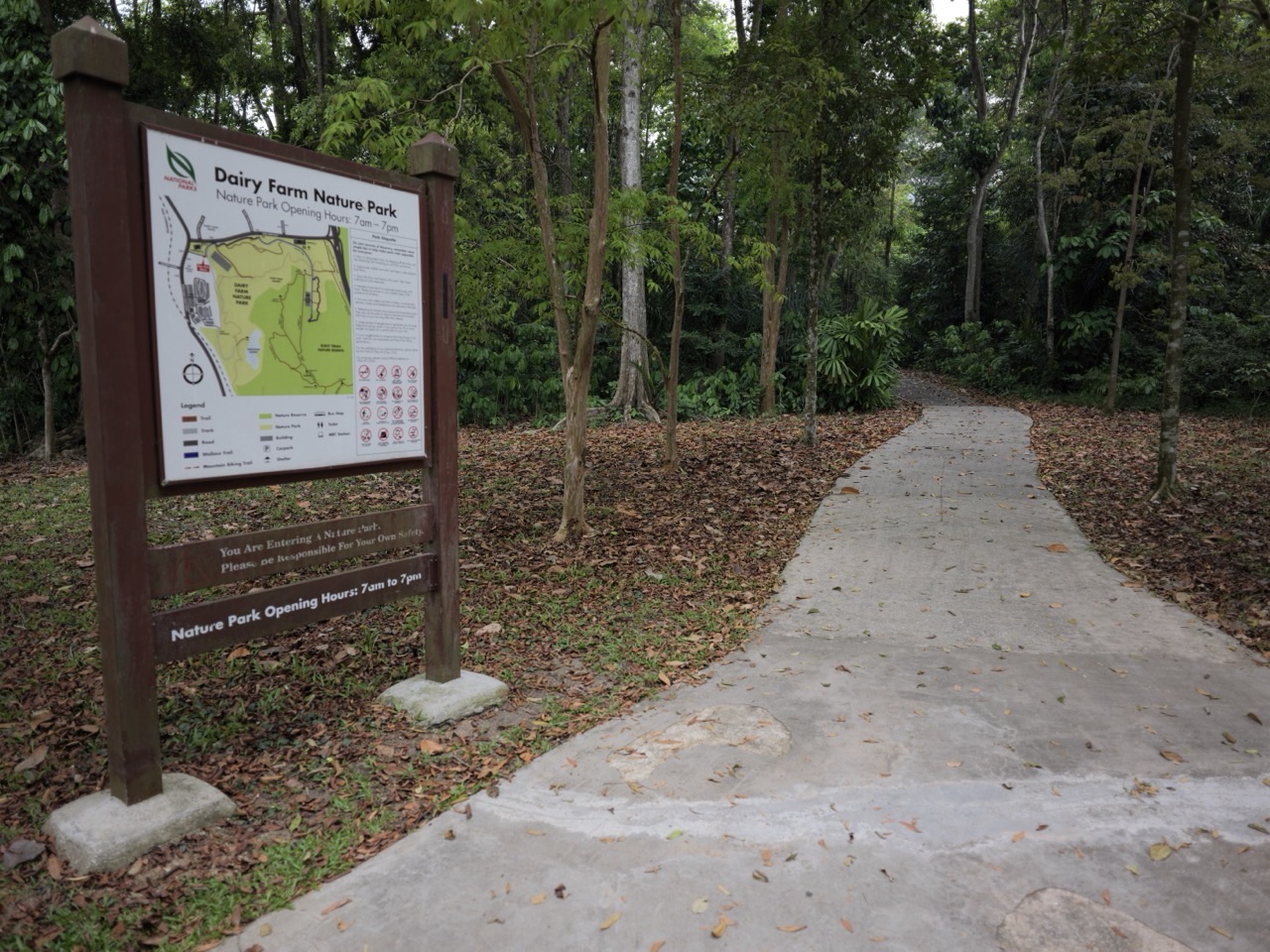
The featured photograph shows an entrance path into Dairy Farm Nature Park, which provides access to the park network. It is not a photograph of Singapore Quarry’s lake.
Find the answer: What is a quarry, and why did Bukit Timah have them? · Why does Singapore Quarry look different from Dairy Farm Quarry? · How does a former quarry support freshwater wildlife? · What can a birdwatcher learn here? · Why does the park have opening-hour restrictions? · Can pets join a walk to Singapore Quarry? · How does Singapore Quarry fit the larger nature network? · How can families turn a visit into a science lesson?
1. What is a quarry, and why did Bukit Timah have them?
A quarry is a place where stone or other material is extracted from the ground. Bukit Timah’s granite-rich geology helped make the surrounding area important for construction materials.
Quarrying changes the shape of the land. Removing rock can create steep exposed faces and a depressed area. After extraction ends, some former pits accumulate water and vegetation begins to establish in and around them.
The result can be beautiful, but the appearance does not erase the human history. It is more accurate to call this a former industrial landscape that has naturalised than to imagine it was always a natural lake.
The other part of the story is transport: stone is heavy. The value of a quarry depended not only on the presence of granite but also on ways to move it to projects elsewhere.
2. Why does Singapore Quarry look different from Dairy Farm Quarry?
NParks identifies two former quarries within Dairy Farm Nature Park. Singapore Quarry is now a scenic water-filled landscape, while Dairy Farm Quarry has been filled with earth and is known for exposed rock cliffs.
That is an important distinction for visitors. A search for ‘Dairy Farm quarry’ can produce photographs of a dramatic dry rock face, while someone expecting Singapore Quarry’s lake may be confused.
The difference offers a practical ecology lesson. Water depth, soil, slope, shade and disturbance determine which organisms can colonise a former quarry. The same general industrial history can produce very different habitats.
Neither landscape should be described as a replica of an undisturbed ancient rainforest.
3. How does a former quarry support freshwater wildlife?
A water body can provide food, resting places and breeding or feeding habitat for different species. Insects such as dragonflies use freshwater environments at stages of their life cycle, while fish and other small animals may support birds higher in a food web.
NParks highlights the possibility of spotting dragonflies and stork-billed kingfishers at Singapore Quarry. A kingfisher may perch quietly and scan the water, but an animal sighting is never guaranteed.
Plants at the margins help create shelter and variations in light and water conditions. Fallen leaves and organic material contribute to a freshwater system that changes over time.
This is not proof that every kind of biodiversity found in an untouched wetland has returned. Naturalised quarry ponds can support wildlife while still differing from the original ecosystem.
4. What can a birdwatcher learn here?
Birdwatching is easier when you begin with behaviour rather than trying to memorise every species name. Look for where birds perch, how they use the water’s edge and whether they move between the trees and the open lake.
The stork-billed kingfisher is memorable for its large bill and conspicuous colours, but it may remain out of sight during a visit. Dragonflies are sometimes easier to notice in sunlit areas when conditions suit them.
Bring binoculars if you have them, and watch quietly from designated viewing points. Avoid playing recorded calls to attract birds or entering vegetation to get a closer photograph.
A field note can record the time, weather, position and observed behaviour. Such notes are more useful than claiming you saw a species because a website said it lives there.
5. Why does the park have opening-hour restrictions?
NParks lists Dairy Farm Nature Park as open from 7am to 7pm, while Singapore Quarry has its own visitor hours of 8am to 6.30pm.
These separate times matter. Someone planning a late-evening visit cannot assume that because the wider park has not fully closed, the quarry viewing area remains available.
Nature areas have operational and safety constraints. Trails can be dark, wet or uneven; sensitive wildlife may be disturbed by inappropriate access. When conditions or temporary closures change, official park notices take precedence over an old travel post.
Never enter a closed area, climb quarry rock faces or enter the water.
6. Can pets join a walk to Singapore Quarry?
NParks’ visitor guidance permits leashed pets on the route from Carpark A to Singapore Quarry. It separately says pets are not allowed on the Wallace Trail to protect wildlife.
That distinction is easy to miss. Some visitors assume a dog-friendly path makes the whole nature park dog-friendly. It does not.
If you bring a pet, check the latest NParks map and stay strictly within the permitted route. Animals may be stressed by barking, close approaches and unexpected encounters even if they are not visibly injured.
Respecting such boundaries is one of the ways public enjoyment and biodiversity protection can coexist.
7. How does Singapore Quarry fit the larger nature network?
Dairy Farm Nature Park lies in the larger Central Nature Park Network near Bukit Timah Nature Reserve. Its green spaces offer recreational opportunities and help maintain habitat around protected forest areas.
A former quarry lake is only one part of that network. Trails, recovering vegetation and nearby wooded areas create different ecological conditions over short distances.
It is helpful to think in layers: the geological layer provided granite; the industrial layer altered the terrain; the ecological layer includes water and regrowth; and the public layer provides safe places for observation.
Each layer gives a different answer to the question ‘How does this place work?’
8. How can families turn a visit into a science lesson?
Try a two-column exercise: ‘evidence of quarrying’ and ‘evidence of living habitat’. The aim is not to decide whether the place is natural or human-made. Both histories are visible together.
Did you know a former granite extraction site could teach geology, ecology and conservation from one viewing point? That is what makes Singapore Quarry more than a scenic backdrop.
- Start with the official map: choose a designated route to the quarry viewing area.
- Distinguish the two quarry sites: Singapore Quarry is water-filled; Dairy Farm Quarry is earth-filled.
- Observe from a distance: record birds, dragonflies, vegetation and exposed rock without approaching the water.
- Take notes: compare human-made features with signs of ecological recovery.
- Check the clock: Singapore Quarry visitor access is listed as 8am to 6.30pm.
- Leave no trace: do not feed wildlife, litter, fish or swim.
Frequently asked questions
Where is Singapore Quarry?
It is a former quarry within Dairy Farm Nature Park in the Upper Bukit Timah area.
Is Singapore Quarry the same as Dairy Farm Quarry?
No. Singapore Quarry is a water-filled former quarry, while Dairy Farm Quarry is filled with earth and has exposed rock cliffs.
What are Singapore Quarry’s opening hours?
NParks currently lists 8am to 6.30pm daily for the Singapore Quarry viewing area. Check notices before visiting.
Can people swim or fish in Singapore Quarry?
Do not treat it as a swimming or fishing venue. Follow NParks visitor rules and remain on approved paths and viewing areas.
Can I bring a dog?
NParks allows leashed pets from Carpark A to Singapore Quarry, but pets are not allowed on the Wallace Trail.
Official sources and further reading
Historical and ecological facts are grounded in official agency references. Check current directories, trail notices and opening times before visiting.
- NParks: Dairy Farm Nature Park and Singapore Quarry visitor details
- NParks: Hiking and nature walks at Dairy Farm Nature Park
- NParks BiodiversitySG: Naturalised streams and former quarries
Continue the How Bukit Timah Works series
- How Dairy Farm became a nature park
- Why granite and quarries shaped Bukit Timah
- How Rifle Range Nature Park restores a quarry wetland
More from this batch: How Bukit Timah Works | Why Coronation Plaza Became a School-District Meeting Point · How Bukit Timah Works | How Cluny Court Preserves Its 1928 Shophouses · How Bukit Timah Works | How Evolution Garden Explains 3.5 Billion Years of Life
Earlier neighbourhood guides: bukit timah road dunearn road one way system · beauty world food centre fourth floor hawker heritage · learning forest keppel discovery wetlands · botanic gardens mrt circle downtown interchange