
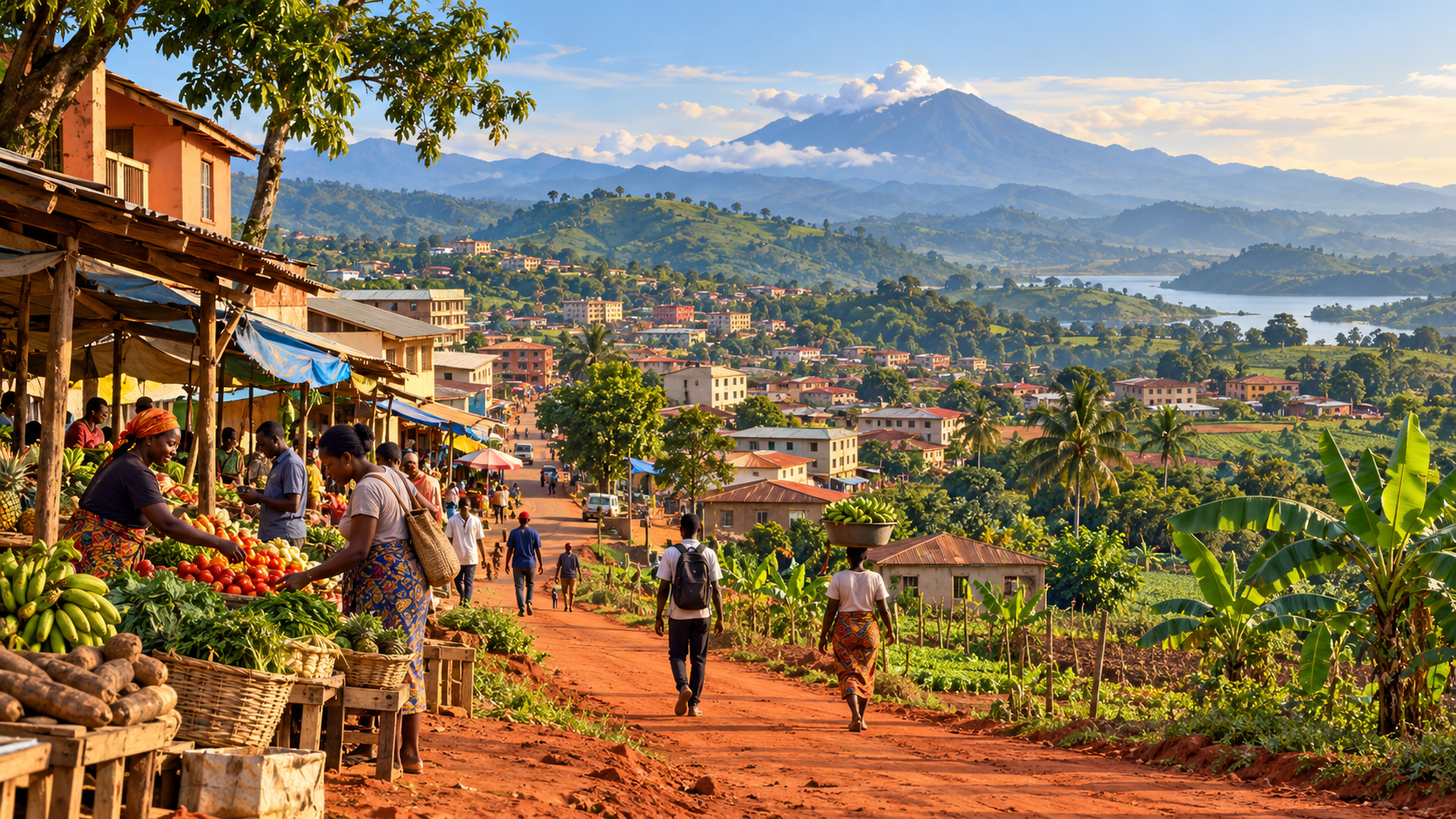
How does Cameroon’s government work, why are English and French both official languages, and how do ten regions, cocoa, ports and schools fit together? Cameroon is a republic in Central Africa, with President Paul Biya exercising national executive authority and a government supported by ministries and territorial administrations. In October 2025 the Constitutional Council declared Biya the winner of a contested presidential election with 53.66% of the vote. Cameroon has ten regions, including the English-speaking North West and South West, alongside French-speaking regions and communities with many other languages and identities.
The fastest way to understand how Cameroon works is to follow national decisions → regions, divisions and councils → ports, roads, electricity and schools → farms, businesses and households. A cocoa farmer needs buyers and a functioning road. A truck heading to landlocked Chad needs customs procedures and a reliable port. A child needs teaching in the appropriate school pathway and a safe journey. Cameroon’s systems connect diverse geography, natural resources and people—and must also operate amid serious security and rights challenges.
Cameroon explained in one minute
- Government: presidential republic with president, prime minister, government, National Assembly and Senate.
- President in October 2026: Paul Biya, declared re-elected in October 2025; that election and subsequent repression were contested.
- Administrative structure: ten regions, then divisions and subdivisions, with municipal and regional council arrangements.
- Official languages: French and English; local languages remain important in communities.
- Economy: services, cocoa, coffee, cotton, agriculture, timber, oil and gas, manufacturing and regional trade.
- Trade routes: Douala and Kribi ports, inland roads and rail links connecting central African markets.
- Regional finance: Central African CFA franc issued by BEAC within the CEMAC monetary union.
- Major challenges: unequal access to services, Anglophone-region conflict, insecurity in the Far North and inclusive employment.
This guide is reviewed on 20 October 2026. The World Bank’s October 2026 Cameroon overview supplies development context. Human Rights Watch’s November 2025 report explains the contested election and crackdown. The Central African central bank’s FAQ documents the currency arrangements.
1. Who runs Cameroon, the president or prime minister?
Cameroon’s president is the central national executive institution under the constitutional system. The prime minister and cabinet coordinate government functions according to the legal powers assigned to them, while ministries operate programmes for education, public works, health, finance, industry and other sectors. The presidency and parliament are not interchangeable institutions.
Paul Biya has been president since 1982. A constitution can explain the formal powers of offices, but the practical effectiveness of public accountability, political competition and the administration of justice requires evidence beyond an organisation chart.
The distinction matters to everyday life. A national policy may be adopted centrally, but a school in a rural region needs teachers, materials and secure access before it produces learning. Legal authority is one link in a much longer delivery chain.
2. What happened in Cameroon’s October 2025 election?
Cameroon held a presidential election on 12 October 2025. On 27 October the Constitutional Council officially declared Paul Biya elected with 53.66% of the vote. His principal challenger, Issa Tchiroma Bakary, disputed the result and made his own claim of victory. Biya began an eighth term in November.
The election cannot be summarised responsibly by the official percentage alone. Opposition protests, violence and arrests followed, and Human Rights Watch documented alleged excessive use of force and called for investigations and due process. The 2025 events remain relevant when discussing democratic accountability in 2026.
For the dated details compare the World Bank’s political context with Human Rights Watch, 28 October 2025. Reporting who was declared the winner is not the same as endorsing the fairness of the process.
3. Does Cameroon have a parliament?
Yes. The Parliament of Cameroon is bicameral, comprising the National Assembly and Senate. These institutions exercise legislative and related functions under the country’s constitutional framework. They are distinct from the president, ministers, regional councils and local municipalities.
A bill can be introduced, debated and adopted, but a completed law is only a starting point for services. If a law establishes an education programme, ministries must provide the curriculum, staff, facilities, finance and monitoring. A parliamentary vote does not immediately put a teacher inside every classroom.
The same sequence helps readers of any country’s news: identify a proposal, enacted rule, implementing order, allocated funds and the independently measurable service that follows.
4. What are Cameroon’s ten regions?
Cameroon has ten administrative regions: Adamawa, Centre, East, Far North, Littoral, North, North West, South, South West and West. Region names describe geography and administration, but they do not mean each region exercises the same powers as a federal state in Canada or Germany.
Regional governors appointed by the state have supervisory and administrative roles, while regional councils are part of a decentralisation framework. Regions contain divisions, subdivisions and various councils and municipalities. The precise authority responsible for a road, clinic or school depends on the sector and asset.
An important legal distinction is the special status of the North West and South West, which are historically Anglophone regions. This arrangement should not be interpreted as having ended the region’s conflict or guaranteed equal service access.
5. What does the ‘special status’ of the North West and South West mean?
Under reforms associated with the 2019 General Code of Regional and Local Authorities, the North West and South West received a special status recognising aspects of their linguistic, educational and legal heritage. It establishes particular institutional arrangements within Cameroon’s overall state.
This is different from full independence, and it does not by itself resolve decades of grievances or the contemporary Anglophone conflict. Communities have experienced displacement, interrupted education and insecurity. Formal decentralisation is one policy response, while meaningful rights, safety and trust require much broader outcomes.
The UK government’s Cameroon background guide explains the distinction between the two special-status regions and the other eight regions.
6. Why are English and French both official languages?
Cameroon’s colonial and post-independence histories produced English- and French-language public institutions. Today English and French are national official languages, and many local languages are spoken in homes, communities and markets. Official bilingualism does not mean every person speaks both languages with equal fluency.
Language affects school pathways, administration, justice, commerce and a family’s ability to understand forms. A notice published only in a language a resident struggles to read may not produce informed action, even if the rule is legally valid.
The broader challenge is compatibility: different linguistic and educational traditions must be able to operate within one country without requiring people to erase their identities. A well-designed public system makes rights and services accessible across those differences.
7. What is the difference between Anglophone and Francophone schools?
Cameroon has two parallel school traditions influenced by English- and French-language structures. The Anglophone system includes examinations such as the GCE Ordinary and Advanced Levels. The Francophone system uses qualifications such as the BEPC and baccalauréat, with different academic stages and rules.
A parent moving between regions should not assume that the same year level or examination name means identical subject requirements. Curriculum administration involves separate ministry functions and examination bodies. School advice must identify the actual subsystem and academic year.
For a focused explanation, read eduKateSG’s Schools of Cameroon, How Education System of Cameroon Works and How Ministries of Education for Cameroon Work. Those pages explain qualifications; this article shows their place inside the national system.
8. What happened to some secondary schools in 2026?
Cameroon continued reorganising and expanding parts of its school network during 2026. In March, the Prime Minister’s Office published decrees creating or transforming secondary institutions, including some Government Bilingual High Schools.
A decree creates or changes an institution’s legal status. The next step is ensuring suitable classrooms, teachers, equipment, materials and safe access. A newly designated school cannot guarantee improved literacy or examination results unless the teaching service is properly delivered.
Read the 13 March 2026 bilingual-high-school decree. This offers a concrete example of the difference between an administrative announcement and classroom outcomes.
9. Why are Yaoundé and Douala both important?
Yaoundé is the political capital and a major administrative centre, while Douala is Cameroon’s leading commercial and port city. Different functions concentrate in each, requiring reliable roads, data, freight services and public institutions between them.
A manufacturer in an inland town may receive imported components at Douala, process them near Yaoundé or another city, and send finished goods to customers. A government department in Yaoundé may oversee a national road project that affects port access in Douala.
A country is not inefficient merely because its administrative and commercial centres differ. The important issue is how effectively organisations connect them and serve settlements beyond both cities.
10. How do Douala and Kribi ports work?
Cameroon has major maritime gateways at Douala and Kribi. Douala sits on the Wouri estuary and handles an important share of national commerce, while Kribi’s deep-water facilities offer another gateway for cargo, industry and trade corridors.
A vessel unloading goods is the start of an inland logistics process. Customs documentation, storage, vehicles, road safety and buyers all matter. A new terminal may add capacity without resolving congestion at a later urban junction or international border.
The US International Trade Administration’s April 2026 guide identifies Douala and Kribi as key ports and explains their role in regional distribution. Use its dated figures rather than inventing current container traffic.
11. Why do Cameroon’s ports matter to Chad and the Central African Republic?
Chad and the Central African Republic are landlocked. International freight can move through Cameroonian ports and onward by road or other transport connections. That makes Cameroon important not only as a domestic market but also as a gateway in Central Africa.
A truck transporting medicine toward an inland hospital may pass a port, warehouse, several road checkpoints and an international border. The medicine only becomes healthcare after the final delivery and local distribution succeed.
This is an example of the invisible geography of a country: a port’s functional reach extends far beyond its shoreline. Trade routes work through agreements, safety and information, not just roads on a map.
12. Why is cocoa a major part of Cameroon’s economy?
Cameroon produces cocoa, coffee, cotton and other crops. Cocoa links smallholder farmers with buyers, processors, transport firms, exporters and international chocolate businesses. The economic value of a crop depends on yields, quality, farm costs, prices and access to markets.
A farmer may face high world cocoa prices but still struggle with poor road access, farm disease or unaffordable inputs. Likewise, an exporter can report increased sales while labourers and communities do not see equivalent gains.
To study cocoa properly, draw its full path: farm → collection → grading → storage → transport → export or local processing → consumer. Every step affects both value and livelihoods.
13. What does ‘value added’ mean for cocoa and timber?
Value addition means doing more useful processing or manufacturing before selling a product. Cocoa beans may be processed into cocoa butter, powder or chocolate ingredients. Timber may be transformed into furniture or building products rather than exported only as logs, subject to legal and environmental requirements.
Processing can support more skilled jobs, but factories need stable electricity, equipment, quality management, local suppliers and markets. A policy that orders more local processing without meeting those requirements may increase costs rather than create sustainable value.
Environmental legality also matters. A product should not be treated as a national success if its production depends on unlawful forest damage or unsafe labour conditions.
14. Why are oil and gas important if Cameroon grows crops?
Oil and gas contribute to exports and public revenues, while agriculture and services support a wider range of livelihoods. Production and energy prices can fluctuate, affecting government budgets and foreign currency earnings. The country therefore needs diverse sources of economic opportunity.
The World Bank’s October 2026 country overview estimated growth of about 3.4% for 2025 and projected an average near 3.7% over 2026–2028. These forecasts and historical estimates should not be mistaken for confirmed future outcomes.
National revenue has to be converted into dependable services through budgets, financial controls, procurement and maintenance. Selling an energy resource does not put safe water into a family’s tap unless the distribution network works.
15. What currency does Cameroon use?
Cameroon uses the Central African CFA franc, shared with other CEMAC countries and issued by the Bank of Central African States, BEAC. It is fixed against the euro at €1 = 655.957 CFA francs under the regional monetary arrangement.
The Central African and West African CFA francs share a similar name and the same euro peg but are issued by different central banks and operate in different monetary unions. They should not be treated as one freely interchangeable physical currency.
The BEAC FAQ identifies the issuing institution and rate. The peg can help stabilise some cross-border financial arrangements, but it cannot prevent individual food, transport or housing prices from changing.
16. Why does electricity matter to factories and families?
Power supports machinery, refrigeration, schools, hospitals and communications. Cameroon has hydroelectric potential and ongoing generation and network investments, but generation capacity and actual household access are different measures.
An industrial plant can have new equipment yet lose productive hours because of distribution problems. A student can have textbooks but struggle to use digital lessons in the evening without reliable electricity. Electricity is a shared input to many public and private outcomes.
The World Bank identifies electricity access and supply reliability among its development priorities, while the effective result depends on transmission, distribution, connections, tariffs and maintenance.
17. How do dams change more than the electricity supply?
Hydropower can generate electricity, but a reservoir and river management project can also affect water flows, ecology, livelihoods and downstream communities. Planning requires attention to both power demand and environmental and social consequences.
A megawatt of installed generating capacity is not the same as a megawatt continuously supplied to a hospital or factory. Seasonal water conditions, grid constraints and equipment maintenance influence delivery.
For a student, the correct chain is river flow → hydropower generation → transmission → local distribution → usable electricity. A missing connection at the end can limit the benefit of the entire investment.
18. What makes Cameroon’s forests important?
Cameroon contains significant areas of Congo Basin forest as well as savanna, mountains and coastal ecosystems. Forests support biodiversity, climate regulation, water cycles and the livelihoods of communities. They can also be affected by logging, farming expansion, mining and infrastructure development.
Conservation should be based on clear land and forest rights, lawful practice, science, community consultation and effective enforcement. A logging licence does not by itself prove sustainability; a protected area on a map does not by itself prove the ecosystem is secure.
A good land-use decision considers jobs and future environmental costs together. Degraded forests and polluted streams may impose lasting costs on people who did not benefit from the original activity.
19. Why do the North West and South West face a serious humanitarian problem?
Cameroon’s Anglophone regions have experienced armed separatist conflict, violence, disruption of education and displacement since the crisis escalated in 2016–2017. It has affected civilians, schools, healthcare and economic activity. Neither a legal declaration nor a new regional office can by itself restore safety.
The World Bank’s October 2026 overview reports that conflict and insecurity have displaced large numbers of people internally. It is important to distinguish the number of people displaced inside Cameroon from refugees who enter Cameroon from neighbouring countries; those are different groups and statistics.
A full country guide must include the people who cannot safely attend school, reach a market or live at home. Public-service capacity is not meaningful if violence prevents intended users from accessing it.
20. What about Boko Haram and the Far North?
Parts of Cameroon’s Far North have faced attacks linked to Boko Haram and other security pressures. Affected communities can experience displacement, interrupted farming, fear and difficulty reaching public facilities. These problems differ from the political and historical origins of the Anglophone crisis.
Government and humanitarian responses must address civilian protection, safe access, rights and livelihoods. Treating all security problems as one interchangeable national issue obscures the needs of particular communities.
For accurate research, examine dated location-specific reports. A serious claim about current conditions requires more than a general assertion that an entire region is unsafe or fully secure.
21. How do refugees change service needs in border regions?
Cameroon hosts refugees from neighbouring conflicts, including people from the Central African Republic and Nigeria. Schools, clinics, water points, transport services and host communities may experience additional demand. Those needs require resources and careful cooperation between national institutions and humanitarian partners.
The World Bank’s country page cited UNHCR figures for August 2026 showing Cameroon hosting more than 414,000 refugees, with people from neighbouring states forming the majority. This is a dated count, not a permanent figure for every month.
A practical response should consider both displaced people and existing residents. A new water point or clinic can benefit the wider community if it is planned and maintained well.
22. Why do school closures affect the future economy?
Conflict-related school interruptions have costs beyond a single missed examination. Young people may lose foundational reading, mathematics and science, and later find it harder to access training or work. Businesses and public services can face skills shortages years after a crisis.
A safe classroom needs more than a physical building. Teachers must be able to work, families must feel secure, students need transport and learning materials, and there must be ways to catch up on lost education.
This is why education is part of national resilience. Restoring school attendance and learning can help preserve future medical, engineering, public-administration and business capability.
23. A day in Cameroon: one bridge, four services
Original fictional example: a family in a farming town uses the same bridge to reach a secondary school, a cocoa collection centre, a clinic and a weekly market. Heavy rain damages the crossing. The family loses trading income, the student misses classes, and health visits become more difficult.
Four separate sector problems appear, but the shared bottleneck is one piece of transport infrastructure. Engineers must secure the crossing, local authorities communicate alternatives, and service providers adjust their arrangements while repairs are planned.
This is the point of a systems guide: look for the shared connection that explains several everyday consequences.
24. How does Cameroon compare with Singapore?
Cameroon and Singapore both depend on education, ports, transport networks, energy and reliable institutions. Cameroon has a large varied territory, significant forests, an agricultural economy, two formal schooling traditions and extensive inland trade corridors. Singapore is a dense island city-state and a major international port and aviation hub.
A port serving Chad from Douala and Singapore’s container transshipment system share a function but face different geographies and commercial arrangements. Likewise, Cameroon’s bilingual school administration is not equivalent to Singapore’s national school curriculum, even though both involve multilingual societies.
Compare How Singapore Works with How Singapore Connects | Roads, Expressways and Junctions. Study what the systems do for people, rather than copying their labels.
25. Six checks before trusting a Cameroon development headline
- Who says it? Presidential office, local administration, port operator, company, humanitarian agency or independent journalist?
- What period? A 2025 election result and a 2026 economic projection are not current service outcomes.
- Where? Douala, Yaoundé, a North West community and a Far North border town can have radically different conditions.
- What stage? Announced road, tender, completed bridge or reliable year-round service?
- Which population? Local residents, internally displaced people, refugees, farmers or factory workers?
- Which consequence? Did the intended people gain safer travel, useful learning, reliable electricity or better care?
A student should be able to write: ‘This organisation claims that X changed in Y place on Z date.’ Then add what the evidence confirms and what remains unknown. That habit produces a stronger explanation than repeating a press release.
Frequently asked questions about how Cameroon works
Who is the president of Cameroon in 2026?
Paul Biya, declared re-elected in October 2025 with 53.66% of the vote by the Constitutional Council. The result was contested and the post-election period involved documented rights concerns.
Does Cameroon have ten regions?
Yes, including North West and South West, which have special-status administrative arrangements.
Why does Cameroon have two official languages?
English and French reflect the country’s history and institutional arrangements. Local languages are also widely used.
Do all Cameroonian students take the same final examination?
No. Anglophone and Francophone school subsystems have different structures and qualifications, including GCE and baccalauréat pathways.
Is Yaoundé or Douala the capital?
Yaoundé is the political capital. Douala is the major commercial and port centre.
Why are Douala and Kribi important?
They are major maritime gateways linking Cameroon to international trade and, through inland corridors, to landlocked neighbours.
What is Cameroon’s currency?
The Central African CFA franc, issued by BEAC and pegged to the euro at 655.957 CFA francs to one euro.
Does Cameroon’s economy depend only on oil?
No. Farming, cocoa, services, trade, manufacturing, timber and other activities matter alongside oil and gas.
Why can school access differ greatly by region?
Distance, resources, language pathway and conflict-related insecurity can all affect whether a child can safely attend and learn.
How should a reader evaluate a new government programme?
Identify the competent institution, exact legal or financial stage, geographic coverage and evidence of usable outcomes.
Explore the connected country series
This is part of How Countries Work, sibling to How Singapore Works. Compare Cambodia’s river and factory economy, Cabo Verde’s island transport, Canada’s provinces and public services, and The Central African Republic’s transport and governance systems.
Sources, limits and date
- World Bank Cameroon overview, updated 2026 — regions, development, 2025 election, displacement and economic trends.
- Human Rights Watch, October 2025 — contested election and protest violence.
- Human Rights Watch, November 2025 — rights and arrests.
- UK government, Cameroon institutions and regions — bilingual regions and special status.
- US International Trade Administration, April 2026 — Douala and Kribi trade routes.
- BEAC — CFA franc monetary union and fixed exchange parity.
- Cameroon Prime Minister’s Office, March 2026 — school reorganisation decree.
- Reviewed: 20 October 2026. Fictional household cases are learning examples, and statements by political actors are distinguished from independent findings.