
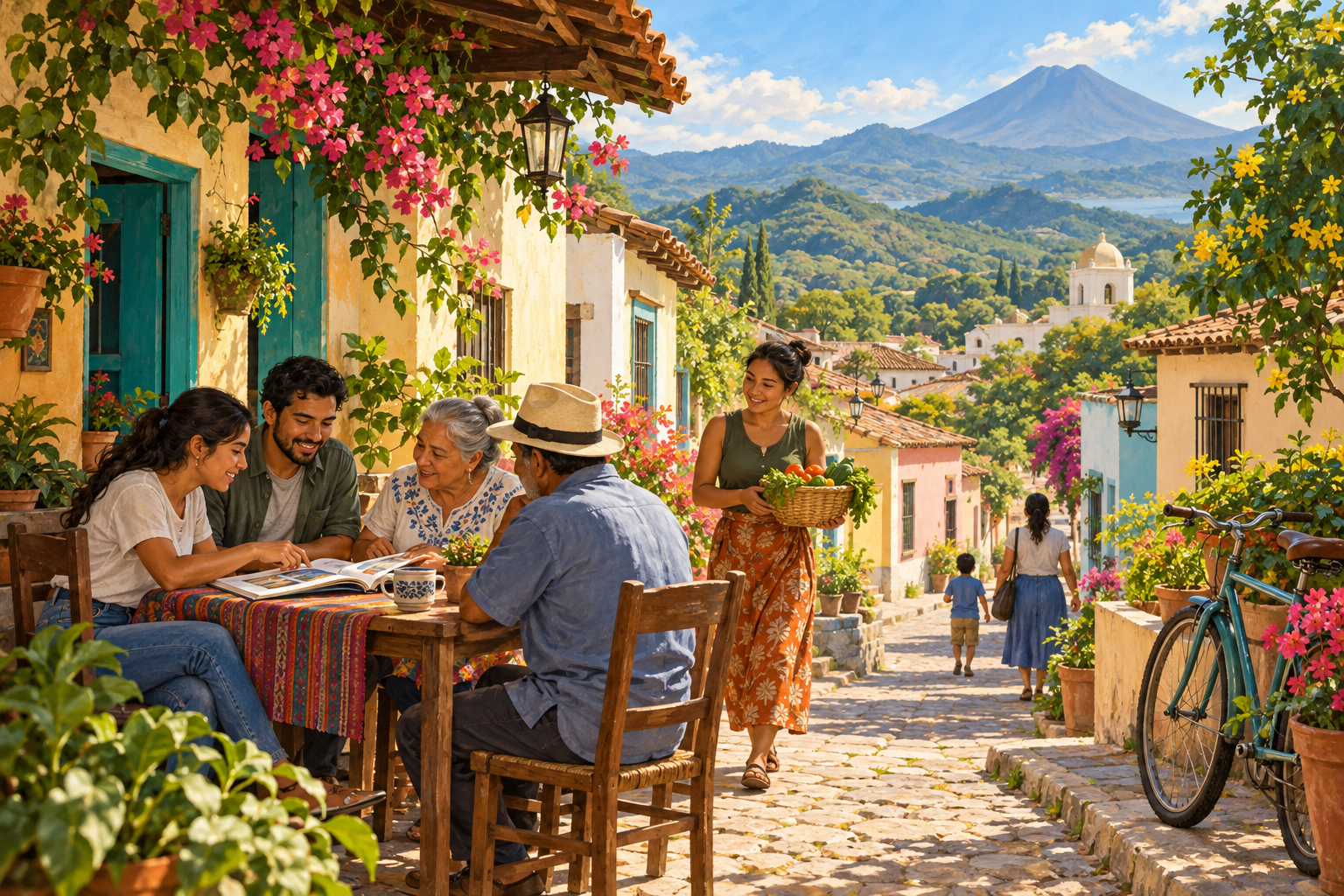
How does El Salvador work in 2026, why does it use US dollars, what changed with Bitcoin, and how has public security affected everyday life? El Salvador is a Central American republic with San Salvador as its capital, 14 departments and a reorganised local-government map of 44 municipalities. It uses the US dollar, receives substantial remittances from people abroad, and has experienced major changes in crime levels, security policy, cryptocurrency rules and constitutional arrangements.
The useful way to understand the country is to follow an ordinary household. A family needs a safe route to school, a job that pays enough to live on, water and electricity, and trustworthy institutions when something goes wrong. A shopkeeper may care about public security and customer spending far more than the price of a digital token. Those connections—between government, money, services and rights—make up the real operating system.
El Salvador at a glance: quick answers
- Capital: San Salvador.
- Location: Central America, with Guatemala and Honduras as neighbours and a Pacific coast.
- Government: presidential republic with a unicameral Legislative Assembly.
- Territory: 14 departments, 44 municipalities and 262 districts under the restructured map.
- Currency: US dollar, adopted in 2001.
- Bitcoin in 2026: private acceptance is voluntary following 2025 reforms; taxes are paid in US dollars.
- Economy: remittances, services, manufacturing, construction, tourism, agriculture and trade.
- Security: reported gang violence has decreased substantially, while exceptional detention practices have drawn serious human-rights criticism.
- Natural hazards: earthquakes, volcanic activity, heavy rainfall, floods and landslides.
1. How does El Salvador’s government work?
El Salvador is a presidential republic. The president directs the national executive, the unicameral Legislative Assembly makes laws, and courts have judicial functions. National ministries and public agencies run programmes covering security, education, transport, public finance and health. Nayib Bukele is president as of October 2026. As in any country, the existence of a ministry or a legal right does not automatically demonstrate that services are equally accessible in every community.
A policy has several stages: proposal, legislation or other lawful authority, budget, implementation, inspection and public accountability. Take a promise to improve a local health centre. Someone must procure equipment, employ qualified staff, provide electricity and water, and maintain safe transport. A family judges the result by whether timely care is available.
Questions about power also include checks and balances, political competition, the courts, human rights and public information. Constitutional amendments made in 2025 changed presidential re-election rules and the election timetable. A description of the institutional structure should state those changes rather than relying on an outdated civics textbook.
2. How many departments and municipalities does El Salvador have?
El Salvador has 14 departments and, following a municipal restructuring, 44 municipalities made up of 262 districts. Before the reform, the 262 local units were municipalities; this is why some older websites still report 262 municipalities as though no change occurred. The Legislative Assembly’s 2023 restructuring announcement describes the legal change and the 44-municipality framework.
A municipality and a district are not now interchangeable official categories. An address may still use the familiar district name, but the authority for a project or election may be the larger municipality. People should confirm which local office controls planning, service requests and applicable documentation.
The capital is San Salvador. Its metropolitan area concentrates many jobs and institutions, while coastal, volcanic and rural districts have different infrastructure needs. A single national programme can affect these areas very differently depending on road access, budgets and local capacity.
3. Why does El Salvador use the US dollar?
El Salvador adopted the United States dollar as its principal official currency in 2001. In ordinary life, wages, prices, public accounts and tax payments are commonly denominated in dollars. Dollarisation does not make the country a US territory. El Salvador retains its own government, fiscal decisions, tax system and financial regulations.
A dollarised economy cannot independently devalue a locally issued currency to improve export competitiveness. Domestic wages, productivity, trade, credit conditions, government budgets and remittance inflows therefore play particularly important roles. Dollarisation does not automatically deliver low prices or secure household income.
A family receives a pay cheque and pays for groceries in dollars; a small exporter may receive dollars from an overseas buyer. That reduces one foreign-exchange complication, but fuel costs, transport, interest rates and competition can still change how far those dollars go.
4. Is Bitcoin legal tender in El Salvador in 2026?
El Salvador became widely known for its 2021 Bitcoin Law, which originally made acceptance mandatory under broad legal-tender provisions. However, amendments in early 2025 removed the essential features of compulsory Bitcoin acceptance. By October 2026, private businesses can decide whether to accept Bitcoin, and tax obligations are to be paid in US dollars. Readers must not repeat the 2021 rules as though nothing changed.
The wording and legal history can be nuanced, but the practical point for a visitor, worker or shopkeeper is clear: do not assume that a merchant must take Bitcoin, or that a government payment can be settled in it. Bitcoin remains an optional digital asset or payment method in private arrangements, with market-price and operational risks. It is not a stable substitute for knowing how much a purchase costs in dollars.
The IMF’s February 2025 programme statement and the October 2026 review document the shift toward voluntary acceptance, limits on public-sector involvement and stronger oversight.
5. What happened to the Chivo Bitcoin wallet?
Chivo was introduced as a government-backed digital wallet in connection with the original Bitcoin policy. Subsequent financial arrangements and reforms changed its ownership and operating framework. In October 2026, the IMF reported that majority ownership and operational control had been transferred to a private operator, while it continued to call for remaining public-sector exposure to be unwound.
That change matters because a digital wallet involves custody, customer funds, technical reliability, fraud prevention and consumer protection. A wallet transaction is not made safe merely by being associated with a national programme. Users need clear rules about fees, dispute resolution, exchange rates, withdrawal and security.
The October 2026 IMF review also addressed supervision of crypto-asset businesses and transparency around public-sector Bitcoin holdings. Do not turn announced reforms or reported donations into a claim that all cryptocurrency-related financial risks have disappeared.
6. How does the government’s public-security strategy work?
Beginning in 2022, El Salvador introduced extraordinary security measures in response to gang violence. Government policing and detention policies were associated with a large reduction in reported gang-related violence and homicides. The World Bank’s October 2026 overview describes a sharp fall in crime as an important economic change, contributing to confidence and removing barriers for businesses.
Safer streets can transform daily life. A shop may open for longer, employees may travel more confidently, and families may feel better able to use public spaces. Those outcomes deserve evaluation through credible crime statistics, community experience and long-term evidence, not political slogans.
Security is also a matter of lawful procedures. Extraordinary measures affect arrest powers and judicial safeguards. The ability to prevent gang violence and the duty to protect the rights of innocent people are not mutually exclusive responsibilities. A serious country guide examines both results and the cost of obtaining them.
7. What are the concerns about detention and human rights?
Since March 2022, El Salvador’s state of exception has been repeatedly extended. Human-rights organisations have documented allegations and evidence of arbitrary detention, limited due process, mistreatment and serious conditions in detention. In an July 2026 investigation, Amnesty International expressed concern about severe and systemic violations.
Human Rights Watch reported in October 2026 on concerns that mass trials involving large numbers of defendants provided inadequate opportunities to contest evidence. These findings should be attributed to the organisations making them, with dates, rather than presented as an individually adjudicated finding about every case.
Governments have a duty to protect people from violent crime. Courts and authorities also have duties to investigate fairly, allow appropriate legal defence and provide remedies against wrongful detention. Understanding El Salvador’s current security system requires both sides of that institutional picture.
8. What changed in the rules for presidential elections?
In July 2025, constitutional changes approved by El Salvador’s legislature removed presidential term limits and made other changes to the election rules and timetable. Supporters argued that voters should be able to choose a candidate repeatedly; critics warned about weakened checks on concentrated executive power. The political implications remain contested and must be examined through the text of the changes and the country’s electoral institutions.
The IMF’s October 2026 staff report notes elections scheduled for February 2027. Readers should verify each date and eligibility rule directly with the electoral authority as election procedures approach. A government guide should distinguish current law from what it was before 2025, and avoid treating an election result as proof that all democratic accountability questions are settled.
Constitutional arrangements matter to households indirectly through which institutions can be held accountable, how leadership can change and whether public decisions face meaningful scrutiny. Those functions are just as important as the architecture of the parliament building.
9. Why are remittances so important?
Remittances are money sent by Salvadorans living and working abroad to relatives in El Salvador. They are an important source of household income and are closely connected to El Salvador’s relationship with the United States. Families may use them to pay for groceries, rent, school fees, healthcare and improvements to homes.
Remittances are not the same as wages earned in El Salvador, government tax revenue or foreign investment. When a relative abroad loses work or transfer costs change, a household’s budget may be affected even if local prices have not moved. The dollars received can sustain small businesses and consumption, but reliance on external income also creates vulnerability.
The World Bank’s 2026 country overview describes remittances and consumption as important features of the economy, while stressing the need for more productive investment and good-quality local jobs. That distinction between spending support and sustainable employment is central to understanding growth.
10. What does El Salvador make and export?
Manufacturing, services, agriculture and commercial trade contribute to the economy. Textiles and apparel, food production, coffee, sugar-related products and other goods connect Salvadoran firms to regional and international markets. Different industries have different labour, energy, quality and logistics requirements.
An apparel factory may import textiles or components, employ skilled workers, produce garments and ship to an overseas buyer. A coffee producer must manage farm quality, processing, storage and marketing. Neither can succeed from a tax incentive alone; roads, electricity, training, contracts and predictable rules are essential.
Export activity matters to the balance of payments and jobs, but national export totals do not tell us automatically how wages or environmental conditions are distributed among workers and communities.
11. How do ports, roads and borders connect the country?
El Salvador lies on Central America’s Pacific coast, between Guatemala and Honduras. Port facilities, roads, logistics yards and border crossings connect producers and consumers with Central American neighbours and overseas destinations. The country has no Caribbean coastline.
A delivery from a factory to a port passes through local roads, freight operators, customs and handling facilities. A delay at a border crossing can interrupt a supply chain even when a road is in good physical condition. Trade efficiency also depends on paperwork, digital systems, inspections and trustworthy enforcement.
Urban congestion creates a separate challenge. A commuter in Greater San Salvador needs reliable routes and affordable travel just as a freight business needs dependable corridors. Transport planning should consider both households and commercial logistics.
12. What drives tourism in El Salvador?
Pacific surf destinations, volcanic landscapes, towns, historic sites, food and culture attract visitors. Tourism can support accommodation, guides, restaurants, transport and retail. Improvements in perceived safety may encourage visitors and private investment, but visitor numbers alone do not demonstrate that local wages, water access or environmental protection have improved.
A coastal guesthouse needs drinking water, wastewater treatment, reliable electricity and safe access roads. During peak periods, tourism adds demand to community infrastructure. Good planning allows residents to benefit from visitor spending while preserving beaches and public services.
Tourism also includes domestic travel and community-based experiences. Local heritage should be presented respectfully rather than reduced to a single fashionable attraction.
13. Why are volcanoes and earthquakes part of everyday planning?
El Salvador sits in a geologically active part of Central America, with volcanoes, earthquakes, steep slopes and seasonal rain. These features shape settlement, farming, tourism and emergency planning. Not every volcano is actively erupting, but the national hazard environment requires ongoing monitoring and building standards.
An earthquake can interrupt water pipes, electricity, road bridges and school operations simultaneously. Heavy rainfall can bring flooding or landslides to communities even when no eruption occurs. Families need trusted emergency information, while public agencies need maintained shelters, access routes and recovery plans.
The best resilience policy links warning systems, safe construction, community preparedness and rebuilding finance. A dramatic disaster photograph is only the beginning of understanding how risk is managed.
14. How does geothermal electricity work?
Geothermal generation uses heat from underground to produce electricity where geological and engineering conditions permit. El Salvador has geothermal resources associated with its volcanic setting, which can support domestic renewable generation. The broader electricity system also involves other generating technologies, regional trading arrangements and transmission networks.
A geothermal plant needs wells, turbines, water or fluid management, maintenance staff, environmental safeguards and grid connections. Even dependable geothermal output does not automatically solve every local outage or affordability problem, because distribution quality and tariffs still matter.
The World Bank’s development programme includes work related to geothermal energy and energy resilience. Engineering performance should be judged through actual capacity, supply reliability and environmental impacts rather than project announcements.
15. How does drinking water reach homes?
El Salvador’s water systems depend on catchments, reservoirs, groundwater, treatment facilities, pumps and distribution networks. Urban growth, dry-season conditions, pollution and ageing infrastructure can complicate reliable supply. Being connected to a water network does not necessarily mean every household receives clean water continuously.
Water services also depend on electricity and maintenance. A power interruption may stop pumping; heavy rain can cause contamination; a broken main may interrupt households and businesses. Wastewater treatment is a separate but related public-health obligation.
A useful test asks how many hours water is supplied, whether it meets safety standards, how much households pay and how quickly faults are repaired. Construction costs alone cannot answer those questions.
16. How do schools and vocational training work?
El Salvador has early-childhood, basic, secondary, technical and higher education pathways. National education authorities establish many standards, and schools need qualified staff, materials, buildings, digital facilities and appropriate learner support. Education also influences the skills that businesses need to grow.
Families should ask about the curriculum, safe transport, attendance, learning quality, pathways into further study and support for pupils with different needs. A laptop or a new classroom can help, but neither guarantees learning unless teachers and students can use it effectively.
Access to better-paid work depends on more than schooling alone. Firms must offer viable jobs, apprenticeships or practical experience, while transport and childcare can determine who is able to participate in training.
17. How does healthcare reach families?
Healthcare delivery involves community clinics, public hospitals, specialist facilities, and social-security or other relevant programmes. Eligibility and patient costs depend on the actual scheme and circumstances. Better medical outcomes require trained professionals, safe water, medicines, functioning equipment and timely referrals.
The World Bank’s development projects in El Salvador include maternal and early-childhood health and improvements to primary care. Programme financing is only an input; families need to see whether appointments, treatment quality and availability have actually improved.
A rural family may face a long journey to specialist care, while an urban family might encounter crowded facilities or scheduling issues. Geography, staffing and reliable information remain important.
18. How do taxes, public debt and IMF arrangements affect services?
Public finance connects income from taxes and other sources to spending on security, education, roads, hospitals, energy and debt obligations. Government borrowing can finance useful investments, but repayment and interest costs create future commitments. Fiscal discipline is not the same as reducing all services; the distribution and quality of spending matter.
In October 2026, the IMF completed the second and third reviews of El Salvador’s Extended Fund Facility arrangement, noting economic recovery and recommending continued attention to fiscal stability, transparency and financial supervision. These reviews are dated evidence, not a promise that every future economic outcome is certain.
A household may notice school quality, access to jobs and the price of food more directly than a sovereign bond spread. A good policy assessment looks at both public accounts and measurable improvements in everyday living standards.
19. What is the economy doing in 2026?
The World Bank’s country overview updated on 6 October 2026 describes growth supported by investment, construction, tourism, consumption and improved security conditions. It also highlights continuing needs involving productivity, employment quality, public finances, infrastructure and skills.
The World Bank estimated stronger economic performance for 2026 than in some earlier periods, but that is still a countrywide measure. It should not be confused with guaranteed wage growth for every household. Economic benefits depend on where new jobs are created, whether they pay adequately, and whether women, younger workers and rural residents can access them.
For a small business, confidence might mean being able to open in a safer area, hire staff and make deliveries. Long-term success still requires customers, finance, competition, electricity, water and consistent legal processes.
20. What should families and businesses verify before making decisions?
A family seeking a school place should verify the current district, school requirements, travel route and available support. Someone registering a business should identify the correct municipality and relevant national agency. A person considering Bitcoin payments should check that acceptance is voluntary and understand pricing, fraud risks and consumer protections. A visitor should confirm up-to-date travel and safety guidance.
People should also distinguish government statements, official data, independent human-rights findings and economic forecasts. Each addresses a different question. The strongest information can be verified through named institutions and dated documents rather than repeated social-media claims.
21. Worked example: a neighbourhood shop and a family abroad
Illustrative shop: A shop owner in a district of a larger municipality wants to operate safely, accept dollar payments, pay suppliers, register with the correct authorities and employ two people. Reduced street violence could improve opening hours, but electricity reliability, transparent rules, customer purchasing power and credit access also matter.
Illustrative family: A parent working abroad sends money to relatives. The household uses it for school supplies and medical needs. If transfer costs rise or employment abroad changes, the household budget changes too. A dollarised currency system reduces one conversion issue but does not remove external dependence.
The shop and family show how national security, monetary policy, municipal governance, remittances and public services connect. Understanding the whole chain is more useful than describing El Salvador solely as either a security story or a Bitcoin experiment.
Frequently asked questions about El Salvador
Does El Salvador use the US dollar?
Yes. The US dollar is its principal official currency and is used for ordinary prices and tax payments.
Do shops have to accept Bitcoin?
No. Following changes to the Bitcoin Law in 2025, acceptance by private businesses is voluntary.
Is Chivo still government-operated?
The IMF reported in October 2026 that majority ownership and control had transferred to a private operator, while remaining public-sector involvement was being wound down.
How many municipalities does El Salvador have?
Forty-four municipalities containing 262 districts, within 14 departments.
Has gang violence declined?
Reported gang violence and homicides have fallen markedly under the security campaign, but rights groups have also documented grave due-process and detention concerns.
When is the next election?
IMF documentation dated October 2026 states that presidential, congressional and municipal elections are scheduled for February 2027; confirm current arrangements with the electoral authority.
What are remittances?
Funds people working or living abroad send to family members at home. They support many household budgets.
Does El Salvador have Caribbean beaches?
No. Its coastline is on the Pacific Ocean.
Related reading across the country library
This guide belongs to How Countries Work, the world-civilisation companion to How Singapore Works. Continue with Understanding the Education System of El Salvador, what to learn when visiting El Salvador and other Central American country guides in the same archive.
Sources, verification and review date
- Legislative Assembly: 44 municipalities and 262 districts
- IMF February 2025: Bitcoin Law reforms and voluntary acceptance
- IMF October 2026: economy, Bitcoin and Chivo policy
- IMF October 2026 staff report and 2027 election timetable
- World Bank: El Salvador overview updated October 2026
- Human Rights Watch: 2026 country review
- Human Rights Watch: October 2026 concerns about mass trials
- Amnesty International: July 2026 report on the state of exception
- Reviewed: 20 October 2026. The household and shop examples are illustrative. Laws, elections, economic estimates and security conditions are date-sensitive; verify later updates with competent sources.