
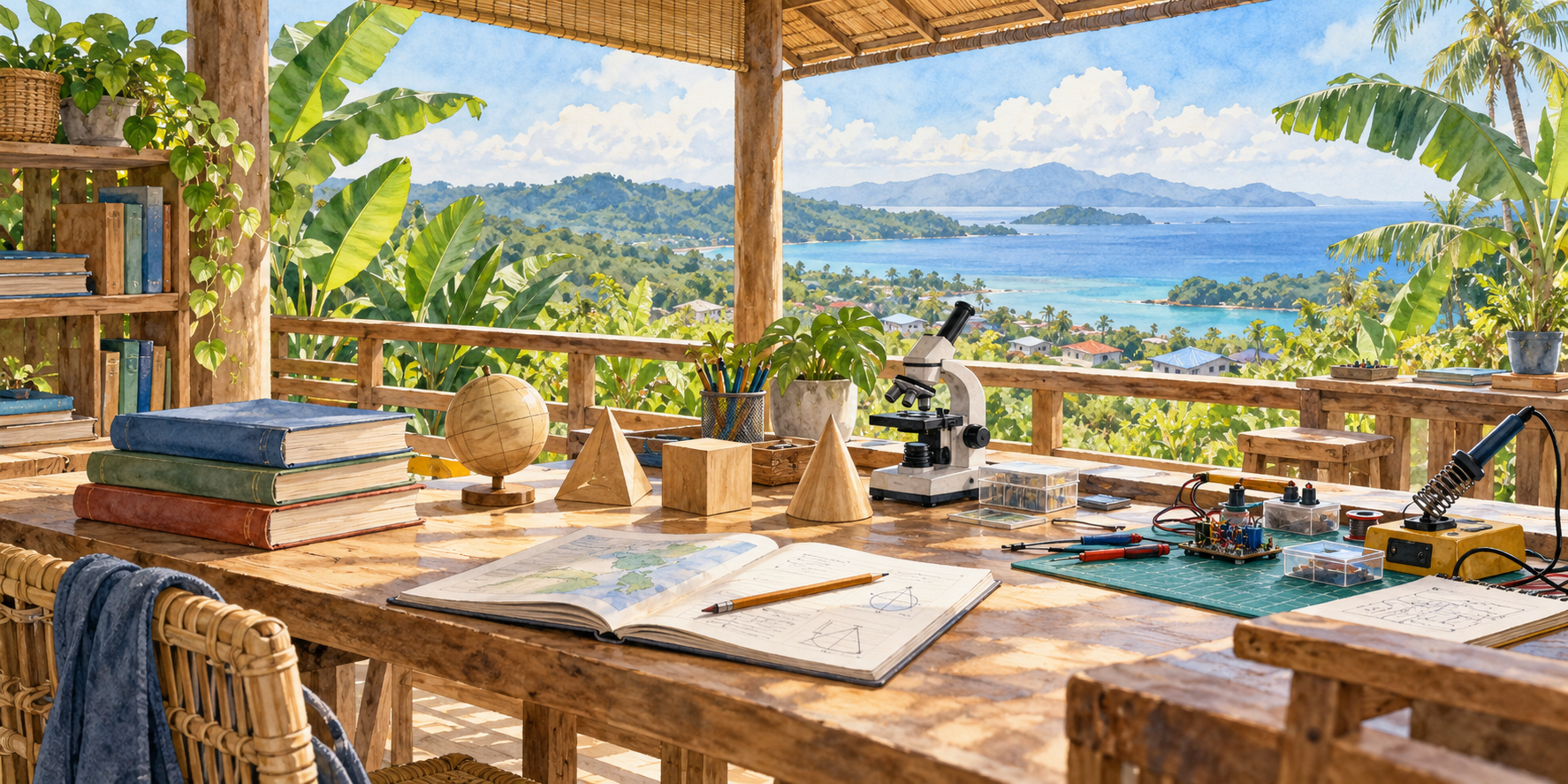
How does the Philippines work? The Philippines is a presidential republic organised through national government, provinces, cities, municipalities and barangays. Its islands connect through ferries, roads, airports, digital networks and public services. Farming, manufacturing, overseas work and business services support the economy, while typhoons and other hazards place extra pressure on transport, homes and schools.
To understand the Philippine government, barangay system, islands, economy and everyday life, follow a familiar journey: how fish reaches a market, how money gets to a family or how a student reaches school during the rainy season. These examples reveal the important connections between local authority, national policies, geography and the people who keep services working.
This guide belongs to How Countries Work, the international companion to How Singapore Works. The full education, tourism, economic and cultural details belong to their existing specialised articles, linked at the end.
The Philippines at a glance
| Question | Short answer |
| Government | Presidential republic with Congress, courts and local government units |
| Local layers | Provinces, cities, municipalities, barangays; Bangsamoro autonomy |
| Economy | Services, manufacturing, farming, fisheries, trade and overseas income |
| Critical links | Ships, ferries, airports, roads, mobile networks and payments |
| Key risks | Typhoons, floods, earthquakes, volcanoes and unequal access |
| Family question | Can essential schools, clinics and markets actually be reached? |
Find your question
- How does the Philippines work in one minute?
- Who runs the government of the Philippines?
- What do provinces, cities, municipalities and barangays do?
- How is Bangsamoro different from an ordinary administrative region?
- Why do the islands make transport so important?
- How do Manila, Cebu, Davao and other cities connect?
- How do jeepneys, trains, buses and ferries work together?
- What does the Philippines produce and export?
- How do overseas Filipino workers and remittances affect families?
- What is business process outsourcing and why does it matter?
- How do farming, fisheries and food prices connect?
- How do typhoons, earthquakes and volcanic risks change the system?
- Why do mangroves, reefs and watersheds matter?
- How does school education connect to the wider economy?
- How do public health and household services reach people?
- How do digital payments and mobile services work?
- A worked example: how does fish reach a household across islands?
- A second example: why does one school day depend on so many systems?
- How can readers verify a claim about the Philippines?
How does the Philippines work in one minute?
The Philippines is an archipelagic republic whose communities, businesses and public services operate across thousands of islands. The national government makes and administers countrywide decisions. Provinces, cities, municipalities and barangays bring many services closer to residents. Ferries, roads, airports, mobile networks, schools and healthcare providers connect people to each other and to markets. The central challenge is not merely making a plan; it is making that plan work in very different places.
A household buying fish shows the connections. Someone goes to sea, another person brings the catch to shore, a cold-storage business protects it, and traders transport it to shops or restaurants. Each step uses fuel, money, safe transport and information. Bad weather can interrupt the route. A child who relies on the same ferry or road to reach school may experience a similar disruption, even though education and fishing look like unrelated subjects.
Different regions have different languages, histories, economic opportunities and climate risks. Manila is important, but it is not the entire country. Cebu, Davao, Iloilo, communities in Luzon, the Visayas and Mindanao, and many smaller islands have distinct needs. This guide explains the national system without treating the experiences of one city as everyone’s reality.
Who runs the government of the Philippines?
The Philippines is a presidential republic. The president leads the executive branch, Congress makes laws through the Senate and House of Representatives, and courts exercise judicial power. The 1987 Constitution sets out these institutions and the legal foundations for local government. The important point is that authority is divided: a law, a budget and a service delivered to a resident are different steps.
National departments manage areas such as education, public works, health and finance. Congress can approve laws and scrutinise spending; the judiciary interprets and applies the law; regulatory agencies and public workers handle many practical decisions. An announced improvement in education will not teach a child unless a school has classrooms, materials and trained staff. The government operates through institutions and people, not only elected leaders.
To understand a particular policy, begin with a sequence: who has legal authority, what funding exists, which department or local unit implements it, who receives the service, and how an error can be corrected. Those five questions are usually more useful than memorising the names of officeholders, which may change after elections or appointments.
What do provinces, cities, municipalities and barangays do?
Article X of the Constitution identifies provinces, cities, municipalities and barangays as territorial and political subdivisions. Local government units have specified powers, responsibilities and revenue sources. A barangay is the smallest familiar local government unit, often the first public office a resident contacts about community matters. But its exact role depends on the issue and applicable law.
Consider a damaged neighbourhood walkway. The responsible body may be a barangay, city or municipality, another public agency or a private property manager. A national highway is a different question. Local leaders may organise community information or services, but they cannot unilaterally repair every network. A good problem report includes the precise location, safety impact and who owns or manages the site.
Local government is meant to make service delivery responsive, yet resources differ between dense cities and rural or island communities. A place with a large tax base may have more options than a small municipality with limited revenue. Central support, coordination and clear responsibilities therefore matter when national standards must be delivered fairly.
How is Bangsamoro different from an ordinary administrative region?
The Bangsamoro Autonomous Region in Muslim Mindanao, usually called BARMM, has a distinct legal arrangement created through the Bangsamoro Organic Law. Its autonomous institutions and transitional political process are not the same as those of an ordinary administrative region. History, self-government, identity and the peace process are central to understanding why the arrangement exists.
Political timing is especially important in 2026. Republic Act No. 12317 rescheduled the first regular Bangsamoro parliamentary elections for September 2026 and extended transitional arrangements. The Supreme Court E-Library’s text of the law explains the legal schedule. A reader should use current official election and regional government records for the resulting officeholders and operational rules rather than treating a past interim structure as permanent.
BARMM also contains communities with different languages, faiths and traditions. The regional label does not mean everyone has the same views or needs. Public services still require safe access, teachers, health workers, budgets and local knowledge. Genuine autonomy can be understood only by examining how the legal powers become practical decisions for families.
Why do the islands make transport so important?
Archipelagic geography changes the economics of ordinary movement. A freight journey may combine a truck, port terminal, inter-island vessel, another truck and a final local delivery. A person visiting relatives may need a bus, ferry or plane. Distances on a map are misleading when a connection is infrequent, weather-dependent or expensive.
Imagine a medicine shipment from a central distribution warehouse to a smaller island clinic. It needs proper packaging, documentation, a temperature-controlled journey when required, port or airport handling and a safe final route. An efficient national procurement system can still fail at the last stage if the local vessel is cancelled or refrigeration becomes unreliable.
This is why roads alone cannot solve every transport problem. Ferries, airports, harbours, intermodal terminals, maintenance and predictable schedules are essential. When one connection closes, the effect can spread into school attendance, food prices, patient referrals and business deliveries.
How do Manila, Cebu, Davao and other cities connect?
Metro Manila concentrates national administration, finance, business services and transport. Cebu and surrounding areas support major trade, manufacturing, education and tourism activities. Davao and other Mindanao centres have their own commercial and regional roles. Iloilo, Bacolod, Cagayan de Oro and many smaller centres add links to a more distributed economy.
Each city needs a functioning local network of homes, public transport, schools, healthcare, energy, sanitation and workplaces. A large port or airport helps reach other markets, but daily productivity also depends on whether a worker can make a safe, affordable commute and whether a local business can receive deliveries reliably.
Urban comparisons are useful when they show mechanisms, not rankings alone. A city may have impressive towers yet struggle with flooding or congestion. Another city may have fewer international flights but a strong local education or agriculture network. Ask which connections make ordinary journeys predictable and which break down under pressure.
How do jeepneys, trains, buses and ferries work together?
Urban and regional transport includes buses, jeepneys, trains, tricycles, ferries, taxis and other services. Their availability, fares and operating rules vary by location. Different modes solve different problems: a major rail line can carry large passenger flows while a small local vehicle connects a neighbourhood with a school or market.
A useful transport diagram begins at the front door, not the railway station. A commuter may walk to a local stop, pay a fare, transfer to another mode and walk again. The total time includes waiting, ticketing, congestion, weather and accessibility. Improving only the fastest segment does not necessarily produce the best whole journey.
Compare this with Singapore’s roads and expressways: both need road hierarchy, junctions and last-mile access. But the Philippines must coordinate across separate islands and a larger variety of local conditions, so the same infrastructure solution cannot simply be copied.
What does the Philippines produce and export?
The economy spans business services, manufacturing, agriculture, logistics, retail, finance, tourism, construction and other work. Semiconductor and electronics supply chains, food production and internationally delivered services are examples of economic activity that require different types of skill and infrastructure. A service can be exported electronically even when no container moves through a port.
Think of an electronics component. A factory needs reliable electricity, materials, equipment, skilled staff and quality controls. Freight operators move inputs and finished products; customs arrangements affect international movement; buyers demand reliable delivery. One small component can have a place in a much larger global product.
The World Bank’s August 2026 update says the Philippines reached upper-middle-income classification. That is an important indicator of national development, not proof that every household has stable work or adequate public services. Income distribution and the quality of jobs remain central questions.
How do overseas Filipino workers and remittances affect families?
Filipinos work in many countries and sectors, including healthcare, maritime services, education, hospitality and technical occupations. When people send money home, those remittances can support food, housing, school fees, savings and small enterprises. Families are also affected by separation, caregiving arrangements and the cost or uncertainty of overseas work.
A remittance crosses a financial network involving an employer, wage payment, transfer provider, exchange arrangements and the receiving household. Its value depends partly on fees and on what local prices can buy. A family may use it for school supplies, but a missing teacher or unsafe road remains a separate problem that money cannot always fix.
Remittances are not a substitute for productive local opportunity. A robust economy aims to offer a genuine choice of work at home or abroad, protect workers and improve the usefulness of money earned. Treat migrant workers as people with lives and families, not just an economic statistic.
What is business process outsourcing and why does it matter?
Business process outsourcing, or BPO, includes services such as customer support, back-office administration and other digitally delivered tasks for domestic and international organisations. The broader information technology and business process management industry also involves more specialised work. A firm can serve clients in another country without physically shipping goods.
Success relies on reliable power and broadband, language and professional skills, cybersecurity, data handling and a well-managed workplace. A new office does little good if staff cannot connect securely or if a flood blocks their commute. Employment can be productive while still raising questions about schedules, work conditions, progression and changing technology.
Automation and artificial intelligence are changing some types of tasks. The practical response is to build adaptable skills, improve foundational education and learn to verify information, use tools responsibly and solve problems that require judgment. Economic resilience depends on people being able to move into valuable work, not only on maintaining yesterday’s job description.
How do farming, fisheries and food prices connect?
Rice farming, fruit production, livestock, fisheries and other agricultural activities support food and livelihoods. Many businesses depend on weather, water, soil, fuel, feed, seed, storage and road or marine transport. Geography means a national food supply can be sufficient in some places while a smaller island faces a high delivered price.
Imagine a banana grown on a farm and sold in a city. The grower prepares land, harvests at the appropriate time, sorts and packs fruit. A truck carries it to a port or market, a ship may transport it to another island, and a retailer receives the product. Every journey creates costs and possibilities for delay or spoilage.
Food policy therefore involves more than a single crop price. Farmers need viable income; families need nutritious food they can afford; ecosystems must stay productive; and transport must be reliable enough that goods are not lost before reaching the buyer. Different pressures affect producers and consumers, which is why simple calls for “cheap food” do not solve the whole system.
How do typhoons, earthquakes and volcanic risks change the system?
The Philippines faces tropical cyclones, heavy rainfall, flooding, landslides, earthquakes and volcanic hazards, but not every locality faces the same level or type of risk. A hazard becomes a social disaster when people, buildings and services are exposed and lack sufficient protection or recovery capacity.
Preparation includes sound land-use decisions, weather and hazard information, evacuation planning, resilient school and hospital buildings, emergency communications and essential supplies. A warning is useful only if residents understand it, trust the information and have a safe and practical way to act. Older people, children and people with disabilities may need additional support.
The most important test comes after the event. Can clean water be restored? Are classrooms safe to reopen? Can roads and ferries resume? Are families able to get medicine or return to work? A system that can repair its essential links quickly is more resilient than one that relies on dramatic emergency announcements alone.
Why do mangroves, reefs and watersheds matter?
Mangroves and coastal ecosystems can support fisheries and help reduce some coastal pressures when they are healthy and appropriately located. Reefs provide marine habitats, and upland watersheds influence water quality and runoff. Environmental protection is therefore connected to food, business, transport safety and health.
Nature is not a magical barrier that prevents every disaster. A mangrove forest cannot replace responsible coastal land-use planning, reliable evacuation or structural protection where necessary. Likewise, healthy watersheds require waste management and sound development decisions alongside conservation rules.
Explore Philippine mangrove ecology vocabulary to learn the precise terms involved. A practical conservation question is whether the ecosystem is in better condition, local communities benefit fairly and the relevant hazards are actually being reduced.
How does school education connect to the wider economy?
Schools provide foundations in literacy, numeracy, science, communication and other areas needed across almost every occupation. The Department of Education manages much basic education policy, while different agencies handle other training and higher education responsibilities. Families need current information because curriculum and examination arrangements change over time.
For 2026, DepEd’s Strengthened Senior High School programme and related issuances show changes affecting senior high curriculum and school calendars. That is why readers should not rely on a static guide listing every subject combination as permanent. The school system must be understood at the child’s year level and under the applicable current rules.
A strong school still needs a functioning wider environment. Teachers require training and materials; students need safe travel and sufficient food; families need time and information; employers need to offer worthwhile opportunities for acquired skills. More school years do not automatically produce better learning without attention to these connections.
How do public health and household services reach people?
Healthcare includes preventive programmes, local facilities, hospitals, specialised referrals, medicines and trained workers. People encounter different public and private providers and financing arrangements. A national policy to widen access must still deliver at a health centre with appropriate staff, supplies and a reliable route for patients.
Clean water, sanitation, electricity and waste collection are public-health systems too. A family in a crowded city may face different issues from a household on a small island where equipment deliveries are infrequent. Electricity matters for refrigeration, clinical equipment and communication as much as for home lighting.
If a person cannot obtain a service, look beyond the final counter. Is the difficulty eligibility, distance, staffing, cost, missing records, supply shortage or damage after a storm? The correct repair depends on locating the failed link rather than simply telling the person to try harder.
How do digital payments and mobile services work?
Mobile banking, digital wallets and electronic transfers can reduce the distance between a customer and a business. A vendor may accept payment through a phone, while a family can send funds across islands without travelling to a branch. The digital system still needs secure identity checks, network coverage, reliable settlement and ways to resolve mistakes.
Suppose a shop accepts a transfer but the network becomes unreliable. The sale may be delayed despite the customer having sufficient money. A person without a smartphone or official documentation may not benefit from the same service. Financial inclusion is meaningful only when the tool is usable, affordable and safe.
Payment technology also makes consumer protection important. Fraud, mistaken transfers, privacy and complaint resolution can undermine confidence. A good digital service has a human support route for difficult cases and makes fees, eligibility and transaction status understandable.
A worked example: how does fish reach a household across islands?
Imagine a fishing crew bringing its catch to a landing site. The crew requires a safe boat, fuel, gear, weather information and proper permissions for the area and activity. Once the catch is landed, it may pass through traders, ice or refrigerated storage, road vehicles and perhaps a ferry before reaching a supermarket, restaurant or local market.
Now follow the supporting systems. The road must be open; electricity may be needed to keep cold storage running; financial services allow payment; workers need food-safety practices; and the retailer needs customers able to pay. A disruption at any stage can reduce quality or increase cost.
Suppose rough seas cancel the inter-island sailing. The fish may be available in one town while supplies decline elsewhere. A new truck cannot solve a cancelled ferry route. Suppose ice becomes expensive because of an energy interruption; storage costs can rise even if the fishing trip was successful. These are examples, not claims about a particular market or day.
This is the operating logic of an archipelago. Good outcomes require dependable links among communities. The useful question is not only how much fish was caught but how safely, affordably and reliably it arrived at the people who wanted it.
A second example: why does one school day depend on so many systems?
Imagine a student on a smaller island preparing for an examination. The student needs a safe home, enough food, learning materials, a qualified teacher and a clear school timetable. If the school is beyond walking distance, transport becomes part of the learning system. Rain and sea conditions may determine whether a crossing is possible.
Suppose a typhoon warning interrupts service. A sensible school response can protect safety but also needs a plan to communicate with families and restore learning later. Internet access may help some students study from home, but only when devices, power, connectivity and quiet space are available. Printed materials and local support may still matter.
Next consider what happens when students finish school. Universities, technical training, employers and migration opportunities offer different routes. A school assessment is useful when it builds capability that survives a change in job or location, rather than merely rewarding short-term memorisation.
The lesson is that educational progress should be measured in actual learning, attendance, safety and opportunity. A ministerial programme can be well intentioned while a student’s experience is limited by a ferry, a power cut or a shortage of teachers.
How can readers verify a claim about the Philippines?
For the constitutional structure and local divisions, consult the Official Gazette and Constitution. For economic classification and the continuing need for better jobs, use the dated World Bank Philippines Economic Update of August 2026. The sources answer different questions and should not be substituted for each other.
For school decisions, check the 2026 DepEd curriculum notices. For Bangsamoro political arrangements, use the applicable autonomy law and newer official records. For hazards or transport disruptions, a current local warning is more useful than an old national average.
Finally ask who is missing from the national overview. Workers on small islands, people in informal settlements, caregivers, Indigenous communities and families far from a major city can have distinct barriers. The most valuable country comparison is not which skyline looks more advanced, but what makes life workable for people in different circumstances.
Frequently asked questions about the Philippines
Is the Philippines a presidential republic?
Yes. The president leads the executive, Congress includes the Senate and House, and courts perform judicial functions under the Constitution.
What is a barangay?
A barangay is a local government unit that performs designated community functions; the correct office for a problem depends on the responsibility.
Why are there so many ferries and domestic flights?
The country is an archipelago, so some journeys and essential shipments require air and maritime links alongside roads.
Is the Philippines an upper-middle-income country in 2026?
The World Bank announced in August 2026 that the country had reached upper-middle-income classification. That does not mean all households have high incomes.
How important are overseas workers?
Overseas Filipino workers contribute skills abroad and remittances to families, but their experiences and economic circumstances vary.
What is BARMM?
The Bangsamoro Autonomous Region in Muslim Mindanao has special autonomous governance arrangements rooted in its organic law and peace process.
Does Manila represent all Filipino life?
No. Cities, provinces, rural and island communities have different transport, economic and public-service conditions.
Why does the country experience frequent disaster risk?
Different islands face combinations of typhoons, flooding, earthquakes, volcanic activity and landslides, with risk shaped by local exposure and preparedness.
Who sets the school curriculum?
DepEd manages major basic-education policy, with separate bodies for higher education and technical training. Current year-specific rules matter.
How is the Philippines different from Singapore?
Both depend on ports, roads, education and services, but the Philippines must connect a widely dispersed archipelago with extensive local governments.
Explore the country series: Return to How Countries Work | A–Z Guide to 195 Countries and Everyday Life, or jump to the P country entries for related country overviews and education guides.
Continue through the connected Philippines and country guides
Use these routes to explore the specialist article relevant to your next question. Each guide has its own job; the national overview connects them.
- Understanding the Education System of the Philippines
- How the Philippines Got So Rich
- Philippines mangrove ecology vocabulary
- Philippines rice terrace conservation vocabulary
- What to learn when visiting the Philippines
- Civilisation Atlas: Philippines and the Sulu world
- How Singapore Works
- How Poland Works
- How Portugal Works
- How Romania Works
Editorial scope, 20 October 2026: This educational systems article distinguishes durable institutions from changing rules. The fish and student journeys are illustrative, not reports about identifiable people or real-time transport. Confirm current education, emergency and service instructions through the relevant authorities.