
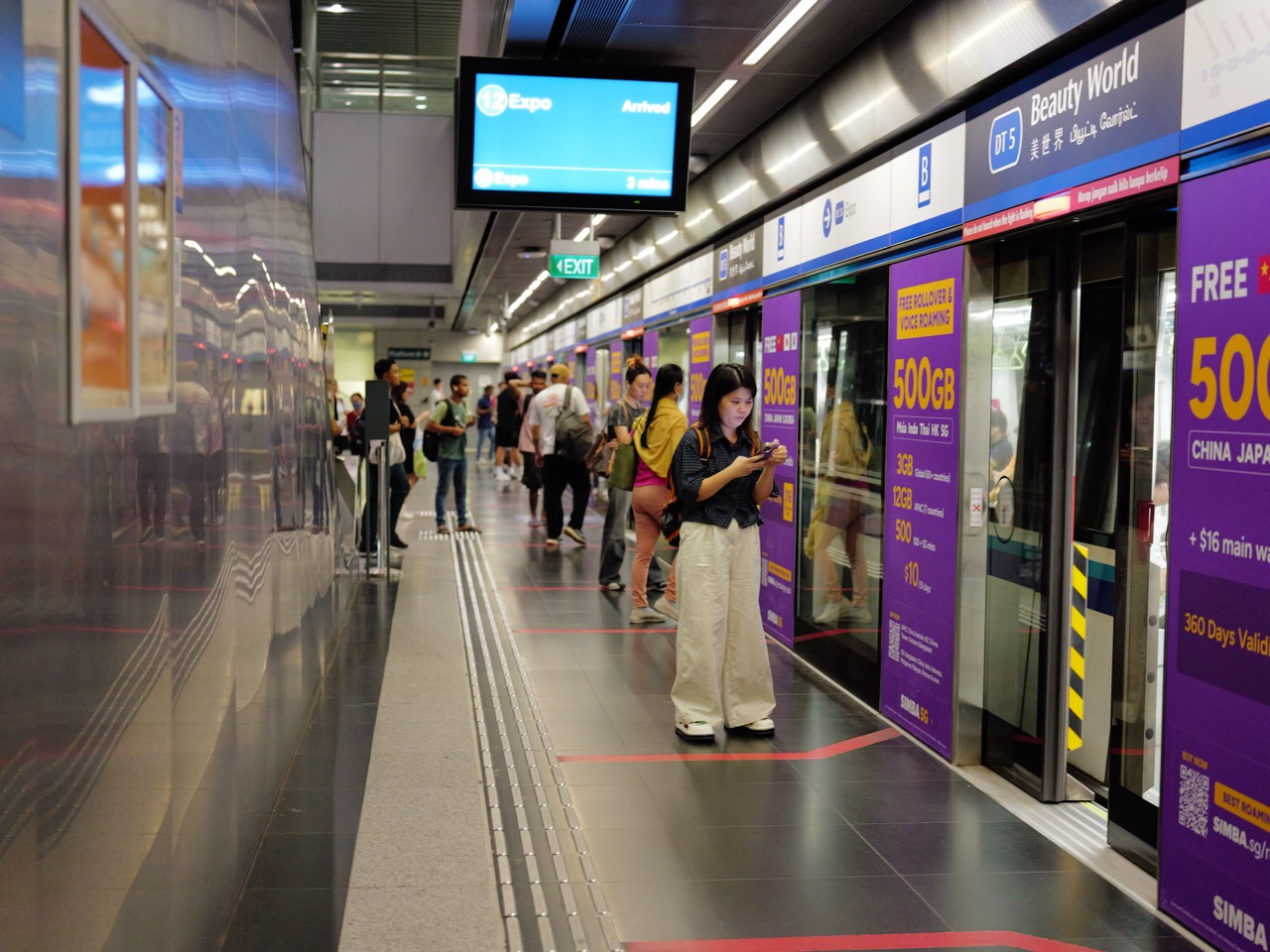
How Singapore connects is not only about trains, tracks and stations.
A railway also needs a nervous system.
Did you know that modern MRT trains can run closer together because signalling systems continuously manage where trains are, how fast they may travel and how much safe separation is required?
The passenger sees a train enter the platform.
Behind that movement are train control, signalling computers, communications, trackside equipment, Operations Control Centres, platform screen doors and safety logic.
This article follows Singapore’s rail-control connection layer: Communications-Based Train Control, train separation, headways, control centres, signalling simulation, platform screen doors and the way software and hardware coordinate trains that may be only minutes—or seconds—apart.
The visible station-and-transfer layer is explored in How Singapore Connects | Bus Interchanges, MRT Stations and Transfer Hubs. The maintenance layer is explored in How Singapore Connects | MRT Depots, Bus Depots and Overnight Maintenance. Here we ask the control question: how does the railway know when a train may move?
Did You Know? Signalling Tells Trains When to Move and When to Stop
LTA’s Rejuvenating the Railway explainer says the signalling system tells trains when to stop or move.
That sounds simple.
At railway scale, it means continuously maintaining safe separation while still moving as many trains as practical.
CBTC Uses Continuous Communication
Communications-Based Train Control, or CBTC, uses frequent communication between trains and the signalling system.
The railway therefore knows more than whether a fixed block of track is occupied.
It can manage train movement with finer resolution.
That supports tighter headways while preserving safety margins.
Did You Know? NSEWL Signalling Can Support 100-Second Headways
LTA says the upgraded North-South and East-West Line CBTC system can support trains at headways of about 100 seconds, compared with 120 seconds before the 2018 upgrade.
Twenty seconds sounds small.
Repeated over a busy hour, it increases how many trains can pass through the line.
Headway Is Railway Capacity Measured in Time
A road lane is often discussed in vehicles per hour.
Rail capacity is strongly affected by the time gap between trains.
Shorter safe headways can increase service frequency.
Signalling therefore converts information into capacity.
Train Separation Is Dynamic
A train ahead slows.
The train behind must remain safely separated.
The signalling system adjusts permitted movement.
The spacing between trains is therefore not just a fixed timetable.
It is a live control problem.
The Operations Control Centre Is the Railway’s Control Room
The OCC monitors train movements and system conditions.
Controllers can see the state of the line and respond to disruptions.
The station platform is local.
The control centre sees the network.
Did You Know? Signalling Is Only One of Several Core Rail Systems
LTA’s 2023 completion of the NSEWL renewal programme described six core systems: sleepers, third rail, signalling, track circuits, power supply and train fleet.
The signalling system can be healthy while another system fails.
Rail reliability therefore depends on several infrastructure layers working together.
Platform Screen Doors Are Part of the Control Interface
Platform screen doors separate passengers from the track area.
They also have to coordinate with train stopping position and door operation.
The train arrives.
Train doors align.
Platform doors open.
Passenger exchange happens.
Doors close.
Train departs.
A simple boarding event is a synchronised machine sequence.
Full-Height and Half-Height Doors Solve Similar Problems
Underground stations commonly use full-height platform screen doors.
Some elevated systems use half-height doors.
Both create a controlled boundary between passenger space and track space.
CBTC Supports Automated Train Operation
LTA’s Jurong Region Line systems description says its CBTC signalling design supports fully automated train operations.
Automation does not mean the railway has no humans.
It means train movement can be controlled automatically within a designed operating framework, while control-centre staff supervise the wider system.
The Signalling System Connects to Train Braking
A movement authority is useful only if the train can obey it.
Braking performance, train speed and signalling logic therefore belong to the same safety chain.
Software rules must match physical vehicle capability.
The Signalling System Connects to Power
No traction power, no train movement.
That links signalling to How Singapore Connects | Electricity Grid, Substations and Power Distribution.
The railway nervous system still depends on the railway muscles.
The Signalling System Connects to Communications
CBTC needs reliable communications between trains and infrastructure.
Radio or network failure can therefore affect train-control capability.
That links the railway to How Singapore Connects | Broadband, Mobile Networks and Public Wi-Fi, although rail signalling uses specialised operational communications rather than ordinary public internet.
Did You Know? Singapore Uses Signalling Simulation Facilities
LTA set up signalling simulation facilities for the Downtown Line and Thomson-East Coast Line so software patches can be tested in controlled environments before deployment to the mainline.
That is a software-engineering lesson inside railway engineering.
Do not test risky changes first on the live system if a realistic simulation can expose faults earlier.
Simulation Lets Engineers Reproduce Faults
A live disruption is a terrible time to learn how a signalling bug behaves.
A simulation environment can reproduce conditions, test patches and train engineers.
The railway gains a laboratory.
Condition Monitoring Makes Signalling More Predictive
LTA’s Jurong Region Line signalling contract includes condition-monitoring capabilities intended to support predictive maintenance over the system life cycle.
Instead of waiting for a component to fail, monitoring can reveal deterioration earlier.
Maintenance becomes more targeted.
The Platform Door System Can Report Its Own Health
Modern door systems can be monitored for faults.
A door that fails to close can delay departure.
One small component can affect the whole line if it blocks platform operation.
One Door Fault Can Become a Network Delay
Train waits.
Passengers accumulate.
The next train approaches.
Headways widen.
Crowding moves downstream.
Railway systems amplify small delays because trains share one corridor.
Signalling Changes How Close Trains Can Run
Older systems often use larger fixed separations.
Modern CBTC can allow a more precise moving separation model.
That does not remove safety margins.
It makes them more information-rich.
The Timetable Is the Plan; Signalling Is the Real-Time Reality
The timetable says when trains should arrive.
Signalling manages what trains are allowed to do right now.
When delays occur, the real-time control system matters more than the original schedule.
The Railway Is a Queue That Moves
Trains enter stations.
Passengers board.
Doors close.
Trains move to the next station.
Every dwell-time variation affects the train behind.
Signalling manages the moving queue.
Dwell Time Can Dominate Capacity
Even perfect signalling cannot move a train through a station while doors are open.
Crowded boarding increases dwell time.
That is why platform management, passenger behaviour and train-control systems belong in the same capacity discussion.
Platform Screen Doors Help Control Passenger Flow
Doors create defined boarding points.
Queue markings can align passengers.
Priority zones can improve access for vulnerable users.
This links signalling hardware to How Singapore Connects | Public Transport Accessibility, Barrier-Free Routes and Priority Travel.
Signal Upgrades Can Require Service Adjustments
Rail systems cannot always be replaced while running at full service.
Testing may require early closures, late openings or full-day closures.
The maintenance article How Singapore Connects | MRT Depots, Bus Depots and Overnight Maintenance explains why engineering hours are scarce.
Software upgrades still need physical railway time.
System Integration Is the Hard Part
A new train must talk correctly to signalling.
Signalling must coordinate with platform screen doors.
Control centres must see the new equipment.
Power and communications must support it.
The railway works when interfaces agree.
The Changi Airport TEL Conversion Shows Integration Complexity
LTA’s 2025 plans for converting existing East-West Line stations toward the Thomson-East Coast Line extension include changes to signalling, communications, controls, power supply, platform screen doors and tracks.
A station cannot simply change its line colour.
Its technical systems have to become compatible.
A Small Example: Train Approaches Station
Signalling authorises movement.
Train decelerates.
Automatic train control stops it at the target position.
Train doors align with platform doors.
Doors open.
Passengers exchange.
Doors close and prove secure.
Train receives authority to move.
The whole sequence is a controlled handshake.
A Small Example: Train Ahead Is Delayed
Front train remains in station longer than expected.
Signalling restricts the following train.
Gap changes.
Control centre monitors the developing delay.
Service regulation may adjust train movement.
One delay becomes a network-management problem.
A Small Example: Software Patch
New signalling patch is developed.
Engineers test it in simulation.
Fault scenarios are reproduced.
Issues are corrected.
Patch is scheduled for deployment during engineering hours.
Mainline risk is reduced.
What Can Break the Rail-Control Connection?
- signalling software fault;
- communications failure;
- trainborne equipment fault;
- trackside equipment fault;
- platform screen door fault;
- power interruption;
- incorrect system integration;
- software change not sufficiently tested;
- sensor or position error; and
- crowding causing extended dwell time.
A modern railway is safe because failures are anticipated, detected and constrained.
How to Read Rail Signalling Like a Systems Thinker
1. Find the train position
How does the control system know where each train is?
2. Find the movement authority
How far may the train proceed?
3. Find the headway
How close can the next train safely follow?
4. Find the station handshake
Train stop, platform doors, dwell and departure.
5. Find the control centre
Who sees the whole line?
6. Find the test environment
How are changes validated before live deployment?
7. Find the fallback
How does the system degrade safely when something fails?
The eduKate Singapore Graph: Signalling Is Time Turned into Safety
Tracks provide space.
Trains provide movement.
Signalling provides permission.
The system decides who may occupy which part of the railway and when.
That is how information becomes safe capacity.
Frequently Asked Questions
What does railway signalling do?
It controls and coordinates train movement so trains maintain safe separation and follow authorised movement conditions.
What is CBTC?
Communications-Based Train Control is a modern signalling approach using frequent communication between trains and control infrastructure for more precise train management.
How close can NSEWL trains run under the upgraded system?
LTA says the system can support headways of about 100 seconds.
What is headway?
The time gap between successive trains travelling along the same line.
What are platform screen doors?
They are doors separating passengers from the track area that open in coordination with train doors.
Can signalling support driverless operation?
Yes. Modern CBTC systems can support fully automated train operation when designed and integrated for that mode.
Why does LTA use signalling simulators?
To test software enhancements and fault scenarios in a controlled environment before changes reach live passenger lines.
Why can signalling work require service closures?
Some testing and installation needs uninterrupted access to railway systems that cannot be safely performed during normal passenger service.
Is signalling the only system that controls rail reliability?
No. Tracks, power, trains, communications, doors and many other systems also matter.
Where can I read official material?
LTA | Rejuvenating the Railway.
Helpful Reading and Singapore Graph Connections
- LTA | Rejuvenating the Railway
- LTA | Signalling Simulation Facilities
- LTA | Cross Island Line Signalling and Platform Screen Doors
- How Singapore Connects | MRT Depots, Bus Depots and Overnight Maintenance
- How Singapore Connects | Public Transport Accessibility, Barrier-Free Routes and Priority Travel
How Singapore Connects: The Train Moves Because the Railway Says It May
Did you know that the most important thing a train receives may not be electricity?
It receives permission.
Move.
Slow.
Stop.
Open doors.
Close doors.
Proceed.
Signalling turns thousands of those permissions into one smooth journey.
The passenger sees motion.
The railway sees control.