
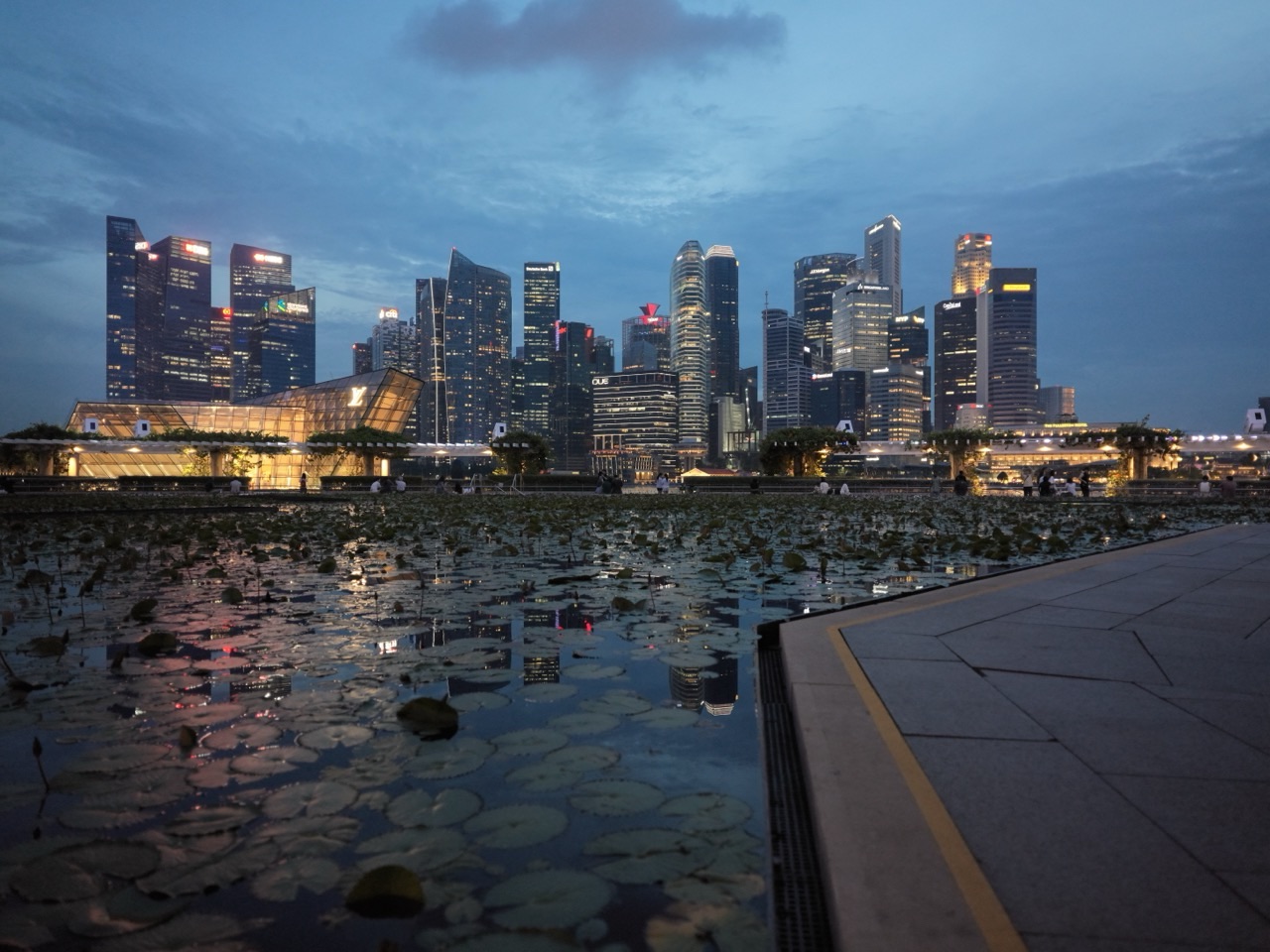
How Singapore connects is not only about roads, rails and data.
Water connects the island too.
Did you know that the rain falling on a school roof, road, park or HDB estate can eventually become part of Singapore’s water story?
Rain enters drains and canals. Some of it is channelled toward reservoirs. Water is treated, stored, pumped and distributed. Used water is collected again, treated again and, through NEWater, can return to the system in another form.
The tap in a kitchen looks simple.
The network behind it is not.
This article follows Singapore’s water connection layer: local catchments, reservoirs, drains, canals, waterworks, NEWater, desalination, used-water collection and the blue-green spaces that bring water infrastructure into everyday life.
The canonical water-security owner remains What happens in Civilisation | Water Security, Drinking Water, Sanitation and Drought Resilience. Here the question is the connection itself: how does water move through Singapore from sky, sea and source to reservoir, treatment plant, building, drain and back into the wider water cycle?
Did You Know? Singapore’s Water System Begins with Four Different Sources
PUB describes Singapore’s water supply through the Four National Taps: local catchment water, imported water, NEWater and desalinated water.
That is already a network lesson.
Singapore does not depend on only one source.
Different sources have different strengths, constraints and operating costs.
Together they form a portfolio.
Local Catchment Water Turns Rain into Supply
Rain falls across the island.
The challenge is to collect useful water while also preventing flooding.
Drains and canals therefore do more than remove stormwater from streets.
They are part of a larger catchment system.
PUB says Singapore has developed a network of about 8,000km of drains, canals and rivers and 17 reservoirs. Many waterways ultimately feed reservoirs used in the water-supply system.
The same infrastructure therefore has several jobs: drainage, conveyance, water collection and, increasingly, public-space value.
A Drain Can Be Both Utility and Landscape
PUB’s Active, Beautiful, Clean Waters Programme was launched to integrate drains, canals and reservoirs more closely with the surrounding environment.
That means a functional waterway can also become a community space.
The engineering remains important.
The public experience changes.
A canal can carry stormwater and still support a park, path, wetland or waterfront.
Did You Know? Bishan-Ang Mo Kio Park Is a Water-System Lesson You Can Walk Through
The Kallang River at Bishan-Ang Mo Kio Park is one of Singapore’s best-known examples of blue-green integration.
A concrete channel was transformed into a more naturalised river environment with space for water to spread during heavy rain.
People experience a park.
The water system experiences flood capacity, conveyance and ecological function.
One landscape performs several jobs at once.
Reservoirs Are Storage Nodes
A reservoir stores water.
That sounds obvious, but storage changes the entire system.
Rainfall is irregular.
Demand is continuous.
Storage allows the network to separate the timing of supply from the timing of use.
The reservoir is therefore a buffer between weather and daily life.
Marina Reservoir Shows How the City Itself Becomes Catchment
Urban areas can be part of water collection when drainage is designed to direct runoff into reservoirs.
This changes the old idea that catchments must be remote forested landscapes.
A dense city can capture water too.
The rooftops, roads and drains become part of the hydrological network.
Imported Water Adds Another Geographic Source
Singapore also receives imported water from Johor under existing agreements.
This shows that water systems can cross political boundaries.
Pipes and reservoirs do not stop being physical infrastructure because they cross a border.
They simply become international infrastructure.
NEWater Connects Used Water Back into Supply
Used water does not have to be the end of the story.
Singapore collects and treats used water, and part of that treated water is purified further to produce NEWater.
NEWater is used especially for industrial and air-conditioning purposes, with a portion also added to reservoirs during dry periods before conventional treatment.
This creates a loop.
Water is used, collected, treated and made useful again.
The Deep Tunnel Sewerage System Is the Hidden Return Network
If water supply is the outward journey, used-water collection is the return journey.
Singapore’s Deep Tunnel Sewerage System moves used water toward centralised water reclamation facilities.
This network is mostly invisible.
Yet it is essential because modern cities need both delivery and removal.
A tap without sanitation is only half a water system.
Desalination Connects the Sea to the Tap
Singapore is surrounded by seawater.
Desalination removes salts from seawater to produce fresh water.
That adds another source independent of rainfall.
The trade-off is energy use.
This is why water and electricity systems are connected even when people experience them as separate utilities.
Water Treatment Connects Source to Human Use
Raw water is not automatically drinking water.
Treatment plants remove impurities and make the water suitable for supply.
The system therefore has a quality transformation step between source and consumer.
In systems language, the input and output are both water.
Their quality states are different.
Pumps Turn Stored Water into Pressure
Water does not move through a high-rise city by hope.
Pressure is required.
Pumps, service reservoirs, pipes and building systems help move water to the places where it is needed.
A glass filled on a high floor depends on a pressure network extending far beyond the kitchen.
Lifts and Water Have More in Common Than They Seem
In How Singapore Connects | Lifts, Escalators and Vertical Mobility, height changes the movement problem for people.
Height changes the water problem too.
Moving water upward requires pressure and energy.
Tall buildings therefore have their own internal water-distribution logic.
Vertical cities need vertical utilities.
Rainfall Can Be Both Resource and Hazard
The same rain that fills reservoirs can also overwhelm drainage if too much falls too quickly.
Water management therefore has to balance collection and flood protection.
Drains, canals, detention features and catchment planning help manage sudden flows.
The system is not trying to eliminate rain.
It is trying to route it intelligently.
Did You Know? Drainage Capacity Is a Time Problem
A drain can handle a certain flow rate.
Flood risk rises when water arrives faster than the system can carry or store it.
That means rainfall intensity matters, not only rainfall total.
Two storms with the same total rain can behave very differently if one delivers the water much faster.
Blue-Green Infrastructure Connects Water to Recreation
PUB has progressively opened several reservoirs for activities such as kayaking, dragon boating and designated fishing under the ABC Waters approach.
This changes public understanding.
A reservoir is no longer only a fenced utility asset.
It can also become a visible part of community life.
The public sees the resource it depends on.
Park Connectors Often Follow Water
The green-route network described in How Singapore Connects | Park Connectors, Cycling Paths and Green Routes frequently runs beside canals, rivers and reservoirs.
That means blue infrastructure and green infrastructure often share corridors.
A canal carries water.
A path carries people.
Vegetation creates shade and ecological value.
One linear space supports several networks.
Water Connects to Food
Food production and food preparation require water.
That links the water network to How Singapore Connects | Food Distribution, Supermarkets and Supply Chains.
A food-security system cannot be separated completely from water security.
Water is one of the hidden inputs in every meal.
Water Connects to Electricity
Pumping, treatment, desalination and water reclamation use electricity.
Power outages can therefore affect water operations.
Water planning and energy planning intersect.
The systems are distinct.
The dependencies are real.
A Small Example: The Rainstorm
Rain falls over an estate.
Roof drains and surface drains collect runoff.
Water enters larger drains and canals.
Some flows move toward reservoirs or waterways.
The same storm that darkens the sky has entered the national water and drainage network.
A Small Example: The Kitchen Tap
A resident opens a tap.
Water arrives under pressure.
Behind that moment are source water, treatment, storage, pumping, pipes and building distribution.
The user sees one handle.
The system sees a chain.
A Small Example: The Used-Water Return
Water leaves a sink or shower.
It enters the sewer network.
It travels toward treatment.
After reclamation, some water can eventually become NEWater.
The system closes part of the loop.
What Can Break the Water Connection?
- extreme rainfall;
- drain blockages;
- pipe leaks;
- pump failures;
- treatment disruptions;
- power failures;
- pollution entering catchments;
- poor maintenance;
- building-level plumbing problems; and
- drought reducing local catchment inflow.
Water resilience therefore depends on diversity, maintenance, monitoring and alternative pathways.
How to Read Singapore’s Water System Like a Systems Thinker
1. Find the source
Rainfall, imported water, NEWater or desalinated water?
2. Find the storage
Reservoir, service reservoir or tank?
3. Follow the quality transformation
Where is water treated or purified?
4. Follow the pressure
How does water reach the building and upper floors?
5. Follow the return
Where does used water go?
6. Watch the weather
Rainfall changes both supply and drainage conditions.
7. Look for multi-use infrastructure
Can the same waterway support drainage, recreation, ecology and public space?
The eduKate Singapore Graph: Water Is the Hidden Blue Layer
Singapore’s local articles already contain rivers, reservoirs, canals, parks, housing estates and industrial areas.
The water network connects those places in another way.
A hill becomes catchment.
A canal becomes conveyance.
A reservoir becomes storage.
A treatment plant becomes transformation.
A pipe becomes distribution.
A sewer becomes return.
Once we see those relationships, the island becomes a water machine as well as a city.
Frequently Asked Questions
What are Singapore’s Four National Taps?
PUB identifies them as local catchment water, imported water, NEWater and desalinated water.
How many reservoirs does Singapore have?
PUB states that Singapore has 17 reservoirs.
How extensive is Singapore’s drainage and waterway network?
PUB states that Singapore has about 8,000km of drains, canals and rivers.
What is NEWater?
It is high-grade reclaimed water produced by further purifying treated used water.
What is desalination?
It is the process of removing salts from seawater to produce fresh water.
Why are reservoirs important?
They store water, separating the timing of rainfall from the timing of water demand.
Why are drains part of water supply?
In Singapore, many drains and canals help route rainwater through local catchments toward reservoirs while also providing flood protection.
What is ABC Waters?
PUB’s ABC Waters Programme integrates water infrastructure with public spaces, ecology and landscape design.
Is this the main eduKateSG water-security article?
No. The canonical broader owner is What happens in Civilisation | Water Security. This page owns the connection lens.
Where can I check current official information?
Helpful Reading and Singapore Graph Connections
- PUB | Singapore Water Story
- PUB | ABC Waters
- What happens in Civilisation | Water Security
- How Singapore Connects | Park Connectors, Cycling Paths and Green Routes
- How Singapore Connects | Food Distribution, Supermarkets and Supply Chains
How Singapore Connects: The Rain on the Roof Is Part of the City
Did you know that the next glass of water begins long before you touch the tap?
It may begin as rain.
Or seawater.
Or imported water.
Or reclaimed used water.
It moves through reservoirs, treatment plants, pipes, buildings and people.
Then another network carries used water away.
The loop continues.
Singapore’s water system connects sky, sea, land, infrastructure and daily life.
And once you see that blue layer, every drain, canal, reservoir and tap becomes part of the same graph.