
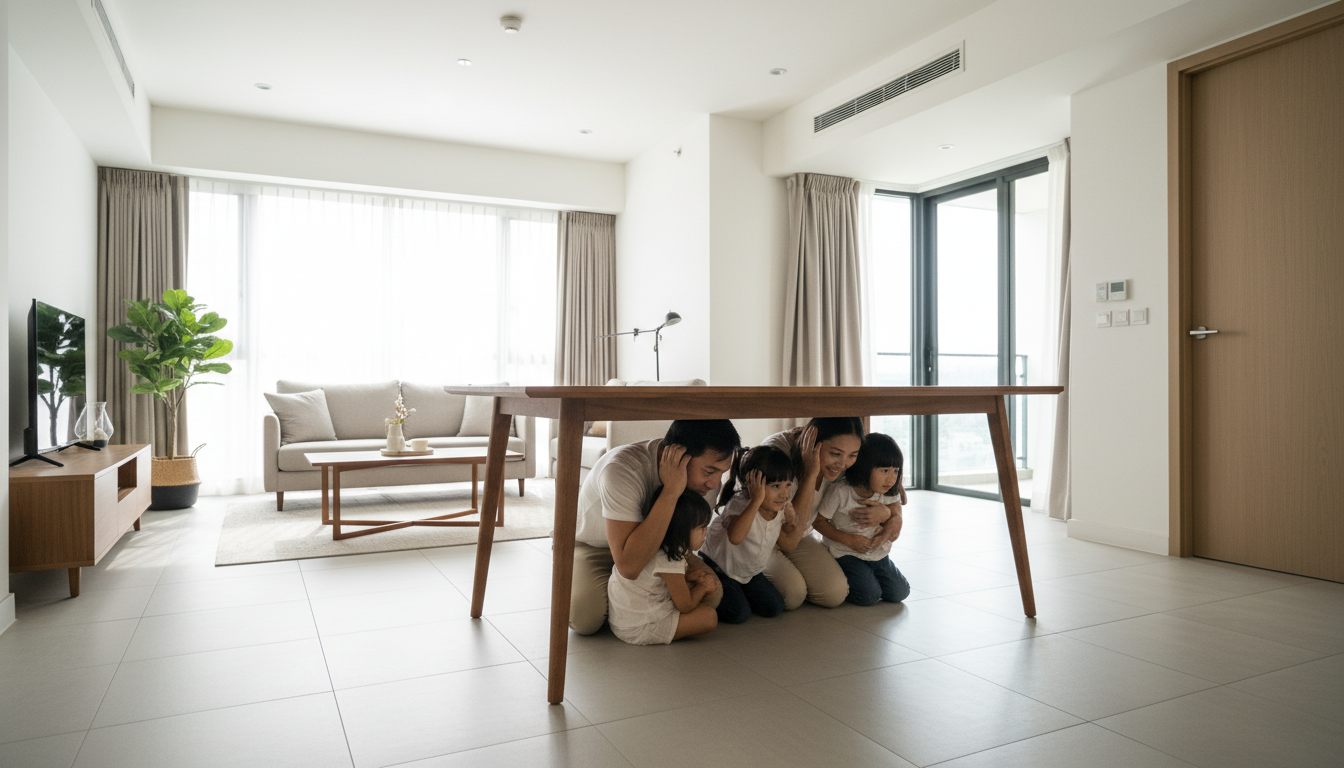
If you feel an earthquake shaking a high-rise apartment, drop to your hands and knees, cover your head and neck beneath a sturdy table if one is close, and hold on until the movement stops. Stay away from windows, heavy shelves and hanging fittings. Do not rush into a lift or down a stairwell while the building is moving. Once the shaking finishes, check for injuries, serious damage, fire, gas leaks and official building instructions before deciding whether to stay or evacuate.
Singapore lies outside major earthquake zones. The Building and Construction Authority (BCA) explains that buildings in Singapore are designed to withstand tremors from distant earthquakes, although people can sometimes feel shaking from regional events. This playbook is useful for Singapore households and travellers in earthquake-prone places, not a prediction that a destructive local earthquake is imminent. Strong local earthquakes abroad can demand additional evacuation, aftershock and tsunami precautions.
- During shaking, Drop, Cover and Hold On; protect your head and neck.
- If indoors, stay indoors until shaking stops; do not race outdoors past falling objects.
- In high-rise buildings, stay away from exterior glass and unsecured furniture.
- If outside, stay in an open area away from façades, poles and cables.
- If driving, pull over safely away from bridges and overhead hazards.
- After shaking, check people, exits, fire, gas and electrical hazards, and visible damage.
- Avoid lifts when shaking occurs or their safety is uncertain; follow authorised evacuation arrangements.
- In earthquake zones, expect aftershocks and repeat protective actions.
- In Singapore, report building concerns to management, HDB/EMSU or BCA, and call 995 or 999 for life-threatening emergencies.
- When a strong earthquake occurs near a tsunami-prone coast, follow the local immediate high-ground evacuation guidance.
Quick Information: What Singapore Authorities Say
The BCA earth-tremor guidance advises indoor occupants to shelter under a table, avoid naked flames and avoid lifts. Outdoors, stay in the open away from buildings. Singapore’s buildings are generally safe from distant tremors; this reassurance is important because fear can produce injuries if residents rush unnecessarily down crowded staircases.
The Ministry of Foreign Affairs earthquake travel advice recommends getting under a table and holding on, covering the head and neck, then leaving through stairs rather than lifts if evacuation is appropriate after shaking. The CDC earthquake instructions updated in 2026 likewise advise people to stay inside when already indoors, drop low, cover and hold on.
For an actual disaster, follow local government, emergency-response, building management and transport notices. The severity and recommended response vary substantially between a distant tremor in Singapore and a damaging earthquake close to an active fault.
What Makes a High-Rise Earthquake Different?
A tall building may sway more noticeably at higher levels when long-period waves from a distant earthquake arrive. Swaying is not the same as collapsing. Buildings can be designed to move within expected engineering limits. However, residents cannot assess structural integrity solely by the feeling of movement, and serious new cracks, displaced structural elements or falling concrete warrant professional assessment.
Several everyday things may hurt people before any structural problem occurs: wardrobes tip, ceiling decorations fall, glass breaks, objects tumble from shelves, and someone runs into a staircase and trips. The hazard most within a household’s control is where people are standing when shaking begins. Choosing a nearby sturdy table and protecting the head is often more useful than searching for the most impressive emergency gear.
The word Black Swan describes an unusually consequential disruption that is difficult to anticipate. It should not be used to imply that every tremor is a rare catastrophe. The reader’s question is simpler: Which actions protect me during shaking? What damage would require help afterward? How can my family communicate and maintain essential care?
The First 10 Seconds: Act, Do Not Analyse
Get low immediately, on hands and knees if able, before movement knocks you down. Cover your head and neck under strong furniture, such as a sturdy desk or dining table, if it is within immediate reach. Hold the furniture so it does not move away. If there is no available sturdy cover, crouch beside a safe interior wall and shield the head and neck with arms.
Do not run to a doorway merely because an old saying calls it the safest place. Modern earthquake instructions do not regard doorframes as universal protective locations. A doorway may swing, contain glass, or place a person in the path of others. Do not jump from windows, move to an exposed balcony or try to stand against an exterior wall to film the skyline.
If using a wheelchair, walker or similar aid, adapt the same principle: lock the wheels if appropriate, remain seated when safer, and protect the head and neck. A helper should not force someone to stand or move through an unstable room to perform an idealised drill. A safe, accessible position beats a dangerous attempt to reach a table on the other side.
Should I Run Down the Staircase?
Not while shaking continues. Staircases, entrances and lower floors may expose people to falls, falling glass and congestion. In a tall building, a person running from an upper floor during a brief tremor may still be on the stairs after the shaking ends. The rush creates risk without necessarily improving protection.
After shaking, check whether building management has announced an evacuation or reported serious defects. An intact building with no urgent hazard may not require everyone to leave. A building with significant damage, smoke, gas leakage or a legitimate evacuation direction requires a different choice. Use safe stairs when directed, and do not rely on a lift whose function or structural safety may be uncertain.
People who cannot use stairs need a separate accessibility plan. Ask management beforehand how assistance is arranged, and never improvise a risky manual carry down many flights during an emergency without trained guidance. A person with reduced mobility can often be assisted through communication, medical support and qualified responders rather than an unsafe rush.
What To Do When the Shaking Stops
First, check injuries. Someone who is bleeding heavily, having trouble breathing, trapped or seriously injured needs urgent help. Give first aid within your skills if safe and contact emergency services. Do not move a person with a possible spinal injury unless immediate danger demands it or trained responders advise.
Next, identify immediate threats: broken glass, falling ceiling materials, exposed wiring, damaged gas connections, fires, unstable furniture, blocked exits and severe new structural cracks. Do not explore a damaged room for the purpose of taking photographs. Observe from a safe place and communicate factual details to management or responders.
Third, count the household members and note who is absent, at school or away for work. Fourth, obtain official notices. Fifth, plan the next hour: shelter safely if the building remains appropriate, or move using an authorised safe route if evacuation is needed.
The end of shaking is the start of inspection and continuity decisions, not an automatic all-clear. A road, stairwell, bridge or water line may have problems that were not apparent at the moment the building first moved.
Visible Damage: What Can Residents Assess?
Residents can recognise warning signs but cannot certify a structure. New major cracks in columns or beams, visible displacement, falling concrete, sudden changes in floors, damaged structural connections and compromised stairways need qualified assessment. A plaster hairline crack and a crack in a load-bearing member are not automatically equivalent.
BCA advises reporting tremors and defects using the relevant BCA or HDB channels, or the management office for private premises. If there is immediate danger of collapse, fire or someone trapped, use the emergency channels. Emergency lines must remain available for people who need rescue and urgent medical support.
Never conclude that an entire estate is unsafe from a forwarded video of one ceiling light swaying. Conversely, do not dismiss a serious visible hazard because a neighbour says Singapore buildings are strong. The correct middle ground is professional assessment and incident-specific instructions.
Gas and Electrical Hazards
If gas may be leaking, avoid flames, smoking, matches and operating electrical switches that could spark. Move away from the hazard, alert those nearby and obtain utility or emergency help from a safe location. Do not return to inspect piping or operate equipment out of curiosity.
Damaged electrical wiring and wet sockets are also dangerous. Keep children away from exposed cables and use a torch instead of improvised flames. If electricity is unavailable or appliances are visibly damaged, follow the provider and qualified electrician’s guidance before restarting them.
Water leaks create additional hazards when they reach electrical equipment, stairs or lift systems. Tell the building manager what you can observe and avoid touching equipment in flooded areas. Services may return at different times; a power restoration notice does not prove all fittings are safe.
What If You Are Outdoors?
Stay outside during the shaking and move to a safe open place away from buildings, trees, power lines, signs and any structure that could fall. If you are already close to a façade, seek a clear area without running into traffic. Kneel or crouch and cover the head and neck when necessary.
Shopfronts and covered walkways can contain glass and hanging fixtures. A roof over your head is not automatically a safe shelter during falling debris. Once shaking ceases, follow local authorities’ instructions on access and avoid damaged buildings.
Do not cross a blocked road or enter an unstable station entrance simply because it is your familiar shortcut. The normal route may remain closed for inspection even if no visible debris remains.
What If You Are Driving or Using Public Transport?
Pull over safely as traffic permits and avoid bridges, overpasses, power lines, lamp posts and large trees. Stay in the vehicle until shaking stops. Resume only when you can assess road damage, traffic management and official restrictions. Do not stop in a dangerous position to film the event.
On public transport, obey station and vehicle staff. Do not force doors open or climb into tunnels. Crowds moving rapidly can produce additional falls and block emergency routes. A paused train may simply be a safety precaution while operators check the system.
If a station or route closes, wait for the operator’s verified alternative. A transport app that still displays normal services may not reflect a very recent incident. Human staff and official service notices are important.
Aftershocks Change the Next Decision
In earthquake-prone regions, smaller aftershocks can occur minutes, days or weeks after the initial event. The CDC advises repeating Drop, Cover and Hold On when more shaking occurs. Partially damaged structures can become more dangerous, making re-entry restrictions especially important.
Do not return to a damaged home because the first shock was over or because a family member wants a bag. Your life is not improved by retrieving an item from an unstable room. Obtain permission from responsible officials and qualified assessors where relevant.
In Singapore, tremors from distant earthquakes are not the same as experiencing a destructive fault rupture locally. But a traveller in another country should monitor its seismic service, building authorities and emergency broadcasts. There is no single global aftershock timetable that can replace local observations.
First Hour: A Safe Household Checklist
- Check people for serious injuries and contact emergency help where necessary.
- Determine whether the building has visible urgent hazards or an evacuation instruction.
- Keep away from gas, damaged electrical equipment and areas of falling debris.
- Account for children, older family members, pets and anyone requiring assistance.
- Save phone battery and send one short verified status message.
- Check official building, utility, transport and local government notices.
- Keep footwear and a torch accessible in case movement later becomes necessary.
- Do not circulate invented earthquake predictions or building-collapse warnings.
These simple actions reduce the most avoidable risks. They also avoid turning a manageable tremor into a crisis caused by crowding, rumours or a rushed journey across town.
Hours 1–6: Check Access to Essential Services
A family may remain physically safe but lose access to a lift, water, electricity or part of its building. Ask whether everyone can obtain drinking water, medicines, food and toilets. Does an elderly resident need help because the lift is closed? Is somebody dependent on a powered medical device? The answer may require a clinician, maintenance team or trusted neighbour.
Avoid assuming the water supply is contaminated solely because the building moved. Follow specific utility notices. Where pipes or electrical systems are visibly damaged, use appropriate precautions rather than trying to restore them yourself.
If another location becomes necessary, verify that the route is open and the destination is genuinely safe. Avoid naming a particular school, MRT station or basement as an emergency shelter unless the authorities have designated it for the incident.
Hours 6–24: Stabilise School, Work and Medical Care
A child at school may be safer staying with authorised staff until collection arrangements are confirmed. Do not order a child to leave independently or travel along a route under assessment. Ask the institution for its official plan, and relay concise information to the family.
Adults should check whether their workplace is safely operating and whether travel is advisable. Non-urgent appointments can be rescheduled, but critical medical care and prescriptions should be managed through the actual provider. A disruption is not an excuse to stop an essential treatment without professional advice.
If the family must temporarily relocate, carry necessary medication, identification, accessible equipment, childcare supplies and emergency contacts. Do not try to move expensive or bulky possessions before ensuring that people have a safe route.
Days 2–3: Repairs, Housing and Recovery
Qualified professionals should assess suspected serious structural damage. Photograph losses from safe positions, document notices and retain receipts if insurance or property-management procedures require them. Do not alter structural elements yourself or enter a restricted area to retrieve evidence.
Staircases, building exteriors, damaged roads and utility systems may be opened in stages. Do not treat restoration of one service as proof that all parts of a building are safe. Communicate clearly about which rooms or routes remain off limits.
When ordinary routines resume, examine what failed in your family plan. Was the emergency contact number outdated? Did anyone lack footwear? Could a grandparent receive reliable information without a smartphone? Small corrections are the most useful form of learning from a disruption.
When Shaking Happens at Night
A night-time event adds darkness, confusion and broken glass. Keep sturdy shoes and a torch near sleeping areas. Do not use candles or naked flames after a tremor, especially if there is any concern about gas or damaged utilities.
If shaking starts, avoid attempting to sprint through a dark corridor toward a distant room. Protect the head and neck where you are, away from windows and heavy items. Once shaking stops, use a torch to inspect the immediate route before moving.
Parents can reassure children with a short script: ‘We are under the table, protecting our heads. We will check the next step after the movement stops.’ Giving a simple instruction is more effective than describing a hypothetical collapse.
Older Residents and Disability Needs
Not everyone can crouch beneath furniture or descend twenty floors. An effective plan must fit the person’s actual mobility, medical needs and preferences. A wheelchair user may secure the wheels and protect the head. Someone who uses a walking frame may need support in a nearby safe location rather than trying to reach a table.
Before an emergency, ask the building manager how accessible evacuation or rescue assistance works. Identify who can deliver medicine or relay a verified notice if the lift stops. Do not pressure an older resident to attempt stairs without considering the actual risks and assistance available.
If someone is trapped, seriously injured or dependent on life-support equipment that is no longer functioning, escalate to appropriate emergency help. A generic recommendation to shelter indoors does not override an immediate threat to life.
Earthquakes and Tsunami Warnings: Different Routes
An earthquake near a coast can create a tsunami risk. If you are on a tsunami-prone coastline and experience very strong or long shaking, follow local natural-warning evacuation advice when movement permits, moving inland or to higher ground. Do not wait to watch the sea. That is a hazard-specific exception to simply staying at an indoor location.
If you are inland or in Singapore feeling a distant tremor, do not assume a tsunami is about to reach you. Rely on official coastal hazard information and local geography. A warning for another country does not prove that your neighbourhood is affected.
Our coastal tsunami evacuation playbook explains the high-ground decisions in more detail.
What Should Be in a Ready Bag?
Keep a portable bag containing a working torch, suitable batteries, charging cable, a little safe drinking water, familiar shelf-stable food, basic first aid, prescribed medicines or a medication list, paper contacts and protected identity details. Add infant, pet or mobility supplies as needed.
The SCDF Ready Bag guidance is a useful starting point. Do not overload a bag to the point that it prevents someone walking safely. Also keep the bag accessible rather than buried in storage.
A ready bag is only part of readiness. A nearby safe cover location, clear exits, working contacts and knowledge of where to seek help may matter more in the first moments of shaking.
Four-Week Preparation Plan
Week 1: Learn Protection During Shaking
Demonstrate Drop, Cover and Hold On for every family member in an age-appropriate way. Identify sturdy cover and places where glass, shelving or ceiling objects could fall. Practice quietly; do not simulate a frightening disaster.
Week 2: Reduce Loose Household Hazards
Move heavy and breakable items away from sleeping areas and secure tall furniture appropriately. Keep passageways clear and a torch by the bed. Ask qualified people before making changes to structural components or fixed installations.
Week 3: Check Communication and Accessibility
Write down school, caregiver, building management and emergency contact details. Speak with residents who need mobility assistance about a practical plan. Discuss how family members in different buildings should avoid rushing to reunite during an active danger.
Week 4: Review the Decision Tree
Ask what everyone would do if shaking started, if the lift failed, if new structural damage were reported, and if a school delayed collection. The plan should give each person a simple first step and a trustworthy source for the next decision.
What People Commonly Get Wrong
The first error is moving too fast. Running to stairs during shaking increases risk. The second is treating a doorway as magical protection. The third is believing that a dramatic video proves every nearby building is unsafe. The fourth is disregarding new cracks, fire or utility hazards because the shaking itself was brief.
A fifth error is assuming every earthquake demands immediate evacuation. The real need depends on building condition and official directions. A sixth is forgetting aftershocks in a region where they can be serious. A seventh is flooding emergency numbers with general enquiries when rescue resources may be needed elsewhere.
The best correction is a short plan: protect yourself during shaking, inspect and report real hazards afterward, then make a measured decision about shelter, movement and family needs.
Frequently Asked Questions
Is Singapore likely to have a devastating earthquake?
Singapore is outside the major earthquake zones, and BCA says local buildings are generally designed for distant regional tremors. A readiness guide does not imply an imminent catastrophic local earthquake.
Why does my upper-floor apartment sway?
Tall buildings can respond to long-period waves in ways that make motion more noticeable at upper levels. Feeling swaying is not equivalent to proving the building is failing, but meaningful defects should be reported for professional assessment.
Should I stand in a doorway?
No. Modern standard guidance favours getting low, covering your head and neck beneath sturdy furniture if available, and holding on until the movement stops.
Can I run outside during shaking?
Usually remain inside if already indoors, protect yourself and wait until shaking stops before reassessing the building. Rushing through entrances can expose you to glass and other falling materials.
Should I use a lift after a tremor?
Avoid lifts during shaking and when their safety or function is uncertain. Follow authorised building instructions; evacuation normally uses safe stairs when required.
Does every tremor require me to evacuate an HDB block?
No. The decision depends on visible hazards, serious damage and official directions. Report suspected structural defects to building management, HDB/EMSU or BCA.
What if I smell gas after shaking?
Avoid flames and electrical switching, move away and report the suspected leak through the appropriate utility or emergency channels from a safe place.
What is an aftershock?
An aftershock is a subsequent earthquake following a larger one. In earthquake regions, they can occur after the first event and may create additional risk in damaged buildings.
What should a child do at school?
Remain with authorised school staff and follow the institution’s emergency and collection arrangements. A child should not leave alone to search for family members.
Should I call 995 every time the room shakes?
Reserve emergency services for urgent danger such as injury, fire or people trapped. Use management and building-authority channels for non-emergency reports and updates.
How do I decide when to return to a damaged building?
Use the restrictions and assessments of responsible authorities and qualified professionals. The end of shaking is not sufficient proof of safety where serious defects exist.
Should I leave the coast after a major earthquake abroad?
In a tsunami-prone coastal area, strong or long shaking can be a natural warning. When safe to move, follow local tsunami evacuation guidance to reach high ground rather than waiting for an app notification.
What if an earthquake triggers another household emergency?
A strong earthquake can disturb electricity, communications, water pipes and access routes. Those are related but distinct hazards. Do not assume that all tap water is contaminated, all electrical circuits have failed, or all buildings need evacuation simply because shaking occurred. Identify which service is actually affected. If water quality is officially restricted, apply the water playbook; if electricity is off, manage lighting, medical devices, food and lifts as a separate problem.
If the family must shelter somewhere else, the fastest relocation is not always the safest. A road can be blocked by debris, a bridge may need inspection, and a building that appears undamaged externally may still be restricted. Ask responsible local services before returning. In a coastal earthquake zone, a tsunami evacuation requirement may take priority over the ordinary impulse to stay near the building after shaking. Each new fact changes the best route.
The practical decision rule is: protect your body during shaking, look for actual hazards when it stops, then choose one response for each verified problem. Write down the responsible provider for electricity, water, transport, building safety and school communication. A family that separates these decisions can respond faster without multiplying rumours.
Connected Black Swan and Doomsday survival playbooks
Disruptions can compound one another. Use the guide for the hazard you actually face, and follow official incident-specific advice whenever two risks require different protective actions.
- Drinking Water and Sanitation Disruption
- Toxic Chemical Release and Shelter-in-Place
- Extreme Heat and Heat Stroke
A further check after any earthquake is whether an individual household member is distressed, isolated or struggling to make practical decisions. Someone who has a disability, cannot climb the stairs, or is caring for several children may need a more specific plan than a healthy adult. Assign a trusted person to check in, and ask what help is actually needed. Information should be shared with consent and without exposing medical details publicly.
Resilience is not measured by how many hours a family can stay in a damaged flat. It is measured by whether people remain safe and can access suitable help when circumstances change.
Official Sources
- BCA Singapore — Precautions to Take During Earth Tremors
- MFA Singapore — General Travel Advice
- US CDC — Safety During an Earthquake
- US CDC — Safety After an Earthquake
- USGS — What Should I Do During an Earthquake?
- SCDF — Ready Bag for Emergency
- eduKateSG — Power Grid Failure, First 72 Hours
The essential lesson: do not try to predict the shaking in order to prepare. Protect your head and neck while it happens, evaluate the actual hazards afterward, and follow verified building and emergency instructions.