
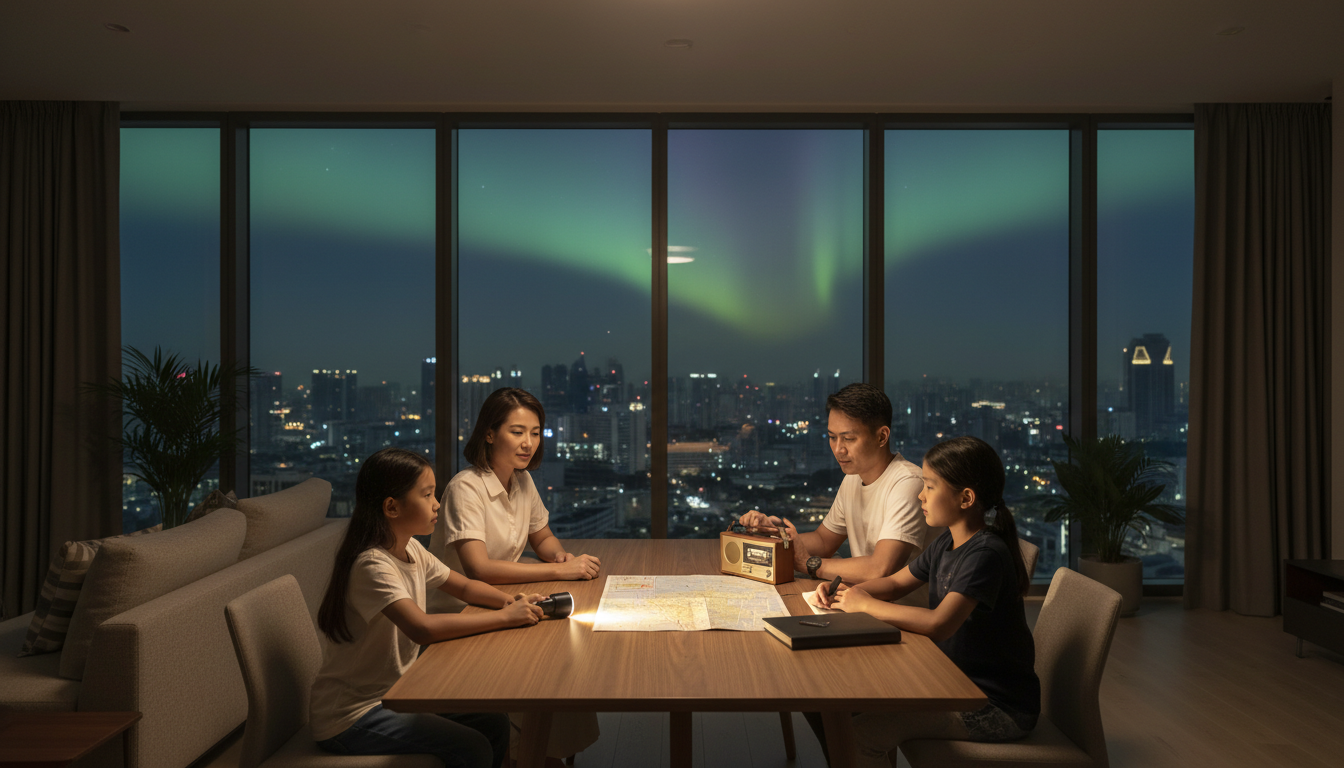
If an extreme solar storm is forecast, verify the alert with the official space-weather agency and prepare for possible technology disruptions, not direct radiation injury at street level. A geomagnetic storm can interfere with satellite navigation and some radio systems; in severe circumstances it can affect power grids. It does not automatically destroy every phone, shut down every network or require an evacuation. Check local electricity and communications providers for real service changes.
This first 72 hours playbook is for ordinary families, students and workers, including Singapore residents who depend on international aviation, shipping and connected services. The goal is to prepare for a scientifically real hazard without assuming a global collapse. A strong forecast and an actual local failure are two different situations, and your actions should change when the evidence changes.
- First 10 minutes: verify the NOAA Space Weather Prediction Center alert, its date, severity and affected technologies.
- Before possible disruption: charge essential devices, test a torch, write down critical contacts and review medical power needs.
- If power fails: follow the electricity provider’s instructions, preserve refrigerated food and medicine, and use safe battery lighting.
- If GPS becomes inaccurate: use physical street signs, transport staff, familiar routes and offline maps without relying blindly on the blue dot.
- If communications degrade: conserve phone power, use a known alternative and arrange a sensible family check-in.
- If no local disruption occurs: continue ordinary activities rather than panic shopping or withdrawing all your money.
- Never take potassium iodide, use unsafe fuel generators indoors or buy radiation remedies simply because space weather is forecast.
- Over 72 hours: track actual disruptions and recovery through trusted sources, not apocalyptic predictions.
Quick Information: What Solar Storms Affect
NOAA’s Space Weather Impacts describes distinct processes. Solar flares can disturb high-frequency radio signals through changes in the ionosphere. Energetic particles can cause problems for satellites and certain high-altitude or polar operations. Coronal mass ejections (CMEs) that interact with Earth’s magnetic field can trigger geomagnetic storms, which influence satellite-navigation accuracy and can induce electrical currents affecting some power-grid equipment.
NOAA’s G1–G5 geomagnetic scale ranges from minor to extreme. G5 includes possible severe voltage-control problems, satellite impacts, some grid blackouts and navigation disruption. It does not predict that every country will lose power. Infrastructure vulnerability, geography, protective actions and the precise storm determine consequences.
Singapore lies at low geomagnetic latitude, unlike high-latitude regions often highlighted in geomagnetic storm warnings. Even so, the country participates in interconnected financial, shipping, telecommunications and aviation systems. An effect abroad may have indirect consequences, while local households may notice little or nothing. Check actual local service notices before changing normal routines.
What Is a Solar Superstorm?
A superstorm is an informal description for an exceptionally intense space-weather event. It is not a separate type of disaster with one universal impact. A large Earth-directed CME can cause significant geomagnetic disturbance; a powerful flare can cause radio blackouts; energetic particles can threaten satellites or astronauts. These processes often overlap in public reporting but they are not identical.
The term Black Swan points to high-impact events whose consequences are difficult to anticipate fully. Solar storms are not unknown: scientists observe the Sun, model disturbances and publish warnings. The remaining uncertainty concerns severity, timing, infrastructure response and cascading effects. It is the scale of potential disruption, not a mystical surprise, that justifies practical preparation.
A household benefits most from thinking in conditional branches. If electricity continues normally, there is no reason to treat the refrigerator as failed. If GPS navigation is inaccurate, use another way to navigate. If medical devices lack power, use their prescribed contingency arrangements. The family is solving observable problems rather than guessing that every modern system will fail.
Solar Flare, CME and Geomagnetic Storm Explained
A solar flare is a sudden release of electromagnetic energy from the Sun. Some of its radiation reaches Earth rapidly and changes the ionosphere, affecting radio signals. In public discussion, this is sometimes called a radio blackout. It does not mean every terrestrial communications technology has stopped working.
A coronal mass ejection is an eruption of plasma and magnetic field. If directed toward Earth, the material can interact with Earth’s magnetosphere after travelling through space. The resulting geomagnetic disturbance is monitored through ground and space instruments. Its strength depends partly on the orientation and intensity of the incoming magnetic field.
A geomagnetic storm can disturb long conductors and satellite signals. These effects explain why electrical utilities, satellite operators, airlines and certain communications services pay attention to forecasts. The same disturbance can produce auroras at suitable latitudes, but a spectacular sky photograph is not a household emergency notice.
The Three NOAA Scales Are Different
NOAA communicates three major event families with G, S and R scales: geomagnetic storms, solar radiation storms and radio blackouts. Each has levels that describe severity. The number is not a combined score telling people how close they are to catastrophe.
A G5 event is the extreme geomagnetic category. It can pose operational challenges for susceptible electricity networks, GNSS and spacecraft. An S-scale solar radiation event is especially relevant to spacecraft and some high-altitude, high-latitude operations. An R-scale radio blackout describes changes to particular radio propagation conditions.
Confusing these categories leads to poor advice. Somebody sees ‘radiation storm’ and recommends iodine tablets, a lead-lined bedroom or evacuation. None is a standard public-health response to a geomagnetic storm for people on the ground. The atmosphere provides major protection from direct energetic-particle exposure at ordinary surface level.
Watches, Warnings and Alerts
A watch says conditions are forecast to become favourable for a geomagnetic storm. NOAA explains that a watch may be issued with up to about 72 hours of lead time, although confidence in precise severity and timing may be limited. It is useful for operators and households planning reasonable contingencies.
A warning uses more immediate observations and often has a shorter lead time, ranging from minutes to a couple of hours. An alert records that a particular threshold is being reached or observed. The exact time zone and issue date matter.
Read NOAA’s watch and warning explanation before sharing a screenshot. A post from last year’s storm may look current without a timestamp. A forecast watch is not proof that a damaging event has arrived. The household should use those categories to decide when to check its plan, not to manufacture panic.
Why a G5 Forecast Is Not a Blackout Notice
The G-scale describes possible effects of an intense geomagnetic disturbance. Different power-grid designs and geographical conditions create different vulnerabilities. Long transmission conductors, ground conductivity and protection systems matter. One country may take precautions while another experiences no residential service interruption.
A major storm can create complex grid problems, but households should not declare a blackout in advance. Electricity providers and engineers monitor their own systems and determine whether any protective action is necessary. If service fails, the provider’s restoration messages are more actionable for residents than a scientific forecast of the Sun.
In Singapore, follow the Energy Market Authority’s blackout-readiness guidance and electricity network updates for local supply information. NOAA describes space weather; it cannot tell you when an HDB block’s lift will run again.
First Ten Minutes After a Credible Notice
Check the original agency notice. Is it a forecast or an observation? What category is predicted, when, and for which technologies? If possible, confirm a local authority or relevant provider notice. A dramatic photograph without an official reference is not evidence of an imminent nationwide problem.
Make a quick household assessment. Does anybody rely on electrically powered medical equipment? Are phones and power banks charged? Is the battery torch working? Are essential medicines and paper contacts accessible? These are ordinary readiness checks that help during other emergencies too.
Do not use the first ten minutes to purchase expensive ‘electromagnetic-proof’ accessories, withdraw all savings or distribute unsupported claims. There may be no interruption at all. The safest preparations are small, reversible and helpful even when the forecast passes without local consequences.
If Electricity Actually Fails
Switch to the household blackout plan. First check injury, smoke, electrical hazards and medical devices that require power. Use a battery-powered torch and avoid open flames. Keep refrigerator and freezer doors closed; know that their cold-storage duration is limited and depends on temperature and how often they are opened.
Turn off non-essential appliances when safe, consistent with electricity provider advice. If the outage continues, plan for cooling, food, sanitation, lift access and communication rather than merely worrying about the Sun. Do not run petrol generators, charcoal or other combustion appliances inside flats, corridors, balconies or other semi-enclosed spaces; carbon monoxide is a deadly hazard.
A brief power interruption is not proof of a solar storm, and a solar storm is not proof of any particular local supply failure. Treat the actual utility problem on its own evidence. The eduKateSG first 72 hours blackout playbook provides more detailed instructions for food, medicine and high-rise buildings.
If GPS and Navigation Become Inaccurate
GNSS satellite signals pass through the ionosphere. Disturbance can make location estimates inaccurate, intermittent or unreliable, especially for precise applications. A blue dot on a screen can still appear confident when the position is wrong.
If walking in Singapore, use familiar streets, posted signs, MRT maps, official staff and previously saved routes. Do not follow an uncertain map into a closed road, canal crossing or restricted area. Drivers should prioritise road signs and traffic officers and stop safely before reviewing navigation.
High-precision users such as surveyors, aviation operators and ship navigators have specialist procedures. Households should not improvise technical fixes to those systems. Listen to their official changes in service when planning travel rather than assuming all transport has stopped.
If Phone or Internet Services Become Unreliable
High-frequency radio disturbance is not the same as every mobile network failing. Fibre broadband and terrestrial communications have different infrastructure and may continue to work. Some satellite-linked services may be more exposed, while power failures can create secondary problems.
Check which communication method actually works. Keep messages short, reduce phone brightness if charging is limited, and use a battery radio where appropriate. Store critical addresses and contacts on paper. A family can agree on a safe next check-in instead of repeatedly calling until devices run out of charge.
A child should know that a missing message does not mean their family is in danger. Remain with teachers and authorised caregivers, follow established procedures, and do not set out independently because an app stops delivering notifications.
Banking, Payments and Digital Identity
A payment terminal may fail because of electricity or network problems, or for unrelated service reasons. A failed purchase is not automatically fraud, and a solar event does not authorise a stranger to request a bank PIN, one-time code or Singpass password.
A modest secure cash reserve may help with essentials when legitimate electronic payments are unavailable. Keep receipts and avoid repeatedly attempting a pending card payment. Reconcile statements once systems restore service. If you actually see unauthorised transactions, contact the bank through a verified anti-scam route immediately.
Be wary of messages claiming that a solar storm requires revalidation of all accounts. Such claims can exploit fear. No legitimate space-weather emergency requires providing passwords or installing unknown remote-access software.
Households with Medical Equipment
The most urgent family member may be the person whose medical device needs electricity, not the one reading dramatic forecasts. Ask clinicians and equipment suppliers about appropriate backup power, battery capacity, transport and emergency escalation before an outage occurs.
Do not unplug life-sustaining equipment to protect it from speculative surges. If an actual power failure threatens care, activate the existing backup plan and seek professional medical help. Medicines that need refrigeration require product-specific pharmacy advice; food-storage rules do not automatically describe medication stability.
Residents with mobility limitations also need an accessible plan if lifts stop. A person may remain safe upstairs while maintenance restores service, but somebody requiring urgent treatment may need coordinated emergency assistance. The response depends on the person and actual condition.
First Hour: A Household Decision Sheet
- Confirm which local services have genuinely changed.
- Check every household member and urgent care requirements.
- Preserve phone power and use reliable official information.
- Keep refrigerated foods closed if electricity is actually unavailable.
- Choose a safe alternative route if navigation or transport is disrupted.
- Record the time, affected service and next verified update.
- Avoid hoarding, unsafe generators and unsolicited recovery messages.
- Follow medical or emergency instructions where safety is threatened.
A written sheet reduces noise. The family can have one person check notices and another check on vulnerable relatives. That division is more valuable than several people refreshing social media and repeating contradictory theories.
Hours One to Six: Prevent Secondary Problems
If power and communications are normal, continue ordinary routines while monitoring trustworthy updates. If an outage develops, check water, food, refrigeration, cooling and the status of lifts. If GPS accuracy is degraded, travel only by verified routes.
People who are medically vulnerable or unable to use stairs may need help sooner than those who can safely wait. Identify those needs without assuming that every person should evacuate. A safer location can be helpful when an actual household constraint makes staying unsafe.
Keep children occupied with familiar routines and reassuring explanations. They do not need repeated graphic news clips. A solar storm is not a supernatural disaster; it is an observable physical phenomenon whose consequences are managed by appropriate agencies.
First 24 Hours: Manage the Real Disruption
Prepare meals using safe supplies and available equipment. Check school, work and transport schedules through authorised channels. Note whether a disruption is local, regional or simply an app problem. The same scientific event can have very different consequences for different households.
A family might have electricity but a delayed flight. Another might have a neighbourhood outage unrelated to the storm. Record facts rather than trying to force everything under one dramatic explanation. Use the specialised procedures of the service providers actually involved.
Do not cancel medical care merely because an internet rumour predicts a technology collapse. Contact the provider and ask whether the appointment is affected. Urgent health conditions require medical assessment regardless of a space-weather alert.
Days Two and Three: Recovery and Continued Planning
Services may recover at different speeds. A working phone does not certify a damaged electrical panel, and the end of a geomagnetic warning does not automatically clear a local outage. Follow local operators and professional advice on equipment restoration.
Reconcile purchases once payment services work, replenish safe drinking water or food used during the interruption, and record any medical or accessibility difficulties. If housing remains unsuitable because of heat, life-sustaining equipment or sanitation, consider an authorised accessible alternative.
The 72-hour timeline is a preparedness window, not a forecast of storm duration. A strong event can vary in its impact and recovery. It is responsible to prepare for several possibilities without declaring one inevitable.
Are Solar Storms Dangerous to People on the Ground?
For most people at Earth’s surface, the direct radiation hazard is not comparable to being unprotected in space. Earth’s atmosphere provides substantial shielding. Some solar radiation events matter especially to astronauts and certain high-altitude aviation operations, where specialists manage exposure.
Do not self-medicate with potassium iodide or other supposed radiation cures. They do not treat geomagnetic disturbance or prevent GPS disruption. Do not create an underground radiation shelter solely because of a solar storm forecast.
If an actual fire, blackout or other local incident occurs, use the safety rules for that incident. Preparing for technology disruption is useful; treating sunlight itself as a poison is not.
Why Geography Matters
Geomagnetic activity is geographically uneven. NOAA’s descriptions frequently highlight higher geomagnetic latitudes for specific grid and radio effects. Singapore’s equatorial location changes the direct risk profile compared with some northern countries.
Yet global commerce and communications are interconnected. Satellite operations, aviation routes and international services can have indirect effects. It would be inaccurate to guarantee zero disruption, just as it would be inaccurate to predict nationwide disaster.
The clearest method is to separate three layers: the physical storm intensity, each infrastructure system’s susceptibility, and the household’s observed consequences. Only the final layer tells most people what to do this afternoon.
A Practical Example: School Trip Navigation
A school group is returning from an excursion when its map shows unreliable location information. Teachers keep students together and use a familiar route, posted signs and transport operator instructions. They do not take shortcuts based on the drifting location dot or tell parents satellites have been destroyed.
The school communicates an accurate updated arrival arrangement when possible. If transport itself is operating normally, the group may continue. If the actual service is suspended, staff follow its established supervision and contingency procedure.
This example demonstrates how scientific understanding improves decisions. A degraded navigation signal calls for verified directions, not an assumption that physical transport has ceased.
A Practical Example: An Older Resident and a Lift
An older resident lives on an upper floor when electricity fails. Their family checks for medication, water, ventilation and accessible support. They contact the responsible building operator rather than trying to carry the person down a long stairwell without appropriate help.
If powered life-support equipment is affected, urgent medical arrangements take priority. If the resident is safe and supported, staying indoors while service is restored may be reasonable. The outage is treated as a building and care problem rather than a reason to panic about the Sun.
Neighbours can help by relaying verified notices or providing supplies when safe. Community resilience is often a series of small, realistic actions.
A Practical Example: False Solar-Storm Alerts
A forwarded voice message predicts that every phone will be permanently destroyed at midnight. It has no official date, alert reference or service provider. The family checks NOAA and the relevant local notices. The forecast may describe serious geomagnetic activity without supporting any such universal claim.
They test torches, keep contacts accessible and continue normal life unless the actual conditions change. If power fails, they use the blackout plan. If it does not, they have improved ordinary readiness without losing money or time.
Evidence checking is itself a survival skill. It prevents anxiety and fraud from creating an unnecessary second emergency.
The Household Ready Bag
- A working battery torch and suitable spare batteries.
- Charged power banks and safe charging leads.
- Battery-operated radio where practical.
- Paper contact numbers, addresses and meeting arrangements.
- Safe drinking water and familiar non-perishable meals.
- Prescribed medicines and specific medical device backup instructions.
- Basic first aid, hygiene and supplies for infants, people with disabilities or pets.
- A small secure amount of cash if appropriate for essential purchases.
The SCDF Ready Bag is a useful practical model for Singapore households. Keep it portable and accessible rather than buying gadgets that are never tested. A bag that obstructs a fire exit is not helping anybody.
Four-Week Preparation Plan
Week 1: Learn the Science
Read NOAA’s explanation of G, S and R events. Learn why a G5 forecast is not a guaranteed local blackout and why a solar radiation storm does not require iodine tablets for ordinary residents.
Week 2: Strengthen Communications
Print critical family contacts, practise one familiar journey without GPS and check that offline addresses are available. Ensure children know their school or caregiver check-in arrangement.
Week 3: Review Essential Power
Test torches and chargers. Ask clinicians about real backup needs for critical devices and temperature-sensitive medication. Learn how to contact building management if lifts are unavailable.
Week 4: Rehearse Two Different Cases
Discuss one scenario in which GPS is unreliable but electricity still works, and another in which electricity fails while mobile data works. Assign sensible actions for each, then put the plan away until its next review.
Frequent Mistakes
The first mistake is confusing a geomagnetic forecast with a confirmed electricity failure. The second is mixing flares, particle storms and CMEs into one vague threat. The third is taking speculative radiation medicine. The fourth is running an unsafe generator indoors to fix a temporary outage.
A fifth mistake is trusting a misleading GPS position over physical road conditions. A sixth is treating a failed payment as proof that a bank has been hacked. A seventh is sharing a stale storm screenshot as breaking news. An eighth is forgetting someone with medical or mobility needs.
All eight have practical corrections: identify the specific event, follow the relevant provider, use safe household backups and monitor the person whose need is most urgent.
Frequently Asked Questions
Does a G5 solar storm mean the world will lose electricity?
No. G5 is the most severe NOAA geomagnetic category and can be associated with serious power-system effects, but damage and outages are not universal. Actual impact depends on location, grid characteristics and protective operations.
Are solar flares and CMEs the same thing?
No. Flares are bursts of electromagnetic energy; CMEs are eruptions of plasma and magnetic fields. Either may be associated with space-weather effects, but the mechanisms and timing differ.
Can a geomagnetic storm damage GPS accuracy?
Yes. Disturbances in the ionosphere can degrade satellite-navigation performance. Use verified road signs, staff and alternative directions if a map appears wrong.
Are mobile phones safe to use?
A forecast does not make mobile phones inherently unsafe. Their services may be affected directly or indirectly in some conditions, but many can continue to operate normally.
Should I unplug every electronic appliance?
There is no general instruction to unplug every device solely because a storm is forecast. If electricity fails, follow local provider guidance about switching off non-essential appliances and protecting against ordinary electrical hazards.
Does the G scale tell me how dangerous solar radiation is?
No. NOAA has separate scales for geomagnetic storms, solar radiation storms and radio blackouts. They describe different physical effects.
Do I need potassium iodide tablets?
No. Potassium iodide is not a solar-storm remedy. Do not take iodine or other unapproved products based on space-weather rumours.
Why are high-latitude regions often mentioned?
Geomagnetic activity and affected technologies are geographically uneven. Certain high-latitude systems, polar radio links and long electrical conductors are often more exposed.
Can Singapore still be indirectly affected?
Yes. International aviation, satellite-linked systems, commerce or service providers elsewhere may experience changes. That does not mean an islandwide Singapore blackout is expected.
Should my family evacuate after a storm warning?
Not solely because of the space-weather forecast. Follow actual local safety instructions if another incident, such as fire or hazardous building conditions, develops.
How long do these storms last?
It varies. Use official time-specific forecasts, observations and local service notices. Infrastructure recovery can take a different amount of time from the geophysical event.
What should a school do during a major solar storm?
Follow official transport, communications and building guidance, supervise students, and use backup contacts if a genuine service fails. Avoid spreading unsupported claims.
When is the emergency over?
When relevant local hazards and service interruptions are resolved and providers have confirmed safe restoration. A falling geomagnetic reading does not itself certify an electrical repair.
Making a realistic travel and technology continuity plan
A geomagnetic alert may affect a flight, a survey, a ship’s navigation system or a specialised satellite service without shutting down an ordinary household. If you have a scheduled journey, ask the actual transport provider whether it has changed its operations. Do not cancel every booking based on a dramatic photograph of an aurora or a generic ‘G5’ headline. Ground staff, airline notices and official road restrictions are more relevant to a passenger’s decision.
If you use satellite navigation for work, agree on a safe fallback before accuracy degrades. A delivery worker may rely on street addresses and a trusted local map; a driver may pause rather than attempt a complex unfamiliar journey; a company operating safety-critical equipment must follow specialist procedures. No one should invent a technical workaround for an aircraft, ship or electrical grid from a consumer article.
Distinguish a forecast, an observed space-weather event and a confirmed local service interruption. Each adds information. A forecast justifies checking supplies, an observed event justifies monitoring exposed services, and a confirmed outage justifies the appropriate household safety response. These stages create proportionate decisions rather than a single panic switch.
Connected Black Swan and Doomsday survival guides
A serious emergency may interrupt more than one service. Choose the guide for the hazard you actually face and follow the relevant local official instructions when actions differ.
- Severe Haze — Survival Playbook
- Asteroid Impact Warning — Survival Playbook
- Mass Evacuation — Survival Playbook
Trusted Sources and Further Reading
- NOAA Space Weather Prediction Center — Impacts
- NOAA — Space Weather Scales
- NOAA — Watches, Warnings and Alerts
- NOAA — Planetary K-Index
- Singapore Energy Market Authority — Power Outage Readiness
- eduKateSG — How Solar Storms Disrupt GPS and Satellites
- eduKateSG — 72 Hours Blackout Playbook
- eduKateSG — Cyberattack and Communications Playbook
The central lesson: space weather can be a serious technological hazard, but sensible preparations are ordinary: verify the alert, protect essential power and communications, navigate safely and respond to observed local conditions.