
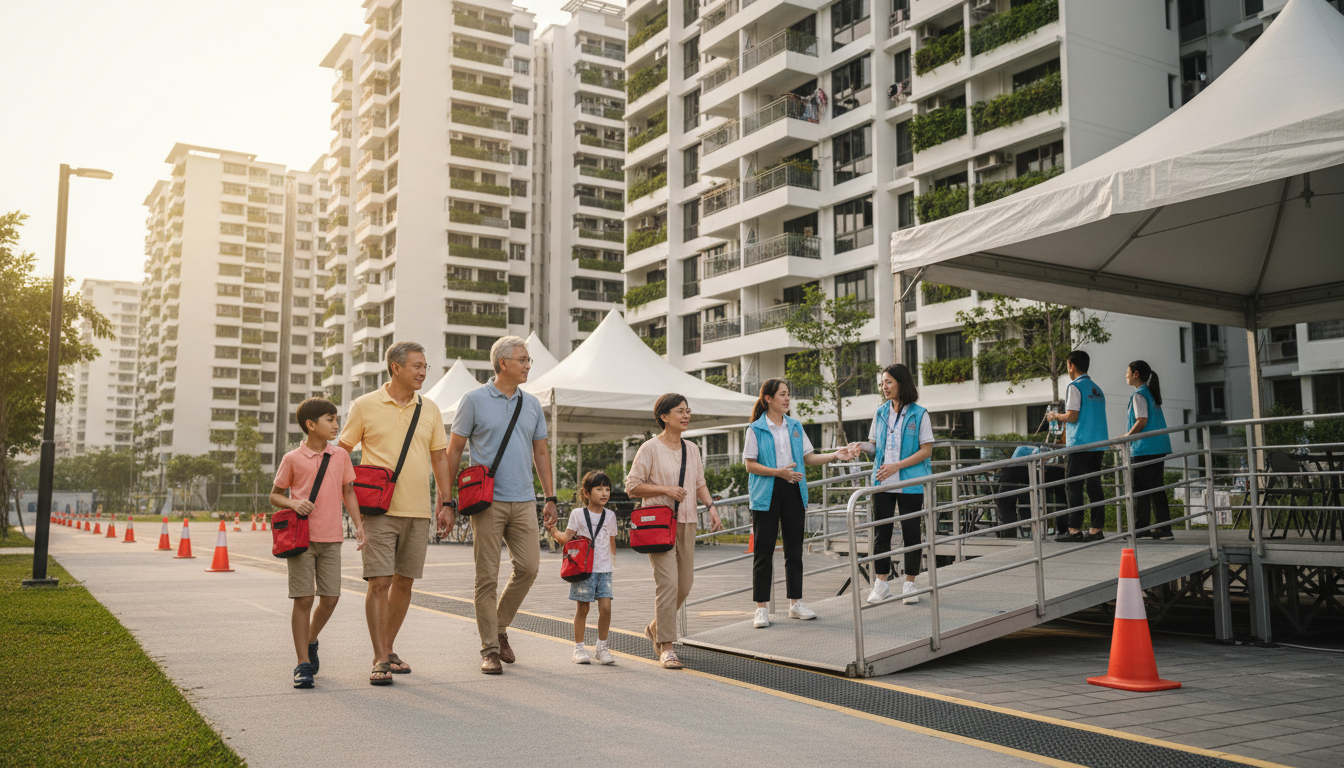
If officials instruct your household to evacuate, read the exact affected area, hazard, route and time of departure, then leave by the authorised safe route with the people who depend on you. Take essential medicines, identification, a small ready bag and mobility or childcare supplies without delaying necessary departure to pack valuable possessions. If a fire or other immediate danger makes your home unsafe, act on that danger and seek emergency help. But if authorities instruct you to shelter from an outdoor toxic plume, leaving the building may be the wrong response.
This first 72 hours mass evacuation playbook is about the human problems that appear when normal routes, home access and family routines are interrupted: children at school, older relatives in high-rise flats, families without cars, pets, accessibility, temporary accommodation, medicines and reunification. It uses Singapore’s civil-defence alert and ready-bag guidance, while recognising that actual evacuation arrangements are incident-specific. It does not claim that a nationwide evacuation is expected.
- First minute: decide whether the instruction says evacuate, shelter in place, avoid an area or tune in for more information.
- Check the source: SCDF, SG Alert where available, the Public Warning System, responsible local authority and building staff.
- If instructed to evacuate: follow the designated route; do not choose a shortcut through a flooded road, fire zone or chemical plume.
- Take people first: children, older residents, disabled family members and anybody with urgent medical needs.
- Bring a portable ready bag: prescribed medicines, a torch, phone, contacts, identification, water and essential childcare supplies.
- At school: children should remain with authorised teachers or caregivers until the institution’s collection and reunification plan is activated.
- At an assembly or reception location: follow staff directions and keep personal details private; never assume a random online map identifies an official shelter.
- For transport: use the authorised options, check closures and ask for accessible help where needed.
- Do not return: until the relevant authority or building manager has cleared the actual hazard and route.
- For immediate danger in Singapore: use 995 for fire or emergency ambulance and 999 for police emergencies, not for general status questions.
Quick Information: Evacuate or Shelter?
The first decision is which protective action addresses the hazard. Evacuate means leave the threatened premises or area using a safe route. Shelter in place means remain in a suitable location and reduce exposure to an external hazard, often because going out could be more dangerous. Avoid the area may apply to people outside the affected zone who do not need to move from home.
Singapore’s SCDF Emergency Alert information explains that SG Alert messages identify the incident, affected locations, protective actions and official sources. The system uses cell broadcast and has a phased rollout, so do not assume every phone and network will have identical availability at every point in 2026. Other official alert channels, including the Public Warning System, radio, TV and institutional instructions, remain important.
The SCDF Public Warning System has distinct signals for imminent danger, an all-clear and an important message. A wailing alert, continuous all-clear or pulsating important-message signal carries a specific official meaning. The right response comes from that meaning and accompanying announcements, not from an alarming sound in a social-media video.
Why Mass Evacuation Is a Different Black Swan Problem
Many disaster articles focus on the hazard itself: a flood, fire, earthquake or toxic release. An evacuation introduces another layer. People must move safely, transport can become congested, family members may be separated across schools and workplaces, and essential care may need to continue in unfamiliar surroundings.
A rare or unusually large evacuation can expose ordinary weaknesses: the person who cannot use stairs, the child whose parent cannot be reached, the prescription stored in a locked flat, the wheelchair inaccessible to a temporary bus or the pet whose carrier was left behind. These are not dramatic movie details; they are practical planning constraints.
The term Black Swan describes a high-impact disruption whose consequences may be hard to anticipate. It should not imply that every emergency becomes a countrywide displacement. A short apartment-block evacuation may be resolved the same day, while a major disaster elsewhere can displace residents for much longer. Build the plan for actual instructions and needs, not for an invented worst case.
The First 60 Seconds: Understand the Message
Stop what you are doing and read or listen carefully. Identify the affected area, the hazard type, the protective action and the time or route specified. If you are outside the zone, an instruction to avoid the area is not necessarily an instruction to leave your own home.
If a building alarm or staff member directs you to move because of an immediate fire danger, use the safe evacuation procedure promptly. Do not delay to search for a broader national announcement. If the alert says shelter from a chemical plume, do not run outdoors merely because a siren sounds.
Ask one adult to repeat the instruction aloud in plain language: ‘We are leaving via the marked staircase and going to the staff-designated gathering point.’ A short sentence reduces confusion and helps children understand what they need to do.
The Difference Between Warning, Order and Rumour
A genuine emergency message identifies an authority and actionable protective steps. A forwarded voice recording claiming that ‘everyone must leave Singapore by midnight’ without a verifiable source should not become an evacuation order.
Check SCDF’s website or communications, the responsible building management and official transport or local government notices as appropriate. Verify the date, location and whether an alert is an exercise. Singapore conducts scheduled Public Warning System familiarisation exercises, so context matters.
If internet access is unavailable, use staff announcements, radio or other established information routes. The absence of one app does not prove authorities are silent. A household should never depend on a single social-media account for life-safety instructions.
First Ten Minutes: Leave Safely Without Overpacking
Account for everyone who is with you. Bring critical medicines, mobility equipment, infant or childcare supplies, a phone and basic identification if they are readily accessible. If your ready bag is kept where it should be, this step can be brief.
Do not spend the departure window searching for expensive electronics, jewellery, bulky books or household records that can be replaced or addressed later. A large suitcase may obstruct stairs, slow a person with limited mobility and create crowding at exits.
Close doors when appropriate to the building’s fire or safety procedure, and avoid touching damaged electrical equipment. Follow the exit signs and instructions relevant to the hazard. If a stairwell is full of smoke, do not enter blindly; seek an alternative safe route or help according to the fire response procedure.
High-Rise Buildings: Lifts, Staircases and Refuge Floors
A high-rise presents a particular challenge because many occupants may need to leave through limited routes. For a fire emergency, SCDF’s high-rise fire advice instructs occupants to use exit stairs rather than lifts. Fire lifts are operated for firefighters and trained responders, not general passenger evacuation.
Some super high-rise buildings have refuge floors designed as temporary safe holding areas during fire emergencies. Their location and suitability are building-specific. Do not assume every HDB block or condominium has one, or that a refuge floor is the correct destination for an unrelated chemical or flood incident.
Use handrails and avoid rushing. Do not force people to descend faster than they can safely manage, and allow responders clear access. A family member with reduced mobility may need trained assistance rather than an improvised carry down numerous flights.
People Who Cannot Use Stairs
Disability-inclusive evacuation must be planned before the emergency. Ask who in the building has an agreed assistance procedure and how the person will communicate their location to responders. An older resident using a walking frame or someone with a wheelchair may require a different safe waiting or rescue process.
Do not assume a person is able to leave just because they are awake and standing. Some people have invisible medical conditions, fatigue, sensory disabilities or cognitive needs. Ask what kind of assistance they prefer, and do not lift or move them without considering the danger to both people.
If there is an immediate life-threatening threat, contact appropriate emergency services and give precise information about the level, unit, stairway, disability or medical equipment involved. A general instruction to ‘go downstairs’ is not enough for every person.
Children at School or Childcare
A child at school may be safer remaining under trained staff supervision until safe collection arrangements are established. Parents should follow the institution’s official communication channel rather than asking the child to leave independently or running through a restricted area.
Make sure the school has current authorised collection contacts. A child can learn two simple rules: stay with the responsible adult and do not search alone for a parent. Those rules remain useful whether the emergency is a local fire, flood, chemical release or transport disruption.
Parents may be anxious about delayed reunion. A clear status message from the institution helps; unnecessary travel into danger does not. The time for collection is determined by the actual safety of routes and the institution’s procedure, not the emotional urgency of the first rumour.
Reuniting Family Members in Different Places
An effective reunification plan should not assume everybody will travel immediately to one point. If a person is safer at school or work under a shelter-in-place order, leaving to meet family elsewhere may increase exposure.
Agree beforehand on a trusted out-of-household contact who can relay short updates. A single person can gather messages from different family members, reducing repeated calls when networks are congested.
The meeting arrangement must be conditional: travel only when routes are safe and authorities permit it. A fixed public place should not become a trap if it lies in the actual affected zone. Keep the contact details on paper as well as in a phone.
How To Build a Safe Transport Plan
If officials provide buses, trains, a designated corridor or a reception point, use those arrangements. Do not assume that a private car is always faster; roads may be closed to keep emergency routes clear and movement may be directed to specific locations.
For people without vehicles, the plan should include walking capacity, public transport changes and assistance from authorised services. A person with a wheelchair or other mobility aid may need accessible transport. Contact the designated responder or transport coordinator rather than choosing an unsafe improvisation.
Do not block fire appliance access, park on a restricted road or drive against a closure. Reaching a destination twenty minutes sooner has no value if it puts the family in the hazard or prevents responders from working.
Why the Nearest Shelter on a Map May Be Wrong
A school, community centre, MRT station or basement may look suitable because it has a roof or a large space. That does not mean it is open, stocked, accessible or designated for an ongoing evacuation. Its conditions may be affected by the very hazard from which you are escaping.
Use an official designated reception, shelter or accommodation arrangement for the specific incident. If none has been confirmed, seek directions from responsible authorities or your building management. Avoid posting an invented ‘evacuation centre’ list that could send hundreds of people to a closed facility.
Singapore’s civil-defence public shelters have specific purposes, particularly for wartime protective needs. They are not automatically the correct destination for every fire, flood or chemical incident. Follow the relevant hazard and public information.
Ready Bag: What To Carry
SCDF’s Ready Bag guidance emphasises accessible portable essentials. It identifies items such as a torch, batteries, essential medicines, a waterproof document folder, whistle, first aid and childcare supplies.
A family can add a modest amount of water, familiar food, paper contacts, cash, a charged power bank and spare clothing if manageable. The contents should support real people rather than replicate a large outdoor-expedition kit.
Keep the bag in a known place and review it periodically. If one household member cannot carry the bag, assign assistance. A pile of emergency goods that blocks the exit creates a hazard instead of resilience.
- A working battery torch with spare suitable batteries.
- Essential prescriptions, medical notes and necessary devices.
- Waterproof copies of important identification and insurance contacts.
- Phone, safe charging cable, power bank and paper telephone numbers.
- Small amounts of sealed drinking water and familiar food.
- First aid, whistle, hygiene items and manageable spare clothing.
- Infant supplies, disability equipment and pet essentials where needed.
- A clear record of who will support each person with special access needs.
Medicines: The Item That Cannot Wait
Someone with diabetes, epilepsy, heart disease, an asthma action plan or a powered medical device may need more planning than someone who is simply missing a meal. Their emergency medical contacts, medication schedule and required storage conditions should be understood before evacuation.
Do not stop a necessary medicine just because the usual pharmacy or clinic is difficult to reach. Contact the treating provider or appropriate medical service for an authorised alternative. Some medicines need refrigeration or special handling; a generic cooler bag may not satisfy the product’s requirements.
Keep personal health information protected. Volunteers may need to know a person’s urgent needs, but there is no reason to post prescriptions, identity numbers or diagnoses publicly in a community group chat.
Infants, Pregnancy and Families with Small Children
An infant may require nappies, formula or breastfeeding support, safe drinking water, suitable clothing and a way to rest. A young child may require a familiar item for reassurance, but that should be small and reachable without slowing essential departure.
Pregnant people may need access to prescribed care and a more comfortable transport arrangement. Discuss relevant medical concerns with healthcare providers where possible. A temporary shelter should not be treated as a substitute for emergency maternity assessment if urgent symptoms develop.
Children benefit from clear, short instructions. Do not use dramatic words such as ‘the whole city is collapsing’ when the actual order is a specific local evacuation. Give the child an achievable task: stay beside the designated adult, keep shoes on and follow staff instructions.
Older Residents and People Living Alone
A person living alone may not hear an alert, have a charged phone or understand the evacuation message. Offer a safe welfare check if circumstances permit, and contact responsible building or community services when someone cannot respond.
Help should be based on actual needs. One neighbour may only need the notice explained, while another may require mobility assistance or urgent medical support. Do not turn a welfare check into pressure to disclose private health or financial information.
If an immediate fire or other hazard threatens the location, emergency responders should receive accurate information about any person unable to leave. Do not enter dangerous smoke or debris to attempt an untrained rescue.
Pets During Evacuation
Pets are part of a household’s care responsibilities. Keep a suitable carrier or leash available, pet identification and a small amount of food or medication where appropriate. The animal may react unpredictably to noise and crowds, so avoid carrying it loosely through a congested stairwell.
The ability to accommodate animals varies between reception centres, transport arrangements and temporary lodging. Check legitimate instructions. Do not assume every emergency shelter accepts every species or that leaving a pet unattended for several days will be safe.
A neighbour may help if an arrangement is established beforehand. A person should not put themselves in immediate life-threatening danger to search for a pet after being instructed to evacuate. Communicate the animal’s location to responsible responders if feasible.
During the First Hour at a Reception Point
Follow registration and movement instructions from staff. Keep children with authorised caregivers and understand where toilets, drinking water, medical assistance and accessible areas are located. If you need urgent medication, inform the appropriate designated staff privately.
Do not photograph or broadcast other displaced families without consent. People may be distressed or recovering from injury. Public posting of identity documents, children’s names or accommodation assignments can expose them to privacy and safety problems.
A family can communicate a concise update to one trusted contact: ‘We are safe at the authorised location. We will confirm the next arrangement after official instructions.’ Avoid announcing unverified evacuation numbers or return times.
Temporary Accommodation: The First Night
Not every evacuation leads to an overnight stay. If the home remains unsafe or access is restricted, follow authorised accommodation arrangements or confirm a safe alternative such as a suitable relative’s home. Consider transport, accessibility, medicines and schooling.
Avoid booking an unfamiliar place near the hazard solely because it appears available online. Check whether roads are open and whether the property is actually safe. A family member with mobility limitations needs an accessible bathroom and entrance, not just a bed.
Plan meals, drinking water, hygiene, infant supplies and rest. A family that has moved safely still needs routine care. Do not let the search for perfect accommodation delay treatment of urgent injuries or illness.
First 24 Hours: Keep the Household Functioning
The first stage is physical safety. The second is confirming who is accounted for. The third is maintaining essential care. Write down which adults, children and vulnerable relatives have reached safe places, what support is needed, and which official contact will provide updates.
Schools and workplaces may issue separate instructions. Do not assume everyone must follow a single household schedule. Avoid repeated travel between sites unless the route has been authorised and the purpose is essential.
If phones or internet connections are unreliable, use paper contacts, verified staff announcements and available radio broadcasts. Preserve battery for urgent messages and keep one family contact responsible for relaying major updates.
Days Two and Three: Manage Longer Displacement
After the first night, temporary arrangements may need to accommodate work, school, prescriptions, caregiving and financial obligations. A family may have to move again if a reception area is not intended for extended accommodation.
Contact insurers, landlords, building management or legitimate assistance services as appropriate. Keep copies of notices and receipts, but do not make false damage claims or pressure staff to provide a return date they cannot verify.
Children may need ordinary study and play routines. Older adults may need mobility and medical assistance. People who were not physically injured may still experience stress. Recovery planning should support these ordinary needs as well as building repairs.
Returning Home: Wait for Clearance
The end of a visible fire, flood or plume does not automatically make a building safe. Electrical hazards, contaminated water, broken glass, hidden structural problems or restricted access may remain. Follow the actual responsible authority’s clearance and building-management instructions before re-entering.
If access is permitted, inspect only what you can safely assess. Do not touch exposed wiring, flooded appliances or unstable structural debris. Photograph losses from safe positions and arrange qualified help when necessary.
A family may return before every service is fully restored, but that decision must consider essential health, sanitation, food and mobility needs. A medically vulnerable person may require alternative arrangements for longer than the rest of the household.
Scams and Misinformation During Displacement
An evacuation can attract fake requests for donations, accommodation payments, identity documents or bank transfers. Verify assistance offers through known official channels. Do not send one-time passwords or share confidential information with strangers promising priority accommodation.
A viral location pin may be old, mislabelled or from a previous emergency. Check the official name, incident and opening arrangements before travelling. A false assembly point can direct crowds into a dangerous route.
For community updates, share the official notice and a short factual summary. Do not include a speculative cause, unverified casualty count or a photo of a child. Responsible information sharing is part of keeping an evacuation orderly.
A Case Study: Fire in a High-Rise Block
A fire alarm sounds in a high-rise building. Residents follow the appropriate SCDF and building fire instructions, use safe exit staircases rather than passenger lifts, and avoid smoke. Someone with limited mobility alerts responders to their location and needs rather than attempting an unsafe unassisted descent.
Outside, people move to the staff-designated safe place and leave access clear for emergency vehicles. Parents account for children. Residents wait for confirmation before returning to collect belongings.
The lesson is that correct routes, life-safety systems and trained responders matter more than reaching the nearest street corner in the shortest time.
A Case Study: Chemical Release Outside the Building
A nearby incident leads authorities to order in-place protection. A family hears the word ’emergency’ and instinctively wants to drive away. But leaving through a hazardous plume may increase exposure. They instead follow the official shelter instruction: reduce outside-air intake, close openings and monitor messages.
If the authority later orders evacuation by a specific route, the family changes course and leaves. This is not inconsistent. Protective actions can change when the hazard and official assessment change.
The example shows why the first word of an alert matters. ‘Shelter’ and ‘evacuate’ are different branches of the same emergency decision tree.
A Case Study: Child and Parent Cannot Reunite Immediately
A child is at school, the parent is at work and transport routes are partially closed. Both places are currently safe. The school directs children to remain supervised while a collection arrangement is developed.
The parent does not instruct the child to walk across a restricted road or attempt to drive through a closure. Instead, both follow the institution’s confirmed steps and send concise messages when possible.
An orderly reunion may be slower than the family wants, but it is more protective than a rushed journey into the hazard zone.
A Four-Week Preparation Plan
Week 1: Understand Alerts and First Decisions
Read SCDF’s explanations of SG Alert, the Public Warning System and the 2026 emergency handbook. Discuss the differences between evacuate, shelter in place and avoid the affected area. Identify the official contacts relevant to your building.
Week 2: Prepare a Portable Ready Bag
Gather medicines, a torch, appropriate documents, contacts, small amounts of safe food and water, and necessary childcare or disability supplies. Keep the bag accessible and light enough to carry.
Week 3: Plan Family Reunification
Check school collection contacts, workplace emergency procedures and the needs of older or disabled household members. Choose a trusted person who can relay messages. Do not make one fixed meeting point unconditional on actual safety.
Week 4: Practice the Correct Route on Paper
Imagine a fire, then an outdoor chemical plume. Ask which instructions differ. Identify the normal building exits and the procedure for asking for mobility assistance without setting off alarms or disrupting fire-safety facilities.
Common Mistakes During Mass Evacuation
The first mistake is leaving before reading whether the instruction actually says to evacuate. The second is delaying necessary departure to pack valuables. The third is using lifts during a fire emergency. The fourth is travelling through floodwater or a chemical plume to reach family.
A fifth mistake is assuming a school or MRT station is a designated shelter. A sixth is leaving children to find parents independently. A seventh is forgetting medicine and accessible transport. An eighth is returning before permission has been given.
The corrections are practical: verify the instruction, prioritise people, use safe authorised routes, maintain essential care and wait for official clearance.
Frequently Asked Questions
Should I evacuate as soon as I receive any emergency alert?
Not necessarily. Read the actual protective instruction. Some alerts direct sheltering or avoiding a particular area rather than evacuation.
How can I recognise an official Singapore alert?
SCDF publishes the meanings of its Public Warning System and explains the SG Alert system. Check the affected location and protective action through authorised government channels.
Will every mobile phone in Singapore receive SG Alert?
SG Alert is being rolled out in phases across local networks. It is intended to deliver cell broadcasts without mobile data, but availability and device compatibility depend on its implementation. Other official alert channels remain important.
What should I put in a ready bag?
Use SCDF’s guidance: torch, batteries, essential medication, protected documents, whistle, first aid and childcare items, with other small necessities suited to your household.
Can I use a lift during a fire evacuation?
No. SCDF advises using exit stairs during a fire; fire lifts are for trained firefighter-led operations. Follow building-specific instructions and responders.
What if I cannot climb stairs?
Discuss a building-specific assistance plan in advance. During an emergency, contact staff or responders and provide your exact location and mobility or medical needs.
Should I collect my child from school immediately?
Follow the school’s authorised collection arrangements and the safety of routes. A child should remain supervised rather than leaving independently.
Where is the nearest emergency shelter?
The correct destination depends on the actual incident and official designation. Do not assume a nearby community centre, station or basement is an open evacuation facility.
Can I bring my pet?
Pet arrangements vary by transport, accommodation and incident. Prepare suitable carriers and supplies, and check the relevant official instructions.
What if my prescribed medicine is left behind?
Do not re-enter a dangerous building to retrieve it. Inform appropriate medical or reception staff and ask a healthcare provider for safe replacement or alternative care.
Should I drive myself out of the affected area?
Follow official transport and road instructions. Driving may be helpful in some circumstances and unsafe or prohibited in others.
How do I avoid false evacuation-centre information?
Use official notices and designated staff. A viral map or screenshot may be inaccurate, outdated or refer to another incident.
When may I return to my flat?
Only when responsible authorities or building management have lifted relevant access restrictions and serious hazards have been addressed.
Can a family member shelter elsewhere instead of meeting me?
Yes, if that is the appropriate protective action and authorised instructions allow it. Reunification must not require travelling into an unsafe zone.
Connected Black Swan and Doomsday survival guides
A serious emergency may interrupt more than one service. Choose the guide for the hazard you actually face and follow the relevant local official instructions when actions differ.
- Solar Superstorm — Survival Playbook
- Severe Haze — Survival Playbook
- Asteroid Impact Warning — Survival Playbook
Official Sources and Related Reading
- SCDF — Emergency Alert SG Alert
- SCDF — Public Warning System
- SCDF — Ready Bag for Emergency
- SCDF — Civil Defence Emergency Handbook, 2026
- SCDF — Fire Outbreak in a High-Rise Building
- eduKateSG — Toxic Chemical Release Shelter Playbook
- eduKateSG — Flood High-Ground Escape Playbook
- eduKateSG — Earthquake High-Rise First 72 Hours
- eduKateSG — First 72 Hours Blackout Playbook
The essential lesson: an evacuation is not a race to leave by any route. It is a coordinated change of location based on the actual hazard, official instructions and the needs of the people being protected.