
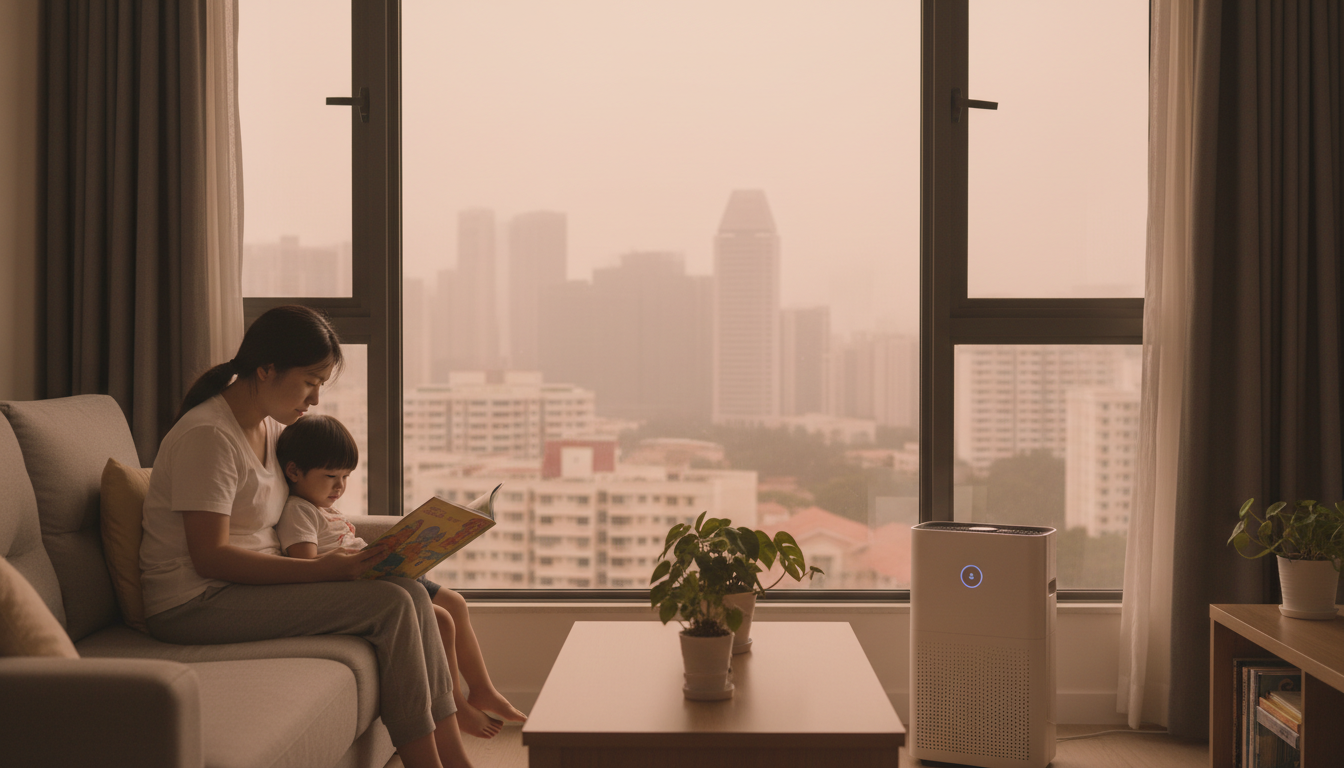
If severe haze or wildfire smoke reaches your neighbourhood, check the official air-quality readings, reduce unnecessary outdoor exertion, and make indoor air as clean as practical. Close windows when outdoor particle levels are high, avoid activities that create additional indoor pollution, and follow Singapore’s Ministry of Health (MOH) advice for your own age and medical risk. If somebody has serious breathing difficulty, chest pain, new confusion or collapse, seek emergency medical care rather than trying to treat the problem with an air purifier alone.
For most Singapore families, a haze emergency is not a reason to evacuate the entire country or wear a respirator continuously indoors. It is a matter of matching the day’s activities to the 24-hour PSI forecast and the next hour’s decisions to the 1-hour PM2.5 readings. This practical playbook covers the first seven days of unusually severe smoke, including schools, HDB flats, outdoor work, medical needs, clean indoor air, masks and what to do when haze combines with heat or a power outage.
- Now: verify the latest NEA haze advisory, the forecast 24-hour Pollutant Standards Index (PSI) and your region’s 1-hour PM2.5 reading.
- Planning tomorrow: use the official PSI forecast and MOH health advisory to decide whether to reduce, minimise or avoid prolonged outdoor activity.
- Planning the next hour: use the current 1-hour PM2.5 band and your health status before exercising or spending a long period outdoors.
- At home: keep outdoor smoke out when levels are high, use suitable air filtration if available and reduce smoking, candles and other indoor particle sources.
- With vulnerable people: check children, pregnant people, older relatives and people with existing lung or heart disease; have prescribed medicines available.
- For masks: fit-tested or well-fitting N95-type respirators may reduce particle exposure during some prolonged outdoor activities, but are not generally needed for short commutes or ordinary indoor settings under MOH advice.
- If a nearby fire threatens your building: obey fire and evacuation instructions; sheltering from regional haze must never become a reason to remain inside a burning home.
- If symptoms are severe or worsening: seek appropriate medical care and use 995 in Singapore for an emergency.
- After levels improve: ventilate when outdoor air is cleaner and resume activity gradually in line with health and official guidance.
Quick Information: The Haze Numbers That Matter
The Singapore Ministry of Health haze advisory, updated 21 October 2026 distinguishes the 24-hour PSI forecast, useful for next-day planning, from the current 1-hour PM2.5 concentration, useful for immediate outdoor choices. MOH defines PSI of 101–200 as Unhealthy, 201–300 as Very Unhealthy and above 300 as Hazardous. PSI is an air-quality index, not a percentage chance of disease.
For the 1-hour PM2.5 reading, MOH uses four bands: Normal at 0–55 micrograms per cubic metre, Elevated at 56–150, High at 151–250 and Very High at 251 or above. At Very High, healthy persons should minimise outdoor activity during the next hour. Vulnerable persons should avoid it. The precise advice also depends on exertion, duration and the person’s health.
The NEA air pollution FAQs explain why the two measurements have different roles. The 24-hour PSI and next-day forecast help plan a full day; the hourly PM2.5 reading can change quickly and is relevant to a decision about going outdoors now. A screenshot from yesterday is not a reliable guide to this afternoon.
When Is Haze a Black Swan Emergency?
Regional haze is a known environmental challenge, especially when smoke from landscape fires travels across borders. Not every hazy morning is unusual or catastrophic. An exceptionally prolonged, severe smoke episode can nevertheless disrupt school sport, outdoor employment, healthcare, travel and household routines all at once.
The unusual danger may come from the combination of smoke and another constraint: a child with asthma needs medicine, a worker cannot avoid the outdoors, an older resident lives in a poorly ventilated hot flat, or power fails while the family is relying on air-conditioning. Those cascading effects deserve a clear playbook.
The aim is to reduce exposure in practical ways, not to claim everyone will become seriously ill. MOH explains that healthy people exposed over a few days may experience temporary eye, nose or throat irritation without major long-term consequences, although exposure and susceptibility vary. People with chronic heart or lung disease require extra care and individual medical advice.
What Exactly Is Haze?
Haze may include fine particles, gases and other pollutants produced by fires and atmospheric processes. During Southeast Asian smoke haze, the pollutant of greatest concern is often PM2.5, fine particulate matter 2.5 micrometres in diameter or smaller. Small particles can enter the lungs and affect sensitive people.
A visible grey sky is not a precise instrument for measuring exposure. Conditions can change with wind direction, rain and regional fire activity. Some days look dramatic but the official level is lower than expected; at other times fine particles can be elevated even without a striking brown skyline.
Do not make emergency decisions from the smell alone. Check the official air-quality readings for the correct location and time. A photograph from Malaysia, Indonesia or another Singapore neighbourhood may be real yet not describe the air at your home today.
PSI Versus PM2.5: The Simple Explanation
The PSI is an index incorporating relevant air pollutants over a period, usually discussed in Singapore’s haze communication using the 24-hour PSI. It supports public-health recommendations for broad daily activities. It is not the concentration of one pollutant measured in micrograms per cubic metre.
The 1-hour PM2.5 reading measures the recent concentration of fine particles and provides a more immediate view of short-term fluctuations. NEA uses bands to help the public make timely choices. A high hourly reading should not be compared numerically with a PSI number as if both were on the same scale.
Imagine that a family is planning a picnic tomorrow. The PSI forecast helps decide whether to postpone it. On the day itself, the latest 1-hour PM2.5 reading helps determine whether a short walk outdoors remains sensible. This two-clock method avoids both overreaction and complacency.
The First Ten Minutes of a Severe Haze Alert
Open an official NEA or MOH source and note the region, hour and forecast. Do not circulate a number without its date. Check whether the people in your household are currently well, especially those with asthma, COPD, heart disease or other relevant medical conditions.
Move strenuous outdoor activities to a safer time or indoors according to the readings and health advice. Confirm that prescribed inhalers and other necessary medicines are readily available. If somebody already feels significantly unwell, seek professional advice rather than spending that first ten minutes shopping for air purifiers.
Tell children a simple truth: ‘The air outside has more smoke particles today. We will play indoors or choose an easier activity and check again later.’ That gives an action and reassurance without making them fear that breathing ordinary air is immediately fatal.
How to Make One Room Cleaner
Start with the simplest step: reduce incoming outdoor particles while haze is elevated. Close windows and doors to the extent practical and safe, and limit unnecessary opening. Avoid lighting candles, smoking, burning incense or prolonged cooking that creates extra smoke in a poorly ventilated space.
A portable air purifier with a suitable high-efficiency particle filter, such as a HEPA filter, can help reduce indoor PM2.5 when sized and operated properly. The HealthHub guidance explains indoor protection, including closing windows, reducing pollution sources and using effective particle filters.
A purifier is not an unlimited guarantee. Its performance depends on room size, air leakage, fan speed, filter condition and whether doors and windows stay open. Choose practical maintenance and a suitable clean-air delivery rate rather than an expensive device marketed as a miraculous ‘toxin neutraliser’.
Fans, Air-Conditioners and Fresh-Air Intakes
Air circulation can improve comfort, particularly in a warm Singapore flat. A conventional recirculating air-conditioner may not introduce much outside air, but some systems deliberately draw outdoor air indoors. When haze is high, follow appropriate building guidance to limit unfiltered external intake.
Closing every opening can make a room hot. Heat stress must still be considered, especially for infants, older adults and people with medical conditions. If a room becomes dangerously warm, find a practical cooler location with suitable filtered air where possible, or seek advice on balancing cooling and air quality.
Do not interfere with shared building ventilation, fire-safety systems or equipment that needs continuous ventilation for safety. A hospital, shop or workplace may have building-specific controls that should be managed by qualified personnel. Your household plan should not create a new fire or heat hazard.
Why Wet Cleaning Helps
Particle pollution can settle as fine dust on indoor surfaces. Sweeping or dry-dusting may stir particles back into the air. HealthHub recommends wet mopping or wiping where suitable. Clean surfaces using appropriate ordinary methods and avoid mixing cleaning chemicals.
A vacuum may help if it has a well-maintained effective filter, but a poorly filtered unit can redistribute dust. Households with babies crawling on the floor or people with respiratory sensitivity may benefit from sensible cleaning and avoiding indoor smoke sources.
Do not spend the entire day scrubbing the flat during severe haze. Heavy exertion inside a hot room can create its own problems. A reasonable light-cleaning routine is sufficient; the key protection remains reducing exposure and maintaining cleaner indoor air.
N95 Masks: When They Help and When They Do Not
A well-fitting N95 or equivalent particulate respirator can reduce inhaled particles during relevant outdoor exposure. It must fit the wearer’s face properly, cover nose and mouth and not have substantial gaps. A loosely worn mask offers less protection.
MOH’s October 2026 guidance says N95 masks are generally unnecessary for normal short commutes and typical indoor settings. At very high hourly PM2.5 levels, healthy people who must be outdoors may consider them; vulnerable people at high or very high levels may also use them when essential outdoor exposure cannot be avoided. Anyone with significant breathing difficulty may need to consult a doctor about respirator use.
A mask is not a reason to ignore the recommendation to reduce exertion. A standard N95 does not filter every gas or chemical vapour, and it is not the right universal tool for an industrial chemical leak. For wildfire smoke, particles are an important concern, but local emergency evacuation instructions take priority if the actual fire is approaching.
Children and School Outdoor Activities
A child may have difficulty recognising or describing shortness of breath, headache or irritation. Parents and teachers should review current official advice and school-specific arrangements. Change PE, sports and outdoor excursions in proportion to the forecast and the child’s health status.
Do not assume a school must close merely because the sky looks hazy. Singapore institutions consider national advisories, on-site conditions and educational needs. Parents should read school notices directly and avoid forwarding rumours about another school’s decisions.
For a child with asthma or other lung disease, discuss with the treating clinician how to use prescribed medicines and when urgent review is needed. Children should not be asked to compensate for poor air quality by wearing an uncomfortable, poorly fitting adult respirator through a long strenuous workout.
Older Residents and People with Chronic Illness
The elderly and people with chronic heart or lung disease may be more sensitive to smoke. Check whether they have access to their prescribed medication, a cooler cleaner indoor environment and a way to seek medical help. A resident who lives alone may need a simple welfare call or assistance with groceries.
New severe breathlessness, chest discomfort, confusion or inability to perform ordinary activities is not something to attribute casually to ‘just the haze’. Seek appropriate medical care. If someone has a specific action plan for asthma or another condition, follow it and contact their clinician when symptoms exceed the plan.
Respect independence. An older relative may prefer a brief, reassuring call and help rescheduling one appointment rather than having family members lock every window and forbid all visitors without discussion. Protection should be proportionate and collaborative.
Pregnancy and Respiratory Protection
Pregnant people may be more sensitive to heat, exertion and air pollution. MOH includes pregnant women among groups needing additional precautions in poor air quality. The appropriate amount of outdoor exposure depends on the forecast and the person’s health status.
A tight respirator can feel uncomfortable and may increase breathing resistance. Someone who is pregnant or who has severe heart or lung disease should consult a healthcare professional when deciding whether prolonged N95 use is appropriate. Staying indoors with suitable air protection is often a better option than a long outdoor activity in a mask.
Do not make medication or supplement changes based only on haze reports. A treating clinician can advise on individual respiratory or cardiovascular conditions and any concerns about pregnancy.
Outdoor Workers and Long Commutes
For employees who work outdoors, Singapore’s Ministry of Manpower haze guidance describes exposure reduction, rescheduling, monitoring readings and additional precautions for vulnerable workers. Employers should apply the current official requirements and assess the intensity and duration of work.
A delivery rider and an office worker do not have the same exposure pattern. A short commute may require less protection than several hours of physically demanding outdoor work. The right comparison considers time and effort, not merely whether somebody stepped outside.
Employers should communicate changes clearly and give workers access to appropriate breaks and necessary protection. A person who develops troubling symptoms must be able to stop and seek medical help without being told to finish one more task.
When Haze and Extreme Heat Occur Together
A sealed room may reduce smoke infiltration but become too hot. This can be particularly difficult in a west-facing flat without effective cooling, during a power outage or for residents with limited mobility. Avoid choosing between clean air and safe temperature without looking for a better alternative.
Seek a genuinely cooler indoor place with filtered air if available and travel is safe. Consider shading, appropriate air-conditioning and low-heat activities. Do not use combustion generators indoors to supply power to an air purifier.
A child with asthma may need clean air, while an older adult may need protection against heat. Your household plan should address both rather than declaring that the same closed room works for every person and every hour.
When Smoke Is from a Nearby Fire Instead of Regional Haze
Regional smoke haze and a fire threatening your own building are different emergencies. A household can often reduce exposure to distant smoke by staying indoors, but it must not shelter inside a burning or structurally unsafe building.
If the fire service orders evacuation, follow that direction. Use safe exits and avoid smoke-filled corridors, lift shafts and blocked stairways. Do not delay to take possessions or operate an air purifier. Call emergency responders for immediate danger.
If you are travelling in a wildfire-prone country, follow local fire and evacuation alerts. A fast-moving fire can be more immediately threatening than the broad air-quality reading. The general Singapore haze plan is not a substitute for the local evacuation route.
First Day: A Realistic Family Routine
In the morning, check the 24-hour PSI forecast and decide whether to postpone long outdoor activities. If the hourly PM2.5 reading is high, reduce immediate outdoor exertion. Put prescribed medicines where they can be found and communicate any school or work changes.
During the afternoon, keep indoor pollution sources low, check the comfort of vulnerable residents and make sure cleaner-air arrangements do not create heat stress. Do not keep opening windows to see if the smoke has disappeared.
At night, check the next advisory and make a simple plan for the next day. Clean surfaces lightly if needed and rest. A family needs sleep and normal meals, not round-the-clock monitoring of the haze map.
Days Two and Three: Prevent Exposure Fatigue
People may become frustrated if outdoor activities remain restricted. Set up ordinary indoor alternatives, maintain schoolwork and social contact where feasible, and avoid turning a brief change in routine into a frightening narrative of disaster.
Review filter condition and the practical operation of any air purifier. Avoid expensive last-minute purchases without checking whether a device is suitable for the room. If no purifier is available, reducing infiltration and indoor pollution can still help.
Check on anyone with increased symptoms. Health needs can change over several days even when the headline PSI category appears similar. Ask the person how they feel, not only what a number says.
Days Four to Seven: Maintain a Sustainable Plan
A week-long smoke episode raises questions about outdoor jobs, childcare, exercise, social isolation and travel. Make decisions from the next-day PSI forecast and current hourly PM2.5 readings, adjusting to actual conditions.
Continue regular healthcare where appropriate and contact providers about essential appointments. People with chronic conditions should not stop medication or delay important treatment merely because haze has appeared.
Seven days is a planning period, not a forecast of how long haze lasts. Conditions depend on changing fires, winds and weather. When outdoor air improves, air out the home if it is safe, and return to outdoor activity in line with official advice and personal health.
A Small Haze Household Kit
- Official NEA and MOH links saved in a known place.
- Prescribed inhalers and necessary personal medicines.
- A suitable high-efficiency particle filter or purifier, if practical.
- Well-fitting particulate respirators for people whose circumstances warrant them.
- Safe drinking water and a plan to keep indoor rooms comfortable.
- Paper health and emergency contacts, especially for someone living alone.
- Basic supplies for children, pets and mobility needs.
- A calm schedule for checking official readings and sharing household updates.
The kit does not need large stockpiles. Air quality is managed by exposure, activity, indoor conditions and individual health, not by owning the most expensive gadget.
How to Avoid Misinformation During Haze
A striking skyline photo can be real but taken years earlier. A PSI reading from another region may not reflect your neighbourhood. A PM2.5 number without units can be misread as a PSI value. Verify the time, location, pollutant and source before sharing.
Some posts promise that vitamins, special drinks or untested devices can ‘detox the lungs’. Do not substitute these claims for recognised medical care, exposure reduction or proper filtration. A person who is wheezing or experiencing chest pain needs relevant medical assessment.
The clearest message to relatives is short: ‘The official hourly PM2.5 is high in our area, so we are keeping outdoor activity light and using cleaner indoor air. We will check the next update.’ That is enough information to support a useful decision.
Four-Week Preparation Plan
Week 1: Learn the Two Air-Quality Clocks
Read the MOH haze guide and practise using the next-day PSI forecast and current 1-hour PM2.5 reading. Teach the family not to confuse a forecast for tomorrow with an observed reading for this hour.
Week 2: Make the Home Cleaner
Check window closure, sensible ventilation controls, indoor smoke sources and filter maintenance. Identify a room where children and older residents can spend time without dangerous overheating.
Week 3: Review Health and School Needs
Check prescribed medicines, clinician action plans, contacts and the school’s communication route. Discuss how to reschedule sport and outdoor work without punishing people for taking precautions.
Week 4: Try a Short Decision Exercise
Imagine a normal PSI forecast but a sudden high 1-hour PM2.5 reading before an outdoor run. Ask what to change. Then imagine a forecast of prolonged unhealthy haze tomorrow. The first concerns an immediate activity; the second concerns planning the next day.
Frequent Mistakes and Their Corrections
One mistake is comparing an hourly PM2.5 concentration with the PSI as though both were the same number. Another is deciding all activities from one old screenshot. A third is wearing an N95 continuously indoors while still conducting heavy outdoor exercise in very poor conditions.
A fourth is forgetting vulnerable family members. A fifth is producing extra indoor pollution with smoking, incense or candles. A sixth is sealing a room so tightly that it becomes dangerously hot. A seventh is ignoring a nearby fire evacuation order because somebody advised staying indoors for haze.
The corrections are straightforward: use current official readings, match advice to health status and activity duration, keep indoor air cleaner while managing temperature, and respond immediately to genuine emergency symptoms.
Frequently Asked Questions
What does PSI 101 mean?
A 24-hour PSI of 101 marks the Unhealthy range in Singapore’s haze communication. Follow the accompanying MOH health advice; the appropriate change depends on your health and how much outdoor activity you plan.
Which reading should I use for a run in the next hour?
Use your region’s current 1-hour PM2.5 band and the personal guide, together with your own health and symptoms. The forecast PSI is more useful for broader next-day planning.
Is the PSI the same as a PM2.5 concentration?
No. PSI is an index incorporating pollutants over a relevant period, while the 1-hour PM2.5 is a concentration of fine particles measured in micrograms per cubic metre.
Should everybody stay indoors all day during haze?
Not automatically. Official advice varies with air-quality level, activity and individual vulnerability. Reduce strenuous outdoor exposure as recommended and adjust if readings or symptoms change.
Does every child need an N95 mask to travel to school?
No. MOH says N95s are generally not needed for short journeys such as commuting. Children should follow current school and health guidance; fit and comfort matter for any mask.
Do N95 masks filter harmful gases?
They are intended for particulate filtration and are not universal protection from toxic gases or chemical vapours. An industrial chemical emergency requires a different hazard-specific response.
Is an expensive air purifier essential?
A correctly sized effective purifier can reduce particles, but reducing outdoor infiltration and indoor smoke sources also helps. No device guarantees perfectly clean air.
Should I open windows when the sky looks better?
Use current outdoor air-quality readings rather than appearance alone. Ventilate when outside conditions improve, as recommended by HealthHub.
What if the room gets too hot with the windows closed?
Manage heat stress and seek a cooler suitable indoor setting if possible. Do not create a serious heat hazard while reducing particle exposure.
Can healthy people exercise during a haze episode?
It depends on the hourly reading, forecast, duration, intensity and personal health. At high and very high PM2.5 levels, MOH recommends reducing or avoiding strenuous outdoor activity.
What if my older parent has asthma or heart disease?
Maintain prescribed medicine and an individual care plan, reduce exposure in line with official advice and seek medical assessment for troubling or worsening symptoms.
Is coughing always caused by haze?
No. Cough and breathing problems have many possible causes. Do not assume haze is the only explanation, particularly with severe symptoms or underlying disease.
Should I evacuate if regional haze becomes very severe?
Not solely because of the haze level. Follow official emergency directions and personal medical needs. If a local fire threatens your building, evacuation or other fire-service instructions can become urgent.
How long will a haze episode last?
Duration depends on fires, winds, rainfall and other regional conditions. Use NEA’s daily forecasts and current readings rather than an invented fixed deadline.
A clean-air room that still supports ordinary family life
Choose a room that people can comfortably use for several hours, including children and older family members. It should have a sensible amount of space, safe electrical sockets for any purifier, access to drinking water and a plan for managing heat. A small room that becomes very hot because every window is sealed can create a different problem. A larger room with effective filtration may be more practical than an uncomfortable tiny room.
If using a purifier, check its recommended room size, filter type and maintenance instructions. Position it so air can circulate without blocking exits or children’s walking routes. Do not put it beside a cooking stove, wet floor or hazardous electrical connection. Portable filtration reduces particles; it does not replace prescribed medicine or clinical care for somebody whose breathing worsens.
A useful daily routine is to check the official 24-hour PSI forecast in the evening, then the current hourly PM2.5 reading before a specific outdoor activity. Tell the family what actually changes: the child plays indoors today, a worker takes more indoor breaks, or an older relative receives help collecting groceries. Clear actions turn air-quality data into protection without making the home feel like a permanent emergency shelter.
Connected Black Swan and Doomsday survival guides
A serious emergency may interrupt more than one service. Choose the guide for the hazard you actually face and follow the relevant local official instructions when actions differ.
- Solar Superstorm — Survival Playbook
- Asteroid Impact Warning — Survival Playbook
- Mass Evacuation — Survival Playbook
Official Sources and Related Reading
- MOH Singapore — Haze Health Advisory, updated October 2026
- HealthHub — How to Protect Yourself Against Haze
- NEA — Air Pollution FAQs and PSI/PM2.5 Explanations
- NEA — Managing Haze
- MOM — Protecting Employees from Haze
- eduKateSG — Singapore Haze Family Preparedness
- eduKateSG — Extreme Heat First Seven Days
- eduKateSG — Toxic Chemical Release and Shelter in Place
The essential lesson: a severe haze episode is managed by accurate information, lower particle exposure, a cleaner but comfortable indoor environment and appropriate healthcare when symptoms demand it. Fear and overspending do not protect lungs.