
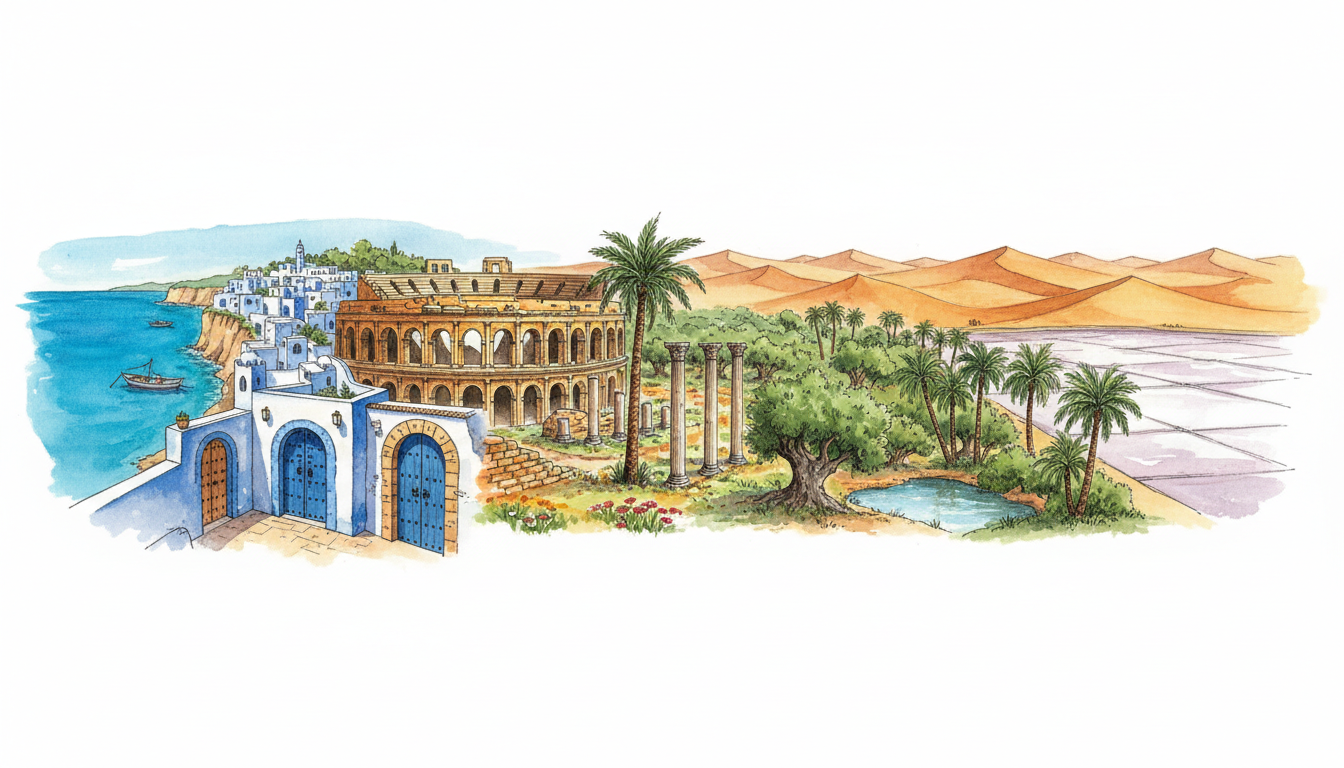
How does Tunisia work? Tunisia is a North African republic on the Mediterranean, where the geography of coast, inland towns and arid southern landscapes shapes work, water, farming and transport. The country has a president, two parliamentary chambers, 24 governorates and an economy connected to European trade, tourism, manufacturing and agriculture.
To understand daily life, imagine a farmer worrying about irrigation, a factory preparing components for export and a family travelling to a coastal hospital. Each needs roads, budgets, trained people, working institutions and—often—water. Tunisia’s 2022 constitutional changes also altered the distribution of political power, so a guide needs to separate the legal structure from debates about how it operates in practice.
At a glance: Tunisia
- Capital: Tunis, in northern Tunisia.
- Location: North Africa on the Mediterranean, bordering Algeria and Libya.
- Political structure: a republic under the 2022 Constitution with a powerful presidency and a bicameral Parliament.
- Parliament: Assembly of the Representatives of the People and the National Council of Regions and Districts.
- Administrative geography: 24 governorates grouped within broader administrative and regional frameworks.
- Currency: Tunisian dinar (TND), not the euro.
- Economy: farming, olives and olive oil, manufacturing and components, services, tourism, trade and remittances.
- Major infrastructure issue: managing scarce freshwater across households, agriculture, industry and tourism.
Where is Tunisia, and why does its geography matter?
Tunisia lies between Algeria and Libya with access to the Mediterranean. Coastal areas support ports, large cities, many tourist destinations and significant industry. Inland and southern communities have different conditions for agriculture, water access and long-distance transport. Tunis, Sfax, Sousse and other centres play different economic roles.
Geography affects both income and costs. An export factory near a port may reach international customers through existing shipping networks, while an inland farm may need additional storage, trucking and reliable irrigation. A regional inequality cannot be understood simply from the country’s national average.
How does Tunisia’s political system work?
Tunisia operates under a Constitution adopted in 2022 that strengthened presidential authority compared with the political settlement established after the 2011 revolution. The president has a central executive role, while a government and public administration carry out policy. The legislature now has two chambers with distinct modes of selection and responsibilities.
The country’s 2011 revolution and subsequent political developments are important context. Supporters of stronger executive coordination and critics concerned about democratic checks have different assessments of the constitutional changes. Readers should distinguish what the Constitution states, what the government says it is doing and what independent observers report about representation, rights and implementation.
What are Tunisia’s two parliamentary chambers?
The Assembly of the Representatives of the People is the main directly elected lower chamber. The National Council of Regions and Districts is a second chamber chosen indirectly through regional and district arrangements. The Inter-Parliamentary Union records a 77-member statutory structure for the second chamber, linked to 24 governorates and five districts.
A law’s journey is more complicated than the name of the president. A proposal is considered under legal parliamentary procedures; public agencies then implement relevant provisions, and courts play their judicial roles. It is worth checking current procedural rules rather than assuming that every legislative question follows exactly the same pathway.
What is a governorate?
A governorate is an administrative territorial unit, and Tunisia has 24. Governorates include urban and rural areas with varying employment patterns, infrastructure needs and access to services. Tunisia’s regional and district bodies intersect with these territorial boundaries in government processes.
A useful map exercise is to compare a densely populated metropolitan governorate and an inland agricultural one. Both are inside the same legal system, yet water access, hospital distances, jobs, road costs and environmental exposure may differ. Administration is not a substitute for geography.
What makes water scarcity such a large economic issue?
Tunisia experiences severe water stress, with competition among drinking-water supply, irrigation, industry and other uses. The World Bank’s September 2026 Tunisia Economic Monitor highlights that long-term management of freshwater is central to jobs and growth. A rainy month can help reservoirs without erasing multi-year structural constraints.
Water is a system: catchment and rainfall, reservoirs or wells, treatment, pipes, leakage control, pumps, tariffs, finance and maintenance. Agriculture may need more efficient irrigation and crop planning; towns need reliable treatment and distribution; hotels and factories need predictable supplies. Drought pressure can cross sectors.
When discussing solutions, separate reducing losses, improving governance, treated wastewater reuse, desalination where feasible, demand management and expanding supply. Each carries costs and energy requirements. There is no single magic pipeline that removes all trade-offs.
How do olives, farms and food exports reach buyers?
Tunisia produces olives and olive oil alongside dates, cereals and other crops. An exporter needs farm production, processing, quality standards, packaging, transport, banking and clearance at a port. The price received by a producer is not the same as the final retail price abroad.
Farming also ties water and employment together. A drought can lower yields, shift labour demand and alter food prices. Adding value through careful processing and branding may help certain products, but quality control and trusted logistics matter. A farm is both part of an ecosystem and part of a trading network.
Why are manufacturing and European trade important?
Tunisia has industrial businesses involved in textiles and mechanical or electrical components, alongside other manufacturing activities. Geographic proximity and established business relationships with European markets can matter for supply chains, although companies still face logistics, financing and skills constraints.
Follow one electrical component from production to an overseas buyer. The factory needs workers, an electricity supply, inputs, equipment servicing and documentation. The delivered product also needs road transport, a port or airport and customs clearance. If any link fails, productive capacity alone cannot fulfil the order.
What role does tourism play in everyday life?
Tunisia’s Mediterranean coastline, historical sites and urban culture support tourism, including accommodation, transport, restaurants and guiding. Visitor spending reaches many different workers and suppliers, but demand fluctuates with seasonality, security perceptions, air connectivity and the wider economy.
A tourist area also uses freshwater, electricity, waste services and roads shared with local residents. Good planning therefore asks how visitor businesses pay for utilities and maintenance and how the benefits of tourism are distributed beyond hotel receipts.
How are electricity, schooling and healthcare connected?
Electricity powers factories, pumps, classrooms and clinics. Fuel supply, generation, grid maintenance and affordability influence daily reliability. Any energy transition involves financial, regulatory and technical choices as well as construction targets.
Education extends from schools to universities and vocational training; language contexts commonly include Arabic and French in different educational and professional settings. Healthcare depends on staff, specialist distribution, referrals and travel. Families should verify qualifications, school requirements and local service availability directly rather than assuming national rules describe every personal case.
How should we compare Tunisia’s economic headlines?
Unemployment, growth, inflation and public debt measure different aspects of the economy. A fall in inflation means prices are rising more slowly, not necessarily that the cost of living has returned to an earlier level. National growth may coexist with difficult job markets in particular regions.
Likewise, rainfall in a good season does not guarantee long-term water security. Compare the period measured, geography and source before drawing conclusions. Tunisia is best understood as an interacting set of fiscal, physical and social systems, not one ranking.
Worked example: what happens when one link fails?
Imagine two businesses: an inland olive cooperative and a coastal restaurant. Both need water. The cooperative may require irrigation and processing; the restaurant needs safe drinking water, cleaning and sanitation. If reservoir levels decline, the consequences and available solutions differ.
Draw separate routes from source to user: reservoir or groundwater, treatment, distribution, customer and wastewater. Add a road that carries the olive oil to a port and food to the restaurant. Which repair would benefit both users, and which would help only one?
Use a fictional 100-unit water investment budget: 30 to reduce leaks, 25 to upgrade treatment, 20 for efficient irrigation, 15 for maintenance and 10 for monitoring. What long-term cost has been omitted? This is an educational example, not a real Tunisia public budget.
Frequently asked questions
How many governorates are there in Tunisia?
Twenty-four. They are territorial units within the country’s public administration; some regional arrangements group them into wider districts.
Does Tunisia have one or two chambers of Parliament?
Two: the Assembly of the Representatives of the People and the National Council of Regions and Districts.
Is the Tunisian dinar the same as the euro?
No. Tunisia has its own currency, the Tunisian dinar. Exchange arrangements and limits can change, so travellers and businesses should consult official and banking sources.
Why is Tunisia worried about water?
Freshwater is scarce relative to demand, and climate variability, irrigation, urban growth and network losses add pressure. Long-term management matters for both jobs and daily supply.
What are important parts of its economy?
Agriculture and olive oil, manufacturing and component exports, services, tourism and connected trade and logistics. Their shares and performance shift over time.
Related country and civilisation guides
- How Countries Work | A–Z Guide to 195 Countries
- Published How Countries Work archive
- How Singapore Works — companion civilisation series
Related country reading: Education in Tunisia (school stages, baccalauréat and training); Everything About Tunisia (history, geography and culture); Detailed Tunisia systems guide (water, governorates and Mediterranean trade). These guides develop the specific systems, education pathways and cultural context introduced above.
Sources and date of review
Reviewed for the 20 October 2026 edition. Legal arrangements, geographic facts and system explanations are based on the sources below. Policy implementation varies and service access can differ significantly among communities. Recheck official agencies for the latest fees, leaders, deadlines, safety notices and live statistics.