
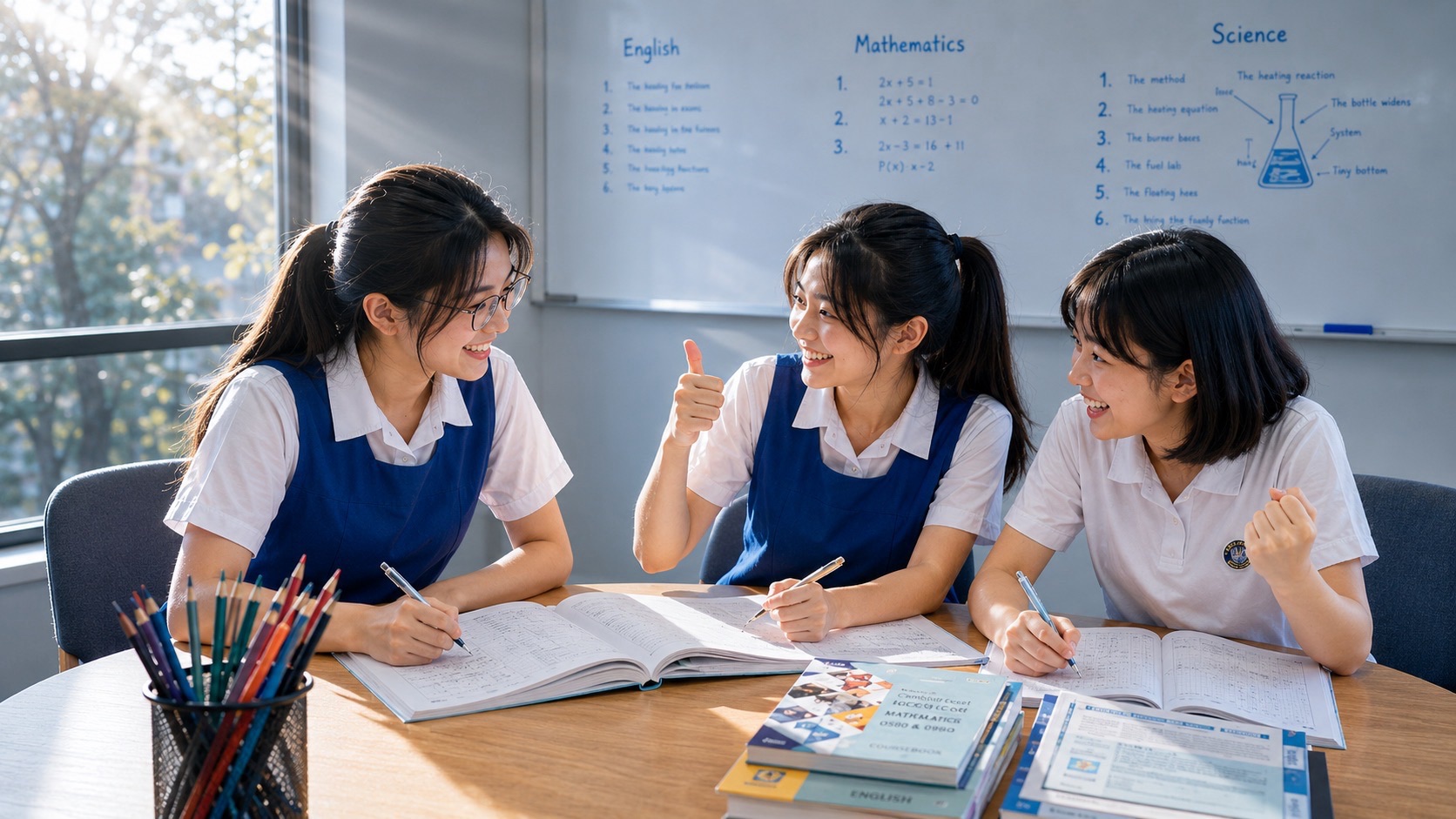
Discover how eduKateSG’s 3-pax Sec 2 Mathematics tuition for Clementi students strengthens algebra, school results, confidence and Secondary 3 readiness.
Our Sec 2 Clementi small-group Mathematics tuition helps students repair foundations, improve daily schoolwork and prepare carefully for the demands of Secondary 3 Mathematics.
When should your child start Secondary 2 Mathematics tuition in Clementi? Compare the November, January, Term 1 and June entry windows for stronger school performance.
When to Start Clementi Secondary 2 Mathematics Tuition for Maximum School Performance
The best time to start Clementi Secondary 2 Mathematics tuition is usually during the November–December holidays before Secondary 2. This gives students time to repair Secondary 1 gaps, prepare for the new syllabus and begin the school year with greater control.
The best time to start Secondary 2 Mathematics tuition is not always when the marks have already fallen.
For most Clementi students, the highest-leverage starting window is during the November and December holidays before Secondary 2.
This gives the student enough time to:
- review the important Secondary 1 foundations;
- repair weak algebra and number skills;
- learn the opening Secondary 2 topics calmly;
- establish better working and checking habits;
- and begin the school year with useful prior knowledge.
The next-best window is the beginning of January, before schoolwork, tests and other commitments begin accumulating.
Students can still improve when they start later. However, the purpose of tuition changes as the year progresses.
Early tuition prepares.
Term 1 tuition stabilises.
Mid-year tuition repairs.
Late-year tuition protects the examination result and prepares the transition into Secondary 3.
Understanding this difference helps parents choose the correct starting point without creating unnecessary urgency.
One-Sentence Answer
For maximum school performance, Clementi students should ideally begin Secondary 2 Mathematics tuition during the November–December holidays before Secondary 2, or within the first few weeks of January, so there is time to repair Secondary 1 weaknesses and prepare for the more connected Mathematics required in Secondary 2.
Why Secondary 2 Mathematics Deserves Early Attention
Secondary 2 can look like an ordinary middle year.
It is not the first year of Secondary school. It is not yet the upper-Secondary examination stage. Additional Mathematics may not have formally begun.
This can make the year feel less urgent.
In practice, Secondary 2 is where the lower-Secondary Mathematics system is tested.
Secondary 1 introduces students to algebra, equations, graphs, geometry and more formal mathematical working. Secondary 2 asks whether those foundations can continue carrying a heavier load.
The subjects are no longer operating independently.
Algebra affects equations.
Equations affect graphs.
Ratio and proportion affect rate and application questions.
Geometry begins requiring more formal relationships.
Weak arithmetic begins leaking into algebra.
Poor working habits create larger losses because solutions contain more connected steps.
The Secondary Mathematics Learning System describes the four-year route clearly:
- Secondary 1 installs the transition;
- Secondary 2 repairs, consolidates and connects;
- Secondary 3 introduces upper-Secondary load;
- Secondary 4 converts accumulated learning into examination performance.
In other words, Secondary 2 is not simply another school year.
It is the final full year available to stabilise lower-Secondary Mathematics before the demands of Secondary 3 arrive.
Parents who would like to see the broader progression can begin with:
- Mathematics Tuition Clementi
- Secondary 2 Mathematics Tuition Clementi
- The eduKate Mathematics Learning System
- How eduKateSG Secondary Mathematics Tutorials Work
The Best Starting Window: November and December Before Secondary 2
The November–December school holidays offer the cleanest starting window.
School has paused.
The Secondary 1 examination papers are available.
There is time to look at mistakes without preparing for another test at the same time.
A careful holiday programme can use the student’s Secondary 1 work to answer five important questions:
- Which concepts are genuinely understood?
- Which methods are remembered but not understood?
- Which mistakes are repeating?
- Which Secondary 1 topics will affect Secondary 2?
- What should be repaired before new content is added?
This is much more useful than beginning the holidays by racing through the entire Secondary 2 syllabus.
What Should Be Done During the Holiday Runway?
A suitable November–December programme may include:
- number and arithmetic control;
- negative numbers;
- fractions, ratios and percentages;
- algebraic manipulation;
- expansion and factorisation;
- substitution;
- linear equations;
- coordinates and graphs;
- geometry foundations;
- clear mathematical working;
- and an error review of the Secondary 1 examination paper.
Once the prerequisites are stable, the student can begin selected Secondary 2 concepts.
The objective is not to finish Secondary 2 before school begins.
The objective is to make the first school encounter feel familiar, manageable and connected to what the student already knows.
Why This Produces Better School Performance
A student who first sees a topic during a busy school lesson must perform several tasks at once:
- understand unfamiliar language;
- follow the teacher’s explanation;
- copy the method;
- connect it to previous learning;
- complete classwork;
- and remember it later.
A student with prior exposure carries a lighter load.
The school lesson becomes a second encounter.
The student can listen for detail instead of merely trying to keep up. Questions become more precise. Homework becomes reinforcement rather than first-time discovery.
This is one reason teaching ahead can be effective when it is done carefully.
The sequence should be:
Repair → Prepare → Encounter in school → Reinforce → Apply → Review
Not:
Rush ahead → Memorise procedures → Forget → Reteach
The January Starting Window: Still Excellent
Starting in January is still a strong decision.
The student can align tuition closely with the school’s teaching sequence and begin building a regular weekly rhythm before the first assessment.
This window is particularly suitable when:
- Secondary 1 results were generally stable;
- the student needs guidance rather than extensive repair;
- the child is adjusting to a new timetable;
- the school’s Mathematics sequence is now known;
- or the family could not begin during the holidays.
The first weeks of January should be used to establish:
- accurate algebraic habits;
- clear working;
- regular revision;
- error correction;
- and familiarity with the school’s question style.
Parents should not wait until the first major examination if smaller warning signs are already visible in classwork, homework or topical tests.
A student does not need to fail before support becomes useful.
Should Parents Wait for the First Test?
Sometimes.
A first test can provide useful information. It may reveal the school’s standard, the student’s present readiness and the exact topics that need attention.
However, waiting is sensible only when the student is coping independently.
Waiting may be reasonable when:
- homework is completed without substantial help;
- the student can explain recently taught concepts;
- algebraic working is generally clear;
- mistakes are noticed and corrected;
- revision is regular;
- and the student is not showing anxiety or avoidance.
Waiting is less sensible when:
- Secondary 1 foundations were already weak;
- the student ended the previous year with an unstable result;
- algebra remains confusing;
- the child depends heavily on answers or examples;
- homework is taking unusually long;
- or the student has begun saying that Mathematics “makes no sense”.
A test confirms the state of the system.
It does not create the problem.
Where the warning signs are already clear, waiting for a poor mark may simply reduce the available repair time.
The Term 1 Starting Window: Diagnose and Stabilise
Students who begin tuition after the first weighted assessment can still make strong progress.
At this point, tuition should use the assessment as diagnostic evidence.
The result should not be read only as a percentage.
A score of 62%, for example, can represent very different situations.
One student may understand the difficult questions but lose marks through signs and brackets.
Another may complete standard questions but be unable to transfer methods.
Another may leave questions blank because of poor time management.
Another may have an incomplete understanding of algebra.
The same mark can therefore require different tuition.
The eduKateSG Parent’s Learning Map helps parents describe the difficulty more accurately by separating concerns such as algebra, equations, graphs, geometry, word-problem translation, calculator use, careless mistakes and paper timing.
What Tuition Should Do After the First Assessment
A useful Term 1 intervention should:
- classify every lost mark;
- separate conceptual errors from execution errors;
- identify repeated patterns;
- repair the prerequisite causing the pattern;
- reteach the relevant topic;
- practise with controlled variation;
- and check whether the correction survives in a new question.
The aim is not merely to improve the next worksheet.
It is to prevent the same weakness from travelling into the next chapter.
Why “Careless Mistakes” Should Not Be Ignored
Secondary 2 is often when parents begin hearing:
“I knew how to do it.”
“I just wrote the wrong sign.”
“I pressed the calculator wrongly.”
“I did not see that part.”
“It was only a careless mistake.”
One isolated mistake may indeed be accidental.
A repeated pattern is different.
Secondary 2 Mathematics places greater pressure on algebra, working memory, attention and multi-step control. Small errors can therefore be signs that the student’s mathematical process is becoming unstable under load.
Common examples include:
- changing a negative sign incorrectly;
- expanding brackets incompletely;
- copying a value wrongly;
- substituting into the wrong expression;
- skipping an algebraic step;
- using a formula without checking its conditions;
- omitting units;
- or answering something different from what was asked.
The appropriate response is not simply, “Be more careful.”
The question should be:
What kind of mistake is repeating, and why does it survive the student’s checking process?
Parents can read:
- Why Careless Mistakes Increase in Secondary 2 Math
- What to Do If Your Child Keeps Making Careless Mistakes in Sec 2 Math
- Why I Am Bad at Secondary Mathematics—and What That Usually Really Means
- Why Secondary Mathematics Breaks at Transitions and Under Exam Load
The May–June Starting Window: The Mid-Year Reset
May and June form an important second entry window.
By this point, parents usually have enough evidence to see whether the child is:
- coping well;
- surviving through effort;
- becoming inconsistent;
- or falling behind.
The June holidays provide enough space to conduct a structured reset.
What the Mid-Year Reset Should Cover
A good mid-year programme should not automatically reteach every chapter.
It should establish:
- which Term 1 and Term 2 topics are secure;
- which mistakes are recurring;
- whether weak Secondary 1 foundations remain active;
- whether algebra is supporting or obstructing progress;
- whether the student can solve questions without prompts;
- and whether speed has been built before accuracy.
The student may then follow one of three routes.
Route 1: Catch Up
For students who have missed or misunderstood important content.
The priority is to close the most damaging gaps before the second semester introduces additional material.
Route 2: Keep Up
For students who understand lessons but are inconsistent.
The priority is to consolidate, connect topics and establish better revision and checking routines.
Route 3: Move Ahead
For students who are already stable.
The priority is to deepen transfer, introduce later topics carefully and prepare for more demanding school questions.
This catch-up, keep-up and move-ahead distinction prevents tuition from treating every child as though they have the same problem.
Starting in July or August: Still Useful, but More Selective
A July or August start is not too late.
There is still time to improve the second-semester result and prepare for the end-of-year examination.
However, the programme must now be selective.
The student has less time available, while school continues introducing new material.
Tuition may need to run two tracks at once:
- support the current school topic;
- and repair the earlier weakness affecting it.
For example, a student struggling with graphs may need current graph practice while also repairing algebraic substitution and coordinate understanding.
A student struggling with mensuration may need current formulas while repairing basic geometry and unit conversion.
This is more demanding than beginning early because the student is repairing the runway while continuing to take off.
It can still be done, but accurate diagnosis becomes increasingly important.
Starting in September or Near the End-of-Year Examination
Starting shortly before the final examination is an examination-protection route.
The immediate priorities may include:
- identifying the highest-value topics;
- correcting repeated error types;
- securing standard questions;
- improving paper completion;
- revising formulas and methods;
- and practising selected timed sections.
There may not be enough time to rebuild every foundation fully before the examination.
Parents should therefore keep expectations realistic.
Late intervention can improve performance. It can also reveal what needs deeper repair after the examination.
The work should continue into the November–December period so that the student enters Secondary 3 with a stronger foundation.
The mistake would be to stop tuition immediately after the examination simply because the paper has ended.
The examination may be over.
The structural weakness is not necessarily over.
Starting After the Secondary 2 Examinations
After the Secondary 2 examinations is the final major transition window before upper Secondary.
At this point, tuition is no longer primarily about maximising Secondary 2 school performance.
It is about protecting Secondary 3.
This is especially important because Secondary 3 is not merely Secondary 2 with a few additional chapters.
The mathematical load becomes denser. Algebra carries more of the subject. Functions, graphs, geometry, trigonometry and upper-Secondary examination methods require greater precision.
Students taking Additional Mathematics will also encounter a more symbolically demanding subject.
Useful next-reading pages include:
- Secondary 3 Mathematics Tuition Clementi
- How Secondary 3 Mathematics Works in Singapore
- Secondary 3 Additional Mathematics: The Phase Shift
- The Latest Secondary 3 G3 Additional Mathematics Updates
- Secondary 3 Additional Mathematics Tuition
A Simple Starting-Time Table for Parents
| Starting period | Main tuition function | Best suited for |
|---|---|---|
| November–December before Sec 2 | Repair Secondary 1 and prepare ahead | Maximum full-year readiness |
| Early January | Align with school from the beginning | Stable students and early support |
| After the first assessment | Diagnose visible school-performance gaps | Students with unexpected or inconsistent results |
| May–June | Conduct a structured mid-year reset | Catch-up, consolidation or controlled acceleration |
| July–August | Repair selectively while supporting current work | Students showing clear second-semester risk |
| September–October | Protect examination performance | Immediate exam weaknesses and paper control |
| After the final examination | Repair the lower-Secondary system before Sec 3 | Upper-Secondary and A-Math readiness |
The Correct Time Depends on the Student
The calendar matters, but the student’s condition matters more.
Student A: Strong and Independent
This student is performing well and can explain the Mathematics clearly.
Tuition is optional unless the student needs:
- deeper challenge;
- preparation for a demanding school sequence;
- more unfamiliar problem-solving;
- or an early route into upper-Secondary Mathematics.
The best starting time may be November, January or not at all.
Good tuition should never be recommended merely because a student is in Secondary 2.
Student B: Performing Well but Inconsistent
This student may score well in one test and fall sharply in another.
The likely problem is not a complete lack of knowledge.
It may involve:
- weak transfer;
- uneven revision;
- careless error patterns;
- poor paper timing;
- or dependence on familiar question forms.
The best starting window is November–January, before inconsistency becomes embedded.
Student C: Working Hard but Remaining Around the Same Mark
This student may complete many worksheets without producing meaningful improvement.
More practice alone may not solve the issue.
The student may be repeating the same misunderstanding or method error across many questions.
This student should begin as soon as the pattern is recognised.
Parents can also use Parenting 101 Mathematics: The Big Picture to examine a mistake through question reading, target identification, given information, method and execution rather than looking only at the final answer.
Student D: Struggling With Algebra
Algebra is one of the clearest reasons not to delay.
Weak algebra does not remain inside one chapter.
It affects:
- expressions;
- equations;
- inequalities;
- graphs;
- formulas;
- coordinate geometry;
- and later Additional Mathematics.
The student should begin when the weakness becomes visible, regardless of the month.
Student E: Already Failing or Avoiding Mathematics
This student does not need to wait for the next examination.
The first objective is to reduce confusion and establish a workable starting point.
Early lessons may return to simpler material because the visible Secondary 2 problem may be caused by an earlier weakness.
This is not moving backwards.
It is finding solid ground.
Student F: Preparing for G3 Mathematics or Additional Mathematics
Secondary 2 is an important readiness year under Full Subject-Based Banding.
Students may take Mathematics at G1, G2 or G3 according to their subject-level route and readiness. Schools also consider their own criteria and the student’s overall suitability when advising upper-Secondary subject combinations.
Parents should therefore avoid treating Additional Mathematics as only a Secondary 3 concern.
The readiness work begins earlier through:
- algebraic fluency;
- symbolic confidence;
- disciplined working;
- persistence;
- and the ability to learn unfamiliar structures.
Useful guides include:
- What Is Full SBB Mathematics?
- What Is Full SBB for Mathematics?
- A Parent’s Guide to Understanding Full SBB
- Full Subject-Based Banding for Parents
Tuition Should Not Begin With Speed
Parents often ask whether tuition can help the child become faster.
Usually, yes.
But speed should not be the first layer.
A student who performs an unstable method more quickly simply produces mistakes faster.
The correct order is:
Understand → Set up correctly → Execute accurately → Check → Repeat → Increase speed
The eduKate Mathematics Learning System places Mathematics development through a progression of understanding, representation, operation, practice, connection, transfer, performance and review.
This is particularly important in Secondary 2 because students are beginning to manage longer and more connected solutions.
Accuracy should become dependable before time pressure is increased.
What Maximum School Performance Really Means
Maximum school performance does not mean every student must score 100%.
It means helping the student produce the strongest sustainable performance available from their present ability, preparation time and learning condition.
This includes:
- understanding what is being taught;
- completing schoolwork independently;
- retaining previous topics;
- transferring methods into unfamiliar questions;
- reducing preventable errors;
- revising efficiently;
- completing papers within time;
- and entering Secondary 3 without hidden structural weakness.
For one student, this may mean moving from failure to a stable pass.
For another, it may mean moving from an inconsistent B to a dependable A.
For a strong student, it may mean learning to solve unfamiliar questions calmly rather than relying on familiar patterns.
Progress should be read against the student’s starting point and future route.
Why 3-Pax Tuition Helps With Timing
The earlier a tutor can see how a student works, the earlier the correct repair can begin.
In a focused 3-pax class, the tutor can observe:
- how the student reads a question;
- where hesitation begins;
- whether algebraic steps are understood;
- which working is omitted;
- how the student responds to correction;
- and whether the student can repeat the method independently.
This matters because two students with the same mark may need very different intervention.
One may need reteaching.
One may need better checking.
One may need stronger transfer.
One may need greater speed.
One may need confidence and a calmer working routine.
For Clementi families, eduKateSG provides carefully structured Secondary Mathematics tuition in small groups near Sixth Avenue MRT, with the class fit considered alongside the student’s level, timetable and learning needs.
Parents can read more about the programme through:
- Secondary 2 Mathematics Tuition Clementi
- Sec 2 Math Tutor and Secondary 2 Mathematics Tuition
- Secondary 2 G3 Mathematics Tutorials
- G3 High-Definition Secondary 2 Mathematics Tuition
- How to Get A1 for Secondary 2 Mathematics
When Tuition May Not Be Necessary
Responsible advice must include the possibility that tuition is not presently required.
A student may not need tuition when the student:
- understands school lessons;
- completes work independently;
- performs consistently;
- can explain mistakes;
- knows how to revise;
- responds well to school support;
- and remains prepared for the next level.
Parents may still wish to provide enrichment, but enrichment is a different objective from repair.
Tuition should solve a real learning need.
It should not become a weekly obligation without a defined purpose.
What Parents Should Bring to a Consultation
A useful Secondary 2 Mathematics consultation begins with evidence.
Parents may bring:
- the Secondary 1 final examination paper;
- recent Secondary 2 tests;
- school worksheets;
- homework showing repeated difficulty;
- the child’s present G1, G2 or G3 Mathematics level;
- school feedback;
- and a short description of what happens during homework and revision.
The working is often more informative than the final mark.
It shows whether the difficulty begins with:
- question reading;
- concept knowledge;
- method selection;
- algebra;
- calculation;
- working layout;
- checking;
- or examination pressure.
The consultation can then determine whether the student needs to:
- catch up;
- keep up;
- move ahead;
- prepare for a more demanding subject level;
- or rebuild confidence before Secondary 3.
Frequently Asked Questions
Is November too early to begin Secondary 2 Mathematics tuition?
No.
November is often the most useful starting window because the tutor can review Secondary 1, repair prerequisites and introduce Secondary 2 without competing with daily school deadlines.
The student should not be rushed through the entire syllabus. The purpose is readiness, not premature completion.
Is January too late?
No.
January remains an excellent starting time, especially for students whose Secondary 1 foundations are reasonably stable.
The student can begin alongside school and establish a strong weekly learning rhythm before the first assessments.
Should we wait for the first weighted assessment?
Wait only when the child is coping independently and no significant warning signs are visible.
Where algebra, homework independence, confidence or Secondary 1 results are already unstable, waiting may reduce the available repair time.
My child is already scoring well. Is tuition still useful?
Possibly, but the objective should be precise.
A high-scoring student may need deeper transfer, greater consistency, preparation for a faster school syllabus or stronger readiness for upper-Secondary Mathematics.
A strong student who is already independent may not need tuition.
Can a student still improve after June?
Yes.
The June holidays provide a valuable mid-year reset. Students can consolidate the first semester and prepare for the second.
The later the start, however, the more selective the repair programme must become.
Is Secondary 2 more important than Secondary 1?
The two years perform different jobs.
Secondary 1 introduces the transition from Primary to Secondary Mathematics.
Secondary 2 tests, repairs and connects that new system before upper-Secondary Mathematics begins.
A weak Secondary 1 creates risk. An unrepaired Secondary 2 carries that risk into Secondary 3.
Should my child prepare for Additional Mathematics during Secondary 2?
The child does not necessarily need to begin the full Additional Mathematics syllabus.
However, strong algebra, symbolic discipline, graph understanding and independent working should be developed during Secondary 2. These form part of the readiness base for A-Math.
Does eduKateSG teach ahead of school?
Yes, where teaching ahead is appropriate for the student.
Foundations are checked first. New material is then introduced in a controlled way so that school lessons become reinforcement rather than first exposure.
How quickly can Mathematics marks improve?
Some execution errors can be corrected relatively quickly.
Accumulated conceptual or algebraic weaknesses usually require a longer runway.
Early progress may first appear as clearer working, fewer repeated errors, better homework independence and improved question recognition before it becomes a large examination increase.
A Calm Decision for Clementi Parents
The best time to start Secondary 2 Mathematics tuition is before the child urgently needs it.
For most families seeking maximum school performance, that means beginning during the November–December holidays or early in January.
This gives tuition time to do its best work:
- understand the student;
- repair the correct foundation;
- prepare what comes next;
- support school learning;
- and convert improvement into independent performance.
When a student begins later, progress is still possible.
The programme simply needs to recognise the changed objective.
Do not ask only:
“Is it too early or too late?”
Ask:
“What job must tuition perform from this point in the year?”
If the job is preparation, begin before Secondary 2.
If the job is stabilisation, begin in January or Term 1.
If the job is repair, begin as soon as the repeated weakness becomes visible.
If the job is examination protection, use the remaining time carefully and continue the deeper work after the paper.
If the job is Secondary 3 readiness, the end of Secondary 2 is the final clean runway.
The correct starting date is not chosen by anxiety.
It is chosen by reading the student accurately and giving the learning system enough time to become stable.
Read Mathematics Tuition Clementi
Explore Secondary 2 Mathematics Tuition Clementi
Understand the Secondary Mathematics Learning System
Book a Mathematics Tuition Consultation
How Our Sec 2 Clementi Small-Group Mathematics Tuition Makes a Difference to School Performance
Secondary 2 is easy to underestimate.
It does not carry the immediate pressure of a national examination year. There is no PSLE transition to announce its arrival, and Secondary 3 subject demands may still feel comfortably distant.
Yet Secondary 2 is often where a student’s future Mathematics performance begins to take shape.
Algebra becomes more important. Questions require more steps. Graphs, geometry, mensuration, ratio, percentage, statistics and problem-solving begin interacting more closely. Students are also expected to work with greater independence.
A student who enters Secondary 2 with small gaps may initially continue passing.
The concern is what happens as those gaps begin combining.
Homework takes longer.
School explanations become harder to follow.
Previously manageable algebra begins affecting several topics.
Test marks become inconsistent.
The student appears to understand when a teacher demonstrates the method but cannot reproduce it independently.
By the end of the year, the student may be academically promoted to Secondary 3 without being mathematically ready for it.
Our Sec 2 Clementi small-group Mathematics tuition is designed to prevent that quiet drift.
We help students repair the right foundations, understand the Mathematics being taught in school, develop more dependable working habits and prepare for the larger upper-secondary demands ahead.
The purpose is not simply to complete more worksheets.
It is to improve how the student learns and performs in school.
One-Sentence Answer
Our Sec 2 Clementi small-group Mathematics tuition makes a difference by identifying why a student is losing marks, repairing the problem in the correct order and building the understanding, working discipline and independence needed for stronger school performance.
Why Secondary 2 Mathematics Matters So Much
Secondary 1 is often described as the transition year.
Students adjust to a new school, new teachers, new routines and the move from Primary Mathematics towards more symbolic forms of thinking.
Secondary 2 is different.
By then, the school expects the student to have adjusted.
The pace may become less forgiving. Teachers continue forward because the student has already had a year to become familiar with Secondary Mathematics.
This is when hidden weaknesses become more visible.
A student may have entered Secondary school with:
- weak fraction control;
- uncertain negative numbers;
- incomplete algebraic understanding;
- dependence on model drawing;
- poor working organisation;
- or a habit of memorising methods without understanding them.
These weaknesses may not cause immediate failure.
Instead, they increase the effort required for every new chapter.
A question that should take five minutes takes fifteen.
A student who should be revising is still trying to understand the lesson.
Corrections are copied but not retained.
The student begins each new topic with less confidence and more unfinished learning.
Secondary 2 therefore has two jobs.
The student must perform well in the present school year.
The student must also build the foundations required for Secondary 3.
Our programme works on both.
Sec 2 Is Not Merely a Waiting Room Before Sec 3
It is tempting to think that serious Mathematics preparation can begin in Secondary 3.
For many students, that is too late.
Upper-secondary Mathematics does not begin from an empty page. It assumes that students can already manage important lower-secondary skills with reasonable control.
These include:
- algebraic manipulation;
- equations;
- ratio and proportion;
- percentages;
- rates;
- graphs;
- coordinate relationships;
- geometry;
- mensuration;
- statistics;
- probability;
- and multi-step problem-solving.
When these foundations are stable, Secondary 3 feels like a meaningful progression.
When they are weak, Secondary 3 feels like two years of Mathematics arriving at once.
The student must learn the new syllabus while simultaneously repairing the old one.
This is particularly demanding for students who later take more advanced Mathematics routes.
Singapore’s current secondary-school structure provides Mathematics at different subject levels under Full Subject-Based Banding. MOE publishes separate G1 Mathematics and G2/G3 Mathematics syllabuses, reflecting different levels of depth and demand.
This flexibility is useful, but movement and opportunity still depend on readiness.
A student needs sufficiently strong Mathematics to benefit from the route available.
That is why Secondary 2 tuition is not only remedial.
It can be protective and strategic.
What We Mean by Better School Performance
School performance is larger than one examination mark.
Marks matter, but they are the final visible output of several earlier processes.
A student’s Mathematics performance is affected by whether the student can:
- understand the lesson;
- begin homework without excessive prompting;
- recall earlier methods;
- recognise the type of problem;
- organise working;
- complete questions within a reasonable time;
- correct mistakes properly;
- prepare for tests;
- and remain calm when a question is unfamiliar.
When these processes improve, results become more stable.
We therefore look for several forms of progress.
Academic Progress
The student answers more questions correctly and loses fewer marks through repeated mistakes.
Operational Progress
Homework becomes faster, working becomes clearer and revision becomes more organised.
Independent Progress
The student requires fewer prompts and can choose an appropriate method without being told how to begin.
Confidence Progress
The student is more willing to attempt difficult questions and less likely to leave work blank.
Transition Progress
The student becomes better prepared for the move from lower-secondary foundations into upper-secondary Mathematics.
A tuition programme that improves only the latest worksheet may provide temporary relief.
A programme that improves the student’s complete working system makes a wider difference to school performance.
Why Students Can Work Hard and Still Underperform
Parents are often concerned when they see their child studying regularly but receiving results that do not reflect the effort.
This does not always mean the child is careless or unmotivated.
The student may be working with an inefficient learning process.
For example, the student may:
- reread notes rather than retrieve methods independently;
- complete many familiar questions but avoid weaker topics;
- refer to solutions too quickly;
- copy corrections without reattempting the question;
- practise individual chapters but struggle with mixed questions;
- memorise procedures without understanding when they apply;
- or spend too long on questions because an earlier foundation is missing.
The child is doing work.
The work is simply not producing enough transfer.
This can be frustrating for the entire family because effort is visible, but improvement remains uncertain.
Our small-group lessons aim to make that effort more precise.
Instead of adding another large quantity of questions, we identify the part of the learning process that is not converting into performance.
The First Difference: We Can See How Each Student Thinks
A student’s final answer does not reveal the complete problem.
Two students may produce the same wrong answer for different reasons.
One may have misunderstood the concept.
One may have selected an unsuitable method.
One may have made a sign error.
One may have copied a number incorrectly.
One may know the method but lack the working discipline to complete it accurately.
These differences matter because they require different corrections.
In a 3-pax class, the tutor has greater visibility over the student’s mathematical process.
We can observe:
- how the student reads the question;
- what the student writes first;
- where hesitation appears;
- which method is selected;
- how equations are arranged;
- whether diagrams are used properly;
- which steps are omitted;
- and whether the student can detect an unreasonable answer.
This gives us a more useful starting point than marks alone.
A mark tells us that something went wrong.
Close observation helps us understand what went wrong.
eduKateSG’s Clementi Secondary Mathematics programme is built around focused 3-pax classes near Sixth Avenue MRT, with first-principles teaching, diagnostic correction and preparation across Secondary 1 to Secondary 4 Mathematics.
The Second Difference: We Repair the Earliest Important Gap
Mathematics is cumulative.
When a student struggles with a current topic, the visible chapter may not be the true starting point.
A student struggling with algebraic fractions may first need better fraction control.
A student struggling with graphs may not understand equations or coordinates securely.
A student struggling with percentage change may have an unstable understanding of the original quantity, the change and the new whole.
A student struggling with geometry may know individual formulas but lack the visual reasoning needed to identify relevant relationships.
Simply reteaching the latest school lesson may help for one evening.
It may not solve the underlying problem.
We therefore ask:
What is the earliest important weakness causing the present difficulty?
Once that point is identified, the learning can be rebuilt in a sensible order.
For example:
Negative numbers → algebraic terms → equations → graphs
Fractions → ratio → proportion → percentage
Angles → properties of shapes → geometric reasoning → mensuration
Coordinates → linear relationships → graph interpretation
This approach prevents the student from repeatedly building new work on an unstable base.
The Third Difference: We Teach Mathematics From First Principles
A student should not experience Mathematics as a collection of unexplained rules.
Rules may produce answers in familiar questions.
Understanding allows the student to use those rules flexibly.
Consider a student solving an equation.
The student may have been told:
“Move this term across and change the sign.”
This shortcut can work in simple questions.
However, it may also create confusion because terms do not literally move by themselves. The equation remains balanced because the same operation is applied appropriately.
When students understand this, they are less likely to misuse the shortcut in more complicated work.
First-principles teaching asks students to understand:
- what the quantities represent;
- why the operation is valid;
- what relationship is being preserved;
- how the method connects to earlier learning;
- and how the answer can be checked.
This does not mean every lesson becomes abstract or unnecessarily theoretical.
It means the student receives enough meaning to use the method accurately.
The explanation should make the Mathematics simpler, not heavier.
The Fourth Difference: We Connect Tuition to Current School Performance
Tuition should not operate in a separate academic universe.
Students are still attending school, completing school assignments and preparing for school-based assessments.
We therefore pay attention to:
- the topic currently being taught;
- upcoming tests;
- recent school papers;
- teacher feedback;
- repeated homework mistakes;
- and the student’s school pace.
This allows tuition to serve several functions at the same time.
Catch Up
Repair earlier foundations that are preventing the student from following present lessons.
Keep Up
Ensure that current school topics are understood and practised properly.
Move Ahead
Introduce upcoming concepts where the student is ready, allowing school lessons to become valuable reinforcement.
The balance will differ between students.
A student with larger gaps may need more repair before moving ahead.
A stable student may benefit from early exposure to the next topic.
A strong student may need more demanding transfer and unfamiliar problem-solving.
The class remains small enough for these differences to be visible.
The Fifth Difference: We Teach Ahead Carefully
Learning ahead can make a meaningful difference to school performance.
When a student first encounters a topic during tuition, the school lesson is no longer the first exposure.
The student recognises the language.
The notation is familiar.
The opening method is already available.
This can improve participation and reduce the cognitive load of following a fast classroom explanation.
However, teaching ahead must be handled carefully.
Moving forward without stable prerequisites can create the appearance of progress while making the student more confused.
Our sequence is:
Repair what is necessary → Introduce the new concept → Practise accurately → Connect it to schoolwork → Review after school exposure
The student moves ahead from a stronger position.
The purpose is not to race through the syllabus.
It is to make school learning more accessible.
The Sixth Difference: We Turn Mistakes Into Useful Information
Students often view corrections as a final administrative task.
The answer is marked wrong.
The correct method is copied.
The exercise is considered complete.
This wastes one of the most useful parts of Mathematics learning.
A mistake tells us where the student’s process became unstable.
We may classify the error as:
Knowledge Error
The student did not know or recall a required fact, formula or rule.
Meaning Error
The student did not understand what the question, symbol or relationship represented.
Method Error
The student understood the topic but selected or executed an unsuitable method.
Transfer Error
The student could complete familiar examples but did not recognise the same structure in a new form.
Calculation Error
The mathematical plan was correct, but arithmetic or algebraic execution failed.
Presentation Error
Important working, units, notation or conclusions were omitted.
Checking Error
The answer was unreasonable or incomplete, but the student did not notice.
Once the error is identified properly, correction becomes more targeted.
The student does not simply learn that the answer was wrong.
The student learns why it became wrong and how to prevent the same failure.
The Seventh Difference: We Move From Guided Work to Independent Work
A student may look strong during tuition because help is always available.
That is not the standard we use.
School tests require independent production.
The student must be able to:
- read the question;
- recognise the structure;
- retrieve the relevant concept;
- choose a method;
- complete the working;
- and verify the answer.
Our lessons therefore reduce support gradually.
A student may first watch a method being demonstrated.
The next question may be completed with prompts.
Later questions are attempted with fewer prompts.
Eventually, the student should be able to complete the method independently and explain the reasoning.
The sequence is:
Demonstration → Guided attempt → Partial support → Independent attempt → Review
This gradual release helps students build real control.
The tutor remains available, but does not remove every productive difficulty.
Students need space to think.
The skill lies in knowing when a student is working through useful challenge and when the student is trapped because an essential idea is missing.
The Eighth Difference: We Build Cleaner Mathematical Working
Secondary Mathematics places increasing importance on working.
Correct working helps the student:
- organise thoughts;
- preserve method marks;
- locate errors;
- check intermediate steps;
- communicate mathematical reasoning;
- and avoid repeating calculations.
Many students lose marks not because they know nothing, but because their working becomes difficult to follow.
Common problems include:
- several steps compressed into one line;
- signs changing without explanation;
- numbers copied inaccurately;
- equal signs used incorrectly;
- diagrams left unlabelled;
- units omitted;
- and final answers not stated clearly.
These habits may seem minor during homework.
Under test conditions, they become expensive.
In a 3-pax lesson, the tutor can see the page closely enough to correct the working process, not only the final result.
Over time, the student develops a clearer mathematical script.
This reduces cognitive load because each step has a proper place.
The Ninth Difference: We Strengthen Algebra Before It Becomes an Upper-Secondary Crisis
Algebra is one of the most important areas in Secondary 2 Mathematics.
It is also one of the most common sources of later difficulty.
Students need increasing control over:
- algebraic notation;
- collecting like terms;
- expansion;
- factorisation;
- substitution;
- equations;
- inequalities where applicable;
- formula manipulation;
- and connections between equations and graphs.
Weak algebra rarely remains inside one chapter.
It begins affecting coordinate geometry, graphs, mensuration, problem-solving and later upper-secondary Mathematics.
For students who may eventually study Additional Mathematics, the cost becomes even greater.
This is why we do not treat an algebraic mistake as an isolated slip when it keeps returning.
We examine whether the student understands the structure beneath the symbols.
Secondary 2 gives us a valuable window.
There is still time to rebuild algebra carefully before it must carry the heavier work of Secondary 3.
The Tenth Difference: We Prepare Students for Mixed Questions
A student may perform well while practising a single topic because the chapter heading already tells the student which method to use.
A test removes that support.
The student must decide whether the question involves:
- ratio;
- percentage;
- algebra;
- geometry;
- graphs;
- statistics;
- probability;
- or a combination of several ideas.
This method-selection stage is often where school performance falls.
The child may know every individual technique but fail to identify the correct one during an assessment.
We therefore move from topical practice towards mixed practice.
Mixed work helps students:
- retrieve methods without chapter cues;
- distinguish similar question types;
- change strategies when the first method is unsuitable;
- and connect ideas across the syllabus.
This is closer to the real demand of school examinations.
The Eleventh Difference: We Protect the Student’s Entire School Week
Mathematics tuition should not make school life more chaotic.
It should make Mathematics more manageable.
A student who understands the lesson more clearly may:
- complete homework faster;
- require less parental prompting;
- spend less time searching randomly for explanations;
- make fewer repeated corrections;
- and retain more time for other subjects.
This is an important form of school-performance protection.
Secondary students are balancing several academic subjects, CCAs, projects and personal responsibilities.
When Mathematics consumes an unreasonable portion of the week, other subjects lose revision time.
The student may appear busy but remain continuously behind.
A carefully designed tuition programme should reduce unproductive struggle.
The student still works hard.
The difference is that the work has a clearer purpose.
What a Sec 2 Small-Group Lesson May Include
The exact lesson changes according to the students and school calendar, but a carefully structured session may include the following stages.
Readiness Check
A short retrieval activity reveals whether earlier knowledge remains available.
Concept Teaching
The tutor explains the mathematical idea clearly, connecting it to prerequisites and showing why the method works.
Guided Practice
Students attempt representative questions with support available at the point of difficulty.
Independent Practice
Students complete questions without step-by-step prompting.
Error Review
Mistakes are examined and classified rather than merely replaced with correct answers.
Variation and Transfer
The same concept appears in a less familiar form, requiring students to recognise the underlying structure.
School Connection
Relevant schoolwork, upcoming topics or assessment demands are incorporated where appropriate.
Consolidation
The lesson ends with a clear understanding of what has been mastered and what still requires attention.
This structure allows each lesson to serve the student’s present performance while continuing to build the larger Mathematics system.
How the Difference May Appear in School
Improvement is not always dramatic at first.
The earliest changes may be quiet.
In Class
The student follows explanations more easily and recognises terms that were introduced during tuition.
During Homework
The student begins questions sooner, refers to examples less frequently and completes work within a more reasonable period.
During Corrections
The student can explain the mistake instead of simply copying the correct answer.
During Tests
Fewer questions are left blank. Working becomes clearer. Time is distributed more sensibly.
Across the Term
Marks become less volatile because the student is not depending on a narrow set of familiar questions.
Before Secondary 3
The student enters the new year with stronger algebra, better mathematical habits and fewer unresolved lower-secondary gaps.
These changes together create more dependable school performance.
Which Sec 2 Students May Benefit Most?
Our Clementi small-group Mathematics tuition may suit a Secondary 2 student who:
- passed Secondary 1 but has unstable foundations;
- understands lessons yet performs inconsistently;
- is beginning to struggle with algebra;
- spends too long on Mathematics homework;
- repeats the same errors across several tests;
- needs closer correction than a larger class can provide;
- is taking Mathematics at G1, G2 or G3 level;
- may need stronger readiness for upper-secondary Mathematics;
- wants to move from acceptable marks towards distinction;
- or has become less confident despite continued effort.
Different students may enter the programme for different reasons.
The common requirement is that the class must match the student’s present level and next academic need.
Three Common Sec 2 Student Profiles
The Student Who Is Falling Behind
This student may have several gaps from Secondary 1.
Current schoolwork feels difficult because too much earlier knowledge must be reconstructed during each question.
The first priority is to identify the highest-impact gaps and restore access to the current syllabus.
The Student Who Is Passing but Unstable
This student may score well in one test and poorly in the next.
The issue may involve weak transfer, inconsistent working, uneven revision or dependence on familiar question forms.
The programme focuses on stability.
The Student Who Is Doing Well but Needs Greater Depth
This student may already understand standard methods.
The next step is to improve precision, unfamiliar problem-solving, explanation, speed and connections between topics.
The programme should extend the student without replacing understanding with unnecessary acceleration.
Why Three Students Can Be Better Than One Large Class
A small group preserves two useful qualities.
The student receives close individual observation.
The student also benefits from learning alongside peers.
Students can:
- compare methods;
- explain reasoning;
- hear questions they had not considered;
- observe alternative approaches;
- and learn that difficulty is a normal part of mathematical development.
The tutor can move between individual correction and shared explanation.
When one student reveals a misconception that may affect the group, it can be addressed collectively.
When one student has a specific gap, it can receive focused attention without turning the whole lesson into a lecture.
The class remains active, but not crowded.
What Small-Group Tuition Should Not Become
Three students in a room do not automatically create a strong programme.
A small group can still be ineffective when:
- every student receives identical work regardless of need;
- the tutor explains for most of the lesson;
- students copy without attempting;
- stronger students dominate;
- weaker students remain silent;
- errors are corrected without explanation;
- or the lesson simply follows the school worksheet page by page.
The value of a 3-pax class comes from visibility, responsiveness and instructional design.
Small-group tuition should feel personal because the teaching is personal—not merely because the room is small.
When Tuition May Not Be the First Solution
Parents should also consider whether the difficulty is caused mainly by:
- irregular attendance;
- missing schoolwork;
- insufficient sleep;
- excessive device use;
- an overloaded weekly timetable;
- or unwillingness to participate in any form of study.
Tuition can provide teaching, sequencing, correction and accountability.
It cannot replace the student’s basic participation.
A 3-pax class may also be unsuitable for a student who requires continuous one-to-one supervision or highly specialised support.
A responsible consultation should consider fit rather than assuming enrolment is always the answer.
What Parents Can Bring to a Consultation
Useful materials include:
- recent school examination papers;
- common tests;
- marked homework;
- topical quizzes;
- examples of unfinished work;
- the student’s current Mathematics subject level;
- and information about the topics currently taught in school.
We also want to understand the student’s weekly experience.
Does homework take too long?
Are mistakes repeating?
Can the student explain school corrections?
Is Mathematics affecting confidence or time for other subjects?
These details help us distinguish a local topic difficulty from a wider foundation problem.
Frequently Asked Questions
Is Secondary 2 too early for serious Mathematics tuition?
No, but tuition should have a clear purpose.
Secondary 2 is an appropriate time to repair lower-secondary foundations and prepare for the demands of Secondary 3.
The student still has enough runway to improve without turning the process into emergency examination preparation.
Should we wait for the year-end results?
Not necessarily.
Parents should pay attention to repeated patterns before the final result arrives.
If homework is taking too long, algebra is becoming unstable and the same mistakes appear across several tests, there is already useful evidence.
Does eduKateSG support G1, G2 and G3 Mathematics?
Yes. The lesson should correspond to the student’s actual subject level, school syllabus, present readiness and academic route.
MOE’s current secondary curriculum provides Mathematics at G1 and G2/G3 levels under Full Subject-Based Banding.
Will tuition simply give my child more homework?
The purpose is not to create uncontrolled volume.
Students need sufficient practice, but the questions should be selected to develop understanding, accuracy, transfer and school readiness.
Ten carefully chosen questions with proper correction may be more useful than fifty repetitive questions completed mechanically.
Can the programme help a student who has already fallen behind?
Yes, provided the class is a suitable fit and the student participates consistently.
The programme begins by identifying which earlier weaknesses are causing the present difficulty.
Repair may need to begin below the current school chapter before moving forward.
Can the programme help a student who is already doing well?
Yes.
A stronger student may work on deeper transfer, unfamiliar questions, cleaner explanation, greater precision and upper-secondary preparation.
The objective is different from remedial support, but close observation remains useful.
Does the programme prepare students for Secondary 3?
Yes.
Secondary 2 foundations are consolidated with attention to the algebra, problem-solving, working habits and independent learning needed for the next stage.
eduKateSG’s wider Secondary Mathematics tutorial route is designed to move students from lower-secondary foundations towards upper-secondary confidence and examination control.
Where are the lessons conducted?
eduKateSG’s Clementi-facing Secondary Mathematics programme is conducted in 3-pax classes near Sixth Avenue MRT, serving students from Clementi and surrounding western areas.
Class suitability and current availability should be discussed during consultation.
A More Stable Secondary 2 Year
The most valuable change in Secondary 2 Mathematics is not always a sudden jump in marks.
It may begin with the student understanding the school lesson more clearly.
Homework takes less time.
Algebra becomes less intimidating.
Working becomes easier to follow.
Repeated mistakes begin disappearing.
The student attempts questions that would previously have been left blank.
These changes gradually improve the complete school experience.
At eduKateSG, our Sec 2 Clementi small-group Mathematics tuition is designed to make that improvement deliberate.
We identify the point where learning has become unstable.
We repair the necessary foundation.
We connect understanding to method.
We move students from guided work towards independence.
We prepare ahead without leaving gaps behind.
And we help students enter Secondary 3 with a Mathematics system that is stronger, calmer and more dependable.
Because Secondary 2 is not simply another school year to complete.
It is the year in which good foundations can still be secured before the demands become significantly heavier.
Find the earliest important weakness. Repair it properly. Strengthen present school performance. Then prepare the student carefully for what comes next.