
How do you register your child for Primary 1 in Punggol, and does living within 1km guarantee a place? For Singapore Citizen and Permanent Resident children, the Ministry of Education uses an online P1 registration exercise with Phase 1, Phase 2A, Phase 2B, Phase 2C and Phase 2C Supplementary. You can apply in a phase for which your child is eligible, subject to that year’s rules. Living within 1km can improve priority when distance is relevant, but it never guarantees admission. If a phase is oversubscribed, the applicable citizenship and distance priorities determine who is considered before computerised balloting.
As of 11 October 2026, the official MOE P1 portal displays the 2026 registration exercise, which placed children for Primary 1 in 2027. Families planning the 2027 registration exercise for P1 entry in 2028 need to know an important announced change: most schools will reserve 60 places for Phase 2C rather than 40; schools with fewer than 180 P1 places retain the 40-place reserve. MOE also announced a special two-track Phase 2C system for 12 named schools outside Punggol. That exception should not be mistakenly applied to Northshore Primary, Punggol Cove Primary or other Punggol schools.
The best Punggol primary school registration strategy combines four pieces of evidence: the child’s actual eligible phase, the official distance assessment, the school’s confirmed vacancies during the exercise and how practical the school journey would be for your family. This guide explains all four without inventing a balloting probability, a hidden school ranking or a promise of admission.
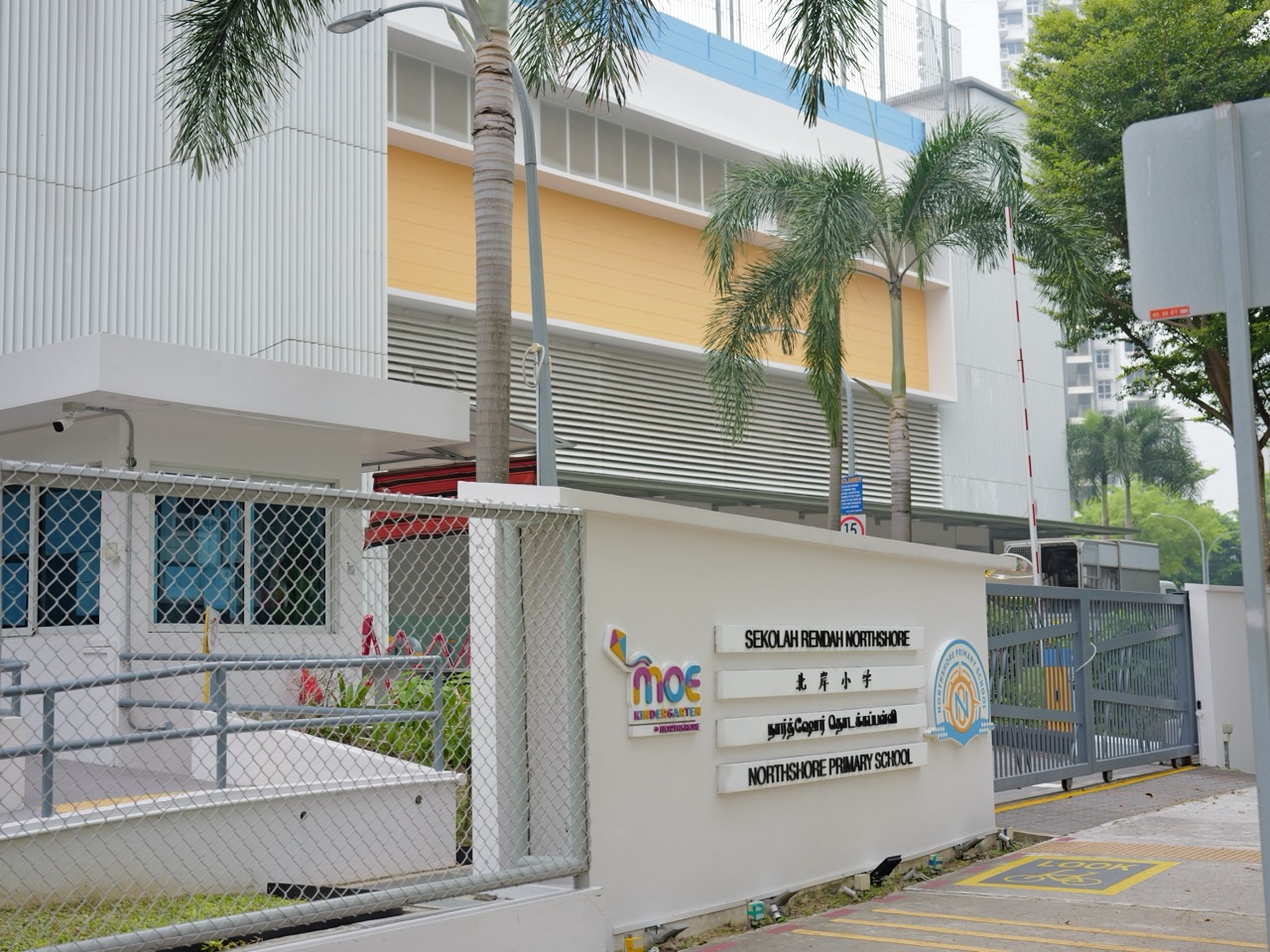
Local photograph: Northshore Primary School entrance and guardhouse. This photograph does not show registration availability, entry chances or official home–school distance.
Choose your reading route
Article contents
Sections 1–6
1. Start with your child’s registration year and eligible phase
2. Why the 1km and 2km school-distance bands matter
3. Understand balloting without chasing an invented probability
4. What changed for the 2027 exercise and which schools are affected?
5. Build a Punggol shortlist around the child, not just the ballot
6. After receiving a school place, make the transition gentle
Primary 1 registration is for entry into a mainstream primary school in the following academic year. The MOE portal states that the 2026 exercise covered children born from 2 January 2020 to 1 January 2021 inclusive. A child entering school in another year belongs to a different exercise, and families must use the official year checker and published calendar rather than reuse an older sibling’s schedule.
The basic phase structure is easy to recognise but should not be treated as interchangeable. Phase 1 is for a child with a sibling already attending the school. Phase 2A includes specified school connections, such as eligible parents, former pupils, school staff or children from the relevant MOE Kindergarten. Phase 2B covers particular eligible volunteer, affiliated and community-leadership routes. Phase 2C and its Supplementary phase are for children who have not secured a place. The exact definitions, proofs and conditions must be checked on MOE’s current phase guide.
International student admission follows a different process, including its own indication-of-interest requirements and Phase 3 rules; it should not be collapsed into the Singapore Citizen and PR phase calendar. Similarly, a child who is already studying in primary school and whose family moves house follows a transfer process, not the new P1 registration exercise.
A helpful first task is to write down your child’s entry year, citizenship or PR status, and the phases for which the family can provide evidence. Only then choose where to focus your research.
- Use MOE’s current birth-date and registration-year checker.
- Confirm the family’s genuine eligibility for each possible phase.
- Check the current exercise’s opening and closing times.
- Follow the international-student process if applicable.
- Keep school-transfer enquiries separate from new P1 registration.
In many P1 registration phases, school demand can exceed available places. This is where home–school distance becomes important. Within the applicable priority order, MOE distinguishes homes within 1km, homes between 1km and 2km, and homes beyond 2km. Citizenship also matters. A child inside 1km generally has a stronger distance-priority position than a child farther away in the same relevant citizenship and registration circumstances, but priority is not a guarantee.
The official distance is a prescribed government measurement, not the number of minutes a parent takes to walk to school. A route across a major junction may feel long even if the home is inside a distance band. Conversely, a pleasant short drive does not prove the home is officially inside 1km. For decisions that depend on the precise boundary, use MOE’s linked official home–school distance checker or SchoolQuery tool rather than relying on an unverified real-estate map or a rough postal-code calculation.
Address declarations also carry responsibilities. If a family uses the parent’s home address or an approved alternative child-care arrangement, the required evidence, residence conditions and permitted processes must be observed. A marketing claim that a rental address automatically secures priority is not a substitute for MOE’s rules. If your circumstances are unusual, clarify with MOE before submitting.
Most importantly, measure two things separately: the official eligibility distance for admission, and the actual route from your home to the school’s reporting gate. They answer different questions. Our Punggol school journey guide covers the second one.
- Check the actual address used for registration.
- Use MOE’s official distance verification method.
- Do not substitute walk time for the prescribed distance category.
- Review caregiver-address declaration rules where relevant.
- Test the real route independently when considering school fit.
A ballot is not a judgement on your child. It is the allocation mechanism used when the number of eligible applicants in a priority category exceeds the remaining places. The precise sequence depends on the phase, citizenship, distance and any applicable special framework. Past balloting data can show how strong demand was during an earlier exercise, but it does not reveal the number of children who will apply next year.
Suppose an illustrative school has more eligible applicants than spaces available at a stage of registration. It must apply the published priority rules; if a particular category still has too many applicants, the remaining places are allocated by ballot within that category. That example illustrates the mechanism only. It is not a statement about a live Punggol school’s vacancies, intake or odds.
Parents can use MOE’s official vacancies and balloting updates during the real exercise and previous-year data as context. Avoid converting last year’s ballot into a promised percentage. A new housing estate, different cohort, changing phase allocation or shift in parent preferences can change demand. Under the announced 2027 framework, the number of reserved Phase 2C places also changes for most schools, making direct reuse of some 2026 figures especially misleading.
Before the exercise opens, prepare a practical shortlist rather than gambling everything on one reputation-driven choice. Consider the school climate, programmes, distance, student care, learning needs and ability to arrive reliably in the morning.
- Understand the order in which the applicable priority categories are considered.
- Treat past ballot outcomes as history, never next-year guarantees.
- Use the official 2027 vacancy figures once published.
- Check whether an earlier secured place affects a later application.
- Make a backup school shortlist based on real family needs.
On 10 September 2026, the Ministry of Education announced changes for the 2027 P1 Registration Exercise, which admits children starting P1 in 2028. Most primary schools will set aside 60 places for Phase 2C, an increase from 40 under the 2026 arrangement. Schools with P1 intake below 180 will retain 40 reserved places. Phase 2B keeps its 20-place reserve. The practical intention is to broaden access for families without school connections, while leaving earlier phases in place.
There is also a separate two-track Phase 2C approach at 12 specified schools located in areas with comparatively little public housing. These include schools in Bukit Timah, Newton and Marine Parade, not the Punggol primary schools discussed here. At those 12 schools, Phase 2C is split between applicants living within 2km and beyond 2km, without an additional 1km priority within a track. It would be incorrect to tell a Punggol parent that every nearby school will now ignore the 1km band.
For the announcement and the named-school distinction, see the 10 September 2026 CNA report of MOE’s announcement. The final operational authority remains MOE’s registration portal and the official 2027 documents when released. An announcement of a framework is not the same as a published school-by-school vacancy list.
This is a useful reminder that school planning is a moving target. The relevant question in October 2026 is not simply ‘What happened this year?’ but ‘Which announced rules will apply when my child actually registers?’
- 2026 exercise: P1 entry in 2027; earlier set of reserved-place rules.
- 2027 exercise: P1 entry in 2028; 60 Phase 2C reserved places at most schools.
- Small-intake exception: fewer than 180 places means 40 Phase 2C reserves.
- Special two-track system: only 12 specified schools, none identified in Punggol.
- Check final MOE operational guidance and live vacancies before relying on any estimate.
Punggol families can compare local primary schools including Northshore Primary School, Punggol Cove Primary School, Horizon Primary School, Oasis Primary School and Punggol View Primary School. These individual guides introduce the schools; they do not rank pupils, forecast admissions or replace MOE SchoolFinder.
School fit has several layers. A child’s language needs and learning profile matter. So do the daily route, opportunities in the arts, sport or outdoor learning, how parents communicate with the school and the demands of after-school care. A school with an appealing programme may be less workable if the journey places a severe burden on the family. Conversely, a nearby school with supportive everyday routines can be a strong choice without being the loudest name in a discussion group.
When visiting an open house, ask concrete questions. How will a new pupil become familiar with the school? What help is available if a child struggles to read or make friends? Are CCA opportunities age-appropriate? How does the school support healthy routines and develop character? Our Punggol school open-house guide provides a fuller list.
Keep admissions and future academic outcomes separate. No credible P1 registration guide can guarantee that a six-year-old who enters a particular school will attain a specific PSLE score. What parents can influence is the quality of the starting match and the support provided across the next six years.
- School’s actual location and morning commute.
- Child’s readiness, language and learning support needs.
- Published programmes and values rather than informal rankings.
- Student care and dismissal practicalities.
- Families’ ability to support six years of ordinary schooling.
Once MOE confirms a place, the family can stop treating every decision as an admissions problem. Read the school’s official reporting information, attend the required orientation, understand booklists and attire arrangements, and practise a simple school journey. Confirm details through the school because even neighbouring campuses can have different gate, arrival and student-care procedures.
One of the most useful things a parent can do is make school life familiar. The child can practise asking a teacher for help, opening a lunchbox, ordering a simple canteen meal, recognising a timetable and knowing where to put their school bag. Our P1 practical-readiness guide and recess and pocket-money guide support this transition.
If the family was not successful at the preferred school in the first eligible phase, follow MOE’s actual next-phase instructions rather than making a rushed informal application. A child who receives a school placement outside the family’s first choice can still have a rich school journey. The aim is to create the best workable next step, not let one ballot become the child’s identity.
Over the next months, measure progress through confidence, friendships, habits, understanding and a steady daily routine. At eduKate we start with the child’s actual learning position before considering any supplementary tuition. Good education grows across years, not from the mythical certainty of a single admissions result.
Frequently asked questions
Does living within 1km of a Punggol primary school guarantee admission?
No. It can improve home–school distance priority when relevant, but if an eligible priority category is oversubscribed, balloting can still occur. Confirm your distance officially and check the real phase rules.
What is the difference between the 2026 and 2027 P1 registration exercises?
The 2026 exercise was for entry in 2027. The 2027 exercise is for entry in 2028 and incorporates MOE’s 10 September 2026 announced Phase 2C changes. Use the calendar and framework for the child’s actual entry year.
Do the special two-track Phase 2C rules apply to Punggol primary schools?
The September 2026 announcement identified 12 specific schools outside Punggol. Under the announced framework, ordinary Punggol schools are not among those two-track schools.
Keep exploring Punggol education
Compare what to ask at an open house, Punggol Primary versus Punggol View Primary, Primary 1 readiness, rainy-day school routes and transferring schools after a move.
Sources and accuracy notes
- MOE: Primary 1 Registration Portal (accessed October 2026; check the specific registration exercise and year).
- MOE: P1 Registration Phases and Key Dates (phase eligibility, priority and application constraints; confirm year-specific updates).
- MOE: How to Register for Primary 1 (official Singpass registration and family declarations).
- Channel NewsAsia, 10 September 2026: MOE’s 2027 Phase 2C framework changes (60 reserved places at most schools and 12-school two-track exception).
- MOE SchoolFinder (official programme and school-information source).
This independent eduKateSG guide is an editorial explanation, not an admissions notice, school offer or guarantee of eligibility. For actual requirements, dates and outcomes, consult MOE and your child’s school. Featured photographs show Punggol school exteriors and do not establish admissions statistics or school performance.