
Mee Toh School is a primary school at 21 Edgedale Plains in Punggol. For families comparing schools in Punggol, its official environmental-education programme provides a concrete point of interest: children are encouraged to connect care for the environment with daily experience and character.
Did you know that an ordinary lunch can begin a useful Science, English and Mathematics conversation? What was left over, why was it left over, and what could change next time? Environmental learning becomes much easier for a child to grasp when the question belongs to a familiar day.
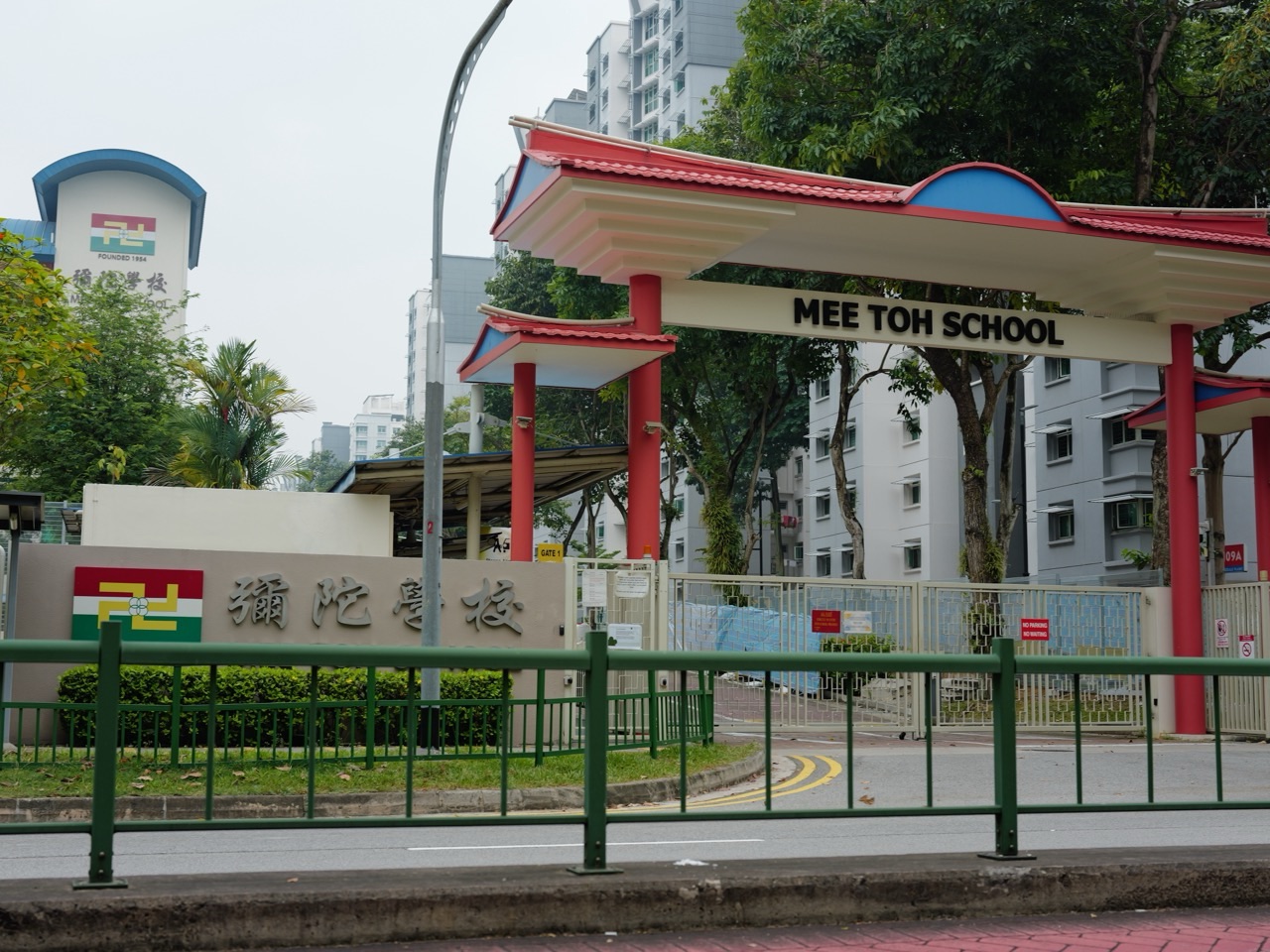
The photograph above captures Mee Toh’s distinctive entrance and visible school name. This guide uses that real neighbourhood view as the starting point for exploring school fit, current published information and small learning habits families can build at home.
Photograph: Entrance to Mee Toh School in Punggol, Singapore. Photo: eduKate.
Find the part your family needs
Start with the school’s published approach, check the daily routine, or go straight to the questions for your next visit.
Understand the school · Check the journey · Plan your next questions
Contents
1–3 · School, place and learning
1. What is the school’s environmental emphasis?
4–6 · Questions, support and next steps
4. Questions to ask before choosing Mee Toh
| At a glance | Details |
|---|---|
| Institution | Mee Toh School |
| Stage | Primary education |
| Location | 21 Edgedale Plains, Singapore 828867 |
| Focus in this guide | Environmental learning connected with everyday care |
Mee Toh’s official Applied Learning Programme page describes a whole-school approach to environmental sustainability. The school connects knowledge and skills with values and opportunities to relate environmental issues to everyday life.
That statement is a useful direction, rather than a complete timetable. Ask the school what pupils in the relevant level will actually do, how activities connect with classroom subjects and how families can support the learning without completing work on the child’s behalf.
Environmental care can invite several kinds of thinking. A child may observe a problem, count or compare quantities, explain a cause and choose an action. Our suggestion is to make those steps explicit. “Be greener” becomes much more understandable when it refers to a specific habit the child can describe.
The prominent entrance roof, school sign and roadside railing help identify Mee Toh. They also remind us that a school is a place a child will enter repeatedly, not merely a name on an application.
Use the official contact page to confirm the address, then check your intended arrival route and collection arrangements. A photograph cannot establish which gate is used at a particular time or whether a proposed waiting place is appropriate.
During a family walk, invite your child to describe three things they notice and one thing they wonder about. Keep observation separate from assumptions. “I can see trees near the entrance” is evidence. “Every classroom must be quiet” is something you cannot infer from this view.
This is an optional eduKate home activity, not a Mee Toh assignment. For three family meals, note which food is left uneaten. Do not ask a child to handle rubbish or turn the task into criticism of anyone’s appetite. A few words or a simple tally are enough.
Ask what might explain the pattern. Was the serving too large? Was there less time to eat? Did someone dislike one ingredient? More than one explanation may be possible, and the family should check before deciding.
Choose one manageable change, such as serving a smaller first portion with more available if wanted. Compare what happens at a later meal. The child can describe the change and the evidence without pretending that a tiny family observation proves a universal rule.
An older pupil could practise the sentence, “Our observation suggests …, but we would need … to be more confident.” A younger pupil can say what changed and draw a picture. Both are useful starts in careful explanation.
Ask how environmental learning appears across the primary years. Request an ordinary example rather than focusing only on special events. How does a child participate if they are still developing language confidence? What does feedback look like?
Families can also ask how the school explains its values in daily routines and how parents hear about learning or social concerns. A values statement becomes meaningful when you can picture what adults and children do in a difficult moment.
Discuss language provision, transition support, student care and the school day directly with the school. For a Primary 1 place, follow the relevant MOE registration process. Do not infer admission rules or a guaranteed place from a school’s reputation.
The existing Mee Toh school-choice guide can help organise your comparison with other schools. Add current answers from the school to your own notes.
For language, the eduKate vocabulary hub gives a route into words such as conserve, observe, portion, compare and responsibility. Ask for a sentence tied to the family investigation. Using a word accurately is a more helpful immediate goal than making the sentence sound impressive.
For Mathematics, build from counting and comparison to the representations your child is ready to use. The Mathematics continuity discussion is relevant here: a graph is useful when the quantities and labels beneath it already make sense.
If schoolwork reveals a difficulty, identify the task rather than labelling the child. Trouble explaining an observation may involve vocabulary, sentence structure or the scientific idea itself. The next teaching step should match the actual problem.
A promising fit combines access to learning with a sustainable routine. Notice whether your child can imagine joining in, whether the commute works and whether the school can answer your questions about support.
Do not ask one visit to settle every uncertainty. Write down the remaining question and contact the school. A clear reply about an ordinary school-day concern may be more useful than another hour comparing broad claims online.
At home, begin with one act of care that your child understands and can sustain. Explain the reason, review what happened and adjust together. That makes the relationship between learning and responsibility visible.
Official sources and further checks
Checked on 10 October 2026. Programmes, operational arrangements and admission requirements can change; use the school or university’s current information for the relevant intake. This is an independent eduKate guide, not an official school publication or an endorsement by the institution.
Environmental Applied Learning Programme
Explore the photographed Punggol school series
This series covers the institutions in these photographs. For wider local context, continue to the existing Punggol schools and education overview.
Primary schools · Secondary schools · University
Mee Toh School — you are here
For a specific learning concern, bring recent schoolwork and the weekly timetable to an eduKate parent–student consultation. Begin with the child’s starting point and consider a suitable 3-pax arrangement where support is needed.