
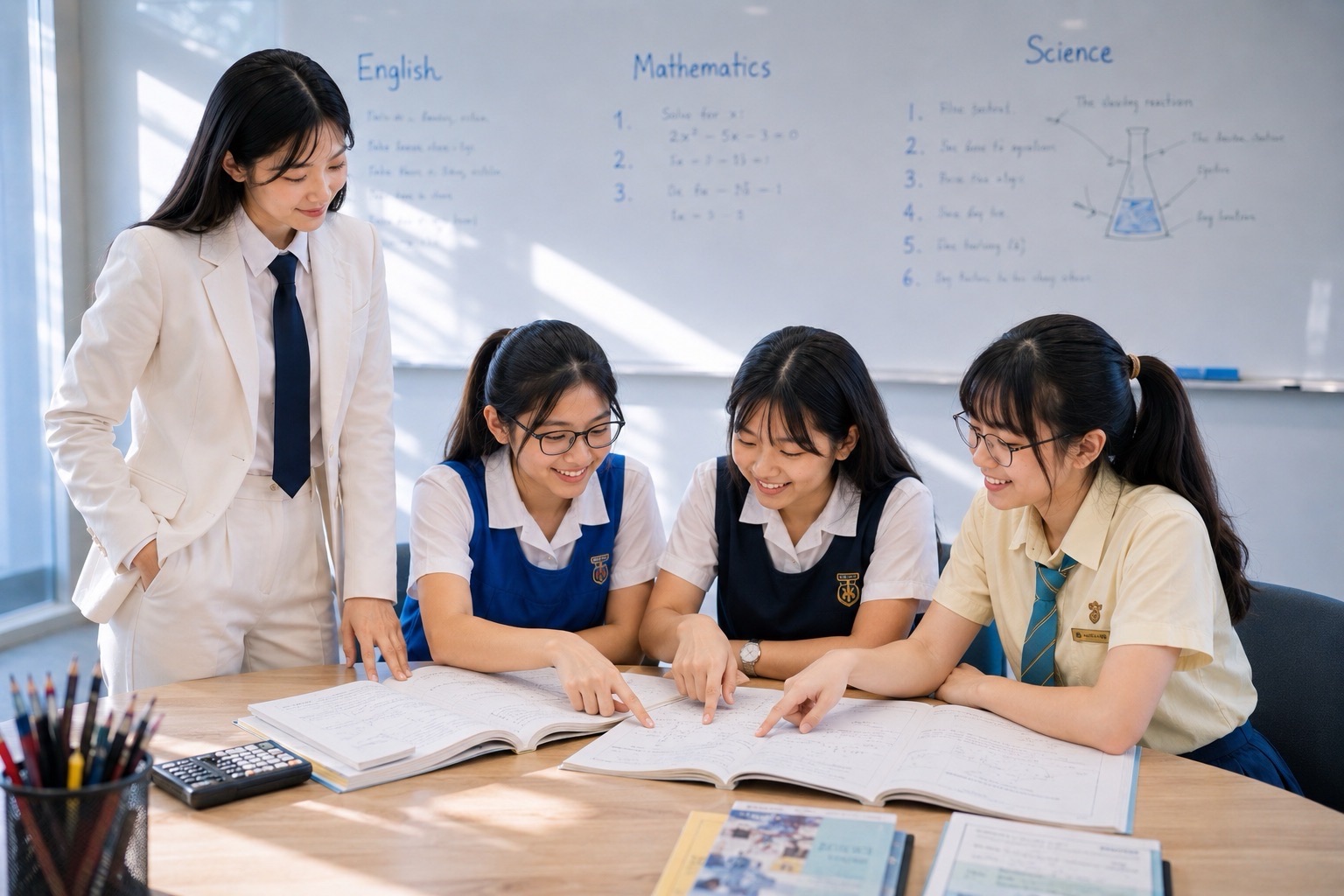
Secondary 3 Additional Mathematics Tuition for Clementi students. Build strong algebra, functions, trigonometry and calculus foundations in focused 3-student classes.
Secondary 3 Additional Mathematics Tuition Clementi
Secondary 3 Additional Mathematics begins with a deceptively simple promise: learn a few new methods, practise them carefully, and become more confident.
The reality is more demanding.
A-Math introduces students to a more connected form of mathematics. Algebra, graphs, functions, trigonometry and calculus no longer sit in separate chapters. Each idea begins to support the next. A weakness that appears small in January can quietly affect several topics by the middle of the year.
Our Secondary 3 Additional Mathematics Tuition for Clementi students is designed to prevent that drift.
We teach each concept from its foundations, make the mathematical route visible and help students develop the accuracy needed to work independently. Lessons are kept to a maximum of three students so that the tutor can observe not only the final answer, but also the thinking and working that produced it.
The aim is not to make A-Math feel easy.
It is to make it understandable, organised and increasingly manageable.
A Clear Starting Point for Secondary 3 A-Math
Secondary 3 is the year students begin constructing the foundation that will carry them into their final secondary examination.
For students preparing for the 2027 Singapore-Cambridge Secondary Education Certificate, G3 Additional Mathematics is examined under syllabus K341. G2 Additional Mathematics is offered separately under syllabus K232. Families should therefore confirm the subject level and examination syllabus registered by the school before selecting materials or tuition support. (SEAB)
This guide focuses mainly on G3 Additional Mathematics.
The G3 syllabus assumes that students already possess a working knowledge of G3 Mathematics. Its content is organised into three broad strands:
- Algebra
- Geometry and Trigonometry
- Calculus
The syllabus also expects students to reason, communicate mathematically, apply methods and connect ideas across topics. (Isomer User Content)
This distinction matters.
A-Math is not simply a longer version of E-Math. It asks students to handle symbols with greater control, recognise less obvious connections and sustain several steps of reasoning without losing accuracy.
Why Secondary 3 Additional Mathematics Can Feel So Different
A student may have performed comfortably in lower secondary Mathematics and still find A-Math unsettling.
This does not always mean the student is weak in Mathematics.
It often means that the rules of the subject have changed.
In lower secondary Mathematics, many questions clearly indicate the required method. A student may see a familiar diagram, equation or formula and begin working almost immediately.
In A-Math, the method may be hidden.
The student must first decide:
- What form is this expression in?
- What is the question actually asking?
- Which earlier result will be needed later?
- Should the expression be expanded, factorised, substituted or transformed?
- Is an exact answer required?
- How much working must be shown?
The calculation may not be the hardest part.
The harder task is choosing and protecting the correct route.
The First Difficulty Is Usually Algebra
Most early A-Math problems are algebra problems, even when the chapter title says something else.
A trigonometry question may fail because the student cannot rearrange an equation cleanly.
A differentiation question may fail because the student mishandles indices.
A logarithm question may fail because the student applies a law without noticing that the terms are not in a suitable form.
A coordinate geometry question may fail because signs are lost during substitution.
This is why our Sec 3 A-Math tuition does not rush past basic algebra.
We check whether the student can:
- expand and factorise expressions accurately;
- work confidently with fractions and negative signs;
- manipulate indices;
- solve linear and quadratic equations;
- substitute without losing brackets;
- rearrange formulae;
- recognise equivalent expressions; and
- present each line of working clearly.
These skills are not revision at the side of the course.
They are the operating system beneath the course.
What Students Learn in Secondary 3 Additional Mathematics
The exact order of chapters may differ between schools. However, students working towards the G3 Additional Mathematics examination will eventually encounter a connected syllabus that includes quadratic functions, equations and inequalities, surds, polynomials, partial fractions, binomial expansion, exponential and logarithmic functions, trigonometry, coordinate geometry, geometric proof, differentiation and integration. (Isomer User Content)
A sound Secondary 3 programme therefore needs to do two things at the same time.
It must support the student’s present school chapter.
It must also prepare the mathematical foundations required by later chapters.
Quadratic Functions and Equations
Students move beyond simply solving a quadratic equation.
They learn to examine maximum and minimum values, complete the square, interpret the discriminant and determine whether lines intersect, touch or avoid a curve.
The student must begin to see one quadratic expression in several ways:
- as an equation;
- as a graph;
- as a function;
- as a model; and
- as information about roots or intersections.
This is an early example of how A-Math connects ideas rather than teaching isolated procedures.
Surds
Surds appear straightforward until several operations are combined.
Students must learn to simplify accurately, rationalise denominators and solve equations involving irrational expressions. Weak multiplication, incomplete factorisation and careless handling of signs often cause unnecessary mark loss.
Our approach is to slow the working down first.
Once the route is stable, speed can develop safely.
Polynomials and Partial Fractions
Polynomial questions require students to understand structure.
They work with the remainder theorem, factor theorem, cubic equations and polynomial division. Partial fractions then require careful factorisation, correct setup and disciplined comparison of coefficients.
Students who rely only on memorised templates often become confused when the denominator changes form.
We teach the reason behind the setup so that the student can reconstruct the method when the question looks unfamiliar.
Binomial Expansion
Binomial expansion introduces notation that can initially feel dense.
The student must understand the role of the power, the changing exponents, the binomial coefficient and the position of a particular term.
Rather than treating the expansion as a long formula to copy, we help students see its internal pattern.
Once that pattern is visible, the notation becomes far less intimidating.
Exponential and Logarithmic Functions
Logarithms are often the point where students discover whether their earlier algebra is truly secure.
They need to work with logarithmic laws, change of base, exponential equations and graphs. They must also understand that logarithms are not arbitrary new rules. They are another way of expressing relationships involving powers.
Good teaching makes that connection explicit.
Trigonometric Functions and Identities
A-Math trigonometry extends well beyond the right-angled triangle.
Students work with angles of different magnitudes, radians, exact values, graphs, identities, equations and transformations.
The challenge is not merely remembering more formulae.
Students must recognise which identity is useful, transform one side of an expression carefully and avoid introducing invalid steps.
Trigonometric proof is especially revealing. It shows whether the student can plan backwards, protect the algebra and communicate a mathematical argument.
Differentiation and Integration
Calculus is often the topic students either anticipate with excitement or fear before it arrives.
When introduced carefully, it is highly logical.
Differentiation helps students describe gradients, rates of change, tangents, normals, stationary points and optimisation. Integration reverses part of this process and allows students to work with areas and motion.
Calculus becomes difficult when it is taught as a collection of rules without meaning.
We begin with the central ideas:
- what is changing;
- what the gradient represents;
- why a stationary point matters;
- how differentiation and integration are connected; and
- how the algebra determines whether the calculus succeeds.
What the Examination Actually Rewards
The G3 Additional Mathematics assessment does not reward routine technique alone.
The published assessment objectives allocate approximately:
| Assessment Area | Approximate Weighting |
|---|---|
| Using and applying standard techniques | 35% |
| Solving problems in different contexts | 50% |
| Reasoning and communicating mathematically | 15% |
This means that most of the assessment extends beyond recalling a familiar procedure. Students must identify relevant information, connect topics, formulate problems mathematically and interpret their answers. (Isomer User Content)
The examination comprises two papers. Each paper lasts 2 hours and 15 minutes, carries 90 marks and contributes 50% of the total assessment. Candidates must answer all questions. The official syllabus also states that omitting essential working can result in the loss of marks.
A student can therefore know the formula and still lose marks through:
- incomplete working;
- an unsuitable method;
- inaccurate notation;
- poor interpretation;
- premature rounding;
- weak time allocation; or
- an answer that is not supported by the required reasoning.
Our tuition prepares students to show what they know, not merely to know it privately.
The Five Levels of A-Math Readiness
A student’s marks do not always reveal the true cause of difficulty.
Two students may both receive 55%, but require very different teaching.
1. Foundation Readiness
The student understands basic algebra, indices, equations and graphs well enough to begin the A-Math chapter.
When this layer is weak, new teaching does not stay secure. Every question becomes unnecessarily heavy because the student is solving both the old problem and the new one at the same time.
2. Method Readiness
The student knows the standard method and can reproduce it in a familiar question.
This is useful, but it is only the beginning.
3. Transfer Readiness
The student can recognise the same concept when the wording, diagram or structure changes.
This is where genuine understanding begins to separate itself from copying.
4. Presentation Readiness
The student can produce clean, logical and sufficient working.
A correct idea written carelessly may still become an incorrect examination response.
5. Performance Readiness
The student can retrieve the method under time pressure, recover from a difficult question and complete the paper with enough time to check.
Secondary 3 tuition should gradually develop all five levels.
Teaching only the current worksheet is not enough.
Common Secondary 3 A-Math Student Profiles
The Student Who Has Just Started A-Math
This student may not have a serious weakness. The family simply wants the subject introduced properly from the beginning.
The priority is to establish:
- clean algebra;
- accurate notation;
- strong lesson habits;
- a reliable correction process; and
- enough familiarity for school lessons to feel manageable.
Where the student is ready, material may be introduced ahead of school. The school lesson then becomes a valuable second encounter rather than the first moment of confusion.
The Student Who Was Doing Well Until A-Math Began
This student may have strong general ability but has been relying on quick pattern recognition.
A-Math exposes the limits of that approach.
The student now needs to slow down, understand why methods work and learn to organise multi-step solutions. Once this adjustment is made, progress can be surprisingly strong.
The Student Who Is Already Failing
A failing grade does not automatically mean the student lacks mathematical ability.
The problem may begin with one or two unstable dependencies:
- factorisation;
- fractions;
- indices;
- equation solving;
- graph interpretation; or
- negative signs.
The correct response is not simply more difficult worksheets.
We locate the earliest weak link, repair it and then reconnect the student to the present school chapter.
The Student Who Is Passing but Unstable
This student may score 70% in one assessment and 48% in the next.
The fluctuation often indicates that knowledge is stored by chapter rather than organised as a connected system. Familiar questions are completed well, while unfamiliar combinations cause the student to hesitate.
Interleaved practice becomes important here.
Instead of completing twenty identical questions, the student learns to identify the method among several possible routes.
The Student Aiming for Distinction
A stronger student does not necessarily need faster teaching.
The student needs deeper control.
This includes:
- comparing alternative methods;
- recognising efficient routes;
- handling non-routine combinations;
- reducing unnecessary working;
- checking answers intelligently; and
- maintaining accuracy across a complete paper.
Distinction performance is often less about learning another trick and more about removing small points of instability.
How eduKateSG Secondary 3 A-Math Tuition Works
We Read the Student First
Before recommending a route, we consider the student’s school level, subject syllabus, current chapters, recent marks, confidence, working habits and examination demands.
A low mark is evidence.
It is not yet a diagnosis.
We Find the Earliest Weak Link
A mistake near the end of a solution may have started several lines earlier.
We examine where the mathematical route first became unstable.
This may be a missing bracket, an incorrect assumption, poor factorisation or a failure to identify the correct form of the expression.
Correcting the first error is more valuable than circling the final answer.
We Teach the Full Method
The tutor models how an experienced mathematician reads and plans the question.
Students see:
- what information matters;
- how the method is selected;
- how the working is organised;
- where common errors appear; and
- how the answer is checked.
This makes invisible expert thinking visible.
We Move into Guided Practice
The student then attempts a related question with support.
Assistance is gradually reduced until the method can be completed independently.
We Vary the Question
A method is not secure simply because the student can repeat the original example.
We change the wording, values, structure and level of connection. The student learns to identify the underlying mathematics rather than depend on surface familiarity.
We Correct During the Learning Process
Correction is most useful while the student still remembers the decision that produced the error.
In a small class, the tutor can examine the student’s actual working and intervene before an unsuitable habit becomes established.
We Return to Earlier Topics
A-Math knowledge must remain retrievable.
Topics are revisited through mixed practice, short reviews and examination-style combinations. This keeps earlier knowledge active while new chapters are introduced.
Why Three-Student Classes Matter for A-Math
eduKateSG’s current standard tuition classes are kept to three students. (eduKate Singapore)
This is particularly valuable for Additional Mathematics because many weaknesses cannot be identified from the final answer alone.
The tutor needs to see:
- how the student begins;
- what the student notices;
- which method is selected;
- where hesitation appears;
- whether the working is logically connected; and
- whether a correct answer came from understanding or imitation.
In a three-student class, each student still receives the benefits of learning beside others, while the tutor retains enough visibility to give precise correction.
The class can also move with greater care.
A student who needs one more explanation is not easily hidden. A student who is ready for a more demanding variation does not have to remain under-stretched.
What Parents May Notice as the Programme Begins to Work
Improvement does not always appear first as a dramatic increase in marks.
The earlier signs are often quieter.
The student begins homework sooner because the page no longer feels completely unfamiliar.
Working becomes easier to read.
Questions are attempted rather than left blank.
The student can explain why a method was chosen.
Mistakes become more specific.
Instead of saying, “I do not understand A-Math,” the student may say, “I understand the differentiation, but I made an error when simplifying the fraction.”
That is progress.
A vague problem has become a solvable one.
Marks usually become more stable when the student’s thinking, method and correction habits become more stable.
When Should a Secondary 3 Student Begin A-Math Tuition?
Before Secondary 3
Students who already know they will take Additional Mathematics may use the year-end period to strengthen algebra and receive a calm introduction to the first chapters.
The objective should not be to race through the entire syllabus.
It should be to make the beginning familiar.
At the Start of Secondary 3
This is the cleanest time to establish strong working habits.
The student can learn each topic properly before misunderstandings begin to accumulate.
After the First Weighted Assessment
The first assessment often reveals whether the student’s lower secondary methods are sufficient for A-Math.
A disappointing result can be useful when it leads to early correction.
After the Mid-Year Examination
Improvement remains possible, but the programme must become more selective.
The tutor may need to repair earlier chapters while preventing the student from falling behind in current schoolwork.
Near the End of Secondary 3
The priority is to prevent unresolved Sec 3 weaknesses from entering Sec 4.
The year-end period can be used to consolidate the full Sec 3 foundation, rebuild weak chapters and prepare for the faster examination rhythm ahead.
It is rarely “too late” in an absolute sense.
However, a later start changes the route. Repair must become more focused, and the student must be prepared to practise consistently.
What Good Secondary 3 A-Math Tuition Should Provide
Parents looking for Secondary 3 Additional Mathematics Tuition in Clementi may wish to look beyond the number of worksheets completed.
A suitable programme should provide:
Clear Conceptual Teaching
The student should understand what the method is doing, not only which buttons or formulae to use.
Strong Algebraic Repair
Earlier weaknesses should be addressed rather than carried silently into every new topic.
Visible Working and Correction
The tutor should examine the mathematical route, not simply announce that an answer is wrong.
Appropriate Challenge
Questions should progress from secure fundamentals to unfamiliar combinations.
Connection Between Topics
Students should learn how algebra, functions, graphs, trigonometry and calculus support one another.
Examination Preparation
The programme should eventually include question selection, time management, presentation, checking and recovery under pressure.
A Sustainable Routine
The best programme is one the student can attend and practise consistently.
A prestigious name or large quantity of material is of limited value when the learning process itself is unclear.
A-Math Tuition for Clementi Students Should Remain Personal
Clementi families have access to many tuition choices.
The most important question is not simply, “Which programme covers the syllabus?”
Most programmes cover the syllabus.
A better question is:
Will the tutor be able to see where my child’s mathematical thinking becomes unstable and know what to do next?
A student who is anxious needs calm structure.
A student who is careless needs disciplined checking.
A student who memorises needs deeper explanation.
A student who is capable but under-challenged needs more demanding transfer questions.
A student who is behind needs a carefully sequenced repair route.
These students should not receive identical teaching simply because they are all in Secondary 3.
Frequently Asked Questions
Is Secondary 3 Additional Mathematics much harder than E-Math?
It is more abstract and more dependent on algebraic control.
Students are expected to recognise connections, select methods and sustain longer chains of working. A strong E-Math foundation helps, but students must still adjust to the reasoning and presentation required by A-Math.
Can a student improve after failing the first A-Math assessment?
Yes, particularly when support begins early and the source of the difficulty is identified correctly.
A failure caused by weak factorisation requires a different response from a failure caused by poor question interpretation or examination anxiety.
The repair must match the cause.
Should my child drop A-Math after one poor result?
One result is rarely enough to make that decision.
Parents should first examine the size of the knowledge gap, the student’s subject combination, future study interests, willingness to practise and whether the earlier teaching has been understood.
A calm academic review is more useful than making the decision while the student is distressed.
What happens when the student is weak in both E-Math and A-Math?
The subjects should not be treated as completely separate.
The current G3 A-Math syllabus assumes knowledge of G3 Mathematics. Weaknesses in equations, graphs, geometry, indices or algebra may therefore need to be repaired alongside the A-Math chapter. (Isomer User Content)
Does eduKateSG teach ahead of the school?
Where appropriate, we introduce concepts before the school reaches them.
This gives the student time to understand the ideas without the immediate pressure of an assessment. When the topic appears in school, the student meets it with familiarity and can use the lesson to deepen understanding.
Teaching ahead is used carefully. It should create readiness, not produce rushed and superficial coverage.
How many students are in each class?
Our standard tuition classes are kept to a maximum of three students, subject to class availability and suitable academic fit. (eduKate Singapore)
Is there a trial lesson?
We begin with a consultation.
This allows us to understand the student’s level, present concern, school demands, confidence and preferred timing. A lesson arrangement can then be considered according to suitability and available space within the three-student class.
Is the programme only for students who are struggling?
No.
Some students begin because they need foundational repair. Others want a stable start, better school readiness or stronger distinction-level performance.
The teaching route is adjusted to the student who arrives.
Begin with a Secondary 3 A-Math Consultation
Secondary 3 Additional Mathematics does not need to become a year of constant uncertainty.
With clear teaching, disciplined correction and enough time to practise, students can learn to recognise the structure beneath the symbols.
For Clementi families considering Secondary 3 Additional Mathematics Tuition, begin by sharing:
- your child’s school and subject level;
- the examination year or syllabus code;
- recent Mathematics and A-Math results;
- the chapters currently being taught;
- any school worksheets or assessment papers;
- your child’s main concern; and
- preferred lesson timings.
We will consider the student’s present position before recommending a suitable next step.
Clear concepts. Clean algebra. Thoughtful correction. Stronger mathematical control.