
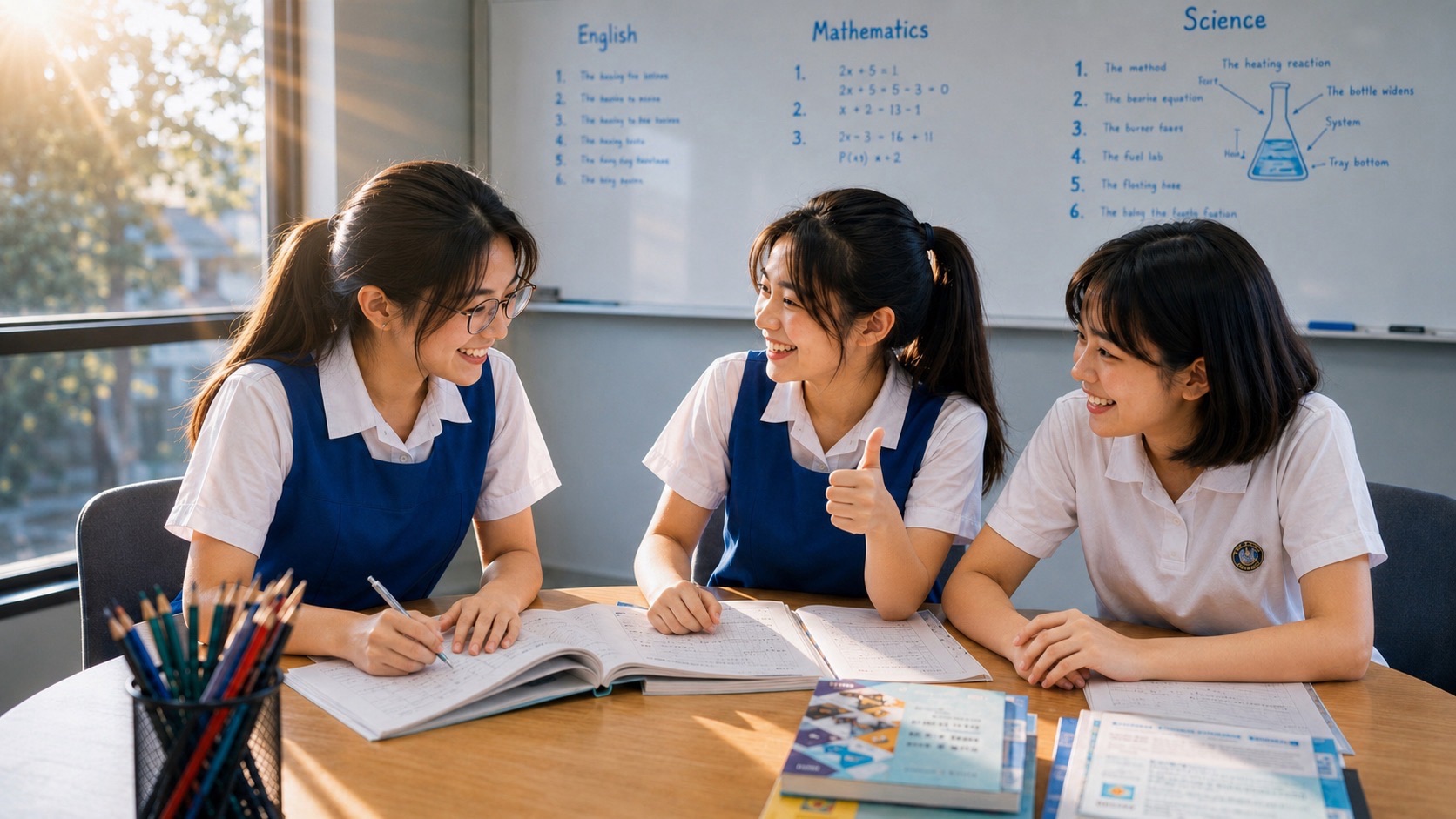
Secondary 2 Mathematics Tuition Clementi by eduKateSG helps students repair foundations, strengthen algebra and prepare for Secondary 3 in focused 3-pax small groups near Sixth Avenue MRT.
Sec 2 Math Tuition Clementi, Secondary Mathematics Tutor Clementi, G2 Mathematics Tuition Clementi, G3 Mathematics Tuition Clementi, small-group Math tuition Clementi, Secondary 2 Math tutor near Clementi
Secondary 2 Mathematics Tuition Clementi should do more than help a student finish the next worksheet.
It should make Mathematics clearer.
It should reveal which foundations are stable, identify where understanding has become fragile, and prepare the student for the considerably heavier demands of upper secondary school.
At Secondary 2, there is still time to repair gaps carefully. There is also enough mathematical maturity to build stronger algebra, reasoning, working habits and independent problem-solving.
This makes Secondary 2 one of the most valuable years for thoughtful intervention.
For families in Clementi, eduKateSG provides carefully structured Secondary Mathematics tuition in 3-pax small groupsnear Sixth Avenue MRT.
The aim is not simply more practice.
It is better mathematical control.
The Secondary 2 Mathematics Year at a Glance
| What is changing | What parents may notice | What tuition should provide |
|---|---|---|
| Algebra becomes more connected | The child knows individual rules but cannot combine them | Clear concept rebuilding and structured algebra practice |
| Questions become less direct | The child does not know how to begin unfamiliar problems | Problem classification and method selection |
| Diagrams carry more information | Geometry answers become incomplete or inaccurate | Visual reasoning and precise mathematical communication |
| Earlier topics remain active | Old mistakes return during tests | Retrieval practice and cumulative revision |
| Upper secondary is approaching | Results begin affecting confidence and future subject readiness | Transition preparation without unnecessary pressure |
| Full SBB allows greater subject-level flexibility | Parents may be uncertain about G1, G2 and G3 pathways | A clear reading of present readiness and possible next routes |
Secondary 2 is therefore not merely a continuation of Secondary 1.
It is the year in which the lower-secondary foundation must become strong enough to carry the next stage.
Why Secondary 2 Mathematics Matters So Much
Secondary 1 introduces students to a new mathematical environment.
Secondary 2 expects them to operate within it.
By this stage, students are increasingly expected to:
- move comfortably between numbers, symbols, diagrams and graphs;
- recognise which method fits a question;
- retain earlier skills while learning new ones;
- explain working clearly;
- manage multi-step problems;
- check whether an answer is reasonable;
- recover when their first method does not work.
The difficulty is not always one particularly advanced topic.
The difficulty is that several mathematical abilities must now work together.
A student may understand an algebraic rule but misread the question.
Another may choose the correct method but make an early sign error.
A third may complete familiar exercises successfully yet become lost when the wording or diagram changes.
These are different problems.
They should not receive the same correction.
Good Secondary 2 Mathematics Tuition Clementi begins by determining exactly where the learning chain has weakened.
Secondary 2 Is the Last Broad Lower-Secondary Consolidation Window
Secondary 3 is often described as the year when Mathematics becomes difficult.
In reality, many Secondary 3 problems begin earlier.
They appear when students enter upper secondary with:
- uncertain algebra;
- weak manipulation of fractions and negative numbers;
- incomplete graph knowledge;
- poor working presentation;
- inconsistent recall;
- limited confidence with unfamiliar questions;
- habits of copying methods without understanding them.
Secondary 2 is the quieter window before this pressure rises.
There is still room to revisit fundamentals without making the student feel that every lesson is an emergency. There is time to improve both understanding and fluency. There is also time to develop stronger learning habits before examinations become more consequential.
This is why effective tuition in Secondary 2 can serve two purposes.
For a struggling student, it is protection against further decline.
For a capable student, it is an expressway towards stronger upper-secondary readiness.
Secondary 2 Mathematics Under Full Subject-Based Banding
Singapore’s secondary-school system now operates under Full Subject-Based Banding.
Students are posted through Posting Groups 1, 2 and 3 and may study different subjects at different subject levels according to their strengths, readiness and school arrangements. The older Express, Normal (Academic) and Normal (Technical) stream structure has been removed for cohorts entering Secondary 1 from 2024.
From 2027, the former GCE N- and O-Level certificates are combined under the Singapore-Cambridge Secondary Education Certificate, or SEC. Subjects are examined at the relevant G1, G2 or G3 level.
For parents, the important point is simple:
A student’s Mathematics route should be read subject by subject, not only through a broad label.
A child may need to:
- stabilise the present subject level;
- prepare for more demanding work;
- protect eligibility for future courses;
- strengthen Mathematics before considering Additional Mathematics;
- build sufficient confidence to work more independently.
Tuition should not treat G1, G2 and G3 as labels of worth.
They are learning routes with different levels of abstraction, pace and examination demand.
The correct question is not, “Which label does my child have?”
It is:
What can my child currently understand, retain, apply and explain—and what must become stable next?
What Students Commonly Meet in Secondary 2 Mathematics
The exact teaching sequence may differ between schools, but Secondary 2 Mathematics commonly develops work across several connected areas.
Number and Algebra
Students may need to work with:
- algebraic expressions;
- expansion and factorisation;
- equations and inequalities;
- algebraic fractions;
- ratios, rates and percentages;
- direct or inverse relationships;
- numerical approximation;
- standard form and related number skills.
Algebra is particularly important because it is not one isolated topic.
It becomes the working language for later Mathematics.
When algebra is weak, the student may also struggle with graphs, coordinate geometry, mensuration, trigonometry and future Additional Mathematics.
Functions, Coordinates and Graphs
Students must increasingly understand that a graph is not merely a picture.
It represents a relationship.
They may be asked to:
- interpret coordinates;
- read scales accurately;
- identify gradients or patterns;
- connect equations to lines or curves;
- use graphical information to solve problems;
- explain what a graph means within a real context.
A student who only memorises graph shapes may cope with routine questions but struggle when information is presented differently.
Geometry and Mensuration
Geometry requires students to combine visual information with formal reasoning.
They may need to work with:
- angle properties;
- polygons;
- congruence and similarity;
- transformations;
- Pythagoras’ theorem;
- mensuration;
- trigonometric relationships;
- geometrical constructions or representations.
The challenge is not only seeing the diagram.
It is identifying which facts are given, which relationships can be inferred and which theorem or method should be used.
Statistics and Probability
Students also learn to interpret data and uncertainty more carefully.
This can involve:
- organising information;
- reading tables and statistical diagrams;
- calculating and comparing averages;
- interpreting spread;
- understanding probability;
- distinguishing possible, likely and certain outcomes.
These topics appear approachable, but they can become difficult when questions contain long descriptions, multiple data sets or unfamiliar representations.
Why Secondary 2 Students Begin to Struggle
A falling Mathematics grade is rarely caused by laziness alone.
More often, several small weaknesses have begun to interact.
1. Earlier Gaps Were Never Fully Repaired
A student may have passed Primary 6 and Secondary 1 while still carrying uncertainty in:
- fractions;
- percentages;
- negative numbers;
- order of operations;
- ratio;
- basic algebra;
- unit conversion;
- problem interpretation.
These gaps may remain hidden while questions are straightforward.
They become visible when Secondary 2 questions demand several operations in sequence.
The new topic receives the blame, but the actual break may be much older.
2. The Student Remembers Steps but Not the Structure
Many students can repeat a demonstrated method.
Fewer can explain why it works.
This difference becomes important when the question changes.
For example, a student may know how to solve:
[
3x+5=20
]
but become uncertain when the unknown appears on both sides, fractions are introduced, or the equation is embedded inside a word problem.
The procedure was remembered.
The mathematical structure was not.
At eduKateSG, we help students connect:
meaning → representation → method → working → answer
This produces knowledge that is more adaptable.
3. Mathematical English Is Becoming a Barrier
Mathematics is also a language.
Students must understand terms such as:
- at least;
- no more than;
- proportional;
- corresponding;
- perpendicular;
- consecutive;
- estimate;
- hence;
- deduce;
- express in terms of;
- give a reason.
A child may have the computational skill but fail to interpret what the question requires.
This is why tuition should teach students how to read mathematical instructions, not simply calculate faster.
4. Careless Mistakes Are Often Control Problems
Parents frequently hear:
“I knew how to do it. I was just careless.”
Sometimes that is true.
However, repeated carelessness often has a pattern.
It may come from:
- weak handwriting;
- skipped algebraic steps;
- poor page organisation;
- sign confusion;
- incorrect copying;
- mental overload;
- rushing before the method is secure;
- no checking routine.
Calling all of this “carelessness” hides the repair.
A good tutor identifies the type of error and introduces a suitable control.
For example:
| Error | Likely source | Useful correction |
|---|---|---|
| Repeated sign mistakes | Weak integer or algebra control | Write intermediate steps and use sign checks |
| Wrong formula | Poor question classification | Identify the topic and required quantity first |
| Correct method, wrong substitution | Inattentive transfer from question to working | Mark given values before calculation |
| Missing units | Incomplete answer routine | Use a final-answer checklist |
| Cannot start | Weak method recognition | Sort questions by structure and trigger |
| Runs out of time | Low fluency or poor allocation | Build controlled speed after accuracy |
5. The Student Practises Topics Separately
During homework, a student often knows the chapter being tested.
During an examination, the chapter name disappears.
The student must decide:
- What kind of problem is this?
- Which information matters?
- Which method should I use?
- Does this require one topic or several?
- How can I check my answer?
This is why cumulative and interleaved practice becomes increasingly important.
Students need opportunities to retrieve methods without being told which method to use.
6. Confidence Has Become Too Dependent on Recent Marks
Secondary students can quickly form an identity around Mathematics.
They may begin to say:
- “I am not a Math person.”
- “I always make mistakes.”
- “I can only do easy questions.”
- “Everyone else understands faster.”
- “There is no point trying.”
This is often the emotional result of repeated confusion, not a permanent limitation.
Confidence should not be built through empty reassurance.
It should be rebuilt through evidence:
- one concept understood;
- one error removed;
- one question completed independently;
- one test approached with a clearer system.
Competence gives confidence something solid to stand on.
Signs Your Child May Need Secondary 2 Mathematics Tuition
Parents may consider additional support when a student:
- understands during class but cannot reproduce the work later;
- requires repeated prompting to begin homework;
- completes routine sums but struggles with word problems;
- loses marks through unclear or incomplete working;
- has unstable results from one test to another;
- avoids revision because the subject feels overwhelming;
- depends heavily on answer keys;
- has forgotten important Secondary 1 topics;
- works very slowly;
- rushes and makes repeated avoidable errors;
- is performing well but needs stronger upper-secondary preparation;
- may be considering Additional Mathematics later.
Tuition does not need to begin only after failure.
It can also be used to prevent a predictable transition problem.
How eduKateSG Reads a Secondary 2 Mathematics Student
Before adding more worksheets, we first need to understand how the child is currently operating.
Our diagnostic reading considers several layers.
Layer 1: Foundation Stability
Can the student accurately use the earlier skills that current topics depend on?
This includes number sense, fractions, ratios, percentages, integers, arithmetic fluency and basic algebra.
Layer 2: Concept Understanding
Does the student understand the mathematical relationship, or only remember a procedure?
We may ask the student to explain:
- what a symbol represents;
- why an operation is valid;
- what changes when a condition changes;
- how two representations are connected.
Layer 3: Representation Control
Can the student move between:
- words;
- equations;
- tables;
- graphs;
- diagrams;
- numerical examples?
Mathematical strength often depends on being able to see the same relationship in more than one form.
Layer 4: Method Selection
Can the student recognise what kind of problem is being presented?
This is where many examination difficulties begin.
The student may possess several methods but fail to select the correct one.
Layer 5: Working Precision
Can the student organise the solution clearly enough to protect accuracy?
Clear working reduces cognitive load and makes checking possible.
Layer 6: Transfer
Can the student use familiar knowledge when the problem looks unfamiliar?
This is the difference between rehearsed performance and flexible understanding.
Layer 7: Retention
Does learning remain available after several days or weeks?
A topic that was understood once but cannot be retrieved later is not yet secure.
The eduKateSG Secondary 2 Mathematics Repair Pathway
Our learning pathway can be expressed simply:
Diagnose → Localise → Rebuild → Strengthen → Transfer → Monitor
Step 1: Diagnose
We look beyond the overall mark.
A score of 58% may represent very different situations:
- strong understanding with many avoidable errors;
- good arithmetic but weak algebra;
- accurate routine work but poor problem-solving;
- slow processing with incomplete papers;
- several old gaps combined with current confusion.
The intervention must match the actual pattern.
Step 2: Localise
We identify the earliest unstable point.
When a student struggles with algebraic fractions, for example, the correct starting point may be:
- ordinary fractions;
- factorisation;
- common denominators;
- sign control;
- algebraic manipulation.
Repair begins at the root, not merely at the latest visible error.
Step 3: Rebuild
The concept is taught again using clear language, worked examples and suitable representations.
The student should know:
- what the concept means;
- why the method works;
- when it applies;
- what common mistakes look like.
Step 4: Strengthen
The student practises until the method becomes reliable.
Practice is graduated carefully:
- direct examples;
- varied examples;
- multi-step questions;
- mixed-topic questions;
- timed or examination-style questions.
Step 5: Transfer
The student learns to recognise the same structure inside unfamiliar wording, diagrams or contexts.
This is where true mathematical flexibility develops.
Step 6: Monitor
Earlier topics are revisited.
Errors are tracked.
The tutor watches whether improvement survives over time and across different question types.
Three Common Secondary 2 Student Pathways
Not every student joins tuition for the same reason.
Pathway 1: Stop the Decline
This student may be failing, near failing or experiencing a sudden drop.
The immediate priorities are:
- reduce confusion;
- identify the most damaging gaps;
- restore basic accuracy;
- make homework manageable;
- rebuild willingness to attempt questions.
The first success is not necessarily an A grade.
It may be the first time the student understands why a method works and can complete it without rescue.
Pathway 2: Stabilise and Improve
This student may be passing but producing inconsistent marks.
The priorities are:
- remove recurring errors;
- improve algebra and problem classification;
- strengthen retention;
- develop better examination routines;
- turn occasional good performance into a dependable standard.
This is often where carefully designed tuition creates the most visible improvement.
The student already has useful knowledge. It simply needs to be organised and made more reliable.
Pathway 3: Protect High Performance
A strong student also needs appropriate teaching.
Simply giving more difficult worksheets is not always enough.
The priorities may include:
- deeper reasoning;
- elegant and efficient solutions;
- unfamiliar problem types;
- better mathematical explanation;
- advanced algebraic fluency;
- early preparation for upper-secondary demands;
- readiness for Additional Mathematics where suitable.
For this student, tuition should not create dependence.
It should increase independence.
Preparing for Secondary 3 and Additional Mathematics
Secondary 2 students do not need to rush prematurely into the entire Secondary 3 syllabus.
However, they should finish the year with a strong lower-secondary floor.
Before upper secondary begins, a student should ideally be able to:
- manipulate algebra with reasonable confidence;
- solve equations systematically;
- interpret graphs and diagrams;
- manage fractions, ratios and percentages accurately;
- present multi-step working clearly;
- recognise common problem structures;
- retrieve earlier methods without constant prompting;
- learn from an incorrect attempt;
- check whether an answer is sensible.
Students considering Additional Mathematics need especially stable algebra.
A-Math does not merely add new chapters.
It expects students to use symbolic relationships with greater speed, depth and precision.
The best preparation is therefore not superficial acceleration.
It is strong algebraic control.
Parents may also read What Is Additional Mathematics? to understand how the subject differs from general Mathematics.
Why eduKateSG Uses 3-Pax Small-Group Mathematics Tuition
A three-student class is not simply a normal classroom made smaller.
It allows a different teaching architecture.
Each Student Remains Visible
The tutor can observe:
- where the student hesitates;
- which line of working introduces the error;
- whether the answer was reasoned or guessed;
- which topics require revisiting;
- whether confidence is genuine or fragile.
A student cannot disappear quietly inside the group.
Students Can Still Learn Together
Mathematics improves when students hear another method, explain an idea and compare reasoning.
A carefully matched small group gives students this shared learning benefit without losing individual attention.
Correction Can Happen Early
A misconception that survives for months becomes expensive to repair.
In a 3-pax class, the tutor can intervene while the error is still forming.
Pace Can Be Adjusted Intelligently
The lesson can slow down for a difficult concept and move efficiently through work that is already secure.
This creates a more refined rhythm than either a large class or an unstructured worksheet session.
Independence Remains the Destination
The tutor is close enough to guide but should not complete every difficult step for the student.
The long-term goal is a learner who can:
- begin;
- choose;
- calculate;
- check;
- correct;
- continue.
eduKateSG’s broader Secondary Mathematics Tuition Singapore programme uses this small-group structure for focused Mathematics development.
What a Well-Structured Lesson Should Accomplish
A Secondary 2 lesson should have a clear purpose.
Depending on the student’s needs, it may include:
Retrieval
Brief questions revisit earlier knowledge before it fades.
Explicit Teaching
A concept is explained from first principles, using language and representations that make the structure visible.
Guided Practice
The tutor and student work through selected examples, with attention given to decision points rather than answer copying.
Independent Attempt
The student completes suitable questions without immediate rescue.
This reveals whether the learning has genuinely transferred.
Error Analysis
Mistakes are classified.
The student learns not only the correct answer but what caused the incorrect one.
Mixed Practice
Current and earlier topics are combined so the student learns to identify methods independently.
Lesson Close
The student should leave knowing:
- what was learned;
- what was repaired;
- which error to watch;
- what must be practised next.
This creates continuity from one lesson to the next.
Teaching Ahead Without Racing Ahead
eduKateSG teaches in advance of the school schedule where appropriate.
However, teaching ahead should not mean rushing through chapter titles.
A student is only truly ahead when the necessary foundation is stable enough to support the next concept.
The useful sequence is:
- repair prerequisite knowledge;
- introduce the new concept clearly;
- practise it carefully;
- connect it to earlier topics;
- revisit it before school assessments;
- train transfer and examination use.
This gives the student familiarity when the topic appears in school.
Instead of meeting the idea for the first time under classroom pressure, the student can listen with recognition, ask better questions and use school lessons as reinforcement.
Secondary 2 Mathematics Tuition for Clementi Families
Clementi is well placed within Singapore’s western education corridor.
Families may be balancing school, co-curricular activities, homework and transport across Clementi, Bukit Timah, Dover, Holland Village, Jurong and the wider west.
Our Mathematics classes are conducted near Sixth Avenue MRT and are accessible from Clementi for families seeking a focused small-group environment. eduKateSG’s established Clementi Mathematics page provides details of the wider Secondary Mathematics Tuition Clementi pathway.
The value of a tuition location is not only geographical.
It should also offer a suitable learning environment:
- quiet enough for concentration;
- small enough for close observation;
- structured enough for steady progress;
- welcoming enough for students to ask questions;
- rigorous enough to produce meaningful improvement.
How Mathematics Works at eduKateSG
At eduKateSG, Mathematics is not treated as a collection of disconnected tricks.
Mathematics works by defining relationships and transforming them through valid rules while preserving truth.
A student learns Mathematics more securely when they can see:
- what is fixed;
- what may change;
- which operation is allowed;
- why the operation is allowed;
- what must remain true after the transformation.
This way of thinking helps students move beyond memorisation.
It also explains why the same core ideas can appear across algebra, geometry, graphs, statistics and real-world applications.
Parents and students can explore the wider knowledge branch through How Mathematics Works and How Mathematics Works: The Transfer of Truth.
Questions Parents Often Ask
Is Secondary 2 Mathematics much harder than Secondary 1?
For many students, yes—but not necessarily because every individual topic is dramatically harder.
The greater challenge is connection.
Students must retain earlier knowledge, interpret less direct questions and combine several steps with fewer prompts.
A stable Secondary 1 foundation makes the transition much gentler.
Should my child start tuition if they are still passing?
Passing does not always mean the foundation is secure.
Look at:
- whether marks are stable;
- how much help homework requires;
- whether the student can explain methods;
- how they respond to unfamiliar questions;
- whether old topics remain available.
Tuition may be useful before marks fall if there are clear signs of fragile understanding.
Can tuition help a student move from G2 to G3 Mathematics?
Tuition can strengthen the knowledge, fluency and confidence needed for more demanding Mathematics, but subject-level movement remains subject to the school’s criteria, assessment and arrangements under Full SBB.
The responsible goal is to build genuine readiness rather than chase a label.
Parents seeking more context may read What Is G2 Mathematics for Secondary School?.
Is Secondary 2 too early to prepare for Additional Mathematics?
It is too early to create unnecessary upper-secondary pressure.
It is not too early to strengthen algebra, working precision, graphs and problem-solving.
These foundations are valuable whether or not the student eventually takes Additional Mathematics.
How quickly can a student improve?
Improvement depends on:
- the age and depth of the gaps;
- attendance and consistency;
- the student’s present habits;
- willingness to correct errors;
- the amount and quality of practice;
- how well school and tuition learning are connected.
Some visible errors can be corrected quickly.
Deep stability takes longer because knowledge must be understood, practised, retained and transferred.
Is more homework always better?
No.
A student can complete many questions while repeating the same misconception.
Useful practice should be:
- accurately targeted;
- appropriately difficult;
- corrected promptly;
- cumulative;
- revisited over time.
Quality determines whether quantity becomes productive.
Choosing Secondary 2 Mathematics Tuition in Clementi
Parents may wish to ask the following questions before selecting a programme:
- Will the tutor identify the child’s actual gaps?
- Is the class small enough for working to be observed?
- Are concepts explained or only demonstrated?
- Does practice include earlier topics?
- Are mistakes classified and corrected?
- Is the student taught how to begin unfamiliar questions?
- Will the programme prepare the child for Secondary 3?
- Can the pace suit both repair and advancement?
- Is feedback specific enough to guide the family?
- Does tuition build independence or dependence?
The right tuition should give parents a clearer picture of the learner.
It should give the student a clearer picture of Mathematics.
A Calm, Stronger Route Through Secondary 2 Mathematics
Secondary 2 is not a year to panic.
It is a year to organise.
When the correct foundations are identified, Mathematics becomes less noisy. The student begins to see recurring structures. Working becomes cleaner. Errors become easier to diagnose. Difficult questions feel less mysterious because the student has a process for entering them.
That is the purpose of well-designed Secondary 2 Mathematics Tuition Clementi.
Not endless worksheets.
Not unnecessary pressure.
Not temporary performance created through memorisation.
The aim is a student who understands more, retains more and can use Mathematics with growing independence.
Families looking for a carefully structured 3-pax programme may begin with the eduKateSG Secondary 2 Mathematics Tutor pathway or view our wider Secondary Mathematics Tuition Clementi programme.
A consultation allows us to understand the student’s present position before recommending the next route.
Secondary 2 Mathematics Tuition Clementi: Almost-Code Summary
STUDENT: level = Secondary 2 location = Clementi subject_level = G1 | G2 | G3 state = struggling | unstable | secure | advancedREAD: foundation_stability concept_understanding representation_control algebra_fluency method_selection working_precision transfer_strength retention confidenceIF foundation_unstable: localise_earliest_gap() rebuild_prerequisites() retest()IF concept_known_but_application_weak: vary_representation() classify_problem_types() train_transfer()IF recurring_careless_errors: identify_error_pattern() install_working_control() practise_checking_routine()IF performance_secure: deepen_reasoning() increase_question_variation() prepare_upper_secondary_transition()RUN: diagnose localise rebuild strengthen interleave transfer monitorOUTPUT: clearer_mathematics stable_foundations cleaner_working stronger_independence protected_secondary_3_transition