
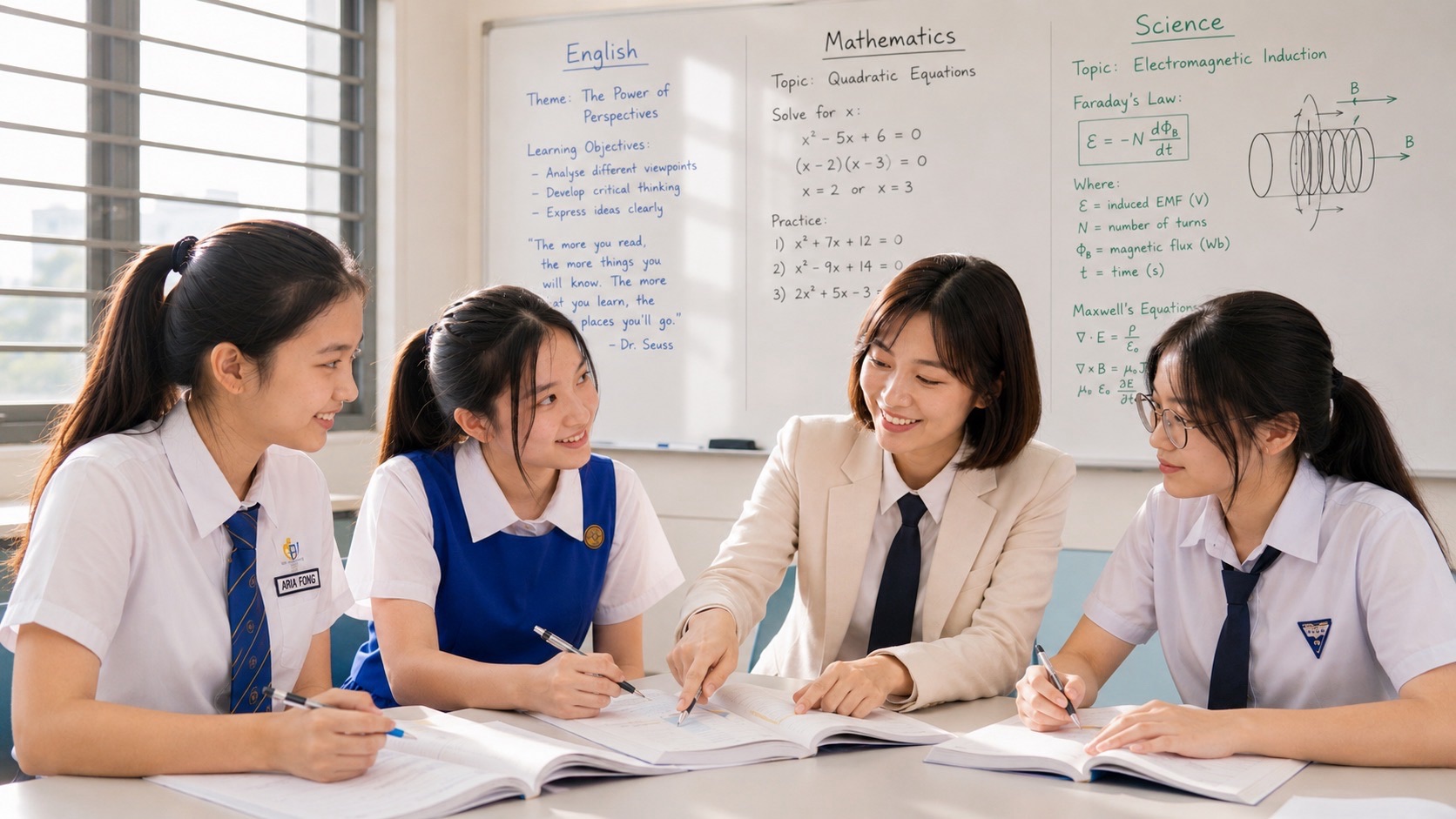
Secondary 4 Additional Mathematics Tuition Clementi in 3-pax groups for gap repair, calculus, trigonometry and full-paper exam preparation.
Secondary 4 Additional Mathematics Tuition for Clementi students who need clearer concepts, cleaner algebra, stronger topic connections and calm preparation for the national examination.
Secondary 4 Additional Mathematics Tuition Clementi
Secondary 4 Additional Mathematics tuition for Clementi students should do more than provide another set of worksheets.
It should identify where marks are being lost, repair the mathematics in the correct order, complete the syllabus carefully and prepare the student to perform under examination conditions.
At eduKateSG, our Secondary 4 A-Math programme is taught in small groups of up to three students. This gives the tutor enough room to see how each student thinks, correct unstable methods and build a clear route towards the national examination.
The objective is simple:
Make the syllabus feel smaller, the working more controlled and the student considerably steadier.
Secondary 4 A-Math Tuition at a Glance
| Programme area | What students receive |
|---|---|
| Class size | Up to 3 students |
| Lesson duration | 1.5 hours |
| Main focus | Concept repair, syllabus completion and examination performance |
| Core subject areas | Algebra, geometry, trigonometry and calculus |
| Exam preparation | Mixed-topic questions, timed sections and full papers |
| Teaching approach | Understand, connect, practise, verify and refine |
| Suitable for | Students rebuilding a pass, securing a stronger grade or preparing for distinction |
| Location access | Bukit Timah classes accessible to Clementi families |
| Placement | Consultation-based, subject to class availability |
Secondary 4 Is Not Simply Another Year of A-Math
In Secondary 3, students are usually learning Additional Mathematics one chapter at a time.
Secondary 4 changes the nature of the work.
The student must now:
- retain earlier Secondary 3 topics;
- learn the remaining syllabus;
- connect chapters that were previously taught separately;
- complete longer questions without losing accuracy;
- manage time across an entire paper;
- show sufficient mathematical working;
- recover calmly when an unfamiliar question appears.
This is where a student may appear to “know the topics” but still obtain an inconsistent result.
A chapter exercise may provide a clear clue about the required method. An examination paper does not always provide that comfort. The student must recognise the structure, choose an appropriate method and execute it without being guided towards the answer.
That difference is where many Secondary 4 marks are lost.
What the Official A-Math Examination Requires
For the 2026 Singapore–Cambridge GCE O-Level examination, Additional Mathematics is listed as syllabus 4049. The syllabus assumes that students already possess the necessary O-Level Mathematics knowledge and organises A-Math into three principal strands:
- Algebra
- Geometry and Trigonometry
- Calculus
It also emphasises mathematical reasoning, communication, application and connections across topics. (Isomer User Content)
The examination consists of two papers. Each paper lasts 2 hours and 15 minutes, carries 90 marks and contributes 50% of the final result. Students must answer every question. SEAB also states that omitting essential working may result in marks being lost.
This matters because A-Math tuition cannot be reduced to formula memorisation.
The official assessment weightings place approximately:
| Assessment demand | Weighting |
|---|---|
| Applying standard techniques | 35% |
| Solving problems in different contexts | 50% |
| Reasoning and communicating mathematically | 15% |
In other words, most of the assessment extends beyond routine repetition. Students must interpret information, move between mathematical forms, connect topics and explain or justify their reasoning.
A note for the 2027 examination cohort
From the 2027 Singapore–Cambridge Secondary Education Certificate examinations, SEAB lists G3 Additional Mathematics under subject code K341, with 4049 shown as the reference code for 2026 and earlier cohorts. Families should therefore follow the syllabus and examination information issued for their child’s specific cohort. (SEAB)
The Real Difficulty Is Control
Secondary 4 students encounter topics such as:
- quadratic functions, equations and inequalities;
- surds;
- polynomials and partial fractions;
- binomial expansion;
- exponential and logarithmic functions;
- trigonometric functions, identities and equations;
- coordinate geometry;
- proofs in plane geometry;
- differentiation and integration;
- tangents, normals and rates of change;
- maxima and minima;
- displacement, velocity and acceleration.
These topics are officially distributed across algebra, geometry and trigonometry, and calculus.
However, the deeper challenge is not the number of chapters.
It is whether the student can maintain control while moving between them.
A question may begin with a curve, require algebraic manipulation, introduce a tangent, move into differentiation and end with an interpretation. Another may combine trigonometric identities, exact values, equations and interval restrictions.
Students who revise every topic as a separate island may struggle when the examination asks them to cross the bridges.
Good Secondary 4 tuition therefore has to teach both:
- the individual topic; and
- the connections that allow the topic to function inside a full examination paper.
Why Students Lose Marks Even After Studying
A-Math results can become unstable for several different reasons.
The student remembers the formula but cannot select it
The formula is present in memory, but the student does not recognise when it applies. This is a method-selection problem rather than a memory problem.
The student understands the lesson but cannot reproduce it independently
Following a teacher’s worked example is not the same as beginning from a blank page. Independent retrieval must be trained.
Basic algebra remains unreliable
Weak factorisation, sign handling, fractions, indices or equation manipulation will continue to affect logarithms, trigonometry and calculus.
The official syllabus assumes students possess the relevant O-Level Mathematics knowledge. A hidden weakness in core Mathematics can therefore surface repeatedly inside A-Math questions. (Isomer User Content)
The student practises only one chapter at a time
Topical practice is necessary while a method is being learned. It is not sufficient for examination readiness.
Students must eventually practise mixed questions where the topic is not announced in advance.
Working is untidy or incomplete
The student may reach the correct numerical answer during home practice but lose method marks in school because essential stages are missing, unclear or incorrectly presented.
The student is too slow
Some students can complete the question with unlimited time. The examination asks whether they can do so accurately within a fixed paper.
Anxiety interrupts otherwise usable knowledge
The student sees an unfamiliar opening, assumes the whole question is inaccessible and stops before identifying the parts that can still be completed.
These students do not always need more pressure.
They need a clearer operating system.
Does Every Secondary 4 Student Need A-Math Tuition?
No.
A student may not require tuition when they can:
- keep pace with school lessons;
- identify and correct their own mistakes;
- revise independently;
- complete mixed questions without excessive prompting;
- finish timed papers;
- maintain reasonably stable results;
- ask their school teacher for help when necessary.
Tuition should not be added simply because the examination year has arrived.
It becomes valuable when the student’s existing system is no longer producing reliable progress.
The question is not merely, “Is my child passing?”
A better question is:
Can my child explain where the marks are being lost and demonstrate a workable plan to recover them?
When neither the student nor the family can answer this clearly, a professional assessment can be useful.
Signs That Additional Mathematics Support May Be Timely
Parents may consider support when they notice a combination of the following:
- test results fluctuate sharply;
- the child spends many hours revising without a matching improvement;
- earlier topics are repeatedly forgotten;
- calculus is being learned on top of weak algebra;
- mixed-topic questions feel much harder than chapter exercises;
- workings contain frequent sign, expansion or substitution errors;
- the student leaves several questions unfinished;
- school corrections are copied but not understood;
- confidence falls after every test;
- the child says, “I understand when the teacher explains it, but I cannot do it alone.”
One weak test does not automatically mean tuition is required.
A continuing pattern deserves closer attention.
How eduKateSG Reads a Secondary 4 A-Math Student
Before increasing the quantity of work, we first try to understand the nature of the difficulty.
1. The knowledge reading
Which topics has the student genuinely learned?
Which topics are familiar only because they were recently revised?
2. The foundation reading
Are indices, algebraic fractions, factorisation, equations and graph skills stable enough to support upper-secondary work?
3. The method reading
Can the student select an approach without being told which chapter the question comes from?
4. The transfer reading
Can the student connect two or more topics inside the same problem?
5. The examination reading
Can the student work at an appropriate speed, show clear steps and recover when a question does not proceed smoothly?
Two students obtaining 48% may require entirely different programmes.
One may understand the mathematics but work too slowly. Another may move quickly while using methods that are structurally incorrect.
A useful tuition programme should be able to see that difference.
The eduKateSG Secondary 4 A-Math Pathway
Our work generally moves through five connected phases.
Phase 1: Establish the Baseline
We begin by reading the student’s present position through school papers, attempted questions, working habits and topic performance.
The purpose is not to produce a label.
It is to establish priority.
A Secondary 4 student has limited time. The tutor must identify which repairs are most likely to unlock improvement across several chapters.
Phase 2: Repair the Mathematical Floor
Where necessary, we return to the essential algebra that supports the rest of A-Math.
This may include:
- manipulation of expressions;
- factorisation;
- equations;
- indices and surds;
- graph interpretation;
- substitutions;
- exact-value handling;
- appropriate calculator use.
Returning to a foundation is not moving backwards.
It is removing the reason the student keeps falling.
Phase 3: Complete and Connect the Syllabus
Topics are taught clearly, but they are not allowed to remain isolated.
For example:
- quadratic equations connect to tangency conditions;
- logarithms connect to graph transformations and modelling;
- coordinate geometry connects to gradients and differentiation;
- trigonometric identities connect to equation solving;
- differentiation connects to tangents, normals, rates and optimisation;
- integration connects to area and kinematics.
The student gradually moves from “Which formula belongs to this chapter?” towards “What mathematical structure is present here?”
Phase 4: Convert Knowledge into Examination Performance
Once the required content is sufficiently stable, practice becomes more mixed and more time-aware.
Students work on:
- mixed-topic sets;
- timed question clusters;
- question sequencing;
- efficient use of working space;
- recognition of higher-value steps;
- checking routines;
- full-paper stamina;
- recovery after an incomplete question.
At this stage, every mistake should provide information.
A wrong answer may reveal a concept gap, a selection error, an execution error, a presentation problem or a time-management issue.
Each requires a different correction.
Phase 5: Refine the Final Grade
The last stage is not about relearning the entire subject every week.
It is about reducing the remaining sources of mark leakage.
For one student, this may mean trigonometric accuracy. For another, it may be incomplete calculus working. For another, it may be spending too long on one difficult problem and sacrificing accessible marks later in the paper.
The closer the student moves towards a stronger grade, the more precise the work should become.
A Calm Secondary 4 Year Plan
School sequences differ, so the programme has to remain responsive. A sound general pathway looks like this:
| Period | Main priority |
|---|---|
| Early Secondary 4 | Repair Secondary 3 weaknesses and continue syllabus learning |
| Before mid-year examinations | Secure current topics and begin mixed-topic retrieval |
| Mid-year period | Analyse paper performance and close high-value gaps |
| Prelim preparation | Complete broad syllabus revision and increase timed practice |
| After prelims | Use evidence from papers to guide targeted repair |
| Final examination runway | Full-paper control, accuracy, pacing and confidence |
Teaching ahead can be valuable, but it should not become racing ahead.
There is little benefit in reaching integration early when the student’s algebra is still too fragile to support it.
Our preference is to create useful readiness: enough prior understanding for the school lesson to feel familiar, while preserving time for consolidation and correction.
What a 90-Minute Lesson May Include
A lesson is adjusted to the students present, but the underlying rhythm is deliberate.
Retrieval and readiness
Students begin by recalling earlier ideas without relying immediately on notes. This shows whether the learning is available independently.
Clear teaching
New concepts or unstable methods are explained from the mathematical structure, not simply presented as a set of steps to imitate.
Guided application
Students attempt carefully selected questions while the tutor observes how they set up the problem.
Independent work
Support is gradually reduced so that the student has to make decisions without continuous prompting.
Correction and verification
The tutor checks not only the final answer but also the method, notation, clarity and efficiency of the working.
Next-step instruction
The student leaves knowing what has improved, what remains unstable and what should be practised next.
The lesson should feel composed rather than rushed.
There is enough structure to make progress visible, but enough flexibility to attend to the student who needs an additional explanation.
Why We Keep the Class to Three Students
A-Math errors often occur in the middle of the working.
A student may copy a term incorrectly, apply an identity in the wrong direction, omit a restriction, mishandle a negative sign or choose an inefficient path.
In a large class, these errors may remain invisible until the answer is marked wrong.
In a three-student class, the tutor can observe the process more closely.
This allows us to:
- question each student directly;
- inspect individual working;
- correct misconceptions before they harden;
- vary question difficulty;
- give a stronger student appropriate extension;
- revisit a foundation without holding back an entire classroom;
- maintain active participation throughout the lesson.
Small-group tuition also preserves a valuable element of shared learning.
Students can hear another approach, explain a method and recognise that difficult questions can be managed without embarrassment.
The class remains intimate, but it is not isolating.
Different Students Need Different Secondary 4 Routes
The student currently failing A-Math
The immediate priority is not to attempt every difficult question available.
It is to establish a dependable mathematical floor, secure accessible marks and prevent repeated errors from consuming the paper.
The first successful movement may be from confusion to a controlled pass.
That is meaningful progress.
The student hovering around a C or B grade
This student often possesses enough content knowledge but loses marks through inconsistency.
The focus may be on:
- mixed-topic recognition;
- cleaner algebra;
- stronger calculus applications;
- better time allocation;
- clearer working;
- fewer unforced errors.
The student aiming for A1
A distinction student needs more than familiarity with advanced questions.
The student must remain accurate on ordinary questions, communicate methods clearly and retain enough time and composure for the demanding sections.
At this level, improvement often comes from refining decisions rather than collecting more formulas.
The capable student whose results suddenly declined
A decline may follow a school topic sequence, a difficult examination paper, accumulated workload or a small foundation gap that has begun affecting several chapters.
The response should be diagnostic rather than dramatic.
We identify what changed and rebuild from there.
Can a Student Join Later in Secondary 4?
Yes, but the programme must become selective.
A late-starting student may not have the luxury of revising every chapter with equal intensity. The tutor has to determine:
- which topics are most unstable;
- which gaps affect several other topics;
- where accessible marks are being lost;
- whether speed or knowledge is the larger constraint;
- which repair will produce the strongest return before the next examination.
A student joining after the mid-year examinations may require a recovery programme.
A student joining after prelims may need tightly focused paper analysis and examination conditioning.
Neither route should begin with panic.
The correct first step is to establish what can still be improved within the available runway.
A-Math Tuition Should Also Protect E-Math
Additional Mathematics and core Mathematics are separate subjects, but they share parts of the same working foundation.
Weak algebraic habits can affect both.
Poor time management can affect both.
Unclear presentation can affect both.
At the same time, A-Math should not consume so much revision time that the student’s other subjects are neglected.
A well-run programme should help the student organise mathematics more efficiently, not enlarge the weekly burden without purpose.
This is particularly important during the Secondary 4 examination year, when the child is balancing languages, sciences, humanities and other commitments.
Why Additional Mathematics Still Matters Beyond the Examination
The official syllabus is intended to provide a foundation for higher mathematical study, including A-Level H2 Mathematics. It also develops reasoning, application, communication and connections between Mathematics and the sciences. (Isomer User Content)
Not every A-Math student will enter a mathematics-heavy course.
The subject can still train useful habits:
- representing a difficult problem clearly;
- separating known and unknown information;
- selecting an appropriate method;
- carrying a process through accurately;
- checking whether an answer is reasonable;
- recovering when the first approach does not work.
The grade matters because it affects present choices.
The quality of thinking matters because it travels further.
Secondary 4 A-Math Tuition for Clementi Families
For families living in Clementi, Sunset Way, Dover, West Coast and nearby western districts, our Bukit Timah classes provide a small-group option within a manageable journey.
The location should be convenient, but convenience alone is not enough.
Parents should also ask:
- Can the tutor explain why the child is struggling?
- Is the class small enough for individual working to be seen?
- Is the programme aligned with the child’s actual examination cohort?
- Does tuition repair foundations or only distribute worksheets?
- Are students taught to work independently?
- Is timed-paper training introduced at the correct stage?
- Can the tutor describe the child’s next priority clearly?
A polished classroom is pleasant.
A precise learning system is more important.
How Parents Can Support the Process
Parents do not need to reteach calculus at home.
The most useful support is often quieter.
Help the student maintain a regular revision rhythm. Encourage them to bring incomplete work and genuine questions to class. Ask what they learned from a mistake rather than only asking for the mark.
After a school test, three questions are especially useful:
- Which marks were lost because the concept was not understood?
- Which marks were lost despite knowing the method?
- What will be done differently before the next paper?
These questions move the conversation from disappointment towards action.
Frequently Asked Questions
Is Secondary 4 too late to begin Additional Mathematics tuition?
It is not automatically too late. The remaining time must be used carefully. We first determine the student’s foundation, current grade, upcoming school assessments and most important areas for repair.
Does eduKateSG teach both Secondary 3 and Secondary 4 A-Math?
Yes. Secondary 3 establishes the subject foundation, while Secondary 4 focuses increasingly on connection, retention, timed performance and national-examination readiness.
Are the classes held in Clementi?
Our relevant small-group classes are conducted at our Bukit Timah location, which is accessible to families travelling from Clementi. Parents may contact us to check the latest class arrangement and availability.
How large is the class?
Classes are kept to a maximum of three students so that the tutor can inspect individual workings, question each learner and adjust the level of support.
How long is each lesson?
The standard lesson duration is 1.5 hours.
Will students receive materials?
Appropriate learning and practice materials are provided according to the programme and the student’s current needs.
Do you teach ahead of school?
We aim to create readiness ahead of important school lessons where appropriate. However, we do not race through topics while leaving weak foundations unresolved.
Can a weak student still improve in Secondary 4?
Yes, although the first objective may be stability rather than immediate distinction. The student may need to rebuild algebra, secure reliable methods and recover accessible examination marks before moving into harder work.
Is the programme suitable for students already scoring well?
Yes. Strong students may need greater precision, deeper mixed-topic work, more efficient problem selection and careful distinction-level refinement.
Do you offer trial lessons?
Placement is usually handled through a consultation because classes are limited to three students. Trial availability depends on the existing class profile and whether a suitable place is available.
A Clearer Final Year
Secondary 4 Additional Mathematics can feel crowded.
There are old topics to remember, new topics to complete, school examinations to manage and national papers approaching.
The answer is not always to add more work.
Often, the answer is to organise the work properly.
At eduKateSG, we help students understand what is breaking, repair it in sequence and convert their mathematical knowledge into controlled examination performance.
For Clementi families seeking close guidance in a three-student class, the next step is a consultation to review the student’s present grade, school timeline, learning gaps and available class placement.
The aim is not to make the year louder.
It is to make the route clearer.