
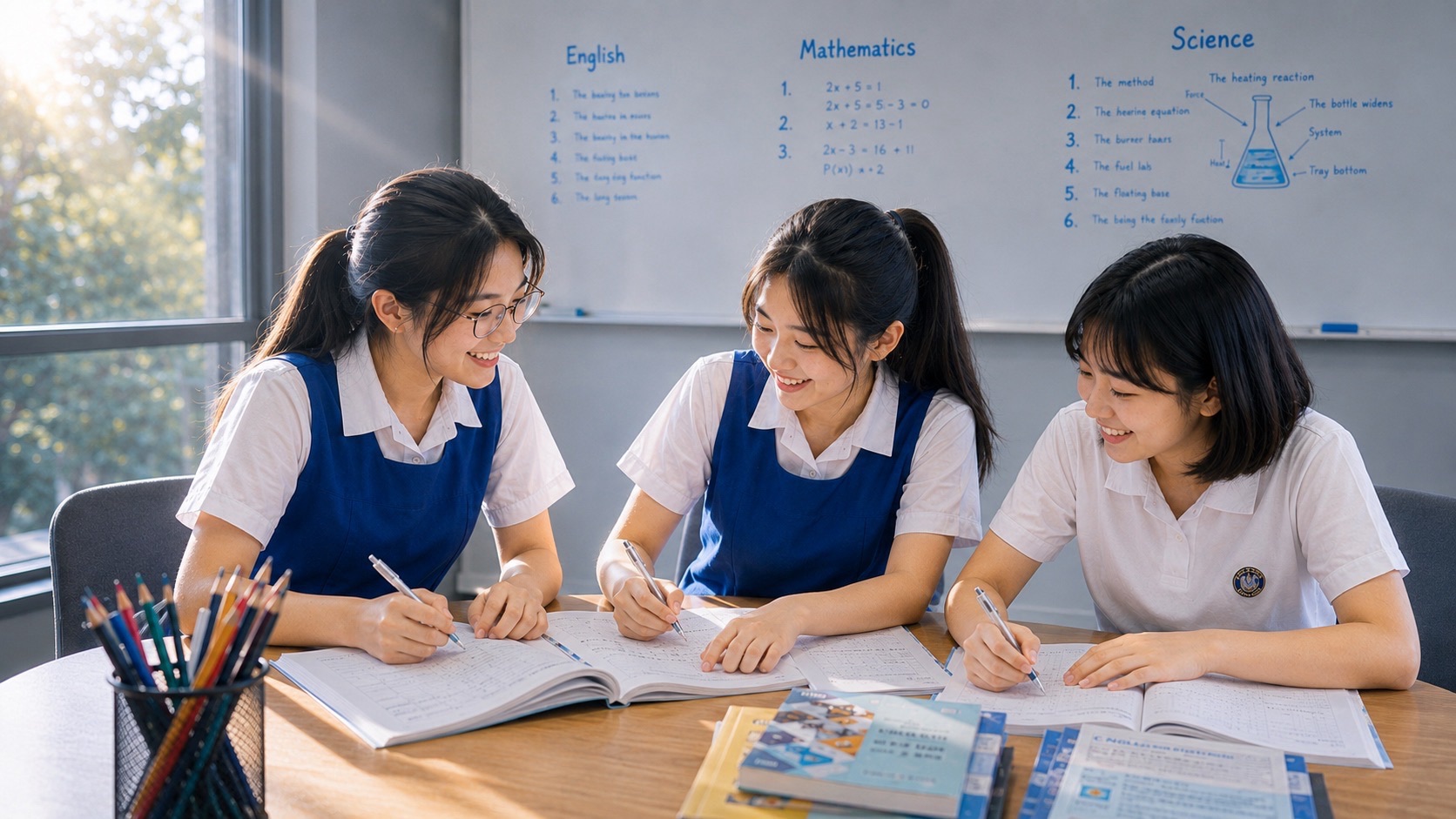
Secondary 3 Mathematics Tuition Clementi in focused 3-pax groups. Repair algebra gaps, understand new topics and prepare carefully for G1, G2 or G3 Mathematics.
Secondary 3 Mathematics Tuition Clementi
Secondary 3 Mathematics Tuition Clementi should do more than help a student complete the next worksheet.
It should help the student enter upper-secondary Mathematics with control.
Secondary 3 is the year when earlier mathematical skills are brought together and used at a higher level. Algebra becomes more demanding. Graphs become more connected to equations. Geometry begins to depend on trigonometric reasoning. Questions become longer, less predictable and more dependent on accurate interpretation.
A student who could previously manage by following familiar examples may suddenly feel that Mathematics has changed.
In many ways, it has.
The subject is no longer organised only as a collection of separate chapters. It is becoming a connected system. A weakness in one area can now affect several others.
At eduKateSG, our approach to Secondary 3 Mathematics tuition is calm, precise and highly attentive. We teach from first principles, repair earlier gaps where necessary and help students build the working discipline needed for Secondary 4 and the national examination ahead.
The One-Sentence Answer
Secondary 3 Mathematics Tuition Clementi helps students repair lower-secondary weaknesses, understand upper-secondary concepts and develop the accuracy, reasoning and examination habits needed for G1, G2 or G3 Mathematics.
Secondary 3 Mathematics Has Become Even More Important
The current Secondary 3 cohort sits within Singapore’s Full Subject-Based Banding system.
Mathematics may be taken at G1, G2 or G3, depending on the student’s subject level and learning route. From the 2027 graduating cohort, students will sit for the Singapore-Cambridge Secondary Education Certificate, or SEC, examination at their respective subject levels. The SEC replaces the previous N- and O-Level certificates with a common national certification that reflects the subjects and levels taken by each student.
For families with a child in Secondary 3 during 2026, this is particularly significant. These students belong to the first Full SBB cohort preparing for the SEC examination in 2027.
The names around the examination may be changing, but the essential learning requirement remains familiar:
A student still needs strong mathematical understanding, accurate working, dependable recall and the ability to apply knowledge under examination conditions.
The Ministry of Education currently provides Mathematics syllabuses at G1, G2 and G3, with Additional Mathematics available through the relevant G2 and G3 routes.
This means tuition should not treat every Secondary 3 student as though they are following the same programme.
The pace, depth, question style and expected level of independence must match the child’s actual Mathematics route.
Why Secondary 3 Mathematics Feels Different
The difficulty of Secondary 3 Mathematics is not caused by one particularly frightening chapter.
It comes from several changes happening at the same time.
1. Earlier Mathematics is assumed
Teachers have less time to reteach every lower-secondary idea.
Students are expected to remember how to:
- manipulate algebraic expressions;
- solve equations;
- work with negative numbers;
- apply indices;
- interpret graphs;
- use geometrical properties;
- handle ratios, percentages and rates;
- present complete mathematical working.
When these foundations are secure, new topics feel manageable.
When they are not, the student may understand the current explanation but remain unable to complete questions independently.
2. Questions contain more stages
A lower-secondary question may make the required method fairly visible.
A Secondary 3 question may require the student to:
- identify the relevant information;
- form an equation;
- select an appropriate method;
- complete several calculations;
- interpret the result;
- present the final answer correctly.
A student can therefore know the topic and still lose marks because the solution route is not well controlled.
3. Topics begin to connect
Algebra is no longer confined to an algebra chapter.
It appears in graphs, coordinate geometry, trigonometry, mensuration, probability and applied problems.
This is one of the most important changes for parents to understand.
A student may say, “I do not understand graphs.”
The deeper problem may be weak algebra.
A student may say, “I always make careless mistakes in trigonometry.”
The deeper problem may be inaccurate substitution, poor calculator use or uncertainty with rearranging formulas.
The visible error is not always the original cause.
4. Speed begins to matter
Secondary 3 is still a teaching year, but examination pressure is already entering the system.
Students must gradually learn to:
- recognise familiar question structures;
- begin solutions promptly;
- avoid spending too long on one question;
- show enough working to protect method marks;
- check answers efficiently;
- recover after becoming stuck.
Speed should not be forced before understanding.
However, understanding must eventually become fluent enough to work within a time limit.
5. Secondary 4 is approaching
Secondary 4 is not the ideal year to discover that Secondary 1 algebra was never stable.
By then, students are expected to consolidate content, work across topics and prepare under increasingly formal examination conditions.
Secondary 3 is therefore the architecture year.
Secondary 4 is the performance year.
What is built carefully in Secondary 3 becomes the platform from which the student revises and performs later.
What Students Commonly Learn in Secondary 3 Mathematics
The exact sequence differs between schools and subject levels. Students may encounter areas such as:
| Mathematical area | What the student must learn to control |
|---|---|
| Algebra | Manipulation, equations, inequalities, formulas and algebraic problem-solving |
| Functions and graphs | Understanding relationships, coordinates, gradients and graphical information |
| Geometry | Applying properties rather than simply recalling them |
| Coordinate geometry | Connecting algebra, graphs, distance and geometrical reasoning |
| Trigonometry | Selecting ratios, reading diagrams and managing multi-stage calculations |
| Mensuration | Working with length, area, surface area and volume in less familiar forms |
| Statistics | Reading, organising and interpreting data accurately |
| Probability | Reasoning about possible outcomes and combined events |
| Applied problems | Converting written information into mathematical structure |
| Examination presentation | Showing clear methods, units, notation and final answers |
These should not be learned as isolated procedures.
Students need to understand what each method does, why it works and how it connects to earlier Mathematics.
That is what allows knowledge to survive when the question looks different.
Additional Mathematics Is a Separate Learning Route
Some Secondary 3 students also begin Additional Mathematics.
Although Elementary Mathematics and Additional Mathematics support each other, they are not interchangeable.
A-Math introduces a more abstract and algebra-intensive route. Students may need to work with functions, surds, logarithms, trigonometric structure, equations and later calculus-related ideas with far greater symbolic control.
A student can perform reasonably well in regular Mathematics while struggling with A-Math. The opposite can also occur when a mathematically strong student enjoys abstract A-Math but loses easy marks through weaker E-Math presentation or applied problem interpretation.
Each subject requires its own teaching sequence and correction process.
Parents looking specifically for support in this area may begin with Secondary 3 Additional Mathematics tuition.
Why Some Students Suddenly Begin to Struggle
Most Secondary 3 difficulties are not random.
They usually arise from one or more identifiable weaknesses.
Weak algebra beneath the new topic
Algebra is the working language of upper-secondary Mathematics.
When students hesitate over negative signs, expansion, factorisation, fractions or rearranging formulas, every later topic becomes harder than it needs to be.
The student may appear slow in trigonometry, graphs or coordinate geometry, but the recurring obstruction is algebraic handling.
Memorising without understanding
A student may remember a formula but not know:
- when it should be used;
- what each term represents;
- how the formula changes when information is missing;
- whether the answer obtained is reasonable.
This creates fragile performance.
The student can complete familiar exercises but becomes lost when the presentation changes.
Incomplete mathematical working
Some students attempt too many steps mentally.
Others write calculations in scattered fragments.
This makes it difficult to:
- locate an error;
- receive method marks;
- check the solution;
- continue after a mistake;
- explain the reasoning to a tutor.
Clear working is not decorative. It is part of mathematical control.
Passive correction
Reading a model answer is not the same as learning from a mistake.
The student must identify:
- what went wrong;
- why it went wrong;
- which earlier skill was missing;
- what the correct decision should have been;
- whether the correction can be repeated independently.
Otherwise, the same error returns in a slightly different question.
Studying chapters without building connections
Students sometimes revise one topic intensively, perform well in a short topical test and assume the skill is secure.
However, formal examinations mix topics.
A student must recognise which knowledge to retrieve without being told the chapter name.
This requires mixed practice, retrieval and repeated application across different question forms.
Loss of confidence
Repeated difficulty can change the student’s behaviour.
The child may begin to:
- avoid starting homework;
- copy solutions too quickly;
- say that Mathematics is impossible;
- rush to finish uncomfortable questions;
- stop asking for help;
- blank out during tests.
Confidence is not rebuilt through encouragement alone.
It returns when the student experiences genuine, repeated control over the subject.
Signs That Secondary 3 Mathematics Support May Be Needed
A single disappointing test does not always indicate a major problem.
Parents should look for patterns.
Support may be useful when the student:
- understands during class but cannot reproduce the method later;
- performs well in topical work but poorly in mixed tests;
- repeatedly loses marks through algebra or negative signs;
- leaves questions blank because the first step is unclear;
- depends heavily on model answers;
- writes incomplete or disorganised working;
- spends excessive time on ordinary questions;
- shows large fluctuations between tests;
- feels overwhelmed after beginning A-Math;
- carries unresolved Secondary 1 or Secondary 2 gaps;
- is passing, but lacks the stability needed for the next year.
A child does not need to be failing before receiving support.
Tuition can be remedial, but it can also be protective.
It may be used to prevent a manageable weakness from becoming an examination-year problem.
What Good Secondary 3 Mathematics Tuition Should Do
A good tuition programme should not simply produce more work.
It should improve the quality of the student’s learning.
At eduKateSG, the teaching route follows a deliberate sequence.
1. Detect the real difficulty
We begin by observing how the student thinks and works.
This includes:
- concept understanding;
- algebraic fluency;
- calculation accuracy;
- question interpretation;
- working presentation;
- calculator habits;
- recall;
- speed;
- response to unfamiliar questions.
The purpose is not to label the child.
It is to find the first point at which the solution begins to weaken.
2. Explain the concept clearly
A student should understand what is happening before being expected to perform quickly.
We return to first principles where necessary.
The tutor may use simpler values, diagrams, patterns or familiar mathematical relationships before moving into the full abstract form.
The explanation should reduce confusion, not add another layer of memorised instructions.
3. Repair the missing foundation
When an earlier skill is blocking the current topic, that foundation must be repaired.
For example:
- weak fractions may obstruct algebraic fractions;
- uncertain expansion may obstruct quadratic work;
- poor equation handling may obstruct coordinate geometry;
- weak ratio understanding may obstruct trigonometry;
- inaccurate substitution may affect formulas across several topics.
Repair is more effective when it is narrow and precise.
The child does not need to restart the whole syllabus. The tutor needs to identify the specific dependency that is failing.
4. Build the new method carefully
Once the foundation is stable, the student progresses through:
- clear worked examples;
- guided practice;
- independent practice;
- varied question forms;
- mixed-topic application;
- timed work when ready.
Difficulty should rise in measured steps.
Too little challenge creates false confidence.
Too much challenge creates noise and discouragement.
5. Verify independent control
A method is not considered secure merely because the student followed it once.
The student should be able to:
- explain the idea;
- complete a similar problem independently;
- apply it after a delay;
- recognise it inside a mixed set;
- use it under moderate time pressure;
- correct an error without being given the entire answer.
This is where temporary familiarity becomes usable Mathematics.
The eduKateSG Mathematics Learning Approach
The eduKate Mathematics Learning System is built around a simple principle:
Mathematics mastery is not created by memorising more answers. It develops through understanding, structured progression and increasingly independent thinking.
For Secondary 3 students, this means lessons are designed to strengthen several layers at once.
Conceptual understanding
Students learn why a method works and what mathematical relationship it represents.
Procedural accuracy
They learn to carry out the method cleanly, including notation, substitution, calculator use and final presentation.
Question recognition
They learn to notice the signals that suggest a suitable approach.
Transfer
They practise using familiar knowledge when the question is presented differently.
Error control
Mistakes are classified and corrected rather than dismissed as general carelessness.
Examination discipline
Students gradually learn to manage time, protect method marks and check their work without repeatedly restarting entire solutions.
Parents who are unsure where their child’s difficulty begins may also use the Mathematics Start Here Navigation Hub to locate the most relevant learning route.
Why Three Students Can Be Better Than a Large Class
eduKateSG Mathematics lessons are conducted in true small groups of up to three students.
This matters because Secondary 3 mistakes are often found inside the student’s process, not only in the final answer.
A tutor may need to notice that the student:
- selected the wrong formula;
- copied a sign incorrectly;
- misunderstood a word in the question;
- skipped an essential algebraic line;
- used the calculator before forming the correct expression;
- abandoned a valid method too early;
- reached the right answer through unstable reasoning.
In a larger class, these details can remain invisible.
In a three-student group, the tutor can inspect working closely, ask the student to explain a decision and intervene before the wrong habit becomes established.
The student still benefits from a social learning environment. There are other learners present, alternative methods to observe and opportunities to explain mathematical ideas.
However, there is very little room to disappear.
The 3-pax format allows personalised correction while preserving the energy and perspective of collaborative learning. eduKateSG uses this model specifically to improve algebra, working discipline, mistake analysis and examination confidence.
What a Typical 90-Minute Mathematics Lesson May Include
A carefully structured lesson may move through five stages.
Retrieval and review
Students begin by recalling earlier knowledge.
This helps the tutor see whether previous learning remains available without notes.
Clear teaching
The tutor explains the new concept or repairs a misconception using first principles.
Guided application
Students work through carefully selected questions with support.
The tutor observes how each student begins, organises and completes the solution.
Independent or timed practice
Once the method is understood, students apply it with less help.
Time limits are introduced only when the underlying structure is sufficiently stable.
Error analysis and next-step planning
Mistakes are reviewed before the lesson ends.
Students should leave knowing what they misunderstood, how it was corrected and what they must practise next.
The 90-minute format gives enough space for explanation, practice, correction and consolidation without turning the lesson into an unfocused volume exercise. eduKateSG’s published 3-pax Mathematics format uses weekly 1.5-hour lessons with curated notes, examination-grade practice and error analysis.
Different Students Need Different Secondary 3 Routes
There is no single improvement plan that suits every child.
Route 1: Catch up
This student has significant lower-secondary gaps.
The immediate priority is to stabilise:
- number accuracy;
- algebra;
- equations;
- graphs;
- essential geometry;
- working presentation.
Current school topics still need attention, but the tutor must repair the foundations that repeatedly cause collapse.
Route 2: Keep up
This student generally understands lessons but produces uneven results.
The focus is on:
- stronger recall;
- mixed-topic practice;
- cleaner working;
- fewer repeated mistakes;
- greater independence;
- steady test preparation.
The aim is consistency.
Route 3: Move ahead
This student is already performing well and requires deeper challenge.
The focus may include:
- less familiar applications;
- more efficient methods;
- stronger reasoning;
- distinction-level accuracy;
- examination speed;
- advanced transfer between topics.
The aim is not to rush through content for appearance’s sake.
It is to build depth without creating hidden gaps.
G1, G2 and G3 Mathematics Require Different Pacing
Full SBB gives students a more flexible subject-level route.
However, flexibility does not remove the need for careful teaching.
G1 Mathematics
The student may benefit from:
- clear and concrete explanation;
- manageable learning steps;
- frequent retrieval;
- strong real-world interpretation;
- repeated practice of essential methods;
- close monitoring of confidence.
The goal is dependable mathematical control and a useful platform for the student’s next educational route.
G2 Mathematics
The student needs a steady balance between understanding, application and examination readiness.
Teaching should strengthen:
- core algebra;
- problem interpretation;
- multi-stage working;
- topic connections;
- consistency under mixed conditions.
G3 Mathematics
The student is expected to manage greater depth, pace and transfer.
Teaching should develop:
- precise algebraic manipulation;
- flexible problem-solving;
- stronger graphical and geometrical reasoning;
- efficient examination execution;
- distinction-level accuracy where appropriate.
The subject level should guide the load.
It should never determine the amount of care given to the student.
When Should a Secondary 3 Student Begin Mathematics Tuition?
The best time is before the problem becomes urgent.
Beginning of Secondary 3
This provides the longest runway.
Earlier weaknesses can be repaired while new topics are being introduced.
After the first school assessment
The first assessment may reveal that the student’s old study method is no longer sufficient.
This is a useful point for diagnosis and adjustment.
During the June holidays
The mid-year break can be used to repair Semester One gaps before the second half of the year becomes more demanding.
After the end-of-year examination
Support can begin with a focused Secondary 3-to-Secondary 4 bridging programme.
This is especially useful when the student passed but did not achieve stable mastery.
Only in Secondary 4
Improvement is still possible, but the available time is narrower.
The programme must balance foundation repair, current school demands, revision and examination preparation.
Earlier support generally allows a calmer and more complete repair process.
Choosing Secondary 3 Mathematics Tuition in Clementi
For Clementi families, convenience matters.
Students already balance school, CCAs, projects, homework and travel. A programme should fit into family life without creating unnecessary exhaustion.
However, the nearest tuition class is not always the most suitable one.
Parents may wish to look beyond distance and consider:
- How many students are in the class?
- Will the tutor inspect the child’s actual working?
- Is the class suitable for the child’s G1, G2 or G3 level?
- Are lower-secondary gaps repaired?
- Is the student taught to understand or merely copy procedures?
- Are mistakes tracked over time?
- Is mixed-topic work included?
- Does the programme prepare the student for Secondary 4?
- Can the student ask questions freely?
- Is there communication when an important weakness is found?
The right class should feel focused rather than crowded.
It should give the student enough space to think, attempt, make mistakes and receive correction.
What Parents Can Do at Home
Parents do not need to reteach the syllabus.
A few well-chosen questions are often more useful than supervising every calculation.
Try asking:
- “Which topic is causing the most difficulty?”
- “Was the mistake caused by understanding, calculation or reading?”
- “Can you redo the question without looking at the answer?”
- “Which earlier skill did this question require?”
- “What will you check next time?”
- “Which questions are you still unable to start?”
These questions direct attention towards the learning process.
Parents can also watch for changes in behaviour.
A student who repeatedly avoids Mathematics may not be lazy. The child may no longer know how to begin.
That is a solvable problem, but it must first be seen clearly.
Frequently Asked Questions
Is Secondary 3 Mathematics much harder than Secondary 2 Mathematics?
It is usually more connected and demanding. Earlier skills are assumed, questions contain more stages and students are expected to work with greater independence. The difficulty is manageable when lower-secondary foundations are stable.
Can tuition help when my child has weak Secondary 1 and Secondary 2 foundations?
Yes. The tuition programme should identify the particular gaps affecting current work rather than blindly restarting every chapter. Common repair areas include algebra, fractions, negative numbers, equations, graphs and geometrical reasoning.
My child understands the lesson but still performs poorly. Why?
Understanding an explanation is only the first stage. The child may still have difficulty recalling the method, recognising when to use it, completing it accurately or applying it under time pressure.
Is this suitable for G1, G2 and G3 Mathematics?
The learning process can support all three subject levels, but the teaching depth, pace, question selection and examination preparation must be matched to the student’s actual route.
Is Additional Mathematics included?
Additional Mathematics is a separate subject route and should receive dedicated instruction. Students taking both subjects need clear differentiation between their regular Mathematics and A-Math requirements.
Will a three-student class provide enough individual attention?
A three-student class allows the tutor to inspect each learner’s working, provide direct feedback and adjust the lesson while retaining the benefits of learning with peers.
Can a student join in the middle of Secondary 3?
Yes. The starting point should be determined through the student’s current work, recent assessments and visible learning gaps. The tutor can then balance repair with the school’s ongoing syllabus.
Does eduKateSG teach ahead of the school schedule?
Where appropriate, students are prepared for upcoming topics so that school lessons become a second point of contact rather than the first encounter. Teaching ahead remains useful only when earlier foundations are sufficiently secure.
How quickly will marks improve?
The timeline depends on the size of the learning gap, the student’s attendance, practice habits and willingness to correct mistakes. Early progress may first appear as clearer working, stronger recall and fewer repeated errors before it becomes a large change in marks.
Are trial lessons available?
The preferred first step is a consultation so that the student’s level, needs and class suitability can be considered properly. Limited lesson availability may depend on the capacity of the three-student group.
Related Mathematics Reading
Parents may continue through the following eduKateSG Mathematics routes:
- Sec 3 Math Tutor: Secondary 3 Mathematics Tuition
- Secondary 3 G3 Mathematics Tuition
- Secondary 3 Additional Mathematics Tuition
- The eduKate Mathematics Learning System
- Our Approach to Learning Mathematics
- Mathematics Start Here Navigation Hub
- Secondary Mathematics Tuition: Real Mathematics Teaching
Secondary 3 Mathematics Tuition Clementi with eduKateSG
Secondary 3 does not need to feel like a sudden wall.
It becomes difficult when new Mathematics arrives faster than the student can organise it, or when earlier weaknesses remain hidden beneath current chapters.
With the right teaching, the year can become something else entirely.
It can become the year in which algebra settles, mathematical working becomes cleaner and unfamiliar questions begin to look more readable.
At eduKateSG, our 3-pax Secondary Mathematics tuition is designed to help students catch up, keep up and move ahead through clear explanation, careful diagnosis and precise correction.
We teach students to understand before asking them to accelerate.
We repair the foundations that matter.
We prepare them for the topics that come next.
Most importantly, we help each student build a Mathematics system that continues to work when the questions become harder.
For families considering Secondary 3 Mathematics Tuition Clementi, the next step is a parent–student consultation to identify the student’s present level, learning needs and most suitable route.
Properly taught kids shine a bright light into the future.