
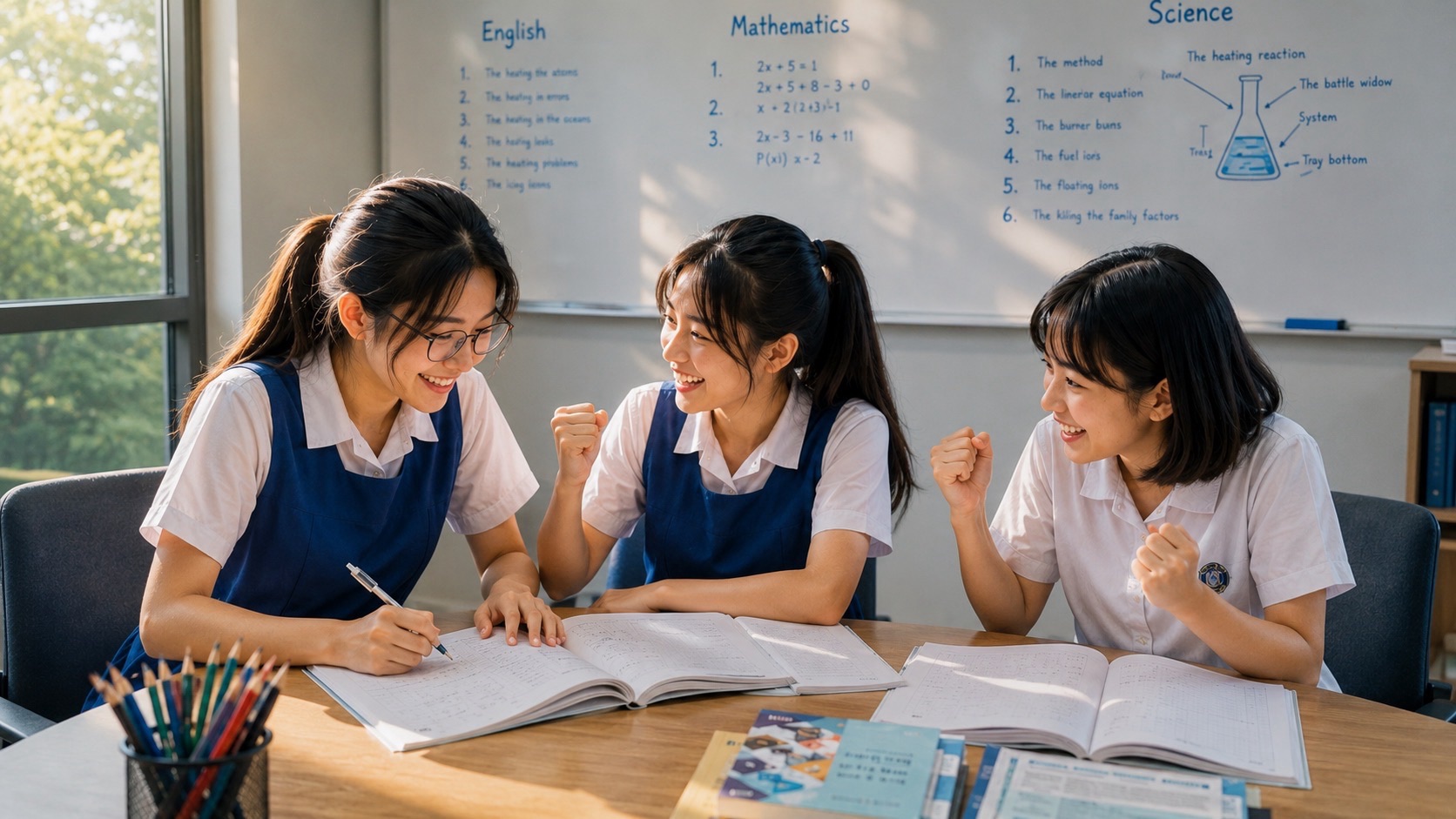
4 Mathematics tutor for Clementi students. Premium 3-pax E-Math and A-Math tutorials near Sixth Avenue MRT, with targeted revision, paper strategy and examination preparation.
Complete the syllabus. Repair the remaining gaps. Convert four years of Mathematics into reliable examination performance.
At eduKateSG, we provide premium 3-pax Secondary 4 Mathematics tutorials for Clementi students attending lessons at our Bukit Timah centre near Sixth Avenue MRT.
Secondary 4 is no longer simply another year of Mathematics.
It is the year when the student must gather everything learned across Secondary 1 to Secondary 4 and make the complete system work under examination conditions.
The student must be able to:
- recall methods without chapter prompts;
- recognise the mathematics inside unfamiliar questions;
- connect ideas across topics;
- maintain accurate working through longer solutions;
- manage both papers within the available time;
- recover when a question becomes difficult; and
- protect marks that should already have been secured.
For students taking Additional Mathematics, the demand becomes even sharper. Algebra, trigonometry, coordinate geometry and calculus must operate together. A weakness in one area can travel into several apparently unrelated questions.
Our Secondary 4 Mathematics tuition is therefore built around more than syllabus coverage.
We teach students to complete, consolidate and execute.
Lessons are available for:
- G2 and G3 Mathematics;
- E-Math examination preparation;
- G2 and G3 Additional Mathematics where applicable;
- students repairing substantial foundation gaps;
- students moving from pass to stronger grades;
- students targeting A1 or A2; and
- IP or school-specific Mathematics support.
Classes are limited to three students and conducted for 1.5 hours weekly.
Arrange a parent–student consultation with eduKate Singapore
Secondary 4 Is the Conversion Year
Secondary 3 is often the construction year.
Students learn substantial new content, particularly in upper-secondary Mathematics and Additional Mathematics.
Secondary 4 is the conversion year.
The student must convert:
- knowledge into recall;
- recall into method selection;
- method selection into accurate working;
- accurate working into completed papers; and
- completed papers into marks.
A student may understand many individual chapters and still underperform in an examination.
This happens because examination performance requires several systems to operate together.
The student must know the topic, recognise when it is being tested, select a suitable route, execute it accurately and finish within time.
That is why simply completing more worksheets is not always enough.
By Secondary 4, tuition must answer more precise questions:
- Which topics are genuinely weak?
- Which topics are understood but too slow?
- Where are marks being lost repeatedly?
- Is the problem conceptual, algebraic, numerical or examination-based?
- Does the student know how to start unfamiliar questions?
- Can earlier topics still be retrieved?
- Is Paper 1 or Paper 2 creating the larger score loss?
- Is the student leaving marks unattempted?
- Are correct methods being weakened by incomplete working?
A Secondary 4 Mathematics tutor should be able to see the full paper, not only the current chapter.
The Current Examination Route: O-Level and SEC
Students graduating in 2026 continue to sit the existing GCE O-Level, N(A)-Level or N(T)-Level examinations according to their examination route.
From 2027, these qualifications will be combined under the Singapore-Cambridge Secondary Education Certificate. Students will sit subjects at the relevant G1, G2 or G3 level, while the overall examination standards and assessment formats remain aligned with the corresponding present pathways.
For parents, the practical teaching principle remains clear:
The student must be prepared for the exact Mathematics subject level, syllabus and examination format assigned to the cohort.
Our programme considers:
- the student’s graduating year;
- subject level;
- school programme;
- Mathematics or Additional Mathematics route;
- preliminary examination timetable;
- present school results; and
- post-secondary objectives.
The label may change from O-Level to SEC, but the need for mathematical understanding, accuracy, problem solving and examination discipline remains.
Secondary 4 E-Math: The Whole Syllabus Must Remain Available
E-Math is often misunderstood as the easier Mathematics subject.
That can lead students to underestimate it.
The real challenge is breadth.
The student must retain a wide range of topics and move between them quickly. A paper may progress from indices to geometry, statistics, graphs, probability and financial Mathematics without allowing the student time to settle into one chapter.
The official 2026 O-Level Mathematics syllabus organises content across three broad strands:
- Number and Algebra;
- Geometry and Measurement; and
- Statistics and Probability.
It also assesses standard techniques, problem solving, reasoning and mathematical communication.
Number and algebra
Students may need to control:
- numbers and numerical operations;
- approximation and estimation;
- standard form;
- indices;
- ratio and proportion;
- percentage;
- rate and speed;
- algebraic expressions;
- formulae;
- functions and graphs;
- equations and inequalities;
- set language;
- matrices; and
- numerical applications.
Geometry and measurement
Students may encounter:
- angle properties;
- congruence and similarity;
- properties of circles;
- coordinate geometry;
- vectors;
- transformations;
- mensuration;
- Pythagoras’ theorem;
- trigonometry;
- bearings; and
- three-dimensional problems.
Statistics and probability
Students may work with:
- data interpretation;
- statistical diagrams;
- measures of central tendency;
- cumulative frequency;
- box-and-whisker plots;
- probability;
- combined events; and
- contextual conclusions.
The challenge is not merely remembering each formula.
Students must identify which part of the Mathematics syllabus is operating inside the question.
Understanding the E-Math Examination Papers
For the 2026 O-Level Mathematics examination, both Paper 1 and Paper 2 are 2 hours 15 minutes long, carry 90 marks and contribute 50% each.
Paper 1 contains approximately 26 short-answer questions. Paper 2 contains 9 to 10 questions of varying lengths, with the final question focused specifically on applying Mathematics to a real-world situation. All questions are compulsory. Essential working is required, and omission of that working can result in lost marks.
This creates two different examination demands.
E-Math Paper 1: breadth, control and tempo
Paper 1 contains many shorter questions.
The student must:
- move quickly between topics;
- avoid spending too long on an early question;
- retrieve standard methods immediately;
- maintain arithmetic accuracy;
- recognise small traps;
- present enough working; and
- preserve time for checking.
A student can understand the syllabus but still lose a large number of marks through small errors distributed across the paper.
Paper 1 improvement therefore depends heavily on:
- automatic recall;
- question recognition;
- numerical control;
- short-route selection;
- checking habits; and
- disciplined pacing.
E-Math Paper 2: depth, integration and endurance
Paper 2 contains fewer but longer questions.
Students must sustain reasoning across several parts. Earlier answers may feed into later sections. A single reading error can affect several marks.
Paper 2 requires:
- careful interpretation;
- structured working;
- integration of several topics;
- persistence through unfamiliar contexts;
- accurate calculator use;
- diagram and graph reading;
- real-world interpretation; and
- sufficient stamina to remain precise near the end.
The final real-world application question may combine several areas of the syllabus rather than behaving like a single familiar chapter exercise.
We therefore do not prepare both papers in exactly the same way.
Secondary 4 A-Math: The Subject Becomes Fully Integrated
Additional Mathematics places a heavier load on symbolic control.
A student may know the main formula and still lose the question because of an earlier algebraic breakdown.
For example:
- a differentiation method may be correct, but expansion fails;
- a trigonometric identity may be known, but factorisation is missed;
- an integration route may be suitable, but indices are mishandled;
- a logarithmic equation may be understood, but domain restrictions are ignored;
- a coordinate geometry method may be correct, but simultaneous equations are solved inaccurately.
The official 2026 Additional Mathematics syllabus is organised into:
- Algebra;
- Geometry and Trigonometry; and
- Calculus.
It assumes knowledge of the Mathematics syllabus and places substantial emphasis on problem solving across varied contexts.
A-Math algebra
Students may need to master:
- quadratic functions;
- equations and inequalities;
- surds;
- polynomials;
- factor and remainder theorems;
- partial fractions;
- binomial expansion;
- exponential functions;
- logarithmic functions; and
- mathematical modelling.
Geometry and trigonometry
Students may work with:
- trigonometric functions;
- exact values;
- radians;
- identities;
- double-angle and compound-angle formulae;
- trigonometric equations;
- R-formula applications;
- coordinate geometry;
- equations of circles;
- transformation into linear form; and
- proofs in plane geometry.
Calculus
Students must develop control over:
- differentiation;
- product, quotient and chain rules;
- gradients;
- tangents and normals;
- increasing and decreasing functions;
- stationary points;
- rates of change;
- maximum and minimum problems;
- integration;
- definite integrals;
- areas under curves; and
- linear kinematics.
The official syllabus gives approximately 50% of its assessment emphasis to solving problems in varied contexts, alongside standard techniques and mathematical reasoning.
This means A-Math preparation cannot stop at memorising procedures.
The student must learn to recognise which procedures belong together.
Understanding the A-Math Examination Papers
For the 2026 O-Level Additional Mathematics examination, Paper 1 and Paper 2 are each 2 hours 15 minutes, carry 90 marks and contribute 50% each.
Paper 1 contains 12 to 14 questions of varying lengths. Paper 2 contains 9 to 11 questions, with individual questions carrying up to 12 marks. All questions are compulsory, and essential working must be shown.
The paper does not provide a safe chapter-by-chapter route.
Students must be prepared for topics to arrive in different orders and forms.
A strong A-Math student therefore needs four layers of control:
Concept control
The student understands what the mathematical idea represents.
Symbolic control
The student can manipulate algebra accurately across several lines.
Route control
The student can select an efficient method and avoid unnecessary detours.
Paper control
The student can allocate time, protect easier marks and return intelligently to difficult questions.
A student may be strong in the first two layers but still lose a distinction because paper control is weak.
Our Secondary 4 A-Math lessons train all four.
Why Students Still Struggle After Completing the Syllabus
Completing a syllabus does not mean the syllabus is available.
A chapter may have been taught, revised and tested months earlier. Yet during a full paper, the student may no longer recognise it quickly enough.
This creates several common Secondary 4 profiles.
The student who understands during lessons but cannot start independently
This student depends on recent demonstrations or chapter headings.
When presented with a mixed paper, the first step is unclear.
The problem is often recognition and retrieval rather than intelligence.
The student who knows the method but cannot complete it accurately
This student begins correctly but loses signs, brackets, units, exact values or numerical precision.
The problem is execution stability.
The student who performs well topically but poorly in full papers
Topical practice reduces the need to choose a method because the chapter has already been identified.
A full paper removes that assistance.
The problem is transfer.
The student who can solve everything but never finishes
This student may use unnecessarily long routes, become trapped in one difficult question or check too slowly.
The problem is paper strategy.
The student who has several weak chapters
This student requires prioritisation.
There may not be enough time to reteach every topic from the beginning at equal depth. Tuition must identify which repairs will release the greatest number of marks.
Secondary 4 requires educational triage.
The tutor must know what to repair first.
Our Secondary 4 Diagnostic Map
We begin by identifying where the marks are actually being lost.
A broad statement such as “weak in Mathematics” is not enough.
We examine the student across five areas.
1. Knowledge
Does the student know the required concept, formula and notation?
2. Recognition
Can the student identify the topic when the question is not labelled?
3. Execution
Can the method be completed accurately?
4. Transfer
Can the student adapt the method when the question changes?
5. Examination control
Can the student perform within the paper’s timing, pressure and mark structure?
Recent school papers are especially valuable because they reveal repeated behaviour.
We look for:
- blank questions;
- incomplete solutions;
- lost method marks;
- wrong formula selection;
- algebraic breakdowns;
- calculator errors;
- weak diagrams;
- poor use of exact values;
- incorrect rounding;
- missing units;
- timing collapse; and
- marks lost after a correct start.
The final score tells us where the student finished.
The working tells us how the student arrived there.
Four Secondary 4 Learning Pathways
1. Rescue and repair
This is for students whose foundations remain substantially unstable.
The programme may prioritise:
- arithmetic and algebra repair;
- essential high-frequency topics;
- reliable standard methods;
- question-starting routines;
- core E-Math marks;
- selected A-Math recovery;
- reduction of blank answers; and
- a realistic examination plan.
The first objective is not perfection.
It is to stop uncontrolled mark loss and build a usable paper.
2. Pass-to-credit consolidation
This student understands parts of the syllabus but performs inconsistently.
The programme focuses on:
- filling major topic gaps;
- stabilising algebra;
- improving retention;
- securing routine marks;
- completing more of the paper;
- correcting repeated errors; and
- strengthening timed performance.
The objective is a dependable score rather than occasional success.
3. B-to-A conversion
This student knows most of the syllabus.
The remaining loss may come from:
- non-routine questions;
- careless mistakes;
- incomplete explanations;
- time pressure;
- inefficient routes;
- weak checking;
- exact-value errors; or
- the final few demanding questions.
The programme becomes more surgical.
We protect the strong areas while correcting the small number of patterns preventing distinction performance.
4. A1 performance refinement
This student is already performing strongly.
The work may include:
- difficult mixed-topic sets;
- alternate solution routes;
- unfamiliar applications;
- full-paper pacing;
- precision under fatigue;
- recovery after a difficult question;
- proof and explanation;
- selective question review; and
- examination-day strategy.
At this level, the student does not necessarily need more content.
The student needs greater reliability.
First Principles Before Final-Year Speed
Secondary 4 creates pressure to move quickly.
However, speed built on misunderstanding is fragile.
A student may memorise that a term “moves across and changes sign”. That language may appear harmless in a simple equation, but it can create confusion when fractions, functions or several algebraic terms are involved.
We return to the valid mathematical operation:
- what changed;
- why it changed;
- which part of the expression was affected; and
- what remained equivalent.
This is first-principles teaching.
It does not mean making every question unnecessarily theoretical.
It means ensuring that the student possesses a dependable rule beneath the shortcut.
Once the principle is stable, speed can be developed safely.
The Fencing Method for Secondary 4 Mathematics
Complex questions are often difficult because too many moving parts arrive together.
We reduce the load by placing the idea inside a controlled fence.
For example, a student struggling with differentiation may first work with:
- one term;
- a positive integer power;
- no brackets; and
- no product or quotient.
Once the rule is secure, the fence expands:
- negative powers;
- fractional powers;
- multiple terms;
- composite functions;
- products;
- quotients;
- stationary points; and
- applied optimisation.
For trigonometry, the sequence might begin with:
- exact values;
- one basic identity;
- one side of an equation;
- a defined interval; and
- a simple transformation.
It then expands towards proofs, compound angles, double angles and R-formula questions.
The Fencing Method allows complexity to increase without letting confusion increase at the same rate.
Retrieval and Interleaving for the Final Year
Topical revision creates comfort.
Mixed revision creates examination readiness.
During a topical exercise, the student already knows that every question belongs to differentiation, vectors or probability.
In the national examination, that support disappears.
The student must decide:
- what topic is present;
- which information matters;
- which method should begin the solution; and
- whether another topic is embedded inside it.
Our lessons therefore include:
Retrieval practice
Students recall earlier methods after a delay.
Interleaved sets
Several topics appear within one practice sequence.
Cumulative micro-tests
Previously learned material remains active while new revision continues.
Full-paper exposure
Students learn to operate across the entire syllabus.
Correction retrieval
Questions previously answered wrongly return later in a changed form.
The objective is not only to remember the correction.
It is to apply it without being reminded.
A Typical 90-Minute Secondary 4 Mathematics Tutorial
Every lesson responds to the students’ present needs, but the structure remains disciplined.
Opening retrieval
Students begin with several questions drawn from earlier topics or previous errors.
This checks whether the learning survived beyond the last lesson.
Precision teaching
The tutor explains one high-value concept, method or misconception.
The explanation may involve:
- rebuilding a principle;
- comparing two methods;
- showing why a common shortcut fails;
- demonstrating an efficient route; or
- connecting several chapters.
Guided application
Students solve selected questions while the tutor observes the working closely.
The tutor looks for the first point at which control begins to weaken.
Independent examination work
Students complete questions without continuous prompting.
This reveals whether the method belongs to the student or remains dependent on the tutor.
Timed micro-set
A short timed sequence trains pacing, recognition and decision-making.
Error analysis
Mistakes are classified and corrected.
Continuation task
Home practice is selected according to the student’s immediate priority.
The assignment may be short.
It must not be random.
Error Analysis: Turning Lost Marks into a System
A wrong answer is not yet a useful lesson.
It becomes useful when the student understands what produced it.
We classify errors into several groups.
Concept error
The student misunderstood the mathematical relationship.
Recognition error
The required concept was known but not identified.
Algebra error
The method was correct, but symbolic manipulation failed.
Numerical error
Arithmetic, calculator entry or approximation caused the loss.
Reading error
A condition, unit or instruction was missed.
Route error
The selected method was valid but inefficient, incomplete or unsuitable for the question.
Presentation error
Working was omitted, unclear or incorrectly organised.
Time error
The student spent too long, rushed or failed to return to a question.
Pressure error
The student abandoned a familiar method because the question looked unfamiliar.
Once the error is classified, the correction can be precise.
“Be more careful” is not a correction system.
A useful correction might be:
- underline the required quantity;
- check calculator mode before trigonometry;
- retain exact values until the final line;
- place one algebraic operation on each line;
- estimate before calculating;
- draw a labelled diagram;
- test a substituted value;
- mark the question and return later; or
- perform a sign scan after expanding brackets.
Reducing Careless Mistakes in E-Math
E-Math papers contain many opportunities for small losses.
A student may lose one mark through:
- incorrect rounding;
- a missing unit;
- copying a value wrongly;
- reading the graph scale inaccurately;
- using diameter instead of radius;
- entering the calculator incorrectly;
- changing an inequality sign incorrectly;
- forgetting a negative value; or
- providing an answer in the wrong form.
One mark may appear insignificant.
Repeated across a paper, it can separate several grades.
Our E-Math error-control routine includes:
- question annotation;
- diagram labelling;
- unit checks;
- reasonableness checks;
- exact-value awareness;
- calculator verification;
- line-by-line copying discipline; and
- a final-answer scan.
The purpose is not to slow the student permanently.
The purpose is to make accuracy automatic enough that speed becomes safe.
Protecting Symbolic Accuracy in A-Math
A-Math errors can travel.
One incorrect sign near the beginning may alter several later lines.
We therefore train students to protect the structure of the solution.
This includes:
- writing enough intermediate steps;
- maintaining bracket discipline;
- separating identities from equations;
- checking domain restrictions;
- preserving exact values;
- distinguishing degrees from radians;
- using appropriate notation;
- tracking constants of integration;
- checking stationary-point classifications;
- confirming interval restrictions; and
- testing whether the final result is mathematically possible.
A clean solution is not merely attractive.
It allows the student to see the mathematics while it is happening.
Paper Strategy: The Student Must Manage the Examination
A national examination is not only a collection of Mathematics questions.
It is also a resource-management problem.
The student has limited:
- time;
- attention;
- working memory;
- confidence; and
- checking capacity.
These resources must be allocated carefully.
First-pass discipline
Students should secure accessible marks without becoming trapped too early.
Time awareness
The student needs internal checkpoints rather than discovering near the end that substantial sections remain.
Mark-value awareness
A two-mark question should not consume the time needed for a larger question elsewhere.
Intelligent skipping
Leaving a question temporarily is not surrender.
It is often good paper management.
Return strategy
The student should mark where the breakdown occurred so that the question can be resumed efficiently.
End-of-paper checking
Checking should be targeted.
Students first inspect:
- incomplete questions;
- signs;
- exact-value requirements;
- units;
- calculator transfers;
- answer spaces; and
- solutions that look unreasonable.
Good examination technique does not replace Mathematics knowledge.
It protects it.
Why Full Papers Should Not Begin Too Early—or Too Late
A student with major foundation gaps may gain little from repeatedly attempting full papers.
The same weaknesses simply reappear for several hours.
Early in the programme, topic repair may provide a better return.
However, remaining exclusively in topical worksheets until the final weeks creates another problem. The student never learns to retrieve and select methods under full-paper conditions.
We therefore move through a sequence.
Stage 1: Repair
Fix high-impact conceptual and algebraic weaknesses.
Stage 2: Consolidate
Connect related topics and stabilise standard question types.
Stage 3: Integrate
Use mixed-topic sets and timed sections.
Stage 4: Condition
Attempt full papers under increasingly realistic conditions.
Stage 5: Refine
Review errors, adjust pacing and protect remaining weak points.
The correct starting stage depends on the student.
A Secondary 4 Mathematics Timeline
The exact school schedule differs, but a well-managed final year generally moves through four phases.
Phase 1: Architecture
The early part of the year is used to:
- complete remaining content;
- inspect Secondary 3 weaknesses;
- repair algebra;
- restore forgotten topics;
- identify paper-specific problems; and
- build the revision map.
Phase 2: Integration
Students begin to:
- mix topics;
- complete longer questions;
- revisit earlier work;
- improve route selection; and
- practise under shorter timing controls.
Phase 3: Preliminary-examination preparation
The programme becomes increasingly paper-facing.
Students work on:
- school prelim formats;
- full-paper stamina;
- score stability;
- completion rates;
- examination routines; and
- rapid correction of remaining weaknesses.
Phase 4: National-examination refinement
After preliminary examinations, every remaining lesson should have a clear purpose.
The priority may be:
- one dangerous topic;
- one repeated error pattern;
- one paper-timing issue;
- one incomplete question type; or
- final consolidation of strong scoring areas.
This is not the time for random volume.
It is the time for precise allocation.
Why a 3-Pax Class Works Particularly Well in Secondary 4
In the final year, students no longer need only general explanations.
They need their individual working examined.
Three students allow the tutor to see:
- how each student starts;
- where time is being lost;
- which topics trigger hesitation;
- whether the algebra remains controlled;
- whether the student recognises a hidden topic;
- which mistakes repeat;
- how corrections are applied; and
- whether performance changes under timing.
Immediate correction
A dangerous error can be stopped before it settles into another week of practice.
Individual paper priorities
One student may require E-Math Paper 1 speed.
Another may need A-Math calculus repair.
A third may need to stop leaving long Paper 2 questions blank.
A small class allows these priorities to coexist.
Frequent explanation
Students must explain why a route works.
This reveals whether the method is understood or merely copied.
Calm examination preparation
The setting remains serious without becoming noisy or impersonal.
Compatible peer momentum
Students see how others approach a question and learn that a difficult paper can be managed methodically.
The class offers attention without removing independence.
Starting Secondary 4 Mathematics Tuition in January
A January start provides the largest runway.
There is time to:
- diagnose earlier gaps;
- rebuild weak foundations;
- complete the syllabus carefully;
- teach selected topics ahead;
- develop mixed-topic control;
- prepare for preliminary examinations; and
- condition full papers gradually.
This is particularly valuable for students taking both E-Math and A-Math.
The two subjects require separate attention, but they also interact through algebra, graphs, trigonometry and mathematical discipline.
Starting After the First School Assessment
This is a common intervention point.
The first substantial Secondary 4 result often reveals that earlier weaknesses have survived into the final year.
There is still meaningful time to improve, but prioritisation becomes important.
We identify:
- the largest topic gaps;
- the fastest recoverable marks;
- repeated careless-error patterns;
- paper completion issues; and
- whether the current study method is producing transfer.
The programme may need to balance school topics with urgent repair.
Starting in June
A June start is still useful, but the strategy must be tighter.
There may not be enough time to rebuild every chapter from first principles at equal depth.
The tutor must identify:
- high-frequency weaknesses;
- load-bearing algebra problems;
- routine marks being lost;
- topics that can be improved efficiently;
- paper strategy failures; and
- the realistic grade objective.
The programme becomes more selective.
Every worksheet should answer a known problem.
Starting After Preliminary Examinations
There is still work that can be done.
However, the objective changes.
This is not a full-year reconstruction programme.
It is final-stage examination repair.
We examine the preliminary papers and ask:
- Which marks were available but lost?
- Which weak areas are realistically repairable?
- Which topics should be protected?
- Where did time disappear?
- Which questions were abandoned too early?
- Which errors repeated from earlier papers?
- What must the student do differently in the next full paper?
A focused student can still improve significantly in paper completion, accuracy and tactical control.
The remaining time simply must be used with precision.
What Parents Should Bring to the Consultation
Useful materials include:
- recent school examination papers;
- preliminary papers;
- topical tests;
- marked assignments;
- teacher comments;
- the school revision schedule;
- the student’s subject combination;
- current target grades; and
- examples of questions the student avoids.
We pay particular attention to the working.
Two students who both receive 55% may require entirely different programmes.
One may know the full syllabus but lose marks through speed and presentation.
The other may have substantial gaps in algebra, trigonometry and graphs.
The score is the symptom.
The paper reveals the structure underneath.
What Progress Should Look Like
In Secondary 4, progress should become increasingly visible in examination behaviour.
Parents may notice that the student:
- starts unfamiliar questions more calmly;
- leaves fewer blanks;
- produces cleaner working;
- identifies the relevant topic faster;
- retains earlier chapters;
- makes fewer repeated algebra errors;
- completes more of the paper;
- returns intelligently to difficult questions;
- checks answers with purpose;
- manages timing more steadily; and
- produces a narrower, more dependable score range.
A single high mark is encouraging.
A stable sequence of stronger papers is more valuable.
The aim is not one lucky performance.
It is reliable performance when the examination arrives.
Frequently Asked Questions
Do you teach both E-Math and A-Math?
Yes.
Secondary 4 students may receive support for Mathematics, commonly called E-Math, and Additional Mathematics according to their school route, syllabus and class placement.
Is E-Math mainly about doing many past-year papers?
Past papers are important, but they are not sufficient on their own.
A student must first understand why marks are being lost. Repeating papers without correcting the underlying pattern often reproduces the same score.
We combine diagnosis, topic repair, mixed practice, timed sections, full papers and error analysis.
Can a weak A-Math student still improve in Secondary 4?
Yes, although the scale and speed of improvement depend on the starting point and available time.
We first identify whether the main problem is:
- algebra;
- missing content;
- weak recognition;
- procedural accuracy;
- poor retention;
- incomplete papers; or
- confidence under pressure.
The programme is then prioritised around the most important weaknesses.
Should my child drop A-Math?
That is a significant academic decision and should be discussed with the school, taking account of present performance, workload, intended post-secondary route and the time remaining.
Our role is to provide a clear academic picture: which foundations are missing, what improvement would require and whether the current difficulties appear repairable.
My child understands A-Math but keeps making algebra mistakes. What can be done?
We separate the advanced concept from the supporting algebra.
The student may understand differentiation or trigonometry but lose control during expansion, factorisation, fractions or equation solving.
These supporting operations are repaired directly and then reinserted into the A-Math question.
How do you prepare students for Paper 1 and Paper 2 differently?
Paper 1 generally places greater pressure on breadth, immediate recall and tempo.
Paper 2 tends to place more pressure on sustained reasoning, longer solutions, integration and endurance.
We train the skills each paper requires while ensuring the full syllabus remains connected.
Do you provide timed practice?
Yes.
Timing begins with small sets and paper sections before moving into full-paper conditions. This allows pacing to develop without sacrificing the quality of the method.
How do you reduce careless errors?
We classify them.
A sign mistake, graph-scale error, calculator error, reading error and time-pressure error do not have the same cause. Each receives a specific prevention and checking routine.
My child is already scoring an A. Is tuition still useful?
It may be useful when the student wants:
- stronger A1 reliability;
- more difficult mixed questions;
- better paper strategy;
- deeper A-Math control;
- reduced variation between papers; or
- preparation for post-secondary Mathematics.
A student already performing confidently and independently may not require additional tuition.
Can a student join during the middle of Secondary 4?
Yes, subject to a suitable 3-pax class placement.
The later the start, the more important it becomes to identify priorities quickly.
Do you align lessons with school preliminary examinations?
Yes.
We consider the school’s topic coverage, assessment timing and recent papers while maintaining a broader national-examination revision plan.
Do you teach G2 and G3 Mathematics?
Yes.
The programme is adjusted to the student’s subject level, school syllabus and graduating examination route.
How quickly can marks improve?
Some students first improve through fewer blank questions, cleaner working and better timing. Marks may then rise as those behaviours become stable.
The rate depends on:
- the size of the foundation gap;
- time remaining;
- attendance;
- independent practice;
- subject combination;
- present paper completion; and
- willingness to correct repeated habits.
We do not treat one lesson or one worksheet as evidence of a completed repair.
Convenient for Clementi Families
eduKateSG’s Bukit Timah centre is located at 8 Fourth Avenue, Singapore 268674, near Sixth Avenue MRT. Consultations and lessons are arranged by appointment.
For students travelling from Clementi, the centre provides access to a focused 3-pax Mathematics environment without requiring travel into the city centre.
Students can travel from Clementi through Buona Vista and Botanic Gardens before continuing on the Downtown Line to Sixth Avenue.
The journey creates a clear transition from school day to focused tutorial time.
Location: eduKateSG, 8 Fourth Avenue, Singapore 268674
Nearest MRT: Sixth Avenue MRT
Class format: Premium 3-pax small groups
Lesson duration: 1.5 hours weekly
Attendance: By consultation and suitable class placement
Class Details
Level: Secondary 4 Mathematics
Subjects:
- G2 Mathematics;
- G3 Mathematics;
- E-Math;
- G2 Additional Mathematics where applicable;
- G3 Additional Mathematics;
- IP Mathematics support; and
- school-specific upper-secondary Mathematics.
Format: Maximum 3 students
Duration: 1.5 hours weekly
Programme elements:
- initial diagnostic review;
- first-principles reteaching;
- targeted topic repair;
- algebra consolidation;
- E-Math and A-Math paper preparation;
- retrieval and interleaving;
- timed micro-tests;
- full-paper conditioning;
- error analysis;
- preliminary-examination review; and
- national-examination strategy.
Materials may include:
- curated notes;
- targeted topic sets;
- mixed-topic revision;
- examination-style questions;
- timed paper sections;
- full papers;
- correction tasks; and
- personalised continuation work.
Additional clinics may be arranged around major assessments, subject to schedule and class requirements.
Limited trial lessons may occasionally be possible when the 3-pax configuration allows. The usual first step is a parent–student consultation so that the student’s needs and suitable placement can be assessed.
How Placement Works
Consultation
We discuss the student’s:
- school;
- subject level;
- present grades;
- E-Math or A-Math concerns;
- preliminary-examination schedule;
- target outcome;
- study habits; and
- available preparation time.
Paper review
Recent work is examined to identify the real mark-loss pattern.
Class matching
Students are placed according to:
- subject;
- syllabus;
- readiness;
- pace;
- timetable; and
- compatibility with the existing group.
Final-year roadmap
The first priorities are established.
The programme may begin with:
- emergency algebra repair;
- syllabus completion;
- E-Math Paper 1 accuracy;
- E-Math Paper 2 integration;
- A-Math calculus;
- trigonometry;
- full-paper timing; or
- preliminary-examination correction.
The student does not receive a generic Secondary 4 worksheet sequence.
The programme begins where the marks are being lost.
Helpful References for Parents
- Secondary Mathematics Tuition Clementi — 3-Pax Small Groups
- Secondary 4 Mathematics Tutor in Bukit Timah — 3-Pax Small Group
- What Happens in Secondary 4 E-Mathematics Tuition?
- Secondary 4 Additional Mathematics Tuition
- Secondary Additional Mathematics Tuition Near Sixth Avenue
- MOE Secondary Mathematics Curriculum and Syllabuses
- SEAB 2026 O-Level Syllabuses
- SEAB Singapore-Cambridge Secondary Education Certificate
Secondary 4 Mathematics Tutor for Clementi Students
Secondary 4 is finite.
There are only so many school weeks, revision cycles and complete papers available before the examination.
That makes clarity important.
Students should know:
- what they understand;
- what they only recognise;
- what they can execute independently;
- where their marks disappear;
- which topics require urgent repair;
- which strong areas must be protected; and
- how they will manage the paper when the examination becomes difficult.
At eduKateSG, our Secondary 4 Mathematics tutorials are built to make that final year orderly.
For students who are behind, we identify the shortest responsible route back into the paper.
For students whose results fluctuate, we build consistency.
For students approaching distinction, we refine accuracy, timing and route selection.
For students taking A-Math, we strengthen the symbolic engine that allows algebra, trigonometry and calculus to work together.
The aim is not merely to finish the syllabus.
It is to enter the examination able to use it.
Arrange a Parent–Student Consultation
Speak with eduKateSG about your child’s:
- E-Math or A-Math performance;
- G2 or G3 subject route;
- remaining syllabus gaps;
- preliminary-examination results;
- paper-completion concerns;
- target grade; and
- suitable 3-pax class placement.
eduKateSG
8 Fourth Avenue
Singapore 268674
Near Sixth Avenue MRT
Premium 3-pax Secondary Mathematics tutorials
By consultation and suitable class placement
Properly taught kids shine a bright light into the future.