
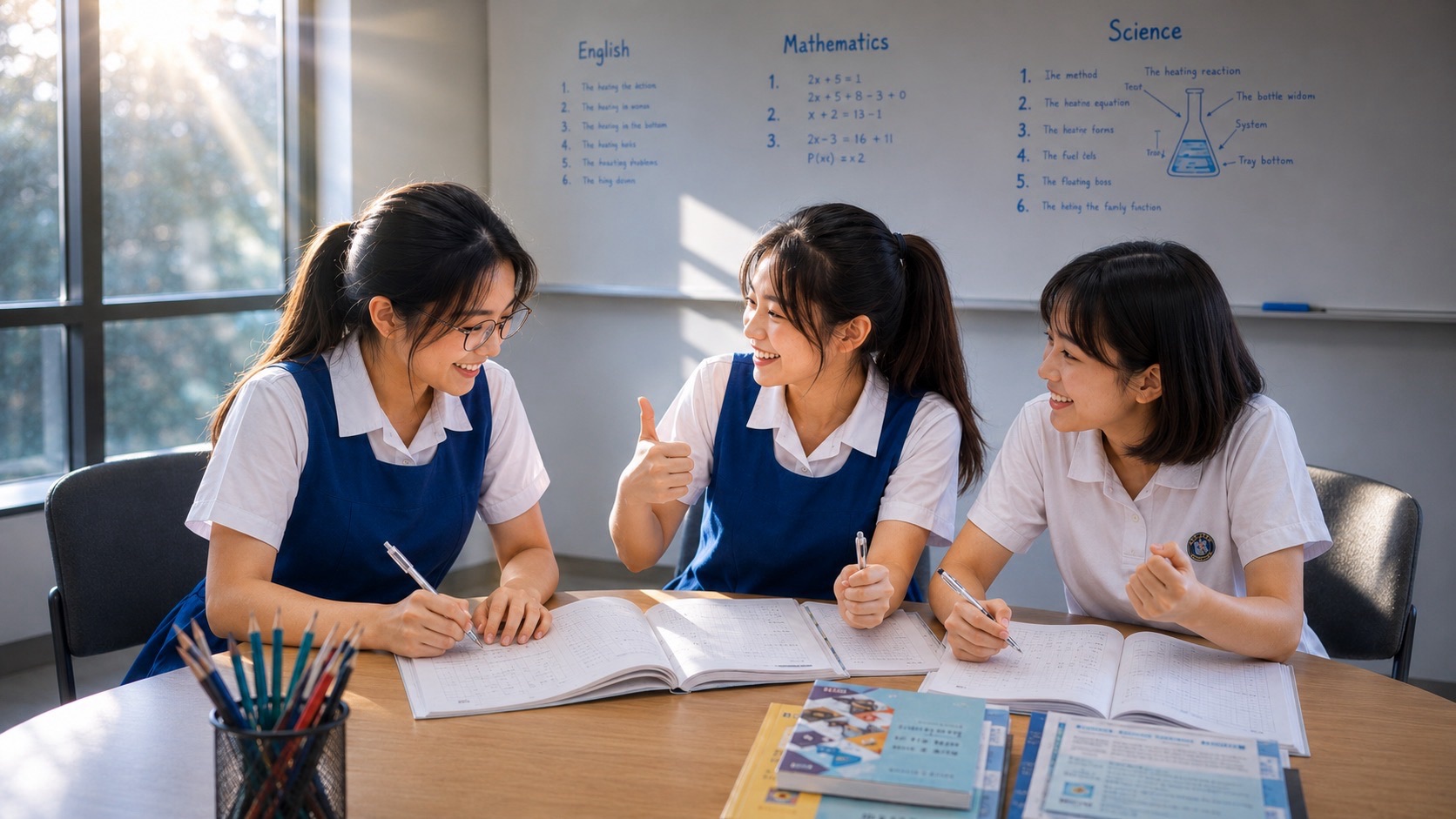
Secondary 4 Mathematics tuition for Clementi students in 3-pax groups. Build E-Math and A-Math control, repair gaps and prepare calmly for O-Levels.
Secondary 4 Mathematics Tuition Clementi
Secondary 4 Mathematics should feel increasingly clear.
The syllabus may be large. Preliminary examinations may be approaching. School revision may move quickly. Yet beneath the volume, the student’s task is quite precise:
Understand the mathematics, recognise what each question requires, select the correct method and complete the solution accurately within the available time.
Our Secondary 4 Mathematics Tuition for Clementi students is designed around this clarity.
At eduKateSG, students learn in carefully managed 3-pax small groups near Sixth Avenue MRT. Lessons support both E-Mathematics and Additional Mathematics, with close teaching, structured revision and deliberate preparation for school and national examinations.
This is not simply a place to complete more worksheets.
It is a calm, systematic programme for helping students repair earlier gaps, connect the full syllabus and convert what they know into dependable examination performance.
A Quick Guide for Clementi Parents
A strong Secondary 4 Mathematics tuition programme should help a student:
- consolidate Mathematics learned from Secondary 1 to Secondary 4;
- identify and repair unresolved conceptual weaknesses;
- connect topics instead of treating every chapter separately;
- recognise common question structures;
- improve calculation accuracy and mathematical presentation;
- manage mixed-topic papers under time pressure;
- prepare differently for E-Math and A-Math;
- enter examinations with a stable checking routine.
Secondary 4 is not only about completing the syllabus.
It is about making the syllabus usable.
Why Secondary 4 Mathematics Feels Different
During earlier secondary years, students can sometimes survive by studying one topic at a time.
They learn algebra for one test, geometry for another and statistics several weeks later. Questions are often close to the chapter recently taught, so the required method is easier to recognise.
Secondary 4 changes this environment.
A single examination paper may move rapidly between:
- algebra;
- graphs;
- geometry;
- trigonometry;
- mensuration;
- statistics;
- probability;
- functions;
- coordinate geometry;
- calculus for A-Math students.
The student is no longer told which chapter is being tested.
They must identify it independently.
This is one of the central difficulties of upper-secondary Mathematics. The student may understand individual methods during topical practice but struggle to choose between them when the topics are mixed.
A good Sec 4 Math tuition programme therefore trains more than content knowledge. It develops recognition, selection, execution and checking.
Secondary 4 Is a Year of Compression
By Secondary 4, students have accumulated several years of mathematical knowledge.
The difficulty is rarely that they know absolutely nothing. More often, their knowledge exists in separate pieces:
- formulas remembered without their conditions;
- methods that work only when questions look familiar;
- algebra that is correct when practised slowly but unstable under pressure;
- geometry facts that cannot be recalled at the right moment;
- calculator habits that hide conceptual errors;
- incomplete working that loses method marks;
- old misconceptions that continue to affect newer topics.
Secondary 4 tuition compresses these separate pieces into a smaller and more organised system.
Instead of remembering hundreds of unrelated questions, students learn to recognise a manageable number of mathematical structures.
For example, they begin to see that many apparently different questions are asking them to:
- form an equation;
- preserve equivalence while transforming it;
- identify a relationship between quantities;
- represent information using a graph or diagram;
- apply a theorem under the correct conditions;
- calculate an unknown from known constraints;
- interpret the meaning of a mathematical result.
Once the structure becomes visible, Mathematics becomes less intimidating.
E-Mathematics and Additional Mathematics Need Different Preparation
E-Math and A-Math are related, but they do not place identical demands on the student.
Secondary 4 E-Mathematics
E-Math requires broad control across the complete syllabus.
The official curriculum organises its content around Number and Algebra, Geometry and Measurement, and Statistics and Probability. It also emphasises reasoning, communication, application and mathematical modelling.
Students must be able to move confidently between many different forms of Mathematics.
A typical paper may require them to:
- manipulate algebraic expressions;
- solve equations and inequalities;
- interpret graphs;
- use bearings and scale drawings;
- work with congruence and similarity;
- apply trigonometry;
- calculate area, surface area and volume;
- interpret statistical representations;
- calculate probability;
- solve real-world application questions.
The challenge is breadth.
Students must keep many topics active and know when each method applies.
Secondary 4 Additional Mathematics
A-Math is more structurally concentrated but often more technically demanding.
Students work with deeper algebra, functions, coordinate geometry, trigonometry and calculus. A small weakness in manipulation can travel through several lines of working and affect the entire solution.
The challenge is continuity.
A student who has weak factorisation may struggle with equations. Weak equations affect functions. Weak functions affect coordinate geometry and calculus. Weak trigonometric manipulation affects identities, equations and later applications.
A-Math therefore cannot be repaired entirely through memorised templates.
Students need to understand how mathematical transformations work, why each step is permitted and what conditions must remain true throughout the solution.
For a deeper explanation, parents may read eduKateSG’s guide to how Additional Mathematics works.
What Our Secondary 4 Mathematics Tuition Does
Our programme is organised around five connected stages.
Stage 1: Stabilise the Foundation
Before pushing into full-paper revision, we identify weaknesses that may be quietly affecting the student’s work.
Common examples include:
- incorrect handling of negative signs;
- unreliable fraction manipulation;
- weak expansion and factorisation;
- confusion when changing the subject of a formula;
- difficulty translating words into equations;
- incomplete understanding of indices and surds;
- poor graph interpretation;
- inaccurate use of mathematical notation;
- calculator entry errors.
These may appear to be small problems.
In an examination, they are not small. They can affect several chapters and repeatedly remove marks from otherwise manageable questions.
We repair these foundations carefully rather than asking the student to work around them.
Stage 2: Consolidate Each Topic
Once the foundation is stable, students revisit the major syllabus areas.
The purpose is not merely to “finish revision”.
For each topic, students should know:
- the central concept;
- the essential formulas;
- the conditions attached to those formulas;
- the main question structures;
- the steps that must be shown;
- common traps;
- suitable checking methods;
- how the topic connects to other chapters.
This produces a more organised understanding of the syllabus.
The student no longer carries a collection of disconnected worksheets. They begin to carry a mathematical map.
Stage 3: Connect the Topics
Real examination questions do not always stay inside one chapter.
An E-Math question may combine algebra with mensuration. A graph question may require coordinate geometry and interpretation. A probability question may include ratios or percentages.
An A-Math question may connect functions with differentiation, coordinate geometry with algebra, or trigonometry with identities and equations.
Students therefore need mixed-topic practice.
We teach them to pause before calculating and ask:
- What information has been given?
- What is the question asking me to find?
- Which relationships are present?
- Which method preserves those relationships?
- What earlier result can be used in the next part?
- Does my answer satisfy the original conditions?
This is where mathematical understanding begins to become examination control.
Stage 4: Condition Examination Performance
Knowing Mathematics and performing Mathematics are not identical.
A student may understand a topic at home yet struggle during a timed paper because of:
- slow method selection;
- excessive hesitation;
- poor sequencing;
- panic after one difficult question;
- spending too long protecting a small number of marks;
- incomplete working;
- careless calculator use;
- failing to return to unanswered questions.
Timed practice helps reveal these behaviours.
We then correct them deliberately.
Students learn how to:
- settle into the paper;
- secure accessible marks efficiently;
- recognise when a question needs more time;
- leave a clear return point;
- present enough working;
- monitor time without becoming distracted;
- check answers using appropriate methods;
- recover calmly after a difficult section.
The aim is not to make students rush.
It is to help them use time intelligently.
Stage 5: Protect the Final Score
At the upper end of the mark range, improvement often comes from reducing preventable losses.
A student may not need ten new formulas. They may need to stop losing marks through:
- omitted units;
- premature rounding;
- incorrect significant figures;
- transcription mistakes;
- unreadable graphs;
- incomplete conclusions;
- unsupported answers;
- sign errors;
- answering a different question from the one asked.
We help students build a personal error profile.
Instead of hearing the general advice, “Be more careful,” the student learns precisely where care is required.
For example:
- Check signs after expanding brackets.
- Keep full calculator values until the final answer.
- Re-read what the axis represents.
- Confirm whether the question asks for length, area or volume.
- Substitute the solution into the original equation.
- Check that a trigonometric answer lies within the stated interval.
- Write the required unit before moving on.
Carefulness becomes a procedure rather than a personality trait.
Why First-Principles Teaching Matters
Many students arrive at Secondary 4 with a large collection of memorised steps.
They may know what to write when a question looks familiar but become uncertain when the wording, diagram or arrangement changes.
First-principles teaching goes beneath the memorised procedure.
We ask:
- What does this mathematical object represent?
- Which rule allows this transformation?
- What must remain unchanged?
- Under what conditions is the formula valid?
- Why does this method produce the answer?
- How can the result be checked independently?
Mathematics works because valid transformations preserve meaning and relationships. When students understand this, they become less dependent on exact question templates.
They can adapt.
That ability becomes especially important in Secondary 4, when examination questions may present familiar Mathematics through unfamiliar surfaces.
The 3-Pax Small-Group Difference
Secondary 4 students do not all need the same explanation.
One student may understand the chapter but work too slowly. Another may be fast but careless. A third may have significant algebra gaps hidden beneath reasonable school results.
In a large class, these differences are difficult to address at the same moment.
Our 3-pax format allows the tutor to observe:
- how each student begins a question;
- which method they select;
- where hesitation occurs;
- whether the working is logically complete;
- what type of error repeats;
- how well corrections are retained;
- whether the student can explain the method independently.
This creates room for both teaching and observation.
The tutor is not merely presenting content at the front of the room. The tutor can see the student’s mathematical process as it happens.
That is particularly valuable in Secondary 4, where a small recurring weakness can affect several examination papers before anyone notices its true cause.
What a Lesson May Include
A Secondary 4 lesson may contain several carefully chosen components.
1. Retrieval
Students recall formulas, identities, definitions or earlier methods without depending immediately on notes.
This keeps essential knowledge available.
2. Concept Clarification
The tutor revisits a principle that has been misunderstood, partially learned or over-memorised.
3. Guided Application
Students work through selected questions while the tutor observes method choice, working and accuracy.
4. Independent Execution
Students attempt questions without step-by-step prompting.
This reveals whether the learning can stand on its own.
5. Mixed Practice
Questions from several topics are introduced so students must identify the required method independently.
6. Error Correction
Mistakes are classified and corrected at their source.
7. Review
The student leaves knowing what has improved, what remains unstable and what should be practised next.
The exact balance changes as examinations approach.
Earlier lessons may place greater emphasis on repair and explanation. Later lessons increasingly include integration, timed work and examination review.
Who This Programme Is Suitable For
Our Sec 4 Math Tuition for Clementi students can support several different starting points.
The Student Who Is Struggling
This student may feel that the class has moved too far ahead.
They need the syllabus reorganised into a manageable sequence, beginning with the gaps that affect the greatest number of topics.
The immediate goal is not to overwhelm them with advanced papers.
It is to restore usable control.
The Student Who Passes but Is Inconsistent
This student may score well in one test and fall sharply in the next.
The issue is often unstable topic coverage, uneven question recognition or preventable examination errors.
They need stronger connections across the syllabus and more mixed-paper practice.
The Student Aiming for a Distinction
This student usually understands most of the content but needs greater precision.
They may be losing marks through incomplete reasoning, slower difficult questions, weak checking or isolated advanced topics.
Their programme focuses on depth, efficiency and score protection.
The Student Taking Both E-Math and A-Math
These students need their workload organised carefully.
E-Math cannot be ignored simply because A-Math appears more difficult. At the same time, A-Math requires sustained practice because its methods are highly connected.
We help students maintain both subjects without allowing one to consume all available revision time.
When Should a Secondary 4 Student Begin Tuition?
The best starting point depends on the student’s present condition.
Beginning of Secondary 4
This provides the most comfortable runway.
There is time to repair foundations, complete the remaining syllabus and gradually introduce full-paper practice.
After the First School Examination
This is often when hidden weaknesses become visible.
A disappointing result can be useful when it is treated as diagnostic information rather than a final judgement.
Before the Mid-Year or Preliminary Examinations
Progress is still possible, but priorities must be selected carefully.
The student may not have time to relearn every chapter in equal depth. Tuition should identify the topics with the greatest effect on overall performance.
Close to the O-Level Examination
At this stage, the programme becomes highly selective.
The focus may include:
- securing accessible marks;
- repairing high-frequency weaknesses;
- improving paper navigation;
- stabilising formulas and procedures;
- reducing repeated mistakes;
- protecting sleep, confidence and examination composure.
Late support can still be useful, but it should not create unnecessary panic.
More work is not automatically better work.
How Parents Can Tell What Is Actually Wrong
A low Mathematics mark does not explain itself.
Two students may both score 55%, yet require very different support.
One may have conceptual gaps.
Another may understand the content but fail to finish the paper.
A third may lose marks through poor presentation.
A fourth may perform well topically but struggle whenever chapters are mixed.
Parents can look for several clues.
“My child can do homework but not tests.”
Possible causes include:
- too much guidance during practice;
- weak independent method selection;
- insufficient timed work;
- anxiety under unfamiliar conditions;
- practice questions that are too predictable.
“My child says everything was careless.”
Some losses may genuinely be careless, but repeated carelessness usually has a structure.
It may arise from rushed algebra, weak notation, poor checking or cognitive overload.
“My child understands when the tutor explains.”
Understanding an explanation is only the first stage.
The student must later retrieve, select and execute the method without assistance.
“My child has completed many papers.”
The number of papers matters less than what the student learns from them.
Repeatedly completing papers without classifying and repairing errors can reinforce the same weaknesses.
What Progress Should Look Like
Improvement is not always a sudden jump in marks.
Before the result rises, parents may notice that the student:
- begins questions with less hesitation;
- writes more organised working;
- asks more precise questions;
- identifies the relevant chapter faster;
- makes fewer repeated mistakes;
- completes a larger portion of timed papers;
- explains why a method works;
- checks answers without being reminded;
- recovers more calmly from difficult questions.
These are important signals.
They show that the student is gaining control over the process that eventually produces the mark.
A Calm Route from Clementi
eduKateSG’s Secondary Mathematics classes are held near Sixth Avenue MRT, making the programme accessible to families travelling from Clementi, Holland, Bukit Timah and nearby western districts. The existing Clementi programme page provides a fuller overview of the journey and the Sec 1–4 E-Math and A-Math route.
For many families, the right tuition decision is not simply the nearest classroom.
It is the programme that uses the student’s time well.
A focused lesson with close guidance can be more valuable than a convenient class in which the student remains unseen.
How We Begin
We begin with a consultation.
Parents can share:
- the student’s current school and level;
- whether the student takes E-Math, A-Math or both;
- recent examination results;
- current concerns;
- topics the student finds difficult;
- learning habits;
- available lesson times;
- the result the student hopes to reach.
Where appropriate, recent work or examination papers can help us understand the pattern behind the marks.
We then consider whether there is a suitable class fit.
Because our groups are deliberately kept small, placement depends on the student’s level, learning needs and current availability.
The purpose is not simply to fill a seat.
It is to create a class in which the tutor can teach each student properly.
Frequently Asked Questions
Is Secondary 4 too late to improve Mathematics?
No, but the programme must be realistic.
A student with several years of unresolved gaps may need careful prioritisation. A student with reasonable foundations may improve more quickly once examination habits and topic connections are corrected.
The important question is not only how much time remains.
It is how intelligently that time is used.
Do you teach both E-Math and A-Math?
Yes. Our Secondary Mathematics programme supports E-Mathematics and Additional Mathematics, depending on class fit and availability.
Is the programme aligned with Singapore’s syllabus?
Lessons are structured with reference to the relevant MOE Mathematics curriculum and SEAB examination requirements. MOE publishes the secondary Mathematics and Additional Mathematics syllabuses, while SEAB publishes the annual GCE O-Level syllabuses for school candidates.
Will students only practise past-year papers?
No.
Past-year and examination-style questions are valuable, but papers are most useful after the student has sufficient conceptual and procedural control.
Where necessary, we return to topical teaching, foundation repair and guided practice before moving into full-paper conditions.
Can a weak student join a distinction-focused class?
Class fit matters.
A student who needs extensive foundation rebuilding may not benefit from a group moving rapidly through advanced papers. Similarly, a student already performing strongly may need greater depth and pace.
The consultation helps us recommend a suitable starting route.
Do you guarantee an A1?
No responsible tutor can guarantee a grade independently of the student.
Results depend on attendance, effort, practice, starting point, school demands, health and examination performance.
What we can provide is clear teaching, close observation, appropriate materials, deliberate correction and a structured route towards stronger performance.
Is a trial lesson available?
Because classes are limited to three students, trial availability depends on whether an appropriate seat is open.
A consultation is usually the better first step. It allows us to understand the student before recommending a class.
Secondary 4 Mathematics Tuition Clementi: The Final-Year Objective
The objective is not to make Mathematics feel impressive.
It is to make Mathematics dependable.
By the time the student enters the examination, they should be able to:
- read the question accurately;
- recognise its structure;
- select a valid method;
- carry out the working clearly;
- monitor time;
- check the result;
- continue calmly to the next question.
That is what well-prepared Mathematics looks like.
Not frantic.
Not dependent on luck.
Quiet, precise and ready.
For Clementi families looking for Secondary 4 Mathematics tuition, eduKateSG offers a closely guided 3-pax small-group route for E-Math and A-Math students near Sixth Avenue MRT.
Begin with a consultation so we can understand your child’s present level, current concerns and the most suitable next step.