
Birdwatching begins with an ordinary act: stop, listen and look. A bird collecting food in a neighbourhood tree can teach a beginner as much about attentive observation as a distant rare visitor. What matters is how the observer approaches wildlife, verifies what was seen and behaves in the habitat.
This guide answers practical questions about bird identification, binoculars, nesting-bird ethics, Singapore’s wetland reserves and recording sightings. Its central idea is that a good birdwatcher does not need to ‘collect’ birds; they need to learn about them without causing harm.
The eduKate Gold Standard master hub defines excellence through repeatable management. Birdwatching applies that principle to ethical observation, and connects naturally to our guides on Hiking, Photography and Walking.
Five questions before leaving home
- Is the park or reserve accessible and open today?
- Have I planned to stay on marked public paths and respect wildlife?
- What one bird behaviour or habitat feature do I want to observe?
- Can everyone in the group manage the route and weather?
- Will my notes distinguish what I saw from what I inferred?
Birdwatching field-guide contents
1. Start with the bird, not the species tally
Birdwatching is the practice of observing wild birds as they live, feed, rest and move. It does not require a large lens, a rare-species checklist or a social-media account. A person watching one ordinary bird collect food outside a window can begin learning immediately. The challenge is to notice without disturbing and to say accurately what was seen.
A field trip becomes weaker when participants measure success only by how many species appear on a list. A noisy group rushing from sighting to sighting can miss behaviour and push birds away. A quieter observer may learn more from a common species by noting where it perches, how it searches for food and what causes it to move.
The gold standard is a repeatable observation process: choose a suitable public location, protect the animals and the habitat, identify cautiously, document only what was actually witnessed and leave the site as it was. Excellent birdwatching is compatible with not identifying every bird. Uncertainty honestly recorded is more valuable than a confident guess.
2. Choose a location that fits your time and skill
A beginner should not need a remote expedition to find a worthwhile birdwatching experience. Many urban parks, gardens and sheltered wetlands offer opportunities. A safe accessible place near home may make regular observation more realistic than an occasional journey to an unfamiliar reserve. Choose the site for what the participant can reasonably manage rather than for the most impressive online sightings.
In Singapore, NParks’ birdwatching page describes both resident and migratory birds across parks and nature reserves. Its etiquette asks visitors to give birds space, refrain from loud noise and bird-call playback, and leave nesting birds alone. These instructions are as important as any suggested viewing location.
Check opening hours, notices, trail surfaces, transport connections and weather before departure. If a reserve is closed for flooding or restoration, there is no acceptable shortcut through a barrier. A good outing plan is one that remains workable without assuming the animals will cooperate with the itinerary.
3. Understand habitat before memorising birds
Birds are often associated with the environments in which they feed or nest. Mudflats, open water, mangroves, gardens, canopy and grassy spaces provide different resources. Learning to recognise these settings gives a novice useful context for identification. A small bird moving between shrubs offers a different set of possibilities from a long-legged bird wading near a shallow pond.
Habitat is a clue, never proof. Species can appear in unexpected places, and seasonal movements complicate a simple rule. Birdwatchers should keep notes on habitat and visible features separately instead of inventing a name from location alone. This distinction helps avoid errors that can spread through shared community sighting lists.
A useful activity for children is to draw a simple map of three microhabitats along a permitted path. At each, record whether birds were heard or seen and what they appeared to do. That exercise connects biology, geography and careful language without implying that three observations establish a complete ecological survey.
4. Time the visit while respecting nature and people
NParks notes that birds are often active early in the morning and that some birdwatching may work near dusk. This is a reason to plan an appropriate visit, not permission to ignore facility opening times. Check the individual location’s current hours. Never climb into a closed reserve for a better light angle or disturb nocturnal wildlife by staying after access closes.
Bird activity can vary with tide, season, weather, food supply and ordinary chance. For wetland birding, the tide may change which feeding areas are exposed; for urban gardens, human traffic and weather can influence what the observer notices. Learn the local pattern over repeated visits instead of making universal predictions from one trip.
An early-morning trip should still account for travel, lighting, drinking water and the experience of children or older companions. The best session is not the earliest one technically possible; it is the one where the group can pay attention without fatigue, rush or unsafe access.
5. Make the first ten minutes observational
Arrive at a safe public vantage point and remain still for a short period. Look with the unaided eye before using binoculars or a camera. Notice major movements: a bird crossing the skyline, one searching leaf litter, another settling into a tree. Movement draws attention, but staying still often reveals behaviour that constant walking would interrupt.
Start a modest field note: date, approximate time, location, weather, habitat and one behaviour. Write ‘small brown bird moved between low branches, called three times’ if that is what you observed. Do not replace it with a species identification merely because a field guide contains a similar photograph.
The first ten minutes are a repeatable learning exercise, not a scientific census by themselves. By returning to the same spot on several occasions, an observer can notice differences and ask better questions. The practice develops attention and restraint—skills that matter long after the novelty of the first sighting fades.
6. Identify by a combination of clues
No single colour or silhouette guarantees a species name. Size relative to familiar objects, bill shape, leg length, posture, habitat, flight style, markings and vocalisations can be useful clues. Field guides work best when the observer describes the unknown bird first and consults comparisons second.
Take the example of a large bird near water. Is the neck held straight or folded in flight? Does it stand motionless, stalk slowly or swim? What shape is the bill? An observer who records these features can compare candidate species more accurately than one who writes ‘heron’ after a brief glimpse. A bird seen from behind may not reveal the feature needed to identify it.
Use a confidence scale in personal notes: certain, likely, possible or unidentified. If the evidence is weak, do not submit a rare-species claim as fact. The objective is not to display authority. It is to build the ability to make and explain increasingly reliable identifications.
7. Let bird behaviour tell a story
Feeding, preening, resting, calling, courtship, flight and territorial interactions all provide opportunities to learn. Bird behaviour can be described without pretending to read the animal’s intentions. ‘The bird turned toward the second bird and called repeatedly’ is an observation. ‘The bird was angry’ is an interpretation that may be mistaken.
Watch for sequences rather than isolated moments. A bird may approach a branch, inspect it, collect material and fly away. A waterbird may search a shallow edge before striking at prey. Describe the order of actions and the place where they happened. This form of narrative recording teaches cause-and-effect thinking while reminding the learner that appearances can mislead.
Where an animal appears agitated by an observer, increase the distance or leave. The opportunity to document behaviour never overrides the obligation to avoid influencing it unnecessarily. The quietest encounter can teach the most when the bird continues normal activity.
8. Learn calls without playing them back
Sound can reveal birds hidden by foliage, but learning calls requires patience. A listener can compare rhythm, pitch and repetition over multiple visits. A recording made appropriately from an accessible location may help later study, provided it does not disturb people or wildlife.
NParks specifically advises against playing bird calls during birdwatching because playback can stress birds. Playing a territorial call to attract an animal for a photograph changes the encounter from observation to manipulation. A responsible birder learns sounds from suitable educational recordings away from sensitive wildlife and does not broadcast them to provoke a response in the field.
When sharing audio, note whether the recording was made by the observer or came from a reference library. Do not upload another creator’s work as your own. Sound identification, like visual identification, can remain uncertain, especially where several calls overlap.
9. Use binoculars without losing situational awareness
Binoculars can make distant details visible, but magnification narrows the field of view. Locate the bird with your eyes first, keep the scene’s landmarks in mind, then raise binoculars gently. If the subject moves, lower the optics, relocate it and try again. Continually scanning through high magnification can be frustrating and may make a learner less aware of hazards underfoot.
Comfortable grip and correct adjustment matter. A borrowed basic pair of binoculars is often enough to learn whether birdwatching is enjoyable before purchasing specialised equipment. A camera is optional; it should be used without pushing beyond marked trails, blocking a narrow boardwalk or preventing other visitors from enjoying a shared viewing point.
Never use binoculars while walking on stairs, crossing roads or navigating uneven terrain. Stop safely before looking through them. The best equipment is the equipment that supports observation without creating new risks or pressure to approach birds.
10. Protect nests and sensitive locations
An active nest is not an invitation for closer inspection. Approaching repeatedly, clearing vegetation for a view or sharing precise nest coordinates can expose birds to disturbance or unwanted attention. NParks advises leaving nesting birds alone and not sharing nest locations online. This is a direct rule of responsible practice, not a matter of taste.
If a nest appears near a path, keep a respectful distance and move along. Do not linger with cameras and a crowd merely because the location is public. A photograph made from far away still may be inappropriate to distribute if it reveals a vulnerable species’ nesting site. The welfare of the bird and habitat takes precedence over a portfolio image.
Many wildlife photographs are made after long periods of waiting. Patience is welcome; intrusion is not. A person unable to obtain the desired image ethically should accept an ordinary distant observation. That decision is a stronger sign of expertise than a technically sharp photograph obtained through disturbance.
11. Never feed wild birds for a sighting
Birds can become habituated to food offered by people, gather unnaturally and expose themselves or others to additional problems. Feeding can also alter observed behaviour, making a staged photograph look like a natural event. Parks and nature reserves have rules that visitors must follow about animals and food.
Bring a sealed snack for yourself if appropriate to the location, and store or dispose of food so it does not attract wildlife. A field trip for children should include a simple reason for not offering crumbs: the observation is meant to discover how the bird finds food in its habitat, not force the bird to perform for visitors.
If someone is feeding animals nearby, do not confront them aggressively. Respect the applicable site rules and use appropriate reporting channels if necessary. Birdwatching etiquette includes the treatment of other people in a shared public place.
12. Make weather and public access part of the field plan
Singapore’s sun, humidity, sudden storms and mosquitoes change the practical difficulty of an outing. Check the weather forecast, wear suitable clothing, carry water and follow local advice on insect protection. In bad weather, NParks may close paths or temporarily restrict access; those notices are more important than a personal species list.
At a wetland reserve, water levels and tides can affect access. Sungei Buloh Wetland Reserve’s official park page warns that some areas may flood due to high tides and bad weather and may be closed. Stay on designated trails and respect barriers, even if a bird appears visible just beyond them.
Birdwatching should never encourage a person to focus so completely on a distant animal that they ignore cyclists, other walkers, open water or uneven paths. Build a habit of stopping before using equipment, allowing others to pass and moving on when access becomes unsafe.
13. Recognise Singapore’s resident and migratory birds
Singapore has resident birds present throughout the year and migratory visitors that use habitats along regional flyways. NParks describes Sungei Buloh Wetland Reserve as supporting many residents and migratory shorebirds. Its official birdwatching guidance lists resident birds such as herons, kingfishers and tailorbirds, while migratory shorebirds can be seen in the August-to-April period.
Learn two examples rather than memorising dozens. A Collared Kingfisher can have a distinctive laughing call; a Common Greenshank has a comparatively slender bill and long yellowish-green legs. NParks provides illustrations and descriptions that help visitors recognise these and other species. An actual sighting should still be checked from the observable features, not assumed from a seasonal guide.
Migration is a changing ecological process. A rare or unexpected record needs stronger evidence than a familiar everyday species. A field notebook should distinguish ‘the guide suggests this species might be present’ from ‘I observed these diagnostic features’.
14. Visit Sungei Buloh thoughtfully
A structured first wetland outing could begin at the visitor centre, continue along an officially open suitable portion of the Migratory Bird Trail and include a stationary observation from a viewing point. The NParks self-guided walk guide describes the 1.95-kilometre Migratory Bird Trail, with hides and shelters for observing resident and seasonal birds.
The length on the website is not a mandate to complete the trail. Choose a segment suited to participants, weather, tide and notices. A family may prefer thirty minutes of careful observation close to an accessible point. A group with experienced members might explore a longer permitted section while keeping to opening hours and trail rules.
The practical lesson is that visiting a famous location does not guarantee rare birds. A thoughtful visitor comes prepared to learn whatever is present and accepts that wildlife will not arrive on schedule.
15. Kranji Marshes teaches a different viewing strategy
Kranji Marshes birdwatching guidance identifies locations such as the raptor-viewing tower and bird hides, with observations differing by season and habitat. These are useful reference points for planning an interest-led outing rather than walking every accessible metre in pursuit of an arbitrary tally.
Open marsh, canopy and wetland edges offer different visual conditions. A distant raptor may be identified through flight shape, while a shy waterbird may be noticed through movement among reeds. The skills overlap but the observation strategy changes. Learn from the habitat rather than bringing a single preferred camera setup to every setting.
Before visiting, check current access arrangements and site conditions. Some opportunities may require particular operating arrangements or restricted access. Never assume all described facilities remain available or that off-trail access is permitted.
16. Record observations in a form another reader can understand
A credible note records more than a species name. Add date, approximate time, general location, habitat, estimated count, observed features, behaviour and uncertainty. For ordinary learning, this can fit on a small card. For scientific reporting, use the requirements of the designated project or monitoring platform.
A sample entry might be: ‘Saturday, 8:15 am; permitted pond boardwalk; one medium-sized grey wading bird standing at the water edge; long legs; made two slow steps; identification unconfirmed.’ That is a useful observation even without a species name. If a later reference helps identify it, preserve the initial raw observation instead of rewriting what was seen.
Keep sensitive locations private. Do not publish precise nest positions or data that could harm threatened wildlife. A high-quality record makes the strength of the identification visible while protecting animals and locations that need protection.
17. Teach children through questions, not a competition
Children often notice motion before they can identify species. A good field mentor asks: ‘What was it doing?’ ‘What could it reach with that bill?’ ‘Was the call repeated?’ ‘What did we see directly and what are we guessing?’ These questions build language, observation and evidence-based reasoning.
Give each child a manageable role: describing colours, sketching a silhouette, counting visible individuals or noting which habitat the group is using. Avoid presenting every guess as a fact to reward enthusiasm. The goal is to celebrate curiosity while teaching how to check an interpretation.
Appropriate adult supervision remains essential near roads, water and nature trails. Do not encourage children to imitate a bird call repeatedly, touch nests or follow a bird away from the group. Outdoor learning should leave both the student and the habitat better respected.
18. Make birdwatching accessible and sociable
Some birdwatchers cannot comfortably stand for long periods, carry heavy equipment, see distant details or hear bird calls. A group can adapt by choosing accessible viewing areas, providing seating or breaks where available, using photographs or descriptive interpretation and offering shorter routes. The participant should be asked what would make the outing useful rather than assigned a limited role.
Different people enjoy different parts of birding. One may love identifying songs, another recording habitat changes, another drawing shapes. A good leader does not insist that every participant collect the same set of visual sightings to qualify as a birder.
Before organising a group, provide honest information about the route, distances, accessible facilities, weather exposure and likely duration. Ensure people can decline a longer section without being embarrassed. That is how a welcoming nature activity becomes something the participants can return to.
19. A four-week birdwatching learning sequence
Week one: choose a nearby permitted site and conduct three short stationary observations. Record birds and unknowns without pressuring yourself to identify everything. Week two: practise noting shape and behaviour before opening a field guide. Week three: compare morning and late-afternoon activity where access and conditions permit. Week four: revisit one site, review notes and choose the next two identification skills to improve.
This schedule is an educational example, not a claim that sightings will occur on command. Weather may cancel visits. A quiet session is not a failed session; it can reveal habitat, human disturbance or the limits of the chosen viewing point. The standard is the accuracy of observations and the quality of field behaviour.
A concise review can ask: Did we respect access? Did we avoid disturbing birds? Which identifications have evidence? What was uncertain? What change would make the next session more accessible or informative? These questions turn a hobby into a sustainable learning practice.
20. The best sighting does not need a photograph
An observer can witness an unforgettable moment without taking a single picture. Photography is useful for later identification or sharing, but not if it pushes people off a marked path, disrupts nesting or encourages a crowd to approach. The value of a birdwatching session includes what was learned and how responsibly the birds were treated.
Nature remains unpredictable. A careful session may produce one familiar bird or many surprises; neither outcome measures the observer’s worth. The real standard is visible in the decisions: choosing a suitable site, staying quiet, giving space, describing honestly, protecting sensitive information and respecting the people sharing the path.
Birdwatching is not the extraction of sightings from a reserve. It is the practice of attending to other lives while leaving them free to continue. That combination of patience, evidence and care is the gold standard.
A reliable sighting log you can reuse
For ordinary personal observation, a small paper notebook is sufficient. Record the limits of a sighting instead of trying to make every observation impressive.
| Field | What to write | Why it matters |
|---|---|---|
| Date and approximate time | When you actually observed the bird | Supports later comparison without invented precision |
| General site and habitat | Public boardwalk, pond edge, tree canopy | Provides context; do not disclose sensitive nests |
| Visible description | Size, bill, colouring, movements | Preserves the evidence behind identification |
| Behaviour | Foraging, preening, flight, calling | Distinguishes actions from interpretations |
| Identification confidence | Certain, likely, possible or unknown | Prevents false confidence spreading |
| Next question | What feature would help next time? | Turns the observation into useful learning |
Frequently asked questions
Do I need binoculars to start?
No. Learn to observe safely with your eyes first. Binoculars become useful for distant detail, but the ability to notice and describe is the stronger foundation.
Where should beginners go in Singapore?
An accessible nearby park is often a sensible starting point. NParks provides birdwatching guidance for a range of parks and reserves, including Sungei Buloh and Kranji Marshes. Check each location’s current visitor notices and accessibility information.
What if I cannot identify a bird?
Record its appearance, behaviour, time and setting as an unidentified bird. Better evidence may support identification later. A guessed name is worse than an honest unknown.
Can I play recorded calls to attract birds?
NParks asks birdwatchers to refrain from bird-call playback because it can stress birds. Learn calls through educational recordings away from sensitive wildlife instead.
Should I share the location of a nest I find?
No. NParks specifically advises leaving nesting birds alone and not sharing nest locations online. Protect sensitive habitats even if a photograph is attractive.
Official resources and further reading
- NParks: Birdwatching — etiquette and tips
- NParks: Birdwatching at Sungei Buloh Wetland Reserve
- NParks: Birdwatching at Kranji Marshes
- NParks: Sungei Buloh access and safety notices
- eduKate: Hiking and safe return
- eduKate: The Gold Standard hub
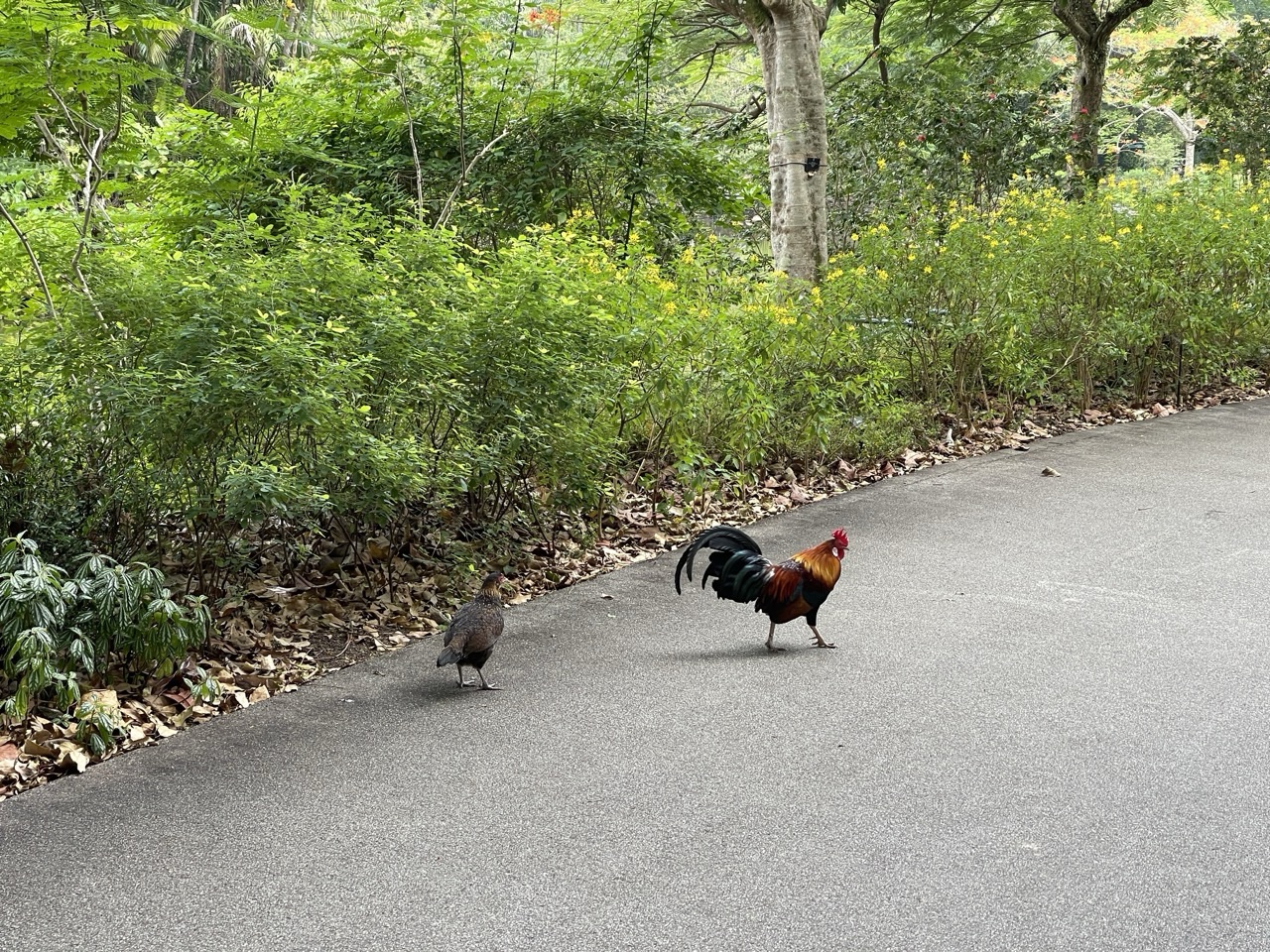
The featured photograph shows free-roaming chickens in Singapore Botanic Gardens, illustrating respectful observation of birds in a public garden; it is not a claim of a rare wild-bird sighting. Follow current reserve notices, wildlife protection guidance and site rules.