
Looking for the best birdwatching spots in Bukit Timah, Singapore? Start at Rifle Range Nature Park’s Quarry Wetland and Waterhen Hide for wetland birds and kingfishers, Hindhede Nature Park for forest-edge birds such as the Greater Racket-tailed Drongo and Banded Woodpecker, and Wallace Trail at Dairy Farm Nature Park for sunbirds, bulbuls, butterflies and squirrels. If you prefer a botanical setting with straightforward transport, the Singapore Botanic Gardens near Botanic Gardens MRT offers another rewarding wildlife walk.
You do not need expensive equipment or a guaranteed rare-bird sighting to have a lovely morning. The best things to do in Bukit Timah for nature lovers involve slowing down, listening for calls, looking at how animals use different habitats and remaining on public trails. A five-minute encounter with a squirrel or a bird feeding in the canopy can be more memorable than an exhausting attempt to cover every quarry in one day.
This guide compares birdwatching, wildlife observation and nature discovery by park, MRT approach, habitat, accessibility and opening hours. It explains which species NParks specifically identifies at these locations; how to enjoy them with children; and how to observe safely around macaques, snakes and nocturnal animals. Every species mentioned is a possibility, not a promised sighting.
Quick answer: the best Bukit Timah wildlife places
- Best overall wetland birdwatching: Rifle Range Nature Park, especially the Quarry Wetland and Waterhen Hide. NParks highlights the Yellow Bittern and as many as five species of kingfishers as birds associated with the park.
- Best gentler forest-edge birdwatching: Hindhede Nature Park. Look and listen for the Banded Woodpecker and Greater Racket-tailed Drongo, two species NParks names in its visitor information.
- Best natural-history walk: Wallace Trail in Dairy Farm Nature Park. NParks lists species including Crimson Sunbird, Olive-winged Bulbul, Asian Glossy Starling, Plantain Squirrel and Common Mormon butterfly.
- Best quarry lake for peaceful observation: Singapore Quarry in Dairy Farm Nature Park. Its former industrial basin is now a lake setting where visitors may see birds and dragonflies.
- Best botanical-garden birding: Singapore Botanic Gardens, particularly suitable general paths and lake-side areas in the Bukit Timah Core. NParks identifies the Gardens as an important bird habitat, including the Eco-Lake.
- Best larger forest experience: Bukit Timah Nature Reserve for visitors prepared for more demanding walking; wildlife encounters are possible but forest paths are not observation hides.
- Best wider northwestern green link: Zhenghua Nature Park, a 2.5km linear landscape around Segar, Bangkit and Chestnut Avenue, which should be planned as its own outing.
- Best for a first outing with children: A short Hindhede visit, or Rifle Range’s easier visitor-pavilion-to-wetland connection, rather than an unexpectedly steep summit hike.
- Best way to observe animals: Stay quiet, keep your distance, use binoculars and never feed wildlife or use recorded bird calls to lure birds.
- Not recommended: Entering forests after park closing, seeking nocturnal animals off trail, approaching nests, walking onto quarry shores, or trying to cross Eco-Link@BKE, the wildlife bridge not intended for public access.
The most useful first decision: choose wetland, forest or garden. The kind of habitat changes what you are likely to notice, where you should stand and what makes the visit enjoyable. You can return for the others on a different day.
Compare wildlife-watching locations in Bukit Timah
| Where to go | Useful MRT/LRT landmark | Wildlife you might observe | Best reason to choose it | Published hours |
|---|---|---|---|---|
| Rifle Range Quarry Wetland / Waterhen Hide | Beauty World | Kingfishers, Yellow Bittern; wetland fauna | Wetland birdwatching from authorised viewing areas | 7am–7pm |
| Hindhede Nature Park | Beauty World | Greater Racket-tailed Drongo, Banded Woodpecker, Plantain Squirrel | Shorter forest-edge walk and quarry lookout | 7am–7pm |
| Wallace Trail, Dairy Farm Nature Park | Hillview | Crimson Sunbird, Olive-winged Bulbul, drongo, butterflies | Longer natural-history trail, 2.2km one way | Park 7am–7pm |
| Singapore Quarry, Dairy Farm | Hillview | Water-edge birds and dragonflies | Lake viewing from designated public area | 8am–6.30pm |
| Singapore Botanic Gardens / Eco-Lake | Botanic Gardens | Garden birds and wetland species | Managed garden paths and lake habitat | Check Gardens and attraction hours |
| Zhenghua Nature Park | Bangkit / Segar / Fajar LRT | Forest-edge birds and insects; sightings variable | 2.5km linear northwestern nature corridor | 24-hour park; choose daylight |
| Bukit Timah Nature Reserve | Beauty World | Forest birds, native macaques, insects; nocturnal colugo habitat | Protected rainforest on marked trails | 7am–7pm |
The table describes potential wildlife and suitable places to observe, not a list of animals present at the time of your visit. Weather, season, time of day, noise, trail maintenance and simple chance all influence what appears. If an attraction is important for mobility reasons, check the exact accessible route instead of assuming every path within a named park has the same surface.
Choose a wildlife outing that suits the way you like to explore
- Why habitat matters more than chasing rare animals
- Rifle Range Nature Park: Quarry Wetland birdwatching
- Waterhen Hide: how to watch birds patiently
- Gliders Boardwalk versus steep Colugo Trail
- Hindhede Nature Park: drongos, woodpeckers and squirrels
- Wallace Trail: forest birds, butterflies and nature history
- Singapore Quarry: looking for movement around water
- Singapore Botanic Gardens: birds, mature trees and Eco-Lake
- Zhenghua Nature Park and the northwest green network
- Bukit Timah Nature Reserve and forest wildlife
- What to do if you see a macaque, colugo or snake
- How to identify common birds without making things up
- Best times of day, weather and seasonal expectations
- Photography, binoculars and a beginner’s field notebook
- Four realistic birdwatching routes by MRT
- Wildlife games and nature learning for children
- Rules that protect birds, wildlife and the forest
- Accessible walks, food and transport planning
- Frequently asked Bukit Timah wildlife questions
- Related guides and official sources
1. Why choosing the right habitat makes wildlife easier to appreciate
Bukit Timah contains several kinds of green space. Rainforest, forest edges, old quarries turned into water habitats, boardwalks, botanical collections and long green corridors offer different conditions for wildlife. A bird that is comfortable around a wetland may not behave like one living high in dense tree cover.
This is the starting point for a successful nature outing. Instead of asking whether a particular bird is guaranteed at a park, ask what habitat you will be looking at and which kinds of behaviour you might observe. A kingfisher may perch near water or on an exposed branch. A woodpecker may work along a tree trunk. A sunbird might visit flowers. A squirrel may travel through branches or investigate fallen fruit.
You don’t have to identify every creature to enjoy it. You can watch what it does, notice its colour or movement and write down a question for later. In fact, waiting to see what is there can be far more satisfying than walking quickly towards a place where someone online reported a sighting weeks ago.
Wetland, quarry and forest are not interchangeable
Rifle Range Nature Park’s Quarry Wetland was created from the former Sin Seng Quarry landscape. It has been restored as a freshwater habitat. That attracts a different set of wildlife from a thick rainforest trail and offers a public hide where visitors can remain in one place.
Hindhede Nature Park combines well-defined trails and former quarry scenery with forest edge and trees. Its NParks wildlife list names birds and squirrels associated with those surroundings.
Wallace Trail at Dairy Farm leads past fruit trees, figs, secondary forest and remnants of the area’s older kampong landscape. It is a more sustained walking experience, with opportunities to notice birds, butterflies and relationships between plants and animals.
Singapore Botanic Gardens is a managed landscape containing mature trees, wetland habitats and collections. It provides opportunities for observing birds while learning why planted and conserved green spaces can support wildlife in a dense city.
The choice is not just about scenery. It determines the right footwear, where you might pause and how you can enjoy the area without disturbing it.
What if you see no rare birds?
You have not failed. Birds may be out of view, hidden by leaves or silent. A butterfly, lizard, squirrel or interesting relationship between plants can still make the visit rewarding. An ordinary species displaying familiar behaviour is often easier to study than a brief glimpse of something uncommon.
An effective nature diary could contain just three notes: what you saw, where you saw it and what it was doing. If you later identify the animal, you can add the species name. If you cannot, an honest description is better than a confident guess.
Use official species lists as possibilities
NParks publishes "what to see" information for several parks. These are useful starting points, but not a claim that each animal is visible on every visit. If a guide lists five types of kingfishers, that is a statement about the park’s wildlife diversity, not a promise that you will count five in one morning.
Look for recent official information and protected-area rules, particularly where an older field guide includes a historic species record. A decades-old record does not guarantee today’s presence at a particular pond.
2. Rifle Range Nature Park: the strongest wetland birdwatching choice
Rifle Range Nature Park is one of the clearest places to begin a Bukit Timah birdwatching outing. NParks explicitly promotes its birdwatching opportunities, which include the Quarry Wetland and an elevated viewpoint. The park covers 66 hectares and contains more than seven kilometres of trails and boardwalks across varied habitats.
Its quarry landscape was once an active extraction site. The former Sin Seng Quarry has been transformed into a freshwater wetland that supports biodiversity. That makes the setting fascinating even when the birds are quiet: you are looking at a landscape with an industrial past and a conservation future.
NParks lists the park as open 7am–7pm, near Beauty World MRT. It has six entrances, including approaches from Rifle Range Road, Upper Bukit Timah Road, Hindhede Drive, Jalan Kampong Chantek and the Rail Corridor. Choose the entrance for your desired route using the official park map.
Which birds does NParks identify here?
The official Rifle Range birdwatching page names the Yellow Bittern and says that up to five species of kingfishers may be encountered. These are distinctive wetland birds and useful examples when thinking about where to look.
The Yellow Bittern can be difficult for a beginner to notice because it blends into vegetation. Kingfishers may be easier to appreciate when one is perched in a visible position, though they can also be very small or fast-moving. If you see a flash of colour that vanishes, note the direction and wait quietly rather than pursuing the bird.
NParks also says the park supports more than 300 species of fauna, including butterflies, dragonflies, lizards, spiders and mammals such as the Malayan Colugo. That richness does not justify leaving the public route to seek a particular animal.
If nothing emerges at the wetland, the plants, water and structure of the habitat remain interesting. You can compare the restored quarry with photos from its industrial past and consider how the different vegetation supports different animal needs.
How to observe at the wetland
Begin by standing still at a permitted observation point. Look at the edge where reeds meet open water, then the branches above, then the more distant open space. Your eyes may notice movement sooner than they recognise a bird’s colour.
Spend several minutes on one small section before moving. Constantly sweeping a camera or binoculars over the entire wetland can make it harder to recognise activity. Let the animal’s movement draw your attention.
If another observer has already stopped nearby, be considerate. A raised voice, sudden movement or aggressive rush towards a railing may startle the wildlife. Give people room to watch from the shared public space.
Why this is different from a summit hike
Bukit Timah Hill is about moving up through a rainforest and experiencing a physical climb. Rifle Range’s wetland is about staying still long enough to notice small changes in a habitat. A short quiet observation can be more productive for birdwatching than a strenuous trail completed quickly.
That is why Rifle Range is an appealing option for beginners, children and people who care more about the natural world than reaching a summit marker.
Read Rifle Range Nature Park | Quarry Wetland and Family Walks for entrance details and Rifle Range Nature Park History | Sin Seng Quarry and Wetland Restoration for the land-use story.
3. Waterhen Hide: the value of quiet observation
The Waterhen Hide is a nest-like public viewing structure by the Rifle Range Quarry Wetland. It gives visitors an opportunity to look out over a protected freshwater habitat from a designated position rather than approaching the shoreline.
Its name is memorable, but do not assume you are guaranteed to see a waterhen. A place-name identifies a feature; wildlife follows its own routines. The real purpose of the hide is to create a quiet observation point.
A five-minute exercise that works for beginners
Settle down and let the setting become familiar. For the first minute, simply look at the water. In the next minute, look for changes along reeds and tree branches. Listen for different calls or rustling sounds without trying to identify them immediately.
After a few minutes, ask yourself whether anything moved more slowly or quickly than you expected. A bird might leave one perch for another, a dragonfly might hold its position briefly, or leaves may shift with a breeze.
Even if no animal appears, you have learned to separate different kinds of movement. That is a real observation skill and one reason patient wildlife watching becomes more enjoyable over time.
What not to do at a hide
Do not use a recorded bird call to make an animal respond. NParks’ birdwatching etiquette warns that call playback can stress birds. Avoid feeding, baiting, shining artificial lights at animals or stepping into vegetation for a closer look.
Do not crowd a child or another visitor against the edge while trying to take photographs. Keep paths and seating usable for everyone.
A hide is not a private filming studio. A tripod, very large lens or long shoot that blocks public access may be inappropriate. Keep your equipment compact and follow current park rules.
What if the hide is busy?
Wait your turn, use another permitted vantage point or simply come back. You may enjoy observing from the boardwalk while leaving the hide for somebody else. A busy viewpoint is still a public space, not something one visitor can reserve by arriving early.
For the dedicated location guide, see Waterhen Hide at Rifle Range | Quarry Wetland and Birdwatching.
4. Gliders Boardwalk versus Colugo Deck: choose the right effort
Two Rifle Range features are frequently mentioned in visitor guides but have very different terrain. Gliders Boardwalk is a barrier-free link from the visitor pavilion towards the Quarry Wetland. Colugo Trail is a steep route towards an elevated deck.
Gliders Boardwalk measures 411 metres as an individual named path. NParks describes a broader approximately 700-metre barrier-free connection between the visitor pavilion and wetland. These are different measurements; neither includes every possible approach from Beauty World MRT.
For wildlife watching, the lower route gives you a chance to observe the wetland and the surrounding canopy without assuming everybody needs to climb a steep hill. It is a useful option when a companion wants a gentler walk.
Notice the animal crossings
NParks describes rope bridges and poles near the boardwalk that support movement by arboreal wildlife, including Long-tailed Macaques and Malayan Colugos. These are habitat features, not structures for visitors to touch, climb or cross.
The crossings reveal an important part of nature conservation. A road or visitor route can break the continuity of animal movement, so designers provide ways for animals to travel between trees. It is fascinating to observe how the park balances public access with the needs of wildlife.
Do not wait under an animal crossing in the expectation that an animal will appear at a particular moment. Give it space, observe from permitted positions and avoid turning the location into a crowded wildlife stakeout.
Colugo Deck is not the easy wetland route
Colugo Trail measures 582 metres and is described by NParks as steep. It reaches a deck about 31 metres above the Quarry Wetland, which provides a high view of the area. The route can be rewarding for hikers who want a more physical experience.
But someone looking for a quiet birdwatching outing may not need the climb. It is possible to enjoy the wetland without reaching Colugo Deck at all.
The deck’s name does not promise a colugo sighting. A Malayan Colugo is a nocturnal mammal, and protected parks close at 7pm. Do not propose an after-dark search through the forest merely to encounter one.
Read Gliders Boardwalk | Barrier-Free Wetland Route and Colugo Deck | Rifle Range Lookout and Trail Guide.
5. Hindhede Nature Park: drongos, woodpeckers and a quarry
Hindhede Nature Park, next to Bukit Timah Nature Reserve, is an excellent choice for visitors who enjoy a shorter nature walk with the possibility of seeing birds and squirrels. The park covers 9.5 hectares, opens 7am–7pm and is reached from the Beauty World side.
Its easy nature trails and former granite quarry create several different places to look. You may hear calls in the canopy, watch a bird move between branches or discover how the forest edge meets an old extraction landscape. The park also has family play facilities, though that means some sections may be livelier than a dedicated bird hide.
NParks specifically names the Greater Racket-tailed Drongo, Banded Woodpecker and Plantain Squirrel among creatures to look out for here. These species make useful starting points for a beginner’s field notebook.
Greater Racket-tailed Drongo: watch the tail shape
This striking forest bird has long outer tail feathers ending in paddle-like shapes, giving it a recognisable silhouette when the full tail is visible. A bird perched high in the canopy may be hard to identify by colour alone, so shape can be more useful.
If you hear a loud unfamiliar call, wait and look for movement in the branches rather than chasing the sound into vegetation. Drongos can produce varied calls, and a sighting often lasts only a moment.
NParks identifies the species in its Hindhede wildlife list and also names it among birds that may be seen on Wallace Trail. That does not mean the two outings will produce identical bird lists.
Banded Woodpecker: search tree trunks and branches
The Banded Woodpecker is another species that NParks explicitly mentions at Hindhede. Instead of looking only at the open sky, examine vertical trunks and branches from a permitted path. You may notice a bird working along a woody surface.
A woodpecker does not need to drum loudly for the whole visit. It may be silent, hidden or elsewhere in the forest. Beginners should treat "I did not see it" as a normal outcome, not as evidence that the park’s official description is wrong.
Plantain Squirrel: watch without offering food
NParks describes the Plantain Squirrel as having a bushy tail, black-and-white side stripes and light eye rings. Squirrels can be fascinating for children because they are often seen moving rapidly along branches.
Observe from a comfortable distance. Do not offer nuts, bread or fruit in order to make one sit still. Feeding wildlife is prohibited and changes animals’ behaviour. A natural encounter is more interesting than a staged one.
Hindhede’s quarry viewpoint is a scenic bonus
At the end of the park’s main scenic route, Hindhede Quarry provides a view of cliffs and water. It is a striking landscape but not a shoreline for visitors to enter. Remain behind the barriers and follow the signed paths.
The quarry can offer a beautiful pause even without birds. A family might look for three colours in the rock, the water and the trees, or discuss how a quarry becomes part of a managed green space after extraction stops.
For the dedicated guide, see Hindhede Nature Park | Quarry Views and Easy Family Walks and NParks’ Hindhede Nature Walks.

The photograph above shows the Beauty World MRT area, a public-transport landmark for Hindhede and Rifle Range. It does not depict either park’s wildlife or imply the quarry begins at the station exit.
6. Wallace Trail: birds, butterflies, squirrels and the history of natural science
If you enjoy a longer nature walk where the environment itself becomes part of the experience, Wallace Trail at Dairy Farm Nature Park deserves a separate morning. NParks describes the trail as 2.2km one way, approximately an hour under its typical planning guidance, and suitable for nature lovers, bird enthusiasts and families who can manage the distance and terrain.
The trail passes through a landscape shaped by former kampong life, old fruit trees and recovering forest. You may see plants with edible fruits, fig trees, butterflies, birds, squirrels and other forest creatures. It is also named for Alfred Russel Wallace, who conducted natural-history research in Southeast Asia.
This is different from standing at the Rifle Range wetland. Wallace Trail encourages you to notice the relationships among plants, insects, birds and the forest floor as you move along.
Birds NParks identifies on Wallace Trail
The official trail information names several species that visitors may look for, including the Crimson Sunbird, Olive-winged Bulbul, Greater Racket-tailed Drongo and Asian Glossy Starling.
A male Crimson Sunbird can be striking because of its vivid red colouring, but it may be small and quick. Bulbuls may be more easily noticed by movement and calls among vegetation. Starlings can be conspicuous when perched or travelling in small groups. The drongo’s tail shape is another useful visual clue when visible.
Do not insist on seeing all four. A slow walk may reveal one clearly and another only as a call. It is completely acceptable to record a sound or colour description and leave the species name uncertain.
The Common Mormon butterfly
NParks also identifies the Common Mormon butterfly among Wallace Trail’s potential wildlife. Its black wings and variable markings can lead to interesting questions about butterfly differences and mimicry.
For a child, butterfly watching is an excellent introduction to patience. Butterflies settle briefly, move again and return to flowers or sunlit gaps when conditions suit them. Stand still and observe rather than chasing one around the path.
Do not catch butterflies, touch their wings or damage plants to create a photograph. A butterfly is best seen doing its ordinary business.
Figs, fruit trees and why animals need them
Wallace Trail includes species of fig trees and remnants of fruit planting associated with older settlements. Figs are important in tropical forests because they can provide food for a range of birds and other animals.
You may notice fruit clusters, fallen fruit or an animal moving near a tree. That is an opportunity to think about relationships: a plant provides food, an animal may disperse seeds, and other insects may be involved in pollination.
Visitors should not take forest fruit, disturb branches or assume fruit is safe for human consumption. Observe and leave the plants and animals undisturbed.
Wallace Education Centre: a natural-history learning stop
The Wallace Education Centre sits in a former cowshed inside Dairy Farm Nature Park. It contains exhibits about the natural history of the Malay Archipelago, scientific discovery and biodiversity.
Its published opening hours are Tuesday–Sunday, 8.30am–5pm, with closure on Mondays. That is different from Dairy Farm Nature Park’s 7am–7pm hours. If seeing the exhibits matters, check the Centre’s schedule before planning an early walk.
An educational gallery gives families a way to connect field observations to scientific questions. You may have noticed an unfamiliar butterfly outdoors, then find a display about biodiversity inside. The visit is not a promise that every wildlife species you saw has a corresponding specimen on display.

The original eduKateSG photograph above shows the forested Wallace Trail. It is not a photograph of the named bird or butterfly species; use the NParks species guides for identification.
Plan the endpoint as carefully as the beginning
Wallace Trail is listed one way. If you return along the same full 2.2km stretch, the trail portion alone can become approximately 4.4km, before any approach to and from Hillview MRT or the car park.
Choose your entrance, turnaround point and return journey from the official map. Don’t promise a small child or an older relative a short loop if you have only checked a one-way distance.
The path’s easy-to-moderate description is not a guarantee of step-free access. NParks limits wheelchair access in Dairy Farm Nature Park to the Carpark B-to-Wallace Education Centre route.
For further details, read Wallace Trail | 2.2km Dairy Farm Walk, Difficulty and Return Planning and the official NParks Wallace Trail activities guide.
7. Singapore Quarry: a lake worth observing rather than approaching
Singapore Quarry is another destination inside Dairy Farm Nature Park, but it should not be confused with Wallace Trail or Dairy Farm Quarry. Singapore Quarry is a former quarry now containing a scenic lake, while Dairy Farm Quarry has been filled with earth and features exposed rock cliffs.
For nature watching, the water, vegetation and surrounding cliffs make Singapore Quarry an attractive place to pause. NParks mentions birds and dragonflies among wildlife that visitors may observe around this former quarry landscape.
The quarry is normally open 8am–6.30pm, while the wider park opens 7am–7pm. That difference matters if you are planning a late-afternoon visit, especially because you must allow time to leave the park afterwards.
What can you look for?
Begin with the water’s edge from the official viewing area. Watch for a bird flying between the vegetation and an exposed branch, or a dragonfly moving along the margins. You may notice reflections and changing patches of sunlight even if wildlife remains hidden.
The best viewing point is the designated visitor area, not the shoreline itself. Do not climb down, cross safety barriers or enter the water. Quarry basins can have steep drops, and the protected landscape is not a swimming or fishing attraction.
For birdwatching, a calm period of observation is more useful than walking rapidly around looking for a better vantage point that may not exist on the public trail.
Don’t combine every Dairy Farm feature automatically
Wallace Trail, Singapore Quarry, Dairy Farm Quarry and the education centre are separate features with different internal routes. They may look close on a simplified map but still take real walking time to connect.
If your main interest is the lake, plan Singapore Quarry as the destination and return. If your interest is forest birds and plant interactions, choose Wallace Trail. Attempting everything may turn a peaceful nature visit into an exhausting trek.
Hillview and your return route
Hillview MRT is a useful general location reference for Dairy Farm Nature Park, but the actual journey to Singapore Quarry depends on the park entrance you use. Choose the exact route and check whether a return by the same way suits your group.
After the walk, there are eating options around Hillview and The Rail Mall. They are not guaranteed to sit immediately at your forest-trail exit, and outlets operate on different schedules.

For route-specific guidance, see Singapore Quarry | Opening Hours, Hillview Directions and Scenic Walk and the official Dairy Farm Nature Park page.
8. Singapore Botanic Gardens: an accessible introduction to watching birds
The Singapore Botanic Gardens belongs on this list because it offers birdwatching in a managed garden landscape with mature trees, wetland habitats and research collections. The Bukit Timah Gate is near Botanic Gardens MRT, making it a practical alternative to the more strenuous trails farther up Upper Bukit Timah Road.
NParks reports extensive bird records for the Gardens and identifies several conserved or restored habitats, including the Eco-Lake, the Rain Forest, Keppel Discovery Wetlands and the Gallop Extension’s stream. These are not all beside one another, and their paths and visitor arrangements differ. Choose a compact area for the kind of observation you want.
For a first outing, you may enjoy simply looking and listening along permitted public paths near the Bukit Timah Core, or choosing an appropriate lake-side public route. A casual half-hour among mature trees can be more rewarding than a rushed attempt to reach every named collection.
Look for familiar birds first
Begin with birds you can identify confidently. A pigeon or myna provides an opportunity to practise size, colour, shape and behaviour. A sunbird among flowers introduces a different feeding pattern. A kingfisher in a suitable lake or garden habitat is an exciting possibility, though never guaranteed.
The official NParks Garden Bird Watch programme identifies common Singapore birds, including White-breasted Waterhen, Asian Glossy Starling, Olive-backed Sunbird, Collared Kingfisher and White-throated Kingfisher. Its list is a useful learning aid, not a guarantee that each species will be found at one chosen Botanic Gardens spot.
For basic identification, the NParks BiodiversitySG guide explains how to compare colour, size, shape and visible markings. Those cues are much more reliable than identifying a species solely from a one-second flash of green or blue.
The value of the Eco-Lake
A wetland or lake changes what you can observe. Instead of searching only tree trunks and canopy, you can inspect the water, reeds, shoreline vegetation and branches around the lake. Different birds may use these parts of the habitat in different ways.
The Eco-Lake has been highlighted by NParks as one of the Botanic Gardens’ key bird habitats. But birding conditions change, and visitors should not assume a historic report of a rare bird means the species will still be there today.
Choose a public viewing position and remain considerate around other walkers and families. The Gardens are shared by people enjoying many activities, not only wildlife watchers with cameras.
Real wildlife photographs from eduKateSG’s library
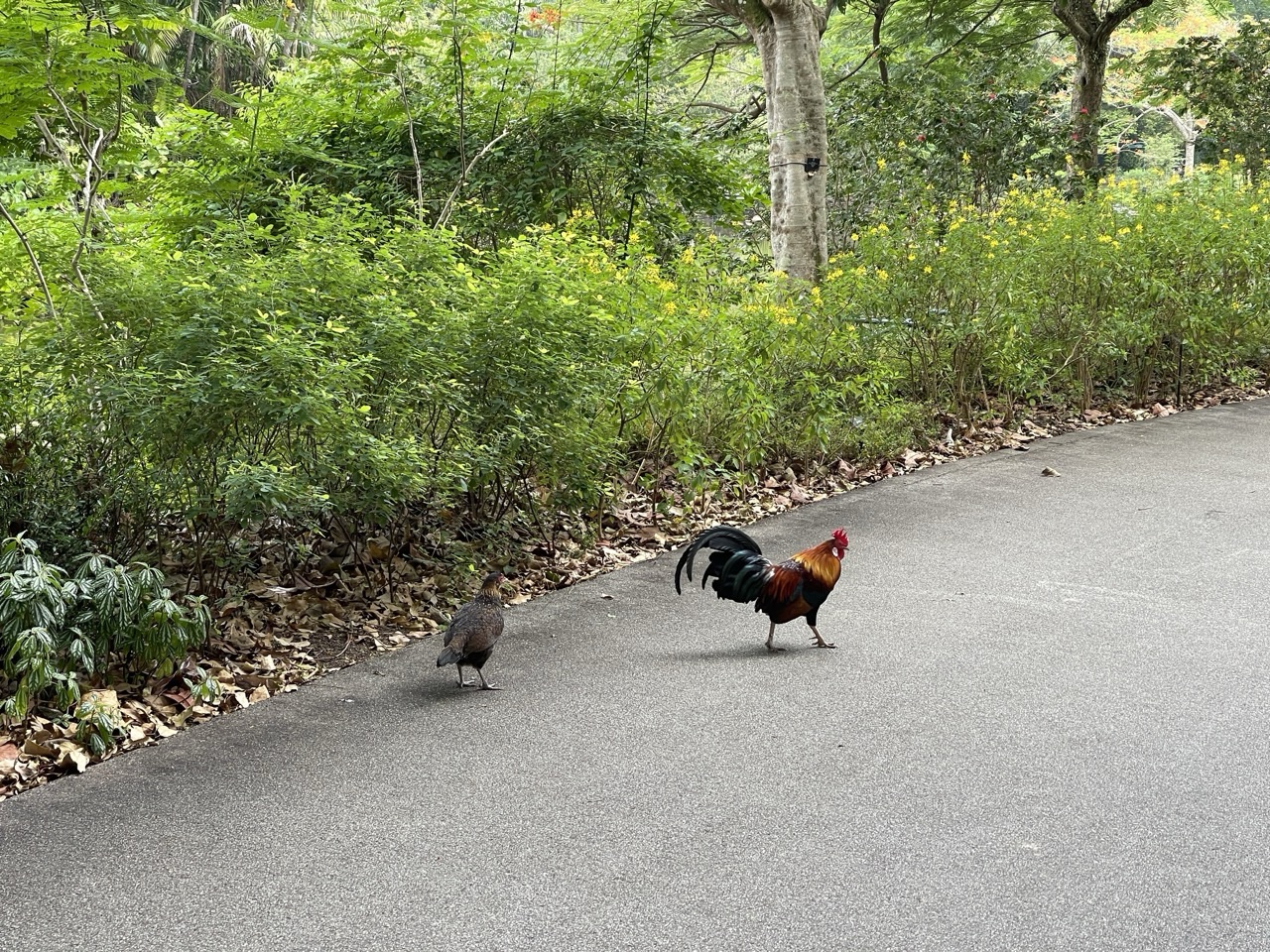
In October 2026, eduKateSG photographed free-roaming chickens within Singapore Botanic Gardens. These ordinary birds are a lovely reminder that observing wildlife or free-ranging birds need not involve a long telephoto lens or a rare-sighting hunt.

The photograph shows the birds actually present in the Gardens during that visit. It does not establish that every similarly coloured bird is a wild Red Junglefowl, nor does it promise an identical sighting later. Accurate identification requires suitable evidence.
The Gardens also contain tall trees, walking paths and planted areas that provide varied settings for birds and insects.

A separate guide for Botanic Gardens birdwatching
If you want a full outing specifically focused on the Gardens, see Singapore Botanic Gardens Birdwatching | Eco-Lake and a Beginner’s Field Guide. It is distinct from a Rifle Range wetland outing and should be planned around the Gardens’ own current map and notices.
The Gardens’ public hours and specific collection access may differ. Check the official Singapore Botanic Gardens visitor information before travelling.
9. Zhenghua Nature Park: a different northwest wildlife walk
For a more northerly green outing, Zhenghua Nature Park is a 2.5km linear nature park connecting landscapes around Bukit Panjang and the wider Central Nature Park Network. It is an ecological corridor, not a short loop beside Beauty World.
NParks lists Segar Road, Bangkit Road and Chestnut Avenue as its principal entrances. Nearby LRT references include Bangkit, Fajar and Segar. It is open around the clock as a public park, but that does not mean a first-time visitor should seek wildlife in unlit areas at night.
Why birdwatchers might enjoy a linear green route
A linear nature park can reveal changes in vegetation as you walk. Some stretches may feel enclosed by trees; others open towards adjacent landscapes. Birds and insects respond to those habitat changes.
Use the route as a slow observation walk, not a race to reach the opposite end. Identify a turnaround point so you do not unexpectedly double the distance with tired children or companions.
If you are keeping a field notebook, try comparing a short segment at the beginning with another later. Did you hear more calls in one place? Was the light different? Were there more flowers and visible insects?
You do not need a rare-species list to make the comparison useful. The exercise builds attention to the natural environment.
This isn’t Chestnut Nature Park
Zhenghua Nature Park and Chestnut Nature Park are separate destinations, even though they are part of a broader green network. Chestnut has distinct hiking and mountain-biking trails with its own opening hours and rules.
Do not follow an unfamiliar unofficial route into protected forest or a cycling track. Use the park maps and permitted trails. If your interest is nature observation rather than distance, remaining on one short Zhenghua segment may be more pleasant.
Read Zhenghua Nature Park | Entrances and Family Walking Guide and NParks’ current Zhenghua page.
10. Bukit Timah Nature Reserve: wildlife watching in a protected rainforest
Bukit Timah Nature Reserve protects 163 hectares of important forest, including Singapore’s highest natural point. Its biodiversity is one of the reasons it matters, but the reserve is not simply a wildlife exhibition where visitors can follow animals through trees.
The reserve opens 7am–7pm, with Beauty World MRT as the nearby train reference. NParks describes it as part of Singapore’s Central Nature Park Network and one of Singapore’s ASEAN Heritage Parks.
Visitors may notice forest birds, insects, squirrels and macaques, and the wider reserve supports many specialised species. However, not every animal is active when people are walking on trails, and dense forest makes wildlife difficult to see.
Watch the forest even when you cannot see an animal
An interesting nature walk may reveal leaf litter, tall trees, fungi, roots and changes in the amount of light reaching the ground. These features tell you something about the conditions animals live in.
Listen for calls without trying to force a response. Watch for movement in branches while continuing to follow the marked route. Do not step into undergrowth to track something you heard. Protected habitat needs to remain undisturbed.
A field guide can help after the visit. You may take a photograph of a leaf or record a description of a bird’s shape and later learn the species. A mistaken identification is easy to correct when the original observation was honest.
The summit is not obligatory
The hill summit route includes steep terrain and is a physical challenge. If your main purpose is to watch birds, it may be more comfortable to use Hindhede or Rifle Range instead.
A protected rainforest can be fascinating even without a summit photograph. The right route depends on the walkers and the actual conditions.
For visitors who do want to hike, see Bukit Timah Hill Summit | Routes 1, 3 and 4 Compared.
Do not turn nocturnal wildlife into a night-hiking plan
A Malayan Colugo is a nocturnal, arboreal mammal that moves between trees using a large gliding membrane. It is sometimes called a flying lemur, but it is neither a true lemur nor a flying animal in the bird-like sense.
NParks documents the species in Bukit Timah’s protected forest system. That makes it an important part of local biodiversity, not a guaranteed night attraction.
Nature reserves and parks close at 7pm for good reasons, including reducing disturbance to nocturnal wildlife. Do not attempt a forbidden or unlit after-dark route to photograph colugos or other nocturnal animals.
For species background, read NParks’ Malayan Colugo account.
11. What to do if you see macaques, snakes or other wild animals
Birdwatching sometimes produces unexpected encounters with other animals. The right response depends on the species, but the general rule is to remain calm, avoid approaching or feeding it, and let it continue its natural behaviour.
Long-tailed macaques: keep food away and don’t stare
The Long-tailed Macaque is a native primate commonly encountered around forest edges in Singapore. The Animal and Veterinary Service advises people to remain calm and quiet, avoid prolonged direct eye contact, and back away slowly without running when a macaque comes close.
Do not hold out food, feed it, chase it or try to take a selfie at arm’s length. Macaques can associate plastic bags and containers with food, which can lead to dangerous interactions. Keep snacks inside a bag and avoid carrying food in the open.
If you are visiting with children, explain that a macaque is a wild animal, not a pet or a toy. Let it move away without obstructing its route.
NParks’ official macaque encounter advisory gives detailed advice. If you are uncomfortable, stop and allow the animal room instead of trying to pass too close.
Snakes: stay clear and don’t attempt to identify one at close range
Singapore is home to native snakes that play ecological roles. If you encounter one on or near a trail, keep a safe distance, do not attempt to touch or trap it, and allow it to leave naturally.
A visitor does not need to know the species before acting safely. It is better to treat an unfamiliar snake with caution than to approach it for a close-up identification. Watch where you step and do not place hands into vegetation you cannot see through.
If a snake is near a busy public access point or creates a safety concern, contact the appropriate wildlife response service rather than intervening yourself. Children should be kept at a safe distance.
For more detailed local discussion, read Snakes in Bukit Timah | What to Do on a Nature Walk.
Squirrels and insects: let small creatures remain small
A squirrel is easier to watch if it does not expect food from humans. Butterflies, beetles, spiders and other invertebrates are also part of the forest, even though they may not attract the same attention as a large mammal.
Do not handle them, damage webs or destroy plants to clear a photograph. A small animal carrying on with its ordinary life provides a more informative observation than one manipulated into position.
You can photograph an insect from a suitable distance and then read about it later. There is no need to catch or collect it.
The animal isn’t "in the way"
When a visitor meets a macaque or snake, the temptation is sometimes to treat the animal as an obstacle that needs to be moved. But the forest is the animal’s habitat. You are a visitor.
Give wildlife time and space. If an animal is blocking a narrow trail, back away and choose a safe alternative instead of forcing it to respond to you.
12. Identify birds by size, shape, colour and behaviour
One of the most enjoyable beginner skills is turning a fleeting observation into a more useful description. You don’t have to know the bird’s name immediately. Start by noticing visible features that somebody else could check.
The official NParks guide to identifying garden birds recommends looking at colour, size and shape. You can add behaviour and the habitat in which you observed it.
Start with size
Was the bird closer in size to a sparrow, a myna or a crow? These comparisons aren’t scientific measurements, but they help distinguish a small insect-eating bird from a much larger waterbird.
Be cautious about distance: a bird far away may look smaller than one close to you. If you are using binoculars, note whether your size estimate is relative or based on something in the scene.
Watch shape before colour
A woodpecker working on a vertical trunk, a drongo with a distinctive tail and a bittern blending into reeds have different postures. You may recognise the broad family or behaviour even if the bird’s colour is difficult to see.
Colours can be misleading under forest shade. A black bird against bright sky may have a blue or green sheen that you cannot see. Avoid identifying a bird by one colour alone.
Listen without playback
Bird calls can alert you to activity that your eyes have missed. Listen for repeated patterns, high or low notes, and the direction from which the sound seems to come.
But do not play a recording of another bird’s call to make wildlife respond. NParks warns that playback may cause stress. A nature outing should not force animals to react merely to satisfy a bird list.
If you want to learn calls, listen to recordings at home or use educational resources before entering the park.
Accept uncertainty
An honest record such as "small olive bird, two pale wing markings, hopping near flowering shrub" is valuable. You can later compare it with official resources.
If you cannot identify a species, leave it at a descriptive level. A false specific name is less useful than an accurate uncertain observation.
13. Best time for birdwatching in Bukit Timah
NParks notes that birds are generally active in the early morning, with another opportunity around dusk. That is helpful guidance, but it does not override the opening hours of the nature park you plan to visit.
Rifle Range, Hindhede, Bukit Timah Nature Reserve and Dairy Farm Nature Park normally open at 7am and close at 7pm. Singapore Quarry has its own 8am–6.30pm hours, and Wallace Education Centre opens later again. Plan within the permitted access window and leave enough time to exit.
Why morning is often attractive
Singapore mornings can be somewhat cooler than midday, and bird activity can be more noticeable. The light may also be more comfortable for observation and photography.
But early morning is not a guarantee of clear weather or quiet paths. Rain, maintenance and crowding are possible. Start with a flexible plan and check the current forecast.
What about late afternoon?
A later daylight visit can also be rewarding. Just remember that a nature park’s closing time is not the moment to start a long trail. Allow enough time for the return, especially if you are going to a lake or viewpoint away from the entrance.
A bird may still be active after the park closes, but visitors must obey closing hours. Wildlife protection and public safety take precedence over an opportunity to chase a sunset picture.
Migration seasons and rare sightings
Singapore receives migratory birds as well as supporting resident species. Seasonal movements can affect what birdwatchers report, but they vary by species and conditions.
Do not promise a migratory rarity during a particular month without current verified records. The park’s official species list and community reports are useful starting points, not booking confirmations for a bird sighting.
For a beginner, resident birds and familiar garden species are often more useful learning subjects than a difficult search for a rare visitor.
What if rain is forecast?
Avoid forested areas during and immediately after severe weather, as NParks advises. Slippery surfaces, lightning, strong winds and falling branches can make an otherwise gentle walk unsafe.
If the weather turns, move to appropriate shelter or postpone. Do not stand at the edge of a wet quarry, wait under an isolated tree during lightning or continue a forest route merely because you have travelled far.
Use the Meteorological Service Singapore forecast and relevant park notices before leaving.
14. What to bring: binoculars, simple camera and field notes
A beginner can enjoy birdwatching with eyes, ears and a notebook. Binoculars can make distant birds easier to see, but they are not required for appreciating a nature park. Start with what you already own rather than assuming you need to buy specialist equipment before your first outing.
If you bring binoculars, practise finding a stationary object before travelling. On a path, it can be difficult to locate a moving bird through magnification if you are not used to the device.
A small notebook is surprisingly useful
Write the date, location, weather and a few observations. Include the animal’s approximate size, colours, behaviour and habitat. You might record "bird perched near still water, blue body visible, flew low across the quarry" rather than guessing which kingfisher it was.
Over several visits, these notes can reveal patterns in your own observations. They also help you remember a short, enjoyable day long after the particular sighting.
Phone photography can tell a different story
A phone may struggle to capture a tiny distant bird sharply. That does not mean the photo is worthless. An image showing the habitat and the bird within it can be more informative than a blurry close-up.
Try taking one wide photograph of the wetland, one image of the viewing structure and a close detail of a plant—only from safe, permitted positions. That sequence tells a story about the place even if the wildlife doesn’t pose.
Do not move towards a nest, cross a safety barrier or step into protected vegetation just to improve the framing. The photograph should never cost the animal its peace.
Photography ethics and special projects
Ordinary low-impact personal photographs are different from a commercial shoot, organised production or filming assignment. NParks has separate permit conditions for those activities, especially in nature reserves and nature parks.
If you are organising a project with clients, crew, lighting or a large group, check the current NParks on-location filming permit guidance before arriving. Do not assume that a casual visitor’s camera permission covers a large production.
For wildlife, keep the environment first. A beautiful image obtained from a safe distance and an honest caption is better than a dramatic picture created by interference.
15. Four wildlife outings you can actually plan by MRT
The following are visitor planning suggestions, not official guided tours or guaranteed sighting programmes. They are designed to make each outing comfortable and flexible. The actual walking and return times depend on the entrance, individual pace, weather and how long you stop to observe.
Plan A: Rifle Range wetland and Waterhen Hide morning
Best for: a first-time birdwatcher who likes wetland birds and wants a clear observation destination.
Arrive by Beauty World MRT in the cooler morning and use the current park map to choose an approach to Rifle Range’s Quarry Wetland. Follow the permitted path towards the Gliders Boardwalk and Waterhen Hide, respecting the terrain and the directions for your specific entrance.
At the wetland, spend ten or fifteen quiet minutes observing. Look at reeds, water and tree branches. You may spot a bird, dragonfly or movement among plants—or simply enjoy the setting.
Avoid adding the steep Colugo Trail unless everybody deliberately wants that physical challenge. Return before the park closes and finish with an optional meal around Beauty World.
Why it works: one main habitat, an appropriate public observation structure and a clear reason to pause rather than rush.
Plan B: Hindhede’s forest-edge wildlife and quarry view
Best for: families, visitors who want a gentler green walk and those interested in forest birds.
Begin near Beauty World MRT and follow the approach to Hindhede Nature Park, using the official map for the park entrance. As you move along the easy trails, listen for calls and look for movement on trunks and in branches.
Use Greater Racket-tailed Drongo, Banded Woodpecker and Plantain Squirrel as possible subjects to learn about, but do not treat them as a checklist you must complete. Stop if you notice something interesting and give wildlife room.
Finish with the authorised Hindhede Quarry viewpoint if conditions permit. Return towards the Beauty World eating area when the group is ready.
Why it works: you can combine wildlife observation with scenic quarry views without turning the day into a full summit hike.
Plan C: Wallace Trail and natural-history discovery
Best for: walkers comfortable with a longer one-way trail, butterflies, forest birds and plant relationships.
Use Hillview MRT as the general transport reference, then follow the current Dairy Farm park map to the appropriate Wallace Trail entrance. Agree in advance whether your outing will finish at a different exit or retrace the trail.
Walk slowly, looking at fig trees, flowering plants, canopy birds and butterflies. The NParks species examples—Crimson Sunbird, Olive-winged Bulbul, Common Mormon and Plantain Squirrel—can help direct your attention without creating unrealistic expectations.
If Wallace Education Centre is open, consider a short visit afterwards. It closes Mondays and operates shorter hours than the park.
Why it works: the trail connects observation with natural history and offers a clear theme for an older child or adult interested in ecology.

Plan D: Botanic Gardens trees and a calm lake-side walk
Best for: beginner birdwatchers who prefer a managed garden setting and convenient public transport.
Use Botanic Gardens MRT and the current Gardens map to choose a compact route near the Bukit Timah Core or an appropriate Eco-Lake viewing area. Spend time listening beneath mature trees, watching the vegetation and looking for birds along the public path.
A family might enjoy photographing ordinary free-roaming birds or comparing calls without expecting a rare species. Leave time for water, toilets and a snack at a separately confirmed open venue.
Why it works: the Gardens provide a relatively accessible public landscape with diverse plants and opportunities to observe familiar wildlife at a comfortable pace.
A fifth outing for another day
If you have already explored all four, consider Zhenghua Nature Park from the Bukit Panjang side. Its 2.5km linear route requires a different transport and return plan. Do it as a separate visit rather than an exhausting extension to the Beauty World or Hillview day.
16. Nature discovery with children: observation without pressure
Wildlife watching can make an excellent family activity when it is pitched at the right level. A very young child may enjoy the rustling of leaves and movement of a squirrel; an older child may want to identify birds or ask how a quarry became a wetland.
The key is to make one small observation goal rather than ask children to memorise species names or stand quietly for hours.
For preschoolers: find movement, shapes and sounds
Choose a short permitted route at Hindhede or a suitable garden path. Ask the child to look for something flying, something climbing and something growing. You do not have to see all three for the outing to be fun.
A parent can model patient observation by describing what they notice rather than shouting "Look, a rare bird!" at every movement. Children often become more curious when adults show that ordinary things are worth attention.
Keep the outing brief enough that everyone remains comfortable. A snack after leaving a protected park may be a useful ending.
For primary-school children: compare habitats
At Rifle Range, ask what birds might need from a wetland: water, food, shelter and a place to perch. At Hindhede, compare the forest edge with the quarry view. At Wallace Trail, look at how fruit trees and animals may interact.
Let the child draw a simple habitat map. Where was the water? Where were the taller trees? Where did you hear a bird call? The activity encourages evidence-based thinking without turning a weekend outing into an examination.
For secondary-school students: make observations testable
Older students can record the time, weather, habitat and the animal’s behaviour. They might compare whether more birds are heard during a still period than during a busy section of walking, while recognising that a few informal observations do not establish a scientific conclusion.
They can use the official NParks Garden Bird Watch species list to practise identifying common birds. Where identification is uncertain, the diary should say so.
That distinction—observed fact versus interpretation—is one of the most valuable lessons nature study can offer.
Learning about conservation without touching wildlife
A child may ask why they cannot feed a squirrel or enter a wetland. Explain that animals need to find natural food, and protected habitats can be damaged by trampling or human interference.
Show how a boardwalk keeps visitors on a managed route while allowing plants and animals to use the surrounding area. At Rifle Range, point out the animal crossings and talk about why they exist.
A nature walk becomes richer when children learn that protecting a place is part of enjoying it.
17. Rules that keep Bukit Timah’s birds and other animals safe
The official NParks birdwatching etiquette offers three especially important reminders: keep noise down, do not play bird calls, and leave nesting birds alone without publicly sharing their locations.
These are simple rules with real consequences. A bird may stop feeding or abandon a comfortable spot when repeatedly disturbed. A nesting location shared widely can attract too many visitors. A recorded territorial call can cause stress instead of producing a harmless photo opportunity.
Don’t share nest locations
If you find a nest, enjoy the observation from a safe distance and move on. Do not post precise GPS coordinates or a route designed to bring a crowd to the nest. Protecting a nesting bird matters more than accumulating likes.
If you have a legitimate conservation concern or observation, use the appropriate official channels rather than turning the location into a public attraction.
Never feed wildlife
Feeding wildlife can harm animals, change their behaviour and draw them towards people and traffic. NParks explains that feeding of wildlife is prohibited in Singapore under the Wildlife Act, with potential penalties.
Keep food and plastic bags securely packed away, particularly around macaques. Do not use food to lure birds, squirrels or other animals into photographs.
Remain on designated paths
Nature reserves and protected nature parks have designated paths for good reasons. Leaving the route may damage roots, seedlings, leaf litter or sensitive habitats. It can also increase your risk of becoming lost or encountering difficult terrain.
Do not create a shortcut between two map points through undergrowth, and do not approach quarry shores or enter fenced ecological connections such as Eco-Link@BKE. The wildlife overpass is intended to support animals, not to operate as a public walking attraction.
Respect closing hours
Rifle Range, Hindhede, Bukit Timah Nature Reserve and Dairy Farm Nature Park generally close at 7pm. The Rail Corridor has broader general access but is largely unlit at night for wildlife reasons. A night photograph online is not proof that visitors may access a protected trail after closing.
Wildlife may be nocturnal, but that is not an invitation to search for it in restricted forest at night. Observe within the legal visitor windows.
Be careful with organised groups
A small family outing differs from an organised wildlife walk with dozens of people. NParks requires permits for certain group activities in nature parks and reserves, with thresholds and lead times listed on the relevant official pages.
If you are organising a school excursion or club event, check the current group rules, supervision arrangements and weather contingencies before advertising the trip.
18. Transport, accessible routes, food and the whole return journey
A useful wildlife guide should help you arrive and leave as well as identify potential animals. Bukit Timah’s parks are not one connected open-access loop where every exit returns you to the same MRT station.
Beauty World for Rifle Range and Hindhede
Beauty World MRT (DT5) is the main public-transport reference for both parks, but they have different entrances. For Rifle Range, choose the entrance suited to the Waterhen Hide or Quarry Wetland; for Hindhede, follow the approach towards the nature reserve Visitor Centre and Hindhede Drive.
Do not assume the quarry viewpoint or wildlife hide begins at the station exit. The real walk includes outdoor pavements and internal park trails. Allow time for weather, crossings and rest stops.
Hillview for Wallace and Singapore Quarry
Hillview MRT (DT3) is the useful reference for Dairy Farm Nature Park. The park has more than one car park and visitor entrance, and its features occupy different routes.
If you want Wallace Trail, save its intended endpoint. If you want Singapore Quarry, follow the official lake-access route and remember the quarry’s 6.30pm closing time. If you want the education centre, plan within its own shorter weekly hours.
Botanic Gardens MRT for a botanical wildlife walk
Botanic Gardens MRT (DT9/CC19) provides the approach to the Gardens’ Bukit Timah Core. Choose one appropriate public path or an Eco-Lake area using the Gardens map.
This is a different outing from the Rifle Range wetland. They are not adjacent viewing areas that a family can casually switch between without additional travel.
Mobility and accessibility: check a particular route
Rifle Range offers a barrier-free visitor-pavilion-to-wetland connection, but its Colugo Trail is steep. Hindhede has a wheelchair-accessible ramp near the reserve Visitor Centre, though visitors should verify the exact continuation to the feature they want.
Bukit Timah Nature Reserve has wheelchair access limited to the visitor-centre area. Dairy Farm Nature Park limits wheelchair access to the Carpark B-to-Wallace Education Centre route. Wallace Trail’s moderate-to-easy difficulty does not establish general wheelchair access.
If someone in your group needs a step-free visit, choose one confirmed appropriate route rather than combining several places with uncertain surfaces.
Read Bukit Timah Stroller and Wheelchair Walks | Accessible Routes to Check.
Food after a nature outing
After Rifle Range or Hindhede, the Beauty World neighbourhood has hawker food, restaurants and cafés. After a Dairy Farm outing, Hillview or The Rail Mall may make more geographical sense. After a Botanic Gardens walk, choose a nearby café or food option according to your actual exit.
A meal should follow the nature activity rather than require carrying exposed food through macaque habitat. Keep snacks securely stored while on protected trails and eat in a suitable permitted area away from wildlife.

For venue options, see Things to Do In Bukit Timah | Best Cafés, Brunch and Hawker Food Guide.
Frequently asked questions about Bukit Timah birdwatching and wildlife
Where is the best place to watch birds in Bukit Timah?
Rifle Range Nature Park’s Quarry Wetland and Waterhen Hide are an excellent first choice for wetland birdwatching. NParks names Yellow Bittern and up to five kingfisher species among birds associated with the park. For forest-edge birds, consider Hindhede; for a longer natural-history walk, Wallace Trail.
Is birdwatching in Bukit Timah free?
Ordinary self-guided birdwatching in the public nature parks generally does not require an admission ticket. Transport, food, parking, special programmes or privately operated activities may cost extra. Check the rules and opening hours of the specific destination.
What birds can I see at Rifle Range Nature Park?
NParks highlights Yellow Bittern and as many as five species of kingfishers. The park supports a diverse wetland-and-forest fauna community, but no individual bird sighting is guaranteed. Use the designated Quarry Wetland observation areas.
What is Waterhen Hide at Rifle Range Nature Park?
It is a nest-like observation structure by Rifle Range’s restored Quarry Wetland. It lets visitors look out from a designated public position. The name does not guarantee that a waterhen will appear during your visit.
What is the nearest MRT to Rifle Range Nature Park?
Beauty World MRT is the nearby station identified by NParks. The nature park has several entrances, so choose the one suited to the boardwalk or wildlife viewing area you intend to visit.
Is Gliders Boardwalk accessible?
NParks describes Gliders Boardwalk as a 411-metre barrier-free trail linking the visitor pavilion towards Quarry Wetland. The broader accessible approach is longer. Check the exact entrance and the complete route for your mobility needs.
Can I birdwatch from Colugo Deck?
You may observe the wider park landscape from the public deck, but reaching it involves the steep 582-metre Colugo Trail. It is not an easier alternative to the Gliders Boardwalk, and the presence of the word colugo does not guarantee seeing that mammal.
What birds are found at Hindhede Nature Park?
NParks specifically mentions the Banded Woodpecker and Greater Racket-tailed Drongo among birds that may be seen. The park also lists the Plantain Squirrel as a possible wildlife sighting.
Is Hindhede Quarry the same as Rifle Range Quarry Wetland?
No. Hindhede Quarry is in Hindhede Nature Park beside Bukit Timah Nature Reserve. Rifle Range’s restored Quarry Wetland was developed from the former Sin Seng Quarry. They belong to different parks with different entrances and viewing routes.
What is the best Bukit Timah nature walk for children interested in birds?
A short Hindhede outing or an appropriate Rifle Range boardwalk route can suit families who enjoy gentle observation. Keep the visit brief, supervise children and let them notice sounds and behaviour rather than insisting on identifying rare birds.
What wildlife might I see on Wallace Trail?
NParks names Crimson Sunbird, Olive-winged Bulbul, Greater Racket-tailed Drongo, Asian Glossy Starling, Plantain Squirrel and Common Mormon butterfly among examples. Wildlife sightings vary and are never guaranteed.
How long is Wallace Trail?
NParks lists 2.2km one way. If you walk the entire trail and retrace it, the trail portion is approximately 4.4km before other approaches. Plan the entrance, endpoint and return before starting.
Is Wallace Education Centre open on Mondays?
No. NParks lists opening 8.30am–5pm, Tuesday to Sunday, with Monday closure. Dairy Farm Nature Park itself has a separate daily opening schedule.
Is Singapore Quarry good for birdwatching?
It offers a lake and vegetation habitat where birds and dragonflies may be observed from designated public positions. It is inside Dairy Farm Nature Park and normally open 8am–6.30pm. Stay behind barriers and do not approach the water.
Is Dairy Farm Quarry the same as Singapore Quarry?
No. Singapore Quarry contains a scenic lake, while Dairy Farm Quarry has been filled with earth and has exposed rock formations. They are distinct features with different trails.
Where can I watch birds near Botanic Gardens MRT?
The Singapore Botanic Gardens offer suitable public paths, mature trees and wetland habitats. The Eco-Lake is an important habitat identified by NParks. Use the official Gardens map rather than assuming every named collection lies beside the MRT.
Can I spot rare birds in Singapore Botanic Gardens?
The Gardens have a rich history of resident and migratory bird records, but any particular rare bird is unpredictable. An older record is not a guarantee of a current sighting. Enjoy common species and habitat observation as well.
Are the chickens in Singapore Botanic Gardens wild birds?
eduKateSG’s October 2026 photograph shows free-roaming chickens. It does not, by itself, establish the precise taxonomic or domestic status of each bird. A reliable species identification should use appropriate visible details and supporting evidence.
Are there macaques in Bukit Timah?
Yes. The Long-tailed Macaque is a native primate encountered around forest edges. Keep food out of sight, remain calm, do not feed or approach it and follow AVS guidance if one comes close.
What should I do if a monkey approaches me?
AVS advises remaining calm, avoiding direct eye contact, backing away slowly and not running. Secure visible food and plastic bags, and do not touch, chase or corner the animal.
Can I see Malayan Colugos on a Bukit Timah walk?
The species occurs in Bukit Timah’s forest network, but it is nocturnal and difficult to spot, especially on a short public daytime visit. Nature parks close at 7pm. Do not break opening hours or disturb habitat while searching for it.
Is a Malayan Colugo a flying lemur?
The name "flying lemur" is commonly used, but a colugo is neither a true lemur nor a powered-flying animal. It is a gliding mammal with a large skin membrane.
Can I enter Eco-Link@BKE to watch wildlife?
No. Eco-Link@BKE is an ecological bridge designed for animals to cross the expressway; it is not an ordinary public-access lookout or walking attraction. Observe wildlife from permitted park routes instead.
Can I feed birds or squirrels in Bukit Timah nature parks?
No. NParks prohibits feeding wildlife. It can harm animals and change their behaviour, drawing them into conflict with people. Observe from a distance without bait.
Is it okay to play bird calls to attract birds?
No. NParks’ birdwatching etiquette advises against playing recorded calls, which can stress birds. Listen quietly and let birds behave naturally.
Can I photograph or share the location of a bird’s nest?
Avoid approaching or disturbing nesting birds, and do not share precise nest locations publicly. NParks explicitly warns against this to protect breeding animals from disturbance.
Do I need expensive binoculars for Bukit Timah birdwatching?
No. You can begin with your eyes, ears and a small notebook. Binoculars can improve distant views, but a careful observation from the public trail is more valuable than special equipment used irresponsibly.
What is the best time for birdwatching in Bukit Timah?
Birds can be active in the early morning, but you must follow park opening hours. Many Bukit Timah nature parks open at 7am and close at 7pm. Weather and the species’ behaviour affect what you actually see.
Is Bukit Timah wildlife watching suitable for seniors or wheelchair users?
Some routes may be. Rifle Range has a barrier-free connection towards the Quarry Wetland, and Hindhede has an accessible approach near the Visitor Centre. Other park trails and summit routes can be steep or uneven. Choose the precise route, not a generic park label.
Are dogs allowed on Bukit Timah birdwatching trails?
No pets are allowed in Bukit Timah Nature Reserve, Hindhede or Rifle Range Nature Park. Dairy Farm has a narrowly defined leashed-dog exception on the Carpark A-to-Singapore Quarry route, not on Wallace Trail. Check the individual park rules.
Can I use a drone to look for birds?
Protected nature parks and reserves have drone restrictions, and the Rail Corridor also prohibits drone flying under NParks rules. Do not use a drone to search for, follow or disturb wildlife.
Can I join a birdwatching or citizen-science programme?
NParks offers Garden Bird Watch, biodiversity citizen-science programmes and community activities at different times. Check the official current programme pages for registration, eligibility and reporting requirements. Do not assume a guided walk is available without booking.
What if it rains during my nature walk?
NParks advises avoiding forested areas during and immediately after bad weather. Seek safe shelter and postpone the outdoor part. A museum or appropriate open café is a better fallback than entering slippery forest paths during a thunderstorm.
A memorable wildlife outing doesn’t need a rare-bird checklist
Bukit Timah rewards the visitor who slows down. Its quarries, restored wetlands, old fruit trees and rainforest edges support an extraordinary range of life, from brightly coloured birds to insects that almost disappear among the leaves.
You may return home with one clear bird photograph, several uncertain calls or simply a better understanding of how a former quarry became a habitat. Those are all worthwhile outcomes. You have not missed the point if you failed to identify every creature.
Choose one park, one manageable route and enough quiet time to observe. Follow the rules, protect the animals and leave before closing. The next visit may reveal something completely different—and that possibility is part of the appeal.
More Bukit Timah walks and wildlife guides
- Birdwatching in Bukit Timah | Rifle Range, Hindhede and Zhenghua Beginner Guide
- Waterhen Hide at Rifle Range | Quarry Wetland Birdwatching
- Singapore Botanic Gardens Birdwatching | Eco-Lake and a Beginner’s Field Guide
- Insects in Bukit Timah Nature Reserve | A Family Guide
- Monkeys in Bukit Timah | How to Respond to a Macaque Encounter
- Snakes in Bukit Timah | How to Understand Them on a Nature Walk
- Things to Do In Bukit Timah | Best Free Attractions, Food and One-Day Itinerary
- Things to Do In Bukit Timah | Best Hiking Trails, Easy Walks and Quarry Routes
- Things to Do In Bukit Timah | Best Photo Spots, Quarries and Scenic Walks
- Things to Do In Bukit Timah | Hidden Gems, Quiet Walks and Heritage Spots
- Things to Do In Bukit Timah | Kids’ Activities, Playgrounds and Water Play
- Things to Do In Bukit Timah | Dog-Friendly Walks, Cafés and Pet Rules
- Things to Do In Bukit Timah | WWII Heritage Trail and Former Ford Factory
- Wallace Trail | Dairy Farm Nature Walk and Return Planning
- Singapore Quarry | Hillview Directions and Scenic Nature Walk
- Things to Do in Bukit Timah When It Rains | Indoor Visits and Food Stops
Official species information, park rules and visitor sources
Information checked on 20 October 2026. The species lists describe animals documented at or associated with the parks, not live availability. Trail closures, opening hours and weather change. Always follow current NParks notices and onsite instructions.
- NParks — Rifle Range Nature Park: location, map and 7am–7pm hours
- NParks — Rifle Range birdwatching: Yellow Bittern, kingfishers and fauna diversity
- NParks — Rifle Range boardwalks, Gliders Boardwalk and Colugo Trail
- NParks — Hindhede Nature Park: birds, squirrels, access and opening hours
- NParks — Hindhede nature walks and birdwatching examples
- NParks — Wallace Trail wildlife and natural-history walk
- NParks — Dairy Farm Nature Park, Singapore Quarry and opening hours
- NParks — Wallace Education Centre: exhibits and opening hours
- NParks — Bukit Timah Nature Reserve and visitor rules
- NParks — Zhenghua Nature Park and entrances
- NParks — Birdwatching etiquette: quiet observation, no recorded calls and nesting protection
- NParks — How to identify garden birds
- NParks — Garden Bird Watch citizen-science species and programme
- NParks — Bird habitat conservation in Singapore Botanic Gardens
- Singapore Botanic Gardens — Visitor information and current notices
- AVS — Macaques in Singapore and safe encounter advice
- NParks — Malayan Colugo biology and forest distribution
- NParks — Dos and don’ts in nature parks and nature reserves
- NParks — Wildlife feeding is prohibited
- NParks — Hiking safety, rain and wildlife etiquette
- NParks — On-location filming and commercial photography permits
- Meteorological Service Singapore — Rain and weather forecasts