
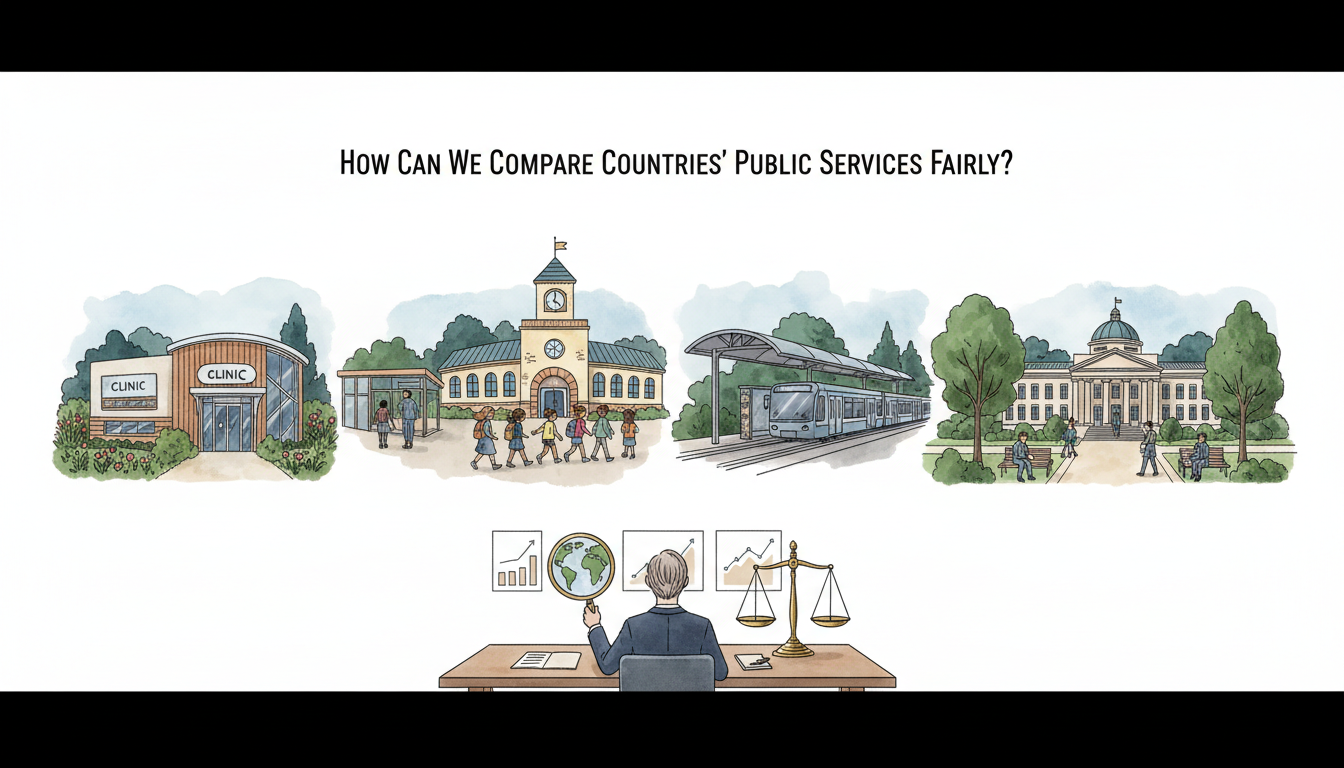
The gold standard of Development Studies is an account of change that connects people’s lives with clear evidence, understood institutions and choices whose consequences can be examined. A rising average, a completed building or a larger budget can matter. The central question is how those changes affect the opportunities people actually have.
Development Studies brings together economics, politics, geography, history, sociology and other fields to investigate living conditions and the processes that shape them. It asks how resources, power, institutions and environments influence change, who benefits, who carries costs and how progress can last.
This root guide connects the existing eduKate articles on education, economics, employment, housing, water, agriculture, governance, sustainability, inclusion and population evidence. It gives readers a method for linking those subjects without assuming that one indicator can describe a whole society. The worked cases are fictional learning exercises, not evaluations of particular countries or programmes.
GOLD STANDARD · DEVELOPMENT STUDIES
Find the part you need
Choose the question closest to yours. Read the guide in order or jump to a chapter; the subject directory connects you with the specialist articles.
Full chapter index · Practical quality check · Subject directory
Full chapter index
Chapters 1–4 · Foundations
Chapters 5–9 · Evidence and methods
Chapters 10–13 · Interpretation and responsibility
Chapters 14–18 · Application and transfer
CHAPTER 1 OF 18 · Define development
1. Begin with the change people should be able to experience
A development question needs an account of what would improve and for whom. More years in school, a shorter journey to water or a more reliable income can describe different changes. Each should be connected to people’s purposes rather than assumed to be beneficial in exactly the same way everywhere.
The UNDP introduction to human development emphasises people’s opportunities and choices. It provides a useful starting point for asking how resources become possibilities in everyday life.
Begin with a concrete question. Can learners use what they study? Can a household obtain a service at a cost and time it can manage? Can people participate in decisions that affect them? These questions make broad goals more observable.
The Education: learning that transfers into life guide supplies a related educational principle. An achievement becomes more meaningful when it supports something a person can understand or do. Development Studies applies that concern across connected systems while examining the resources, institutions and conditions required to sustain the change.
CHAPTER 2 OF 18 · Define development
2. Distinguish economic growth from the full development question
Economic growth describes change in economic output under the relevant measure. It can create resources and opportunities, but its relationship with people’s lives depends on distribution, public services, prices, working conditions and many other circumstances.
Ask how a reported economic change reaches households and communities. Which sectors expand? Who can obtain the new opportunities? What happens to people whose work or place becomes less secure? These questions connect a national measure with the mechanisms that matter locally.
The Economics root develops production, allocation and evidence. Development Studies uses economic analysis alongside questions about institutions, history, participation and the environment. A useful explanation shows how these lines of inquiry meet.
For a fictional exercise, consider a town whose output rises after a new business opens. Ask what evidence is needed before describing the change as an improvement for all residents. Employment, income distribution, local costs, service demand and environmental effects may each matter. The purpose is to understand the pathway, rather than treat growth as either a complete answer or an irrelevant statistic.
CHAPTER 3 OF 18 · Define development
3. Use summary indices without asking them to describe everything
A summary index combines selected dimensions into a manageable measure. It can support comparison and raise useful questions. Its value depends on understanding which dimensions it includes, how they are combined and what the resulting average leaves outside the picture.
The UNDP Human Development Index explanation identifies health, education and standard of living as its broad dimensions and explains that the index captures part of human development. Read the technical documentation before interpreting a specific score or change.
A national index is not a description of every person’s experience. Two places with similar values may differ in distribution, access or other conditions. A ranking also does not by itself explain why an observed difference exists.
Ask students to describe what an index helps them notice, then name one additional question requiring another source. This creates a practical reading habit: use the measure for its intended contribution and retain the wider inquiry. A compact number can begin a discussion without becoming the final definition of a society’s progress.
Poverty measurement needs a stated concept and method. Monetary measures examine resources through a specified basis; other approaches examine deprivations across selected dimensions. Thresholds, units, price adjustments and reference periods affect the interpretation.
The World Bank poverty resources provide routes into measurement and related research. For a current comparison, use the relevant dataset documentation and the applicable version of its methodology. Avoid copying a remembered threshold without its currency, price basis and period.
A poverty rate and the number of people experiencing poverty answer related but different questions. Population change can make their movements differ. An aggregate also needs to be connected with the depth, persistence or combination of disadvantages relevant to the inquiry.
For a fictional task, give learners two clearly defined household surveys with different coverage. Ask whether their results can be directly compared and what information is missing. The strongest answer may identify a useful comparison after adjustment, or explain why the available evidence cannot support it. Correct arithmetic cannot repair incompatible definitions.
CHAPTER 5 OF 18 · Read the evidence
5. Keep inequality and average progress distinct
An average can rise while people experience different changes. Distribution matters when asking who benefits, who remains excluded and whether an apparent improvement reaches groups facing particular barriers. Inequality and poverty are connected questions, but they are not interchangeable measures.
Inspect how a dataset is divided and who is absent. A national average may conceal differences across regions, ages, household types or other relevant categories. Disaggregation also requires appropriate sample sizes and privacy protection.
The Statistics and Data roots develop honest comparisons and responsible handling. Development Studies adds the practical question of how a pattern should inform a decision without turning a group label into an assumption about every individual.
Consider a fictional town in which average income rises because one small group receives a large increase. Ask learners what the average establishes and what another distribution measure or household evidence might reveal. Then ask which policy question they actually need to answer. This links numerical literacy with a clear purpose: an indicator is useful when it illuminates the people and choices relevant to the task.
CHAPTER 6 OF 18 · Read the evidence
6. Read country and regional comparisons in context
Comparisons need compatible definitions, periods and units. A difference can arise from the underlying conditions, the measurement process or both. Examine geographic boundaries, coverage and revisions before using a table to explain why one place differs from another.
The Geography and Demography roots provide related routes into place, population and change. Development Studies also asks how historical conditions and institutions influence the present comparison.
Keep purchasing power, nominal values, totals and per-person measures distinct when they are relevant. A reader should not need to guess which quantity is being compared. Where a dataset has already made an adjustment, understand its purpose rather than adding an incompatible correction.
For a classroom exercise, compare two fictional districts using a small set of explicitly defined indicators. Write one descriptive sentence and one question about explanation. This separates seeing a difference from knowing its cause. A well-prepared comparison can direct useful research while avoiding a league-table story that assigns a single identity to a whole population.
CHAPTER 7 OF 18 · Read the evidence
7. Use history to investigate pathways rather than destiny
Present conditions have histories. Infrastructure, land use, education, trade, institutions and political decisions can shape the options available later. Historical inquiry helps examine how a pattern developed and why a proposed intervention might interact with existing arrangements.
The History root develops evidence about change over time. Development Studies uses that method to investigate particular pathways rather than assume that every place passes through one inevitable sequence.
Distinguish an historical explanation from a prediction that change is impossible. Institutions and constraints can persist, but they can also be altered through choices whose feasibility and consequences need evidence.
Ask learners to construct a fictional timeline of a water service: settlement growth, construction, maintenance changes and later access problems. Which earlier decision helps explain the present difficulty? What other explanations remain possible? The exercise makes history practical. It can reveal responsibilities and constraints relevant to a current choice without reducing living communities to a story in which their future has already been decided.
CHAPTER 8 OF 18 · Follow everyday systems
8. Connect education access with learning and use
Education can be examined through entry, attendance, completion, learning and the opportunities to use knowledge. These are different stages. A new classroom or higher enrolment is important evidence of provision, but it does not establish every later outcome.
The Education root and learning that transfers into life guide provide the wider routes. Development Studies asks how education interacts with household circumstances, language, work, mobility and institutional arrangements.
Trace the learner’s actual path. Can they reach the setting, obtain understandable teaching, participate, receive feedback and continue to a useful next step? The barrier may sit between services rather than inside a single lesson.
Use a fictional programme that supplies study materials. Ask whether the materials reached the intended learners, whether the learners could use them and which learning evidence was collected. Then distinguish those findings from claims about later employment. A clear sequence of outcomes makes the programme easier to understand and evaluate while giving each achievement credit for what it actually establishes.
CHAPTER 9 OF 18 · Follow everyday systems
9. Understand health and care through functioning systems
Health-related development questions concern more than the presence of a facility. Staffing, supplies, affordability, transport, information, referral and continuity can influence whether people obtain appropriate care. Technical clinical decisions require the relevant expertise and authoritative guidance.
At root level, follow the service rather than prescribe treatment. A referral sent, an appointment offered and care actually received are different events. Each can help locate a barrier when the definitions and circumstances are clear.
Care within households and communities also shapes participation in education and paid work. A study should examine who provides that care and what resources or support are available, without assuming that every household has the same arrangements.
For a fictional service map, identify the steps from recognising a need to reaching an appropriate provider and completing the legitimate follow-up. Ask which steps have evidence and which depend on assumptions. This gives students a systems question they can investigate safely: what conditions make a service usable and continuous for the people it intends to serve?
CHAPTER 10 OF 18 · Follow everyday systems
10. Follow water and sanitation beyond installation
A water point, pipe or sanitation facility is part of a continuing service. Reliability, appropriate quality assurance, maintenance, access and the user’s practical journey affect what the installation accomplishes. Counting completed assets is one stage of the evidence.
The Water root develops the wider system. The school water, sanitation and hygiene access article connects facilities with the everyday conditions of learning.
Ask who operates the service, how faults are reported and how the necessary work is funded and carried out. Technical design and health requirements need competent assessment; a generic classroom example cannot certify a real facility.
Consider a fictional school with a newly installed water point that is unavailable during part of the day. The installation count is accurate, but the claim of dependable access needs further evidence. Ask learners to trace availability, legitimate quality checks and repair responsibilities. They should describe the actual service received and the next corrective question, rather than use the completed construction as a substitute for the continuing outcome.
CHAPTER 11 OF 18 · Follow everyday systems
11. Connect livelihoods with the conditions of work
Employment figures are useful, but a development question may also concern income reliability, safety, hours, access, progression or the ability to manage a disruption. People can be counted in work while facing quite different conditions.
The Employment and Agriculture roots offer connected routes. In agriculture, production interacts with land, water, inputs, storage, transport and markets. In other sectors, different dependencies shape whether an opportunity becomes a sustainable livelihood.
Examine the whole route through which value reaches the worker or household. A higher selling price may have to be considered alongside costs, losses or changes in bargaining conditions. Avoid assuming that a favourable movement in one indicator determines the final result.
For a fictional farming cooperative, trace the path from harvest to payment. Identify the observation at each stage and the person responsible for it. Then ask what happens if transport is delayed. The exercise connects economic activity with resilience and actual household resources. It also shows why a useful study can require evidence across several services rather than one headline production number.
CHAPTER 12 OF 18 · Follow everyday systems
12. Examine housing and urban change through everyday use
Urban development affects how people reach work, learning, services and one another. New buildings and transport connections should be examined through their use, costs, reliability and effects on existing communities. A visible construction programme does not by itself describe every change in people’s lives.
The Housing and Geography roots supply related foundations. Population evidence from Demography helps clarify who is being planned for and how estimates depend on definitions and assumptions.
Ask which households can use the new arrangement, what happens to previous residents and which ongoing services are required. These are empirical questions that need evidence suited to the place and decision. A broad plan can contain benefits alongside uneven burdens.
A fictional relocation exercise can compare the advertised home with the full daily journey: travel time, school access, recurring costs and relevant support. Learners should identify the information needed before judging the change. The outcome is a fuller understanding of a place as a set of lived relationships, rather than a count of structures viewed in isolation.
CHAPTER 13 OF 18 · Evaluate choices
13. Keep environmental conditions within the development account
Development choices use resources and affect environments that support present and future lives. The relevant question is how benefits, costs and risks are distributed across places and time. A favourable immediate output may need to be examined alongside maintenance, resource use or later damage.
The Sustainability root develops continuing usefulness and environmental responsibilities. Development Studies connects those questions with livelihoods, public services, institutions and people’s ability to influence decisions.
Define the boundary of an assessment. Which stages, locations and effects are included? A project can appear efficient when a significant cost sits outside the selected calculation. Equally, an asserted environmental benefit needs evidence rather than a reassuring label.
For a fictional project comparison, list the intended service, resource requirements, continuing responsibilities and evidence about the relevant effects. Ask who gains now and who may carry a later cost. This makes trade-offs discussable without pretending that every decision has a consequence-free option. The standard is a transparent account of the choice and the responsibilities it creates.
CHAPTER 14 OF 18 · Evaluate choices
14. Understand governance through authority and delivery
Institutions influence how decisions are made, resources are used and responsibilities are enforced or reviewed. A policy announcement, budget allocation and delivered service are different stages. Following the path between them helps identify where an intended change becomes real or breaks down.
The Governance root develops the relationship between authority, process and accountability. The Public Policy root connects public choices with evidence and implementation.
Ask who may decide, who carries out the work, who can question a result and which records make the process reviewable. These questions should be answered for the actual setting. An organisational chart alone may not show how a service functions in practice.
Give learners a fictional grant intended to repair community facilities. Trace approval, contracting, delivery, verification and maintenance. Which evidence belongs to each stage? Who responds when the repair does not work? This connects governance with everyday outcomes. It also helps distinguish a documented promise from a verified result without assuming that every gap has the same cause.
CHAPTER 15 OF 18 · Evaluate choices
15. Make participation and inclusion observable
Participation concerns people’s opportunity to influence matters that affect them. An invitation to a meeting is one form of access, but the timing, language, format, information and response process can shape whose views are heard and used.
The Inclusion and Society roots provide related routes. Development Studies asks how differences in access and power affect both the decision and the evidence used to describe it.
Identify who may be absent and why. A convenient survey or public meeting can overrepresent those already able to participate. A report should explain its reach and limitations rather than describe the respondents as everyone affected.
For a fictional neighbourhood project, compare the consultation record with the population and activities relevant to the choice. Ask what legitimate additional methods might improve understanding. Then examine how the final decision responds to the evidence. Meaningful participation includes an intelligible account of what happened next, especially when preferences conflict and not every request can be adopted.
CHAPTER 16 OF 18 · Evaluate choices
16. Read international connections through actual mechanisms
Trade, migration, finance, knowledge and environmental processes connect development across borders. These relationships can create opportunities and dependencies. Their effects need to be traced through the particular mechanism rather than inferred from whether a country is described as connected.
The Economics, Geography and Demography roots provide routes into those mechanisms. Ask how a change reaches the household, business, institution or place being studied.
Keep the source, recipient and conditions clear. A flow of funding is not automatically a delivered service; a new market is not automatically accessible to every producer. The relevant rules, costs, capacities and risks influence the result.
Use a fictional programme that supports an agricultural export route. Trace training, quality requirements, transport, payment and ongoing operating costs. Then ask which parts depend on an external partner and how continuity is planned. The learner should be able to identify an international contribution while preserving the local institutions and work through which that contribution becomes useful.
CHAPTER 17 OF 18 · Evaluate choices
17. Worked case: the training count becomes an employment claim
A fictional programme reports that 500 learners completed training. Its publicity then states that 500 lasting jobs were created. Completion records establish participation under the programme’s definition. They do not by themselves establish employment, duration, earnings or whether the programme caused the later outcome.
Build the sequence carefully: places offered, learners reached, completion, demonstrated capability, access to work and later conditions. Identify which stages have suitable evidence and which remain unobserved. Ask whether the follow-up reaches those who left or could not obtain work.
The Employment and Statistics roots develop related questions. A causal claim also needs an appropriate comparison and examination of alternative explanations. Better results among participants can reflect selection as well as programme effects.
Have learners write a fair report that credits the verified completion outcome, describes the evidence still needed and identifies a useful next decision. This is a practical evaluation skill. It allows a programme to learn and improve without either exaggerating its achievements or dismissing the work that the records genuinely establish.
A strong learner can move between people’s experiences, institutional processes and quantitative evidence. They can define the change being sought, identify the mechanism that could produce it and explain what would count as useful evidence.
The UN global SDG indicator framework offers one organised route into development measurement. Use the applicable definitions and metadata, while retaining local evidence needed for the actual question. A global framework supports inquiry without replacing it.
Choose one fictional service and change the setting. What remains useful in the original explanation? Which assumptions now need checking? This develops transfer: the learner carries a method into a new situation while recognising that institutions, people and conditions differ.
Return to Education: learning that transfers into life. The gold standard is a reader who can connect progress with people, follow a claim through the evidence and choose a responsible next question. The directory below leads into the existing specialist subjects that make those connections more precise.
Previous chapter · Contents · Continue to the subject directory
Development Studies subject directory
Choose the existing article that matches the next question. These routes develop the specialist work, connected subjects and practical cases introduced in this root guide.
People, evidence and comparison
- How to use a Library | Find Geography, Countries, Population and Human Development Data
- The Gold Standard of Data
- The Gold Standard of Statistics
- The Gold Standard of Demography
- The Gold Standard of Geography
Learning, work and livelihoods
- The Gold Standard of Education
- The Gold Standard of Education | Learning That Transfers into Life
- The Gold Standard of Employment
- The Gold Standard of Agriculture
- The Gold Standard of Economics
Places and everyday services
- The Gold Standard of Housing
- The Gold Standard of Water
- The Gold Standard of a Ministry of Education | School Water, Sanitation, Toilets and Menstrual Hygiene Access
- The Gold Standard of Society
Institutions, inclusion and lasting change
- The Gold Standard Of Governance
- The Gold Standard of Public Policy
- The Gold Standard of Inclusion
- The Gold Standard of Sustainability
- The Gold Standard of History
A practical quality check
| What to examine | Useful evidence |
|---|---|
| Purpose | The intended improvement and the people affected are defined. |
| Distribution | Benefits, costs and excluded experiences remain visible. |
| Mechanism | Resources and institutional actions are connected with the proposed outcome. |
| Evidence | Measures, coverage, comparisons and causal limits fit the claim. |
| Continuity | Operation, maintenance, accountability and future effects are examined. |
Questions readers ask
Is Development Studies only about economic growth?
Growth is an important subject within it. Development Studies also examines living conditions, distribution, institutions, participation, environments and the processes connecting them.
Does a completed project prove an improved outcome?
It establishes an activity or asset under the relevant definition. Evidence about access, use, reliability and the intended change is needed to assess the resulting service or opportunity.
Can one index describe a whole country’s development?
A summary index measures selected dimensions. Distribution, local conditions and other relevant outcomes require additional evidence.
Sources and further reference
These primary references support the concepts and research routes discussed here. The worked examples are fictional teaching cases. For a consequential real-world decision, use the appropriate specialist expertise, current authoritative guidance and evidence about the actual situation.