
A fish premaxilla is an important upper-jaw element that may survive in archaeological deposits after the rest of a fish has disintegrated. Its articulations, teeth and processes can contribute to species identification and, under narrow validated conditions, skeletal measurement. It cannot independently establish a fish’s exact size, age, feeding speed or the human activity that deposited it. This complete teaching reference explains how premaxillary evidence becomes a defensible taxonomic or archaeological claim.
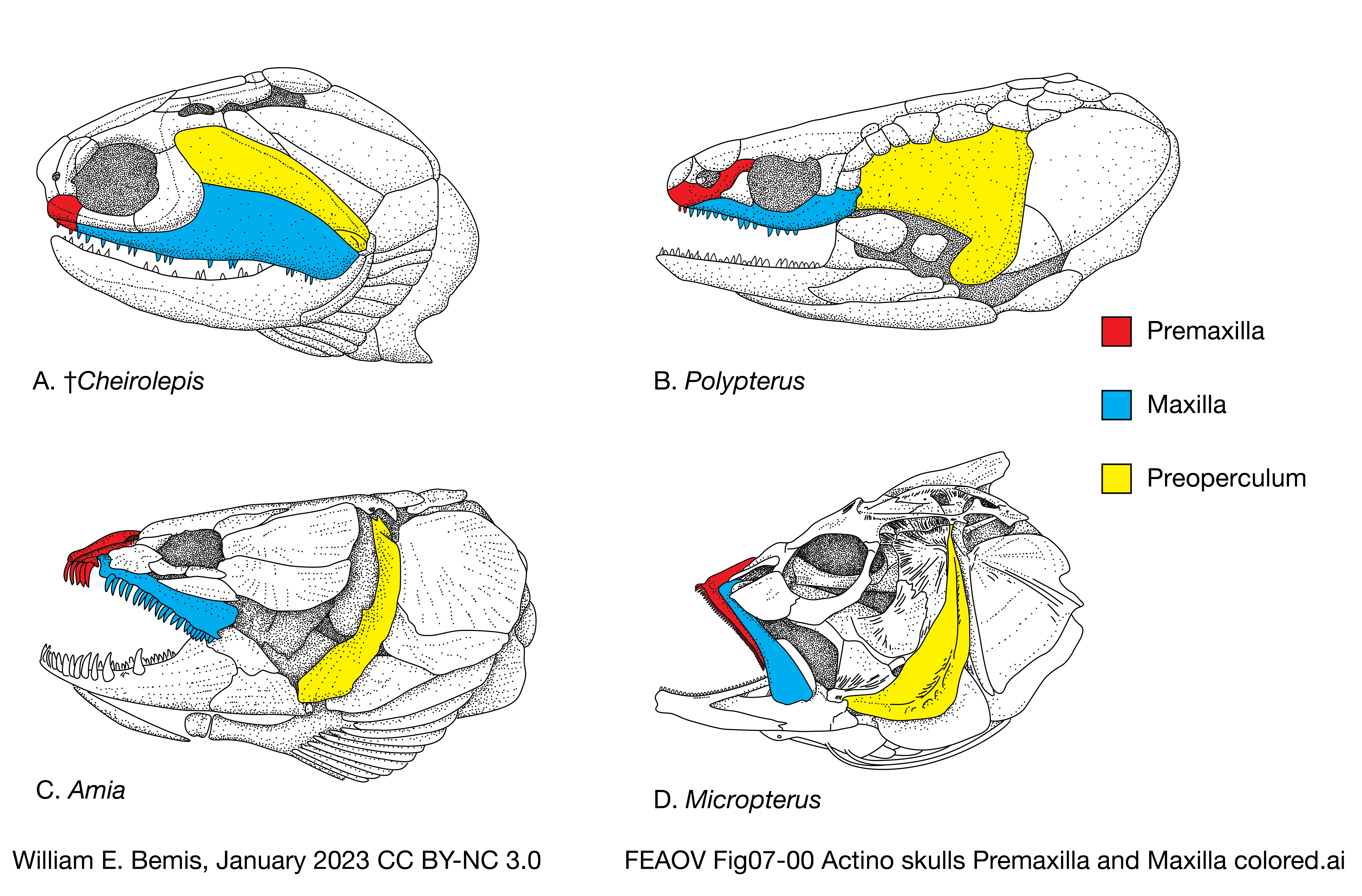
The Marsh Quay calculations are invented for teaching and do not come from an excavation. The comparative osteology figure reproduced here is a genuine 2023 anatomical illustration by William E. Bemis, not a photograph of finds from Marsh Quay. Begin with the anatomical distinctions and chapter index, then follow the worked examples, competing formation histories and research-grade assessment criteria.
Scientific starting points include Leach’s diagnostic fish-bone protocol, comparative cypriniform protrusion research, and the 2024 fish-bone atlas.


1. Identify an actual premaxilla before writing an ancient fishing story
The premaxilla is an upper-jaw skeletal element in many ray-finned fishes. Its tooth-bearing margin, ascending process, articulation and overall shape can help a specialist distinguish particular taxa. In archaeological deposits it commonly survives as a detached or fragmentary bone, rather than as part of a complete head. An isolated specimen might establish the presence of a fish group but not an individual fish count, capture season or human meal. The opening question for any research student is therefore not ‘what did the fish eat?’ but ‘which diagnostic anatomical structures remain on this particular bone?’
Put three hypotheses beside a scale-labelled fragment: a premaxillary element has been identified; a particular fish species contributed material to the assemblage; people captured that fish at a particular place and date. Those are increasingly demanding claims. A bone can support the first without securely establishing the second, and the second can be true without establishing the third. Ask students to name the independent comparison or archaeological observation that would justify each advance in interpretation.
2. Locate the premaxilla, maxilla and dentary correctly
In a typical derived teleost, paired premaxillae form much of the anterior upper jaw, with the maxillae positioned close behind and involved in the movement or support of the oral apparatus. Dentaries lie in the lower jaw. Their contacts, articulations and tooth-bearing surfaces depend on fish lineage. The premaxilla should not be confused with the dentary merely because both may carry oral teeth. Likewise, a maxillary fragment is not automatically a missing extension of the premaxilla. These distinctions matter before any species identification is attempted.
Use the real comparative osteology image by William E. Bemis to identify how the premaxilla and maxilla differ in basal ray-finned fishes and more derived teleosts. Have students make a three-column anatomical table, noting position, visible articulations and whether teeth are present in the particular reference species. The correct table will include exceptions, not a single claim that all fish jaws look alike.
3. Recognise the tooth-bearing alveolar portion
The tooth-bearing or alveolar process of the premaxilla varies greatly among fishes. Some taxa have visible tooth rows or sockets, while many cypriniforms lack oral jaw teeth even though their upper jaw includes premaxillae. Erosion can remove a thin tooth row or leave sockets without crowns. A convincing diagnosis relies on the preserved morphology and reference material, not a blanket statement that premaxillae must bear teeth. The distinction between a toothless premaxilla and a broken toothed margin can be archaeologically important.
Create a practical comparison with one complete toothed reference, one taxon whose oral jaws are toothless and one fossil fragment with an eroded margin. Ask what can be said directly about each. Students should describe sockets, ridges, attachments and missing edges separately. A false ‘no teeth’ statement based on broken enamel can become a false species claim, so preservation condition belongs beside every anatomical character.
4. Understand the ascending process, when the taxon has one
In numerous mobile-jawed teleosts, an ascending process extends dorsally from the premaxilla and plays a role in its movement relative to the skull. Length and geometry can affect the potential excursion of the upper jaw, but the morphology varies substantially across lineages. Not all fishes use the same protrusion mechanism or possess the same process configuration. Archaeologists should not interpret a long-looking fragment as direct proof of fast suction feeding without a validated functional comparison and knowledge of the complete surrounding anatomy.
Students should label the ascending process and alveolar portion on appropriate modern references and describe their orientation. A fragment lacking the rising process may remain clearly identifiable as premaxillary material while being unsuitable for functional reconstruction. This is a teaching example of how a fossil may supply taxonomic evidence without supplying enough information to reconstruct movement.
5. Trace evolutionary change without drawing a universal ladder
Comparative osteology shows that upper-jaw bones changed in both shape and mobility across ray-finned fish evolution. In some relatively basal lineages the cheek and upper jaw form a less mobile complex; many more derived teleosts have increased mobility and various protrusion mechanisms. Such differences are evolutionary patterns involving multiple lineages, not a chronological ladder in which every living fish represents a stage toward one ideal modern jaw. The 2023 Bemis illustration is useful because it makes these anatomical differences visible.
Ask students to compare how the premaxilla and maxilla are positioned in the illustrated contrasting skulls. Then ask what information an isolated ancient premaxilla would actually retain about its original mobility. A bone’s shape may constrain a functional hypothesis, but ligaments, joints and other skeletal components are missing in most deposits. The most informative reconstruction describes those missing relationships explicitly.
6. Explain protrusion without assuming it occurred in life
Upper-jaw protrusion can move the mouth forward during feeding, helping some fishes interact with prey and surrounding water. The 2008 study by Holzman and colleagues analysed how protrusion can alter suction-feeding forces in living fishes. This demonstrates a real possible functional consequence in appropriately adapted species. Nevertheless, measuring protrusion requires motion or sufficiently complete, anatomically validated mechanical models. A premaxilla recovered from sediment does not record how far its individual owner projected the mouth while alive.
Set up a comparison between a documented high-speed feeding sequence and a detached premaxilla from an archaeological site. Students identify which variables were directly measured in living fish and which are unobservable in the fossil. The honest result may be an anatomical feature consistent with a class of mobility rather than an exact speed, prey-capture distance or inferred fish diet.
7. Distinguish kinethmoid-mediated protrusion in cypriniforms
Cypriniform fishes such as common carp have a distinctive median kinethmoid involved in upper-jaw movement. Experimental work by Staab, Ferry and Hernandez compared five cypriniform taxa, and X-ray movement studies on common carp showed coordinated kinethmoid rotation and premaxillary protrusion. The system differs from jaw protrusion in many acanthomorph fishes, where a different arrangement of bones and ligaments operates. These mechanisms should not be merged merely because both can extend the upper jaw.
Ask a class to sketch two labelled pathways for protrusion, one involving a kinethmoid and one based on the corresponding acanthomorph anatomy. They should identify which bones and tissues must be known before inferring movement. A loose cyprinid premaxilla without its kinethmoid does not demonstrate the preserved position or degree of rotation of the original mechanism.
8. Separate shape from actual feeding behavior
Anatomy may influence what kinds of feeding movements are possible, but behavior also depends on muscles, ligaments, prey, environmental conditions and individual variation. Living fish can adjust how they feed, and the same skeletal configuration may be used differently on different occasions. A premaxilla that resembles those of benthic-feeding species cannot prove that its ancient owner consumed one specific bottom-dwelling organism. Ecological interpretation should remain at the scale supported by the reference.
Make students propose at least two functional explanations for one modern toothless protrusible upper jaw. They must list the biological evidence that discriminates between them, such as controlled feeding observations or suitable live-fish studies. In archaeology, an independent diet proxy or associated prey remains would be needed before a specific prey account becomes credible.
9. Identify the maxilla-premaxilla contact, not just a profile
The premaxilla and maxilla may have articular relationships crucial to the operation of the upper jaw. Contact surfaces and process orientations are useful for anatomical identification, yet breakage can remove the region that distinguishes two taxa. An isolated curved element may therefore be difficult to label unless reference collections include both maxillae and premaxillae in comparable views. The 2014 Hemibrycon research figure demonstrates why separate upper-jaw elements should be documented as different objects even within one species.
Students should photograph a reference jaw from more than one side, labelling the contact surfaces. They then receive a fictional worn fragment and state whether its anatomical category can be assigned confidently. A precise scientific description of surviving articular morphology is more valuable than an unexplained ‘definite premaxilla’ label.
10. Take exceptional fish skulls seriously
Not every teleost conforms to the familiar tooth-bearing premaxilla plus supporting maxilla arrangement. Konstantinidis and Johnson’s investigation of the deep-sea telescopefish genus Gigantura re-evaluated unusual upper-jaw elements and concluded that the expected premaxilla is absent, with a major toothed element being the palatine instead. This is an important caution about homology: an element’s position and contacts, not just its teeth or large size, determine anatomical identity.
An exercise presents a hypothetical huge toothed bone from an unfamiliar fish. Learners must not call it premaxilla solely because it dominates the front of the mouth. They should ask for topology, adjacent bones, developmental information where available and specialist references. Exceptional anatomy reveals why mechanical rules learnt from one familiar species need explicit taxonomic limits.
11. Build reference collections that cover regional alternatives
The Archaeological Fish Resource at the University of Nottingham catalogues diagnostic bones from more than ninety Mediterranean and North Atlantic freshwater and marine fishes, including separate premaxilla and maxilla views. Such databases are invaluable training tools but are not universal coverage of all fish faunas. The 2024 European freshwater and migratory fish atlas similarly warns about overlap in shape and the need for suitable comparative reference collections.
Ask a student to identify a fossil from a tropical archaeological estuary using only a temperate European photograph. The correct response should recognise that reference coverage is inadequate and that close regional taxa need comparison. An intermediate family-level identification may be appropriate pending a wider reference collection; certainty cannot be manufactured by selecting the nearest online image.
12. Read Leach’s 1986 Pacific fish-bone protocol
Foss Leach’s 1986 Journal of Archaeological Science method for Pacific Island fish-bone assemblages used a reference collection of roughly three hundred fish species and routinely identified diagnostic bones including the premaxilla, maxilla, dentary, articular and quadrate. The method highlights the analytical value of correctly diagnosed cranial elements and systematic coding. Its strength lay in coherent reference practices and contextual records, not a claim that every fragment from every fish is species-diagnostic.
Students should build a specimen-record template naming eligible skeletal parts, taxonomic rank, fragment completeness, original deposit and reference image or specimen. They should explain how the same fish might contribute several such bones. A long list of identified elements is not a list of independent catches, and a protocol’s taxonomic names do not replace the need for biological comparison.
13. Distinguish identification confidence from body-size confidence
Some modern studies correlate a defined premaxillary dimension with fish body length. Yet a premaxilla can be identified taxonomically while lacking the process required by a particular measurement. Conversely, a complete bone may have an excellent measurable landmark but uncertain species. Both source-taxon confidence and model applicability need reporting. The fact that a caliper yields an exact value does not show that an archaeological fragment meets the anatomical or statistical requirements of the reference equation.
Give students a two-by-two table comparing secure versus uncertain taxon with intact versus broken model landmarks. Only certain combinations can support a conditional numerical prediction. The others may yield valid descriptive measurements, useful anatomy or a reason to seek additional reference specimens rather than a published fish length.
14. Use genuine model definitions before estimating fish length
An Oxford Archaeology fish-bone report documented measurement of the width of the ascending process of certain cod-family premaxillae, alongside dentary and vertebral measurements, to support fish-size interpretation using established reference methods. This is a real example of a precisely defined skeletal landmark. It does not mean the same measurement can be used for a carp or an unrelated deep-sea fish. Valid conversion also requires a stated target—total, standard or fork length—and a compatible size range.
Students should underline the exact ‘ascending-process width’ definition in the source protocol and draw the chosen axis on a reference premaxilla. Then they should examine an ancient fragment missing part of that process. The correct outcome may be to withhold the body-length estimate while retaining the original preserved dimensions.
15. Differentiate standard, fork and total fish lengths
Standard length is measured to the end of the vertebral column or base of the caudal fin under the study’s convention, fork length to the fork of an appropriate caudal fin, and total length to the fin’s distal extremity. These are not interchangeable target variables. An equation predicting one type must not be relabelled as another without a validated biological conversion. Different fish tails can also make some conventions more appropriate than others.
A classroom report should include a simple fish-length diagram and a prominent unit label beside every equation. Learners then audit two published studies with different targets. The practice prevents a false change in reconstructed fish size caused solely by merging incompatible measurement conventions.
16. Use a deliberately fictional model without pretending it is calibrated
In an invented Marsh Quay lesson, one imaginary fish taxon has a fictitious rule: predicted standard length in centimetres equals 10 plus 9 times a defined premaxillary-process width in millimetres. A hypothetical intact width of 3.0 mm gives 10 + 9 × 3.0 = 37 cm, while 4.5 mm gives 50.5 cm. These numbers illustrate dimensions and arithmetic; neither the coefficients nor the predictions describe a real fish species, fossil, catch or archaeological excavation.
Students must show where the physical measurement would be taken and state that the output is conditional on an invented reference. If the process is broken or the premaxillary taxon remains uncertain, they must withhold the prediction. They should never reprint the toy equation as a scientific conversion for gadids, cyprinids or any other fishes.
17. Check incomplete processes and measurement bias
Processes that control premaxillary articulation or protrusion may be slender and vulnerable to breakage. The surviving length or width of a damaged process can look well-defined while falling short of the true original landmark. A regression applied to that surrogate dimension will give a precise-looking but inaccurate fish length. A morphology catalog should therefore distinguish intact, partly preserved and completely missing measurement endpoints instead of burying completeness information in informal comments.
Provide two fictional readers measuring one damaged specimen. One reports 3.0 mm on a surviving remnant and another 3.3 mm using a different imagined endpoint. Under the toy formula those values imply 37 and 39.7 cm, a 2.7 cm spread. This exposes sensitivity but cannot repair the missing original landmark; withholding the size estimate remains scientifically appropriate.
Marsh Quay: invented dimensional model
| Imaginary intact process width | Toy standard-length rule | Fictional output |
|---|---|---|
| 3.0 mm | 10 + 9 × 3.0 | 37.0 cm |
| 4.5 mm | 10 + 9 × 4.5 | 50.5 cm |
| Incomplete ascending process | Model landmark missing | Withhold prediction |
18. Track tooth rows, growth stage and taxon separately
Premaxillary teeth, where present, can vary in position, number, form and spacing as a fish develops. Tooth loss and replacement can alter a fossil fragment without changing the species. Some cypriniform taxa lack oral teeth entirely while others may bear substantial tooth rows. A taxonomic claim should therefore consider whether the bone came from a juvenile or adult and whether apparent tooth absence represents biology, abrasion or postmortem damage.
Students should draw a diagnostic row on a modern reference and note both visible teeth and sockets. They then classify an invented fragment with one crown missing. The correct record separates observed teeth, preserved sockets, age-class uncertainty and species assignment rather than converting the lost crown into an unusual natural tooth formula.
19. Preserve left-right sidedness and avoid double counts
Premaxillae are paired in many fishes, and one jaw can fragment into several identifiable pieces. A raw tally of ten premaxillary objects need not represent ten original fish. In an appropriate closed context, secure duplicated left-side elements of one species can sometimes constrain the minimum number of fish, but this requires correct side identification and exclusion of refits. Loose fragments with unknown side are not comparable for MNI purposes.
Ask students to compare three clearly diagnosed right premaxillae with a mixed bag of a dozen unsided shards. They should explain why the first can support a cautious minimum under suitable context while the second simply supports an identified-specimen tally. Both counts should be retained rather than converted to one falsely precise fish population.
20. Record excavation method and sediment denominator
Small fish jaw fragments are easily lost in coarse sieves or hand sorting, and recovery of fragile toothed margins may differ from recovery of robust toothless structures. Processed sediment mass or volume, mesh size, sorting effort and preservation should be recorded for every sample. A rise in premaxillary objects in a new excavation may reflect better recovery rather than more ancient fish. Counts without eligible-specimen definitions cannot be compared confidently.
An invented Marsh Quay example gives Sample A forty-eight classified premaxillary fragments from 1.6 kilograms and Sample B sixty-three from 4.2 kilograms. Their simple recovered rates are thirty and fifteen per kilogram. The raw count is higher in B while its normalised count is lower. This arithmetic demonstrates denominator literacy, not a twofold difference in historical fishery productivity.
21. Keep fragment counts distinct from biological population
One original premaxilla can yield multiple fragments after transport, heating, trampling or excavator handling. Conversely, loss of diagnostic ends may remove an original element from the identified tally entirely. Both processes change the number of counted objects without any change in the original fish population. A taxonomic percentage may also change if one bone type is more likely to preserve recognisable features. Report fragments, refitted original elements and undiagnostic remains separately where the material permits.
Students should model a bone broken into two, four and six pieces and describe how simple NISP might be affected. The learning goal is not to abandon counting, but to define exactly what is counted and to avoid treating observations nested within one fish as independent animals.
Marsh Quay: invented recovery comparison
| Sample | Identified premaxillary fragments | Dry sediment | Observed fragments per kg |
|---|---|---|---|
| A | 48 | 1.6 kg | 30 |
| B | 63 | 4.2 kg | 15 |
22. Consider predation and water transport before human use
Premaxillary bones can enter archaeological deposits through natural fish mortality, predator feeding, water movement or human capture and processing. Some elements survive digestion or retain wear resulting from chewing by another animal. Others can be transported from a river into a nearby settlement drain. Finding a diagnostic upper-jaw fragment inside a human settlement does not alone prove it was a meal or that the fish lived directly beside the feature.
Give learners three competing formation histories for a toothed premaxilla from a ditch: fish processing, predatory discard and flood transport. Require one independent test for each, such as cut-mark assessment, digestive alteration or sediment facies. The report should name which processes are supported and which remain possibilities.
23. Distinguish import and trade from local fish ecology
A marine fish premaxilla at an inland excavation may indicate movement of a fish product through trade, food storage or human travel. It does not establish that a marine ecosystem once surrounded the inland settlement. Similarly, a freshwater jaw in a coastal context might come from an upstream source or imported catch. Tooth morphology and taxon identification can inform the organism’s likely biological habitat, but not every step of the material’s travel.
Ask students to separate habitat, place of death, place of processing, transport and final discard on a timeline. A useful archaeological conclusion describes the provenance evidence for each stage rather than collapsing them into the last known findspot.
24. Separate archaeological dates from fish growth and capture
The site layer supplies chronological context through archaeology and dating, while a premaxilla usually does not directly record the calendar year in which the fish lived, was caught or eaten. Fish products can be stored and traded, and bones can later be redeposited. A difference in recovered premaxillae between two sampled layers cannot be ascribed confidently to one exact fishery policy or climate event if the ages overlap broadly or if the contexts are mixed.
Students should plot both sample positions and age ranges rather than smoothing the fragment ratios into a falsely precise annual graph. A claim about a particular historic event requires independently dated contextual evidence. This is a general chronological principle rather than a special weakness of premaxillae.
25. Use CT or geometric morphometrics proportionately
Photographs, surface microscopy and, when appropriate, CT can document jaw processes and tooth sockets without immediately damaging an archaeological specimen. Geometric morphometrics may compare shapes from modern reference taxa, but its classification performance depends on anatomically homologous landmarks and relevant training variation. A beautifully rendered 3D jaw can still be taxonomically ambiguous if the comparative species are too similar or the specimen has lost critical processes.
Ask students to propose the cheapest justified observation capable of resolving one taxonomic question. They should use multiple views and scale before recommending expensive scans or destructive sampling, and state what uncertainty the new method could realistically reduce. Technology is valuable when tied to a research decision.
26. Protect fragile jaw bones and ethical archaeological context
Some historical collections are rare, culturally protected or covered in conservation consolidants that influence imaging or chemical analysis. Irreversible preparation should require appropriate custodial permission and a compelling research gain. Classroom exercises can use licensed osteological images, synthetic datasets and modern properly curated reference material without sacrificing an original site specimen. Source labels, conservation histories and retained fractions should be archived with the data.
A student writes a specimen stewardship plan including unique identifier, provenance, image credit, requested method and preservation rationale. If the bone is too incomplete for reliable length reconstruction, choosing not to section or sample it can be the soundest scientific decision.
27. Write a conclusion that holds when challenged
The fictional Marsh Quay lesson supports the stated fragment-per-kilogram comparison and a demonstration of why an invented body-size model cannot be treated as evidence for a real fish. It cannot prove that a particular fish species was caught more often, that the fish used a particular feeding technique or that people used a named net in one year. To advance any such claim, the next study would need suitable reference fish, matched recovery, preserved anatomical landmarks and independent site context.
A credible final paragraph states the diagnosed structure, identification rank and its uncertainty, preservation, raw and normalised counts, and the historical alternatives still open. The gold standard of teaching premaxilla analysis is a learner who can make a useful taxonomic or ecological observation without allowing a persuasive story to outrun the bone.
Twenty-two applied archaeological evidence cases
All the following cases are fictional decision exercises. The purpose is to test distinct aspects of anatomy, comparison, numerical reasoning and site formation, not to present unverified archaeological discoveries.
1. One fossil assigned to both upper-jaw elements
A slender jaw fragment is entered simultaneously as premaxilla and maxilla. Students compare articular and tooth-bearing characters and use an unresolved category when necessary instead of double-counting one object.
2. The missing ascending process
A fossil retains a tooth-bearing alveolar portion but has lost its ascending process. Students explain why taxonomy may remain possible while jaw protrusion geometry and a process-width length estimate cannot be derived.
3. A toothless carp jaw called damaged
A complete premaxilla from a toothless oral-jaw taxon is misdescribed as having lost all its teeth. Learners consult correct taxonomic anatomy and distinguish natural toothlessness from missing crowns.
4. The tooth-bearing palatine exception
A Gigantura-like unusual skull has a large upper tooth-bearing element. Students explain why bone location and homology, not teeth alone, determine whether it is premaxilla or another element.
5. The kinethmoid confusion
One report applies the acanthomorph protrusion mechanism to cypriniform carp without considering the kinethmoid. Students sketch both mechanisms and list which supporting bones are absent from the fossil.
6. An unknown fish inferred to suction feed
A premaxillary ascending process resembles that of a living suction-feeding reference fish. Learners explain the limits of reconstructing behavior from one isolated component without other joints or comparative biomechanics.
7. The 1986 counting scheme
One fish deposits two premaxillae plus other diagnostic cranial bones. Students show why the Pacific fish-bone protocol records several objects rather than several individuals and how a proper MNI may use sidedness.
8. A tall process mismeasured as a width
The reference protocol defines ascending-process width, but a student measures its total height. The class corrects the measurement definition before attempting any body-size inference.
9. The fictional length example
An imaginary intact process width of 3.0 mm gives 37 cm under the invented Marsh Quay rule. Learners state that the equation is not a modern calibration and must never be used to estimate actual ancient fish lengths.
10. A broken 4.5-millimetre process
A fragment’s surviving length is entered as a complete process width, giving a large toy fish prediction. Students withhold the result because the proper landmarks were not preserved.
11. The left/right minimum fish count
Three clearly right-sided premaxillae occur in one secure context. Learners distinguish a possible minimum individual constraint from a dozen unsided tooth-bearing shards that could derive from fewer fish.
12. The sediment recovery reversal
Marsh Quay A has 48 counted objects from 1.6 kg and B has 63 from 4.2 kg. Students calculate 30 versus 15 per kg, then explain why neither number is fish per year.
13. A small fragment lost through the sieve
A coarse screen loses small premaxillary elements from one deposit. Students assess recovery method and taxonomic size bias before declaring that ancient fish grew larger.
14. The predator stomach source
A diagnostic bone is recovered among predator-affected remains near a settlement. Learners compare digestion, fragmentation and spatial context with the human-food hypothesis.
15. The inland marine maxilla dilemma
An upper-jaw fragment from a marine species appears far inland. Students describe trade or transported food as alternatives to the false claim that a saltwater coast surrounded the settlement.
16. A bad chronological graph
A premaxillary count shift is plotted against an exact year although the core’s age range spans decades. Students redraw the evidence with sample positions and realistic chronological uncertainty.
17. A modern reference image becomes a fossil
The Bemis comparative osteology image is captioned as a field photograph. Students correct source, authorship, licence and its proper role in describing upper-jaw evolution.
18. A fractured taxonomic character
An archaeological premaxilla loses the diagnostic anterior articular region. Students propose a broader taxonomic rank and specify what modern comparison could resolve the uncertainty.
19. Two readers disagree about landmarks
One analyst identifies a preserved process while another considers it a fracture. They record both interpretations, examine an authentic comparative specimen and evaluate how the uncertainty affects downstream measurement.
20. A fish-size model applied to another continent
A cod-family premaxillary calibration is applied to a tropical characiform fossil. Students reject the taxonomic extrapolation and define the reference programme a defensible model would require.
21. The false annual catch census
A midden with hundreds of jaw pieces is interpreted as hundreds of yearly catches. The class distinguishes bone fragments, original fish, sediment mass, mixed deposition periods and the missing chronological denominator.
22. The final claim audit
Students edit a fictional story asserting one premaxilla proves a fast-protruding carnivore, one meal and one historic fishing policy. They preserve the supported anatomy and propose specific tests for each stronger claim.
Three-session research teaching sequence
- Session One: locate premaxilla, maxilla and dentary, identify ascending and alveolar regions, compare tooth-bearing and toothless groups, and read authentic fish osteological plates.
- Session Two: evaluate modern protrusion and kinethmoid mechanisms, distinguish them from unsupported fossil behavior, practise anatomy-based measurements and the invented Marsh Quay denominators.
- Session Three: investigate recovery fractions, MNI versus NISP, predator and flood deposition, archaeological chronology, conservation ethics and defensible conclusions.
- Submission: context-coded diagnostic image, identified structure and confidence, preservation record, raw and per-kilogram counts, model-applicability assessment, alternative source histories and a referenced report.
Gold Standard assessment rubric
| Area | What meets standard | What does not |
|---|---|---|
| Element identity | Premaxillary processes and articulations recorded with comparison | Upper-jaw tooth alone assumed to be premaxilla |
| Taxonomy | Regional reference collection, rank and uncertainty | Convenient species name based on superficial resemblance |
| Feeding mechanics | Properly identified fish group and independent functional evidence | Protrusion speed guessed from one fossil |
| Body-size inference | Validated taxon, defined intact process, known length target and error | Imaginary model used to assign real fish sizes |
| Counting and context | Left/right anatomy, fragmentation, sampling mass and dates distinguished | One recorded fragment equated with one catch |
| Publication ethics | Licensed images, accurate caption, material custody and raw data | Modern reference figure passed off as excavation evidence |
Frequently asked questions
What is the fish premaxilla?
A paired upper-jaw bone in many ray-finned fishes; its position, tooth margin and processes vary substantially by group.
Is the premaxilla the same as the maxilla?
No. They are distinct upper-jaw elements in many teleosts with different contacts and often different roles during feeding.
Does every fish premaxilla carry teeth?
No. Some groups have toothless oral jaws, and some unusual fishes have different upper-jaw skeletal identities.
Can one fossil premaxilla prove a species?
Sometimes only if enough diagnostic anatomy survives and an appropriate regional reference collection is available; fragments often justify a broader taxonomic rank.
Can premaxillary shape tell how fast a fish fed?
Not from an isolated fossil alone. Movement requires a validated functional comparison and knowledge of other bones and tissues.
What does the kinethmoid do in carp?
It participates in the specialised premaxillary protrusion linkage of cypriniform fishes, which differs from many acanthomorph mechanisms.
Can a premaxilla estimate fish body length?
Some defined premaxillary measurements can be calibrated to body length for specified taxa and regions; an unrelated equation is not transferable.
Does one premaxilla mean one fish?
No. Many fishes have left and right premaxillae, and original bones may break into multiple recorded fragments.
Are Marsh Quay’s numbers actual archaeological data?
No. Marsh Quay, its bone-count comparison and its model equation are entirely invented for classroom instruction.
Why report fragment condition and recovery mesh?
Because breakage, incomplete identification and excavation protocols can change the number and type of bones detected independently of original fish abundance.
Primary research, verified image source and related eduKate chapters
- William E. Bemis (2023), comparative premaxilla/maxilla osteology and CC BY-SA image
- Leach (1986), Pacific Island fish-bone identification and reference protocol
- Colley and Brownlee, anatomical coding of archaeological fish diagnostic bones
- Davis et al. (2024), European freshwater and migratory fish photographic atlas
- Archaeological Fish Resource, modern premaxillary comparisons
- Holzman et al. (2008), jaw protrusion and suction feeding force
- Staab et al. (2012), comparative cypriniform premaxillary protrusion
- Gidmark et al. (2012), common carp kinethmoid and upper jaw motion
- Konstantinidis and Johnson (2016), telescopefish premaxilla homology
- Oxford Archaeology report measuring cod-family premaxillary ascending-process width
- Teaching Archaeological Fish Dentary Analysis
- Teaching Archaeological Fish Operculum Analysis
- Teaching Archaeological Pharyngeal Tooth Analysis
- Teaching Archaeological Fish Vertebra Analysis
- The Gold Standard of Palaeoecology
- The Gold Standard master hub
The gold standard of teaching fish premaxilla analysis is a learner who distinguishes upper-jaw elements precisely, identifies the anatomical features that actually survive and knows which taxonomic, functional and archaeological conclusions remain conditional. An openly documented narrow result is stronger than an impressive story assembled from unsupported anatomical assumptions.