
eduKate · The Gold Standard of Wastewater
Find your next learning step
Choose the question closest to your purpose, or follow the guide in order.
Full chapter index · Questions and checks · The Education root
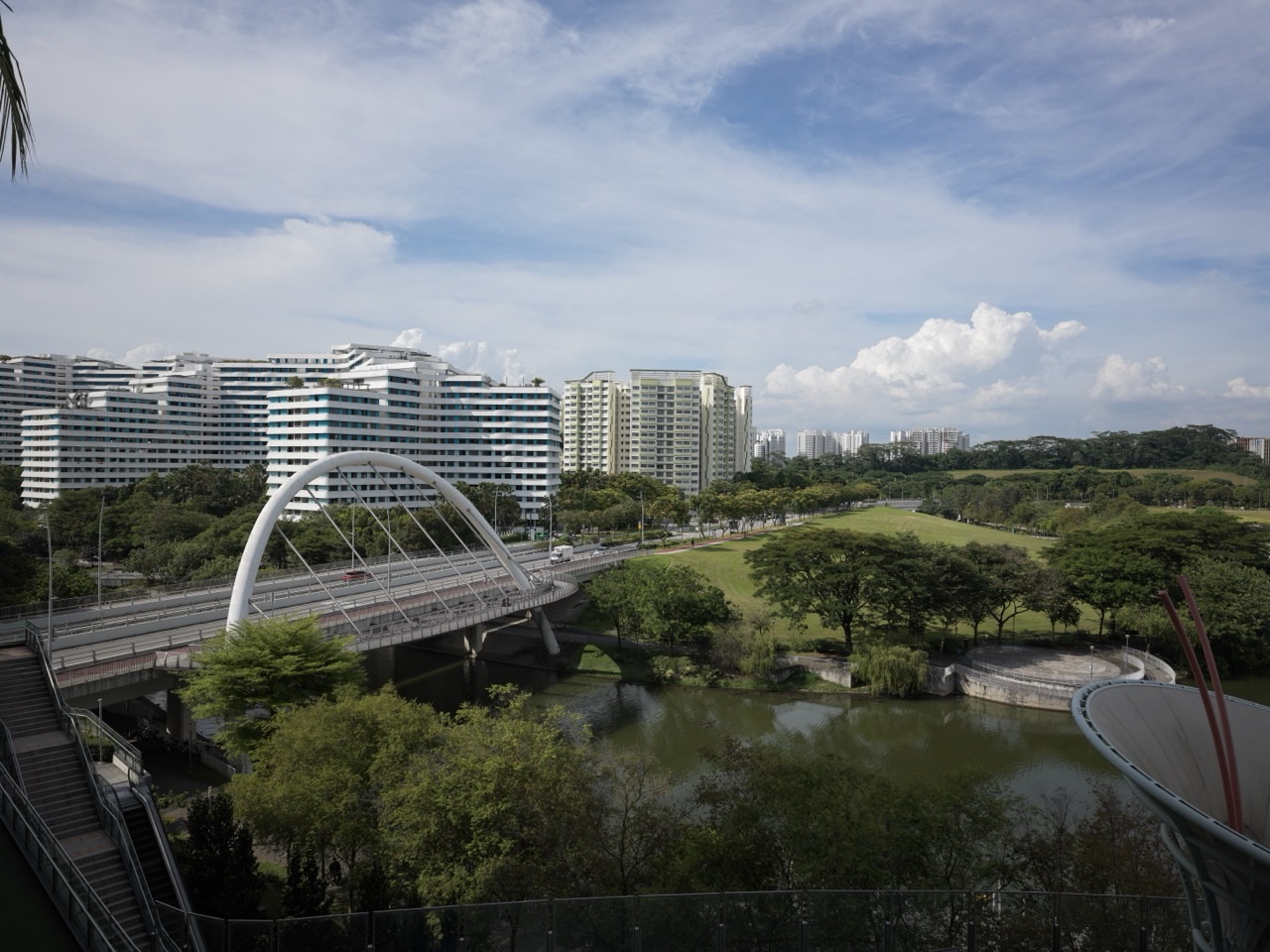
Header: Punggol Waterway Park’s canal and bridge. This is a public water landscape, not a wastewater channel or treatment plant; protecting receiving environments is one reason the less visible used-water system matters.
The gold standard of wastewater is a complete, accountable route for used water: collect it appropriately, treat it for the required outcome, manage the remaining materials and verify the destination. Making water look clearer is not the same as establishing suitable quality.
Wastewater connects ordinary activities with a system most people rarely see. Homes, businesses and industries produce different flows and constituents. Pipes, treatment processes, monitoring, maintenance and responsible discharge or reuse turn those flows into a managed service.
This root connects the Wastewater Engineering, Treatment Plants, Urban Wastewater Management and Water Reuse branches. The numerical examples are fictional learning cases. They are not a treatment design, permission to discharge or guidance for handling sewage.
Full chapter index
1–4 · Foundations and first explanations
5–8 · Worked cases and connected ideas
9–12 · Interpretation, evidence and transfer
13–15 · Specialists, questions and sources
CHAPTER 1 OF 15 · Follow the used-water route
1. Begin with the source and intended destination
Wastewater is water changed through use, with a composition that depends on the activity and setting. A domestic flow and an industrial process stream should not be assumed identical. Their collection and treatment requirements need the appropriate context.
Start with two questions: where does the water come from, and what must be true at its destination? The destination might involve an authorised discharge or a defined reuse. Those outcomes are not interchangeable merely because both follow treatment.
A useful system explanation names the source, collection route, treatment boundary, residual streams and receiving environment or user. It should also identify which organisation is responsible at each interface.
For students, draw this route from supplied information. Mark any branch that is not explained. A pipe leaving a diagram is not an answer to the destination question; it is where the next part of the investigation begins.
CHAPTER 2 OF 15 · Follow the used-water route
2. Keep sewerage, drainage and water supply distinct
A water-supply system delivers water for the relevant use. Sewerage collects used water. Drainage handles runoff under the system’s actual arrangement. These functions interact with the urban environment but should not be merged into one generic network.
Arrangements differ between places. EPA’s municipal primer describes sanitary and combined systems in its United States context. That is not a reason to assume a foreign diagram represents a particular Singapore street.
The important habit is to check the actual network and authority. An opening, pipe or channel should not be identified or used by appearance alone. Do not open covers, enter structures or trace buried infrastructure as an informal learning activity.
For a classroom comparison, label separate fictional networks and follow one flow at a time. Then add the interfaces described in the exercise. The model helps students recognise why a wrong connection or missing boundary can matter without turning the lesson into operational instruction.
Source reading: US EPA — Primer for Municipal Wastewater Treatment Systems
CHAPTER 3 OF 15 · Follow the used-water route
3. Understand treatment as a sequence of functions
Treatment combines functions suited to the incoming water and required outcome. EPA’s introductory resource distinguishes physical, biological and chemical processes. These are categories of action, not a claim that every facility has an identical sequence.
Physical separation can remove selected material. Biological processes use organisms to transform suitable constituents under controlled conditions. Chemical processes can change constituents or assist separation. A general label does not establish removal of every substance.
Different process arrangements can combine functions. Read the actual design and performance evidence rather than assuming that the absence of a familiar-looking tank means a function is missing.
For students, put an action word beside each stage in a supplied diagram: separate, transform, disinfect or monitor, as appropriate to the supplied information. Then ask which outcome has been established. A process name becomes useful when the learner can explain its job and limits.
Source reading: US EPA — Primer for Municipal Wastewater Treatment Systems
CHAPTER 4 OF 15 · Build the Mathematics
4. Distinguish concentration from pollutant load
Concentration describes an amount of a constituent per volume. A pollutant load describes an amount passing a boundary over time. Flow links them. A smaller concentration does not by itself establish a smaller total load.
If water volume increases while the constituent mass remains the same, the concentration can decrease without removing that mass. This is why dilution and removal must not be treated as synonyms.
A useful report specifies the constituent, unit, flow period and measurement method. Results for different constituents are not interchangeable: a favourable solids result does not establish a favourable result for everything else.
Before calculating, check the units. Milligrams per litre multiplied by cubic metres per day needs a conversion. The worked example makes that conversion explicit so that the number retains its physical meaning.
CHAPTER 5 OF 15 · Build the Mathematics
5. Worked example: convert concentration and flow into load
Consider a fictional steady flow of 1,000 cubic metres per day containing 200 milligrams per litre of one specified constituent. One cubic metre is 1,000 litres, and one kilogram is 1,000,000 milligrams.
The daily load is 1,000 × 1,000 × 200 ÷ 1,000,000 = 200 kilograms per day. Equivalently, with these units, load in kilograms per day is flow in cubic metres per day × concentration in milligrams per litre ÷ 1,000.
Suppose the simplified outlet flow is the same and the outlet concentration is 20 milligrams per litre. The corresponding load is 20 kilograms per day. The difference is 180 kilograms per day, or 90 per cent of the stated incoming load.
This is a calculation for one constituent under stated assumptions. It does not establish compliance, drinking-water suitability or removal of every contaminant. Real assessments need representative measurements, compatible periods, other relevant streams and the applicable requirements.
CHAPTER 6 OF 15 · Build the Mathematics
6. Worked example: lower concentration can mean the same load
Take a second fictional case. Flow rises to 2,000 cubic metres per day while the specified constituent concentration falls to 100 milligrams per litre. The load is 2,000 × 100 ÷ 1,000 = 200 kilograms per day.
That is the same constituent mass per day as the first example’s inlet, despite half the concentration. A headline announcing a 50 per cent concentration reduction would not establish a 50 per cent reduction in this load.
The arithmetic does not tell us why the flow changed. Nor does it establish that dilution occurred in a real system. It shows the information needed to interpret a claim: concentration and flow belong together when the question concerns mass per time.
Ask students to compare three possible statements: concentration fell, load fell, and treatment improved. Which is established by the supplied numbers? In this case only the concentration statement is supported without additional evidence about the process and comparison.
| Fictional case | Flow | Concentration | Specified load |
|---|---|---|---|
| First inlet | 1,000 m³/day | 200 mg/L | 200 kg/day |
| First outlet | 1,000 m³/day | 20 mg/L | 20 kg/day |
| Second comparison case | 2,000 m³/day | 100 mg/L | 200 kg/day |
CHAPTER 7 OF 15 · Follow every output
7. Follow the separated and transformed materials
Treatment does not make every incoming substance vanish. Some material is separated into residual streams; some is transformed; some remains in the water. A complete account follows the relevant destinations rather than ending when the main water stream looks improved.
EPA’s primer includes residuals and biosolids as part of the treatment system. The appropriate management depends on the material and jurisdiction. A general educational description cannot authorise a particular reuse or disposal route.
In a fictional dewatering example, 1,000 kilograms of wet material contains 2 per cent dry solids: 20 kilograms. If a later 200-kilogram wet material contains the same 20 kilograms of dry solids, its dry-solids fraction is 10 per cent.
The wet mass fell by 800 kilograms because water was removed in this simplified case. The dry-solids mass did not fall by 80 per cent. This distinction is valuable whenever a report compares wet quantities, dry quantities and a claimed reduction.
Source reading: US EPA — Primer for Municipal Wastewater Treatment Systems
CHAPTER 8 OF 15 · Follow every output
8. Read Singapore’s used-water loop without skipping stages
PUB describes the Deep Tunnel Sewerage System as infrastructure for used-water collection, treatment, reclamation and discharge. The connection matters: collecting a flow and producing a usable reclaimed-water output are different functions within a longer chain.
PUB’s NEWater explanation describes further purification of treated used water. Its resources distinguish the reclamation pathway from the wider receiving and use arrangements. The word recycled is not a substitute for understanding those steps.
Avoid presenting planned infrastructure as already operational. PUB’s current DTSS page describes phased commissioning of the second-phase network and Tuas Water Reclamation Plant from 2027. Readers making a current project decision should consult the latest official update rather than rely on a general guide.
For learners, annotate a simplified loop with source information and dates. Clearly distinguish an existing function, a described technology and a future milestone. That habit transfers to many infrastructure announcements, where completion of one construction stage is not the same as a fully operating service.
Source reading: PUB — Deep Tunnel Sewerage System · PUB — NEWater
CHAPTER 9 OF 15 · Check intended use
9. Understand reuse as fit for a defined purpose
Reuse needs a destination with defined requirements. Water suitable for one industrial process is not automatically suitable for another use. The relevant quality, delivery arrangements, monitoring and authorisation must fit the actual purpose.
PUB’s NEWater resources provide a concrete Singapore example of additional purification and designated uses. Follow the official explanation rather than reducing it to the slogan that a single filter turns any used water into any desired product.
The Water Reuse Management, Industrial Water Reuse Engineering and Membrane Separation branches explore different parts of that question. A membrane’s existence alone does not establish integrity, operating performance or the suitability of the complete output.
For a classroom decision, supply two fictional users with different stated requirements. Ask whether the available results answer each user’s question. The correct response may be that the data are insufficient, even if both users are described loosely as industrial.
Source reading: PUB — NEWater · PUB — NEWater Quality
CHAPTER 10 OF 15 · Check intended use
10. Protect the evidence chain behind performance claims
A result belongs to a sample, location, time, method and parameter. Records should preserve those connections. An isolated favourable number becomes much less useful when its origin or relationship to the relevant flow is unclear.
Representative sampling and compatible accounting periods matter when comparing input and output. A simple average of selected readings may not answer the question a report claims to answer. Explain the basis rather than allowing a spreadsheet format to imply validity.
Applicable requirements also depend on the discharge, place and authority. This guide does not set a universal numerical limit. The Trade Effluent and treatment-company guides direct readers toward distinct responsibilities rather than a one-size-fits-all threshold.
For students, write a bounded conclusion using the supplied data and a separate request for missing evidence. A fluent explanation should not be allowed to invent a laboratory result, a permit or an unseen operating record.
To compare period loads while accounting for changing stored amounts, follow The Gold Standard of Wastewater | Comparing Inlet and Outlet Loads When Material Remains Stored.
Qualified concentrations can bound a period load without fixing one exact total. Bounding period loads when concentrations are reported below a limit preserves represented volumes, sample-specific bounds, missing intervals and the distinction between a compatibility range and a substituted estimate.
CHAPTER 11 OF 15 · Check intended use
11. Keep operation, maintenance and safe responsibility visible
An operating system needs competent people, maintained assets, monitoring and arrangements for abnormal conditions. A new plant or completed pipe is the beginning of an ongoing service responsibility, not the end of the story.
Wastewater infrastructure is not an informal exploration space. Students and visitors should stay within authorised educational arrangements. Do not handle sewage, enter chambers or attempt a repair because a general explanation makes the process seem familiar.
For an organisation, ordinary readiness includes knowing who reviews results, who responds to a concern and how unresolved actions are tracked. A maintenance task and verification of the relevant operating outcome should remain distinguishable.
A useful teaching scenario gives a handover record with one missing responsibility. Ask who is expected to act next and what evidence they need. The lesson is that dependable infrastructure combines technology with clear continuity of work.
CHAPTER 12 OF 15 · Check intended use
12. Learn the whole system, then choose the specialist branch
Begin by separating the water route from the residual routes. Explain the difference between concentration and load, then work one conversion carefully. Repair the units before adding more constituents or more complicated flows.
Next, compare the equal-load example and the wet-solids example. In both, a changed percentage can sound impressive while describing a narrower change than the reader assumes. State the denominator and follow the actual quantity.
For extension, examine the route from collection to intended reuse or discharge, the monitoring record and the responsibility for ongoing operation. Use the specialist directory to deepen the stage that matters for the reader’s purpose.
The gold standard of wastewater is a verified outcome across the entire route. Follow the water, follow the remaining material and keep the evidence connected to both. The less visible parts of everyday life deserve explanations as careful as the parts we can see.
Use these existing ecosystem guides to deepen the question that matters to you. Their different scopes are deliberate: an introductory root, a specialist method and an operating service do not establish the same things.
Follow the complete used-water system
The Gold Standard of Wastewater Engineering | From Used Water to Safe Reuse — Engineering from collection to reuse.
The Gold Standard of Wastewater Treatment Plants | Controlled Flows, Clean Effluent and Accountable Recovery — Controlled flows and accountable treatment.
The Gold Standard Of Urban Wastewater Management — Urban wastewater as a managed service.
The Gold Standard of Environmental Engineering | Pollution Prevented, Performance Proven — Pollution prevention and proven performance.
Choose the intended treatment and reuse route
The Gold Standard of Water Treatment Companies | Valid Quality Results, Safe Plants and Lawful Discharge — Quality results and treatment responsibilities.
The Gold Standard Of Water Reuse Management — Managing reuse for a defined purpose.
The Gold Standard of Industrial Water Reuse Engineering | Fit-for-Process Quality and Verified Savings — Fit-for-process industrial recovery.
The Gold Standard of Membrane Separation Engineering | Selectivity, Integrity and Useful Output — Membrane integrity and separation performance.
Protect the interfaces and evidence
The Gold Standard of PUB Trade Effluent Written Approval Services | Lawful Discharge and Protected Water Reclamation — Trade-effluent responsibilities and reclamation.
The Gold Standard of Grease Trap Maintenance Services | Clear Flow, Licensed Collection and Verifiable Disposal — Grease-trap maintenance and disposal records.
The Gold Standard of Drain Cleaning Services | Clear Flow, Safer Work and Verified Drainage — Clear flow and controlled maintenance.
The Gold Standard Of Water Quality Monitoring — Traceable water-quality measurements.
What is the gold standard of wastewater?
A complete, verified route through collection, treatment, residual management and an appropriate destination.
Does clear-looking water prove suitable quality?
No. Relevant measurements and the intended use are necessary.
Are concentration and load the same?
No. Concentration is amount per volume; load is amount per time.
Does dilution remove pollutant mass?
Not in the simplified equal-mass example. It changes concentration without establishing mass removal.
Does less wet sludge mean the same reduction in dry solids?
No. Water content can change the wet mass while dry solids remain unchanged.
Does this guide permit discharge or reuse?
No. Actual activities require the appropriate current requirements, authorisation and competent assessment.
The resources below support the concepts and reading routes. Use current primary information for actual requirements, conditions or editions; the teaching examples in this guide have deliberately stated limits.
US EPA — Primer for Municipal Wastewater Treatment Systems
PUB — Deep Tunnel Sewerage System
Keep the learning usable
Return to The Gold Standard of Education to connect knowledge, explanation and judgment across subjects.
For a concrete Mathematics learning route, explore Secondary 1 Mathematics Tutor Clementi — small-group tutorials. Begin at the first unstable step, make the relationship clear and practise applying it under changed conditions.