
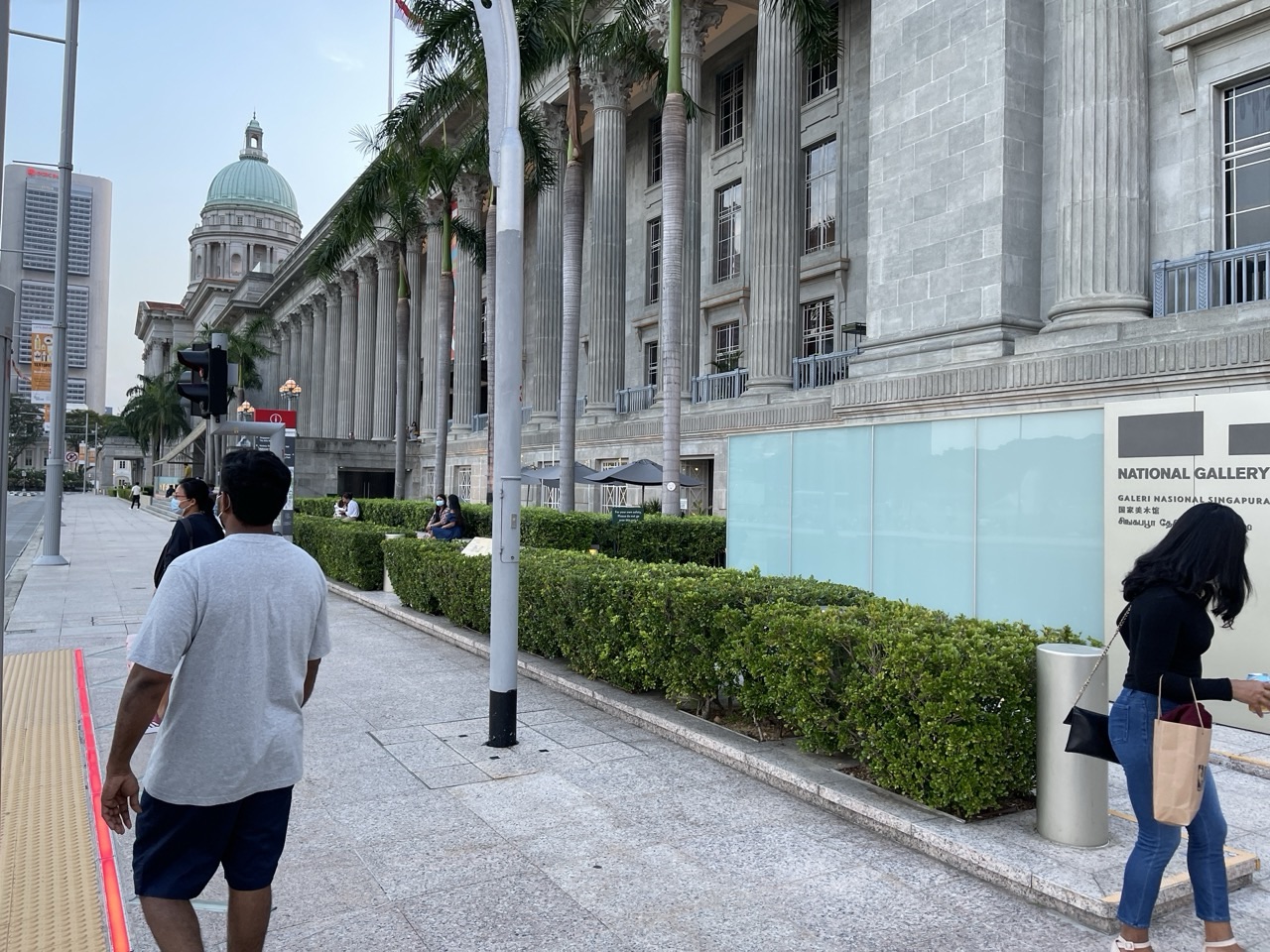
Things to do near City Hall MRT for free: explore the Padang and St Andrew’s Cathedral from permitted public areas, walk the National Heritage Board’s Civic District Heritage Trail, visit National Gallery Singapore’s free-entry spaces, and enjoy family art activities at the Keppel Centre for Art Education. City Hall station (NS25/EW13) is an interchange for the North–South and East–West Lines. It puts historic civic buildings, museums, shops and public streets within walking distance, without requiring a paid tour or a shopping trip.
For a simple first visit, take City Hall MRT Exit B → National Gallery Singapore → the Padang and nearby civic landmarks → a choice of free gallery spaces or a short NHB heritage route. The Gallery advises that it is around seven minutes’ walk from Exit B, opens generally 10am–7pm and offers selected unticketed areas to everyone. Singapore citizens and permanent residents have free general admission to many regular exhibitions, while overseas visitors pay for relevant exhibition tickets. A major 2026 update matters: UOB Southeast Asia Gallery is temporarily closed until late 2027; other collections and exhibitions remain available. Families should also check the Keppel Centre’s daily cleaning intervals before promising an activity to children.
Quick answers:
- Station: City Hall NS25/EW13, North–South and East–West Lines.
- Best exit for art and civic history: Exit B towards National Gallery, St Andrew’s Cathedral and Padang.
- Best easy shelter and food base: Raffles City, linked to Exit A.
- Free family art: Keppel Centre for Art Education at National Gallery Singapore, Level 1.
- Free gallery areas: selected public exhibitions, ArchiGallery and rooftop or deck spaces, subject to current operator access.
- Gallery hours: generally 10am–7pm, last admission 6.30pm.
- Keppel Centre: cleaning closures 12.30–1pm and 3.30–4pm; last entry 6.40pm.
- Important closure: UOB Southeast Asia Gallery closed until late 2027.
- Official heritage route: NHB’s Journey to Nationhood short trail, approximately 550 metres, or longer thematic trails.
Choose art, public history or a family afternoon
City Hall is one of Singapore’s busiest historical meeting points. The same station can serve a museum visitor, a family heading to an art activity, a commuter meeting friends at Raffles City and a student trying to understand national history. All may walk through the same neighbourhood, but their goals, budgets and walking tolerance are different.
Decide what you want to learn or enjoy before leaving the fare gates. If the objective is civic history, the Padang and former City Hall buildings are an effective starting point. For art, the National Gallery deserves most of the afternoon. For younger children, the Keppel Centre offers a free family-focused indoor activity. If the purpose is a meal and a short stroll, do not pressure everyone into a long heritage route.
| Your goal | Start with | What to avoid |
|---|---|---|
| 45-minute public history | Padang and former City Hall | Full 22-stop trail |
| Free art for children | Keppel Centre | Arriving during cleaning closure |
| Two-hour art afternoon | National Gallery and its free areas | Assuming every exhibition is free |
| Heritage walk and photo stops | NHB short civic trail | Entering restricted buildings |
| Rain, food or easy rest | Raffles City and selected galleries | Outdoor long loop in lightning |
A good day out does not need to include the National Museum, Esplanade, Singapore River, Fort Canning and every gallery in between. Some destinations lie beyond the immediate City Hall MRT cluster. Leaving them for another visit makes the current outing easier and more meaningful.
City Hall MRT exits: the easiest way to avoid needless walking
City Hall station is NS25/EW13. For the Civic District and National Gallery, Exit B is a practical choice. National Gallery Singapore’s own directions describe an approximately seven-minute walk from City Hall MRT Exit B along the Art Connector. The operator’s route information is more useful than a generic map pin when you want to reach a particular museum entrance.
Exit A is convenient for Raffles City and the part of the district around CHIJMES, Raffles Hotel and Bras Basah. Exit D connects towards Capitol Singapore and Funan, while Exit C is relevant for CityLink Mall and longer walking connections towards the Esplanade precinct. These are not interchangeable directions, especially when travelling with older relatives, young children or shopping bags.
Before leaving the station, decide whether the first stop is a museum, a public landmark or a meal. If you follow other commuters into a mall without knowing your destination, you may spend unnecessary time searching for an exterior landmark from inside a multi-level retail space. A few seconds reading the signs can save ten minutes of backtracking.
Use current station and building signs for lifts and step-free access. For a group, name a specific meeting place, such as the designated National Gallery visitor entrance or a clear mall landmark, rather than just saying “City Hall MRT”. The station has several exit directions and people can reach different street corners.
The eduKate City Hall MRT guide gives fuller station and exit details. This article concentrates on walking activities and how to choose among them.
Free stop 1: Padang and the former City Hall
The Padang is a major open civic landmark near City Hall MRT. Together with the former City Hall and Supreme Court buildings, it offers a striking introduction to Singapore’s political and public history. Looking towards the National Gallery, visitors see buildings that once served government and judicial functions and have since been adapted for public art and cultural use.
National Heritage Board describes the former City Hall as completed in 1929 and the former Supreme Court as completed in 1939. The site is connected to national milestones, including the swearing-in of Singapore’s first fully elected government in 1959. The two buildings now form National Gallery Singapore. That is an unusually clear example of changing function without erasing a landmark.
A family can appreciate the exteriors from authorised public areas without entering a ticketed exhibition. Ask children how they can tell a civic building from a shopping mall. They may notice columns, a dome, broad steps or a formal open space. Then explain that architectural style is only a clue; the historical function of a building needs sources rather than assumptions.
Be aware that the Padang may be used for ceremonies, national events, preparations or other activities. Public access to portions of the space can change. Do not enter cordoned areas, walk across event setups or assume that an open lawn is always available for games. Use signed paths and respect security instructions.
The official Civic District Heritage Trail provides the documented context. It is a better starting point than guessing at the meaning of a historic building from its appearance alone.
Free stop 2: St Andrew’s Cathedral and a respectful architecture walk
St Andrew’s Cathedral is a well-known landmark close to City Hall station. National Heritage Board describes it as the oldest surviving Anglican place of worship in Singapore, consecrated in 1862. Its white Gothic-style exterior and grounds present a visual contrast with the civic buildings, office towers and shopping complexes nearby.
The cathedral is an active religious institution. Visitors can appreciate its exterior from permitted public viewpoints, but interior access depends on worship, events, opening arrangements and the cathedral’s own visitor rules. A guided visit may be possible under particular conditions; do not assume that a public heritage listing gives unrestricted entry to every area.
A simple observation task is to compare the cathedral’s pointed arches and vertical forms with the broad classical geometry of the old civic buildings nearby. Why might two institutions built for different purposes use different architectural styles? A primary-school child can begin with shapes and purposes. A secondary student might ask how ideas about authority, identity and design influenced colonial-era architecture.
Keep a respectful distance from worshippers and do not interrupt services to photograph interiors. If the grounds are busy or there is an event, continue the exterior walk rather than insisting on entry. A good civic district guide helps people recognise that public history and living community functions overlap.
For some families, the cathedral and Padang are enough for an enjoyable short walk before a visit to the Gallery. There is no obligation to add more sites merely because they appear on the same trail map.
National Gallery Singapore: free access and ticketed exhibitions explained
National Gallery Singapore occupies the former City Hall and Supreme Court buildings at 1 St Andrew’s Road. The main art museum generally opens 10am–7pm daily, with last admission at 6.30pm. Its architecture and public spaces are worth exploring, but admission requires a careful distinction between places that are free for everyone and exhibitions that require an admission pass.
The operator’s current visitor page lists several non-ticketed areas open free to all visitors. These include parts of the Ngee Ann Kongsi Concourse Gallery, the Keppel Centre for Art Education, the Chief Justice’s Chamber and Office historical display, the ArchiGallery and public rooftop or deck spaces, subject to current access arrangements. Because temporary displays rotate, always confirm what remains open on your chosen date.
Singapore citizens and permanent residents enjoy free general admission to eligible regular exhibition spaces, with identity verification requirements. Standard general admission for other nationalities is currently listed as S$20, and other categories and concessions apply. All Access and special exhibitions can cost extra even for a local resident, so “free general admission” does not mean every ticketed show is included.
Visitors should consult the official National Gallery visitor information for admission categories, operating hours and current galleries. If your family mainly wants an indoor place for children to create art and understand the building, a free-area itinerary may be enough without any paid exhibition.
The museum recommends allowing significant time for a broader art visit. Resist the temptation to rush through a large collection merely because you already made the journey. One carefully chosen artwork may lead to a richer family conversation than a dozen rooms explored at examination speed.
The 2026 closure: UOB Southeast Asia Gallery is not open
Some travel articles and school-visit guides still direct visitors to the UOB Southeast Asia Gallery as if it is open in late 2026. National Gallery Singapore’s current official notice says that the UOB Southeast Asia Gallery is temporarily closed and is expected to reopen in late 2027. The museum itself is not closed. Works from the National Collection remain displayed in other areas, and different exhibitions continue.
This is an important distinction for a family planning an art learning journey. An attraction’s name can remain in a guide after its physical galleries have been closed for renovation. If the purpose of the trip is a particular collection or artwork, verify its present location rather than arriving and discovering the gallery is unavailable. Museum operators may move works, change display rooms or alter routes as renovations progress.
One current alternative for visitors wanting Southeast Asian art is Let’s Imagine the World Together: Art in Southeast Asia, which the Gallery lists from 5 November 2026 to 26 September 2027 in the Level 4 Gallery. It requires a general admission ticket rather than being one of the universal unticketed free areas. Check admission category and current availability before promising this exhibition to a child or school group.
For a completely free-first visit, choose the ArchiGallery, Keppel Centre and other listed public areas instead. Do not present a paid or ticketed substitute as though it were part of the free public itinerary.
See the Gallery’s current exhibition listing and closure and admission guidance for date-specific information.
Keppel Centre for Art Education: the family stop with cleaning intervals
The Keppel Centre for Art Education is one of the most useful family-friendly stops near City Hall MRT. It sits in the City Hall Wing, Level 1, of National Gallery Singapore and provides interactive art-focused spaces for young visitors. General access is free, although some separately scheduled workshops or programmes may have charges or registration requirements.
The operator lists it as open daily, with two important regular cleaning intervals: 12.30pm–1pm and 3.30pm–4pm. Last entry is generally 6.40pm. These are exactly the details that make a family outing easier. A parent who arrives at 12.40pm expecting immediate entry may meet a temporarily closed activity space despite the Gallery itself being open.
The Centre can become busy on weekends. National Gallery advises that waits may reach around 30 minutes or longer when capacity is reached. If your child has limited patience, try an earlier weekday visit when possible or have a simple backup such as viewing one freely accessible public exhibition. Do not rely on guaranteed admission at a precise time if the space is full.
For a child, the aim is to experiment with art and learn to describe what they have made. A good question is, “Which colour or shape did you choose, and why?” Avoid demanding a perfect picture. The learning comes from observation, choice and explanation, not from an adult ranking the result.
Read the Keppel Centre’s official visitor guidance for age suitability, access, family rules and current programmes before setting out.
Free ArchiGallery: how old buildings become a modern museum
One of National Gallery Singapore’s most suitable free public attractions is the ArchiGallery on Level 4, which interprets the transformation of the former City Hall and Supreme Court buildings. Its ongoing exhibition, Listening to Architecture: The Gallery’s Histories and Transformations, is listed as free to enter and explains how the building’s past and present connect.
This is a particularly useful stop because it helps visitors understand the museum itself rather than only the artworks hanging inside. Buildings are not neutral containers. Their former uses, layouts and materials shape how people encounter them. An old courtroom or office corridor has a different atmosphere from a purpose-built modern white-box gallery.
For younger children, ask them to find one element that looks historical and another that seems more recently added. For older students, ask what a conservation architect should preserve when changing a public building’s function. Keeping every detail unchanged may make a building difficult to use; altering everything may destroy the evidence that makes it meaningful. This tension is a valuable introduction to design trade-offs.
The Gallery notes that the area is step-free overall, though some display elements within ArchiGallery include steps and may not be accessible to every visitor. Use its access advisory and choose the available route for your group. Accessibility should be considered at the level of the exact exhibition object, not merely the building entrance.
Read ArchiGallery’s current exhibit and accessibility information. If the space is temporarily affected by an event, use another free-area stop rather than insisting on entering a closed room.
Roof gardens, decks and the free view from inside a civic landmark
National Gallery Singapore identifies public spaces such as the Ng Teng Fong Roof Garden Gallery and the Padang and Coleman Decks among its unticketed areas, subject to current access. These provide a different experience from traditional exhibition rooms. You can consider the scale of the surrounding city, see historic façades from an elevated perspective and ask how an older civic complex has been adapted to welcome contemporary visitors.
Because exhibitions and installations rotate, a travel guide should not promise that a particular rooftop artwork will remain on display indefinitely. Check the operator’s current free-area list. Rooftops can also have different rules during severe weather, private events or maintenance work. A freely accessible space on an ordinary day may not be available at the exact moment you arrive.
For children, a view from a deck can encourage observation of urban patterns: street grids, greenery, paths between buildings and different roof shapes. Ask them to identify the Padang and consider why a large open space is preserved near high-value city land. Older students can discuss how a civic district serves public life as well as tourism.
Do not lean over railings, climb on structures or block circulation routes for photographs. Public art is not necessarily designed to be touched or used as seating. Follow signs and staff directions, especially if the view attracts a crowd near the edge of a public deck.
A short roof-garden visit may be enough to end a museum afternoon. People often remember a single clear view and a conversation more vividly than a hurried attempt to cover every floor.
NHB Civic District Heritage Trail: use a shorter route first
The National Heritage Board’s Civic District Heritage Trail provides an evidence-based framework for exploring this part of Singapore. Its main online trail lists 22 points, but the heritage agency also offers shorter thematic routes. One is Journey to Nationhood, approximately 550 metres and an estimated 30-minute walk. Others include Functions of the Civic District, about 2.2 kilometres, and Seeking Fortunes, Forging New Lives, about 1 kilometre.
For a family with younger children, the 550-metre approach is often more sensible than trying to cover every building. The half-hour figure is a walking estimate, not a guarantee for people who stop to read markers or require frequent rest. Treat the official trail as a menu of meaningful stories rather than a race. It is perfectly reasonable to do one short section now and revisit the rest later.
The heritage route includes sites connected to government, courts, monuments, museums, places of worship and public gathering spaces. The point is to understand their changing functions. Do not assume that being on a heritage trail grants the right to enter a court, government building, parliament compound or religious venue without following its visitor rules.
For a first outing, select the former City Hall, Padang and one nearby landmark. Ask what the buildings were used for, who could access them in the past and how public use has changed. This provides enough history for a satisfying morning without exhausting a child or an older visitor.
Download or consult the NHB online Civic District Trail, where the short routes and their supporting histories are presented.
CHIJMES, Raffles City and Capitol: architectural interest without a ticket
Not every worthwhile City Hall stop is a museum. CHIJMES, the nearby Raffles City complex and the Capitol area offer a chance to see how conservation, retail and public access coexist. A family that needs food, shelter or a shorter itinerary may find these destinations more practical than a long open-air heritage walk.
CHIJMES is a conserved complex associated with a former convent and school. Its recognisable chapel architecture gives visitors a strong contrast with the modern buildings around it. It is now used for dining, events and commercial activities; the heritage character does not mean every interior room is a permanently open free museum. Private functions may restrict access. View permitted public spaces respectfully and follow event notices.
Raffles City is useful as an arrival or rest point from City Hall MRT Exit A. You do not have to buy anything to benefit from its shelter and wayfinding, but restaurants and shops operate commercially. If young children need a meal, choose that before adding too much walking. Tiredness can turn a pleasant architectural outing into a stressful one.
At the Capitol side, consider how an old performing-arts or commercial building has been integrated with contemporary retail. Ask children whether a building can be historically important even when its present use is different. Then consider how shops, transport and public spaces affect whether people continue to use heritage buildings.
These areas can form a useful rainy-day alternative when outdoor civic sites are uncomfortable. Do not rely on obsolete tenant names, and check current public access if your visit is built around a particular chapel, event or venue.
War Memorial Park and the responsibility of visiting memorials
War Memorial Park sits near the City Hall and Raffles City area and contains the Civilian War Memorial. It provides a quieter kind of public-history experience than the museum or the shopping streets. The site commemorates civilians who lost their lives during the Japanese Occupation of Singapore. A memorial is not simply a distinctive shape to photograph; it is a place where grief, remembrance and historical interpretation matter.
For families with younger children, a brief respectful visit can be appropriate if the discussion suits their age. Explain that people use monuments to remember difficult events and honour those affected. Avoid giving graphic detail that the child is not ready to understand. Older students can ask why nations construct memorials and how public remembrance shapes collective memory.
Keep voices considerate and do not use memorial steps or surfaces as play equipment. Follow any event restrictions or ceremonial arrangements. If people are attending a remembrance activity, allow them space and privacy. Taking a photograph of a memorial from a public pathway is different from treating mourners as a tourist display.
The site’s story connects with the wider Civic District, but it need not become a long history lecture. Ask one clear question: What does a memorial help a community remember? Then look for the official interpretation rather than inventing a dramatic story about the monument’s design.
A trip to War Memorial Park is best paired with another calm stop, not a noisy activity planned immediately beside the monument.
The longer option: Victoria Theatre, Esplanade and civic waterfront
Visitors with more time can extend a City Hall outing toward Victoria Theatre and Victoria Concert Hall or the Esplanade waterfront. These are meaningful destinations but should not be described as immediately beside the station. Walking time depends on the chosen route, crossings and whether the family is navigating crowds or carrying bags.
National Heritage Board includes Victoria Theatre and Concert Hall in its Civic District trail. The complex is significant for Singapore’s performing arts history and occupies historic buildings linked by a clock tower. Public views of its exterior offer an easy architectural observation; performances, tours and particular interiors may require tickets or bookings.
The Esplanade – Theatres on the Bay offers a changing programme of performances and activities, including some free public shows. But a free performance is not necessarily happening at the moment you arrive. Check Esplanade’s current visitor and programme information, noting any cancellations, space access and photography rules.
For families, the longer route works best when the performance or public artwork is the main objective. Arrive for a verified event, take a small surrounding walk and return. Do not promise a “free concert every night” based on an old festival programme; event calendars change across weeks and months.
Older children can consider why a city places theatres and museums in a district once strongly associated with governance. Cultural institutions provide ways for the public to discuss society, history and identity. That connection makes the walk richer than simply moving from one pretty building to the next.
What costs nothing, what requires a pass and what needs booking?
When people search “free things to do near City Hall MRT”, the answer should not mix unticketed public space with exhibitions that require identification or a purchased ticket. Outdoor views of the Padang and public heritage façades generally cost nothing. National Gallery has a defined list of spaces open free to everyone. General exhibitions are free for eligible Singapore citizens and permanent residents but cost money for some other visitors. Special or All Access exhibitions may require additional payments even for locals.
The Keppel Centre is free for general entry, with separate rules for certain organised programmes. The ArchiGallery is explicitly listed as free. NHB’s self-guided public trail can be followed without paying for a commercial tour, but it does not grant interior access to every building along the route.
| Activity | Admission position | Practical check |
|---|---|---|
| Public heritage exteriors and short trail | Generally free | Event barriers and respect for sites |
| National Gallery free areas | Free for all where designated | Current list and operating hours |
| Keppel Centre | Free general access | Cleaning breaks and capacity |
| Gallery general exhibitions | Local residents free; others ticketed | Identity and exhibition eligibility |
| All Access or special exhibitions | Separate pricing | Exact ticket inclusions |
| Performance at a theatre | Free or paid depending on event | Calendar, tickets and seat rules |
Choose your budget before leaving home. A free-first outing can combine one short NHB trail section with the Gallery’s unticketed areas. A low-spend afternoon adds lunch. A ticketed gallery experience focuses on one specific exhibition and gives it enough time.
Family itineraries: 45 minutes, two hours and half a day
45 minutes: outside architecture and history
Use City Hall Exit B, enjoy a permitted public view of the former City Hall and Supreme Court, then look towards the Padang and one nearby civic landmark. Discuss one historical fact and return comfortably. This is suitable for a short stop between appointments or for an older family member who prefers limited walking.
Two hours: free art and a short city walk
Make National Gallery the anchor. Visit one listed free space such as ArchiGallery or the Keppel Centre if it suits the children’s ages, then take a short look at the surrounding civic architecture. If you are travelling around lunchtime or mid-afternoon, account for Keppel’s cleaning closures. Do not arrive with a promise of immediate entry when the operator has published a break.
Family half-day: art, public space and lunch
Start with the Keppel Centre, choose one public exhibition or roof/deck space, pause for a meal and finish with a short NHB trail section. Keep the historical discussion focused on a few landmarks rather than trying to teach all of Singapore’s political history in one afternoon. If the weather becomes uncomfortable, use the indoor art time as the main achievement.
Older students: civic functions route
Choose a longer NHB thematic route if students are ready for a more demanding walk. Compare the functions of a courthouse, city hall, parliament, museum and place of worship. Ask which institutions serve the public and how their roles differ. The emphasis should be on reasoning from historical evidence, not merely photographing a nameplate.
Free performance version
If there is a verified free Esplanade event, use that as the fixed appointment and keep the Civic District stroll short. A scheduled performance is much easier to enjoy when the family has not spent the previous three hours walking in the heat.
Comfort, accessibility and safe public-space behaviour
City Hall is well connected to public transport, but heritage visits include pedestrian crossings, open spaces, older buildings and busy commercial corridors. A stroller-friendly mall connection does not guarantee that every historic site has step-free interior access. Check station lifts and the specific public entrance of the museum or venue you plan to use.
National Gallery lists accessible restrooms, ramps, lifts and wheelchair-related services at its visitor entrances. It also notes that some exhibition elements may have their own access limitations. A visitor with mobility needs should consult its current venue advisory and choose a realistic route rather than assuming the entire building is equally accessible.
For families, agree on a meeting point before anyone explores separate rooms. Children should not run through galleries, touch artworks unless invited, or block an accessible passage. Photography varies by exhibition and programme; read the posted rules. Some public displays may welcome casual pictures while other exhibition rooms restrict flash or recording.
On the streets, avoid stopping at traffic signals to take a group photograph or crossing against the lights because a monument looks close. Heat and thunderstorms can change the pace substantially. During lightning, leave open areas such as the Padang and find appropriate shelter. The city will still be there when conditions improve.
A good accessible itinerary is one the whole group can complete safely and without pressure. If a companion needs rest, choose a shorter museum-and-café visit. It is unnecessary to prove that everyone can walk the full 2.2-kilometre civic route.
Learning through the city: history, art and how institutions work
City Hall offers a chance to connect many school subjects with buildings students can actually see. The trick is to choose a question that makes sense for the child’s age. A list of dates alone does not explain why the district matters. A child who can distinguish the role of a court, a city hall and a museum is beginning to understand how public institutions work.
Ages 5–8: name places and their purposes
Ask a young child what people do at a museum, in a church or in a public square. Then show how the buildings look different. Keep explanations short and let the child ask questions. At the Keppel Centre, encourage creating and describing rather than copying an adult’s idea of what the art should look like.
Ages 9–12: connect a building with a historical change
Explain that the buildings which house National Gallery once served City Hall and the Supreme Court. Ask how the purpose of the place changed and what might have been preserved. Use NHB’s historic descriptions to verify the answer. The challenge is to explain cause and function, not memorise a complicated date sequence.
Secondary students: compare evidence and interpretation
Investigate the Padang or a selected civic landmark. Ask what evidence supports an account of a major event and why public monuments may emphasise some aspects of a national story over others. Artworks may interpret the past differently from a government archive. Both can contribute to learning, but they do not always make the same kinds of factual claims.
Family read-back
After the outing, each person chooses one building or artwork and explains one thing they noticed, one reliable fact and one unanswered question. This simple approach builds language, reasoning and curiosity without another worksheet. A meaningful visit can feel relaxed while still helping a child understand the world.
Did you know? Five City Hall distinctions
City Hall MRT is a station, not the former City Hall building. The names are related geographically, but the transport hub and historic civic building serve entirely different functions.
National Gallery Singapore occupies two former civic buildings. The former City Hall was completed in 1929 and the former Supreme Court in 1939. Their later transformation into an art museum is part of the visitor experience.
A museum may have both free and ticketed rooms. At National Gallery, designated unticketed public areas are free to everyone, while general or special exhibitions have their own admission rules.
The Keppel Centre has regular cleaning closures. A free family facility does not mean continuously open access through every minute of the museum’s operating hours.
A longer heritage trail is not automatically a better one. NHB publishes a 550-metre Journey to Nationhood route alongside longer itineraries. The shorter choice may be ideal for a family that wants a coherent story without exhaustion.
Frequently asked questions about City Hall MRT
What are the best free things near City Hall MRT?
Visit permitted public viewpoints around the Padang and historic civic buildings, follow a short NHB heritage route, or enjoy designated free spaces within National Gallery Singapore.
Which MRT exit goes to National Gallery Singapore?
Exit B. The Gallery lists an approximate seven-minute walk via the Art Connector.
Is National Gallery Singapore free for Singaporeans?
Singapore citizens and permanent residents receive free general admission to eligible regular exhibitions, subject to verification. Some special exhibitions and All Access tickets cost extra.
Are there free things to do inside the Gallery for overseas visitors?
Yes. The operator lists several non-ticketed spaces open free to all visitors, including ArchiGallery and Keppel Centre, subject to current access.
Is UOB Southeast Asia Gallery open in November 2026?
No. It is temporarily closed, with reopening expected in late 2027. Other exhibitions and free areas remain available.
Is Keppel Centre for Art Education free?
General entry is free. Some separate programmes may have fees. It closes for cleaning twice daily, 12.30–1pm and 3.30–4pm, with last entry at 6.40pm.
How long is the Civic District Heritage Trail?
The NHB online trail contains 22 sites and offers shorter choices, including a 550-metre, approximately 30-minute Journey to Nationhood walk and longer thematic routes.
Can I visit St Andrew’s Cathedral?
Exterior viewing from permitted public areas is straightforward. Interior access depends on current worship and visiting rules, so check with the cathedral before a planned visit.
Can I visit the Padang at any time?
Public access can change for events, ceremonies or operational restrictions. Follow site signage and do not enter cordoned areas.
Is City Hall a good rainy-day outing?
Yes. National Gallery and Raffles City provide indoor options, but their specific facilities have opening hours and access conditions. Avoid exposed public spaces during nearby lightning.
Are Esplanade performances free?
Some are free and others ticketed. Check the Esplanade’s current event calendar; a programme from a past festival does not prove a performance is happening today.
Can I do the route with grandparents or a stroller?
Yes, with a shorter route and careful attention to lifts, crossings, accessible toilets and resting places. Choose one or two destinations rather than insisting on the full heritage circuit.
Official references and next useful reading
Information checked 6 November 2026. Events, gallery installations, ticket categories and access arrangements can change. The newest official venue notice and onsite directions should always take precedence when travelling for a specific programme.
- National Heritage Board — Civic District Heritage Trail and short routes
- National Gallery Singapore — admission, hours, closures and access
- Keppel Centre for Art Education — free entry, cleaning breaks and capacity
- ArchiGallery — free exhibition and access details
- Let’s Imagine the World Together — exhibition dates and tickets
- Esplanade — visitor rules and programme information
- eduKate — City Hall MRT station guide
- eduKate — Chinatown heritage and temple walk
- eduKate — free Orchard Road architecture walk
Start with one civic landmark, one art experience and one unhurried conversation. You do not need an expensive ticket or a full-day itinerary to understand why this part of Singapore matters. The best reason to return is a question you have not answered yet.