
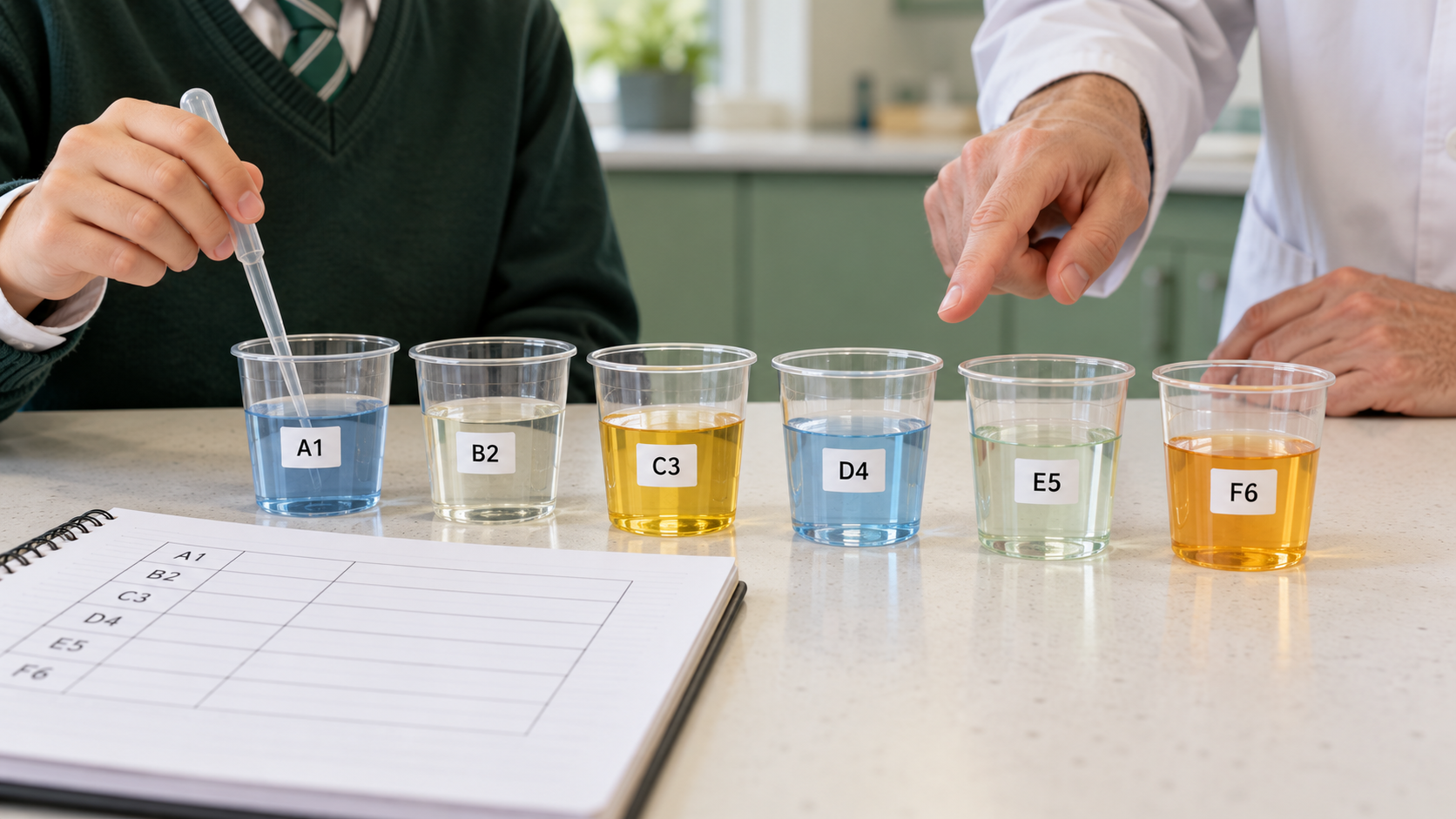
Toa Payoh lower-secondary students can understand Energy Transfer by tracing where energy starts, which object or system receives it and what changes as a result. Energy can be transferred between objects and converted among forms, while the total energy is conserved in an appropriately defined system. A clear explanation does not say that energy disappears when a moving object slows down; it identifies where some energy has moved or been transformed.
Singapore’s MOE G2/G3 Lower Secondary Science syllabus, updated in April 2024, includes Application of Forces and Transfer of Energy as Topic 9. Students recognise transfers and conversions, changes in rest or motion, turning effects and deformation, and the conservation of energy. The syllabus marks pressure investigations, the unit of work and energy in joules, and the school definition of work done as optional for G2. It also connects energy sources with environmental choices. This guide distinguishes the required foundation from extensions without presenting fabricated data about Toa Payoh facilities.
- Track energy through a defined system rather than saying it is lost
- Distinguish a transfer between objects from a conversion between forms
- Recognise chemical, electrical, kinetic, gravitational, thermal, light and sound forms in suitable contexts
- Know that interacting objects can change speed, direction, shape or pressure
- Conservation means total energy is accounted for, not that every output is equally useful
- Understand why friction can transfer energy into heating
- Identify input, useful output and other forms in a device
- Discuss energy sources using benefits, limits and environmental impacts
- Do not confuse energy with force, work, power or electricity
- Recognise that pressure, joules and the work-done outcome are optional for G2
- Interpret diagrams and data using actual labels and units
- Leave heavy loads, electrical circuits and heating experiments under qualified supervision
Definition lock: energy transfers, converts and remains conserved
Energy can be transferred between objects and converted among forms; the total is conserved in an appropriately defined system. A force can cause changes in motion, shape or other physical behaviour. The formal joule, mechanical work and pressure extensions are optional for G2 in MOE’s April 2024 lower-secondary syllabus.
Part One: forms, conversions and physical interactions
Energy is a useful way to explain changes
Energy is a physical quantity used to describe the capacity for change and transfer in systems. At lower-secondary level, students can recognise it through heating, movement, light, electrical devices and other familiar phenomena without treating energy as a coloured substance flowing through every diagram.
An object may speed up after interacting with another object, while a lamp emits light after electrical energy is supplied. These events are different, but both can be analysed through changes in energy form and location.
Ask what the starting system contains and what changes. A device may receive electrical energy, produce light and warm its surroundings. The explanation should identify those outputs rather than claim that all incoming energy becomes light.
Students sometimes memorise that energy is everywhere without being able to analyse one situation. Begin with a simple input–process–output story in which the source and effects are clear.
The strongest answer names the energy forms and the transfer or conversion relevant to the question. It does not simply add the word energy to every sentence.
A transfer occurs between objects or regions
Energy transfer describes energy passing between parts of a system or between systems through an interaction. A warmer object can transfer thermal energy to a cooler object, while a force acting during motion can also transfer energy under appropriate conditions.
Consider an original fictional pair of objects at different temperatures. If they are brought into suitable thermal contact, heat can flow from hotter toward colder, changing their conditions.
The learner should identify the direction from the stated temperatures rather than assume energy always travels from the larger or heavier object to the smaller one.
A transfer does not automatically change the form of energy. The energy can move between regions while remaining thermal in the analysis, though wider processes may also occur.
Ask the pupil to label the source and receiver and explain which evidence supports the direction of transfer. This is clearer than drawing an unlabelled arrow.
A conversion changes the form of energy
Energy conversion occurs when energy in one form becomes energy in another. An electrical appliance may convert electrical input into light, sound, movement or thermal energy, depending on its design.
A fictional desk lamp receives electrical energy and produces light while also becoming warmer. The light and thermal outputs represent forms different from the electrical input.
Students should not assume one device has only one output. Real systems can transfer or convert energy in several ways, and a simplified school diagram may show only the forms relevant to the task.
Ask whether the energy has changed its location, its form or both. This comparison helps distinguish a transfer from a conversion while recognising that many devices involve both.
A complete explanation begins with the given input and ends with named outputs. The word conversion should describe a real relationship, not serve as a decorative synonym for activity.
Conservation of energy is not the same as no change
The conservation principle means energy cannot be created or destroyed in ordinary physical interactions; it can be transferred or converted. The observed amount in one chosen form may decrease while energy appears elsewhere in the wider system.
Suppose a fictional moving object slows because friction acts. Its kinetic energy decreases, but some energy can be transferred into thermal energy of the contacting surfaces and surroundings, rather than vanish from the universe.
A pupil may say energy is used up when a battery runs down. In everyday language that can describe the reduced store of chemical energy available for useful work, but scientifically the broader transfers still need accounting.
The system boundary matters. Energy may leave the object being observed as heat or sound, so the object’s energy can decrease without violating total conservation.
Ask what form decreased and where energy may have gone. The answer should be tied to the actual process, not a generic claim that the remaining energy is missing.
Kinetic energy relates to motion
Kinetic energy is associated with an object’s motion. In a suitable comparison, a moving object has kinetic energy, while one at rest in the chosen frame has no translational kinetic energy.
A student who sees a ball rolling faster may connect the change with its kinetic energy, but an exact numerical calculation requires additional information and the appropriate level of Physics.
Speed and kinetic energy are related but not identical quantities. A larger object and a smaller object at equal speeds can have different kinetic energies because mass matters.
The lower-secondary syllabus asks students to recognise movement changes due to interactions, not necessarily to perform every upper-secondary kinetic-energy equation.
Ask whether the problem reports a change in speed, a transfer from another energy store or a force. Each is useful information for a coherent explanation.
Gravitational energy can change as height changes
An object raised above a reference level may store gravitational potential energy because of its position in a gravitational field. As it falls under suitable conditions, that energy can be converted into kinetic energy.
Imagine a fictional object moving down a gentle slope in a diagram. Its height decreases, and its motion may speed up if other effects do not counteract the change.
Students should not claim that the object acquires energy from nothing as it descends. The initial raised position and interaction with gravity provide the relevant context.
The energy changes may not all become kinetic when friction or other interactions are present. Some transfer into heating or other forms can occur.
At this level, a clear qualitative account is often more valuable than an unsupported calculation of potential energy using constants that the task has not provided.
Elastic energy and deformation are connected
An elastic object such as a suitable spring can store potential energy when compressed or stretched within its appropriate range. Releasing it may produce motion as energy changes form and is transferred.
Do not confuse force with energy. The spring can exert a force, while the energy description accounts for stored capacity and changes during deformation and release.
A pupil may say the spring creates energy at release. It does not; an earlier interaction supplied energy during compression or stretching.
Different materials behave differently, and some springs can be damaged or hazardous. The school diagram is a simplified model, not permission to compress powerful mechanisms at home.
Ask what was done to prepare the spring and what happens when it returns toward its earlier state. The before-and-after relationship supports the energy account.
Chemical energy is stored in suitable substances
Chemical energy can be associated with substances such as fuels, batteries and food. Relevant chemical reactions can transfer or convert energy into other forms, depending on the system.
A battery-powered motor may receive electrical energy from a circuit whose supply depends on chemical processes within the battery. The motor can produce movement and heating.
Food contains chemical energy that living organisms can use during cellular processes. This is different from saying people directly absorb movement from the food.
Some pupils treat chemical energy as a visible fluid within a battery. The term describes the energy associated with the chemical system rather than a coloured material that can simply be poured out.
Ask whether the relevant source is a chemical store or an electrical transfer route. The distinction helps explain more complex devices without collapsing every step into the word battery.
Thermal energy is related to internal processes
Thermal energy is associated with microscopic behaviour and internal energy in matter. Heating can occur when energy moves because of temperature differences or when other energy forms are converted into internal energy.
Friction during a suitable physical interaction can cause surfaces to warm. The warming is not evidence that energy vanished; it shows one way energy can spread into surrounding materials.
Students should keep the concepts of heat transfer and temperature distinct. Temperature is a measure connected with thermal state, while energy transfer describes a process.
A warmer object is not necessarily guaranteed to contain more total internal energy than every larger cooler object, because material amount and composition matter.
A good explanation identifies the actual change and source of energy rather than assume the largest temperature reading tells the whole story of the system.
Electrical energy can be transferred and converted
An electrical circuit can deliver energy to components such as lamps, motors or buzzers. These may produce light, movement, sound and heating according to their design.
A pupil may describe electricity as an energy source without identifying where the electrical energy originally came from. A battery, generating station or other supply system can provide useful context.
The circuit’s connections and safety controls matter. A simple school drawing represents intended energy delivery, not an invitation to wire real appliances or modify sockets.
Ask what a component receives and what it produces. A motor receiving electrical energy and moving a fan blade illustrates conversion to kinetic energy with other outputs.
Distinguish energy transfer from the flow of electric charge when the course covers those ideas. They are related concepts but should not be reduced to one interchangeable word.
Light and sound carry energy
Light can transfer energy from a source to an absorbing surface, while sound involves energy transmitted through vibrations and a medium under appropriate conditions. These forms appear in everyday devices and phenomena.
A solar panel uses light energy to help generate electrical energy. A speaker converts electrical input into sound and other outputs, such as thermal energy.
Students should not claim that light and sound are the same kind of wave or that every sound source uses electricity. Different devices and physical processes can generate sound.
A sound or light output may be the intended useful product, as in an alarm or lamp. In another device, a similar output may be unwanted or less useful.
Ask what the device is designed to do before labelling an output useful or wasted. The same energy form can have different roles in different contexts.
A force can transfer energy during movement
Interactions involving forces can change an object’s state of motion, direction or shape. When the force acts during movement in an appropriate direction, mechanical work provides a quantitative language for energy transfer.
The MOE lower-secondary syllabus marks the formal description of work and its SI unit as optional for G2, so pupils should not be expected to perform every advanced mechanical calculation simply because they recognise pushes and pulls.
A person pushing a box across a suitable surface can transfer energy to the box and surrounding system. The motion, friction and other forces determine how the energy is distributed.
A stationary object can experience a force without undergoing the relevant displacement. This distinction helps explain why the formal mechanical-work concept is more specific than simply being tired or exerting effort.
Teach the qualitative relationship first: identify the object, interaction and observed change. Introduce numerical work only at the level actually required by the school.
Part Two: devices, work and responsible energy choices
Useful and less useful outputs depend on a device’s purpose
A device may convert incoming energy into several outputs. Calling an output useful depends on the purpose of the system, not on the physical form alone. Light is useful from a lamp but can be unwanted from a poorly shielded instrument.
A fictional electric fan is intended to move air. Some electrical input contributes to movement of its blades and air, while some becomes heating and sound. These outputs should be named accurately without implying that energy disappears.
Students sometimes use the phrase wasted energy as though the conservation principle has stopped working. In ordinary school descriptions, less useful energy may spread to surroundings, while total energy is still accounted for in a sufficiently broad system.
Ask what the device was designed to accomplish, what input it receives and which other outputs are present. A clear sequence is more valuable than a diagram consisting of arrows labelled simply energy.
A good response distinguishes intended function from conservation. Energy can remain conserved while a device becomes less effective at achieving its intended output.
Efficiency is a relationship, not a conservation exception
Efficiency compares useful output with the relevant input in a defined system. A highly efficient device directs a larger share of its incoming energy toward the intended task, but it does not create energy from nothing.
Consider a hypothetical device receiving one hundred units of energy and delivering sixty units in its intended useful form. The remaining forty units are transferred or converted into other forms under the stated model.
At an appropriate later level, a simple ratio may describe efficiency as sixty percent. However, the lower-secondary Topic 9 outcomes emphasise conversions and conservation; do not assume every G2 learner must master advanced numerical efficiency formulas.
A pupil may say the other forty units are destroyed because they were not useful. The better explanation identifies a transfer to other outputs, such as heating or sound, while recognising the model’s limits.
Ask what counts as useful for the particular device. Without defining that purpose, the efficiency claim is incomplete even when the arithmetic is correct.
Work and joules have syllabus boundaries
In Physics, mechanical work can describe energy transferred when a force acts through a displacement with an appropriate component along the motion. The SI unit of work and energy is the joule.
MOE’s April 2024 lower-secondary syllabus marks the joule and the work-done definition as optional for G2. This means those details should not be imposed automatically as a compulsory early-secondary calculation for every student.
A fictional learner pushes a suitable object along a surface. The force may cause a displacement and relevant energy transfer, while friction and other effects can change how energy is distributed.
A person may feel tired holding a heavy object stationary, but the formal mechanical-work calculation for the held object’s displacement is different from describing human effort or metabolic activity.
Ask what interaction occurs and whether movement in the relevant direction is supplied. Teach formal quantities only when the student’s level and question make them necessary.
Turning effects show how a force can change a system
A force can create a turning effect on an object around a pivot, as when a suitable lever rotates. MOE’s Topic 9 explicitly includes turning effects as a consequence of interactions.
A fictional door may rotate around its hinges when pushed at an appropriate point. The push’s placement and direction matter to the turning effect; simply saying more force always turns faster is too vague.
Students should identify the pivot and the location where the force acts. An arrow that points through the pivot may have a different turning consequence from one acting farther away under comparable conditions.
Do not require Primary-style force names alone to explain a lever. The geometry and system arrangement determine the effect.
Physical demonstrations with heavy doors, machinery or loads can be hazardous. A labelled diagram offers an appropriate teaching context without inviting unsafe testing.
Pressure extends force effects in a defined way
Pressure compares force with the area over which it acts in the relevant model. An equal force distributed over a smaller contact area can produce a greater pressure than when spread over a larger area.
The lower-secondary syllabus marks investigation of pressure, including the relation pressure equals force divided by area, as optional for G2. Families should follow the actual school course before assigning numerical pressure tasks.
A hypothetical comparison of a broad supporting base and a narrow one can illustrate how contact area affects pressure while the applied load remains comparable.
Students sometimes assume pressure is another name for force. The area matters, so two situations with the same force can have different pressures under the appropriate conditions.
Avoid asking children to stand on sharp surfaces, manipulate heavy loads or improvise compressed-air demonstrations. Use diagrams and teacher-approved evidence for the concept.
Fossil fuels provide energy but involve environmental costs
Coal, oil and natural gas are examples of fossil fuels used as energy sources in various settings. Their chemical energy can be released through suitable processes and converted into heat, movement or electricity.
Fossil-fuel use can contribute greenhouse-gas emissions and other environmental impacts. The precise scale depends on fuel type, technology, operation and broader systems, so one blanket claim about every installation is insufficient.
Students should distinguish the energy source from the form of energy supplied to a household device. A generator may use fuel-derived heat to produce electrical energy, which later powers a lamp or motor.
A convenient energy source can still have drawbacks. Reliable supply, cost, infrastructure and environmental effects are all relevant when discussing responsible choices.
Do not invent current fuel mixes or emission figures for Toa Payoh buildings. Use official national data if a task requires a factual local claim rather than a hypothetical comparison.
Solar energy can be converted into electrical energy
Solar photovoltaic panels use light from the Sun to generate electrical energy under suitable conditions. The source is incoming sunlight; the output is electrical energy that can support other devices through appropriately designed systems.
A pupil may claim a solar panel makes energy from nothing because its electricity is not supplied through a fuel tank. The energy originates from sunlight and is converted, preserving the broader conservation principle.
Output depends on system design and available light, as well as other environmental conditions. A panel’s photographed size alone cannot establish exact electricity production.
Solar technology can contribute to lower-emission energy systems, but manufacturing, land use and variability of sunlight are part of responsible assessment.
Children should not handle rooftop panels, live wiring or household electrical installations to test the principle. Official diagrams and energy-conversion chains are adequate for learning.
Wind and moving water can support electricity generation
A wind turbine converts energy associated with moving air into mechanical rotation and then electrical output through suitable generation equipment. The process includes several components whose functions should be distinguished.
Hydroelectric systems can use the gravitational potential and motion of water to drive a turbine and generator. The exact energy chain depends on the design and how water flows.
Students should not call the wind or water a newly created energy source when they set a machine in motion. The moving material possesses energy that is transferred and converted by the system.
Real projects involve ecological impacts, infrastructure requirements and variation in available wind or water. A diagram showing a turbine does not provide exact output or cost without additional data.
Ask the pupil to name the starting energy source, the mechanical stage and electrical output. This is a practical application of conservation without requiring equipment construction.
Geothermal energy and biofuels need contextual evaluation
Geothermal systems make use of heat from within the Earth in suitable locations and technologies. Biofuels use energy stored in biological material, often derived ultimately from processes involving plants and sunlight.
Both sources can offer benefits and limitations. Geothermal feasibility depends strongly on local conditions, while biofuel sustainability depends on feedstock, land use, processing and life-cycle impacts.
Students should not claim every renewable source is automatically zero-impact or that every technology works equally well in Singapore’s physical environment.
The syllabus lists different sources so learners can recognise the forms and appreciate environmental choices, rather than memorise a single ranking that is true in every region.
An accurate answer names the energy resource, the conversion or application and a grounded consideration relevant to the stated context.
Nuclear energy is another distinct source
Nuclear power plants use energy released in controlled nuclear processes to generate heat and ultimately electricity through an engineered system. The physics and safety controls differ from burning a fossil fuel.
A pupil should not describe nuclear electricity as produced without any energy transfer. The system converts energy from its source through thermal and mechanical stages to electrical output.
Nuclear generation involves important questions about safety, waste management, infrastructure and regulation. Discussing these topics requires credible sources rather than exaggerated claims that the technology is universally harmless or inevitably catastrophic.
The lower-secondary syllabus encourages appreciation of energy sources and their environmental impacts, not operation of nuclear technology or advanced reactor calculations.
Ask which conversion steps are relevant and which practical limitations the stated question supplies. A balanced explanation is stronger than emotional vocabulary unsupported by evidence.
Compare energy options fairly
An energy comparison should identify its criteria: reliability, available resource, environmental effects, infrastructure, cost or suitability for a particular purpose. Different criteria can lead to different reasonable conclusions.
A fictional community might consider solar panels and another supply option. Its decision would depend on available space, output patterns, maintenance and the existing electricity system, rather than simply the fact that one technology sounds greener.
Students should compare the same type of information across alternatives. A claim about one source’s cost cannot fairly be compared with an unrelated claim about another source’s appearance.
Where the task lacks current data, state the general physical trade-off and identify what additional evidence would be needed for a specific decision. Do not invent prices, emissions or national generation shares.
Scientific reasoning means acknowledging both benefits and limitations. A responsible answer is clear about uncertainty without pretending all options are identical.
A six-week energy-learning progression
Week one focuses on identifying energy forms and the difference between transfer and conversion. Week two explores how interactions change motion or shape, using safely described scenarios.
Week three develops energy conservation, with attention to what happens when friction and other effects produce less useful outputs. Week four analyses devices through input and output diagrams.
Week five considers energy sources and their environmental implications. Optional G2 extensions involving pressure or formal work and joules should be introduced only where the school teaches them.
Week six mixes unfamiliar graphs, energy chains and choices of source. The pupil explains the relevant starting point, interaction and outcome rather than copying a familiar diagram.
Progress means recognising a correct energy chain and conservation boundary for a new scenario. It is not guaranteed by a particular number of practice sheets or days.
Frequently asked questions
Does energy disappear when an object stops moving? No. Energy can be transferred or converted, including into thermal energy of objects and surroundings.
Does a device have to produce only one form of energy? No. Its outputs can include intended and unintended forms such as motion, light, sound or heating.
Is mechanical work compulsory for every G2 pupil? The April 2024 lower-secondary syllabus marks formal work-done descriptions and joule outcomes as optional for G2.
Are renewable sources automatically free of environmental impacts? No. Technologies can involve infrastructure, materials and ecological considerations that need context.
Must a pupil know exact Singapore energy-source percentages? Not for a general conceptual explanation. Current statistics should come from authoritative dated sources when relevant.
What demonstrates mastery? A student identifies an energy source, a transfer or conversion, the resulting change and where other output energy goes.
Your next step: explain one device without losing energy
Choose a fictional energy diagram of a lamp, fan or moving object. Ask where energy starts, how it transfers or converts and what outputs are useful for the device’s goal. Then describe another form that reaches the surroundings. This demonstrates conservation rather than memorised labels.
Official references and related learning
MOE — G2/G3 Lower Secondary Science Syllabus, Topic 9 Energy and Forces
MOE — Full Subject-Based Banding Overview
Energy Market Authority — Singapore Energy Resources
eduKateSG — Primary 6 Science Forces and Gravity
eduKateSG — Secondary Particle Model and Matter
eduKateSG — Secondary Science Laboratory Safety
eduKateSG — Primary 4 Science Heat and Temperature
eduKateSG — Clementi Immutable Format Reference
Parent–student consultation
eduKateSG offers premium three-student small-group academic tutorials at 8 Fourth Avenue, Singapore 268674, near Sixth Avenue MRT, by appointment. Toa Payoh families can bring a specific Science energy question to clarify the child’s actual misconception. Confirm suitable subjects and transport before arranging classes.