
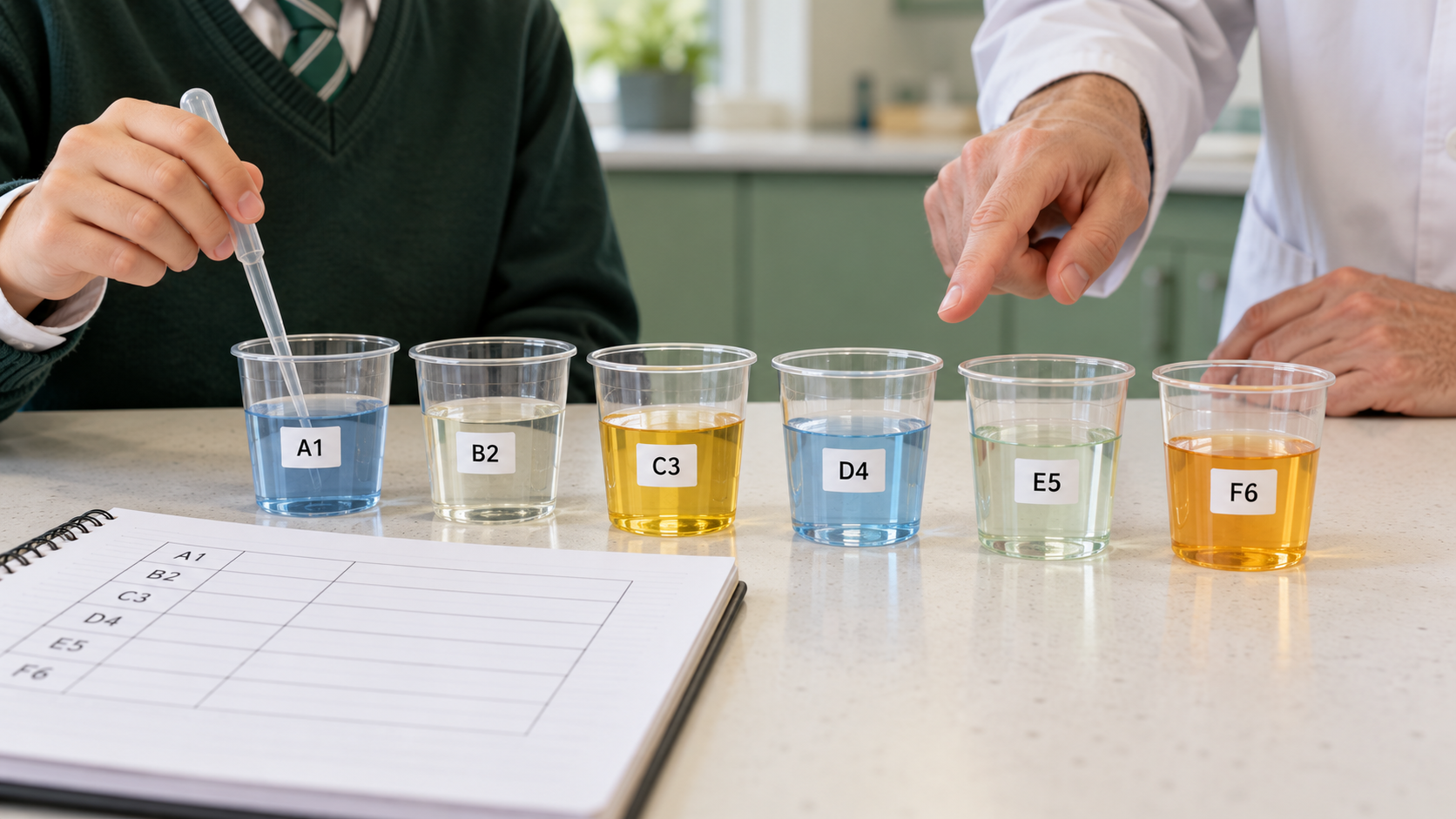
Toa Payoh Secondary 1–2 students can understand separation techniques by asking what a mixture contains, which physical properties its components have and what the task needs to recover. Magnetic attraction, filtration, evaporation, distillation and paper chromatography use different differences between substances. A correct Science answer selects the technique for the specified mixture and explains why it works, rather than assuming every material can be separated by a filter.
Singapore’s MOE G2/G3 Lower Secondary Science syllabus, updated in April 2024, identifies these five techniques under Exploring Diversity of Matter using Separation Techniques. It also connects separation with conserving water, food safety, recycling and Singapore’s water management. Reverse-osmosis examples in this part of the syllabus are marked optional for G2. This guide uses fictional samples and paper-based analysis: actual solvents, heat, distillation glassware and unknown chemicals must remain within authorised, supervised school laboratories.
- Distinguish a pure substance from a mixture of constituents
- Know the difference between an element, compound and mixture
- Identify solute, solvent, solution and suspension correctly
- Do not confuse a substance dissolving with it disappearing
- Recognise that filtration separates appropriate suspended solids from liquids
- Use magnetic attraction only when a suitable component responds to a magnet
- Evaporation can recover a suitable dissolved solid while the solvent leaves
- Distillation can recover an evaporated and condensed liquid
- Paper chromatography may separate suitable mixture components by movement
- Compare observations with the physical property causing separation
- Keep scientific safety distinct from school-paper problem solving
- Explain why industrial water treatment is more complex than classroom filtration
Definition lock: mixtures are separated by differences in constituent properties
Separation techniques act on appropriate mixtures and exploit properties such as magnetic response, particle size, volatility or differing movement through a stationary medium. A dissolved solute is not simply a suspended solid. Classroom separation diagrams do not certify that a product is pure, sterile or safe for human consumption.
Part One: choosing and explaining separation methods
The central question is: what are we separating?
The aim of separation is to obtain or distinguish constituents of a mixture. Before choosing equipment, identify which substances are present, whether the mixture is solid–solid or solid–liquid, and what the question wants to recover. The outcome changes the appropriate method.
A fictional mixture of suitable magnetic material and sand invites a different technique from one containing a dissolved salt and water. The first may exploit magnetic response; the second cannot be separated by an ordinary filter that traps only suspended particles.
Ask the pupil to list every constituent in a simple table. If the mixture contains two substances but the child identifies only one, the later method cannot be evaluated properly.
The task may request one useful component rather than all of them. Evaporating water to recover a dissolved solid differs from distillation when the liquid itself is valuable.
Method selection is a reasoning problem about properties and goals. The learner should explain which difference the proposed technique uses instead of writing a familiar method name without justification.
A mixture is not the same as a compound
A mixture contains two or more substances that are not chemically combined as a single new compound. Its constituents may retain relevant individual properties, and their relative amounts can vary within suitable limits.
A compound contains elements chemically combined in a defined composition. Separating a compound into its elements generally requires different processes from physically sorting the constituents of a mixture.
Students sometimes think that combining two substances in one container always creates a new chemical substance. Merely mixing them does not establish a chemical reaction; the evidence and chemical composition matter.
For an invented salt-and-sand mixture, the substances may remain separate constituents even though the particles are mixed closely. A sequence of physical methods may recover them without assuming they became a new compound.
Ask what changed: the proximity of substances or their chemical identity? This distinction helps pupils understand why physical separation techniques are appropriate for mixtures rather than arbitrary compound decomposition.
Elements, compounds and mixtures need separate definitions
An element consists of one type of atom in the school introductory sense, while a compound contains atoms of different elements chemically combined. Mixtures contain two or more substances not chemically combined into one fixed compound.
An element such as iron can be part of a mixture, and a compound such as sodium chloride can also be a constituent. The group label mixture does not mean the ingredients must themselves be elements.
A child may classify salt water as a compound because it looks uniform. The solution remains a mixture of water and dissolved substances even when individual particles cannot be distinguished by eye.
Chemical formulas and particle models can help at the appropriate level, but pupils should not claim every homogeneous-looking sample has one fixed chemical composition.
Before choosing a separation method, ask whether the task actually describes a mixture. If it describes a compound, mechanical filtration may not recover its component elements in the way a mixture can be separated.
Dissolving creates a solution, not disappearance
When a suitable solute dissolves in a solvent, its particles become distributed within the resulting solution. The solute has not simply vanished from existence because it can no longer be seen as separate grains.
A fictional example uses common salt dissolving in water. The resulting liquid may appear clear, but the solution still contains water and dissolved salt under the intended model.
Do not infer that any clear liquid is pure water. Transparency to the eye is not proof of chemical purity, and a solution can contain dissolved constituents that an ordinary filter does not remove.
A pupil should name the solute, solvent and solution in the question. For the familiar example, salt is the solute and water is the solvent; their combination is the solution.
This vocabulary prepares students to choose separation methods. Recovering dissolved salt requires exploiting appropriate physical behaviour, not looking for visible grains that no longer remain in suspension.
Solubility is different from dissolving rate
Solubility concerns how much of a substance can dissolve under stated conditions, while the rate of dissolving concerns how quickly dissolution happens. An action that speeds dissolving does not necessarily increase the equilibrium amount that can dissolve.
Stirring a suitable solute into a solvent may increase how quickly it disperses or dissolves. That observation alone does not prove that infinitely more solute can dissolve.
The type of solute, type of solvent and temperature can affect solubility, but detailed expectations vary by course. Some optional G2 outcomes differ from those required for G3.
Ask which quantity the experiment measures. If the table records seconds until a solid disappears from view, it addresses a rate-related observation, not automatically the maximum amount soluble.
Use teacher-approved data and explanations instead of asking children to heat unknown chemicals or taste solutions. Scientific reasoning does not require hazardous household trials.
Solutions and suspensions behave differently
A suspension contains particles dispersed in a fluid that have not dissolved into a molecular or ionic solution in the same way. Under appropriate conditions some suspended particles may settle or be trapped by a filter.
A solution can appear transparent because dissolved particles are far too small for an ordinary classroom filter to catch. The key distinction is the state of the constituent particles, not simply the colour of the liquid.
An imaginary mixture of insoluble sand and water can illustrate a suspension, while suitable dissolved salt in water illustrates a solution. The two mixtures require different thinking when separation is requested.
Real suspensions can behave in complex ways and may not settle rapidly. A pupil should follow the stated observation rather than assume every cloudy liquid will separate fully after five minutes.
Ask whether the substance dissolved and whether the proposed filter can retain the relevant solid. This prevents treating every solid–liquid mixture as if it were identical.
Filtration exploits particle size and physical barriers
Filtration can separate suitable insoluble or suspended solid particles from a liquid or gas by passing the mixture through a barrier that retains particles too large to pass. The common school example is a suspension, not a dissolved salt solution.
The solid retained by the filter is called the residue. The fluid passing through is the filtrate. Both terms describe where material ends up in the process.
A pupil may think the filtrate must be pure and safe to drink because it looks clear. That is incorrect: dissolved substances and microorganisms can remain, and a simple classroom filter is not a validated drinking-water treatment system.
Ask what the filter’s openings can trap and what is able to pass. The explanation should refer to the appropriate physical properties of the mixture rather than simply say the filter cleans everything.
No home water sample should be declared safe to consume after a homemade filter test. Classroom techniques teach physical separation, not medical or public-water certification.
Magnetic attraction works only for suitable constituents
Magnetic separation uses the response of certain materials to a magnetic field. An imagined mixture containing appropriate iron particles and non-magnetic sand may permit a magnetic component to be recovered.
Not all metals respond to an ordinary magnet in the same way. A learner who assumes every shiny or metallic-looking material is attracted is applying appearance rather than the specified material property.
A magnet does not dissolve, burn or chemically transform the non-magnetic component in a normal separation model. The technique sorts constituents according to their different magnetic responses.
A paper-based diagram may show a magnet near a protected mixture. Ask which component is attracted, which remains and whether the sample conditions establish the classification.
Do not let children handle loose metallic filings, strong magnets near sensitive devices or unidentified scrap. The aim is understanding magnetic response, not unsupervised collection of dangerous fragments.
Evaporation can leave a dissolved solid behind
If a suitable solution contains a dissolved non-volatile solid, evaporation of the solvent can leave the solid behind. The learner should identify which constituent changes state and which remains in the container under the given conditions.
A fictional salt-water problem may use evaporation to recover salt. It should not claim that every mixture behaves the same way or that all recovered solids are automatically pure.
The evaporated solvent moves into the surrounding air in an open system; it does not cease to exist. This connects separation techniques to conservation of matter and the particle model.
Students sometimes choose filtration to recover salt from salt water, but dissolved ions pass through an ordinary classroom filter. The correct method depends on whether the material is dissolved and which component is desired.
Evaporation often involves heating in school demonstrations, which can create burn hazards. Physical procedures belong under qualified laboratory supervision; pupils can reason from written diagrams without conducting them at home.
Distillation collects a liquid after vaporisation and condensation
Distillation uses differences in volatility or boiling behaviour, followed by condensation of vapour, to separate or purify a suitable liquid mixture. It differs from open evaporation because the vapour is captured and cooled so a liquid product can be collected.
In an idealised salt-water example, water evaporates and is condensed into a separate receiver, while much of the non-volatile salt remains. The collected liquid is the distillate.
A pupil may say that a filter collects the water during distillation, but the key transformations are vaporisation and condensation, not trapping particles on paper.
The recovered liquid is not automatically certified sterile or potable. Actual purity depends on the mixture, equipment, contamination and validation; the classroom diagram is a conceptual model.
Distillation equipment can involve heat, glassware and pressure risks. Pupils should never improvise apparatus, sealed heating vessels or chemical purification at home.
Filtration, evaporation and distillation answer different goals
Three questions help choose among these techniques: is an insoluble solid suspended, is a non-volatile dissolved solid to be recovered, or is a suitable liquid itself required? The answers point toward filtration, evaporation or distillation under the appropriate assumptions.
An invented mixture of sand and water may be filtered to separate sand from the filtrate. An invented salt solution may be evaporated to obtain solid salt or distilled to recover the solvent.
The same mixture can support different methods depending on the desired product. A question that asks for both constituents may require more than one stage and careful consideration of what each stage retains.
Students should not write the method first and invent the purpose later. The materials and goals determine the sequence.
A compact decision table can record mixture, target substance, property used and expected location of each component after separation. This makes method selection explicit and checkable.
Paper chromatography separates suitable components in a moving solvent
Paper chromatography can help distinguish components of certain mixtures, such as compatible coloured substances, as a solvent moves through paper. Different components may travel different distances because of their relative interactions with the mobile and stationary phases.
An ordinary diagram may show one initial spot separating into several marks. This provides evidence that the original sample may contain more than one suitable component, under the method’s conditions.
A pupil should not infer that every ink or dye must form many distinct spots. The outcome depends on sample composition and the chosen solvent, paper and technique.
The diagram is a result representation, not a command for children to use household solvents. Laboratory chemicals, pigments and vapours can be hazardous or unsuitable for unsupervised handling.
Ask which spots share the same starting point, how far the solvent travelled and what the result suggests. The explanation should remain within the actual observations.
Chromatography evidence requires careful interpretation
If two suitable samples produce spots at similar positions under the same chromatographic conditions, that can support a comparison. It does not automatically prove they are chemically identical in every respect.
The solvent front, initial sample line and component spots have different meanings. A pupil who measures from the top of the page rather than the origin may misrepresent the separation.
Overlapping spots can hide components, and poorly chosen solvents may not separate a mixture clearly. An apparently single spot does not guarantee a pure substance under all possible testing methods.
Advanced numerical analysis such as retention factors belongs to the applicable syllabus and task. Introductory G2/G3 separation learning should first secure the concept and interpret the actual diagram.
Teach an evidence statement rather than an exaggerated identification claim. The student should describe what the chromatogram shows and what additional verification would be needed for certainty.
The right sequence may combine more than one technique
Some mixtures contain several constituents with different relevant properties. A fictional combination of suitable magnetic pieces, insoluble sand and dissolved salt may require a sequence rather than one universal separation method.
Magnetic separation could recover the magnetic constituent. Filtration could separate the remaining insoluble solid from a solution, and a suitable further method could recover dissolved material or solvent.
The order matters because one step changes what remains for the next. A student should trace every constituent through the proposed sequence instead of listing three method names in arbitrary order.
Do not claim that each step makes the entire remaining mixture perfectly pure. The school example simplifies real processes, and actual purity requires suitable evidence and validation.
A useful flowchart labels the input mixture, the property exploited in each step and where each recovered material goes. This makes the process explainable without conducting a potentially hazardous practical.
Separation does not always involve a chemical reaction
Many separation techniques rely on existing physical differences, such as solubility, magnetism, particle size or boiling behaviour. The constituents need not become new chemical substances for separation to occur.
A pupil may write that sand and water react during filtration. In the ordinary introductory example, the filter physically retains suitable particles while water passes through.
Likewise, evaporating water from a salt solution does not mean that the salt itself has been chemically transformed into the water vapour. The components follow different paths.
The distinction matters for conservation of matter and for later Chemistry, which asks students to distinguish physical processes from chemical reactions.
Ask what changes—position, state or chemical identity. A strong answer uses the simplest valid explanation supported by the task instead of inventing a reaction that the evidence does not show.
Fair separation investigations control relevant conditions
A school practical may compare two filter materials or two methods. The outcome must be defined: amount of solid retained, volume recovered, apparent clarity or another appropriate measure.
If two trials use different starting amounts and different mixtures, the observed results cannot be attributed confidently to the filter alone. Comparable conditions are needed before declaring one method more effective.
The pupil should identify the deliberately changed factor, measured response and relevant controlled variables. This is the same inquiry reasoning used in Primary Science, now applied to more specialised materials.
Safety matters even in apparently simple experiments. Heat, glass, sharp particles and chemical solvents are not suitable for improvised home laboratories.
Use original hypothetical datasets to practise analysis. A sound conclusion acknowledges the actual test conditions and does not claim broader purity or safety than the evidence establishes.
Singapore’s water story illustrates layered purification
Singapore’s national water agency PUB describes NEWater production through advanced treatment involving microfiltration or ultrafiltration where applicable, reverse osmosis and ultraviolet disinfection. This is far more sophisticated than a simple classroom filter made from paper.
Reverse osmosis uses a specialised membrane process to remove many dissolved and other contaminants, while ultraviolet treatment provides an additional disinfection step. These are distinct functions within an engineered water-reclamation system.
PUB also describes Singapore’s use of reverse osmosis in seawater desalination. The MOE syllabus marks reverse-osmosis examples optional for G2 in the stated topic, so parents should not force advanced membrane engineering as a compulsory introductory calculation.
Do not suggest that home filtration, evaporation or a clear-looking sample produces drinking water equivalent to professionally treated municipal supply. Safe drinking-water quality requires validated processes and monitoring.
The appropriate learning connection is why separation properties matter for resource management, while recognising that real public-water systems involve multiple stages, quality controls and professional operation.
Recycling and resource recovery depend on material properties
Separation supports recovery of useful constituents and reduces unnecessary waste when appropriately designed. Magnetic sorting, filtering and other techniques can help identify and retrieve materials under suitable industrial or school contexts.
A child should not assume every item marked recyclable is accepted in every collection route. Product condition, contamination and the local waste system affect real-world recovery.
In a fictional processing example, separating magnetic material from non-magnetic material can be useful because their properties differ. The classroom principle does not specify the full design or safety of an industrial facility.
Explain both the desired outcome and the physical property exploited. Environmental value does not eliminate the need for accurate technical descriptions and safe processes.
A good answer connects a scientific method with a relevant resource-use goal without claiming it solves every waste-management problem automatically.
Choosing a method is a test of understanding
Students may memorise the five technique names in order and still fail when the problem changes the mixture. The diagnostic question is which property distinguishes the constituents and what the question wants to obtain.
For example, if the target is a non-volatile dissolved solid, filtration may fail to retain it. Evaporation could be considered under suitable conditions. If the target is a recoverable liquid, distillation may fit more naturally.
The correct method should be justified by the starting mixture’s physical characteristics, not by a single trigger word such as water or sand.
Ask the learner to explain why two tempting alternatives would not achieve the same stated objective. This comparison makes the chosen method more credible.
After correction, give a fresh fictional mixture with different ingredients but the same relevant property. The pupil should transfer the principle rather than recall a memorised species or chemical name.
A six-week progression from mixtures to applications
Week one develops the difference between elements, compounds and mixtures, alongside solute, solvent, solution and suspension. Week two examines physical properties and chooses suitable methods for simple two-constituent cases.
Week three focuses on filtration and magnetic separation through written methods and observations. Week four compares evaporation with distillation, highlighting which substance is recovered and where it goes.
Week five interprets original paper-chromatography diagrams and designs suitable multi-stage separation sequences. Week six discusses Singapore water treatment, recycling and methodological limits using authoritative sources.
The plan should match the learner’s actual G2 or G3 course, particularly optional reverse-osmosis details for G2. A changed unfamiliar question is a stronger assessment of understanding than a repeated example.
Successful learning means choosing the correct property, method and predicted output without unsafe practical experiments or invented purity claims.
Solvent choice changes what chromatography can reveal
Paper chromatography works only when the components and the moving solvent behave suitably. A solvent that does not transport the substances may yield little useful separation, while another solvent can produce distinguishable marks. The method’s success cannot be judged solely from the presence of paper.
A school diagram may show several original inks tested on the same strip. Comparisons are more informative when the solvent, paper and test conditions are consistent, since those choices affect movement.
Students sometimes believe the darkest or highest spot must be the heaviest chemical. The positions arise from interactions with the moving solvent and the paper, not a simple visible ranking of mass or danger.
Ask what the task provides about the original spot, solvent front and developed component spots. A result should be interpreted within the diagram rather than treated as proof of chemical identity.
Laboratory solvent selection is not a suitable home experiment. Some solvents are flammable or toxic, so families should practise with authorised images and school-generated observations rather than improvise with cleaning liquids.
Recovering a constituent is not always proving purity
A method that separates one visible component may leave trace amounts or dissolved substances behind. The presence of a clear liquid, colourless solid or neat chromatogram does not automatically prove complete purification.
A filtration step can remove a visible suspended solid while dissolved contaminants remain. A distillation setup can collect a liquid, but the result depends on which substances can vaporise and how the equipment is operated.
Students should distinguish the immediate observation from the larger claim. Observing no sand in the filtrate is not equivalent to proving that the filtrate contains only water molecules.
Some tasks specify a simplified ideal process. Use that assumption when solving the school question, but avoid extending the conclusion to every real mixture or to drinking-water safety.
Scientific honesty means naming the evidence and its limits. A pupil who explains what a process can recover and what it cannot establish has understood more than one who writes completely pure without justification.
Mass balance can check a separation story
An appropriate closed-system model can use the conservation of mass to check whether constituents have been accounted for. If a fictional mixture contains six grams of one recoverable solid and four grams of another, the initial total is ten grams.
After an ideal separation, the recovered masses should be consistent with that original total when there is no loss or additional material. A result claiming fourteen grams of recovered original constituents requires further explanation.
In an open evaporation process, some solvent can leave the observed container as vapour. A decrease in the container’s measured mass does not mean matter has been destroyed; the accounting boundary has changed.
Actual laboratory recovery can be incomplete because some material remains on equipment or transfers are imperfect. A school question must specify whether its model assumes complete separation before a numerical conclusion is drawn.
Ask which constituent is retained, which leaves and whether the reported masses include the whole system. The same careful accounting supports both the particle model and later quantitative Chemistry.
Frequently asked questions
Will ordinary filtration remove dissolved salt? No. A normal classroom filter retains suitably sized suspended particles; dissolved salt passes through with the solution.
Does evaporation recover the solvent? Open evaporation generally lets the solvent leave as vapour, while distillation can collect a condensed liquid. Choose the method according to which product the task wants.
Can every metal be separated with a magnet? No. Magnetic response varies among materials. The task must identify a suitably attracted constituent.
Does one spot on chromatography paper prove a substance is pure? Not universally. Separation depends on the method and solvent, and additional tests may be needed.
Is water from a homemade filter safe to drink? Not automatically. Drinking-water safety needs approved purification, disinfection and quality monitoring; visual clarity is insufficient.
What demonstrates mastery? A student can identify a new mixture’s constituents, select an appropriate technique, explain the physical property used and trace where each material goes.
Your next step: draw a separation decision chart
For three fictional mixtures, write the components, the desired recovered substance and one relevant physical property. Choose a method and state what remains or is collected. Have the learner explain why an alternative method would fail before attempting a new mixture without prompts.
Official sources and related reading
MOE — Lower Secondary G2/G3 Science Syllabus, Updated April 2024, page 33
MOE — G1 Lower Secondary Science Syllabus
PUB — NEWater Process and Water Reclamation
PUB — Desalinated Water in Singapore
PUB — Singapore Tap Water Quality
eduKateSG — Primary Science Materials and Properties
eduKateSG — Secondary Particle Model and Matter
eduKateSG — Secondary Laboratory Safety and Practical Skills
eduKateSG — Immutable Clementi Tutorial Reference
Arrange a parent–student consultation
eduKateSG provides premium three-student small-group academic tutorials by appointment at 8 Fourth Avenue, Singapore 268674, near Sixth Avenue MRT. Toa Payoh families can discuss a school Science separation question and the pupil’s working. Confirm suitable subjects and travel before arranging lessons; chemical practicals require qualified school supervision.
Properly taught kids shine a bright light into the future.