
Service learning connects a meaningful contribution to a community with deliberate learning, reflection and responsible action. Volunteering usually focuses on giving time or skills to a cause, while service learning also makes the educational aims explicit. The two can overlap. In Singapore schools, Values in Action (VIA) is a key Student Development Experience within Character and Citizenship Education (CCE), encouraging students to apply values and participate constructively in society. The quality of the experience depends on community needs, suitable preparation and thoughtful follow-up—not simply the number of hours recorded.
This guide explains service learning, community service, volunteering and VIA for Singapore parents and students. It shows what MOE’s CCE syllabus actually describes, how to work respectfully with community partners, why photographs and certificates are insufficient evidence of impact, and how to design safe age-appropriate activities. It includes Primary, Secondary and pre-university examples, reflection prompts, limits of research claims, a four-week family or classroom plan and practical questions for parents evaluating school programmes.
- Community first: understand what the partner and people involved actually need, rather than impose a convenient student project.
- Learning goal: identify relevant values, knowledge or skills the experience is meant to develop.
- Responsible action: plan age-appropriate activities, appropriate safeguarding and clearly defined roles.
- Reflection: examine what happened, the evidence of usefulness and what should change next time.
- Honest evaluation: service hours, photographs and certificates do not automatically prove impact or academic gains.
Find the answer you need
- What is service learning in plain English?
- What is volunteering?
- What is Values in Action in Singapore?
- VIA and service learning: where they overlap
- How MOE describes Student Development Experiences
- Service learning is not charity performance
- The community partner should have a real voice
- Identifying a need before choosing an activity
- The difference between need, assumption and evidence
- Why preparation matters as much as enthusiasm
- Safeguarding and vulnerable people
- Respecting privacy and consent
- What does meaningful participation look like?
- Service hours: useful record, incomplete outcome
- Why one-off events sometimes achieve little
- Reflection: what happened, why and what next?
- Reflection is not a compulsory story of gratitude
- Community impact versus student learning
- Why service learning is not a guaranteed academic booster
- How service learning connects to academic subjects
- English: clear communication with a real audience
- Mathematics: planning and interpreting quantities
- Science: environmental projects and evidence
- Social Studies: understanding community institutions
- Empathy must respect boundaries
- Civic responsibility and the everyday school community
- Service learning in Primary school
- Service learning in Secondary school
- Service learning at junior college or pre-university
- Leadership through service, not only titles
- Collaboration and the problem of unequal group roles
- Recognising different needs and abilities
- Financial costs and ethical fundraising
- The danger of mandatory spending disguised as service
- Overseas service and ethical caution
- How to evaluate a project’s actual usefulness
- When a partner says the plan did not help
- When the project creates unintended harm
- Reflection prompts students can actually answer
- What parents should ask about their child’s VIA
- A fictional case: Alicia and the book-sharing programme
- A fictional case: Ben and a publicity-first project
- A fictional case: Mira develops leadership through listening
- A four-week service-learning plan
- Common myths about service learning
- The long-term purpose of service learning
- Frequently asked questions
- Sources and connected reading
What is service learning in plain English?
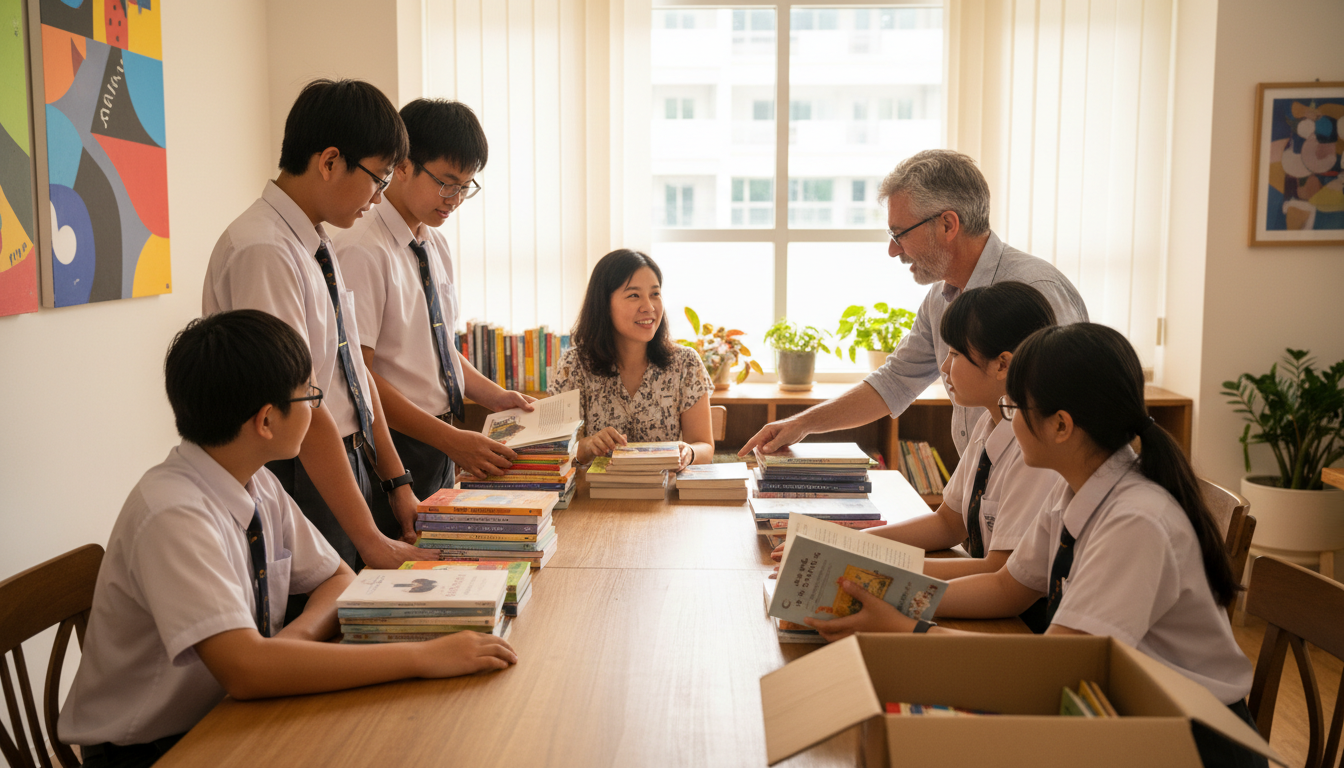
Imagine students working with a community library partner to help organise accessible reading materials. The partner explains which resources are needed and how volunteers should handle them. Students prepare, carry out appropriate tasks, ask questions and later reflect on how their choices affected the people they intended to help. They consider whether the work was useful and what they would do differently.
This differs from a field trip where children merely observe or a performance intended only for publicity. Service learning combines contribution with deliberate educational reflection. It also differs from treating community members as subjects for a student portfolio. A good programme identifies the real partner’s priorities, respects people involved and makes both the service and the learning accountable.
What is volunteering?
Volunteering generally involves giving time, effort or skills freely for a community or organisational purpose. People may volunteer for charities, public initiatives, cultural programmes or local groups. The primary aim may be the service itself, without a teacher setting formal learning objectives.
Volunteers can still learn substantially through experience. A person might discover how an organisation coordinates resources or how to communicate with different participants. The distinction is a matter of programme design, not the worth of the contribution. A well-planned school service-learning project may include volunteering, but not every volunteering session is organised as an educational intervention.
What is Values in Action in Singapore?
Values in Action (VIA) is part of Singapore’s Character and Citizenship Education approach. MOE’s Primary CCE syllabus identifies VIA, including Everyday Responsibilities, as one of the key Student Development Experiences. It describes opportunities for students to apply values, social-emotional and civic competencies through relevant activities and reflection.
VIA should therefore be understood as more than a school checklist. The intended educational outcomes involve responsibility, care and meaningful contribution, within the applicable school programme. The details of activities, supervision and reflection vary by school and student level. Parents should consult the school’s latest description instead of assuming every child must participate in the same project or meet an identical publicised service-hour quota.
VIA and service learning: where they overlap
VIA may include activities that resemble service learning when students engage with actual community needs, connect action to relevant values and examine what they learned. Some VIA experiences also involve everyday responsibilities, school contributions or other civic learning situations rather than a large external volunteer event.
The educational design is what matters. Teachers can help pupils understand why a task serves someone, whose voice should guide planning and what evidence would show useful contribution. A short appropriate action can teach responsibility when it is intentional. A glamorous excursion without reflection may do less to develop the intended competency.
How MOE describes Student Development Experiences
MOE’s Overview of Singapore’s Education System (2025) explains that Student Development Experiences such as CCAs, VIA, outdoor learning and student leadership provide opportunities to apply learning and values. They complement the academic foundation rather than replace English, Mathematics or Science.
The primary CCE syllabus also explains that these experiences use intentional dialogue, discussion, reflection and application. This is a useful check for parents: what did the pupils discuss before action, what contribution took place and how did they evaluate it afterward? A planned experience should help children make informed, responsible decisions beyond the day of the event.
Service learning is not charity performance
A student project can become performative when the priority shifts from a community need to photographs, branding or the appearance of generosity. Participants may be encouraged to pose with people receiving assistance without sufficient respect for privacy or dignity. The organisation’s real needs may receive little attention.
A responsible school should ask the community partner what is useful, which activities are appropriate for pupils and what should remain private. Students need to understand that people are not props for a portfolio. A project’s value is better judged through the partner’s priorities and meaningful reflection than through the number of promotional images created.
The community partner should have a real voice
Service learning is stronger when a legitimate community organisation helps define the problem and evaluate the proposed contribution. Students might assume that a collection drive is needed when the partner actually lacks volunteers to sort existing donations. Listening first prevents well-intentioned but unhelpful work.
Teachers can guide students to ask respectful, practical questions about priorities, constraints and appropriate forms of assistance. The partner should not be pressured to accommodate an activity that mainly suits a school timetable. Shared planning teaches students that effective care includes humility and attention to other people’s expertise.
Identifying a need before choosing an activity
Students may begin with broad concerns such as food insecurity, environmental protection or loneliness. Those topics are meaningful but too large for a single class project to resolve. A useful first step is to identify a bounded need within the capabilities and authorisation of the group.
For example, a community partner may request help preparing accessible activity packs for a supervised event. The class can then determine which materials are useful, how they should be organised and what constitutes a completed task. Clear scope protects both educational quality and the partner’s time. Avoid assuming a project must be dramatic to be meaningful.
The difference between need, assumption and evidence
A group may assume that older residents would enjoy a particular activity without asking whether the programme is welcome or appropriate. Students should learn to separate their preferred idea from evidence of what people actually need. Respectful consultation is often a stronger beginning than an elaborate presentation.
Teachers can use fictional scenarios to model how to ask questions without invading privacy. Real projects should follow partner procedures and safeguarding requirements. Where direct consultation is inappropriate, partner staff may provide suitable anonymised information. The educational lesson is evidence-based service rather than choosing the most attractive story about helping.
Why preparation matters as much as enthusiasm
Students need to know the activity’s purpose, roles, boundaries and safety procedures before participating. A well-meaning child may misunderstand how to interact with a vulnerable person or mishandle donated materials. Preparation can prevent avoidable problems and teach respect for the organisation’s established practices.
Teachers should provide age-appropriate instructions and assign tasks suited to pupils’ capabilities. Complex or sensitive activities may require trained adult staff rather than direct student involvement. Genuine service learning recognises limits rather than assuming enthusiasm makes someone qualified. Safety and responsible supervision are part of educational design.
Safeguarding and vulnerable people
Some community activities involve children, older adults, people with disabilities or others requiring special protection. Schools and community partners must use appropriate safeguards, permissions and trained supervision. Student volunteers should not be expected to handle confidential information, provide medical advice or undertake responsibilities beyond their training.
Parents can ask about supervision, transport, privacy and who to contact if a problem occurs. Students should know what boundaries apply and when to seek adult help. A good programme can create meaningful roles without exposing participants or community members to unnecessary risks. Service learning is not an exemption from professional standards.
Respecting privacy and consent
Community members may not want their names, faces, home circumstances or personal stories shared. Students should ask permission through appropriate procedures and follow the partner’s guidance before photographing or publishing anything. The fact that a school project has good intentions does not grant unlimited rights to circulate private information.
Teachers can use anonymised reflections or photographs of materials when appropriate, but should still consider whether the partner approves. Students need to distinguish recording what they learned from collecting personal evidence about someone else. Privacy is an ethical competency in itself, not merely an obstacle to a more impressive portfolio.
What does meaningful participation look like?
Every pupil should have an appropriate opportunity to contribute. Some may organise materials, communicate with a partner, check instructions or help analyse a process. Roles can differ according to ability, safety requirements and the partner’s needs without making some learners permanently peripheral.
A school should avoid giving one confident student all the planning and others only decorative tasks. Clear roles, fair expectations and review can support genuine participation. Teachers should also recognise when a child requires an accessible format or adapted task. The goal is appropriate contribution, not compulsory identical performance.
Service hours: useful record, incomplete outcome
Counting hours can show attendance or participation, but not whether the activity met the community’s needs or developed a particular skill. A student may spend many hours performing tasks poorly, while another contributes effectively in a shorter, well-planned session.
Schools may have formal requirements or recognition processes, and parents should follow the actual current rules where relevant. But when evaluating educational value, also ask what happened, what feedback was received and whether the student learned something they can use responsibly later. Hours should not be confused with impact or character.
Why one-off events sometimes achieve little
A single large event can create excitement and photographs but may not fit a partner’s longer-term needs. Students may learn more from a smaller sustained relationship that allows preparation, action, reflection and revision. The appropriate duration depends on the project, however, and some short tasks are genuinely useful.
Ask the partner what continuity would help. Schools should not promise years of assistance they cannot deliver. An honest one-off contribution with suitable follow-up can still be worthwhile. The lesson is to match the activity with an actual need and avoid treating every event as a permanent solution to a complex social issue.
Reflection: what happened, why and what next?
Reflection connects action to knowledge and values. Students can describe the task, the partner’s stated need, what went well, what failed and which assumptions changed. The strongest reflection is specific enough to influence future decisions instead of merely saying the event was inspiring.
A younger pupil might discuss one problem and one improvement. A secondary learner can examine planning, communication and evidence of usefulness. Teachers should not require students to reveal private emotional experiences to classmates. The point is responsible analysis of the service and its learning consequences.
Reflection is not a compulsory story of gratitude
Some programmes expect every student to report that the experience made them more grateful. This can turn reflection into a performance that conceals questions about whether the project was useful or ethical. A learner who notices a limitation may have developed valuable judgement.
Educators should permit thoughtful, respectful criticism. A student might report that the planned materials did not match the partner’s request and suggest a better process. That reflection may show deeper learning than a generic emotional paragraph. Values develop through honest decisions and evidence, not through requiring the same personal conclusion from every participant.
Community impact versus student learning
Service learning has at least two distinct questions: did the activity help the community partner, and what did the students learn? A student can gain organisational skills while the project produces limited community benefit. Conversely, a task may be genuinely helpful while students do little intellectual reflection.
These outcomes should be evaluated separately. Ask the partner for appropriate feedback and examine student understanding through suitable tasks. Avoid claiming academic improvement solely because children volunteered. Clear outcome definitions make the programme more accountable and help schools decide what to change next time.
Why service learning is not a guaranteed academic booster
Students may develop communication, planning or civic understanding through meaningful participation, but no one activity guarantees higher Mathematics or English scores. Educational programmes vary in design, duration and assessment. Studies of youth social action may focus on teamwork or confidence rather than academic attainment.
The EEF Community Apprentice trial illustrates a programme designed around social action, self-efficacy and teamwork. Such evidence should be interpreted for its actual outcomes, sample and context. A Singapore school should not quote research about one intervention as a universal guarantee for every VIA activity.
How service learning connects to academic subjects
An appropriate project may involve real writing, numerical planning, communication or research. Students organising book materials may practise clear instructions and accurate records. A sustainability activity may require measurement and evidence about waste, with suitable supervision.
However, adults should identify the actual subject outcome instead of claiming every task automatically develops every discipline. A fundraising poster might involve persuasive writing but may not improve algebra. Academic connections are strongest when the teacher explicitly teaches the relevant knowledge and checks independent understanding afterward.
English: clear communication with a real audience
A service project may require writing a concise notice, explaining an event or communicating instructions to volunteers. Students can consider what their audience already knows, which terms need defining and how to make an action clear. The teacher can model a suitable structure before pupils draft original messages.
Feedback should focus on accuracy, relevance and audience, not only how attractive the poster looks. A changed communication task later can test whether students transfer the skill. The service context provides a meaningful reason to write, while explicit English teaching supports the actual improvement.
Mathematics: planning and interpreting quantities
Students might count materials, compare quantities or prepare a simple budget for an authorised project. The relevant Mathematics includes choosing units, checking totals and explaining assumptions. A learner who can perform calculations but misunderstands the reference quantity needs corrective teaching.
Teachers should not allow pupil budgeting exercises to become unsupervised handling of actual funds. Appropriate adults remain responsible for financial controls and authorisation. A fictional or supervised dataset can teach the principle safely. The educational target is sound numerical reasoning rather than giving children responsibilities beyond their role.
Science: environmental projects and evidence
A school may plan a garden or recycling-related service activity. Students can learn to identify what is being measured and avoid claiming environmental impact from an unsupported estimate. A small audit may reveal a specific process that could improve, but a single measurement cannot establish all long-term effects.
Teachers should clarify variables, safety and the limits of inference. If the partner asks for work that students are not qualified to perform, adults must arrange suitable supervision or an alternative. A scientific learning objective remains separate from the practical act of helping. Accurate data are more valuable than an impressive but invented success figure.
Social Studies: understanding community institutions
Service learning can help pupils understand how community organisations identify needs, allocate resources and cooperate with public or voluntary bodies. A Social Studies task might ask students to explain the responsibilities of different participants and the trade-offs involved in a project.
Students should avoid reducing complicated social issues to a simple story about good people rescuing others. The community partner’s knowledge and constraints deserve attention. Teachers can discuss evidence, context and limitations without requiring children to solve national policy. Civic learning becomes stronger when students understand institutions and responsibility as well as goodwill.
Empathy must respect boundaries
Students may feel sympathy for someone facing difficulty, but empathy should not become pity that treats a person as powerless. A good programme recognises the agency, expertise and privacy of people involved. Community partners should help define respectful interactions.
Teachers can encourage questions such as ‘What does the organisation say would be useful?’ rather than ‘What would make our group look generous?’ Children can learn to listen without demanding personal disclosures. Empathy is meaningful when paired with responsible action and boundaries. The community’s dignity is more important than a student’s emotional performance.
Civic responsibility and the everyday school community
Not all values-in-action learning requires a large external event. Everyday responsibilities in school can involve caring for shared spaces, supporting appropriate routines and treating others respectfully. MOE’s primary CCE syllabus includes Everyday Responsibilities within the VIA concept.
A simple classroom duty is not identical to a community partnership project, but it can teach reliability and respect when adults explain the purpose and ensure fair participation. The educational focus is whether children understand and carry out responsibility meaningfully. A school should not turn ordinary care into a constant competition for public recognition.
Service learning in Primary school
Primary children can begin with age-appropriate actions such as organising classroom materials, caring for shared spaces or participating in supervised school-community initiatives. They need clear explanations of why the activity matters, suitable instructions and opportunities to discuss what happened.
Young pupils should not be given sensitive or hazardous tasks merely to make a project appear significant. Teachers can model one responsibility and invite a short reflection about what was useful. A child who follows a simple routine with less prompting may have developed a meaningful skill. The objective is responsible participation, not grand claims about permanent character transformation.
Service learning in Secondary school
Secondary students may be able to research a bounded community issue, plan an appropriate activity with a partner and evaluate its contribution. They still need school supervision and realistic role boundaries. The partner’s needs should shape the action rather than the pupils’ desire to produce an impressive portfolio.
A teacher can require evidence-based reflection, fair group roles and a responsible communication plan. A student may discover that the first idea was unsuitable and revise it. That can be a valuable learning outcome. The programme should not reward only polished publicity or the longest record of service hours.
Service learning at junior college or pre-university
Older students can examine community needs with more sophisticated research and consider links among social issues, institutions and policy trade-offs. Singapore’s pre-university CCE syllabus discusses VIA as a platform for reflecting on community concerns, social responsibility and leadership through service.
Even at this level, students should not assume they possess the training to provide specialist advice or handle vulnerable people without safeguards. The educational depth comes from better questions, responsible partnerships and critical reflection. A substantial project should be evaluated for actual service quality and learning rather than treated as a guaranteed admissions advantage.
Leadership through service, not only titles
A student may learn leadership by clarifying responsibilities, listening to a community partner, coordinating a manageable task and admitting when a plan needs revision. A formal title is not the only evidence of these abilities. Someone without an officer position can still contribute responsibly.
Teachers should give feedback on real decisions rather than reward popularity or volume of speech. A strong leader may need to change direction after learning that the community’s priorities differ from the original plan. Service leadership involves accountability to people affected, not just visibility in school publicity.
Collaboration and the problem of unequal group roles
Group service projects can become unequal when one child makes all important decisions while others perform only decorative tasks. Teachers can assign or rotate meaningful responsibilities and check individual learning. A pupil should understand why their contribution matters to the partner.
Not every task is suitable for every learner, especially when safety or accessibility is involved. Roles should be adjusted thoughtfully while preserving genuine intellectual and practical participation. A polished team result does not establish that each student developed planning or empathy. Individual reflection and appropriate questioning can help reveal those differences.
Recognising different needs and abilities
Students may have disabilities, language differences or other barriers that affect how they participate in particular activities. A good project seeks meaningful accessible roles rather than assuming everyone must do the same physical task. Inappropriate exclusion can undermine both the educational goal and the stated values of the programme.
Teachers should discuss functional needs and suitable arrangements with relevant school support staff. Some community activities may not be appropriate for a particular student, requiring an alternative way to contribute. Inclusion is not achieved by placing someone in a photograph; it means ensuring the person has a genuine opportunity to act and learn safely.
Financial costs and ethical fundraising
Some service projects involve collecting donations or raising funds. These activities need proper authorisation, transparent handling and compliance with the relevant organisation’s procedures. Schoolchildren should not be expected to manage sensitive financial responsibilities without adult oversight.
Parents can ask whether contributions are genuinely voluntary where applicable and whether pupils are being pressured to donate to demonstrate care. A family’s financial capacity should not determine a child’s perceived character. Students can learn about budgets and responsible communication using suitable fictional examples while authorised adults manage real funds.
The danger of mandatory spending disguised as service
An activity that requires families to buy costly materials or contribute money may create inequality while being described as generosity. Schools should distinguish what is essential, what is optional and what assistance or alternatives exist. The community’s needs might be better met through a simpler approach.
Parents can ask how project costs were decided and how the partner measures usefulness. A child from a lower-income household should not be treated as less caring because they cannot fund a particular item. The educational goal is thoughtful responsibility and contribution, not a competition over who can spend the most.
Overseas service and ethical caution
Overseas service activities may expose students to new contexts and complex development challenges, but the benefits and risks must be evaluated carefully. Short visits can create superficial impressions or impose burdens on hosts if projects are not requested and maintained responsibly.
Schools should consider suitable partnerships, preparation, safety, sustainability and whether the tasks match the students’ competence. A local project may be equally or more meaningful. International travel does not automatically make learning more sophisticated or service more useful. The partner’s priorities and long-term impact should guide decisions.
How to evaluate a project’s actual usefulness
An evaluation can begin with what the partner asked for, what was delivered and what the partner says changed. Some outcomes may be measurable, while others involve relationships or process improvements. Students should distinguish direct observations from assumptions and avoid claiming a broad social problem was solved by one short project.
Schools can collect proportionate feedback without invading anyone’s privacy. An honest evaluation may say the work helped with a limited task while further need remains. That is not failure. Reliable conclusions and a clearer next step make service learning more credible than dramatic impact claims unsupported by evidence.
When a partner says the plan did not help
Students may feel disappointed when their idea is not useful or a community partner requests changes. A good teacher helps the group listen, identify why the approach failed and propose a manageable correction. Respect for the partner matters more than defending a student plan at all costs.
Reflection should name the mistaken assumption and the evidence that changed it. The students may learn more about responsible planning through a careful revision than through an uncomplicated event. The educational lesson is that meaningful service requires responsiveness, not the appearance of flawless execution.
When the project creates unintended harm
A well-intentioned activity can be disruptive if students arrive without appropriate preparation, publicise private circumstances or deliver unwanted items. Schools should plan safeguards and consider how to stop or adjust an activity if the partner identifies a problem.
Adults remain responsible for protecting participants and beneficiaries. Students can learn to recognise risks and report concerns rather than manage serious situations alone. The purpose of discussing harm is not to frighten children away from community participation. It is to make their contributions more responsible and effective.
Reflection prompts students can actually answer
After an activity, ask: What did the community partner request? What actions were completed? Which evidence suggests they were useful? Which decision was difficult? What assumption changed? What would the partner want us to do differently next time?
These questions can be adapted for age. A Primary pupil may answer orally with one concrete example, while a Secondary student may prepare a brief evidence-based reflection. Avoid forcing emotionally dramatic personal stories. The point is clearer understanding and responsible choices, not the length of the journal entry.
What parents should ask about their child’s VIA
Ask the school what the project’s learning objectives are, who the community partner is and what supervision or safeguards apply. How are students prepared? Are activities accessible? How is the partner’s need confirmed? What will the children do after the event to evaluate the experience?
These questions are more informative than only asking how many hours will appear on a certificate. Some schools may have different programmes by year level. Current official communications determine the actual requirements. Parents can encourage participation while also protecting the student’s academic workload and family commitments.
A fictional case: Alicia and the book-sharing programme
Alicia’s class plans to donate books to a community programme. The students initially collect whatever they can find, but the partner explains that many materials are unsuitable for the intended readers. The teacher guides them to use the partner’s criteria and adjust the collection.
After the event, pupils discuss what was actually useful and how they could avoid unnecessary sorting work next time. Alicia learns that helping begins with listening rather than assuming. This fictional case illustrates practical reflection and respectful partnership, not proof that any particular charity operates such a programme.
A fictional case: Ben and a publicity-first project
Ben’s group prepares a photo-heavy presentation about visiting a community centre. Their teacher asks what the partner requested and whether the students can explain the contribution. The group realises it spent more time preparing publicity than understanding the need.
They change the reflection to focus on the partner’s guidance, appropriate tasks and honest limitations. The teacher also checks that photographs may be used before any publication. This fictional scenario illustrates why an attractive project portfolio is not automatically evidence of service quality or civic understanding.
A fictional case: Mira develops leadership through listening
Mira is asked to coordinate roles during a school-community event. She initially assigns the most visible tasks to her friends. A teacher notices that other students have little meaningful work and asks her to review the partner’s priorities and the group members’ capabilities.
Mira revises the plan, gives clearer responsibilities and checks that the activity serves its intended purpose. Her development is visible in better decision-making rather than a leadership title alone. The case is fictional, and different pupils may need different support to learn similar skills.
A four-week service-learning plan
Week 1 — Understand the need. Identify a realistic community partner or an approved school responsibility. Ask what the partner actually needs, confirm appropriate permissions and establish one educational goal. Do not begin by purchasing materials or organising publicity.
Week 2 — Prepare responsibly. Clarify roles, supervision, accessibility, safety, privacy and the resources needed. Teach the relevant background knowledge and communication skills. Ask students to explain why their proposed action fits the partner’s request.
Week 3 — Act and record appropriately. Carry out the authorised contribution, follow the partner’s procedures and observe whether the plan works. Make adjustments when adults identify a concern. Record task outcomes without collecting unnecessary personal details or images.
Week 4 — Reflect and improve. Ask the partner for suitable feedback, discuss what students learned and identify one better next action. Keep service impact and learning outcomes distinct. This is a planning framework, not formal authorisation for a school or community project.
Common myths about service learning
Myth: service learning is just volunteering hours. Correction: it includes educational goals and reflection. Myth: a photo proves the community benefited. Correction: ask the partner about the actual contribution. Myth: an overseas event is always more meaningful. Correction: need and responsible partnership matter more than distance.
Myth: volunteering automatically raises exam scores. Correction: educational outcomes require appropriate evidence. Myth: every student must do identical tasks. Correction: meaningful accessible participation can differ. Myth: good intentions remove safeguarding requirements. Correction: safety, consent and boundaries remain essential.
The long-term purpose of service learning
Well-designed service learning can help students connect values with responsible actions, understand community needs and learn from real feedback. It can support communication, civic participation and practical judgment while complementing rigorous subject learning. Its value should be described honestly and evaluated through appropriate evidence.
Parents and teachers do not need to organise a spectacular project to begin. One bounded, useful contribution with suitable preparation and reflection can be meaningful. The strongest learning occurs when pupils become more attentive to other people’s needs and more capable of acting responsibly—without making those people into props for a certificate.
Frequently asked questions
What is service learning?
An approach combining a meaningful community contribution with explicit educational goals, preparation and reflection.
How is service learning different from volunteering?
Volunteering primarily concerns contribution, while service learning deliberately connects action to assessed or reflected educational development. They can overlap.
What is Values in Action in Singapore?
An MOE Character and Citizenship Education Student Development Experience for applying values and civic competencies, including everyday responsibilities.
Does VIA require every school to run the same project?
No. Schools design appropriate programmes in their contexts under relevant MOE guidance. Check the actual school’s current arrangements.
Do VIA hours guarantee leadership or academic results?
No. Hours record participation; meaningful capabilities and community impact require other evidence.
How can students reflect on service?
Describe the partner’s need, the contribution, evidence of usefulness, lessons learned and what should improve.
Are photographs of beneficiaries always allowed?
No. Privacy, consent, partner procedures and school safeguards matter. Do not publish personal details without appropriate permission.
Can young children participate?
Yes, through safe, age-appropriate school or community responsibilities with adult support and a suitable educational purpose.
What if the project did not help the partner?
Listen to feedback, acknowledge limitations and revise responsibly. A critical reflection can still be meaningful learning.
How can parents evaluate a VIA programme?
Ask about learning objectives, partner needs, safeguarding, roles, reflection and evidence of actual usefulness.
Sources and connected reading
Official Singapore context: MOE Primary Character and Citizenship Education Syllabus (2021); MOE Overview of Singapore’s Education System (2025); MOE Pre-University CCE Syllabus; EEF Community Apprentice social-action evaluation. These documents describe educational goals and programmes, not guaranteed individual academic gains.
Related eduKate reading: Education Hub, Service Learning and Community Partnerships, Character and Citizenship Education, Experiential Learning, Holistic Education, and Education for Sustainable Development. Begin with the community’s real need and follow it with honest reflection.