
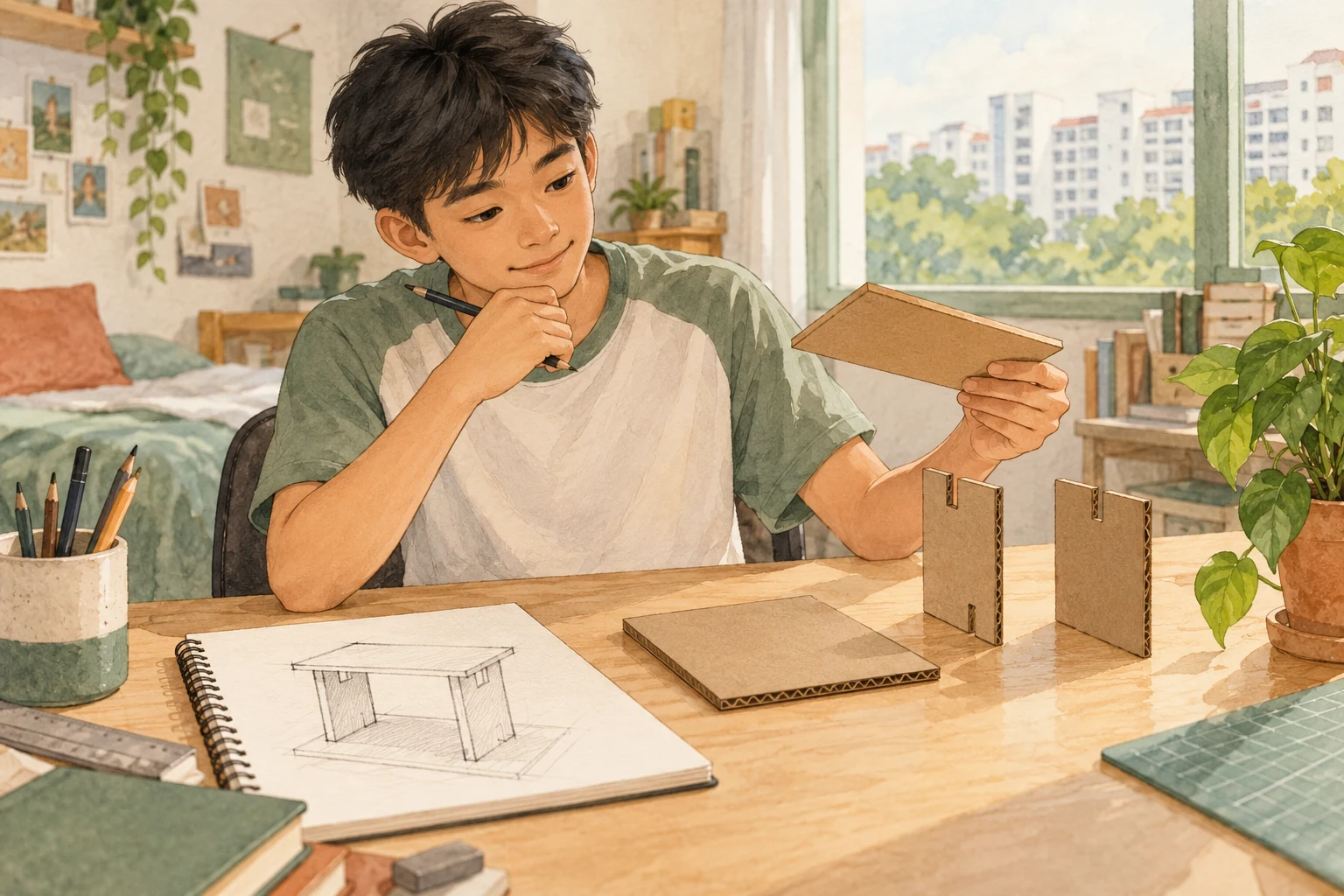
Did you know that a rough sketch with a convincing reason behind it may show more understanding than an elaborate picture copied from someone else? Art rewards attention: what did you observe, who is the work for, what did you change, and how does the result communicate?
When families search for ‘PG1 Art’, they are often asking two questions at once: what will my child learn, and which education doors could remain open? Before either, there is a crucial distinction. PG1 describes secondary-school posting; G1 Art is a particular examined subject level.
Art can develop imagination, visual literacy and the discipline to test an idea. But none of those useful benefits is a substitute for the formal qualifications a later ITE, polytechnic, JC or university programme requires.
A quick, evidence-based guide for Singapore families. The 2027 syllabus and announced post-secondary pathway rules were checked on 24 October 2026. Confirm the examination year and intake conditions for your child.
The 60-second answer
- PG1 is the posting group, while the nationally examined 2027 G1 Art subject code is K126.
- Paper 1 is a 90-minute Art Examination worth 40% of the grade.
- Paper 2 is a supervised portfolio worth 60%, with up to 10 digital screens of visual materials and two artworks in different media.
- Students need to observe, explore, make design choices, communicate and reflect—not merely produce a neat picture.
- Later admission is determined by the complete qualification profile, not by the original posting group or one Art grade.
First, PG1 is not a subject level
Posting Group 1 is a Secondary 1 admission grouping. It is not the name of an SEAB examination or a permanent definition of a learner’s potential. Under Full Subject-Based Banding, students may take different subjects at General 1 (G1), General 2 (G2) or General 3 (G3) where eligible, subject to school placement and provision.
The Singapore-Cambridge Secondary Education Certificate (SEC) starts in 2027. A learner’s certificate records the actual subjects and levels taken, not a special ‘PG1 certificate’. This is why a parent should check the school subject-combination record before choosing a syllabus, workbook or post-secondary target.
From 2028, MOE’s Post-Secondary Admissions Exercise (PSE) replaces the main results-based admission exercises for eligible ITE, polytechnic, JC and MI applicants. Being able to participate in an exercise never means a student qualifies for every programme. The complete subject-level combination, grades and course-specific conditions matter.
What does Art really help your child learn?
Visual messages are part of daily life. A school sign must be understood quickly. A product label needs a clear hierarchy. A story illustration can express feelings without a paragraph of explanation. Art builds the ability to notice why a picture or design communicates effectively.
The thinking begins with observation. What does the viewer see first? Does a line point to the most important information? What role do contrast, shape, space and texture play? Asking these questions replaces vague feedback such as ‘make it nicer’ with choices a learner can understand and test.
Good Art practice also teaches students not to defend every first draft. A concept that looked impressive may be difficult to read, hard to make or unsuitable for its audience. The ability to revise without losing the original purpose is a valuable learning habit in other subjects and in later life.
Parents need not have artistic training to ask useful questions. ‘Which feature were you trying to emphasise?’ and ‘What evidence made you change it?’ are more productive than guessing whether a piece of work deserves a high mark.
The core skills behind Art
- Perceive: look closely at objects and images and identify important visual qualities.
- Research: gather relevant visual references and attribute other people’s work correctly.
- Explore: try alternatives in composition, material and technique rather than copying the first possible answer.
- Design: identify the audience and problem before making a visual response.
- Communicate: explain how a sketch or artwork conveys an intention.
- Reflect: compare intention with what a viewer actually understands and justify a revision.
- Independence: know which evidence is authentic student work, especially in assessed portfolio tasks.
Inside the 2027 SEC G1 Art K126 syllabus
SEAB’s 2027 G1 Art K126 syllabus has two compulsory papers. The 90-minute Paper 1 is 40% of the grade, with questions requiring identification and selection, short responses and a short Art task. The task can ask for a concept sketch and a concise explanation in response to a visual stimulus.
Paper 2 carries 60% and requires a portfolio completed under the published 18 supervised hours within eight weeks. Part A presents up to ten screens of visual materials, such as drawing, research, experimentation, work in progress and selected journal content. The work explores at least two art forms and media, one of which must be design.
Part B submits two artworks in different media, distinct from those selected as the visual materials. The portfolio is internally assessed and externally moderated; the school authenticates students’ assessed work. This is why parents should not draw a finished component, manufacture a submission or copy online examples for their child.
Paper 1 also has restrictions on the drawing media used in its short Art task. Families should follow the examination-year syllabus and the teacher’s published instructions rather than assuming that every material from a studio or home kit is permitted.
Visual experimentation has a purpose: the pupil must be able to explain why a form, material or composition suits the intended communication. A beautiful result with no authentic development evidence can leave an important part of the assessment unseen.
Did you know? A worked example worth discussing
Imagine a fictional school library wants a clearer sign for the book-return area. Students keep walking past the box because the arrow and label are difficult to notice. This is an invented practice brief, not an official SEC question.
First define the audience and action. A hurried student should see where to return a book before reaching the library counter. Sketch two approaches: one uses a large arrow and book symbol; the other shows a short route from the door to the box.
Next compare the sketches at a distance. Which part gets noticed first? Does a label explain the symbol? Does the design still make sense to someone who has never used the library?
Now change only one important feature, perhaps contrast, spacing or arrow position. Ask another viewer what they would do after seeing it. If the viewer points in the wrong direction, the test has found a meaningful weakness.
The student can then write, ‘I increased the contrast between the arrow and background because the first version was hard to see from the entrance.’ That sentence links evidence, decision and purpose. ‘I made it more colourful’ describes an action but may not explain the design.
Notice the learning sequence: observe a real communication problem, propose alternatives, test the effect and explain a reasoned revision. This is the kind of independent thinking that can transfer to schoolwork beyond Art.
Common learning gaps and their repairs
- A student starts drawing before stating who the viewer is. Repair: write one sentence describing the audience and communication purpose.
- The learner imitates a reference exactly. Repair: cite influences and explain what has been genuinely adapted or developed.
- The picture is polished, but there is no evidence of investigation. Repair: keep authentic, concise records of meaningful trials and revisions.
- A pupil changes colours without a purpose. Repair: link one visual quality to readability, emphasis or mood.
- Adults complete the assessed portfolio. Repair: help with planning and safe materials, but preserve the pupil’s authorship and the teacher’s supervision.
- The student cannot discuss the work. Repair: use the simple sequence ‘I intended…, I tried…, I noticed…, therefore I changed…’.
A routine that makes progress visible
Start with one manageable task. Ask the child to explain what the problem is before showing how to solve it.
Model a single small step, guide a second attempt and then remove the hints. If the learner cannot explain the choice independently, return to the first uncertain decision.
Try a changed example later in the week. A skill that works only when the answer looks familiar has not yet transferred to new circumstances.
Keep a one-page record of the task, the first error, the student’s correction and when it was independently checked again. That gives families and teachers useful evidence instead of an unhelpful label such as ‘weak at everything’.
Secondary 1 to Secondary 4: what to practise next
- Secondary 1: practise observation, simple media, sketching and describing what a viewer can see.
- Secondary 2: explore design and different forms of visual expression, and get comfortable revising ideas.
- Secondary 3: check actual Art subject availability and G-level at school; begin organising personal experiments and purposeful reference material.
- Secondary 4: use the examination-year K126 portfolio and written-paper requirements; authenticate work properly and map the complete SEC results to the next programme.
Interests, electives and later opportunities
Art may spark interest in visual communication, design, media, illustration, exhibition work and creative production. These are fields to investigate, not jobs promised by one secondary subject.
Some later design or arts programmes ask for a portfolio, interview or proof of aptitude in addition to academic qualifications. Different courses set different expectations, so a family should not spend months making an unrelated portfolio without checking actual programme criteria.
For fields where design meets architecture, engineering or technology, Mathematics and other academic requirements may be as important as creativity. The child can explore Art now while building the wider subject profile needed for later choices.
Education Pathway: ITE, Polytechnic, Junior College and University
Did you know that ‘can my child ever attend university?’ and ‘can my child enter this diploma immediately after SEC?’ are different questions? A possible long-term destination is not a guaranteed next admission. Treat every new qualification as a checkpoint, and verify the pathway from the learner’s real subject results rather than the original PG1 label.
1. ITE and Higher Nitec
For an eligible G1-focused SEC profile, an appropriate three-year ITE Higher Nitec programme can be an important next qualification. Selection depends on current course offerings, grades, subject requirements and places; completing a particular secondary elective never guarantees an ITE offer.
After Higher Nitec, eligible graduates can pursue further technical or diploma qualifications under published progression rules. Such progression is a separate process, not automatic promotion into a course or a university.
At ITE, an eligible Higher Nitec programme in a creative, technical or services field may support practical development. The exact list changes, and selection still depends on recognised SEC entry requirements, not one G1 Art grade.
2. Polytechnic diploma: direct entry versus progression
A polytechnic diploma may be reached through recognised ITE-to-diploma progression, or directly from SEC where the student has the qualifying G3/G2 grades and subject combination. From the 2028 intake, the direct diploma aggregate can count an eligible G2 subject in the prescribed fifth position; this does not make a stand-alone G1 subject sufficient for direct admission.
Check the diploma’s actual English, Mathematics, Science or other requirements, its current intake criteria and any portfolio or aptitude selection. The name of an attractive field does not tell you the minimum education profile.
A diploma route may follow qualifying Higher Nitec results or direct SEC admission where the full G3/G2 aggregate and the course’s prerequisites are met. Some design fields add aptitude evidence.
3. Junior College and Millennia Institute
JC and Millennia Institute are pre-university routes governed by published admission criteria. Under the announced 2028 JC L1R4 framework, the counted subjects are at G3 level. PG1 at Secondary 1 is not an everlasting barrier, but an interested student must genuinely acquire the necessary subject levels and results.
A family planning for JC should discuss subject-level opportunities and readiness with the school in time to build appropriate foundations. A G1 elective cannot by itself substitute for missing G3 examination qualifications.
JC and MI are not automatic destinations for a PG1 student who enjoys Art. The necessary actual G3-level examinations, grades and application requirements must be in place.
4. University as a later qualification checkpoint
University is a later qualification and selection checkpoint. A student may eventually qualify through an appropriate diploma route or recognised pre-university route, but programme prerequisites, grades, selection and places still apply.
Think of practical skills as something to build now and recognised qualifications as doors to verify later. It is more helpful to say ‘this next step is available if the student qualifies’ than to promise a particular degree at age thirteen.
University arts or design study is possible after recognised qualifying education and selection; some institutions require portfolios or interviews. Good creative habits are useful, but no single school portfolio guarantees a degree place.
One practical week for Art
- Monday: analyse what a public sign asks the viewer to do.
- Tuesday: sketch two ways to communicate the same message.
- Wednesday: compare line, contrast and layout in a visual work and explain one effect.
- Thursday: make an unassessed small experiment using safe, available drawing materials.
- Friday: write a short evidence-based explanation of one revision.
- Weekend: show the work to someone who has not seen it before and note whether the intended message comes through.
Three helpful family pathway conversations
- Conversation A: Ask the learner to show a recent piece of work they can now complete without hints. Which precise understanding changed?
- Conversation B: Confirm the exact SEC subject level and syllabus code with the school. Discuss readiness and any appropriate future subject-level adjustment before assuming a different paper can be taken.
- Conversation C: Choose one actual ITE, diploma or pre-university programme of interest. Read its published minimum requirements and compare them with the full planned SEC profile—not one favourite subject.
What parents should track
A simple learning notebook needs four columns: task attempted; first uncertain decision; correction made; and next independent review date. This is more useful than recording only marks.
Once a month, ask for an unfamiliar example the student can now explain independently. If the learner is progressing, the new work should show more accurate decisions, not only longer homework. Discuss appropriate next challenges and formal pathway conditions with teachers.
Frequently asked questions
Is PG1 Art itself a SEAB examination?
No. Posting Group 1 is about admission to Secondary 1. The 2027 G1 Art examination is K126.
Does Art only test drawing talent?
No. The syllabus includes knowledge, visual analysis, exploration, design response, authentic portfolio work and communication.
How much is the portfolio worth?
For 2027 G1 Art K126, Paper 2 Portfolio is 60%; Paper 1 Art Examination is 40%.
What is the portfolio requirement?
Up to ten screens of selected visual materials and two artworks in different media, subject to specific school-supervised rules.
Can a parent help finish the portfolio?
Assessed works must be the student’s authentic work under the teacher’s required supervision. Parents should not produce assessed components.
Does taking Art at G1 guarantee polytechnic design entry?
No. Full qualification, course prerequisites and any aptitude selection determine entry.
Can a PG1 student reach university?
Potentially, by earning the later recognised qualifications and meeting each admission criterion.
Where to verify the syllabus and entry requirements
SEAB lists G1 Art under official 2027 subject code K126. Its precise paper structure belongs to that year’s syllabus. Future examination and admissions changes should be checked on the official source, not assumed from an old book.
MOE’s PSE announcement describes the results-based process from 2028, but eligibility still varies by pathway and destination. A pupil’s school is the right place to verify actual subject offerings and subject-level decisions.
SEAB — official 2027 SEC G1 school-candidate list
SEAB — 2027 G1 Art K126 syllabus PDF
SEAB — SEC examination overview
MOE — post-secondary admissions announcement 2026
ITE — Higher Nitec academic progression
Continue reading on eduKateSG
What is PG1? Posting versus subject levels
PG1–PG3: how SEC and 2028 PSE pathways work
The official SEC subject directory explained
Learn Everything about Art in the MOE and SEAB syllabuses
A closer look at 2027 G1 Art assessment
PG1 Design and Technology: reasoning from needs to workable ideas
Our foundation-first small-group learning approach
One good question to ask tonight
What is the most important thing you want the viewer to notice, and how would you know they noticed it?
Let the learner explain their own thinking before providing the answer. Reliable understanding and purposeful practice help students make better decisions now while their future pathways remain open to exploration.